
Judge, 1886-04-17 · page 5 of 18
Judge — April 17, 1886 — page 5: what you’re looking at
What you’re looking at
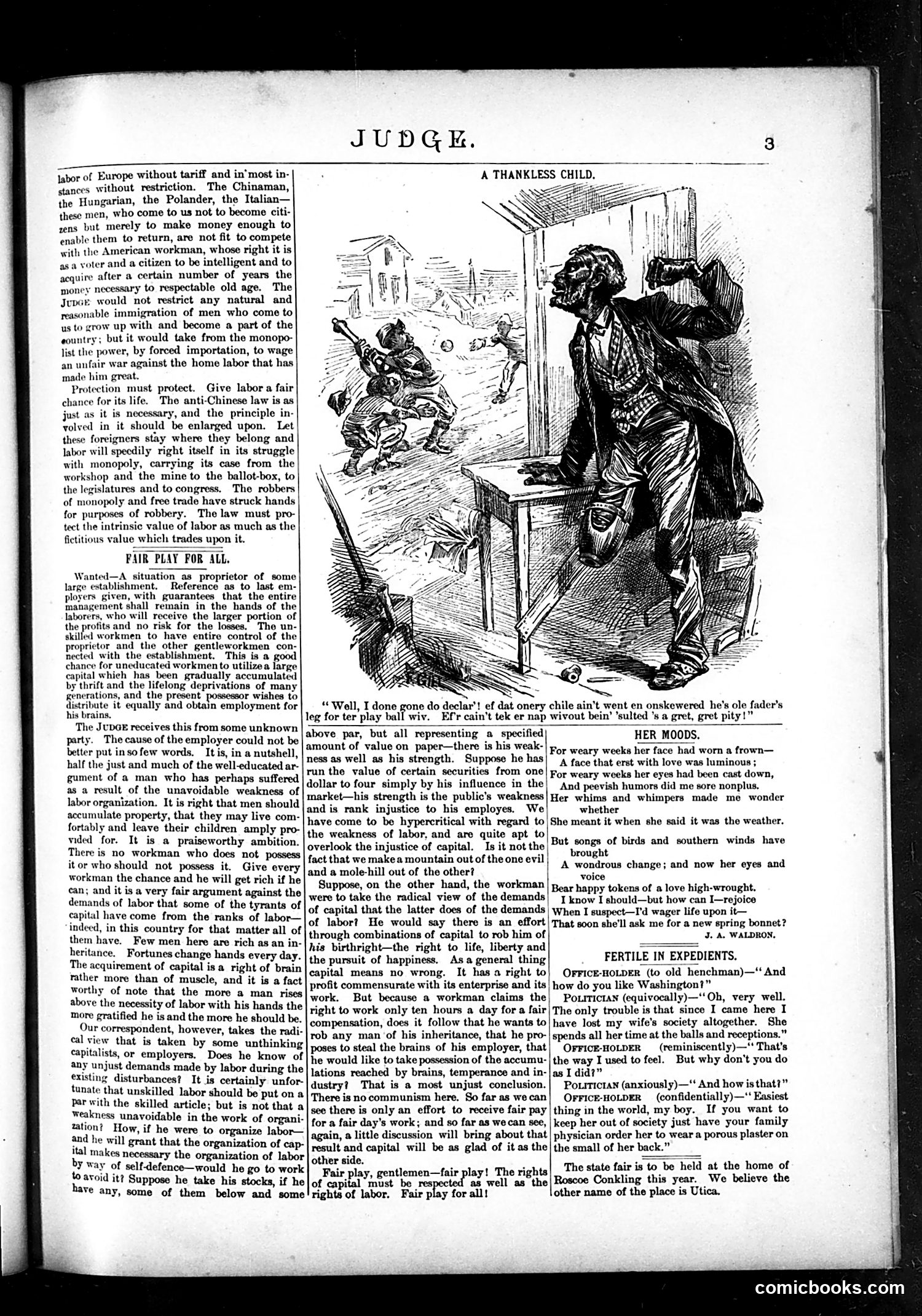
This page presents arguments about labor, immigration, and capitalism during America's industrial era (likely 1880s-90s). **Main Arguments:** The left column advocates **protecting American workers** from cheap foreign labor (Chinese, Hungarian, Polish, Italian immigrants). It argues these workers undercut wages and should be restricted, supporting the anti-Chinese exclusion laws of that era. **"Fair Play for All"** section presents a satirical **classified ad from a capitalist** seeking workers who will manage his business while he profits—without risk. Judge uses this to mock employers' contradictory demands: they claim workers lack capability to manage capital, yet want workers to shoulder all responsibility while surrendering ownership. **The cartoon** (upper right, titled "A Thankless Child") appears to show a child rejecting or mistreating an adult—likely representing labor rejecting capital's authority, or vice versa. **The satire's point:** Judge exposes capitalist hypocrisy—wealthy men resist sharing power or profits with workers, yet expect workers to manage their enterprises.
📄 Transcribed text from this page (OCR, searchable)
Machine-transcribed from the original scan — historical spelling and the odd misread are preserved.
labor of Europe without tariff and inmost in- stances without restriction. The Chinaman, the Hungarian, the Polander, the Italian— these men, who come to us not to become citi- zens but merely to make money enough to enable them to return, are not fit to compete with the American workman, whose right it is asa voter and a citizen to be intelligent and to acquire after a certain number of years the money necessary to respectable old age. The Sepak would not restrict any natural and reasonable immigration of men who come to us to grow up with and become a part of the eountry; but it would take from the monopo- list the power, by forced importation, to wage an unfair war against the home labor that has made him great. Protection must protect. Give labor a fair chance for its life. The anti-Chinese law is as just as it is necessary, and the principle in- volved in it should be enlarged upon. Let these foreigners stay where they belong and labor will speedily right itself in its struggle with monopoly, carrying its case from the workshop and the mine to the ballot-box, to the legislatures and to congress. The robbers of monopoly and free trade have struck hands for purposes of robbery. The law must pro- tect the intrinsic value of labor as much as the fictitious value which trades upon it. PAIR PLAY FOR ALL. Wanted—A situation as proprietor of some e establishment. Reference as to last em- ployers given, with guarantees that the entire management shall remain in the hands of the laborers, who will receive the larger portion of the profits and no risk for the losses. The un- skilled workmen to have entire control of the proprietor and the other gentleworkmen con- nected with the establishment. This is a good chance for uneducated workmen to utilizea large capital whieh has been gradually accumulated by thrift and the lifelong deprivations of many generations, and the present possessor wishes to distribute it equally and obtain employment for his brains. The JuDGE receives this from some unknown party. The cause of the employer could not be better put insofew words. It is, in a nutshell, half the just and much of the well-educated ar- gument of a man who has perhaps suffered as a result of the unavoidable weakness of labor organization. It is right that men should accumulate property, that they may live com- fortably and leave their children amply pro- vided for. It is a praiseworthy ambition. There is no workman who does not possess it or who should not possess it. Give every workman the chance and he will get rich if he can; and it is a very fair argument against the demands of labor that some of the tyrants of capital have come from the ranks of labor— indeed, in this country for that matter all of them have. Few men here are rich as an in- heritance. Fortunes change hands every day. The acquirement of capital isa right of brain rather more than of muscle, and it is a fact worthy of note that the more a man rises above the necessity of labor with his hands the more gratified he is and the more he should be. Our correspondent, however, takes the radi- cal view that is taken by some unthinking capitalists, or employers. Does he know of any unjust demands made by labor during the existing disturbances? It is certainly unfor- tunate that unskilled labor should be putona Par with the skilled article; but is not that a Weakness unavoidable in the work of organi- zation? How, if he were to organize labor— and he will grant that the organization of cap- ital makes necessary the organization of labor by way of self-defence—would he go to work to avoid it? Suppose he take his stocks, if he ve any, some of them below and some “Well, I done gone do declar’! ef dat onery chile ain't went en onskewered he's ole fader’s leg for ter'play ball wi Efr cain’t tek er nap wivout bein’ ’sulted ’s above par, but all representing a specified amount of value on paper—there is his weak- ness as well as his strength. Suppose he has run the value of certain securities from one dollar to four simply by his influence in the market—his strength is the public's weakness and is rank injustice to his employes. We have come to be hypercritical with regard to the weakness of labor, and are quite apt to overlook the injustice of capital. Is it not the fact that we makea mountain out of the one evil | and a mole-hill out of the other? Suppose, on the other hand, the workman were to take the radical view of the demands of capital that the latter does of the demands of labor? He would say there is an effort through combinations of capital to rob him of his birthright—the right to life, liberty and the pursuit of happiness. Asa general thing capital means no wrong. It has a right to profit commensurate with its enterprise and its work. But because a workman claims the right to work only ten hours a day fora fair compensation, does it follow that he wants to rob any man of his inheritance, that he pro- poses to steal the brains of his employer, that he would like to take possession of the accumu- lations reached by brains, temperance and in- dustry? That is a most unjust conclusion. ‘There is no communism here. So far as we can see there is only an effort to receive fair pay for a fair day’s work; and so far as wecan see, again, a little discussion will bring about that result and capital will be as glad of it as the other side. a Fair play, gentlemen—fair play! The rights of capital must. be res ted ad well as the rights of labor. Fair play for all! HER MOODS. For weary weeks her face had worn a frown— A face that erst with love was luminous ; |For weary weeks her eyes had been cast down, | And peevish humors did me sore nonplus. Her whims and whimpers made me wonder | whether She meant it when she said it was the weather. But songs of birds and southern winds have | brought | A wondrous change; and now her eyes and voice Bear happy tokens of a love high-wrought. I know I should—but how can I—rejoice | When I suspect—I'd wager life upon it— That soon she'll ask me for a new spring bonnet? J. A. WALDRON, FERTILE IN EXPEDIENTS. ) OFFICE-HOLDER (to old henchman)—“ And |how do you like Washington?” | PoLITICtAN (equivocally)—"‘Oh, very well. The only trouble is that since I came here I have lost my wife's society altogether. She spends all her time at the balls and receptions.” OFFICE-HOLDER _(reminiscently)—‘‘ That’s the way I used to feel. But why don't you do as I did?” Po.irIctaN (anxiously)—‘‘ And how is that?” OFFICE-HOLDER (confidentially). Easiest thing in the world, my boy. If you want to keep her out of society just have your family physician order her to wear a porous plaster on the small of her back.” The state fair is to be held at the home of Roscoe Conkling this year. We believe the other name of the place is Utica, comicbooks.com