
A complete issue · 16 pages · 1885
Judge — December 12, 1885
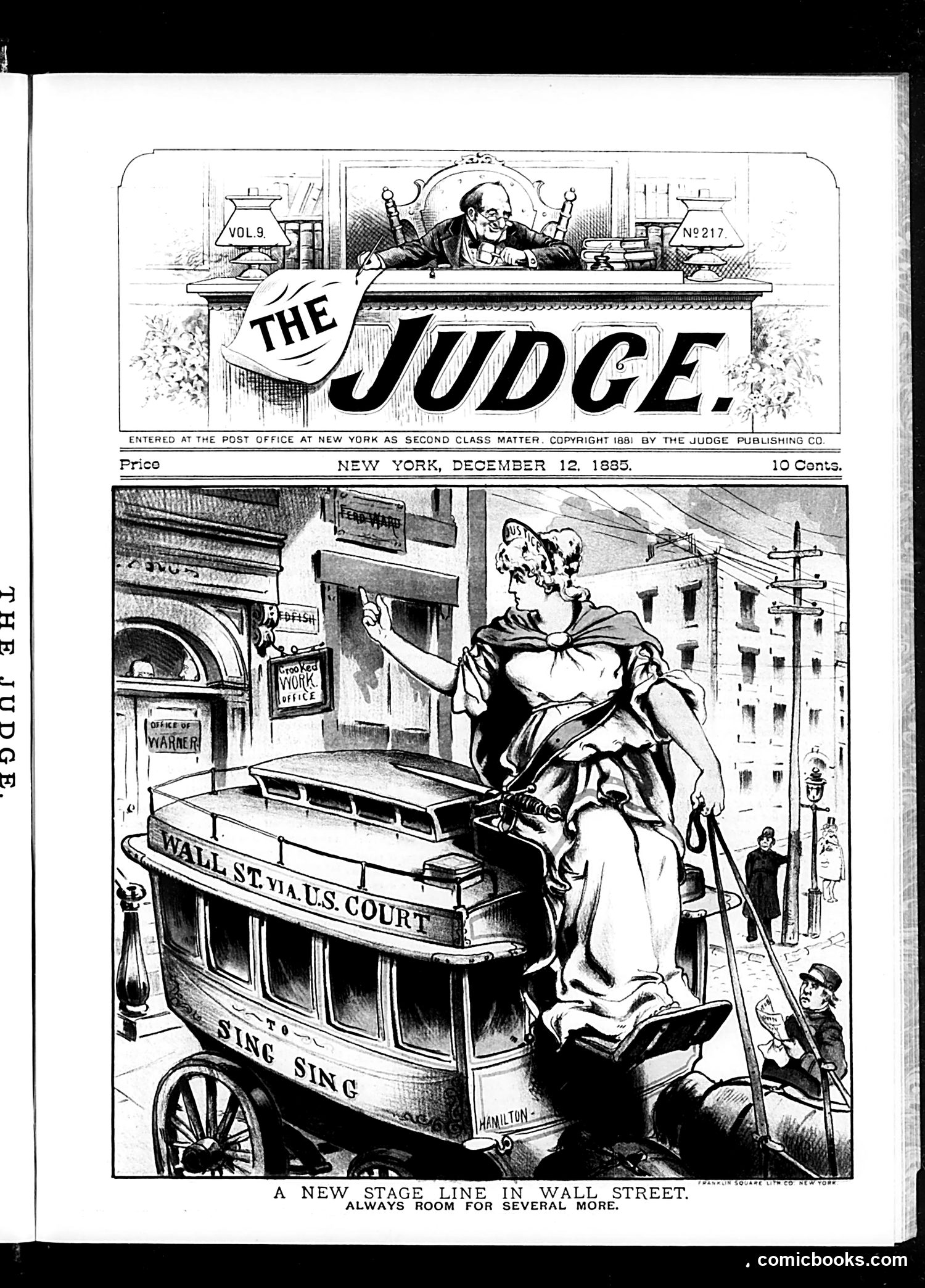
This December 1885 Judge cartoon satirizes Wall Street financial speculation. Lady Justice (identifiable by her classical pose and robes) sits atop a streetcar labeled "Wall St. via U.S. Court" and "Sing Sing" (a notorious prison). The vehicle is driven by Hamilton, apparently representing Alexander Hamilton or Hamiltonian financial principles. The caption "Always Room for Several More" suggests the cartoon mocks how Wall Street financiers escape legal consequences—literally traveling between courts and prison without genuine accountability. The "stage line" metaphor implies this cycle is routine, even comfortable. The artist critiques the revolving door between financial fraud and the justice system, suggesting the wealthy regularly dodge serious punishment.
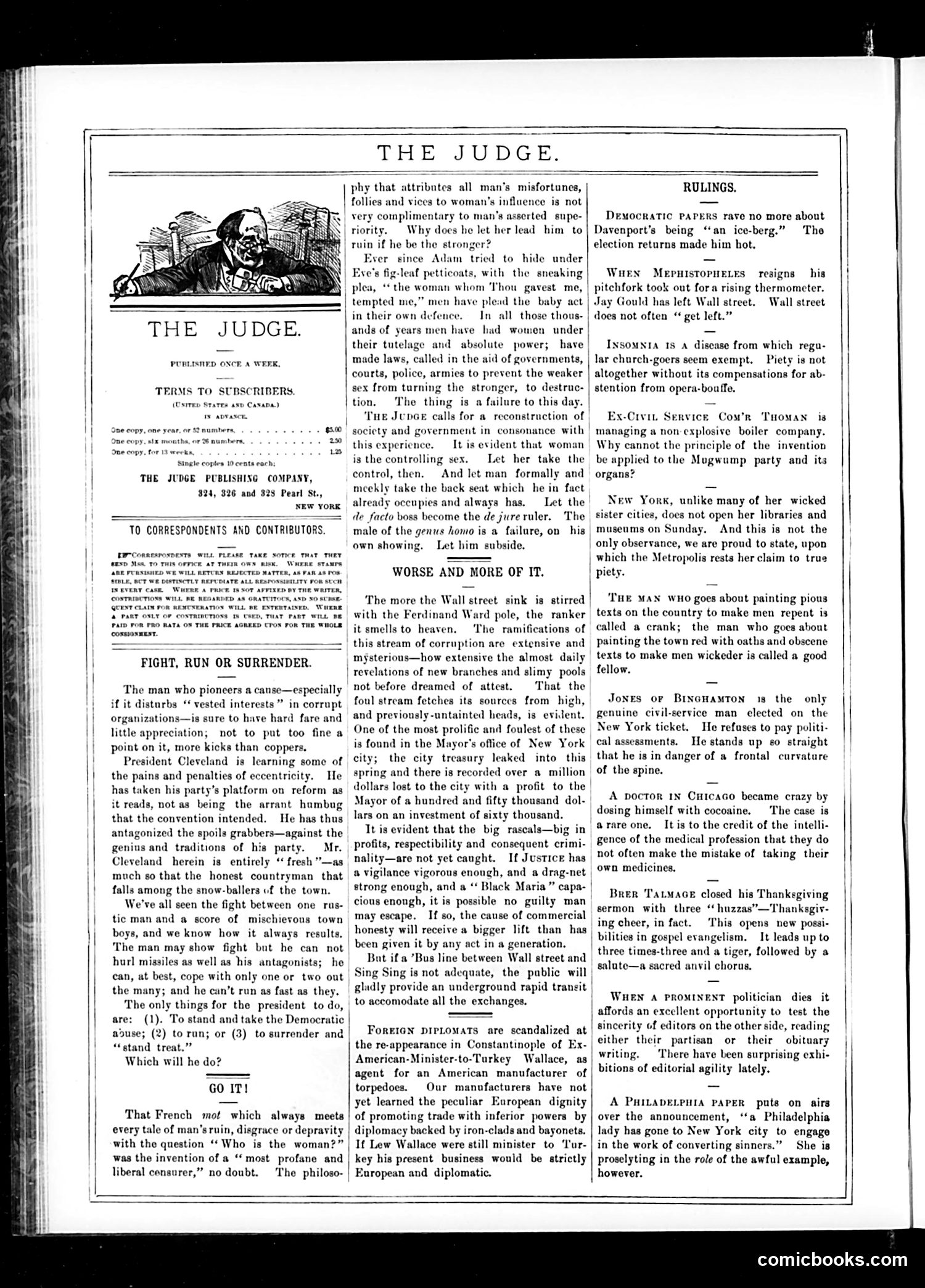
The main cartoon depicts a disheveled man (likely representing corruption or mismanagement) surrounded by papers and documents, illustrating the opening editorial's complaint about women's influence on government and society. The editorial argues that women's control over men—dating back to Adam and Eve—has caused societal failures. It calls for men to reassert dominance in government and institutions, blaming women for corruption in business and politics. The "Rulings" section contains brief satirical jabs at contemporary figures and events, including references to Wall Street financial scandals, political corruption in New York City government, and various social personalities. This reflects late 19th-century Judge magazine's tendency toward anti-feminist rhetoric while simultaneously criticizing political and financial corruption—ironically, while blaming women for these male-dominated failures.
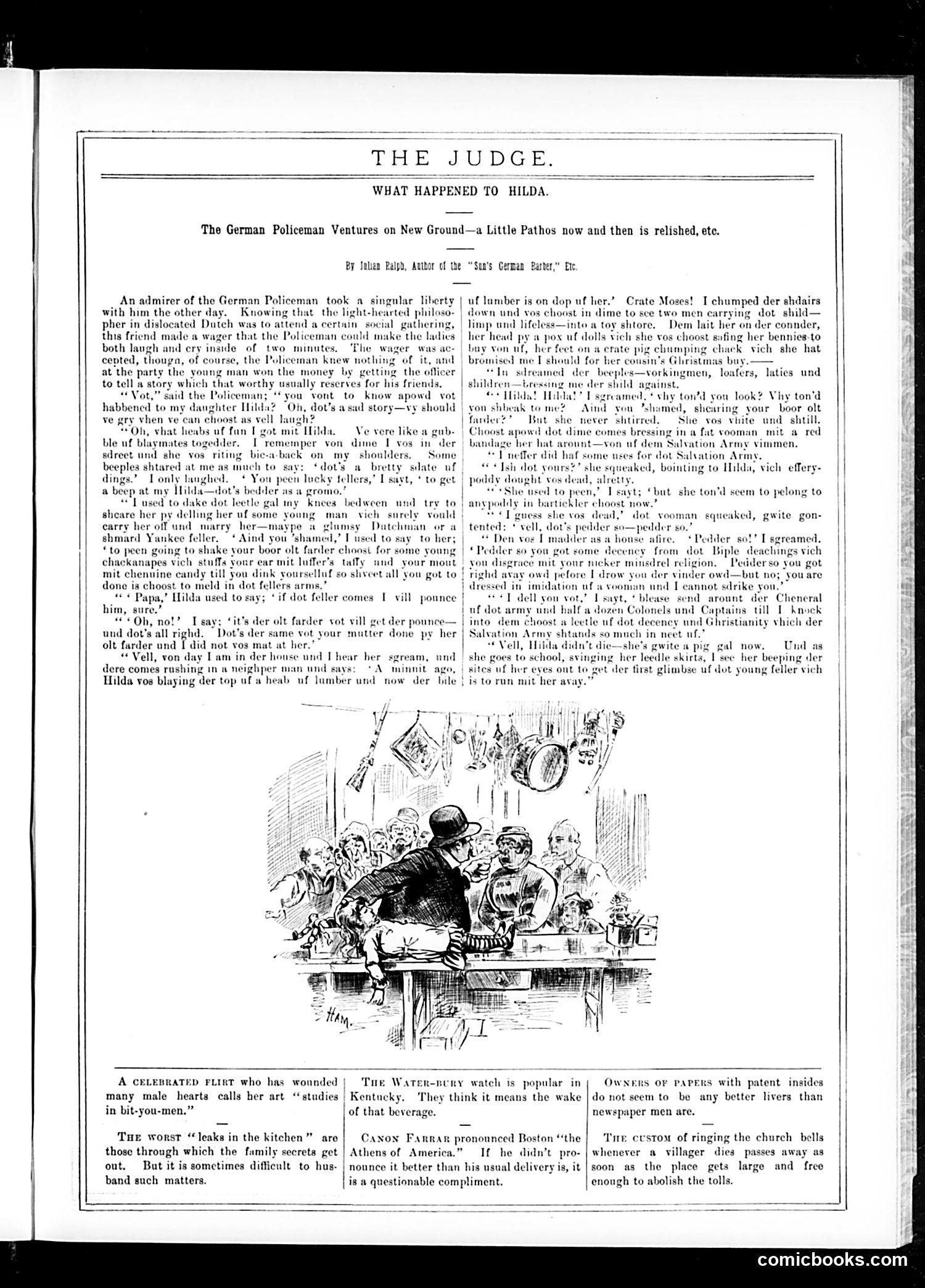
This page contains a sentimental story by a German-dialect character (the celebrated "German Policeman" — a recurring Judge figure known for philosophical humor). The narrative describes how the narrator's daughter Hilda was struck by a carriage, rescued by two men who brought her to a toy store, then recovered by a Salvation Army worker. The satire operates on multiple levels: it gently mocks the German policeman's heavy accent and malapropisms while unexpectedly introducing genuine pathos—the subtitle promises "a little Pathos now and then is relished." The humor undercuts sentimentality; the Salvation Army worker initially appears mercenary, demanding payment, before being shamed into decency. The accompanying illustration shows the policeman entertaining an audience. The piece satirizes both ethnic stereotypes and the Salvation Army's reputation for aggressive fundraising, while ultimately celebrating unexpected human compassion.
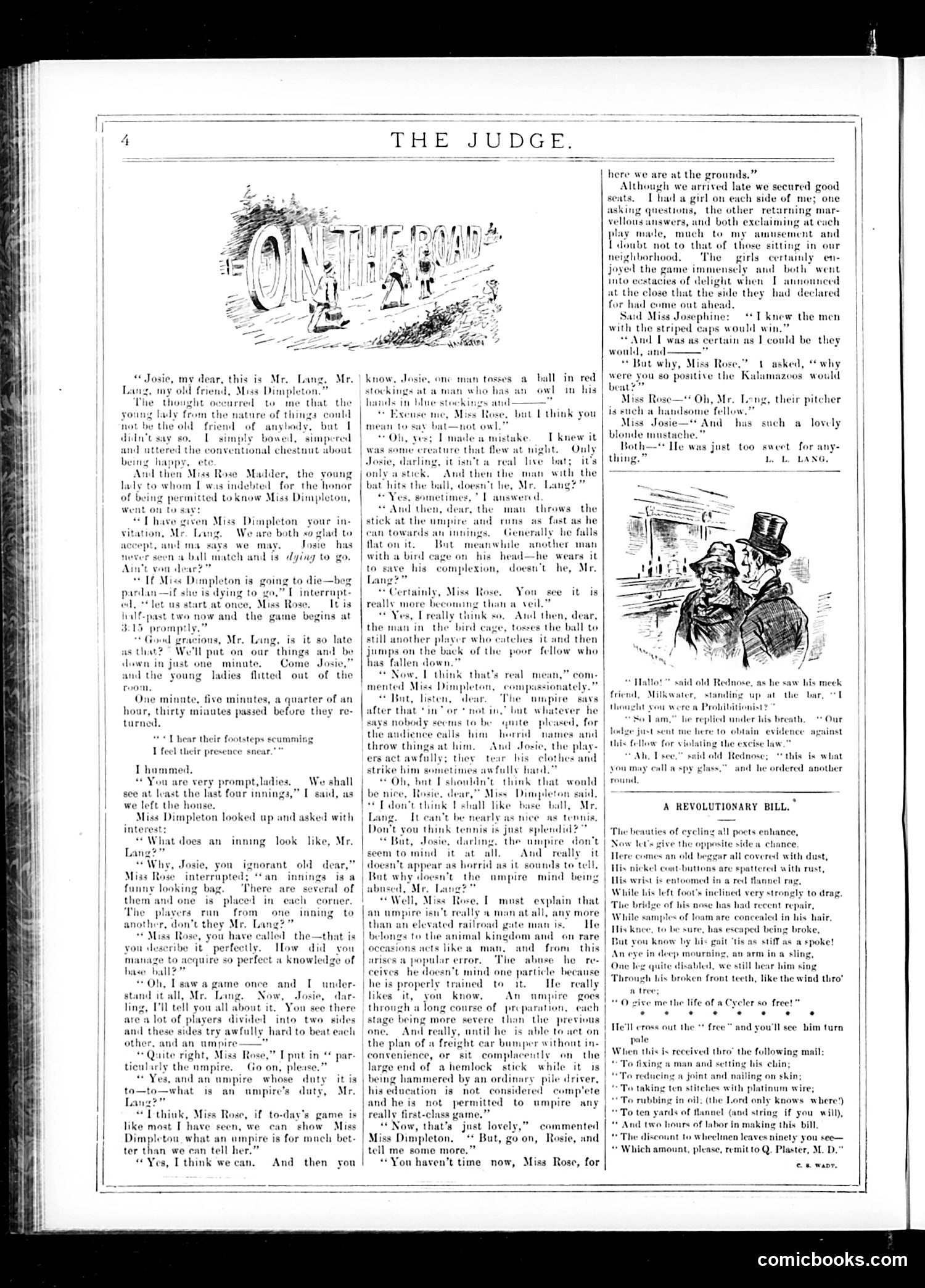
This page satirizes **baseball and the umpire's role** through a humorous dialogue between Mr. Lang and young ladies Miss Dimpleton and Miss Rose at a baseball game. The joke centers on **Miss Rose's absurdly incorrect description of baseball** to Miss Dimpleton. She describes the sport as violent chaos: players throwing sticks at umpires, men falling flat on their faces, someone wearing "a bird cage on his head" (catcher's mask), and audiences calling the umpire "horrid names." **The satire targets two things:** 1. **Umpires' unpopularity** — portrayed as scapegoats for audience abuse despite just doing their job 2. **Women's supposed ignorance of sports** — the joke assumes educated young ladies wouldn't understand baseball's basic rules The humor relies on the gap between Rose's ridiculous account and actual baseball, while also mocking how poorly umpires were treated by fans and players alike. This reflects late 19th-century attitudes about both baseball culture and gender.
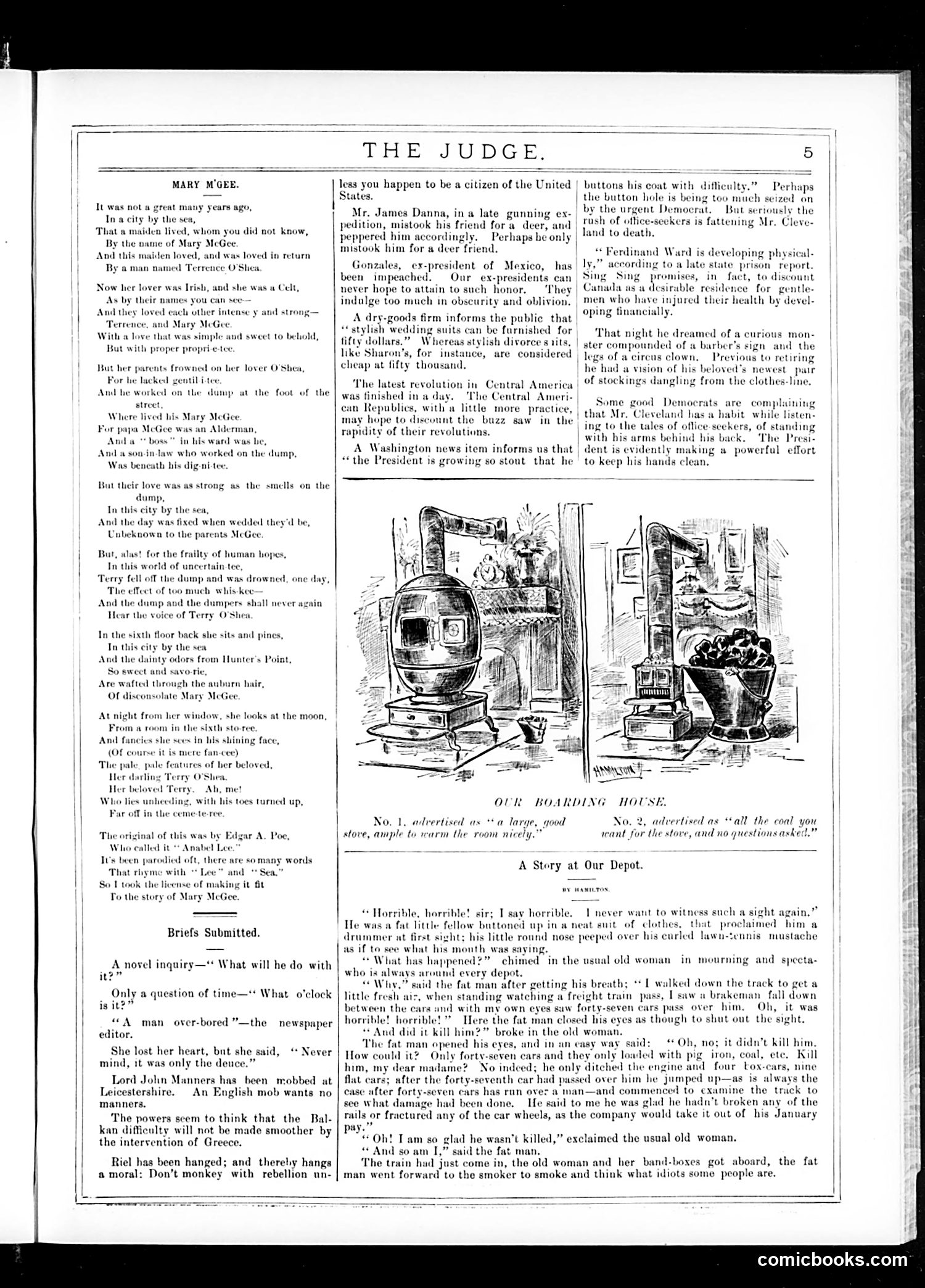
This page contains a sentimental poem "Mary McGee" (a parody of Poe's "Annabel Lee") about an Irish-American working-class couple. Mary loves Terry O'Shea, a dump worker, but her father—an alderman—disapproves of his low social status. Terry drowns after drinking whiskey, leaving Mary pining from a sixth-floor tenement overlooking the dump where he worked and died. The satire is gentle rather than biting: it mocks both the pretensions of the newly respectable McGee and the tragic romanticism of Irish immigrant life. The repeated phonetic spellings ("sto-ree," "ceme-te-ree") reinforce the working-class Irish accent. The "Briefs Submitted" section contains typical political humor: jokes about newspaper editors, British politics (Lord John Manners), and contemporary events like Cleveland's weight gain and Ferdinand Ward's imprisonment (a Gilded Age scandal). The two sketches titled "Our Boarding House" appear to be unrelated domestic humor illustrations.
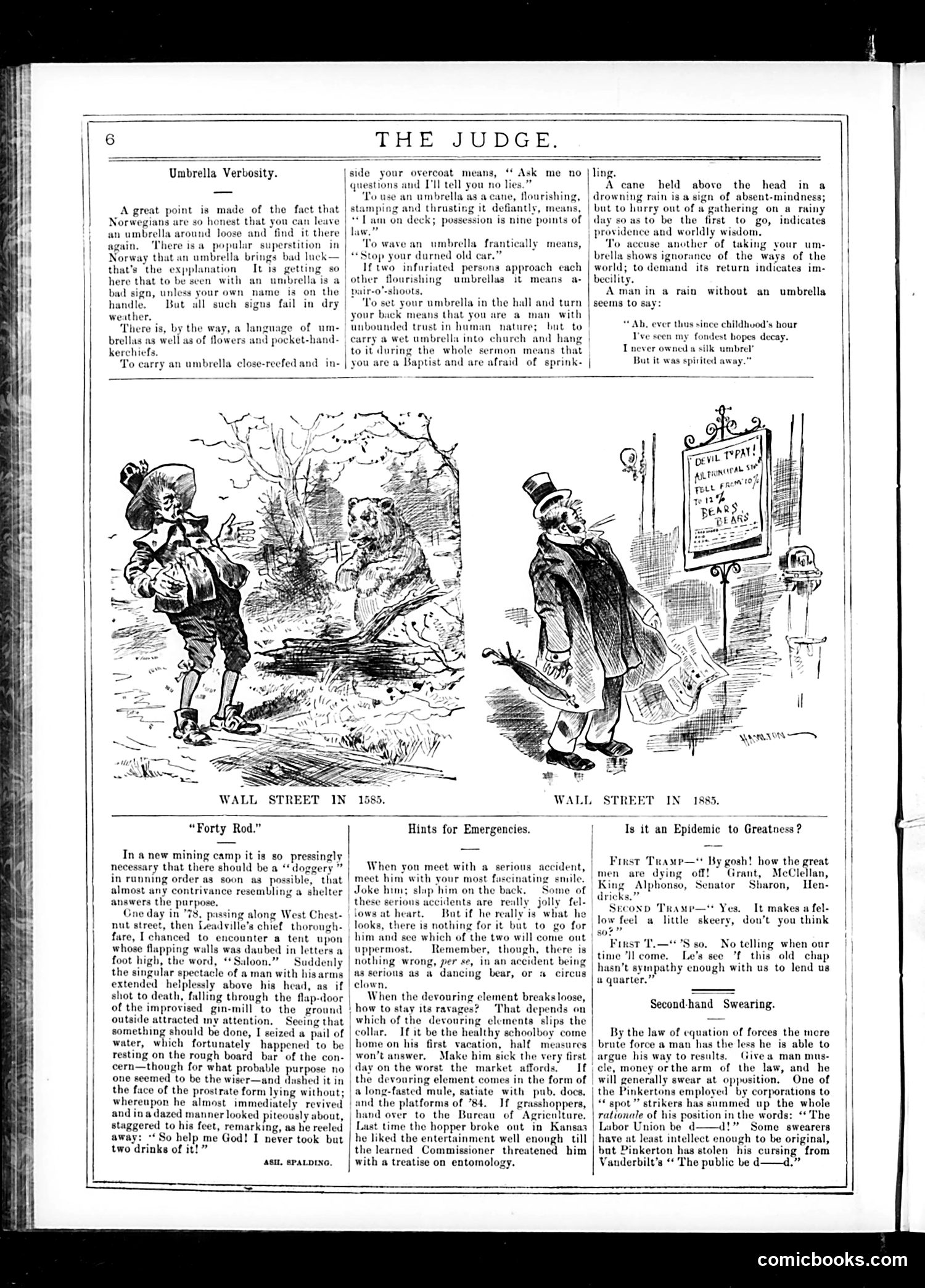
## Main Cartoons: "Wall Street in 1583" vs. "Wall Street in 1885" The two side-by-side illustrations compare Wall Street across three centuries. The 1583 figure appears to be a prospector or vagrant in ragged clothes; the 1885 figure is a well-dressed gentleman in top hat and coat, suggesting Wall Street's transformation from rough frontier to refined financial center—though likely with satirical intent about the pretense of that refinement. ## "Umbrella Verbosity" Essay This humorous article assigns social meanings to umbrella-handling—a British preoccupation with class signaling. It mocks how people's umbrella behavior supposedly reveals character: carrying it defiantly means ambition; forgetting it suggests foolishness; demanding its return indicates "imbecility." The satire targets Victorian-era social anxiety about what minor behaviors communicate about one's standing. The remaining sections ("Forty Rod," "Hints for Emergencies") appear to be separate humorous pieces about frontier life and accident management, unrelated to the main satire.
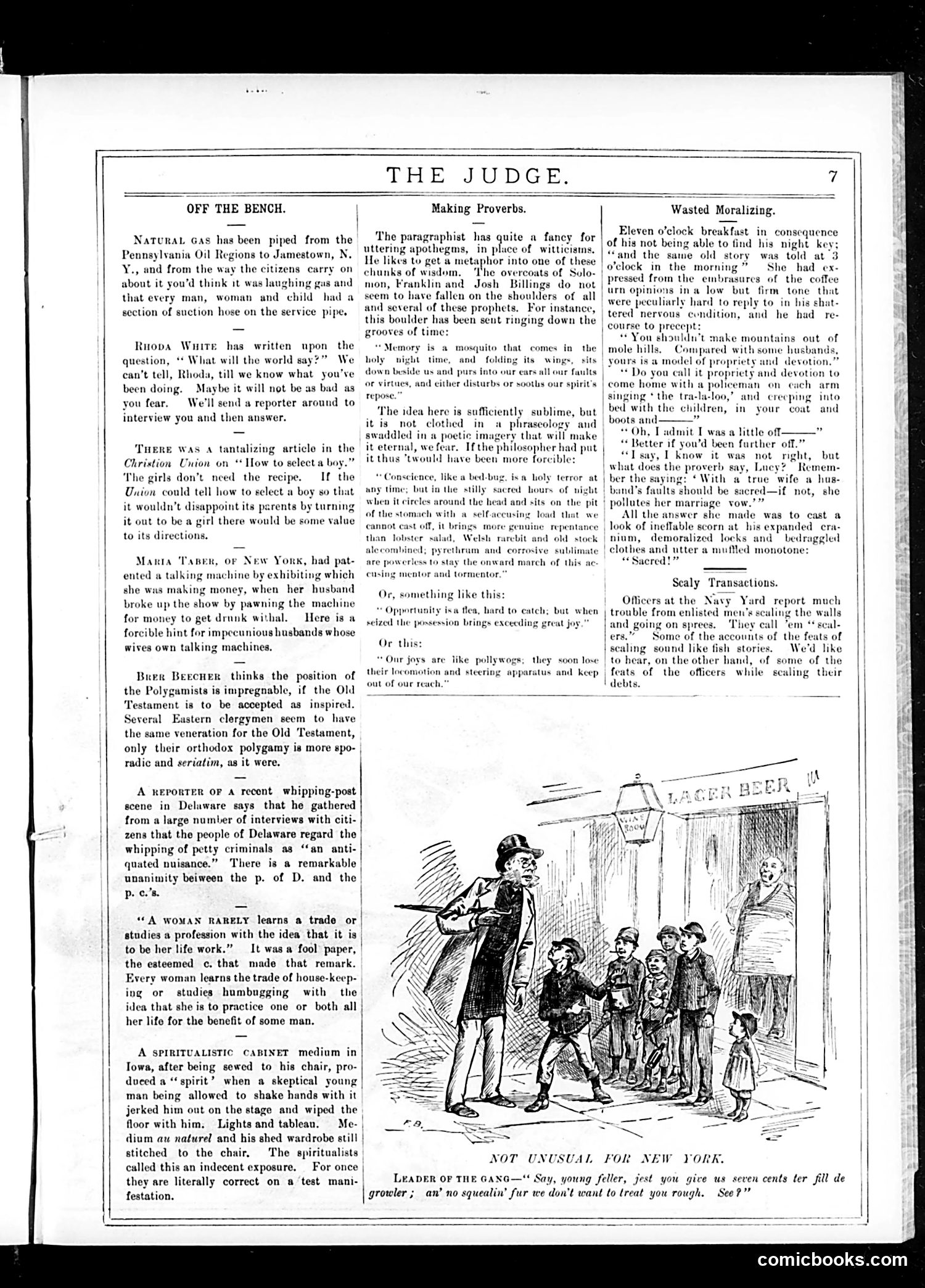
This cartoon satirizes street begging in New York City. A well-dressed man (likely a gentleman or businessman) stands at what appears to be a lager beer establishment, surrounded by children and youths asking for money. The caption quotes the gang leader negotiating with the man: "Say, young feller, jest you give us seven cents ter fill de growler; an' no squeakin' fer we don't want to treat you rough. See?" The satire mocks both urban poverty and the brazen, organized nature of street begging in 1880s New York. The "growler" reference—a container for carrying beer—adds specificity: these impoverished youngsters are literally panhandling to buy alcohol. The title "Not Unusual for New York" suggests Judge magazine's readers would recognize this as a typical city scene, satirizing both the prevalence of child poverty and the audacity of organized beggar gangs who approach strangers with quasi-threatening demands.
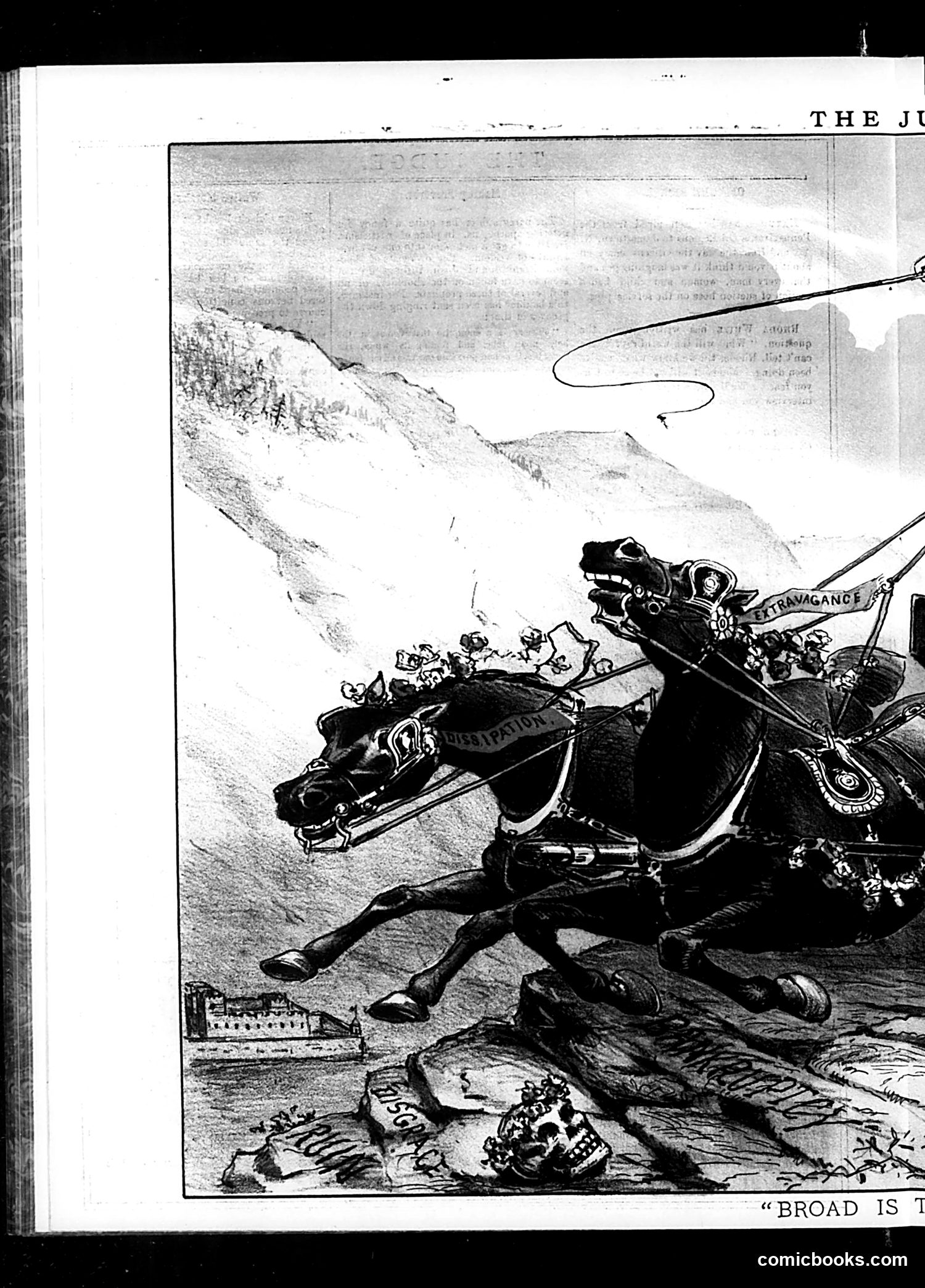
This page contains a political cartoon showing figures in ornate carriages or sleighs being pulled by horses across a mountainous landscape. The visible text fragment "BROAD IS T" (likely "BROAD IS THE WAY") suggests a biblical reference, possibly to Matthew 7:13 about the wide path to destruction. The heavily laden, decorated carriages appear to represent excess or indulgence, while the mountainous terrain and the dramatic composition suggest perilous or treacherous circumstances. Without more complete text or clearer identification of the specific figures, the exact political targets remain unclear, though the cartoon likely satirizes wealthy or powerful individuals pursuing a path of moral or political danger. The Judge magazine context indicates this is American political satire, probably from the late 19th or early 20th century.
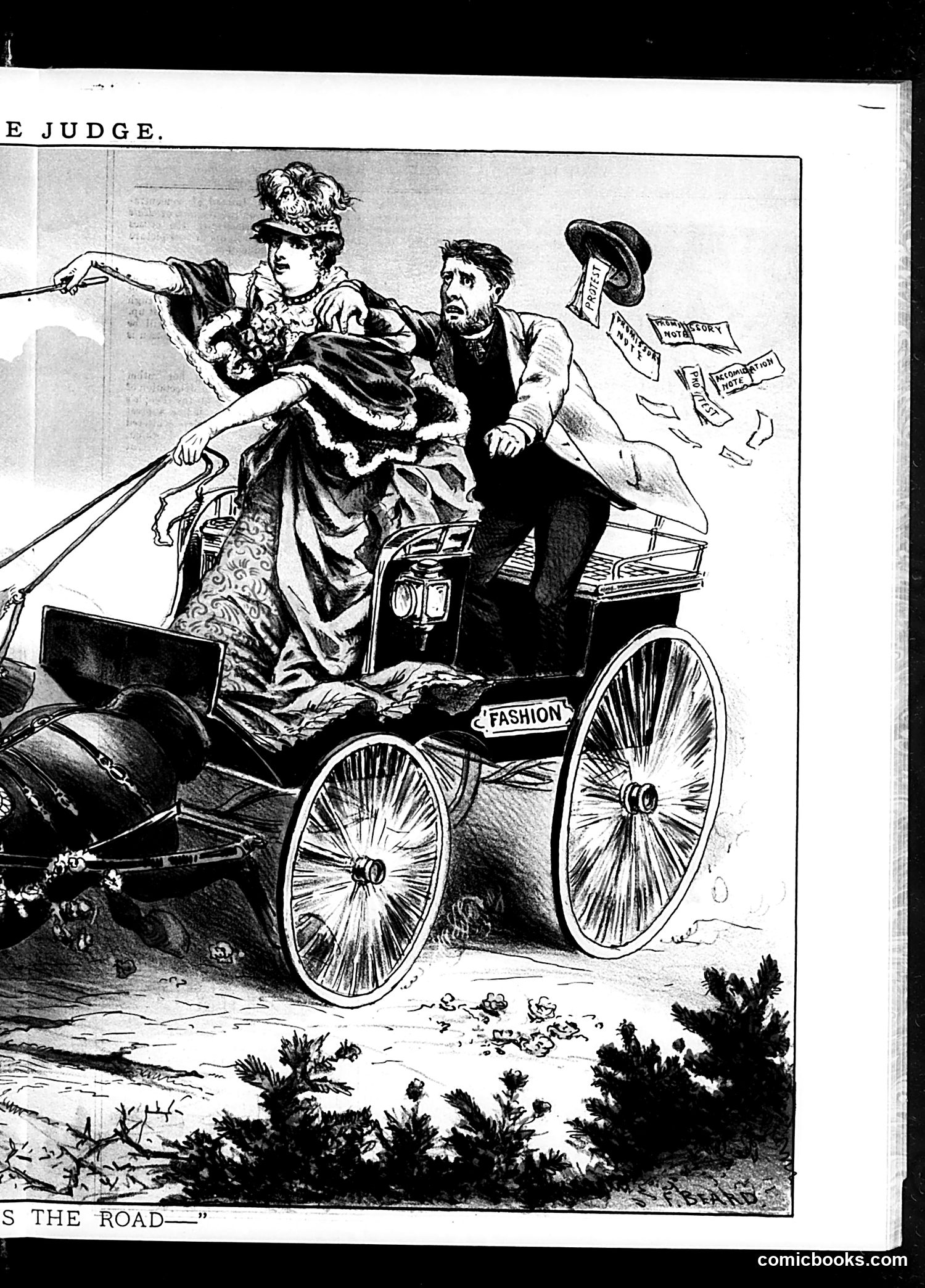
This satirical cartoon depicts three figures riding in a carriage labeled "FASHION." A woman in elaborate dress gestures commandingly from the vehicle, while two men—one appearing to be a servant or attendant, the other a gentleman—are pulled along. Papers labeled "IMPORTPORT" scatter behind them. The satire critiques the tyranny of fashion trends, particularly as dictated by women of wealth and status. The carriage metaphor suggests fashion "drives" society forward chaotically. The scattering documents imply fashion's disregard for practical matters. The cartoon mocks both the arbitrary nature of fashion demands and society's willingness to follow them blindly, with male figures portrayed as helpless passengers to female-driven fashion whims—a common satirical theme in Gilded Age humor about consumer culture and gender dynamics.
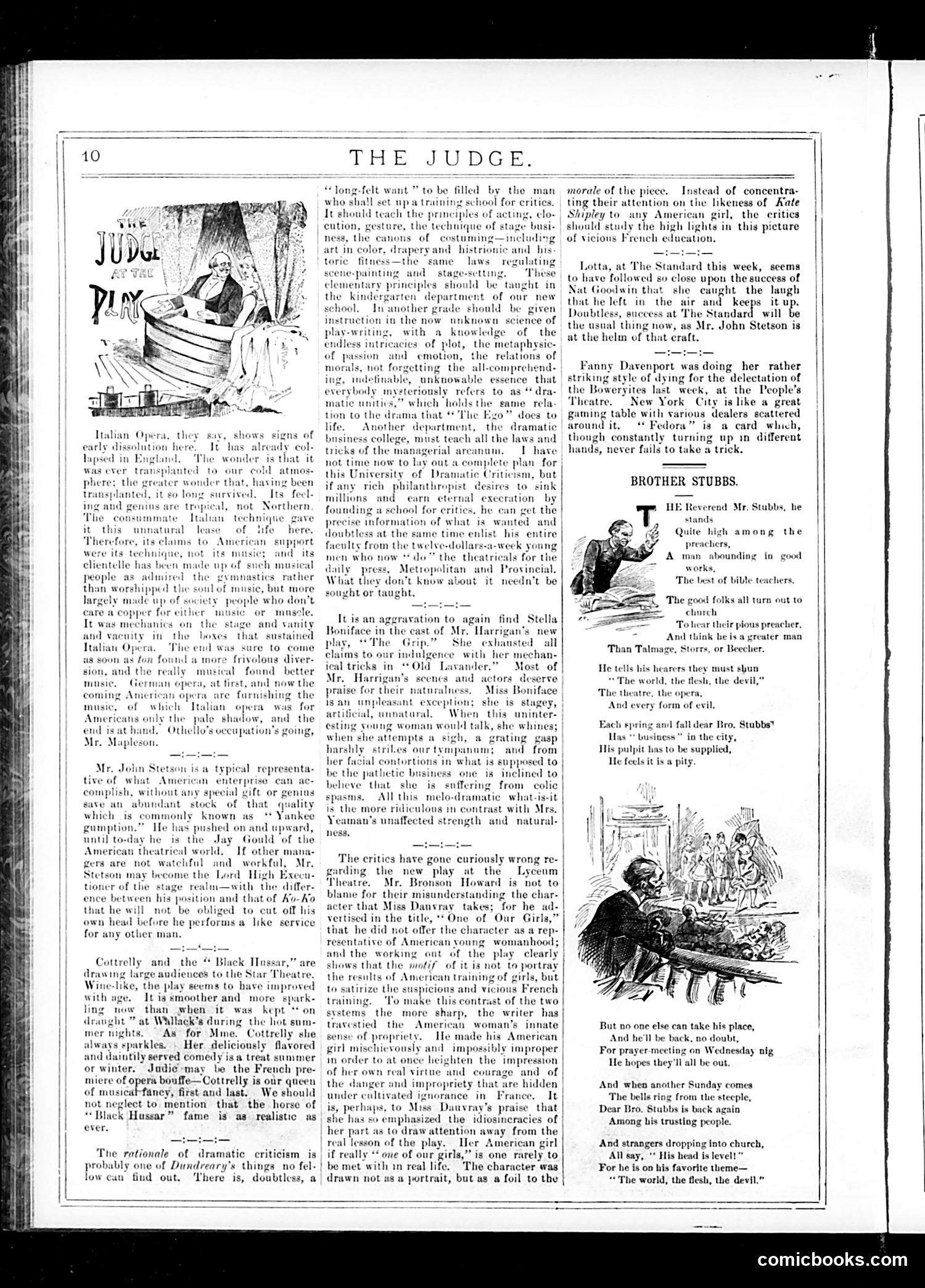
This page contains theater criticism from Judge magazine, focusing on dramatic arts and theatrical personalities of the era. **Main Content:** The lead article critiques proposals for a "training school for critics," sarcastically suggesting a comprehensive curriculum including acting technique, playwriting, and theatrical management. The critic implies current theater reviewers are incompetent, referring mockingly to "twelve-dollars-a-week young men" reviewing productions. **Key Theatrical References:** - Discussion of Italian Opera's decline in America, attributed to audiences preferring frivolous entertainment - Praise for theater manager John Stetson, compared to Jay Gould for his business acumen - Reviews of productions including "Black Hussar" at the Star Theatre, featuring Mme. Cottrelly (praised for her comedic talents) - Commentary on Stella Boniface and Mr. Harrigan's theatrical work **The Satire:** The piece mocks both theatrical critics' lack of expertise and the American theater establishment's commercialism, suggesting that professional training—rather than talent or insight—defines critical judgment.
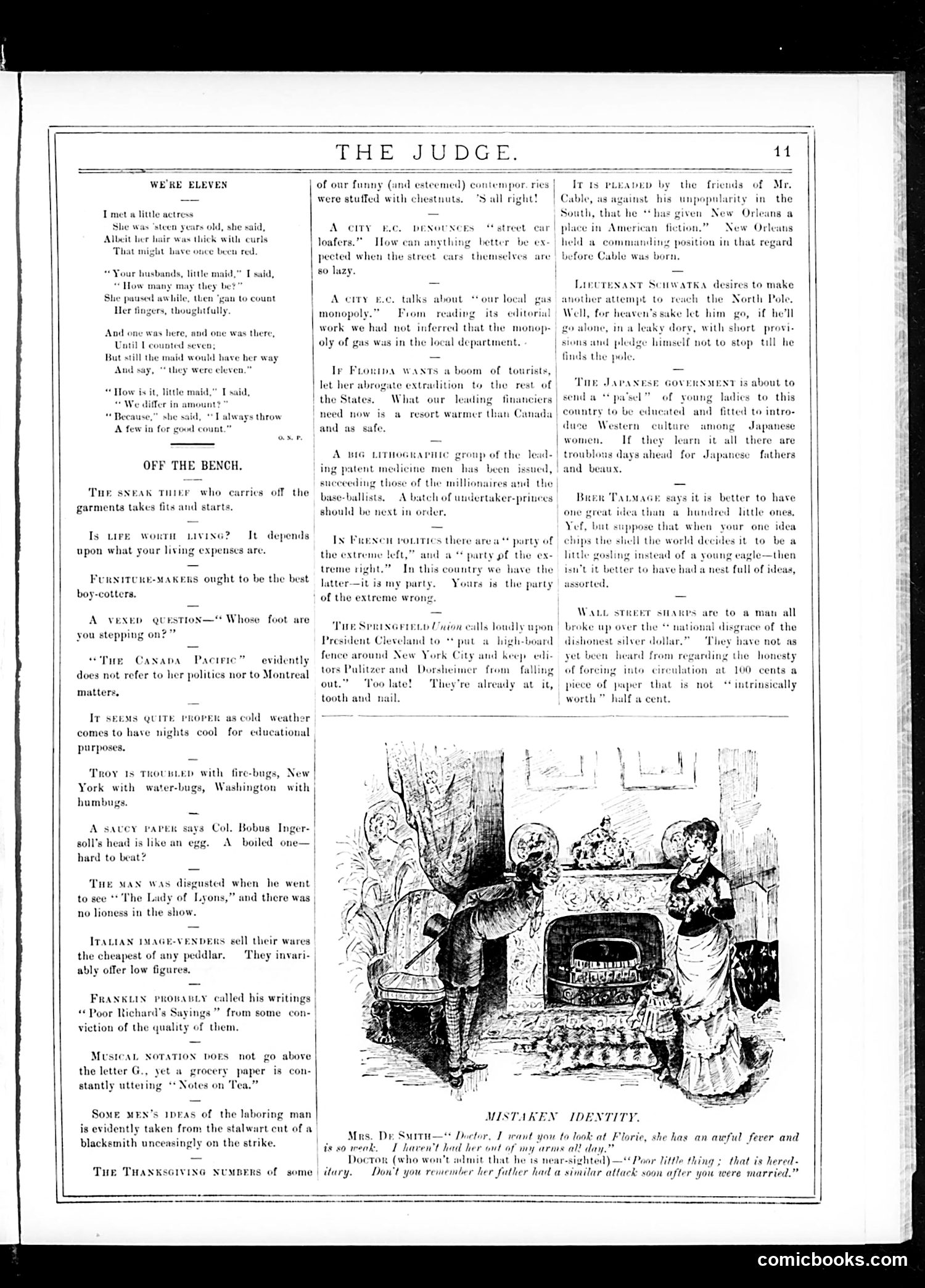
This page from *Judge* contains brief satirical commentary items ("We're Eleven," "Off the Bench") and a cartoon titled "Mistaken Identity." **The Main Cartoon:** Shows what appears to be a domestic scene where a woman confronts a doctor. The caption reveals the joke: Mrs. Dr. Smith has mistakenly believed her husband was visiting a patient named "Florrie" with a fever, but he was actually elsewhere. The doctor denies the affair she suspects, claiming he hasn't left his office "in days." The satire targets spousal suspicion and marital misunderstanding—a common theme mocking Victorian domestic anxiety. **The Text Items:** These are one-liners mocking contemporary figures and issues: references to Cable's unpopularity in the South, Lieutenant Schwatka's Arctic expedition, Japan's effort to educate young women in Western culture, and various political/social absurdities. The tone is lighthearted social commentary rather than hard political satire. The page represents *Judge*'s typical mix of domestic humor and topical jabs at 1880s-90s American life.
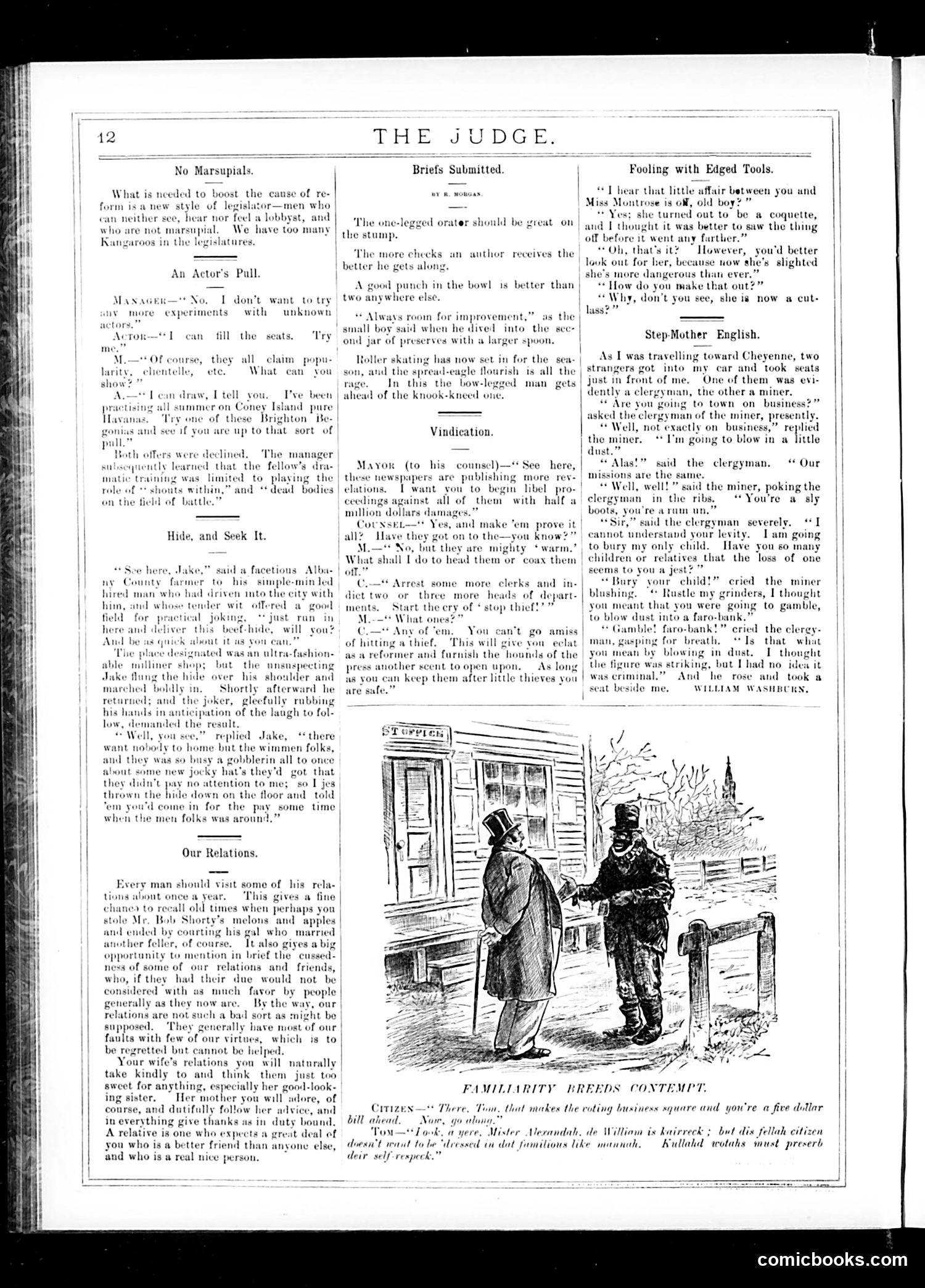
This page contains several satirical pieces targeting political and social corruption circa early 20th century: **Main Cartoon ("Familiarity Breeds..."):** Shows two men outside a "Supplier" shop. The dialogue mocks class pretension—a wealthy citizen condescendingly addresses a working-class man about "business" while the worker speaks in exaggerated dialect. The satire targets artificial social hierarchies and condescension disguised as familiarity. **"Vindication" Section:** A mayor instructs his counsel to file libel suits against newspapers exposing his corruption, then cynically suggests arresting random petty thieves to appear as a "reformer." This exposes how corrupt politicians manufactured false reform credentials while silencing critics. **"No Marsupials":** Advocates for legislators who cannot be influenced by lobbyists—direct criticism of legislative corruption. **Other Pieces:** Include jabs at theatrical managers, reformers, and marital dissolution. The overall theme: exposing hypocrisy among politicians, the wealthy, and self-proclaimed reformers who use manipulation and misdirection rather than genuine reform.
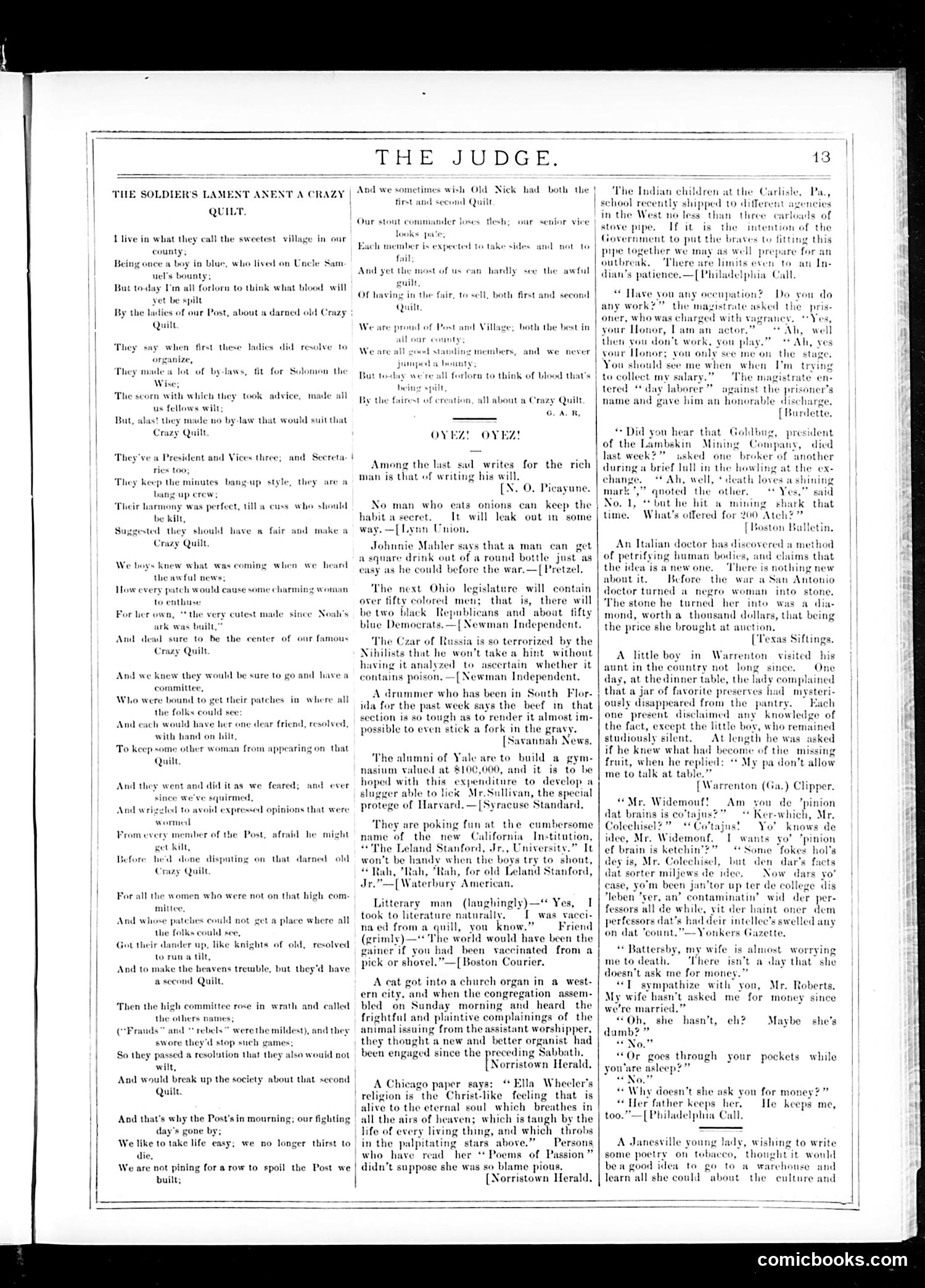
This page from **Judge** magazine contains a satirical poem titled "The Soldier's Lament About a Crazy Quilt," accompanied by miscellaneous humorous items. The main satire mocks post-Civil War social tensions at a military installation. A veteran ("boy in blue") describes how ladies' auxiliary members of the Post (a veteran's organization) plan to create a charity quilt, but their infighting over which patches will be displayed becomes so acrimonious that the entire organization fractures. The poem's irony lies in soldiers surviving actual warfare only to see their community destroyed over trivial domestic disputes. The surrounding short jokes reference contemporary issues: a legislator's concerns about colored representatives in Ohio; the Russian Tsar's paranoia about Nihilists; and competitive claims between Yale and Harvard athletic programs. The humor operates through gentle mockery of post-war American society's petty conflicts and emerging social anxieties, typical of Judge's satirical approach in the Reconstruction era.
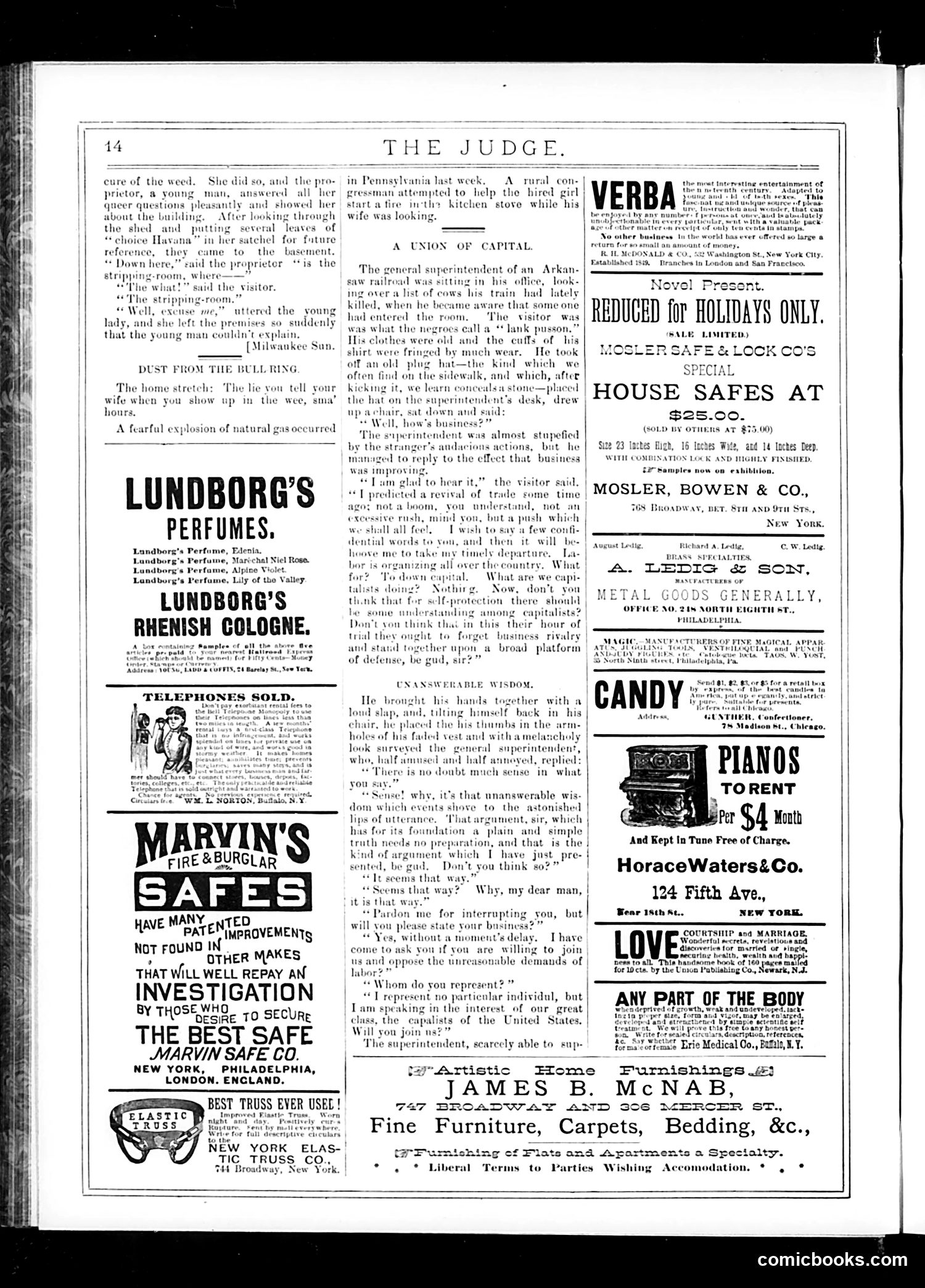
This page is primarily **advertising** with embedded short satirical pieces. The main content includes: **"A Union of Capital"** (top): A dialogue between a railroad superintendent and a visitor. The joke appears to satirize capitalist justifications for poor labor conditions—the superintendent claims business is "improving" despite hardship, using circular logic ("it seems that way...it is that way") to dismiss workers' concerns. The visitor represents capital interests seeking to unite against "unreasonable demands of labor." **"Dust from the Bull Ring" and "Unanswerable Wisdom"**: Brief anecdotes mocking social pretension and faulty logic. **The advertisements** dominate the page, hawking safes (Marvin's, Mosler), perfumes (Lundborg's), pianos for rent, furniture, and medical products—typical of Judge's era. The satire targets **labor-capital conflict** of the Gilded Age, depicting how capitalists justified exploitation through evasive rhetoric rather than honest argument. The "unanswerable wisdom" that "it is that way" reflects contemporary dismissal of workers' legitimate grievances.
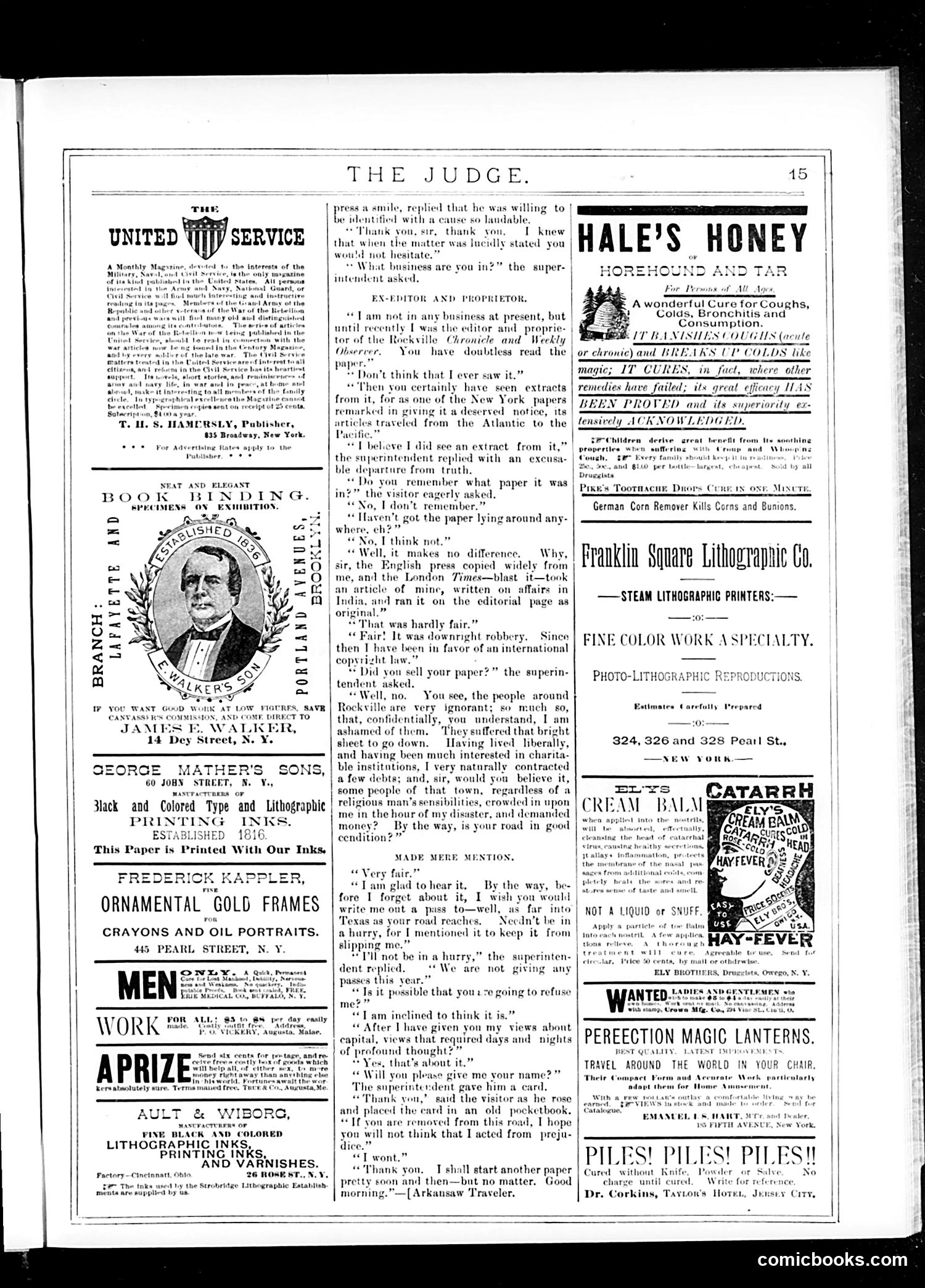
This page is primarily **advertisements and a multi-panel satirical story** rather than a political cartoon. The main narrative—"Ex-Editor and Proprietor"—depicts a conversation between a railroad superintendent and an unemployed former newspaper editor from Rockville. The editor unsuccessfully petitions for a free railroad pass by boasting about his paper's influence: claiming the London *Times* plagiarized his work and that his articles "traveled from Atlantic to the Pacific." The superintendent remains unmoved. **The satire targets**: self-aggrandizing failures—men who blame external circumstances (ignorant townspeople, plagiarism, unpaid debts from "charitable institutions") rather than admitting incompetence. The editor's entitled behavior and the superintendent's cold refusal mock both pretentious would-be intellectuals and the emerging corporate indifference to personal pleas. The page is dominated by period **advertisements** for lithography companies, remedies (Hale's Honey, Pixe's Toothache Drops, Catarrh Cream Balm), and printing services—typical of Judge's revenue model.
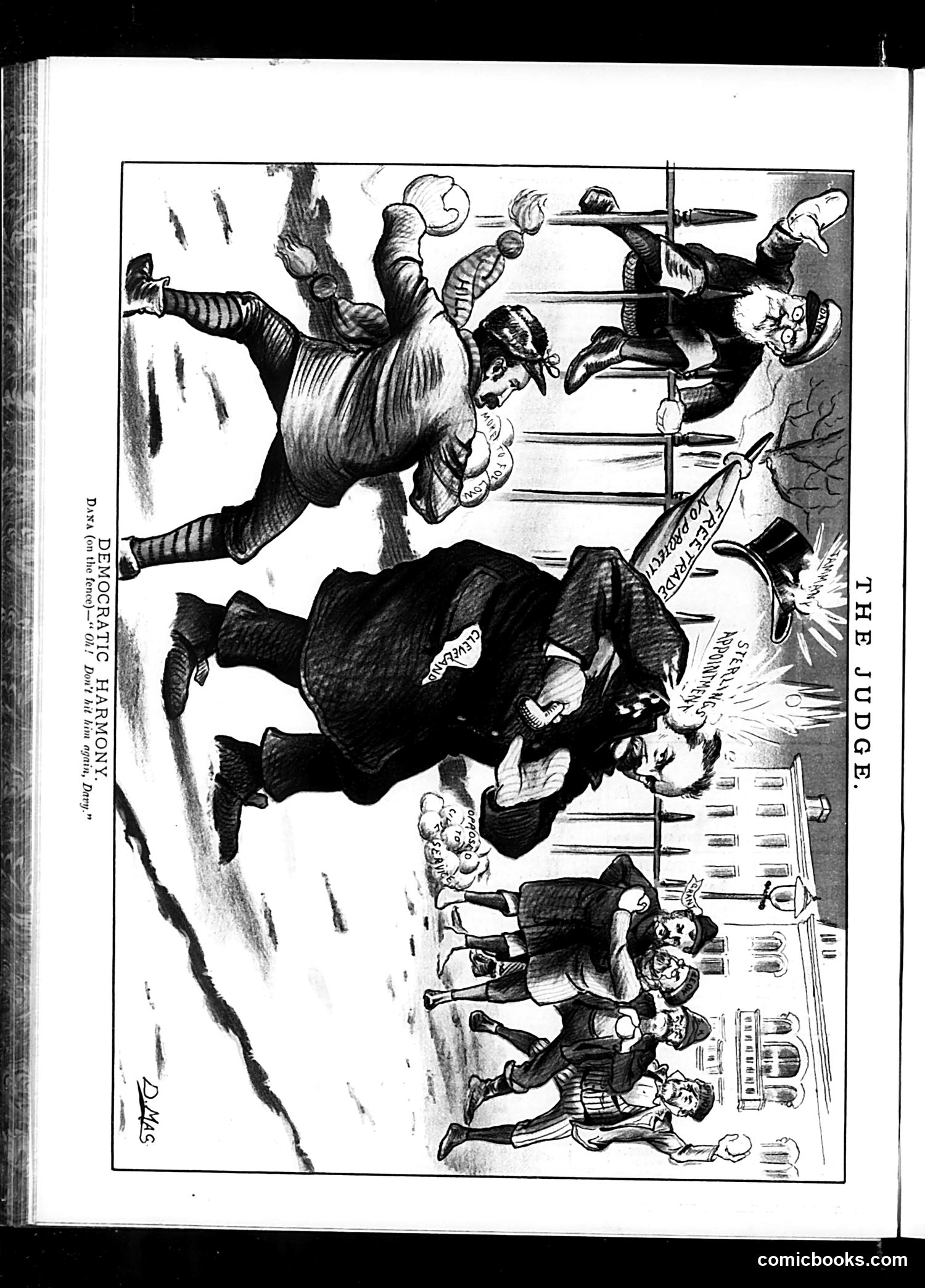
This political cartoon depicts a courtroom or judicial scene with exaggerated caricatures. A central figure labeled "THE JUDGE" presides while others appear to be engaged in physical conflict—one man is being struck while another figure (labeled "Davy" in the caption) protests from the sidelines with "Oh! Don't hit him again, Davy." The cartoon likely satirizes judicial corruption, abuse of power, or favoritism in the legal system. The "fence" reference in the caption suggests someone remaining neutral or complicit during wrongdoing. The chaotic composition and violent imagery mock the failure of the justice system to maintain order or fairness. Without additional context about the specific date or political figures caricatured, the precise historical reference remains unclear, though the satire targets institutional dysfunction in American law.