
Judge, 1885-12-12 · page 10 of 16
Judge — December 12, 1885 — page 10: what you’re looking at
What you’re looking at
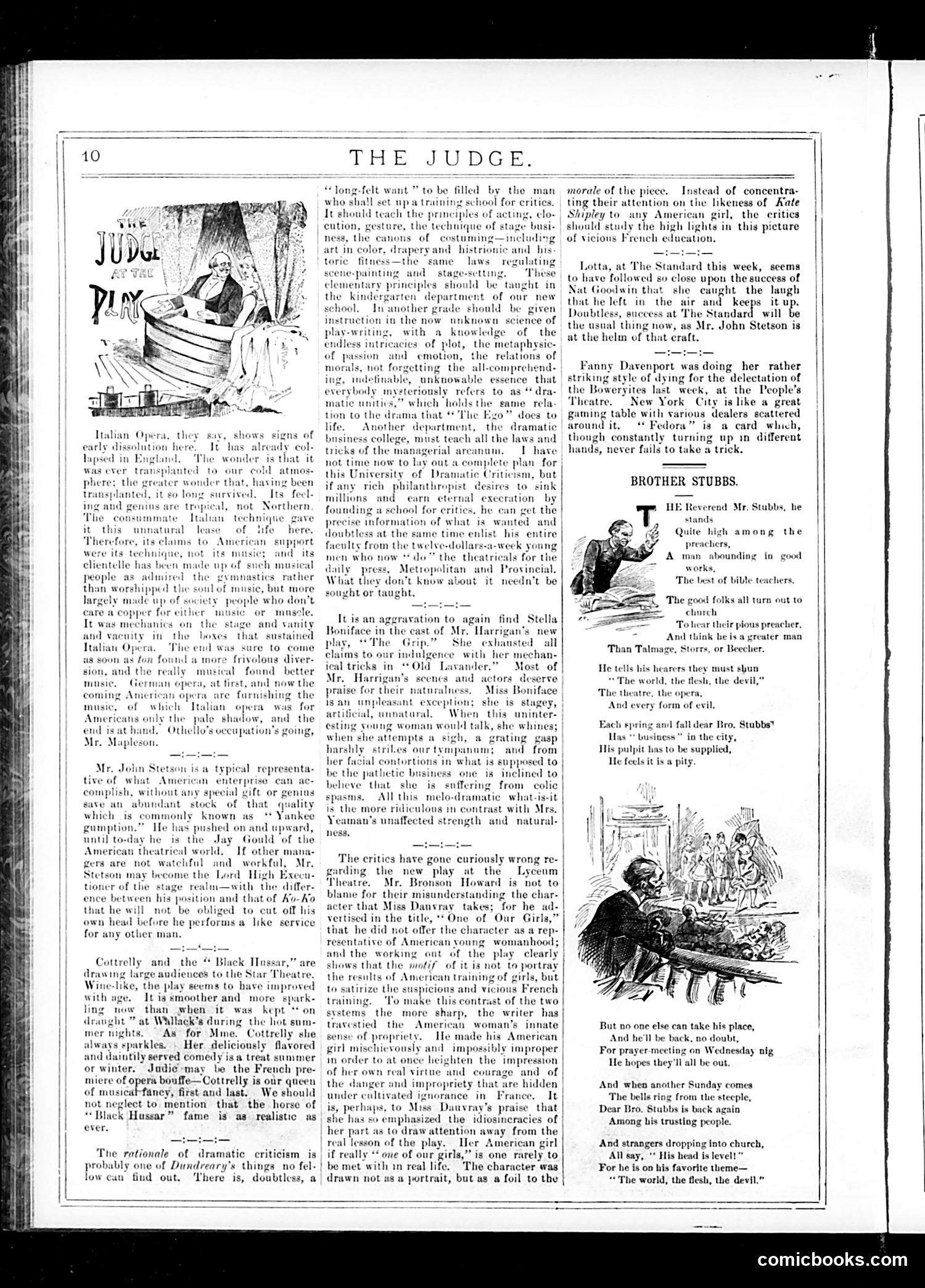
This page contains theater criticism from Judge magazine, focusing on dramatic arts and theatrical personalities of the era. **Main Content:** The lead article critiques proposals for a "training school for critics," sarcastically suggesting a comprehensive curriculum including acting technique, playwriting, and theatrical management. The critic implies current theater reviewers are incompetent, referring mockingly to "twelve-dollars-a-week young men" reviewing productions. **Key Theatrical References:** - Discussion of Italian Opera's decline in America, attributed to audiences preferring frivolous entertainment - Praise for theater manager John Stetson, compared to Jay Gould for his business acumen - Reviews of productions including "Black Hussar" at the Star Theatre, featuring Mme. Cottrelly (praised for her comedic talents) - Commentary on Stella Boniface and Mr. Harrigan's theatrical work **The Satire:** The piece mocks both theatrical critics' lack of expertise and the American theater establishment's commercialism, suggesting that professional training—rather than talent or insight—defines critical judgment.
📄 Transcribed text from this page (OCR, searchable)
Machine-transcribed from the original scan — historical spelling and the odd misread are preserved.
Italian Opera, they early dissolution here. lapsed in r is that it was ever t 0 0 id atmos. phere; th having been survived, tropical, not Northern isummate Italian technique gave unnatural lease of its chums to American support its musie; and. its of such musical rather >, but more herefor were echnique, ne clientelle has been ma people as admired the gyn than worshipped the soulof m largely made up of opper for eith It was mechanics on and vacuity in the boxes Italian Opera. The end w a3 as fon found a more frivolous diver- sion, and the really musical found better music. German opera, at first, and now the coming Americ furnishing the music, of which opera for Americans only the the end isathand. Othello ing, Mr. Maplesc stics or mus and vanity that sustained sure to come opera are Italian was: nd Mr. Jolin Stetson is a typical representa- tive of what American enterprise can ac- complish, without any special gift or genius save an abundant stock of that 5 which is commonly known as ** Yankee gumption.” He has pushed on and upward, until to-day he is the Jay Gould of the American theatrical world. If other mana- gers are not watchful and workful, Mr. Stetson may become the Lord High Execu- tioner of the y realm—with the differ- ence between his position and that of A’o-A’o that he will not be obliged to cut off his own head before he performs a like service for any other man, the “ Black I[nssar,” are drawing large audi to the Star Theatre. y the play seems to have improved Jt is smoother and more spark- than when it was kept ‘on tat Wallack’s during the hot sum- mer nights. A8 for Mme. Cottrelly she always sparkles, . Her deliciously flavored and daintily served comedy is a treat summer or winter, Jadie-may be the French pre- micre of opera bouffe—Cottrelly is our queen of musicabfancy, first and last. We should not neglect to mention that the horse of “Black Hussar” fame is as realistic as ever. Cottrelly and of dramatic criticism is oof Dundreary’s things no fel- fiud out. here is, doubtless, a The rationale probably low can THE JUDGE. “long-felt want ” to be filled by the man who shall set up a trainin: al for critics. It should teach the principles of clo- cution, gi p, the technique of sta susi- ness, th s of costumin artin ‘yand histri toric same laws regulating ttn These iples should be tanght in en department of our new school. In another grade should be given instruction in the now unknown science of play-writing, with a knowledge of the endless intricacies of plot, the metaphysic- of | and emotion, the relations of mor tting the all-comprebend- ing, definable, unknowable essence that everybody mysteriously refers. to ‘dra- matic unitics,” which holds the sa rela tion to the drama that ‘The Ego” does to life. Another department, the dramatie business college, must teach all the laws and tricks of the managerial arcanum. 1 have not time now to lay out a complete plan for this University of Drama riticism, but if any rich philanthropist desires to sink millions and earn eternal execration by founding a school for critics, he can get the precise Information of what is wanted and | doubtless at the same time enlis' entire faculty from the twelve-dollars k young | men who now * “the theatricals for the Metropolitan and Provinei don’t know it needn't be clementary prin the kinde not avation to again find Stella he cast of Mr. Harrigan’s new ip.” She exhausted all ulgence with her mechan- “Old Lavander.” Most of "s scenes and actors deserve Miss Boniface isan unpl ption; she iss artificial, unnatural, Wh this uninter- esting young woman would talk, she whines; when she attemp' ing gasp harshly strily and from er facial contortions in what is supposed to be the pathetic business one is incline believe that she is suffering from colic ms. All this melo-dramatic what-is-it s the more ridiculous in cont with Mrs. man’s unaffected strength and natural- ical tricks in Mr. Harr praise f The critics have gone curious arding the new play at the — Lyceum tre. Mr. Bronson Howard is not to for their misunderstanding the char- | that Miss Dauvray takes; for he ad- vertised in the title, ** One that he did not offer the character resentative of American young womanhood; and the working ont of the play clearly shows that the motif of it is not to portray the results of American training of girls, but to satirize the suspicions and vicious French | training. ‘To make this contrast of the two | systems the more shurp, the writer has | travestied the American woman's innate | nse of propriety. He made his American rl mischievously and impossibly improper im order to at once heighten the impre of her own real virtue and courage and. of | the danger and impropriety that are hidden under cultivated ignorance in Fr s, perhaps, to Miss Dauvray’s pri she has so emphasized the idiosincracie her part as to draw attention away from the real lesson of the play. Her American if really ove of our girls,” is one rarely to be met with in real life. The character was drawn not as a portrait, but as a foil to the wrong re- a rep of Our Sie morale of the piece. Instead of concentra- ting their attention on the likeness of Hate Shipley to American girl, the critics should study the high lights in this pictare of vicions French edu Lotta, at The Standard this week, seems to have followed so close upon the success of Goodwin that she caught the laugh athe left in the air and keeps it up. Doubtless, suecess at The Standard will the usual thing now, as Mr. John Stetson is at the helm of that craft. Fanny Davenport was doing her rather striking style of dying for the delectation of the Boweryites last week, at the People’s ‘Theatre. — New York City is like a great gaming table with various dealers scattered around it. Fedora” is a card which, though constantly turning up in different hands, never fails to take a trick. BROTHER STUBBS. HE Reverend Mr. Stubbs, he stands Quite high among preachers, A inan abounding in good works, ‘The best of bible teachers, the The good folks all turn out to 2 church To har their pious preacher, And think be is a greater man ‘Than Talmage, Storrs, or Beecher. He tells his hearers they must shun * The world, the flesh, the devil, ‘The theatre, th a And every form of evil. ope Each spring and fall dear Bro, Stubbs" Has ** business” in the city, His pulpit has to be supplied, He feels it is a pity. But no one else can take his place, And he'll be ‘k, no doubt, For prayer-mecting on Wednesday nig He hopes they'll all be out. And when another Sunday comes The bells ring from the steeple, Dear Bro. Stubbs is back again Among his trusting people. And strangers dropping into church, All say, ‘* His head is level!” For he is on his favorite theme— “The world, the flesh, the devil.” comicbooks.com