
A complete issue · 16 pages · 1885
Judge — November 21, 1885
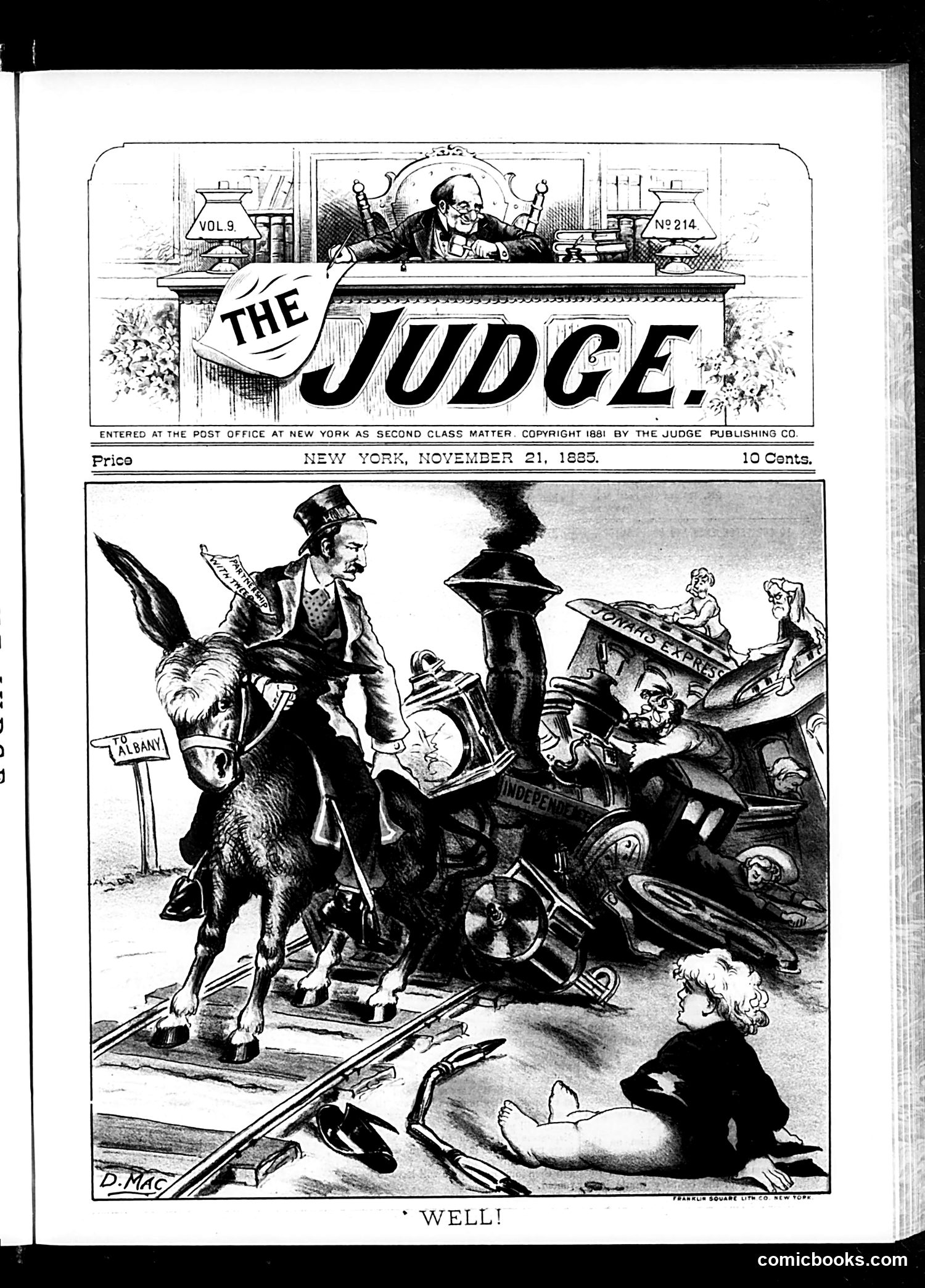
This is the cover of Judge magazine from November 21, 1885. The cartoon depicts a man in a top hat riding a donkey labeled "ALBANY" toward a derailed locomotive marked "INDEPENDENT." The donkey appears to be pulling or controlling the train wreck, while figures scatter around the damaged engine. The satire likely comments on New York state politics, with Albany representing state government. The "Independent" label suggests this cartoon criticizes how political independence or an independent political movement has been derailed or corrupted by Albany's political machinery. The man steering the donkey symbolizes political manipulation—someone using state political power to wreck an independent political effort. The title "WELL!" suggests ironic commentary on this political outcome.
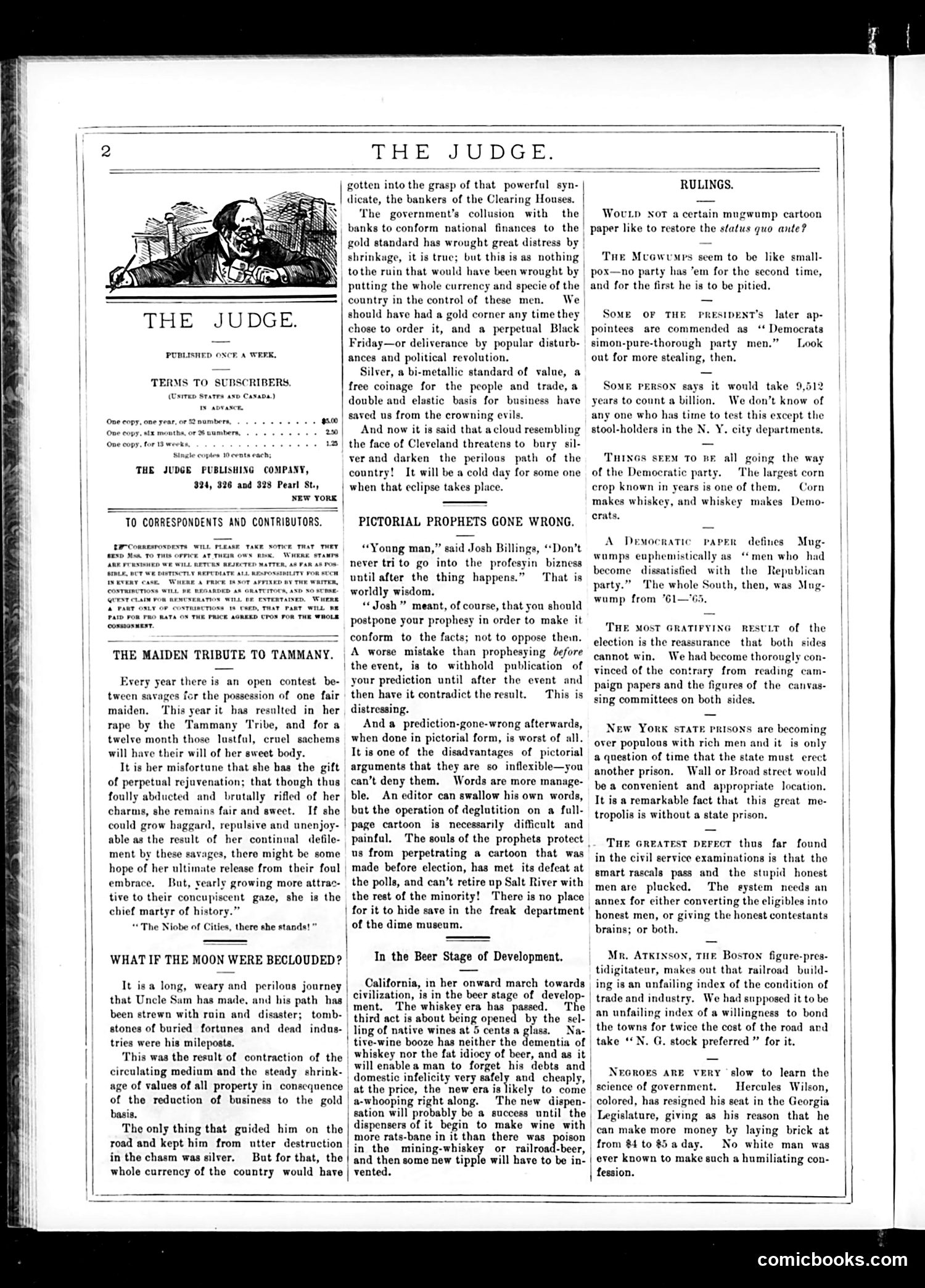
The main cartoon shows a bearded man at a desk—likely a political figure or banker—depicted in a caricatured style typical of 19th-century satirical journalism. The surrounding text discusses currency manipulation, the "Clearing Houses," and financial schemes involving bankers and government collusion. The satire targets what appears to be Gilded Age banking practices and monetary policy corruption. References to "gold corner," "silver," and currency control suggest criticism of financial elites manipulating national currency for private gain. The text mentions Cleveland (likely President Grover Cleveland) and criticizes prophetic predictions in political cartoons—suggesting this is satirizing predictive political commentary that proved wrong. The overall tone attacks financial corruption and suggests the banking system is rigged against ordinary people.
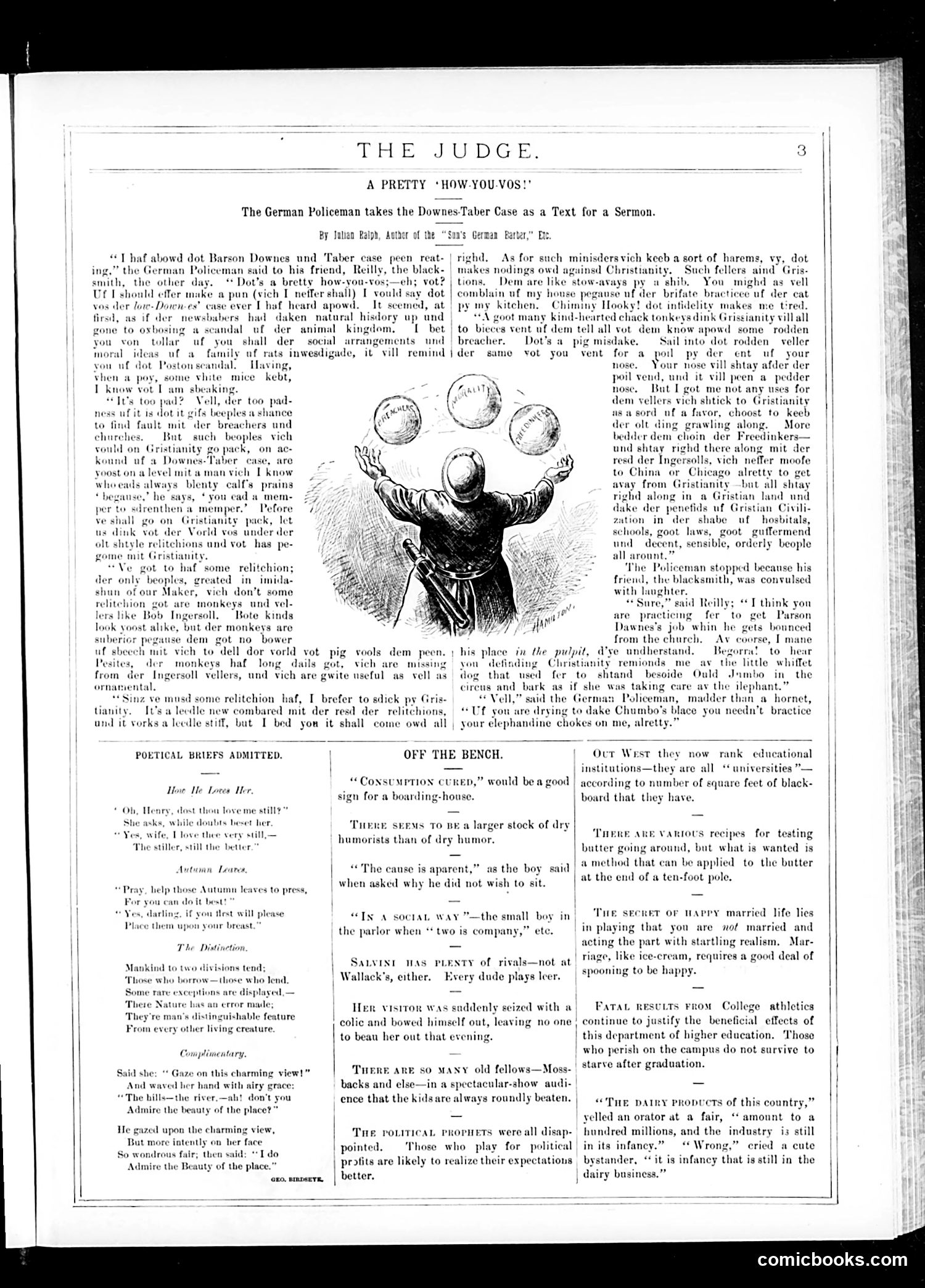
This cartoon features a German policeman delivering a religious sermon that uses the "Downes-Taber Case" (apparently a contemporary scandal Judge's readers would recognize) as its moral foundation. The humor relies on **ethnic caricature**: the policeman speaks in a thick German accent (represented by deliberate misspellings: "vos," "shtay," "Gristianity"), a common Judge satirical device. His sermon ironically defends Christianity against supposed rivals—apes and monkeys—by comparing humans to animals, then contradicts himself by claiming those without religion are "monkeys" and those with Christianity are superior. The central joke appears to target **moral hypocrisy**: a German policeman lecturing about Christian virtue while using crude logic and broken English. The visual of him juggling spheres (possibly representing different religions or ideas) emphasizes the absurdity. The piece satirizes both **immigrant pretension** (a working-class cop preaching theology) and **loose Christian morality** among those claiming religious superiority, using the Downes-Taber scandal as evidence that Christianity doesn't prevent misconduct.
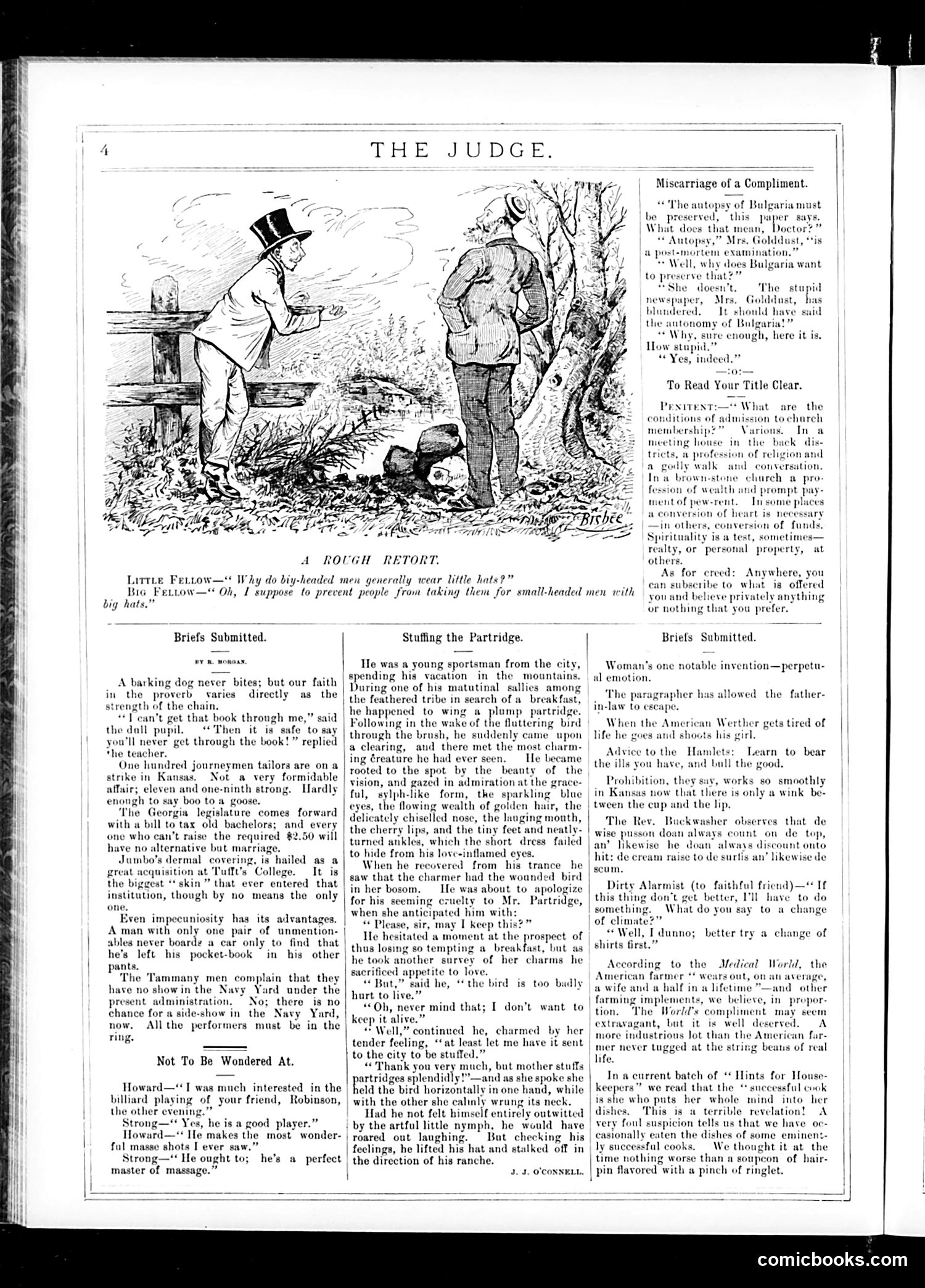
This page from the satirical magazine *Judge* contains several brief humorous pieces typical of the era: **"A Rough Retort"** depicts a dialogue about why bald men wear small hats—the punchline being they do so to avoid being mistaken for small-headed men wearing large hats. It's simple wordplay humor. **"Briefs Submitted"** collects short jokes on various topics: a Georgia law taxing bachelors, a joke about Jumbo's skin at Tufts College (likely referencing the famous elephant), and a pun about a billiard player being a "master of massage." **"Stuffing the Partridge"** is a longer satirical story about a city sportsman hunting in mountains who wounds a partridge, then encounters an attractive woman holding the bird. When he offers to have it "stuffed" (taxidermied) in the city, her mother casually wrings its neck and offers to stuff it herself—the humor lying in his romantic hopes being thwarted by her practical matter-of-factness. The page represents typical turn-of-the-century American magazine humor: puns, social commentary, and romantic/domestic satire aimed at middle-class readers.
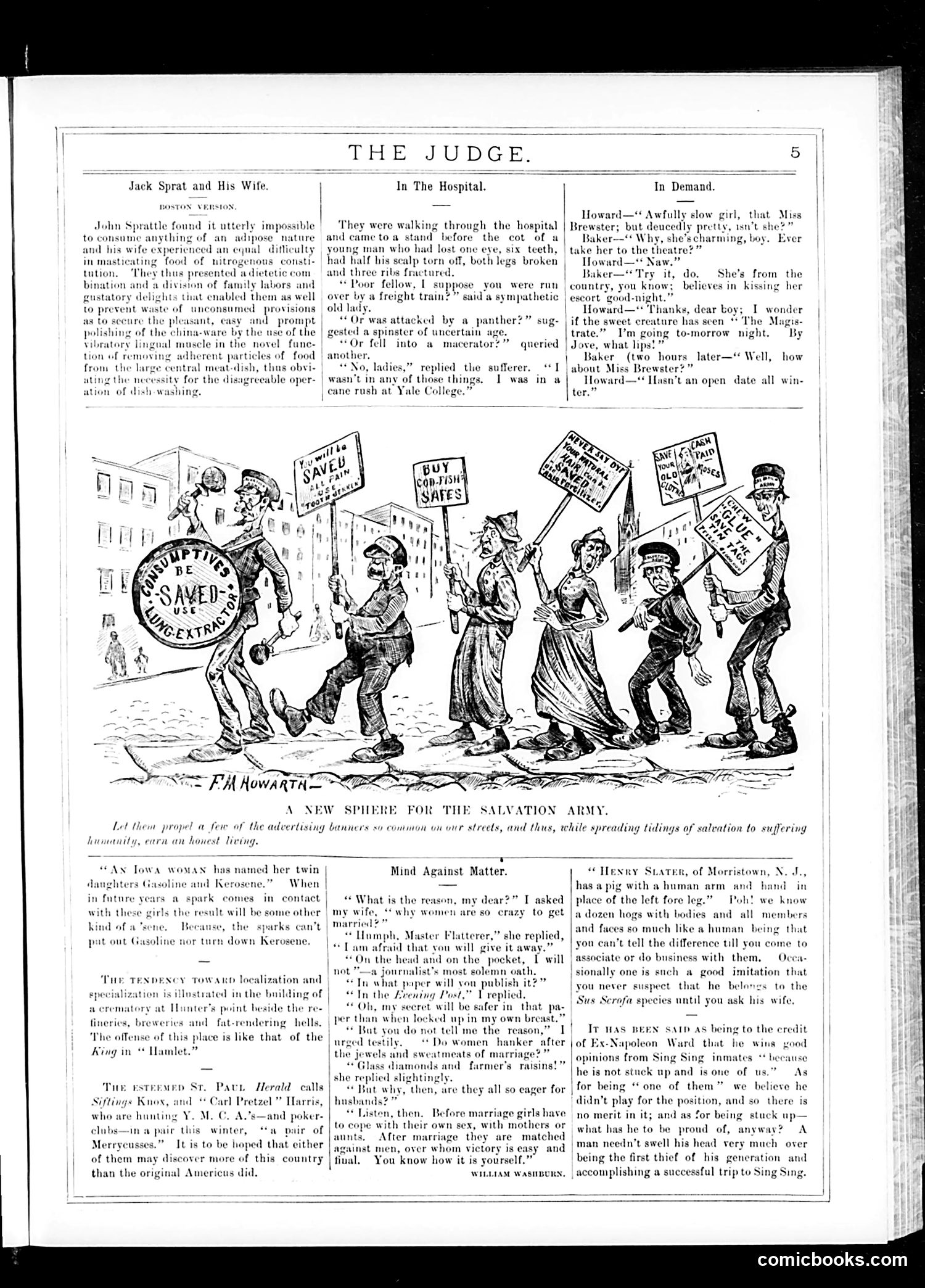
This page contains three satirical pieces typical of late-19th-century American humor: **"Jack Sprat and His Wife"** mocks a couple whose metabolic incompatibility—one cannot digest fats, the other cannot digest proteins—perfectly complements their household division of labor, with the wife efficiently consuming leftover food by licking dishes. **"In the Hospital"** is a joke setup about a young accident victim so severely injured he's barely recognizable, played for dark comedic effect. **"In Demand"** features brief dialogue about a slow country girl named Miss Brewster, suggesting rural women were viewed as unsophisticated and undesirable romantic prospects. **The main cartoon**, titled "A New Sphere for the Salvation Army," satirizes the Salvation Army (a real charitable organization) by depicting them advertising commercial products on street banners while preaching salvation—mocking what Judge saw as hypocritical commercialism masquerading as religious charity. The remaining text contains various brief humorous anecdotes about women, advertising, and oddities, reflecting the magazine's miscellaneous satirical approach.
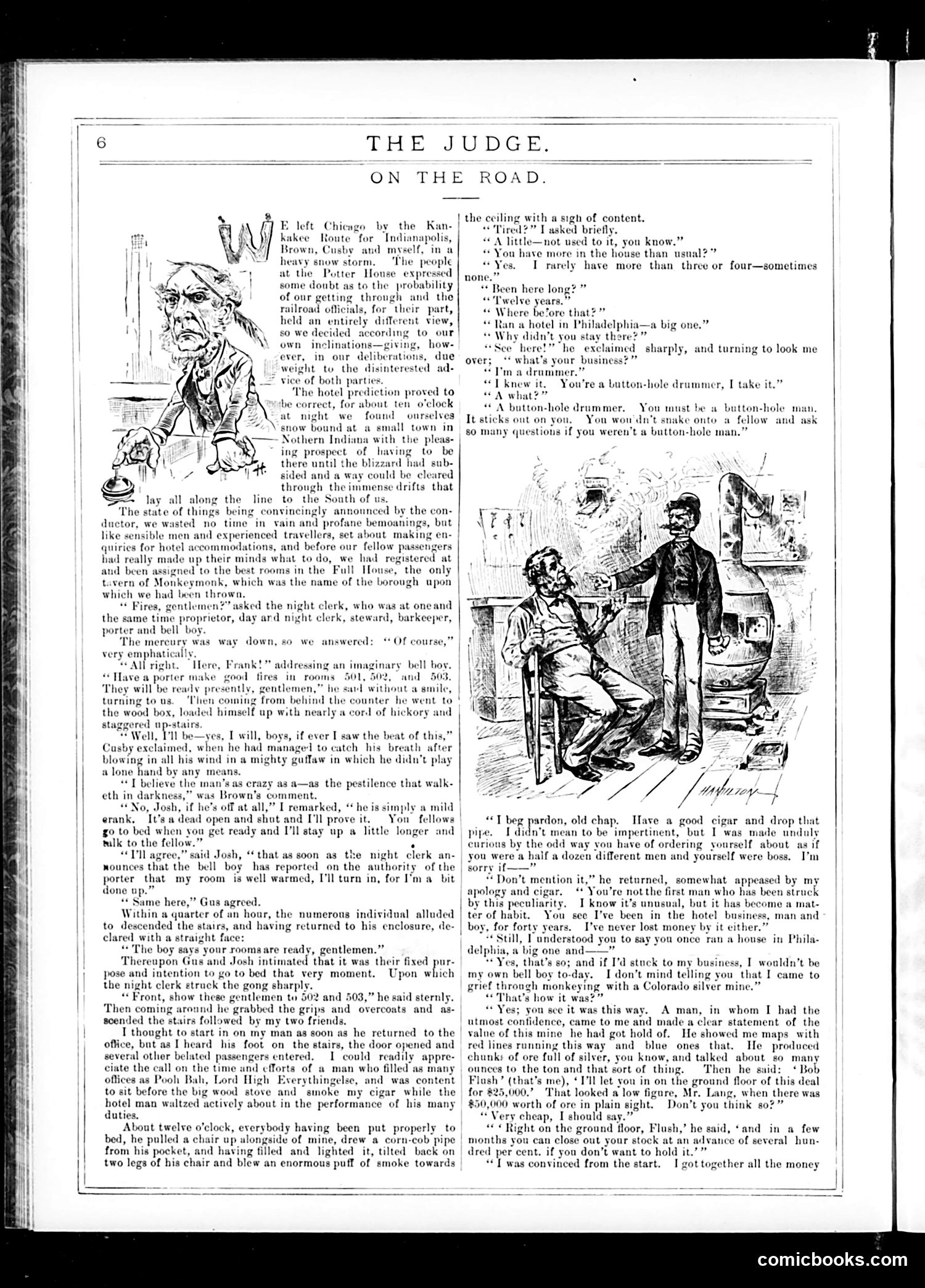
This page from *Judge* magazine presents "On the Road," a humorous travel narrative featuring three men stranded by blizzard at a small Indiana hotel called the Full House. The central joke involves a multi-tasking hotel employee (proprietor, clerk, barkeeper, porter, and bell boy rolled into one) who speaks in rambling, colorful dialect. The satirical target is the incompetence and eccentricity of rural American hospitality during harsh winter conditions. A key exchange mocks a traveling salesman ("button-hole drummer"—slang for an aggressive salesman who buttonholes customers). The term implies someone who pressures people into unwanted conversations or sales pitches. The satire reflects late-19th-century urban attitudes toward rural America: depicting backwoods innkeepers as simultaneously colorful and unreliable, the crude heating inadequate, and frontier hospitality more entertaining than comfortable. The "crazy" innkeeper character embodies period stereotypes about rural eccentricity.
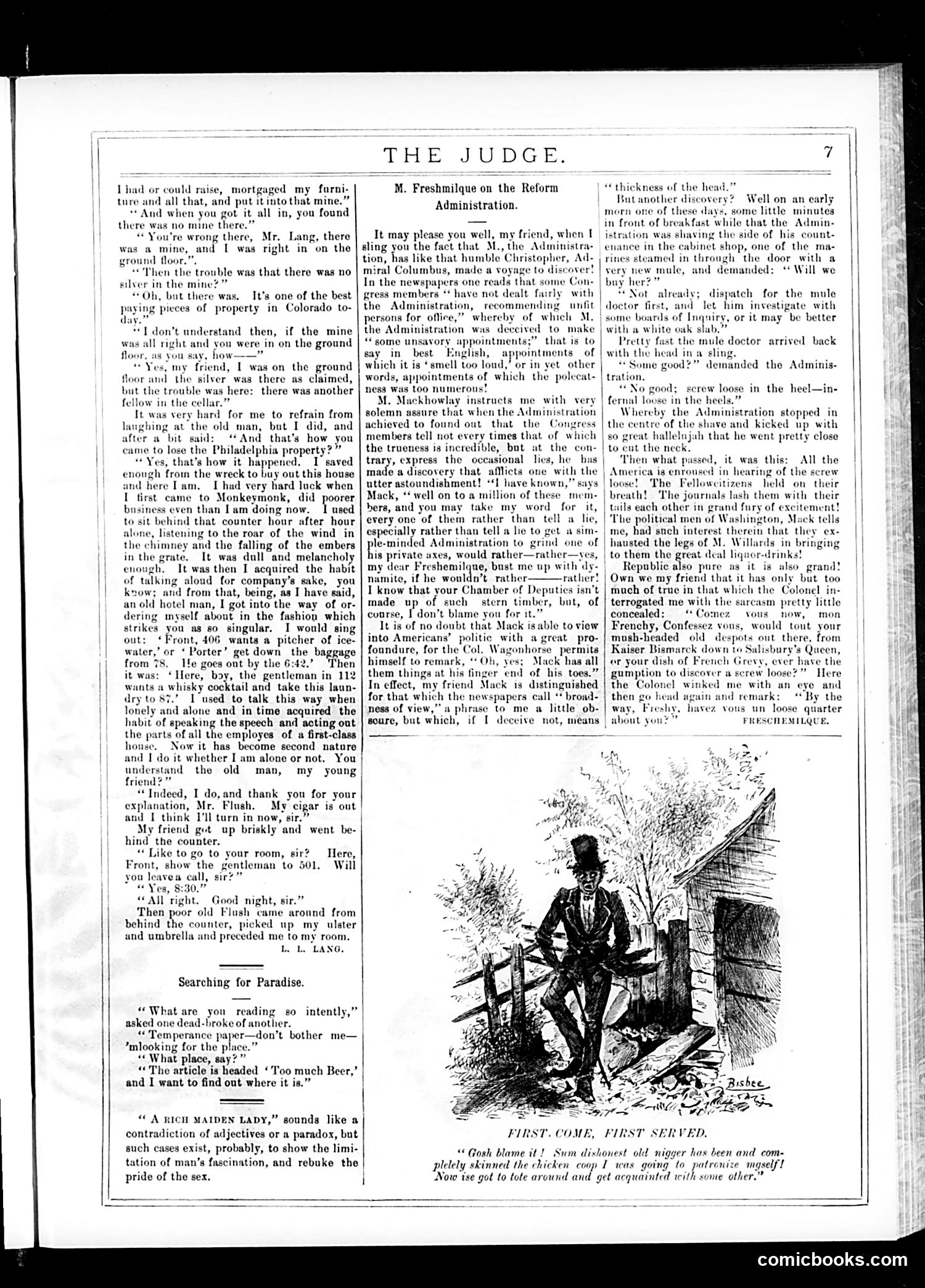
This page satirizes the **Cleveland administration's reform efforts** through two interconnected pieces: ## Main Cartoon Section The illustrated scene depicts a man sitting by a fence with a donkey—likely representing an **incompetent government official** dealing with bureaucratic chaos. The caption "First Come, First Served" suggests criticism of how the administration distributes positions or resources. ## Text Content The political commentary, attributed to "M. Freshmilque," mocks the administration's claimed **"discoveries" of corruption**. The satire uses absurdist humor: the administration supposedly finds serious problems (like an unfaithful aide hiding "in the cellar") only after being deceived by Congress members recommending unfit appointees. The extended metaphor of the donkey with a "screw loose in the heel" represents the administration itself as fundamentally broken—all the noise and investigation (journalists "lashing" with tails) cannot fix underlying dysfunction. ## Point Judge ridicules the reform administration for **discovering obvious corruption too late** while blaming Congress, portraying reformers as bumbling rather than effective.
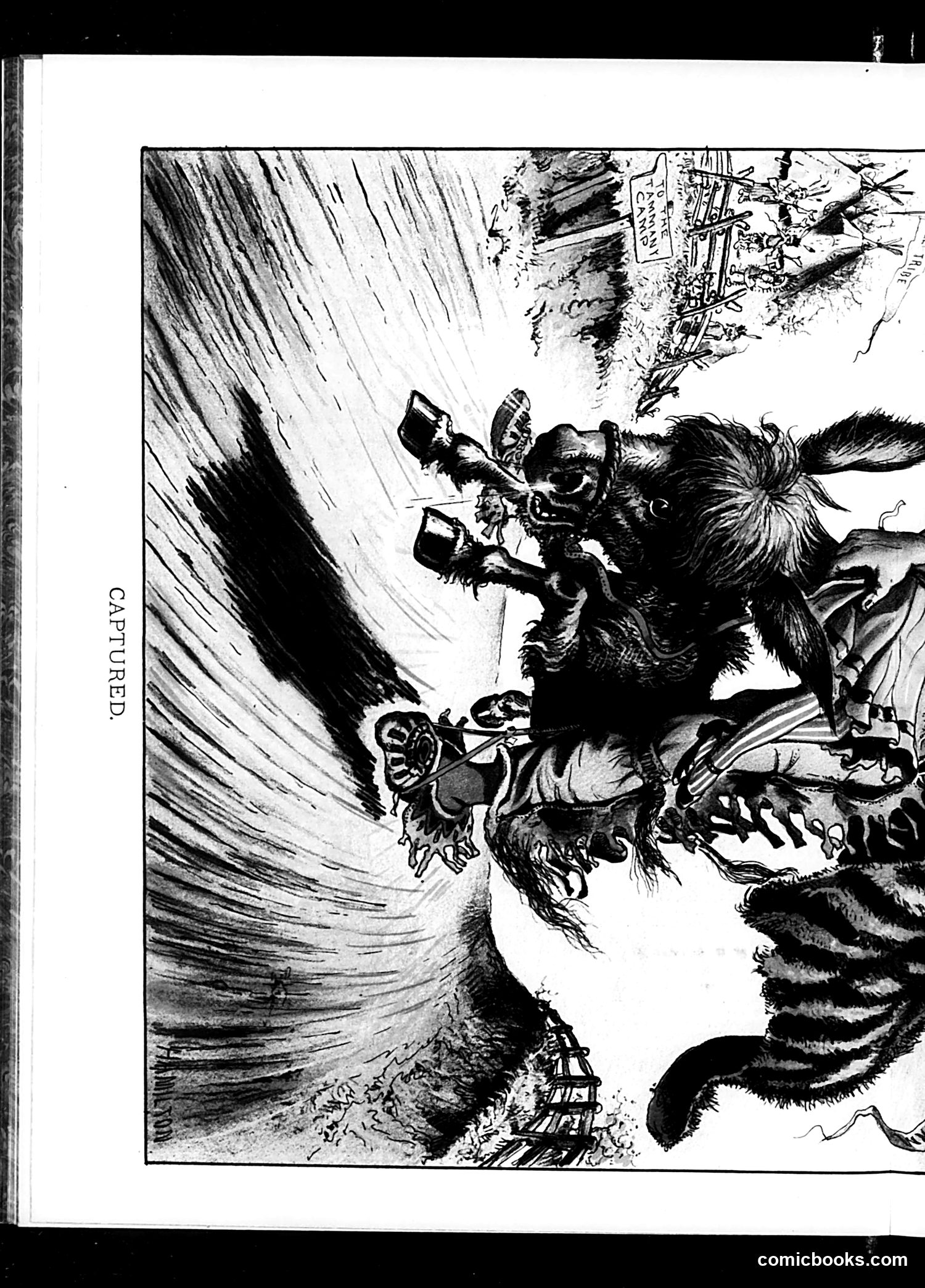
This appears to be a political cartoon from Judge magazine (a prominent American satirical publication). The word "CAPTURED" is printed vertically on the left side. The image shows caricatured figures that appear to be military or political in nature, depicted in an exaggerated style typical of late 19th/early 20th-century political satire. However, without a visible date, caption, or clearer OCR text identifying the specific figures or event being satirized, I cannot definitively identify which political figures, conflict, or historical moment this references. The artistic style and composition suggest commentary on a military victory or diplomatic capture, but the specific historical context and satirical point remain unclear from the image alone.
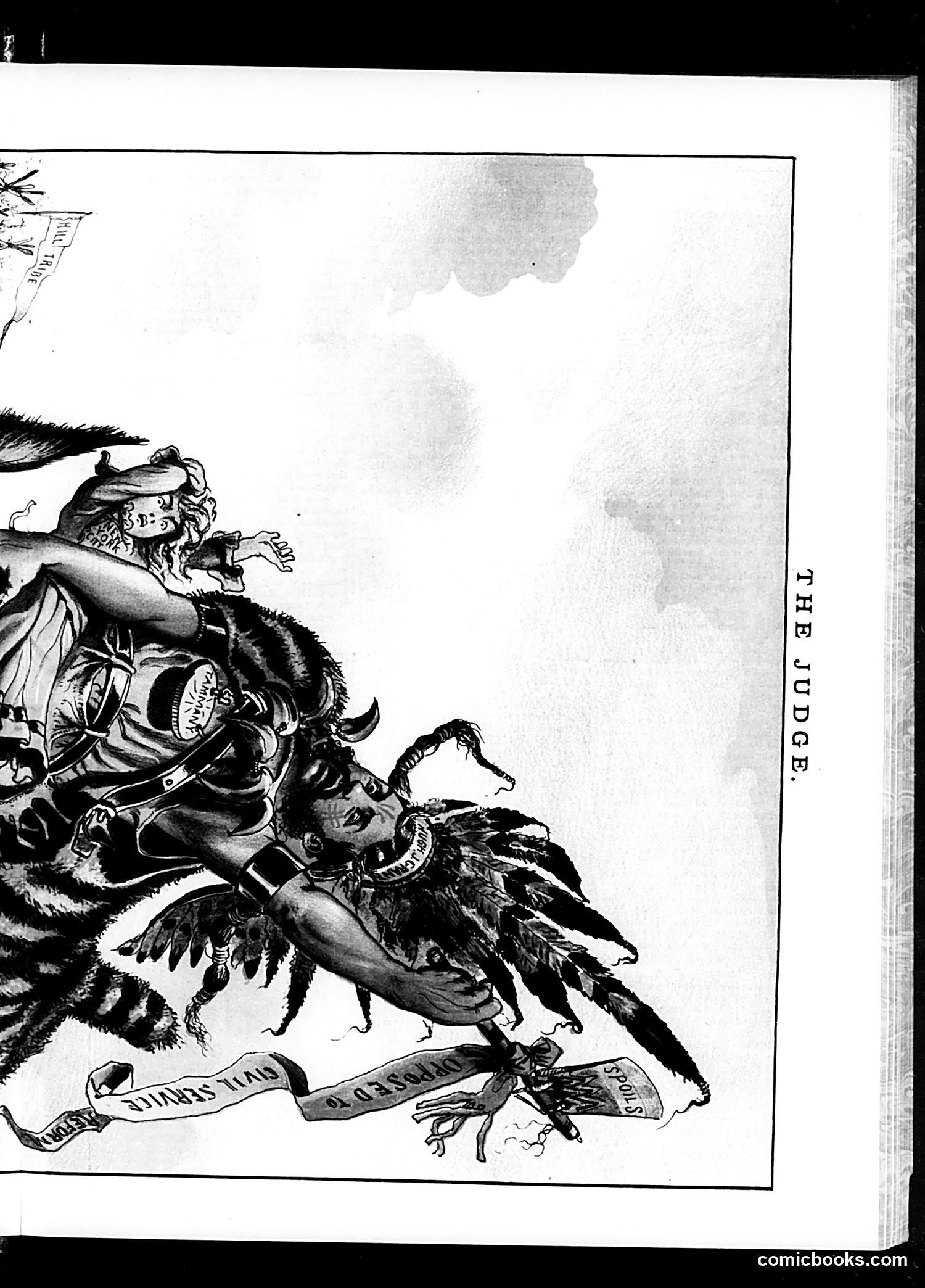
This page appears to be a title page or section header from *Judge* magazine, reading "THE JUDGE" vertically on the right side. The illustration on the left depicts a grotesque, demonic figure with exaggerated features riding or controlling what appears to be a winged creature or beast. The style is characteristic of late 19th/early 20th-century political satire—using monstrous imagery to represent vice, corruption, or a despised political opponent. Without a visible caption or date, the specific target of this satire remains unclear. However, the dramatic, accusatory tone suggests it likely critiques a political figure, corrupt institution, or social evil prominent during *Judge*'s era of publication. The detailed engraving technique was standard for the magazine's satirical commentary.
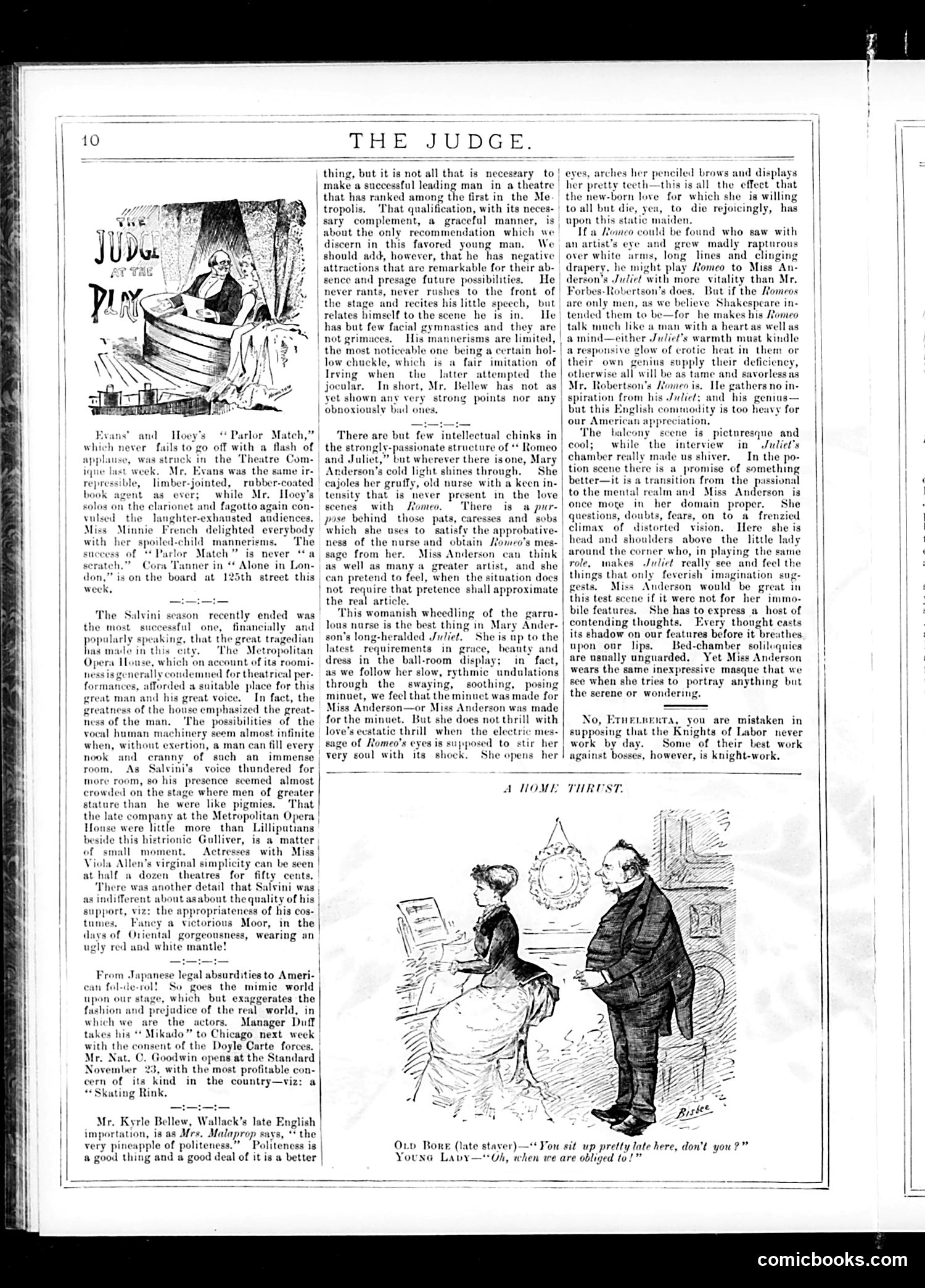
This page contains theatre reviews and criticism typical of Judge's satirical coverage. The main cartoon, titled "A HOME THRUST," depicts two women in Victorian dress—one seated showing another a picture or document, with the caption: "Old Bore (late riser)—'You sit up pretty late here, don't you?' Young Lady—'Oh, when we are obliged to!'" The joke targets social hypocrisy: a man who stays up late himself criticizes a young woman for doing the same, revealing double standards in Victorian morality regarding women's behavior. The text reviews theatrical performances, including praise for Evans and Hoey's "Parlor Match" and Salvini's tragic performances at the Metropolitan Opera House. Critics discuss actors' techniques and stage presence, with particular attention to Mary Anderson's portrayal in "Romeo and Juliet." The reviews emphasize vocal power, physical presence, and emotional restraint as marks of superior acting.
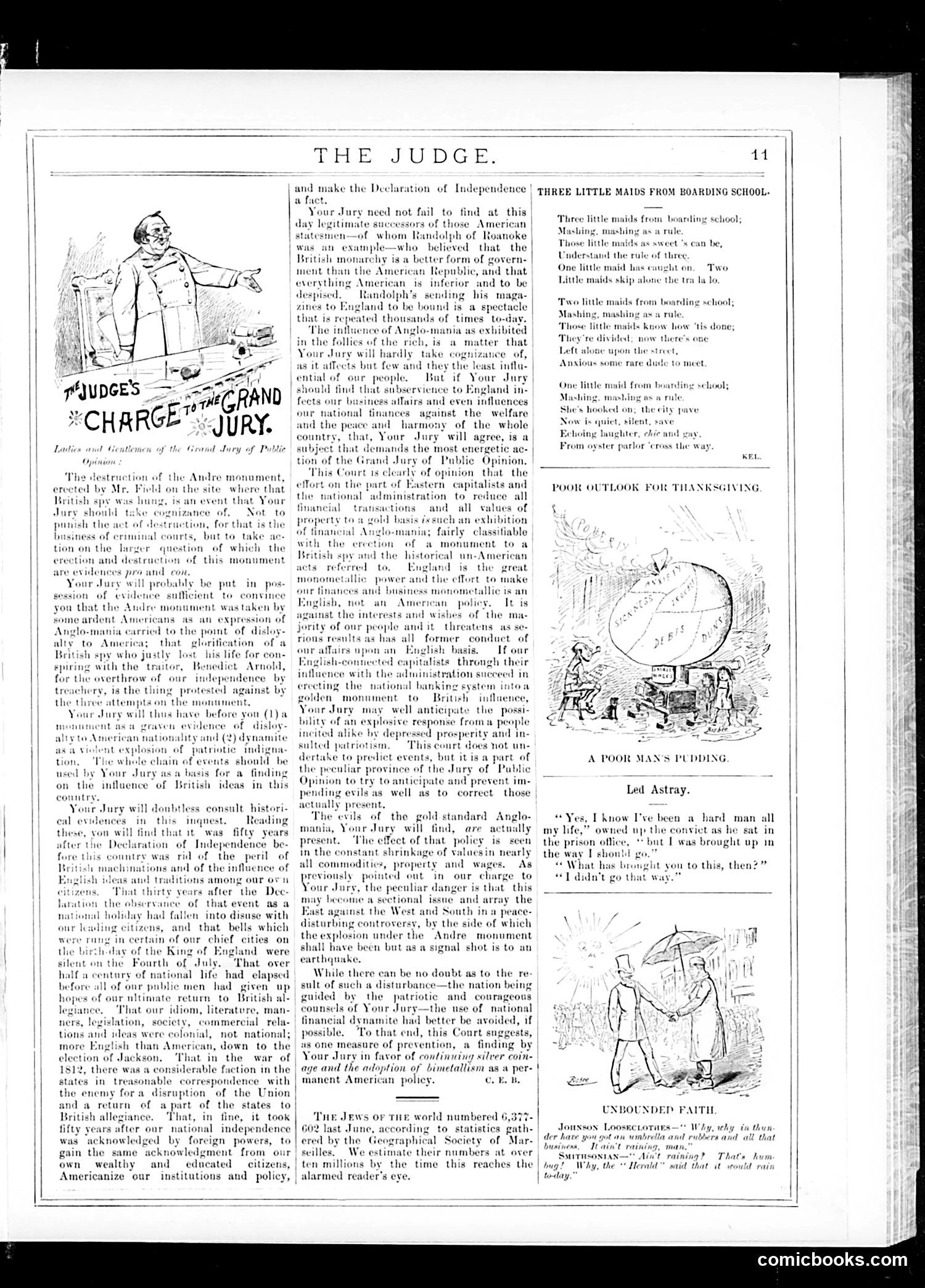
This is the main editorial cartoon, showing a judge (likely representing editorial authority) addressing a jury about the Andre Monument controversy. The text reveals the underlying political argument: the cartoon satirizes what it presents as dangerous "Anglo-mania"—the excessive British cultural influence and pro-British sympathies among American elites. The judge argues that British ideas persistently threaten American independence, citing evidence including: wealthy Americans' admiration for British monarchy, pro-British capitalists influencing national finance policy (specifically the "gold standard" monetary debate), and even the erection of a monument to British spy John André as proof of disloyalty. The satire targets Eastern establishment figures (particularly those favoring the gold standard) as closet Anglophiles whose financial policies harm the nation. The cartoon frames patriotism as resistance to British influence and pro-British economic policy.
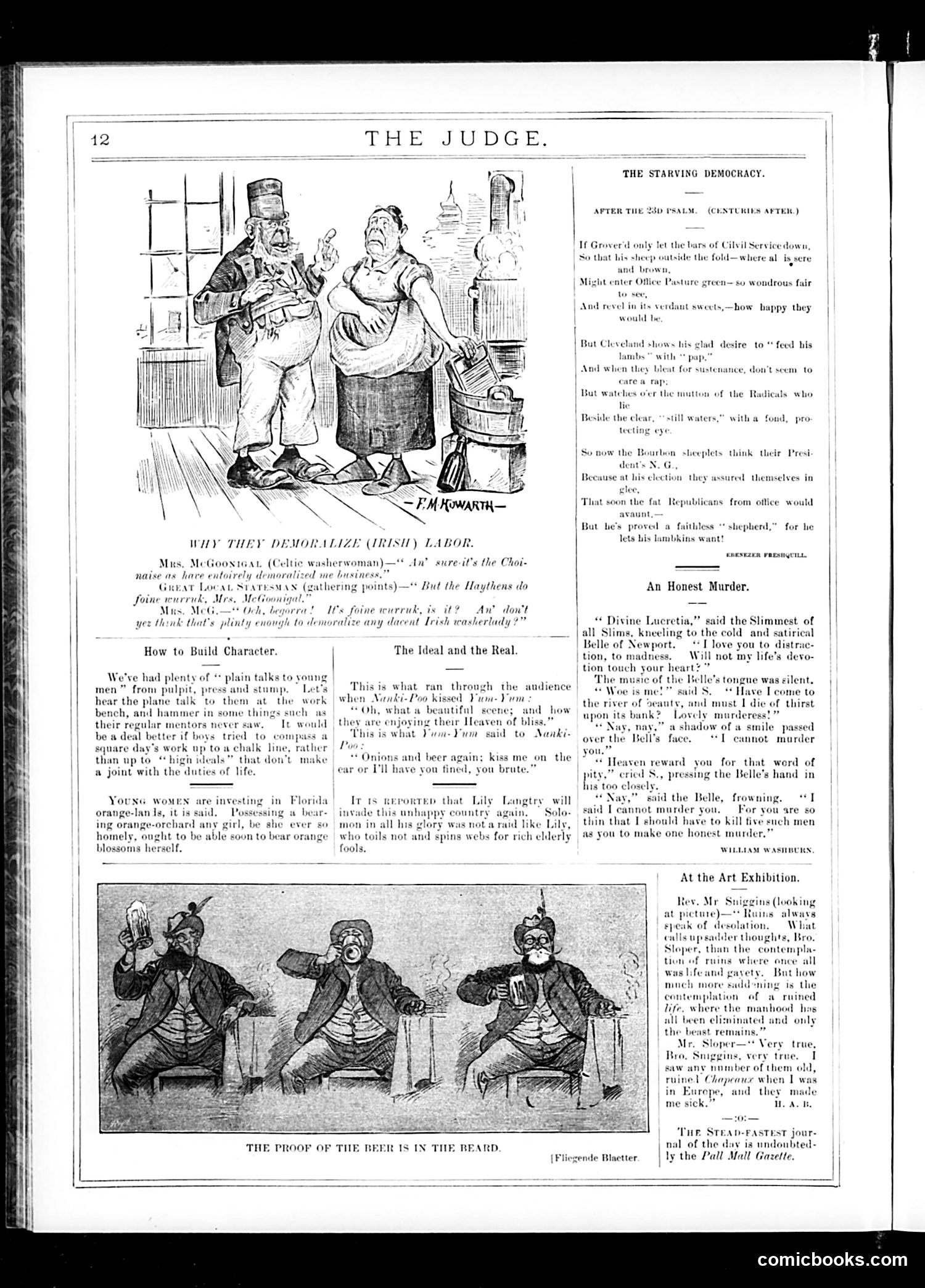
**"Why They Demoralize (Irish) Labor"** (top cartoon): A well-dressed politician offers Irish washerwoman Mrs. McGoonigal "fine work" at low wages, claiming it won't "demoralize any decent Irish washlady." The satire mocks how employers justify exploitative labor conditions—particularly targeting Irish immigrant workers—as somehow beneficial. **"The Starving Democracy"** (right column): A parody of Psalm 23 comparing American workers to starving sheep under President Cleveland. The poem bitterly attacks Cleveland's failure to remove Republicans from civil service positions despite his election, leaving Democratic "lambs" unfed while Radical "shepherds" remain in office. It's a critique of unfulfilled political promises regarding patronage reform. Both pieces satirize labor exploitation and political disappointment in the Gilded Age, when Irish immigrants faced discrimination and job insecurity, and when civil service reform remained incomplete despite reform rhetoric.
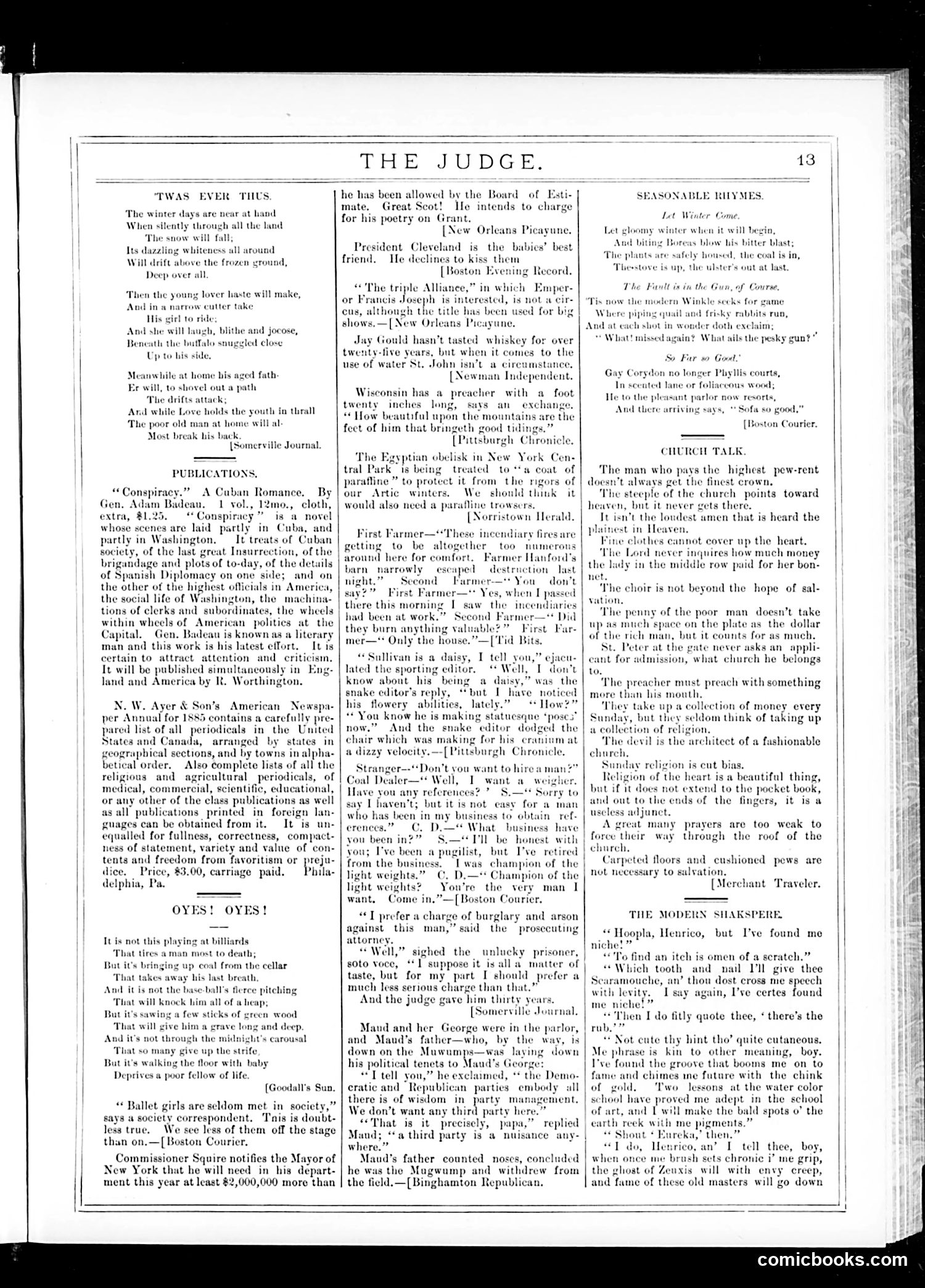
This page from Judge contains primarily **humorous sketches and social commentary** rather than political cartoons. The content reflects late-19th-century American satirical humor: **Key Items:** 1. **"'Twas Ever Thus"** — A sentimental poem contrasting young lovers' winter romance with an elderly father shoveling snow, highlighting class/generational hardship. 2. **Commissioner Squire's budget request** — Mocks New York City bureaucratic waste (requesting $2 million annually). 3. **Winter/labor jokes** — Satirize how dangerous winter chores (wood-sawing, coal-hauling) pose greater threats than sports injuries. 4. **Celebrity gossip items** — References to Jay Gould, St. John (likely John St. John, Prohibition candidate), and President Cleveland dismissing requests. 5. **Miscellaneous quips** — On preachers, ballet dancers, and farm fires. The satire targets **bureaucratic spending, manual labor dangers, and Victorian-era social pretensions** rather than specific political figures. The tone is lighthearted rather than acerbic.
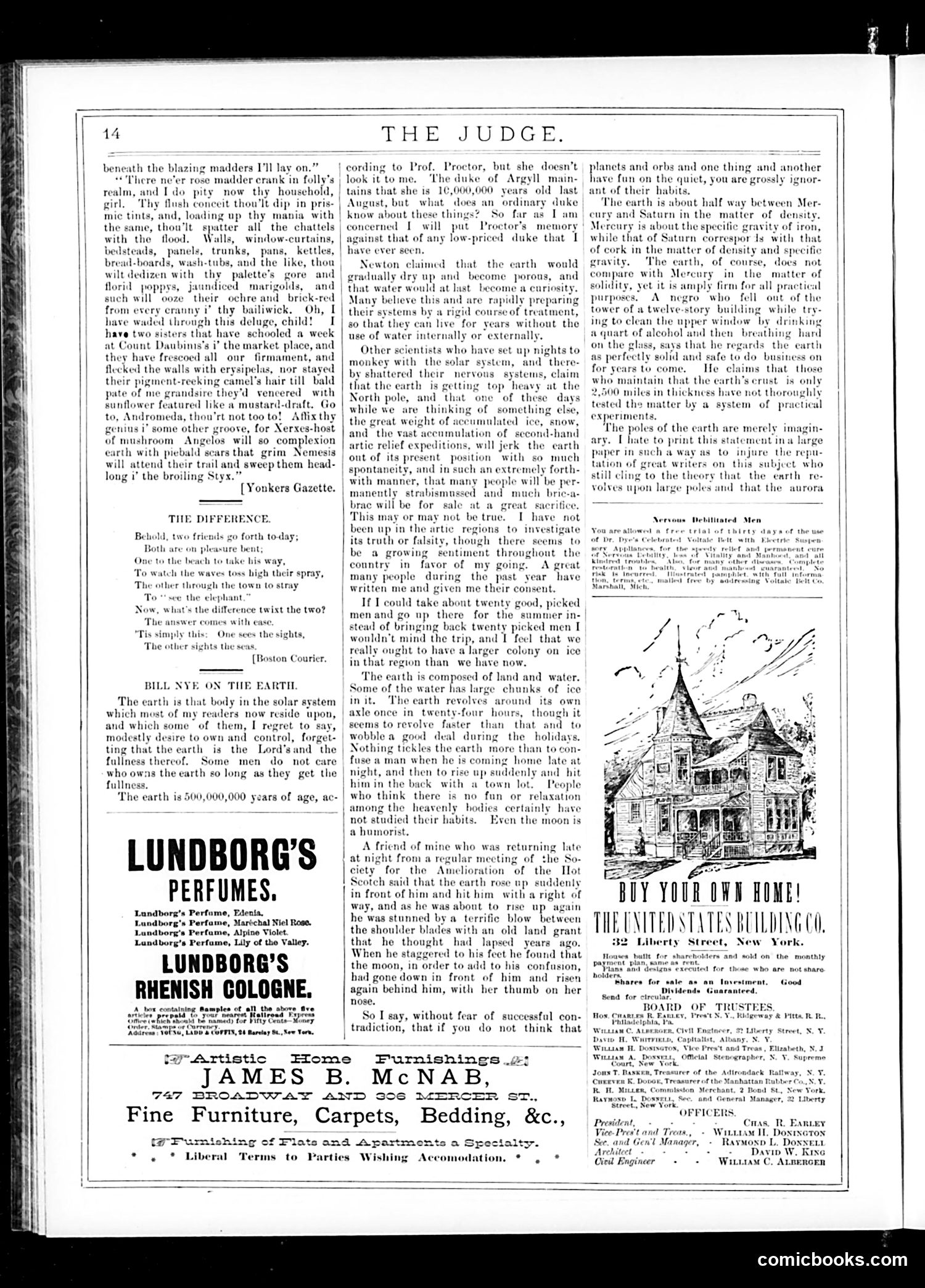
This page is primarily **advertising and miscellaneous content** rather than a coherent political cartoon or satirical piece. The top section contains literary excerpts—one appears to be Shakespeare-influenced verse about painting ("madders," "ochre," "erysipelas") and another discusses scientific theories about Earth's age and composition. The actual satirical content is minimal. There's a brief humorous piece titled "BILL NYE ON THE EARTH" that pokes fun at conflicting scientific claims about the planet's age and properties—competing statements from "Prof. Proctor" and "the duke of Argyll" about Earth's age, and various pseudoscientific theories about drying up or the poles. The page is otherwise dominated by **advertisements**: Lundborg's Perfumes, James B. McNab's furniture, and The United States Building Company's real estate offering. **For a modern reader:** This reflects 19th-century popular science debates, where competing theories about Earth's geology were common fodder for humor.
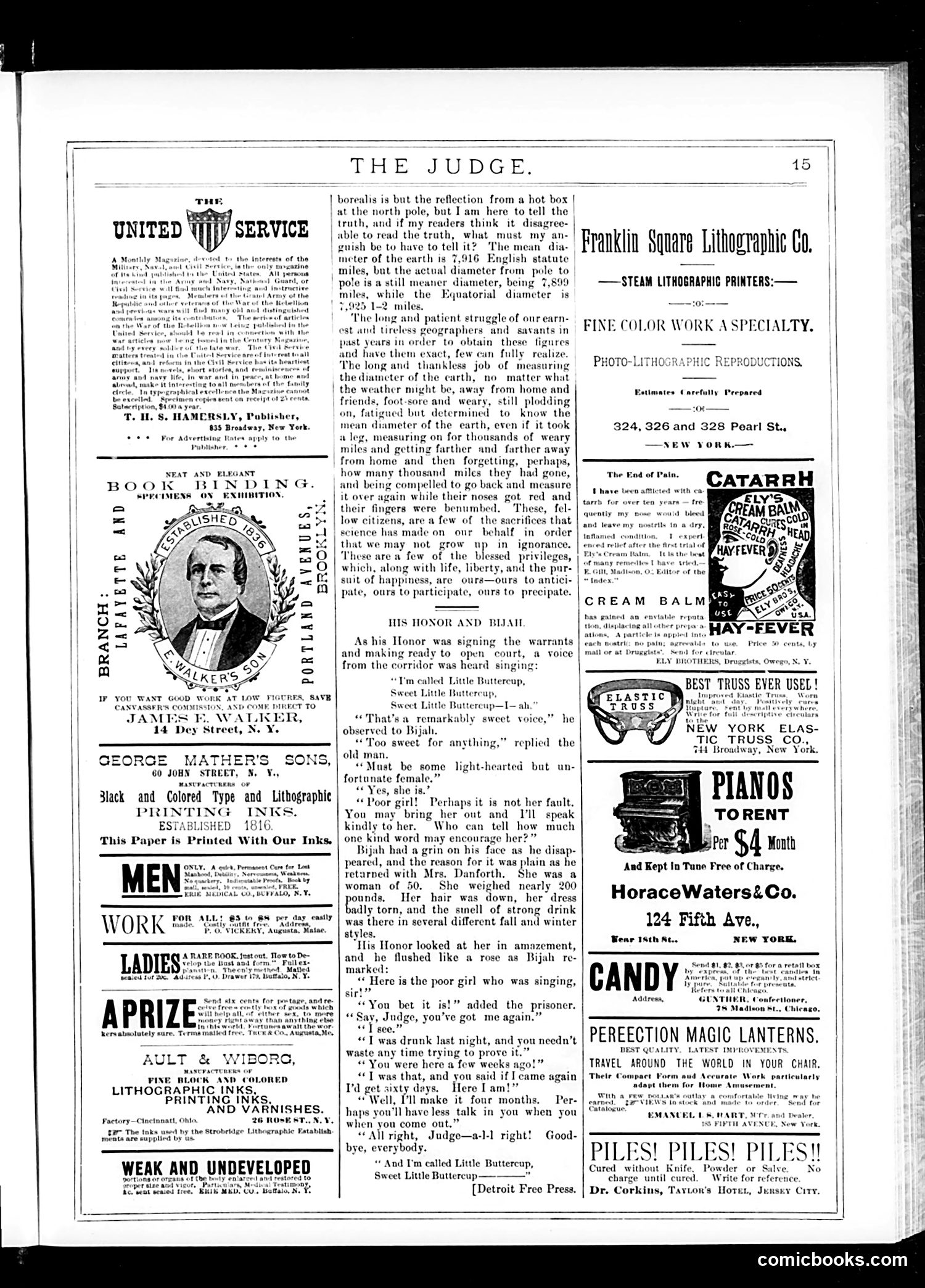
This page is primarily **advertisements** for printing companies and patent medicines, but contains one notable satirical cartoon titled "His Honor and Bijah." The cartoon mocks judicial hypocrisy. A magistrate ("His Honor") prepares to sentencing, declaring his intention to speak "kindly" to a poor singing woman, imagining a young, unfortunate female deserving sympathy. When the prisoner arrives, she's revealed as Mrs. Danforth—a 50-year-old, 200-pound woman with disheveled hair and clothes reeking of alcohol. The judge is humiliated by his own sentimentality. He sentences her to four months (harsher than the promised sixty days) while she departs cheerfully, having manipulated his sanctimonious pity. The satire targets judges who make assumptions based on class and appearance, and who deliver harsh punishment when their romantic expectations are deflated. The cartoon suggests judicial decisions are driven by personal emotion rather than justice.
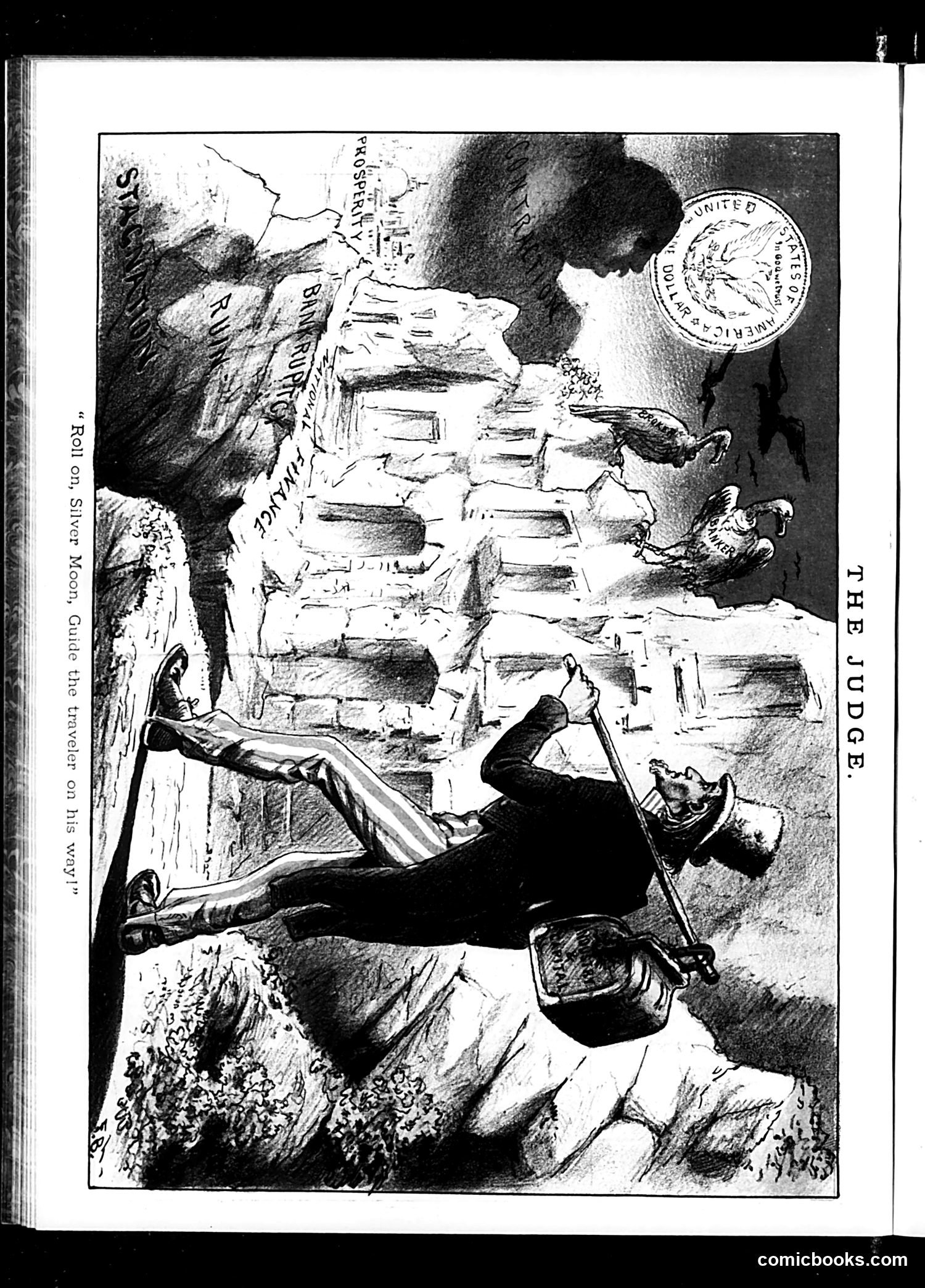
This appears to be a title page or cover from *Judge* magazine featuring a cartoon labeled "THE JUDGE." The image shows a man in formal attire reclining on what appears to be a bench or judicial seat, holding a gavel. He's depicted in a relaxed, somewhat indolent pose. The caption references "Silver Moon" and mentions "Guide the traveler on his way," suggesting celestial or navigational themes. The circular seal at top right is a U.S. government seal. Without clearer identification of the specific figure or dated context, the cartoon likely satirizes judicial authority or a particular judge's character—perhaps criticizing complacency, bias, or self-satisfaction in the legal system. The recumbent pose suggests the judge is inactive or lazy rather than diligent in his duties.