
Judge, 1885-11-21 · page 10 of 16
Judge — November 21, 1885 — page 10: what you’re looking at
What you’re looking at
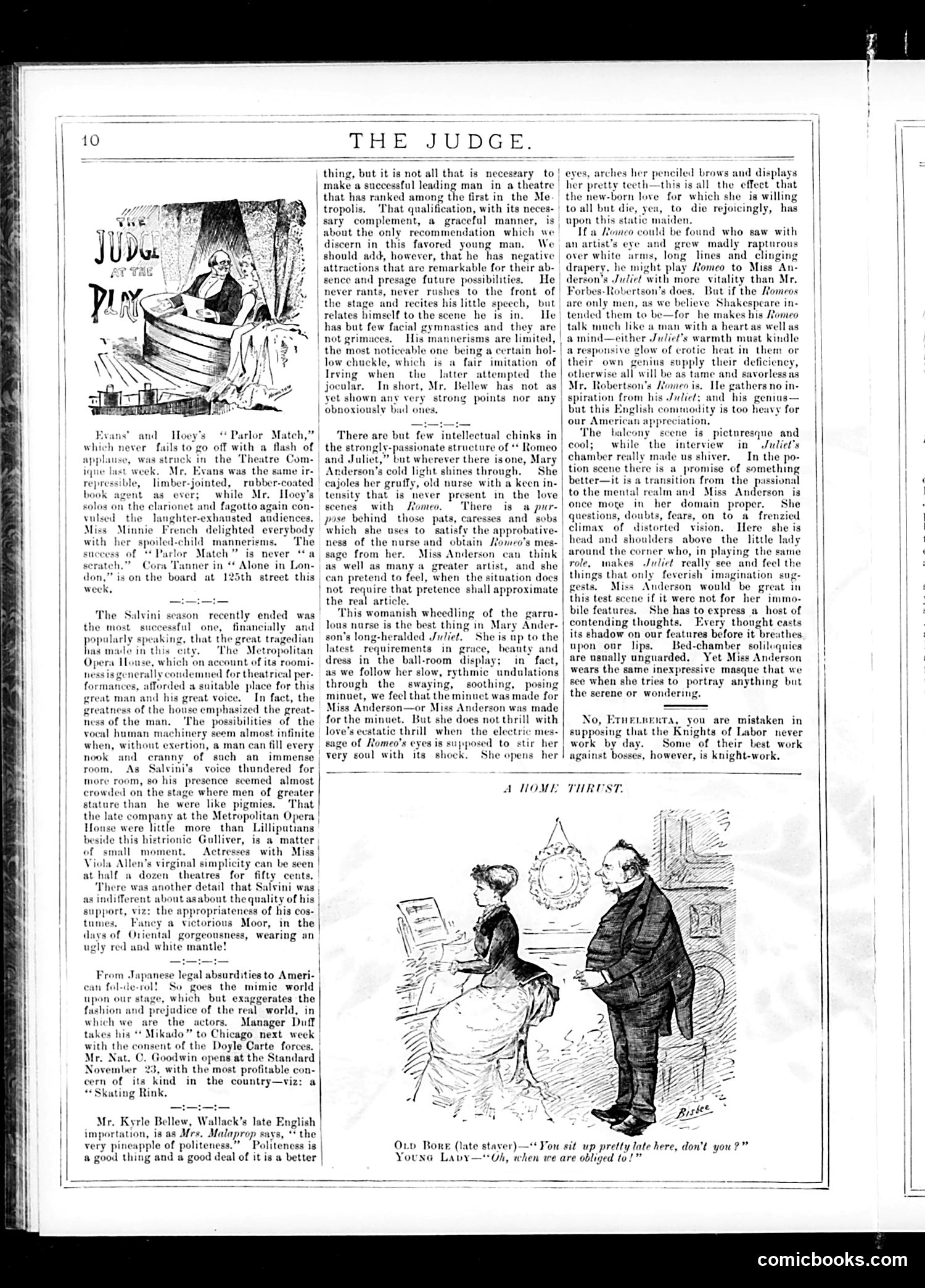
This page contains theatre reviews and criticism typical of Judge's satirical coverage. The main cartoon, titled "A HOME THRUST," depicts two women in Victorian dress—one seated showing another a picture or document, with the caption: "Old Bore (late riser)—'You sit up pretty late here, don't you?' Young Lady—'Oh, when we are obliged to!'" The joke targets social hypocrisy: a man who stays up late himself criticizes a young woman for doing the same, revealing double standards in Victorian morality regarding women's behavior. The text reviews theatrical performances, including praise for Evans and Hoey's "Parlor Match" and Salvini's tragic performances at the Metropolitan Opera House. Critics discuss actors' techniques and stage presence, with particular attention to Mary Anderson's portrayal in "Romeo and Juliet." The reviews emphasize vocal power, physical presence, and emotional restraint as marks of superior acting.
📄 Transcribed text from this page (OCR, searchable)
Machine-transcribed from the original scan — historical spelling and the odd misread are preserved.
‘Parlor Match,” ro off with a flash of ivans’ and Hoey’s nnever fails te applai as struck in the Theatre Com- ique last'week. Mer. Evans was the same ir- repressible, limber-jointed, — rubber-coated book ent ever; while Mr. Hoey’s solos on the clarionet and fagotto again con- vulsed the langhter-exhausted andiences, Miss Minnie French delighted everybody with her spoiled-child mannerism: The suceess of ** Parlor Match” is never “a Cora Tanner in * Alone in Lon- don,” ison the board at 125th street this week. The Salvini season recently ended was the most successful one, financially and popularly speaking, that the great tragedian has made in this city. The Metropolitan Opera House, which on account of its roomi- ness is generally condemned for theatrical per- formances, afforded a suitable place for this 1 his great voice. In fact, the as of the house emphasized the great- of the man. ‘The possibilities of the vocal human machinery seem almost infinite when, without exertion, a man can fill every nook cranny of such an immense room, As Salvini’s voice thundered for more room, so his presence scemed almost crowded on the stage where men of greater stature than he were like pigmies. ‘That the late company at the Metropolitan Opera House were little more than Lilliputians beside this histrionic Gulliver, is a matter small moment, — Actresses with Viola Allen's virginal simplicity at half a dozen T Ivini was as indifferent about asabout the quality of his | support, viz: the appropriateness of his cos- tumes. Fancy a victorious Moor, in the days of Oriental gorgeonsness theatres for fift ents, From | can fol-le-rol! So goes the mimic. world upon our stage, which but exaggerates the fashion and prejadice of the real world, in which we are the actors. Manager Duff takes his ‘* Mikado” to Chicago next week with the consent of the Doyle Carte forces. Mr. Nat. C. Goodwin opens at the Standard ovember 23, with the most profitable con- cern of its kind in the country—viz: a “Skuting Rink. Mr. Kyrle Bellew, Wallack’s late Kogith importation, is as Mrs. Malaprop says," the very pineapple of politeness.” —Politencas i a good thing and a good deal of it is a better Miss | n be seen | : rea | ese legal absurdities to Ameri- thing, but it is not all that is neces make a successful leading man in a theatre that has ranked among the first in the Me tropolis. ‘That qualification, with its nece sary complement, a graceful manner, ut the only recommendation which we ern in this favored young man. We should add, however, that he has negative ions that are remarkable for their ab- sence and presage future possibilities. He | never rants, never rushes to the front of » and recites his little speech, but himself to the scene he is in. He has but few facial gymnastics and they are not grimaces. His mannerisms are limites the mo: le one being a certain hol: low chuckle, which is a fair imitation of Irving when the latter attempted the jocular. In short, Mr. Bellew has not as yet shown any very strong points nor any obnoxiously bad ones, There are but few the strongly-passionate structure of ** Romeo and Juliet,” but wherever there isone, Mary Anderson’s cold light shines through. She s her gruffy, old nurse with a keen in- y that is never present in the love with Romeo. ‘There is a pur- scenes pose behind those pats, caresses and ‘sobs which she uses to satisfy the ness of the nurse and obtain /omeo’s mes- sage from her. Miss Anderson can think well as many a greater artist, and she can pretend to feel, when the situation doe: | not require that pretence shall approxima the real article. This womanish wheedling of the garru- lous nurse is the best thing in Mary Ander- son’s long-heralded Juliet. She is ap to the latest requirements in grace, beauty and dress in the ball-room displ in’ fact, we follow her + tythmic undulations through the swaying, soothing, posing minuet, we feel that the minuet was made for Miss Anderson—or Miss Anderson was made forthe minuet. But she does not thrill with love’s ecstatic thrill when the electric mes- sage of Romeo's eyes is supposed to stir her very soul with its she She opens her pprobative- e A HOME | | Ov Bore (late staver) Youn ary to| intellectual chinks in | eyes, arches her penciled brows and displays Her pretty teeth—this is all the effect. that the new-born love for which she is willing to all but die, yea, to die rejoicingly, has upon this static maiden. Ifa Loneo could be found who saw with an artist's and grew madly rapturous over white arms, long lines and clinging apery. he might play Romeo to Miss An- derson’s Juliet ‘vith more vitality than Mr, For Lertson’s dor But if the Romeos are only men, as we believe Shakespeare in- tended them to be—for he makes his J talk much like a man with a heartas well as a mind—either Ju/iet’s warmth must kindle a responsive glow of erotic heat in them or their own genius supply their deficienc herwise all will be as tame and savorless as Mr. Robertson's Ife gathers no in- spiration from his Juliet; and his genius— but this English commodity is too heavy for our American appreciation. The balcony scene is picturesque and cool; while the interview in Juliet’s chamber really made us shiver. _ In the po- tion scene there is a promise of something better—it is a transition from the passional to the mental realm and Miss ‘Ande rson_ is once more in her domain proper. She questions, doubts, fears, on to a frenzied climax of distorted vision. Here she is head and shoulders above the little lady around the corner who, in playing the same role, makes Juliet really see and fe things that only feverish imagination sug. Miss Anderson would be great in this test if it were not for her immo- bile featu She has to express a host of contending thoughts. Every thought casts its shadow on our features before it breathes upon onr lips. Bed-chamber_solilequies are usually unguarded. Yet Mise Anderson wears the same inexpressive masque that we see when she tries to portray anything but the serene or wondering. ome mmnen is, No, Erne.nenta, you are mistaken in supposing that the Knights of Labor never work by day. Some of their best work against bosses, however, is knight-work. THRUS - You sit up pretty late here, don't you?” Lavy—"Oh, when we are obliged to!” comicbooks.com |