
A complete issue · 16 pages · 1885
Judge — November 7, 1885
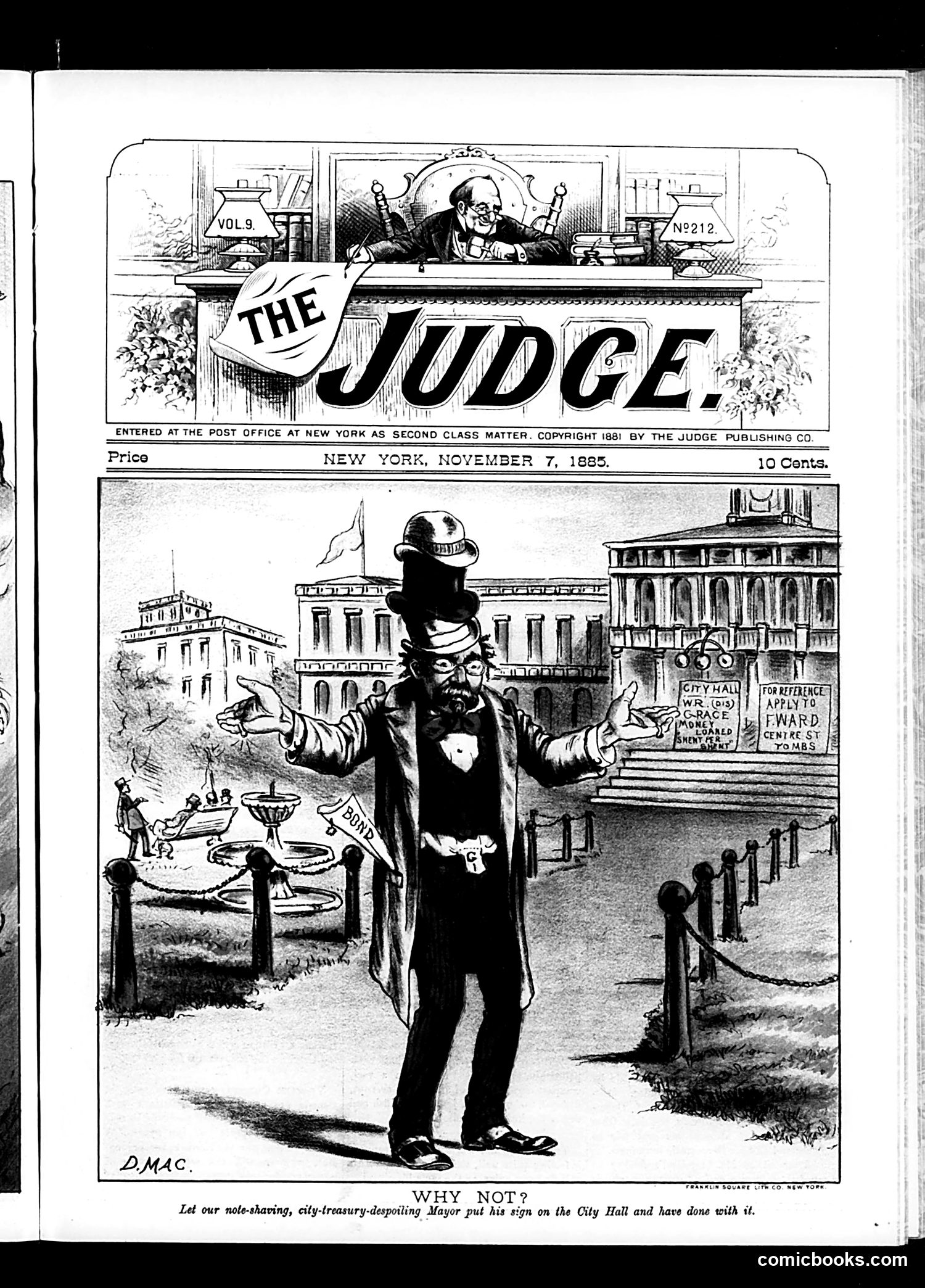
This cartoon satirizes New York City's mayor regarding municipal finances. The central figure—a well-dressed man in top hat with arms spread wide—stands before City Hall. The caption reads: "Let our note-shaving, city-treasury-depositing Mayor put his sign on the City Hall and have done with it." The satire attacks the mayor for allegedly depleting the city treasury through questionable financial practices ("note-shaving"—discounting promissory notes at unfair rates) and improper treasury deposits. The gesture of spreading his arms suggests he's brazenly displaying his control over civic institutions. The "Why Not?" title sardonically proposes the mayor should openly claim ownership of City Hall, implying he already effectively controls it through financial mismanagement. This reflects 1880s concerns about urban political corruption and treasury fraud.
The main cartoon depicts a disheveled man amid scattered papers and documents, illustrating "A PYRAMID OF FRAUD." The accompanying article references a Southern president who held office through fraudulent means, with specific mention of Cleveland and his relationship to Democratic principles. The text criticizes how this president "cut off the evidences to his own complicity" while looting municipal funds—approximately a million dollars—through corrupt officials including a City Comptroller and Marine Bank connections. The satire targets perceived Democratic corruption and hypocrisy: despite claiming reform credentials, Democratic leadership allegedly enriched themselves through fraud and embezzlement. The cartoon visually represents the chaotic, layered deceitfulness the text describes, with the "pyramid" suggesting systematic, escalating corruption from top officials down.
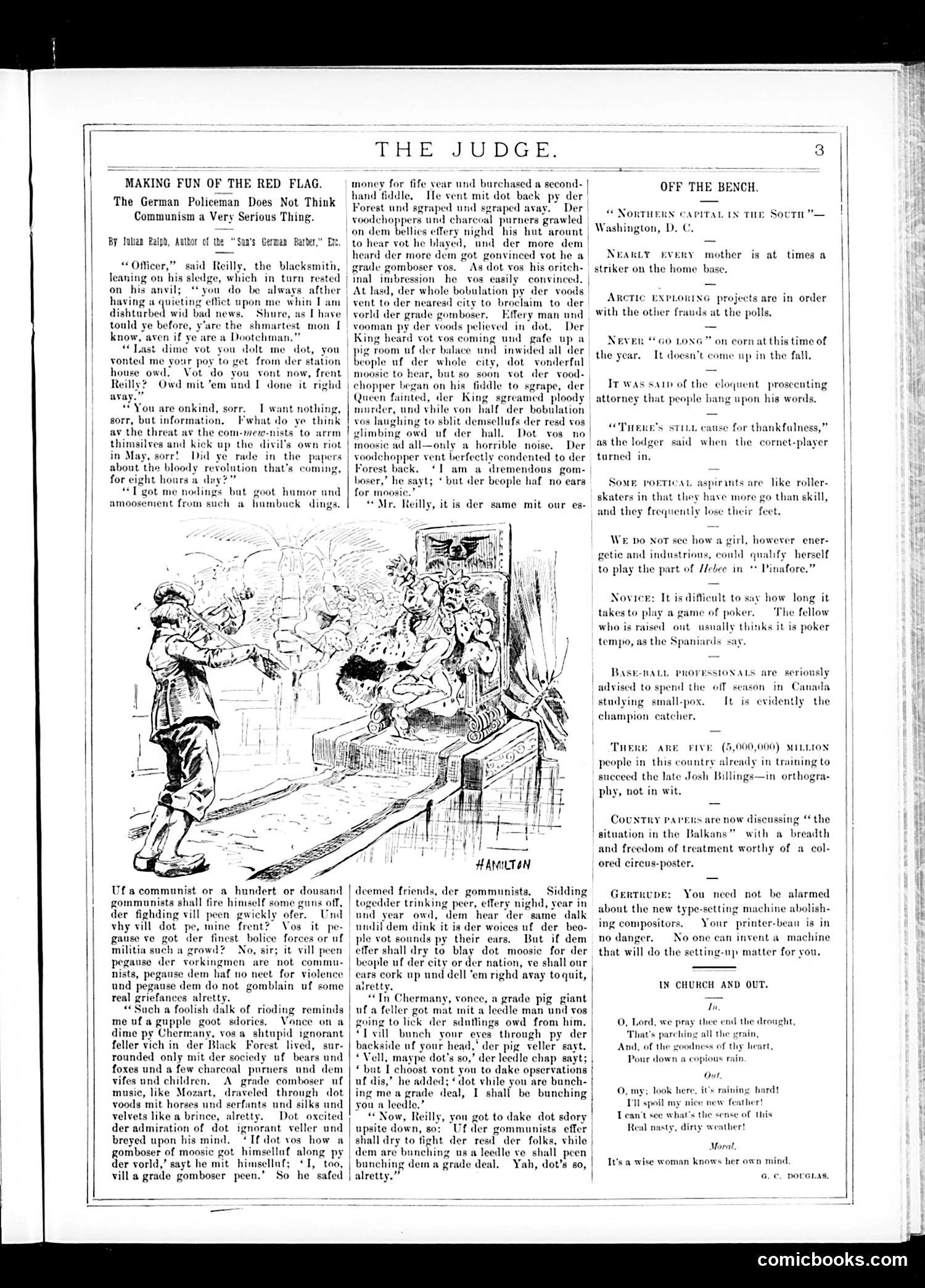
This page satirizes German communist threats through a dialogue between an Irish blacksmith (Reilly) and a German policeman. The policeman dismisses communist revolution as harmless, arguing that German workers lack genuine grievances—they merely echo revolutionary talk in taverns without real conviction. The humor relies on the policeman's thick German accent (rendered phonetically) and a lengthy parable: a forest hermit learns fiddle badly, gains a delusional reputation through repeated exposure, then horrifies the king with his actual performance. The moral: communists are like this charlatan—they've convinced themselves and each other of their importance, but their actual "music" (revolution) will instantly fail when tested. The cartoon mocks both communist pretensions and German complacency about the rising threat. It reflects pre-WWI anxieties about labor unrest while suggesting the established order will easily suppress any uprising.
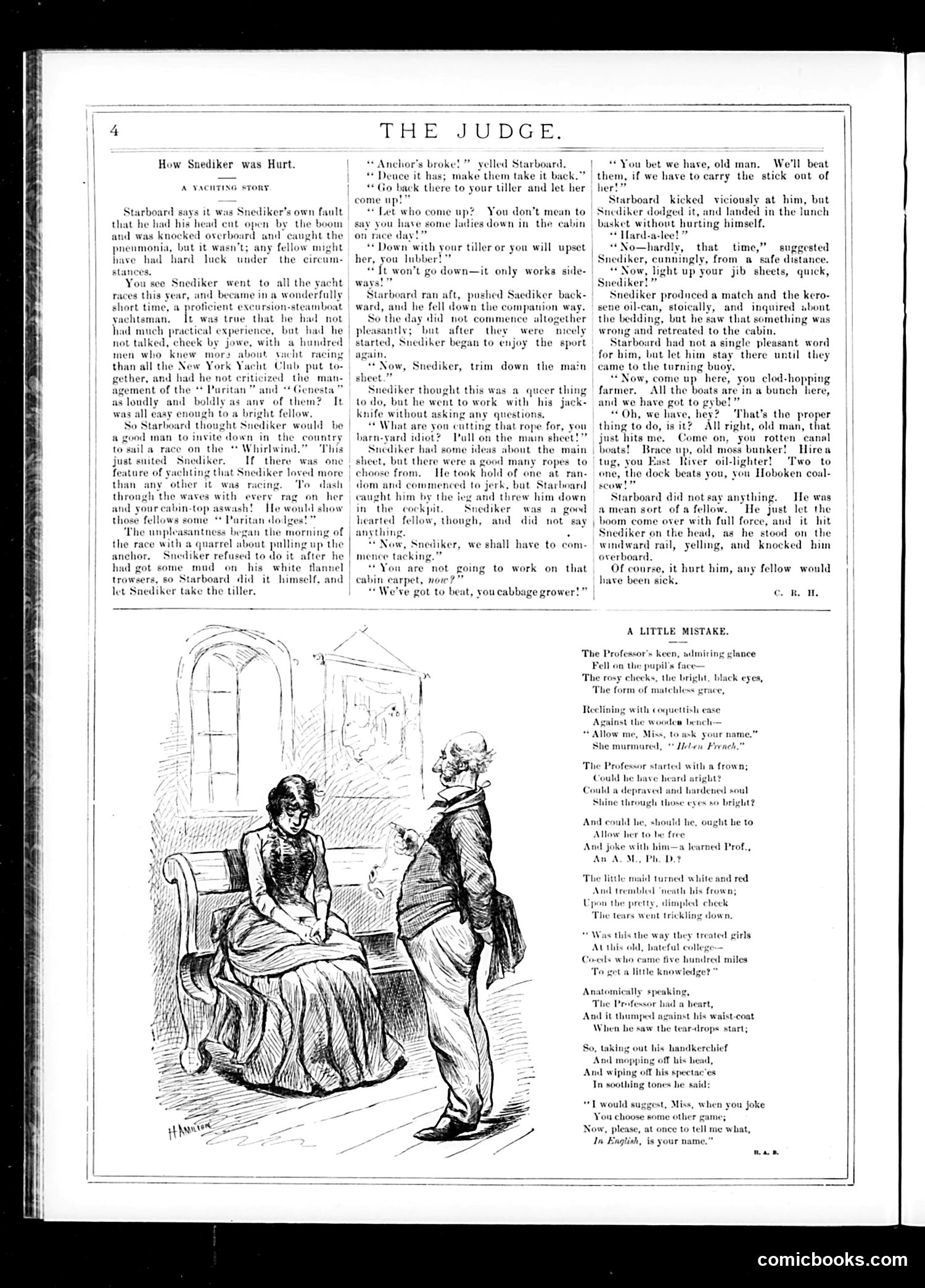
This page contains two separate pieces from *Judge* magazine: **"How Snediker Was Hurt"** is a humorous yachting story about an arrogant novice sailor who talks constantly about racing but lacks real experience. Snediker joins an experienced yachtsman named Starboard on a competitive race. Through a series of comedic mishaps—Snediker misunderstands sailing orders, operates equipment incorrectly, and gets verbally abused by Starboard—he eventually gets knocked overboard by the boom. The satire targets social climbers who gain superficial knowledge through gossip rather than genuine expertise, then bungle practical tasks while maintaining false confidence. The accompanying illustration shows the confrontation between the two men on deck. **"A Little Mistake"** is a brief poem about a professor making an awkward romantic advance toward a female student, misinterpreting her polite behavior as encouragement. The humor lies in the professor's misreading of social cues and the student's embarrassment.
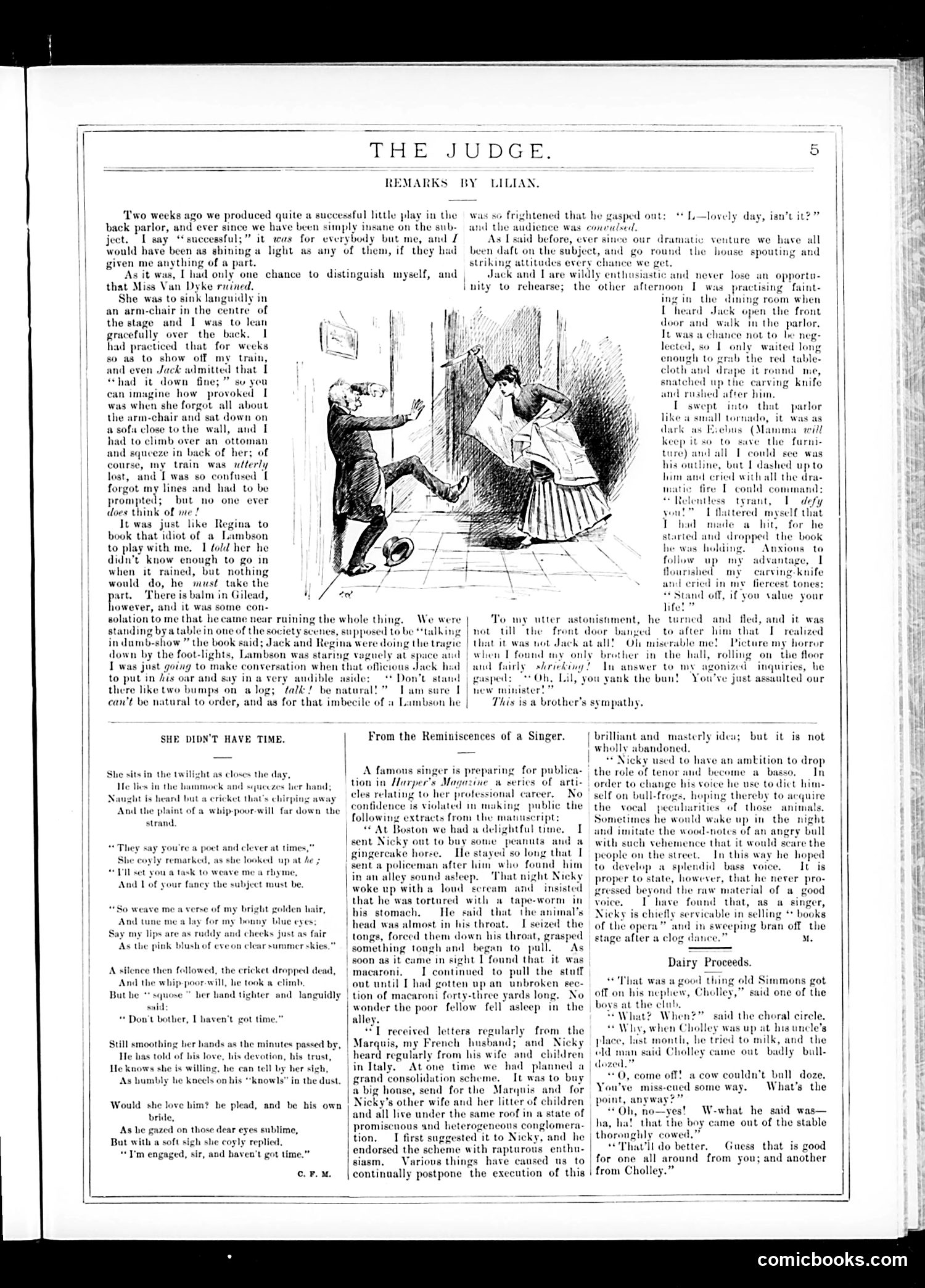
This page from **Judge** magazine contains three distinct pieces of social satire: 1. **"Remarks by Lilian"** (main article with illustration): A theatrical actress complains about being upstaged during an amateur play production. She resents missing her chance to show off her trained stage skills—particularly her dress train—because Miss Van Dyke unexpectedly sat on a sofa instead of an armchair, forcing the narrator into an awkward position. The satire mocks amateur theatrical vanity and petty competition among society women performing in "parlor plays" (popular Victorian-era home entertainment). 2. **"She Didn't Have Time"** (poem): A sentimental poem about a busy woman with no leisure time, even for romance. 3. **"From the Reminiscences of a Singer"**: Anecdotal humor about a famous opera singer's domestic life and travels, including a comedic story about sending her husband ("Nicky") to buy peanuts. The overall theme targets upper-class leisure activities and theatrical pretension, typical of Judge's satirical focus on American society life.
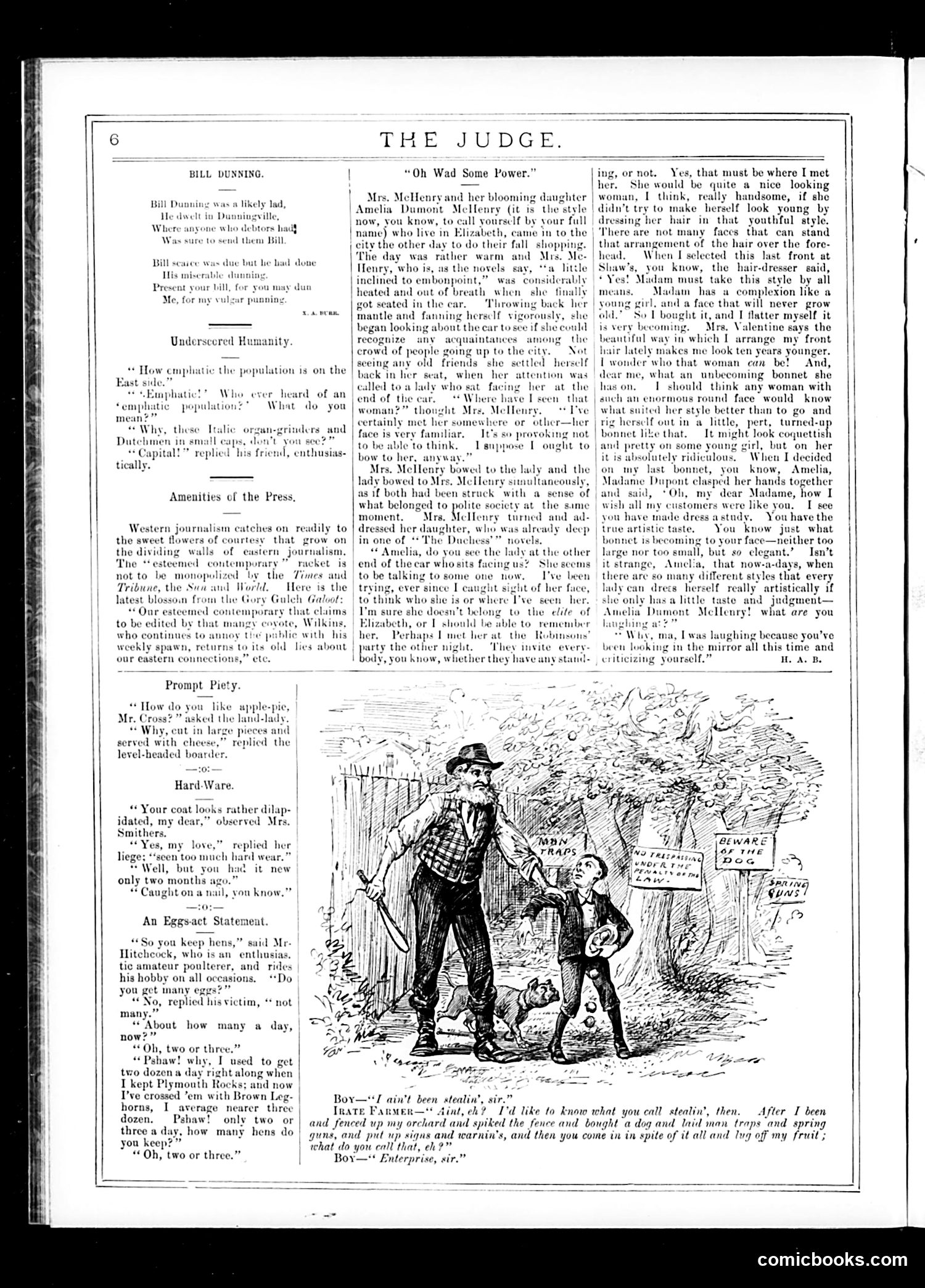
This page satirizes social climbing and snobbery among the urban middle class. The main cartoon follows Mrs. McHenry, a woman from Elizabeth, who becomes anxious when she spots an unfamiliar woman on a streetcar wearing an elaborate bonnet and hairstyle. Convinced the woman must be someone important she should recognize, Mrs. McHenry grows increasingly flustered trying to place her socially. The joke reveals Mrs. McHenry's insecurity: she spends the entire encounter obsessing over the stranger's appearance and social status, only to discover—through the woman's hairdresser monologue at cartoon's end—that the "mysterious" woman is simply a client discussing her new hairstyle. The satire mocks how urban Americans of the era judged worth by appearance and social connections, and the anxiety this created among aspirational classes trying to maintain proper status. The title references Robert Burns's poem about wishing for social insight.
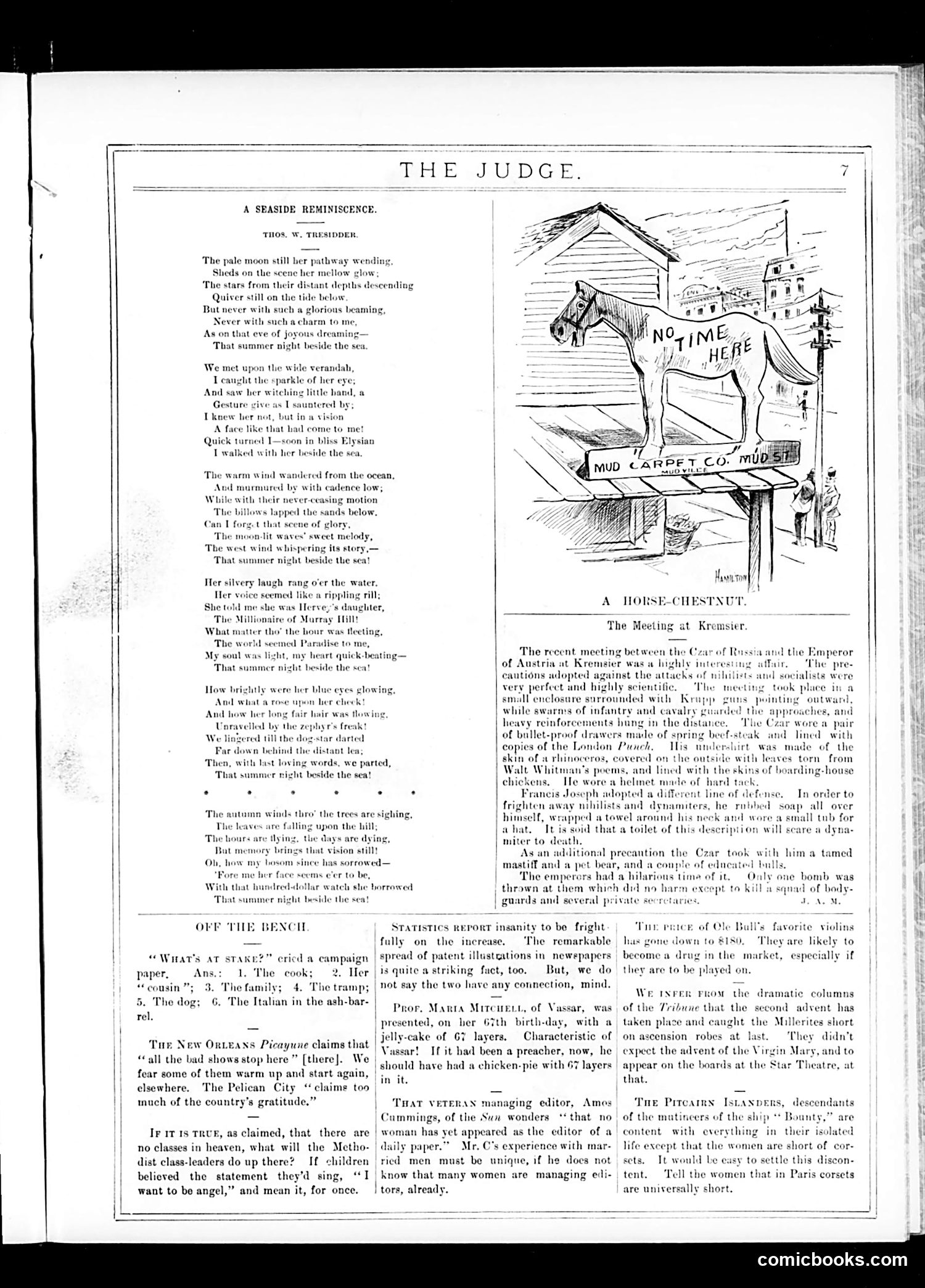
This cartoon satirizes the extravagant security measures adopted by European monarchs against anarchist threats. The image depicts a horse labeled "NO TIME HERE" standing on a platform marked "MUD CARPET CO.," representing the absurd lengths to which leaders went for protection. The accompanying text mocks the meeting between Russia's Czar and Austria's Emperor at Kremsier, describing their ridiculous defensive preparations: bullet-proof drawers made of spring beef-steak and copies of the *London Punch*, rhinoceros skin armor, and even a tamed mastiff and educated bull bear as bodyguards. The satire culminates in the claim that a toilet designed to "scare a dynamiter to death" was employed. The joke targets both the genuine threat of anarchist violence in the 1870s-80s and the paranoid, comically excessive responses of autocratic rulers. The cartoon ridicules monarchy's defensive desperation while acknowledging real political instability.
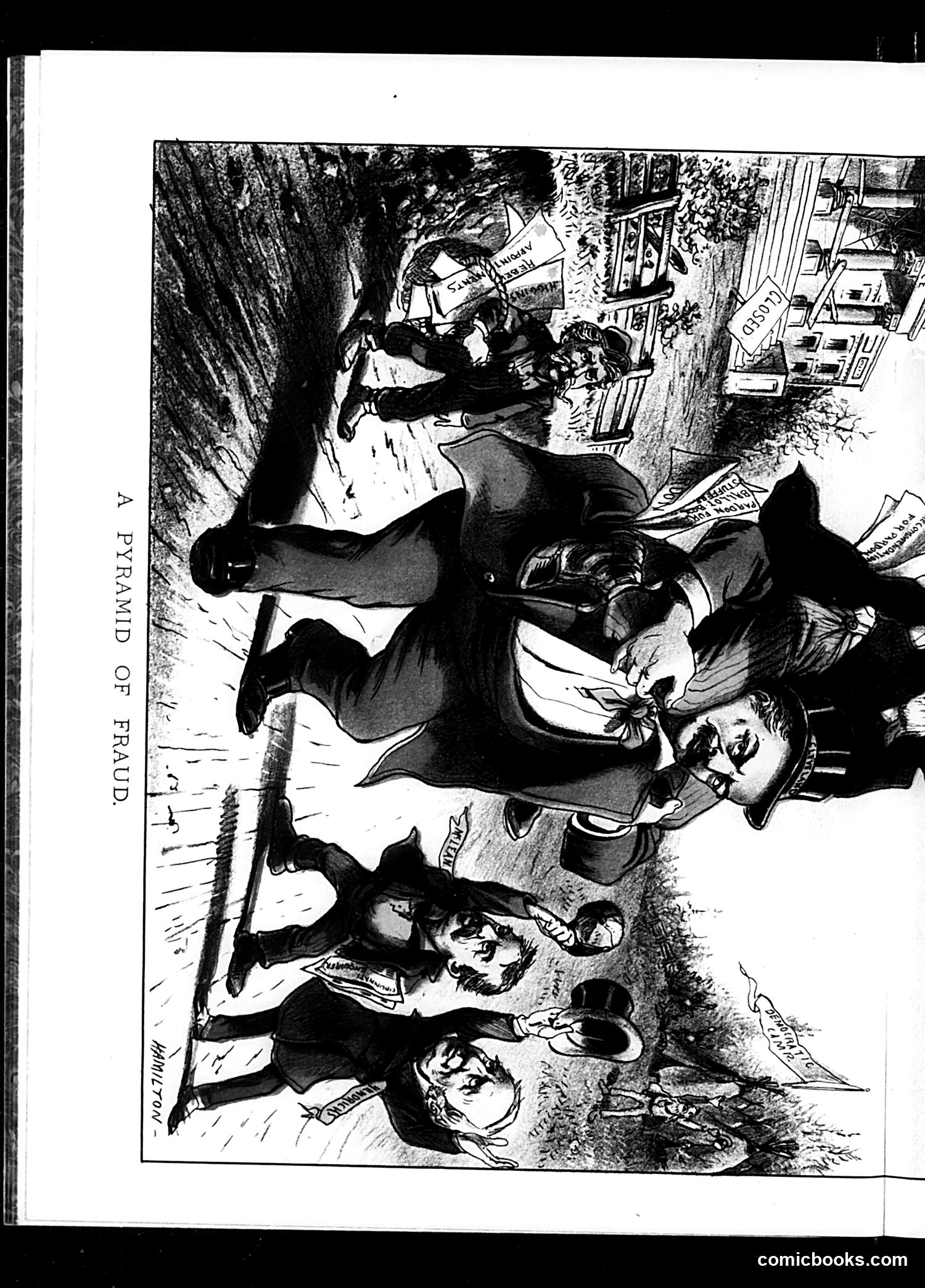
This Judge magazine cartoon depicts a pyramid scheme or fraudulent financial structure. The image shows figures stacked vertically, with the caption "A PYRAMID OF FRAUD" identifying the satire's subject. The cartoon likely critiques a specific financial scandal or con artist operating during Judge's publication period. The pyramid structure suggests how such schemes work: participants at the bottom support those above through fraudulent promises, with money flowing upward to those orchestrating the scheme. The style and composition indicate this is political/economic satire targeting public deception. Without clearer identification of specific figures or dates visible in the image, I cannot specify which particular fraud or swindler this references, though such pyramiding schemes were recurring targets of American satirical magazines during various economic periods.
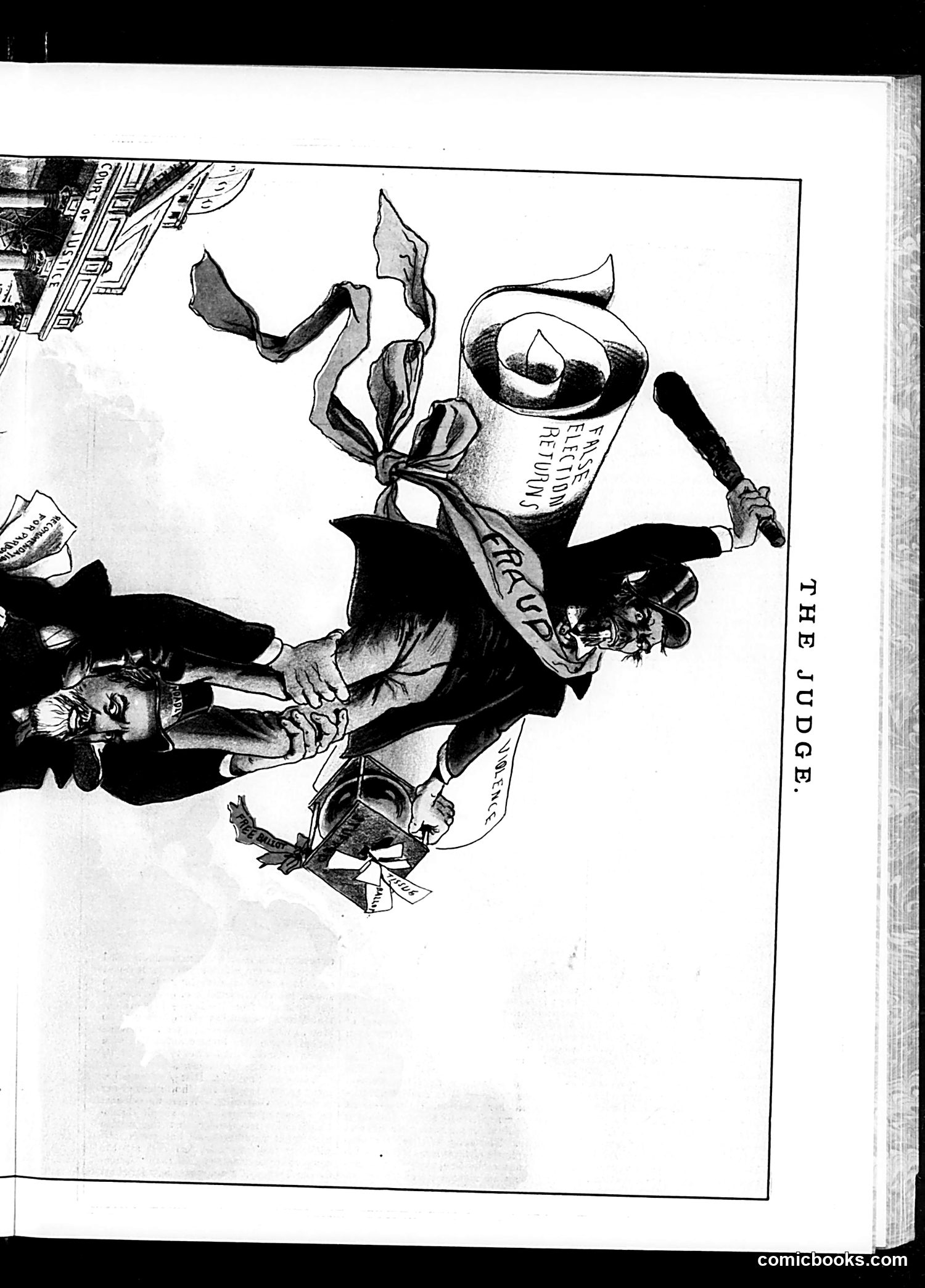
This political cartoon depicts a figure labeled "THE JUDGE" wielding a gavel and appearing to strike down or condemn something. The figure holds what appears to be a large ceremonial mallet or hammer and is dressed formally in dark clothing. Based on the title and imagery, this likely satirizes judicial authority or a specific court decision. The elaborate dress and theatrical pose suggest mockery of judicial pomposity or overreach. However, without a visible date or additional context on this page, I cannot definitively identify which specific legal case or judge is being targeted, or what particular decision prompted this satire. The allegorical style was common in *Judge* magazine's political commentary.
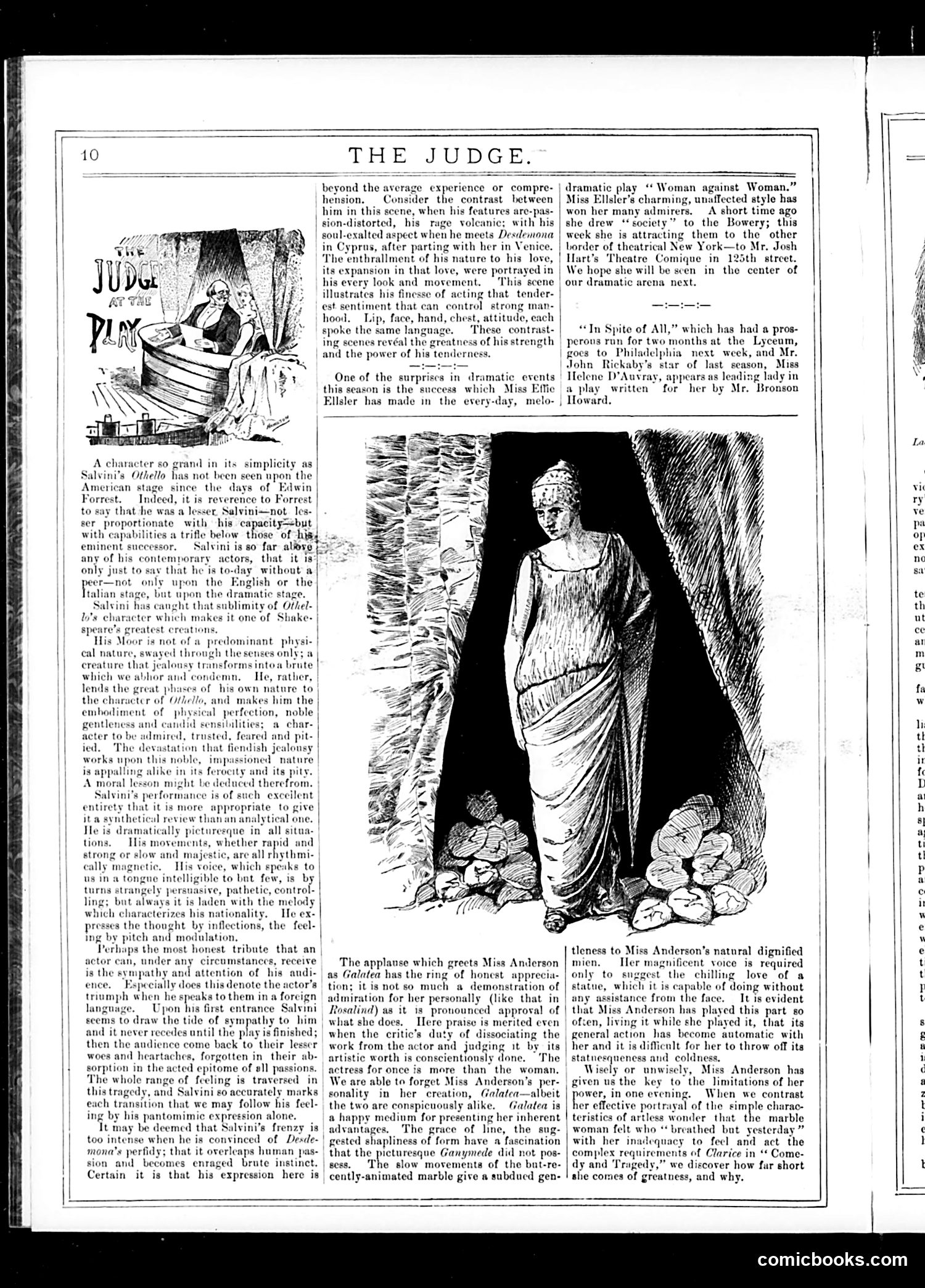
This page reviews two theatrical performances. The main illustration shows **Tommaso Salvini**, a celebrated Italian actor, performing in Shakespeare's *Othello*. The critic lavishes praise on Salvini's portrayal, emphasizing his physical grandeur, emotional range, and ability to captivate audiences despite performing in Italian—a foreign language to American viewers. The review contrasts Salvini favorably with contemporary actors, celebrating his nuanced performance: his tender portrayal of Othello in love versus his volcanic rage upon learning of Desdemona's alleged infidelity. The text also briefly mentions **Miss Effie Ellsler**'s success in the melodrama *Galatea*, noting that her performance transcends mere personal charm—the actress becomes the character rather than overshadowing it with her personality. Both reviews exemplify 19th-century theater criticism's focus on an actor's physical presence, vocal technique, and emotional authenticity as measures of greatness.
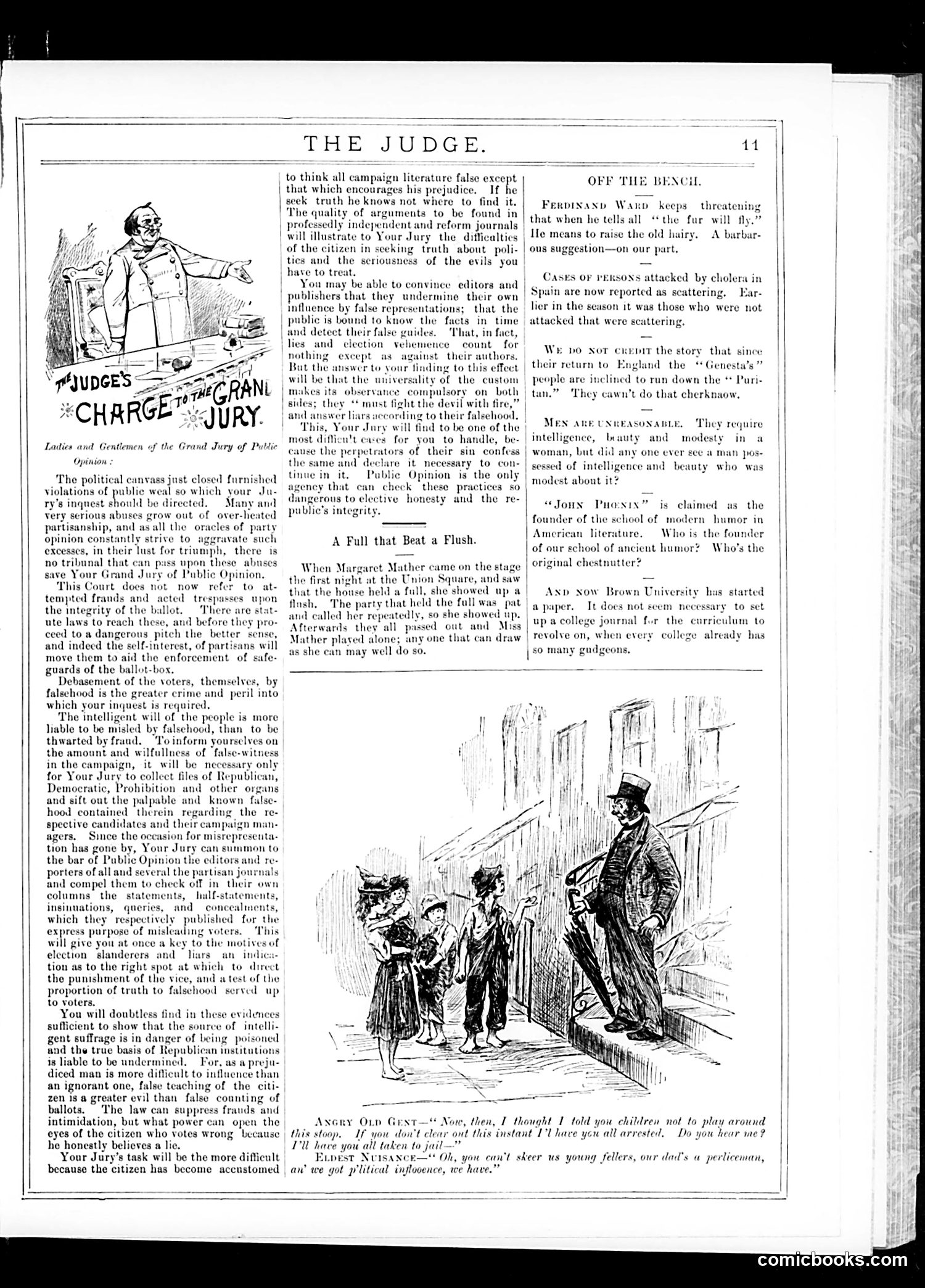
This page combines a serious judicial address with satirical commentary on 1890s American politics. **Main Content:** The left side features "The Judge's Charge to the Grand Jury"—a formal address about electoral fraud and campaign dishonesty. The judge warns jurors that political falsehoods are widespread across partisan newspapers (Republican, Democratic, Prohibition organs), and that voters face systematic misinformation. He urges the jury to investigate campaign literature for lies. **The Cartoons:** Two illustrations accompany this. The top shows a figure addressing jurors. The bottom depicts an "Angry Old Gent" confronting children playing in a street, threatening arrest if they don't leave—likely satirizing overreactive authority or busybodies. **Satire:** The page satirizes the hypocrisy of political campaigns where "fighting the devil with fire" (falsehood with falsehood) has become normalized. It mocks newspapers' shameless partisan bias and suggests that ordinary citizens cannot discern truth from propaganda—a persistent problem in democratic elections. The tone is reform-minded, criticizing both parties' corrupt practices.
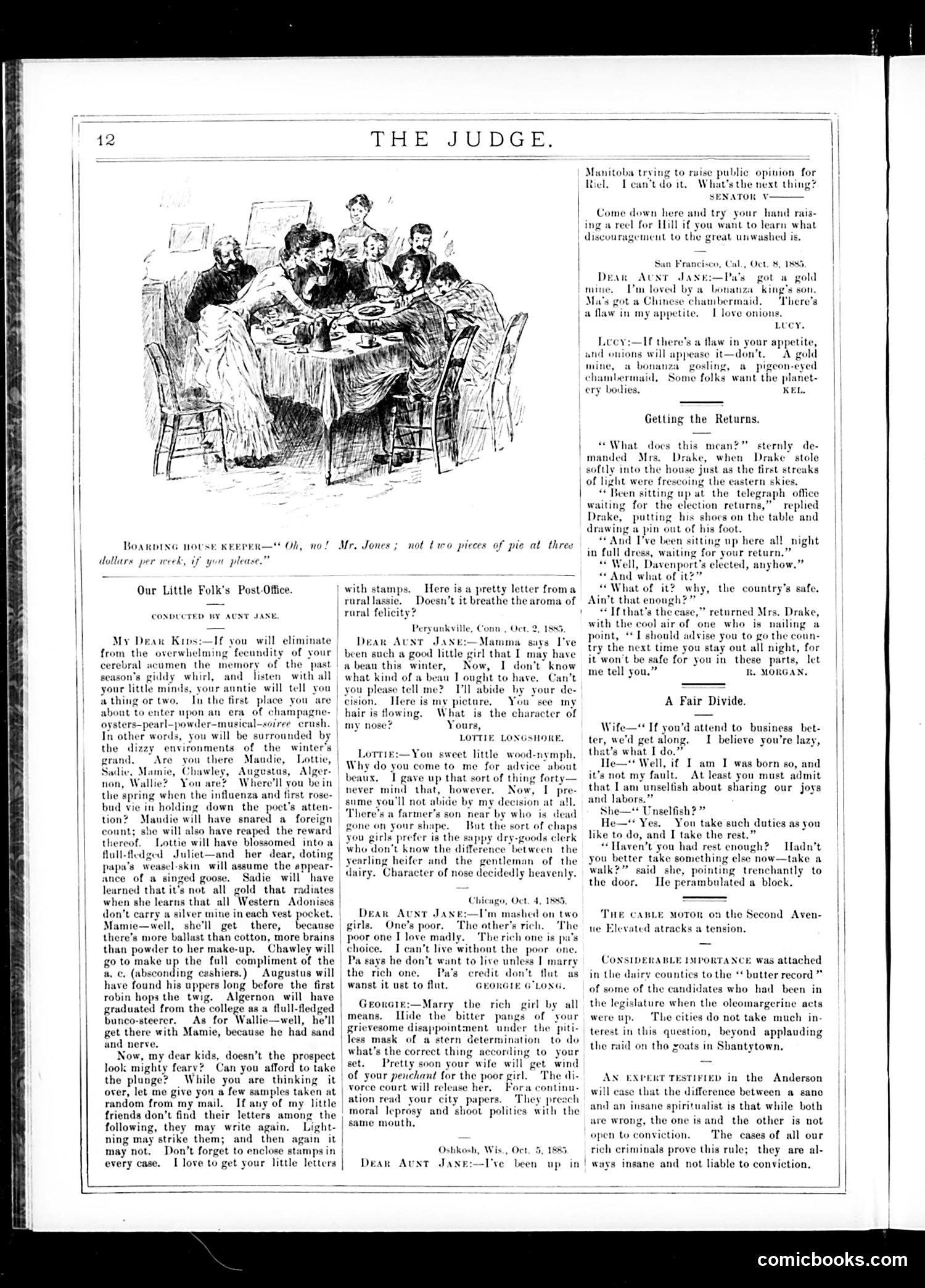
This page combines a satirical cartoon with an advice column ("Our Little Folk's Post-Office" by Aunt Jane), both mocking upper-class social pretensions of the Gilded Age. **The Cartoon:** Shows a boarding house keeper complaining about wages to residents at dinner—a scene of domestic discord among the genteel classes. **The Advice Column:** Purports to guide young people through the "champagne-oysters" social season. Aunt Jane's responses are deliberately cynical, treating marriage as mercenary calculation. She advises one writer to marry a rich girl while pursuing a poor lover, predicting inevitable divorce. Another column mocks provincial aspirations (a farmer's son suitor described with "nose decidedly heavily"). **The Satire:** Judge ridicules both the pretensions of wealthy youth seeking status through advantageous marriages and the hypocrisy of their "moral" society. The column's flippant tone about divorce and infidelity exposes the shallow materialism beneath respectable appearances. Names like "Chawley" and "Algernon" parody affected society speech. The satire targets Gilded Age excess and the era's cynical approach to marriage as financial transaction.
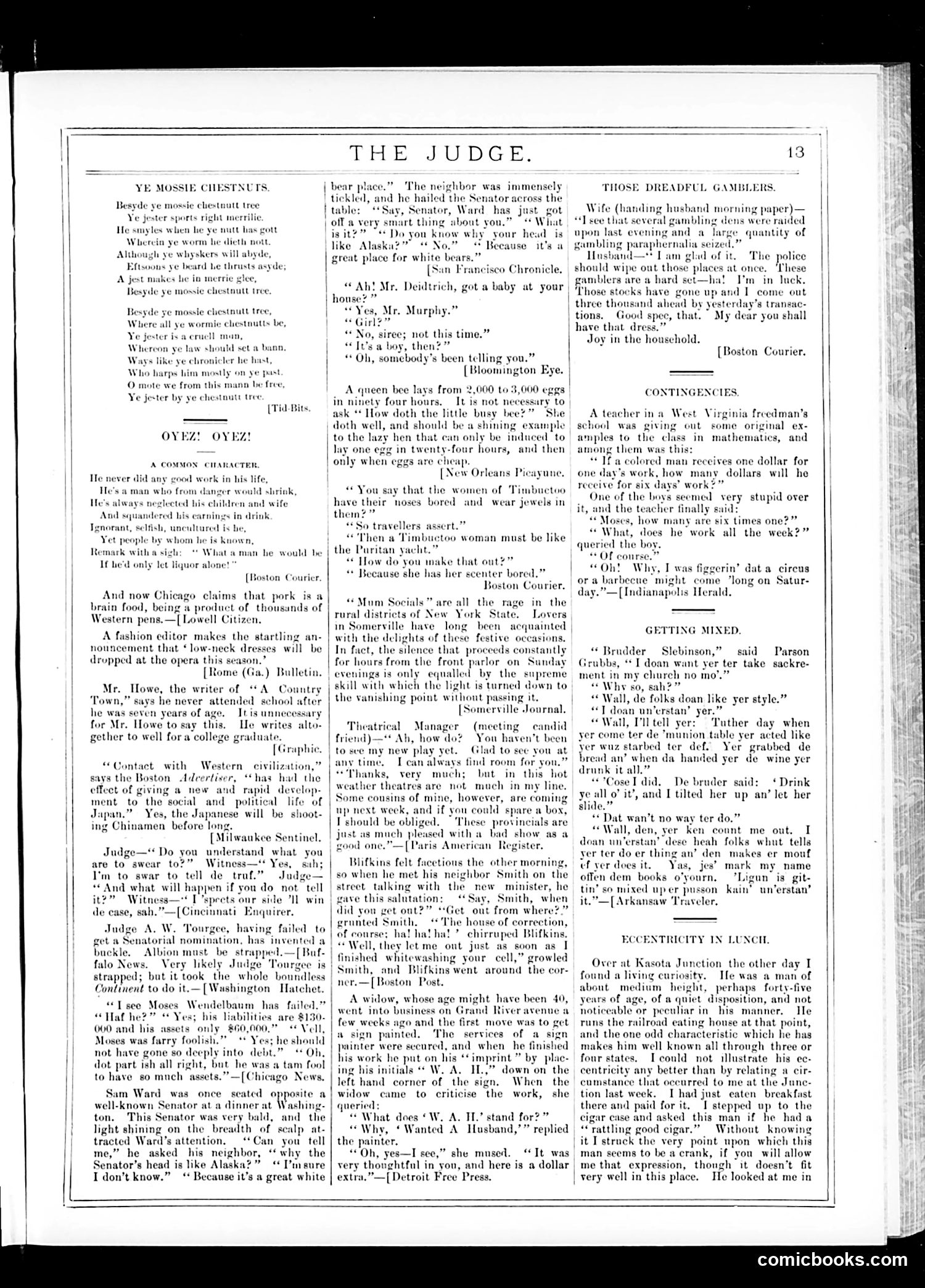
This page from *Judge* magazine (a 19th-century American satirical publication) contains multiple short humorous pieces rather than a single cartoon. **Key content includes:** - **"Ye Mossie Chestnuts"**: A mock-archaic poem mocking overused, tired jokes ("chestnuts" was period slang for stale jokes) - **Various brief anecdotes** satirizing contemporary figures and ideas: - A "common character" sketch about a lazy, worthless man society tolerates - Chicago's dubious claim about pork being "brain food" - Fashion editor pronouncements about low-neck dresses - Judge A.W. Tourgee's failed senatorial bid (appearing to mock his subsequent patent for a buckle) - A bald Senator joke (playing on Alaska as a "great white place") **The satire targets:** - Worn-out comedic tropes - Quack food science claims - Fashion absurdities - Failed politicians' comedowns - Hypocrisy and social pretension The page exemplifies *Judge*'s style: quick-hit social commentary and gentle ridicule of American foibles rather than sharp political attack.
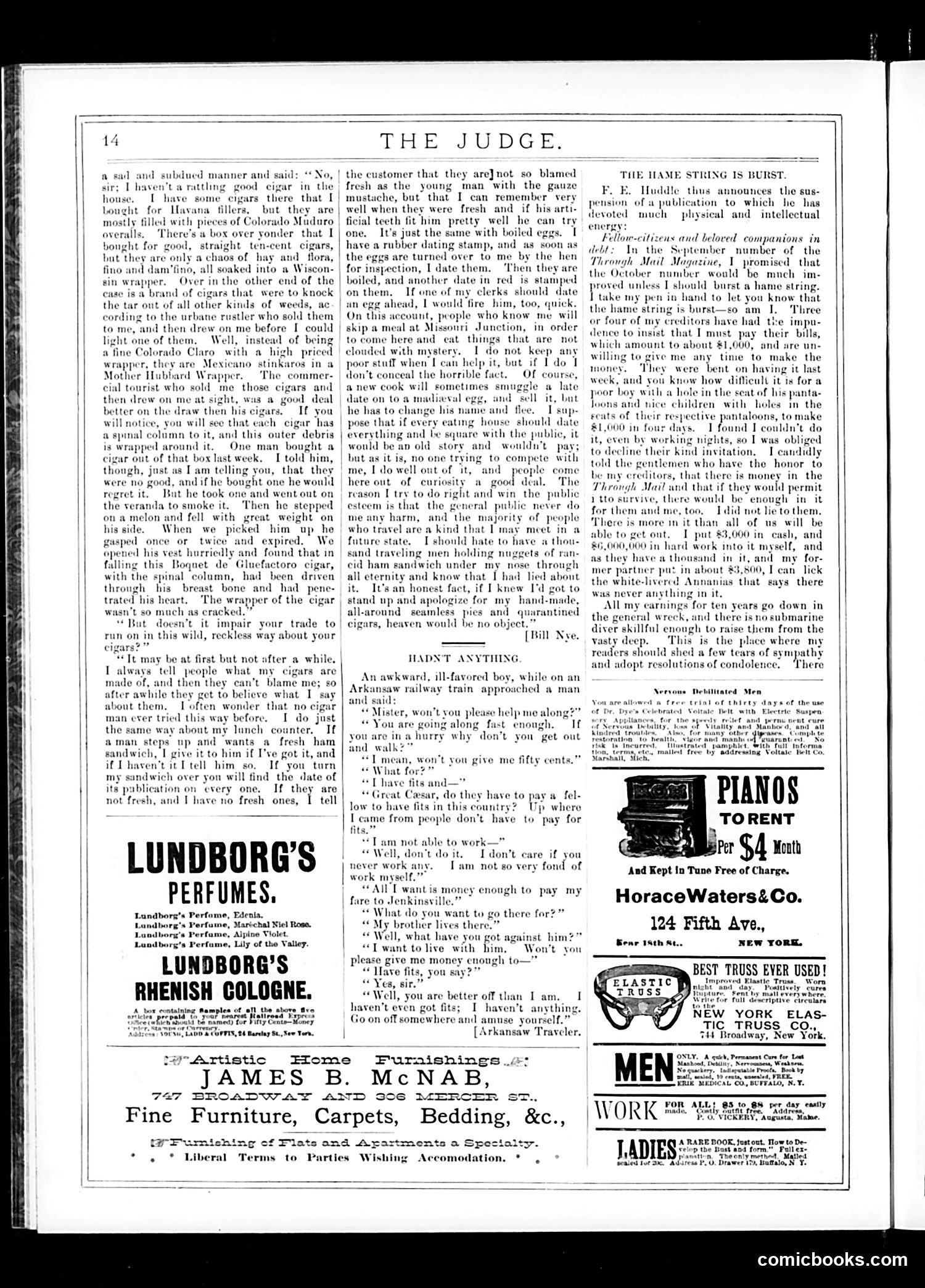
This page from *Judge* magazine contains primarily **advertising and serialized fiction** rather than political cartoons. The main content is a continuing story titled "The Hame String is Burst," a humorous narrative about a businessman's financial troubles and creditor problems. The story's narrator discusses his cigar inventory and dating system for food freshness—satirizing both commercial practices and personal financial mismanagement. The phrase "hame string is burst" (a reference to a horse's harness breaking) serves as a metaphor for the protagonist's financial collapse. The advertisements below include pianos for rent, furniture from James B. McNab, and medical devices (the "Elastic Truss"), typical of early 20th-century periodical marketing. **No clear political satire or caricature is evident on this visible page**—it appears to be a humor/lifestyle magazine section focused on commercial narrative rather than partisan commentary.
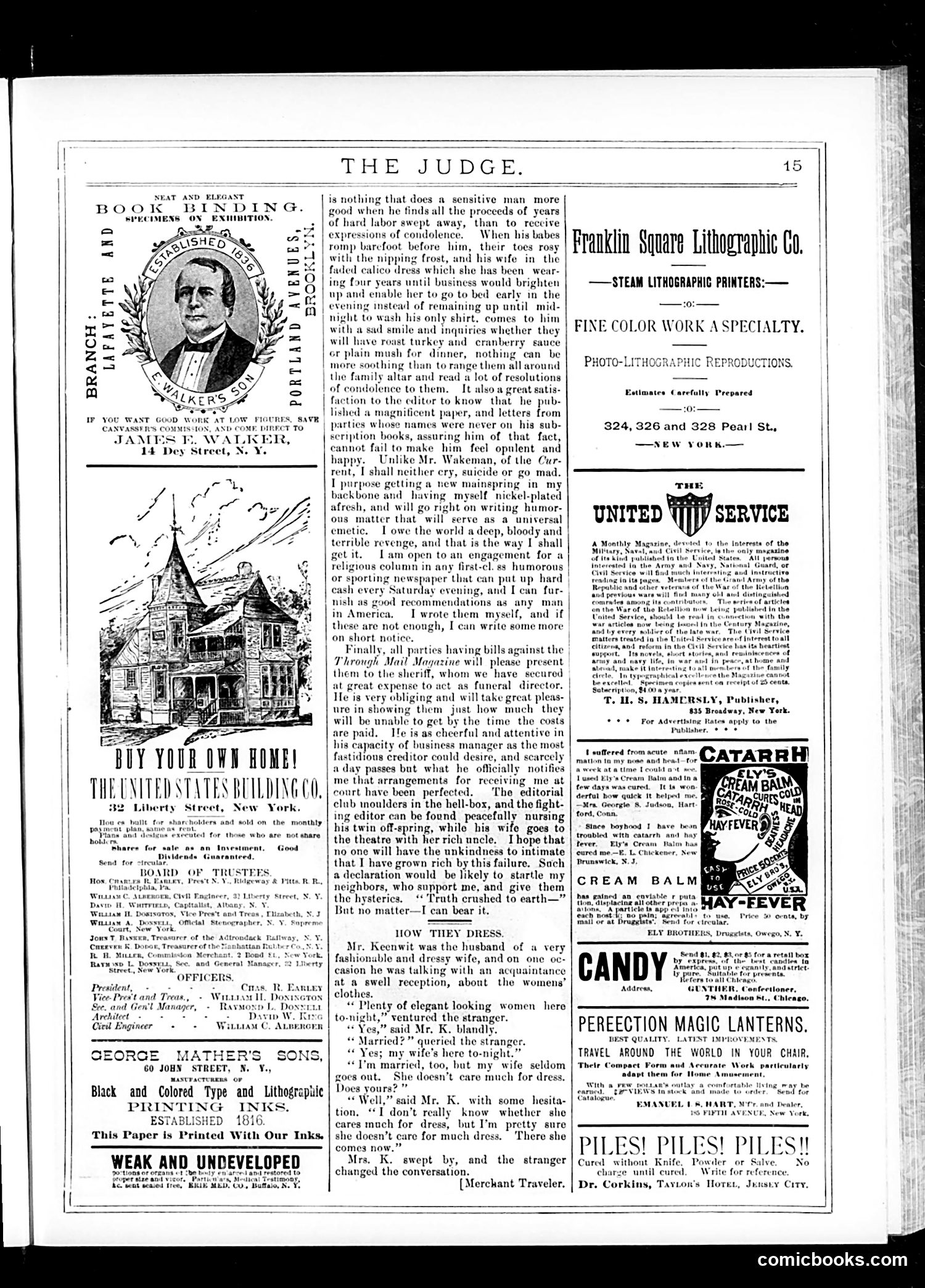
This page is primarily **advertisements and filler content** with one satirical piece. The main article, "How They Dress," is a brief joke about a husband (Mr. Keenwit) whose wife attends a fancy reception in minimal clothing—a double entendre on "not caring for dress" (meaning disinterest in clothing vs. literally wearing little). The humor relies on Victorian-era proprieties around women's fashion and modesty. The lengthy editorial text above discusses financial hardship and loss, apparently from Judge magazine's editor facing business difficulties. The tone is darkly comedic—describing poverty with sardonic detachment ("roast turkey and cranberry sauce or plain mush for dinner") while sarcastically thanking condolence letters. The page is heavily dominated by **period advertisements** for lithography services, building companies, and patent medicines (Catarrh Cream Balm, hay-fever remedies, magic lanterns), typical of 1880s-90s magazine filler.
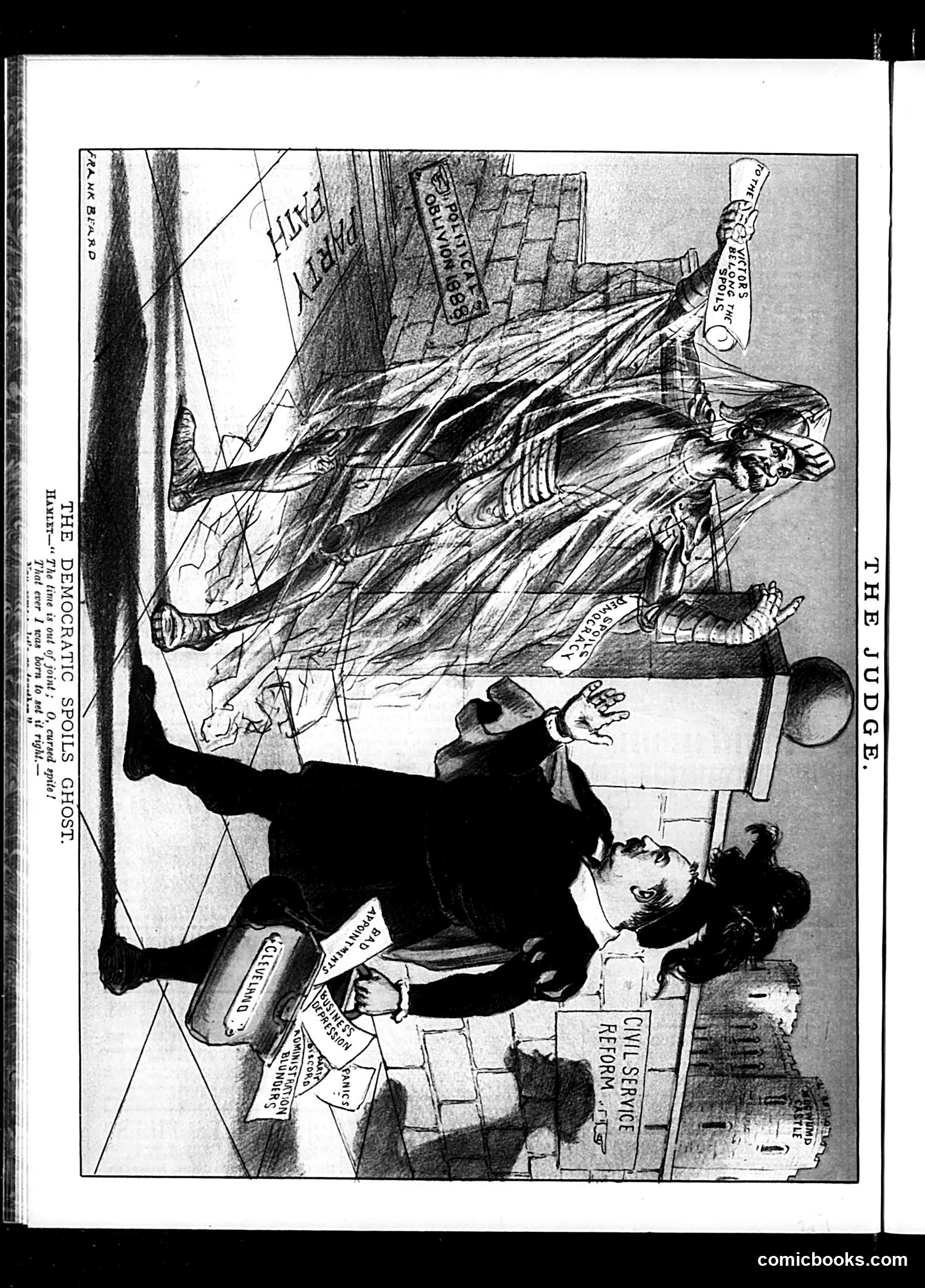
This political cartoon satirizes corruption in government through a Shakespearean reference. A judge figure sits at a desk labeled "CHILD SERVICE DEPARTMENT" while confronted by a ghostly apparition—"the spoils ghost"—representing the corrupting influence of political patronage and bribery. The ghost carries various labels suggesting corrupt practices: kickbacks, bribes, and improper appointments. The cartoon critiques how "spoils system" politics (awarding government jobs as political favors rather than merit) infiltrates even child welfare services. The Shakespearean quote ("cursed spite / ...to set it right") invokes Hamlet's moral dilemma, suggesting the judge recognizes corruption but feels powerless to stop it. This appears to attack Progressive Era reformers' target: how patronage networks compromised public institutions meant to protect vulnerable populations.