
Judge, 1885-11-07 · page 10 of 16
Judge — November 7, 1885 — page 10: what you’re looking at
What you’re looking at
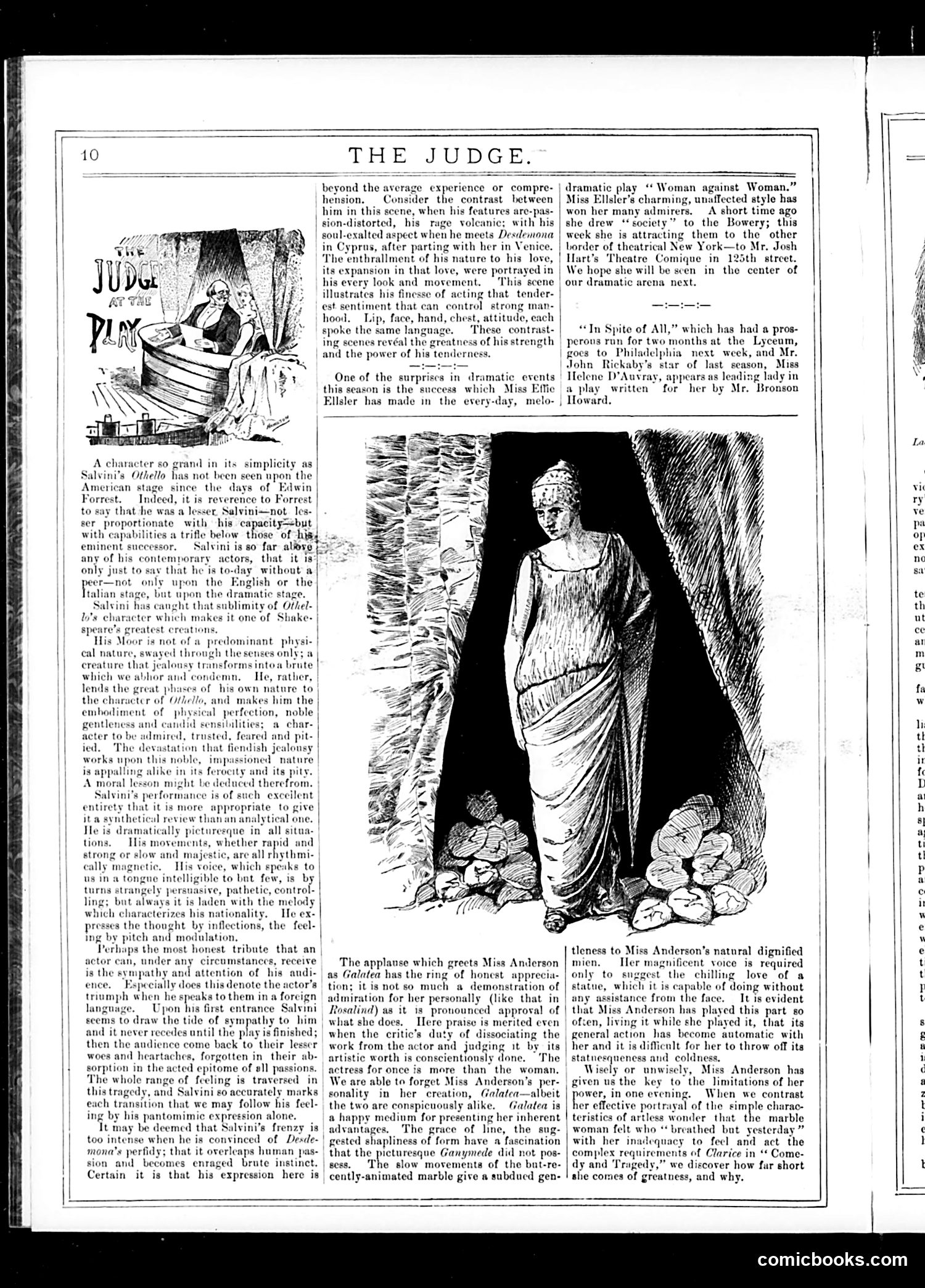
This page reviews two theatrical performances. The main illustration shows **Tommaso Salvini**, a celebrated Italian actor, performing in Shakespeare's *Othello*. The critic lavishes praise on Salvini's portrayal, emphasizing his physical grandeur, emotional range, and ability to captivate audiences despite performing in Italian—a foreign language to American viewers. The review contrasts Salvini favorably with contemporary actors, celebrating his nuanced performance: his tender portrayal of Othello in love versus his volcanic rage upon learning of Desdemona's alleged infidelity. The text also briefly mentions **Miss Effie Ellsler**'s success in the melodrama *Galatea*, noting that her performance transcends mere personal charm—the actress becomes the character rather than overshadowing it with her personality. Both reviews exemplify 19th-century theater criticism's focus on an actor's physical presence, vocal technique, and emotional authenticity as measures of greatness.
📄 Transcribed text from this page (OCR, searchable)
Machine-transcribed from the original scan — historical spelling and the odd misread are preserved.
THE JUDGE. A character so grand in its Salvini’s Othello has not been n stage since the ¢ Forres Indeed, it to say that he was a | ser proportionate with with capabilities a trifle below those of shisg eminent successor, Salvini is so far above y of his contemporary actors, that it A implicity as ‘en upon the ys of Famin) only just to say that he is to-day without a peer—not only upon the English or the Nation stage, but upon the dramatic stage. Salvini has canght that sublimity of Othel- do's character which makes it one of Shake- are’s greatest creations, His Moor is not of a p swayed throt ture that je which we ab) lends the great ph the character of O/hel dominant physi- | the senses only; ntoa brute condemn, He, rather, f his own nature to ad makes him the embodiment of physical perfection, noble gentleness and candid sensi | r to be admire | The devas v this noble, imp: like in its ferocit e is of such exceilent appropriate to give | un an analytical one. | lly picturesque in’ all situ: Ilis movements, whether rapid and are all rhythmi- cally magnetic ks to us in a tongne intelligibl is by strangely uasive, pathetic, control. but always it is laden with the melo¢ which characterizes his nationality. He ex- presses the thought by inflections, the fee by pitch and modulation, | Perhaps the most honest tribute that an tions. strong or slow and ma actor can, under any circumstances, receive is the sympathy and attention of his audi- ence. “Especially does this denote the actor’s triumph when he speaks to them in a foreign language. Upon his first entrance Salvini seems to draw the tide of sympathy to him and it never recedes until the play is finished; then the andience come back to their lesser woes and heartaches, forgotten in. the! sorption in the acted epitome of ell passions The whole range of feeling is traversed in this tragedy, and Salvini so accurately marks ing by his pantomimic expression It may be deemed that Salvini’s frenzy is too intense mona’s perfidy; that it overleaps human yp» sion and becomes enraged brute instinct. Certain it is that his expression here is when he is convinced of Desde- | beyond the average experience or compre- hension. — Consider the contrast between him in this scene, when his features are-pas sion-distorted, his rage volcanic; with his meets Desdemona prus, g with her in Venice. nthrallment of his nature to his love, its expansion in that love, were portrayed in his every look and movement. ‘This scene illustrates his finesse of acting that tender- est sentiment that can control strong m: hood. Lip, face, hand, chest, attitude, each spoke the same lang’ ‘These contrast- ing scenes revéal the greatness of his strength and the power of his tendern One of the surprises in dramatic events this season is the success which Miss Eff Ellsler has made in the every-day, melo- The appl as Galatea b se which greets Miss Anderson ation for her personally (like that in Rosalind) as it is pronounced approval of what she does, Tere praise is merited even when the critic’s duty of dissociating the work from the actor and judging it by its artistic worth is conscientionsly done. “The actress for once is more than the woman, We are able to forget Miss Anderson’s per- sonality in her creation, Galatea—albeit the two are conspicuously alike. Galatea is a happy medium for presenting her inherent advantages. The grace of line, the sug- gested shapliness of form have a fascination that the picturesque Ganymede did not pos- & The slow movements of the but-re- cently-animated marble give a subdued gen- the ring of honest apprecia- | tis not so much a demonstration of | dramatic play “Woman against Woman.” Miss Ellsler’s charming, unaffected style has | won her many admirers. A short time ago || she drew “society” to the Bowery; this || \| | week she is attracting them to the other || | border of theatrical New York—to Mr. Josh | Hart’s Theatre Comique in 125th street. We hope she will be scen in the center of our dramatic arena next. | “In Spite of All,” which has had a pros- perous run for two months at the Lyceum, | goes to Philadelphia next week, and Mr. John Rickaby’s star of Miss Helene D’Auvray, appears in | a play written for her by Mr. Bronson | Howard, La | | vic ry ve pa op ex nd sa te | th ut 1 ce ar m gt fa 7 hh th th it | fe | D a } oh 5 a u tl P a c } oil x | e | w tleness to Miss Anderson’s natural dignified | e mien. nificent voice is required t only to suggest the chilling love of a t statue, which it is capable of doing without I any assistance from the It is evident t that Miss Anderson has played this part so often, living it while she played it, that its 8 general action has become automatic with E: her and it is difficult for her to throw off its u statnesqueness and coldn 1 Wisely or unwisely, Miss Anderson has ¢ ; given us the key to the limitations of her Q pore in one evening. When we contrast 2 | her effective portrayal of the simple charac- t teristics of artless wonder that the marble i woman felt who ‘breathed but yesterday ” ¢ with her inadequacy to and act the } complex requirements of Clarice in “ Come- dy and Tragedy,” we discover how fur short t she comes of greatness, and why. comicbooks.com