
A complete issue · 16 pages · 1885
Judge — October 31, 1885
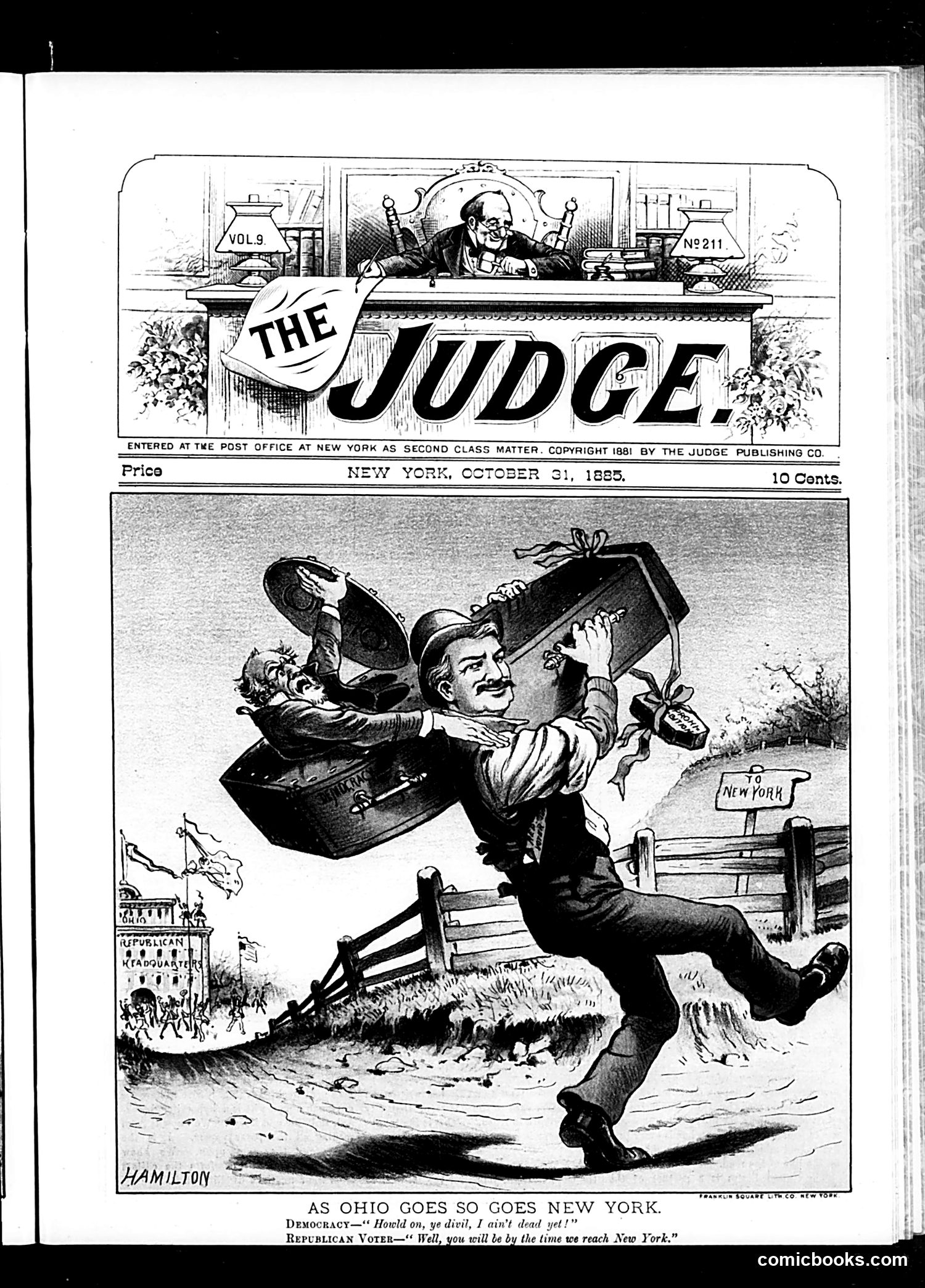
This cartoon satirizes the 1884 presidential election aftermath. A man (likely representing a Democratic politician or voter) frantically flees toward New York, carrying a ballot box labeled "Ohio." The "Republican Headquarters" building appears in the background on the left. The caption plays on the political axiom that Ohio's electoral outcome predicted national results. The Democracy figure says "Hold on, ye devil, I ain't dead yet!" while the Republican Voter responds, "Well, you will be by the time we reach New York." The satire suggests Republicans hope to replicate Ohio's electoral success in New York, threatening Democratic political survival. The cartoon reflects post-election tensions between the two parties over contested results and regional political control.
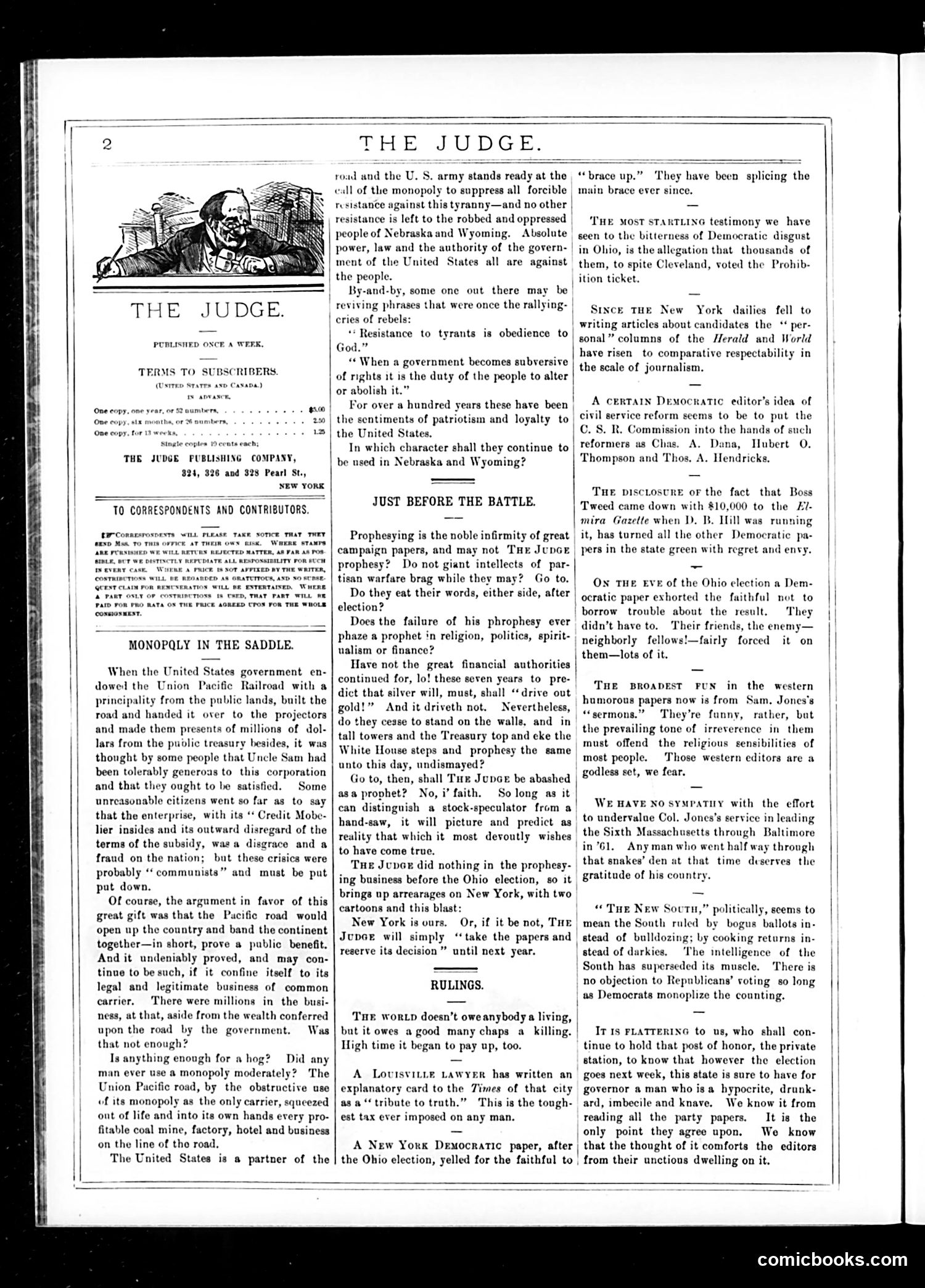
The main cartoon depicts a figure (likely representing railroad monopoly interests or government corruption) controlling the nation like a rider on a horse. The accompanying editorial attacks the Union Pacific Railroad's monopoly power, claiming the government built the railroad with public funds but allowed private interests to profit enormously. The satire argues this constitutes unfair "monopoly" - the company extracts excessive wealth while common carriers should serve public benefit. The cartoonist sarcastically questions whether monopolies can operate "moderately" and suggests the government should either reclaim the railroad or regulate it properly as a public trust. The piece reflects 1870s-80s Gilded Age anxieties about corporate power overriding democratic governance.
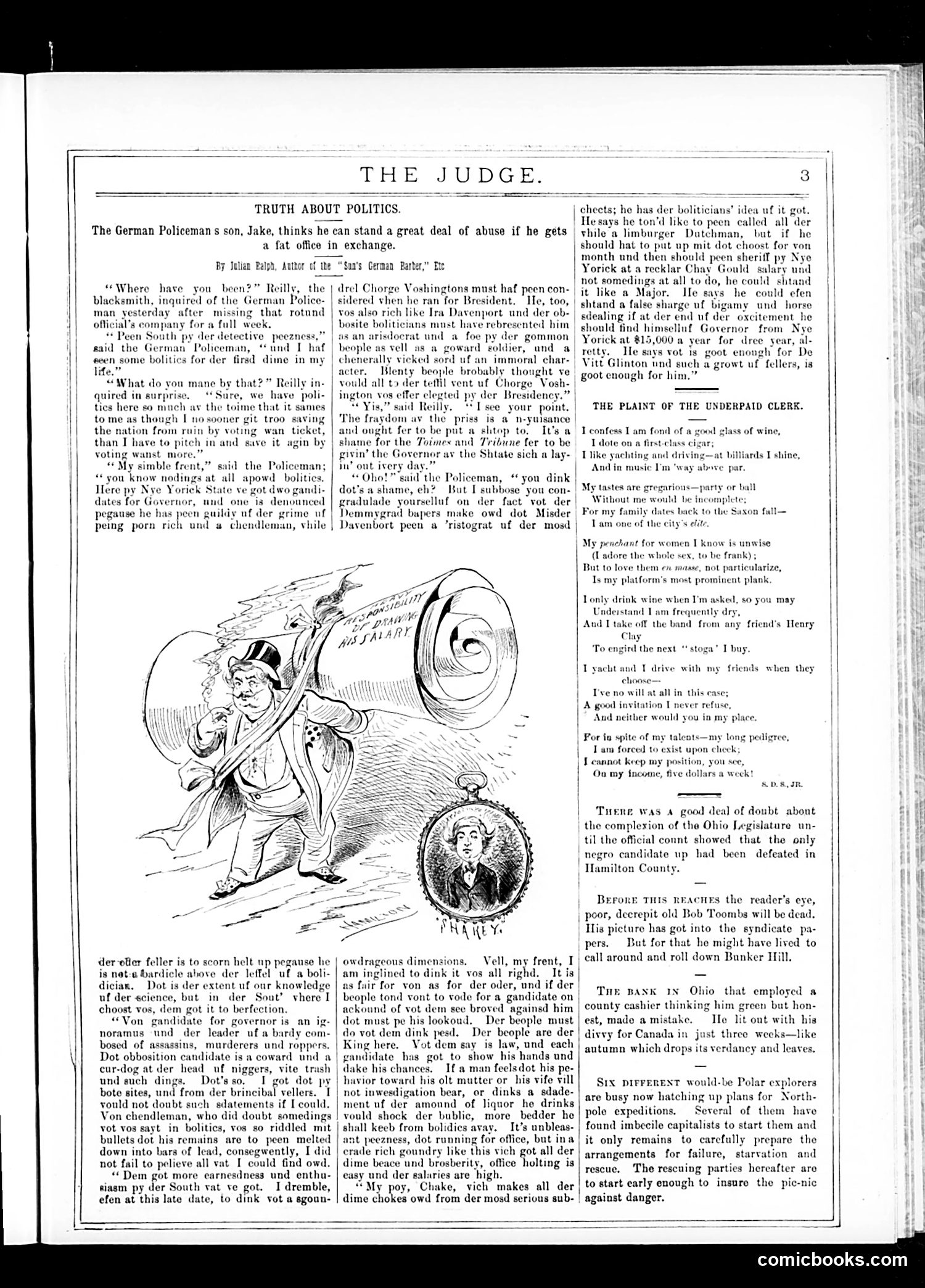
This page satirizes American politics through a dialogue between an Irish immigrant ("Reilly") and a German immigrant ("the Policeman's son, Jake"), written in heavy dialect by Julian Ralph. **The Satire's Point:** The German immigrant describes Southern political corruption—where candidates are either "ignoramuses" leading "assassins, murderers and robbers" or cowards, yet voters believe everything because violence backs up political claims. He contrasts this with the North, where a wealthy man (possibly alluding to real New York political figures) can become governor despite accusations of bigamy, simply because wealth and position provide cover. **The Joke:** The immigrant finds American politics bewilderingly corrupt at all levels. He's shocked that a "gentleman" can survive scandals by promising office-seekers patronage jobs—suggesting that buying loyalty through positions is considered normal political business. **Visual Element:** The cartoon shows a German figure struggling with what appears to be a large barrel or container, illustrating the burden of navigating American political corruption. The page mocks both immigrant naïveté and American political cynicism simultaneously.
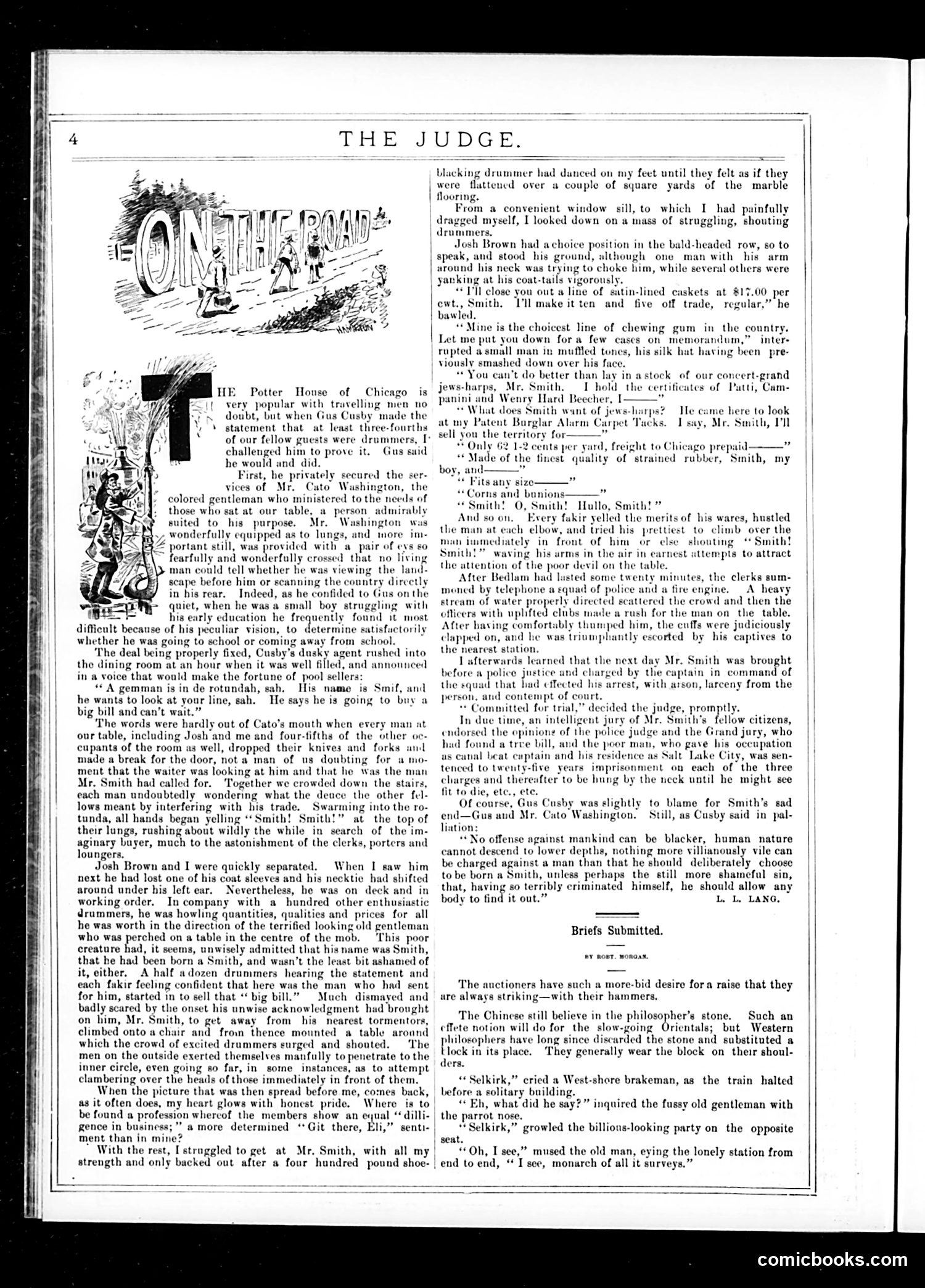
This satirical piece mocks traveling salesmen (drummers) of the Gilded Age. The joke hinges on a prank orchestrated by "Gas Cusby" using Cato Washington, a cross-eyed Black porter, to announce a potential buyer named "Smith" in the hotel lobby. The humor exploits the salesmen's desperation and competitive ruthlessness: every man abandons his meal, believing this mysterious Smith is *his* customer. The chaos escalates when an actual Mr. Smith admits his identity, prompting multiple salesmen to simultaneously assault him with their pitches, forcing him onto a table for safety. The satire targets the cutthroat nature of commercial culture—the "Git there, Eli" determination to secure sales at any cost. The narrator's prideful reflection on this chaotic scramble as evidence of professional virtue underscores Judge's critique: American business culture celebrates ruthless, undignified hustling as noble ambition. The caricatured portrayal of Washington reflects period racism but serves the satirical purpose of highlighting salesmen's foolishness.
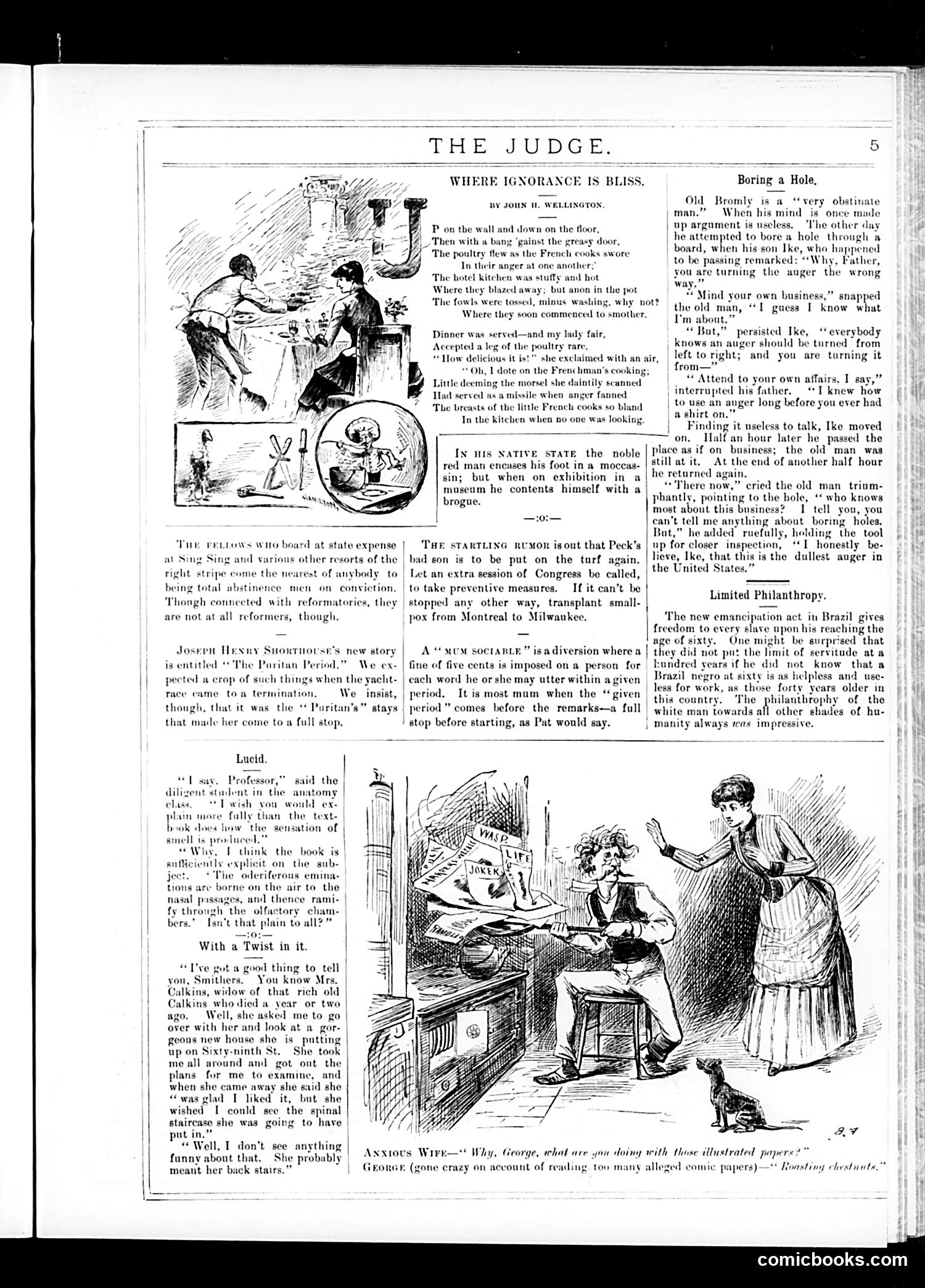
This page from *Judge* contains several short satirical pieces typical of late 19th-century American humor: **"Where Ignorance is Bliss"** mocks French cuisine pretensions—a lady unknowingly eats poultry that French cooks fought over in a dirty kitchen, yet praises "the Frenchman's cooking," satirizing blind admiration of foreign sophistication. **"Boring a Hole"** ridicules stubborn ignorance: Old Bromly refuses his son Ike's correct advice about auger direction, insisting on his own wrong method. The joke: after hours of effort, he admits the auger is defective—never considering he was doing it backwards. **Other brief items** mock Native Americans in museums, Congressional incompetence, and Brazilian slavery laws that free slaves only at age 60 (useless, the author snipes, since they're then decrepit anyway). The cartoons use exaggerated dialect and physical comedy typical of the era. The satire targets pretension, stubbornness, and social hypocrisy rather than specific political figures or dated events.
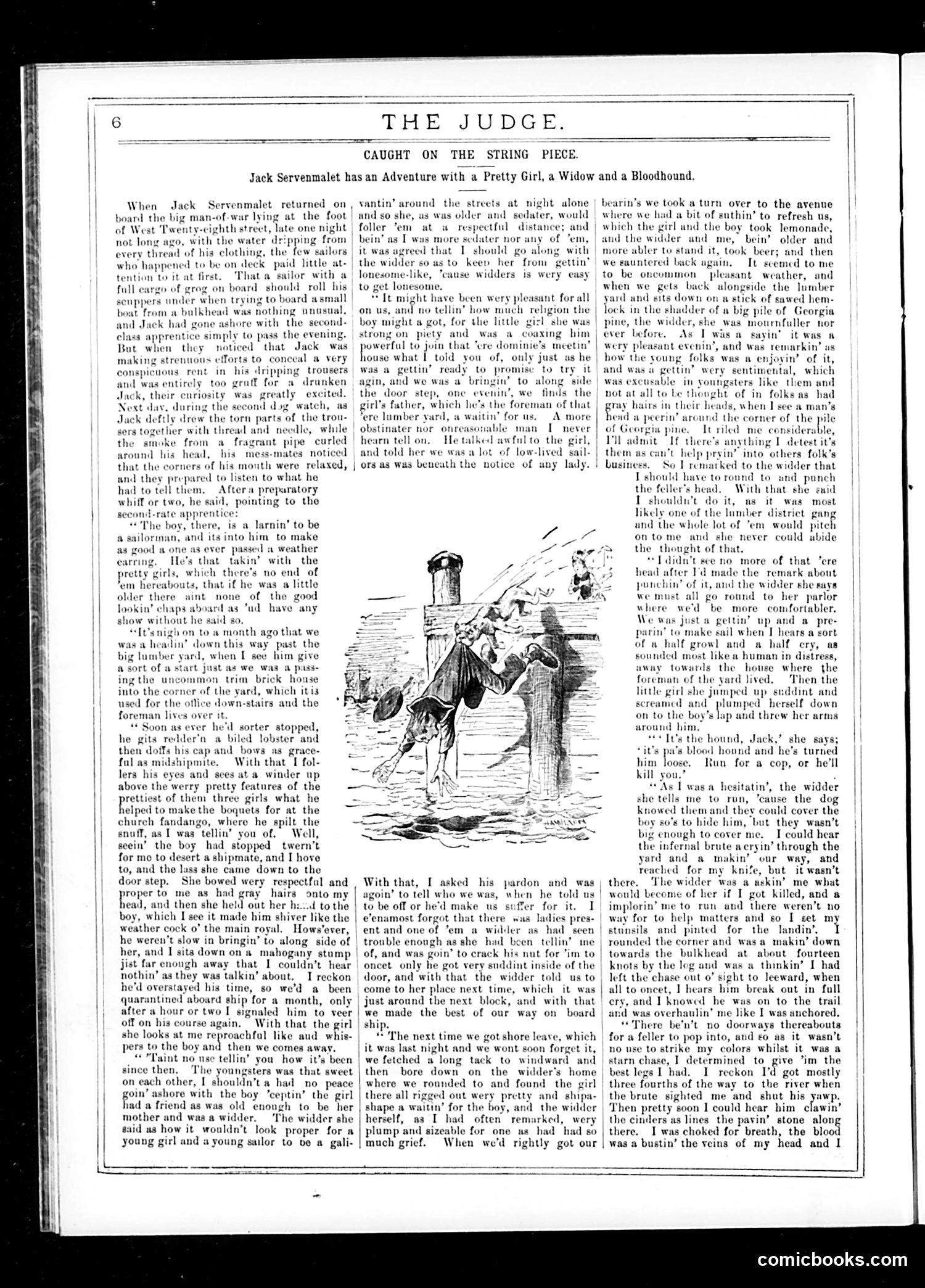
This is a serialized humorous short story (not political satire) about a sailor named Jack Servenmalet recounting an adventure to his shipmates. The narrative concerns a young sailor's romantic entanglement with a pretty girl at a lumber yard, chaperoned by her widow friend and the story's narrator. The illustration depicts the central incident: Jack and the girl encounter a bloodhound in a yard. The story involves romantic mishaps, physical comedy (Jack tears his trousers), and the complications of courtship—the widow serves as chaperone to maintain propriety. The humor derives from sailor dialect, working-class romance, and slapstick situations rather than political commentary. This appears to be Judge magazine's fiction content, demonstrating the publication offered entertainment beyond satire. The page represents late-19th-century popular humor aimed at working-class readers.
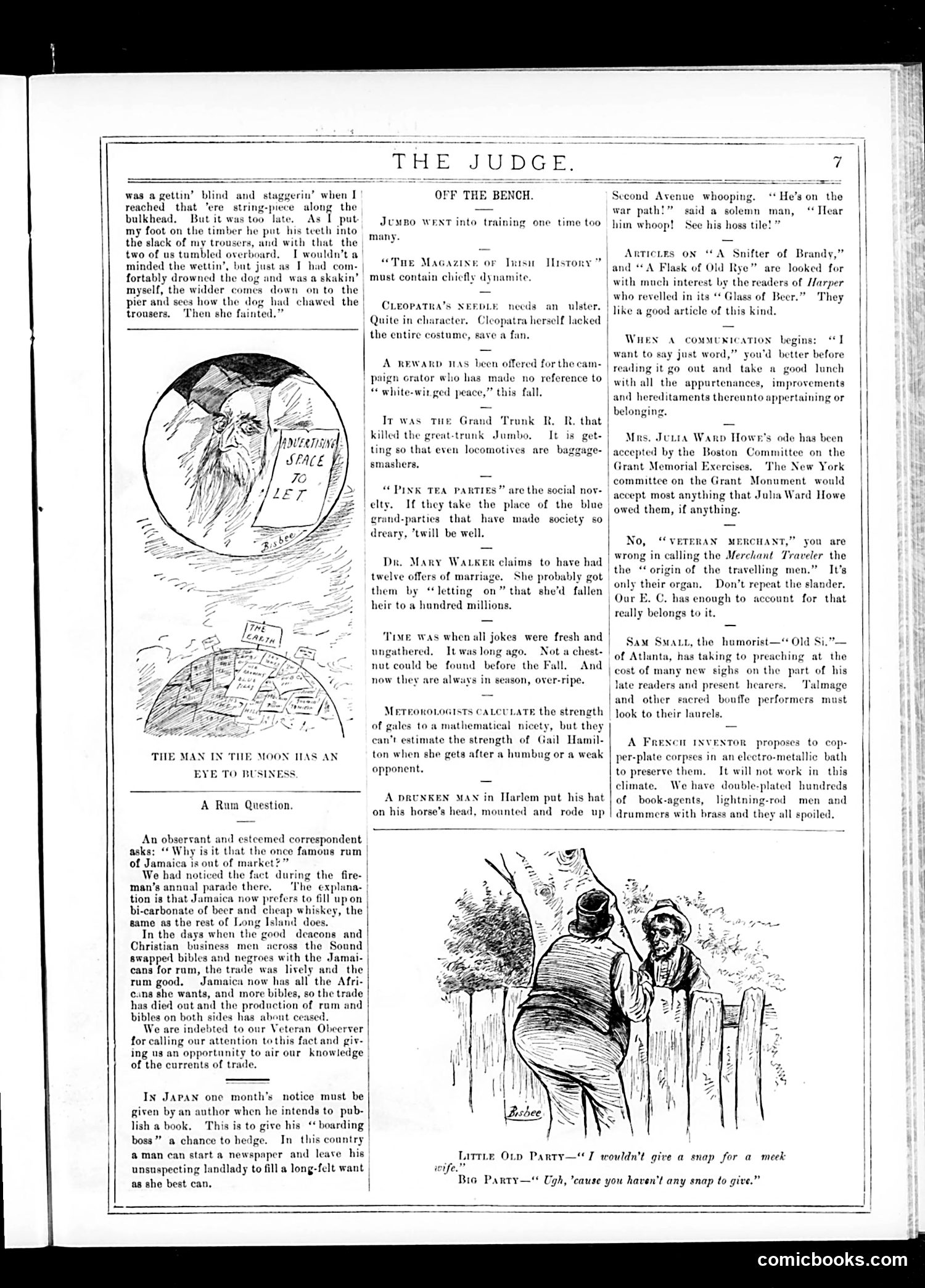
This page from the satirical magazine *Judge* contains several brief social commentaries and jokes typical of late 19th-century American humor: **Key Content:** The cartoons mock everyday absurdities: a man drunkenly placing his hat on his horse's head, and a dispute between neighbors about "snops" (handouts). The text items satirize contemporary figures and trends—Dr. Mary Walker's implausible marriage claims, Cleopatra's Needle monument (needing protection from weather), and "pink tea parties" (fashionable social gatherings seen as frivolous). **Recurring Theme:** The page criticizes Jamaica's rum trade decline, attributing it to islanders' preference for cheap beer and whiskey rather than traditional rum production—a veiled commentary on economic change and shifting trade patterns. **Tone:** Typical of *Judge's* style—irreverent, punching at both high society pretensions and working-class foibles with equal vigor. The humor relies on readers' familiarity with contemporary figures, social conventions, and commercial trends of the era.
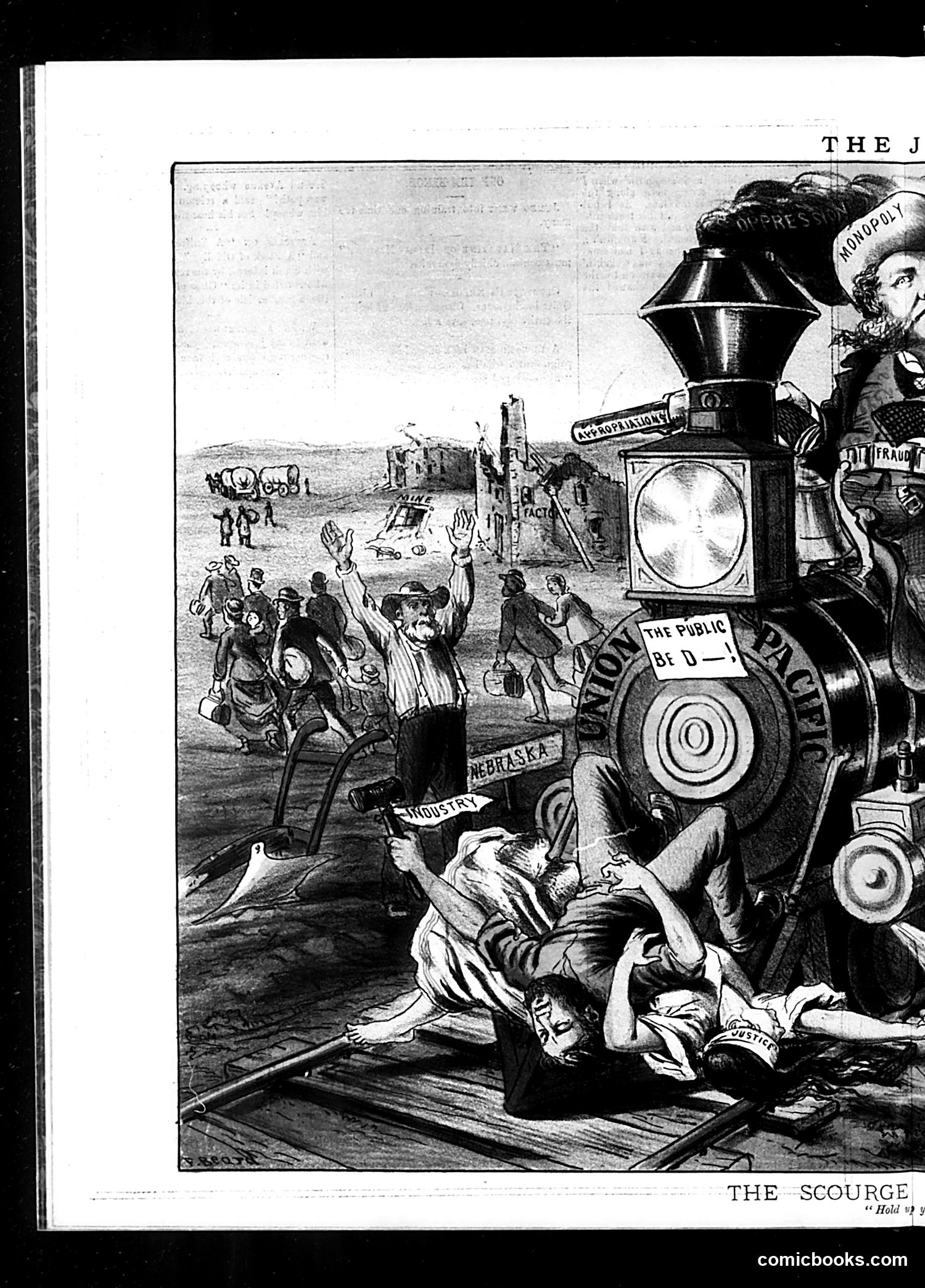
This appears to be a political allegory depicting industrialization as a destructive force. A large mechanical contraption—labeled with references to "monopoly," "Nebraska," and "industry"—operates like a grinding machine crushing people beneath it. The figure operating it wears a top hat marked "monopoly," suggesting wealthy industrialists or monopolists controlling the machinery. In the background, settlers or common people react with alarm, some with raised hands. The title "The Scourge" indicates Judge magazine is critiquing industrial monopolies as harmful to ordinary citizens and settlers, particularly in western territories like Nebraska. This likely reflects late 19th or early 20th-century anxieties about unchecked corporate power crushing labor and frontier communities.
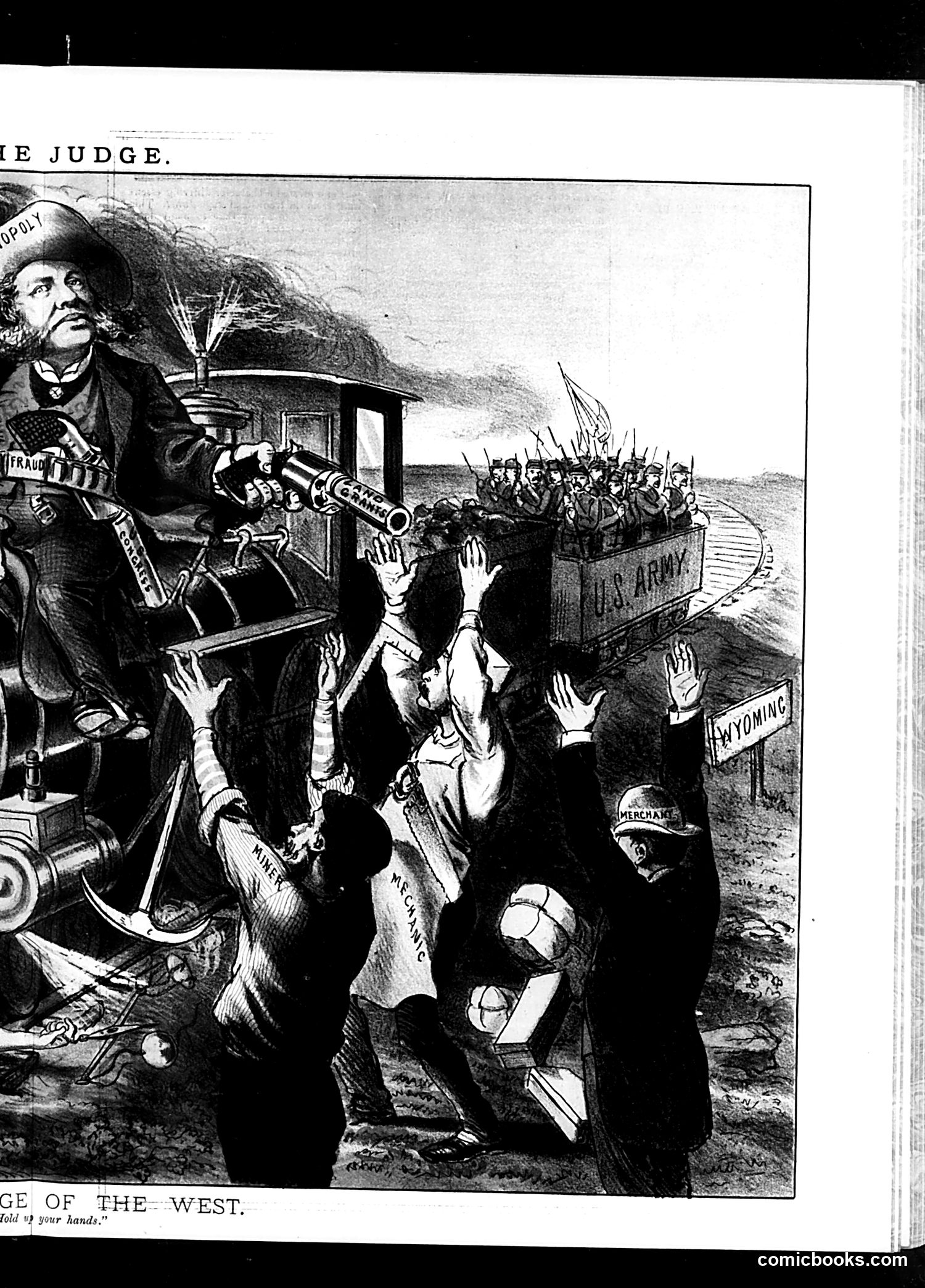
This Judge magazine cartoon depicts a military or authority figure (left, wearing what appears to be a general's uniform and labeled "FRAUD") pointing a cannon at kneeling figures representing commerce and labor interests. A train labeled "ARMY" carries armed soldiers in the background. A "WYOMING" sign is visible. The caption reads "fold your hands," suggesting these economic interests are being forced into submission or compliance. The cartoon appears to satirize heavy-handed federal or military intervention in Western economic/labor disputes—possibly referencing late 19th-century conflicts between federal authority and Western commercial interests, mining operations, or labor disputes. The "fraud" label suggests the cartoonist viewed this intervention as illegitimate coercion of civilian populations.
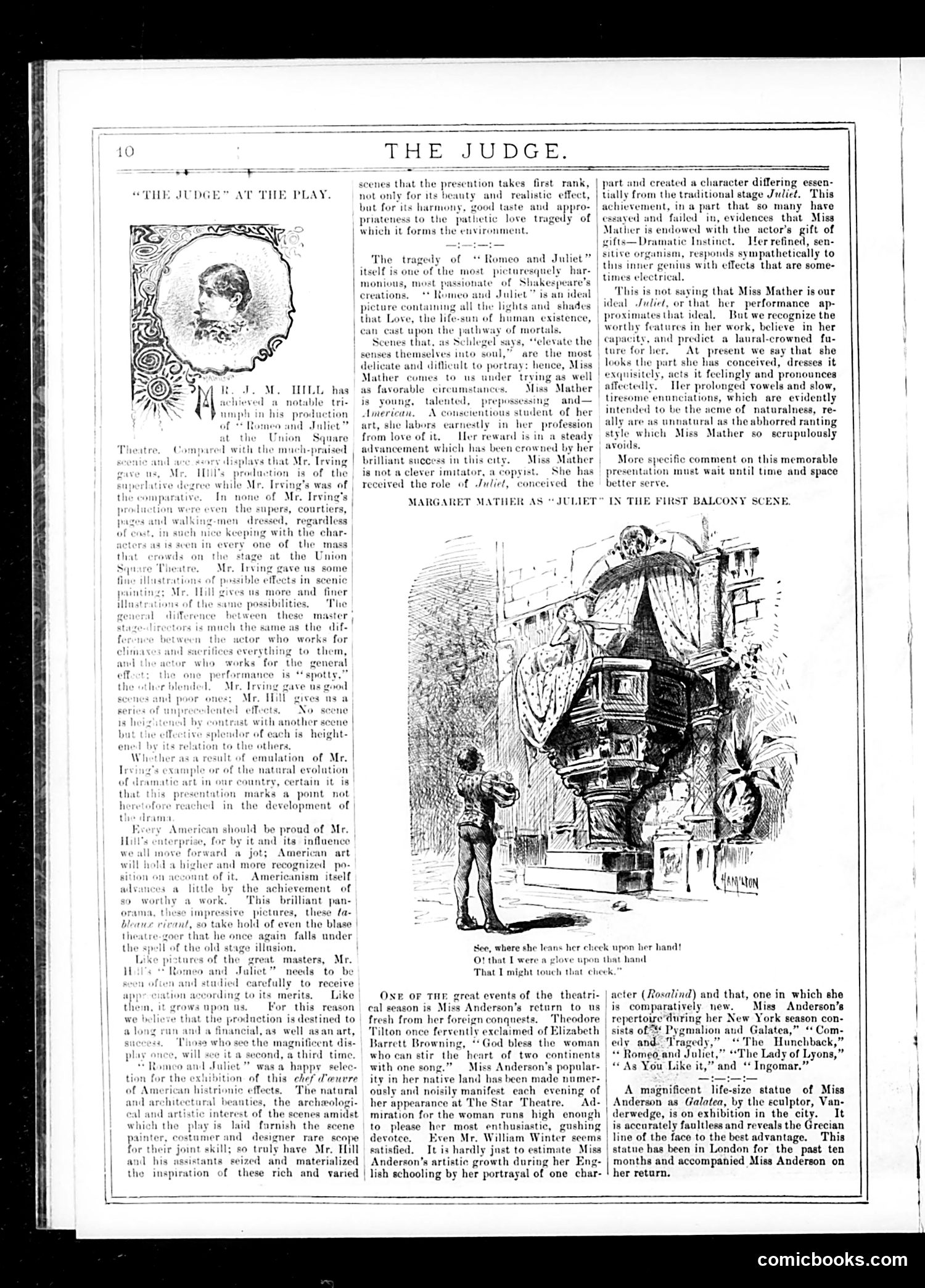
This page reviews a theatrical production of *Romeo and Juliet*, likely from the 1880s-90s. The text discusses Mr. Irving's production design and Margaret Mather's performance as Juliet. **Key figures:** - Mr. Irving: appears to be the production designer/director whose scenic work is praised - Margaret Mather: the actress playing Juliet, described as young, talented, and earnest **The critique:** The reviewer praises the production's visual beauty and architectural design but offers mixed assessment of Mather's acting. While acknowledging her talent and promise, the critic faults her "prolonged vowels" and affected delivery—she's criticized for artificial theatrical mannerisms, though the reviewer notes she avoids excessive "ranting." **The satire/point:** Rather than sharp satire, this appears to be serious theatrical criticism celebrating American dramatic achievement while maintaining critical standards. The illustrated scene shows Juliet on the balcony, the play's most famous moment. The page represents Judge magazine's cultural coverage—positioning American theater as worthy of serious artistic discussion.
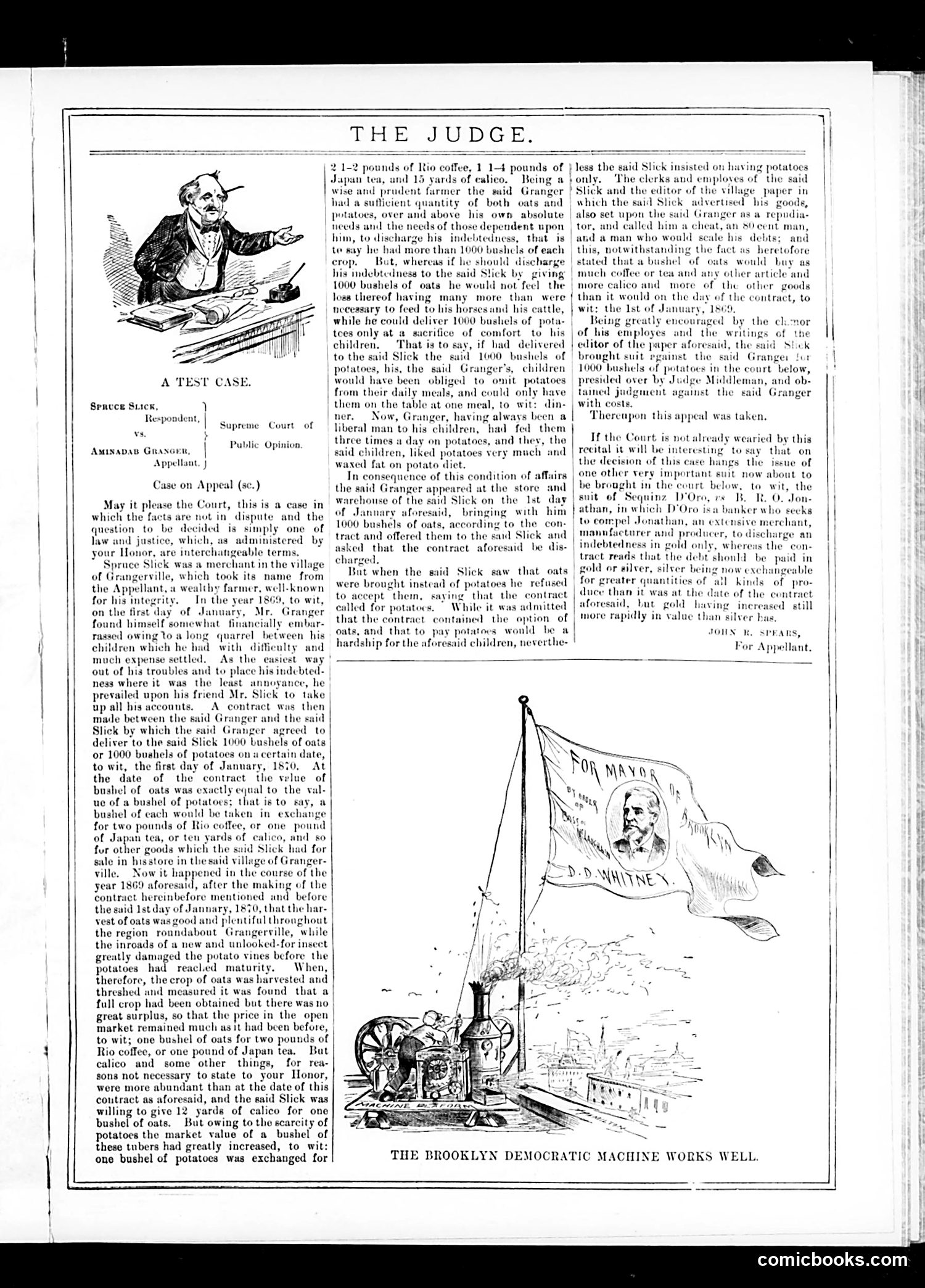
This page contains a legal satire titled "A Test Case," mocking both rural debt disputes and judicial reasoning. The central story involves **Granger** (a farmer) and **Slick** (a merchant) in a contract dispute over 1,000 bushels of oats versus potatoes as payment. The satire targets the absurdity of strict legal literalism: Granger offered oats (which had risen in value), but Slick demands potatoes per their contract's exact wording, despite this causing hardship to Granger's children who depend on potatoes for food. The "judge" and village opinion side with Slick, calling Granger dishonest for not delivering potatoes. The second cartoon shows **"The Brooklyn Democratic Machine Works Well,"** depicting a political machine—likely critical of Brooklyn Democratic Party operations, though specific figures aren't identified. The satire criticizes how rigid contract enforcement ignores equity and changing circumstances, and how public opinion follows merchant interests over farmers' welfare.
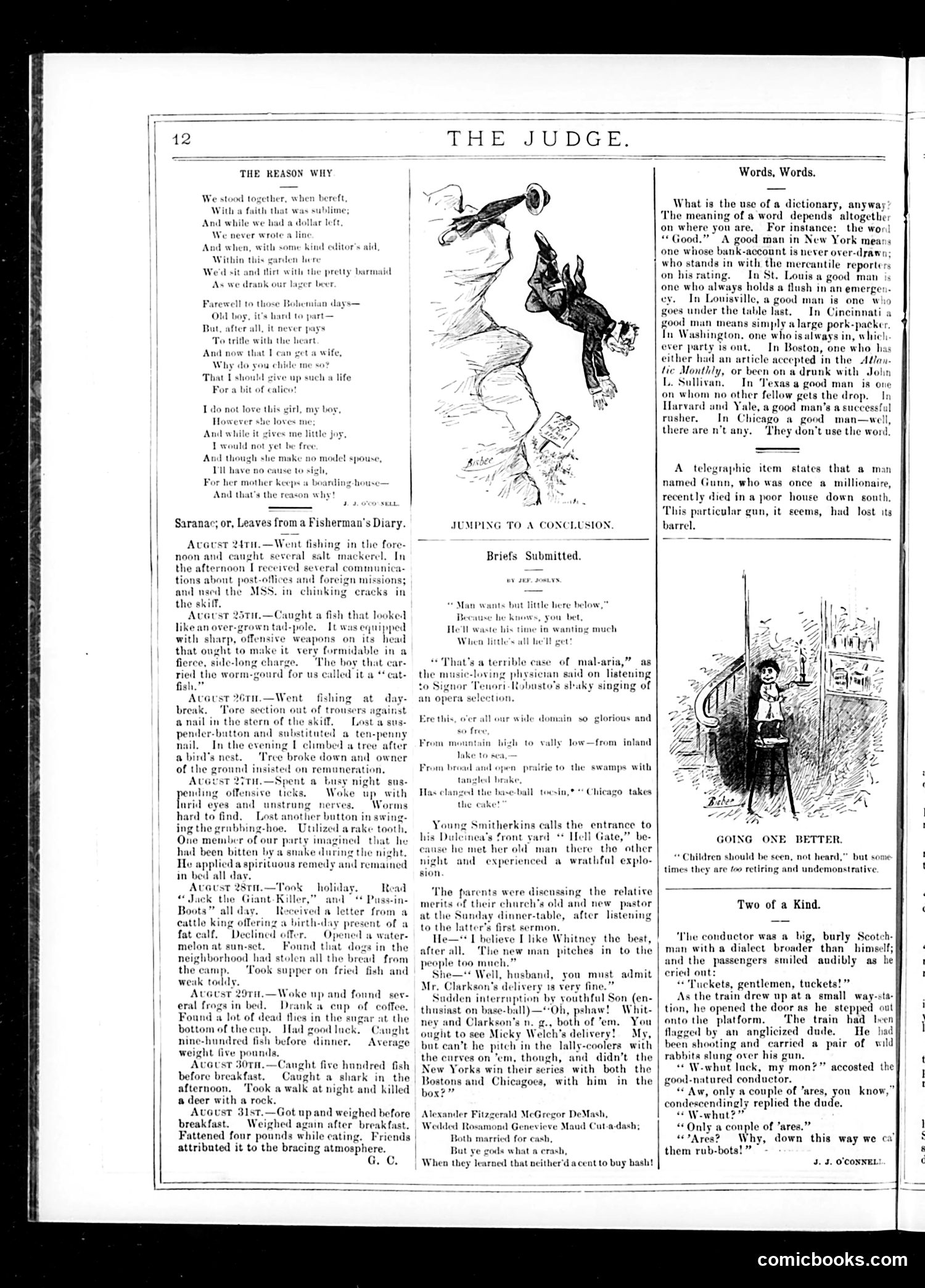
This page from Judge magazine (likely 1880s-90s) contains three distinct satirical pieces: **"The Reasons Why"** (poem, left): A humorous lament about a loveless marriage to a woman whose mother runs a boarding house—the speaker stays in the marriage for financial security rather than affection. **"Jumping to a Conclusion"** (center cartoon): Depicts a man seemingly falling or jumping, illustrating the editorial's point about hasty conclusions. **"Words, Words"** (right column): Satirizes regional American attitudes by redefining "good man" across different cities—mocking New York bankers, St. Louis gamblers, Chicago businessmen, etc. The joke: each region's definition reflects its actual values (greed, gambling, ambition) rather than genuine morality. **"Saranac; or, Leaves from a Fisherman's Diary"** (left column): A humorous fishing diary documenting mishaps—lost buttons, suspicious fish, exaggerated catch claims—poking fun at tall fishing tales and incompetent sportsmen. The page combines light social satire typical of Judge's commentary on American regional differences and middle-class pretensions.
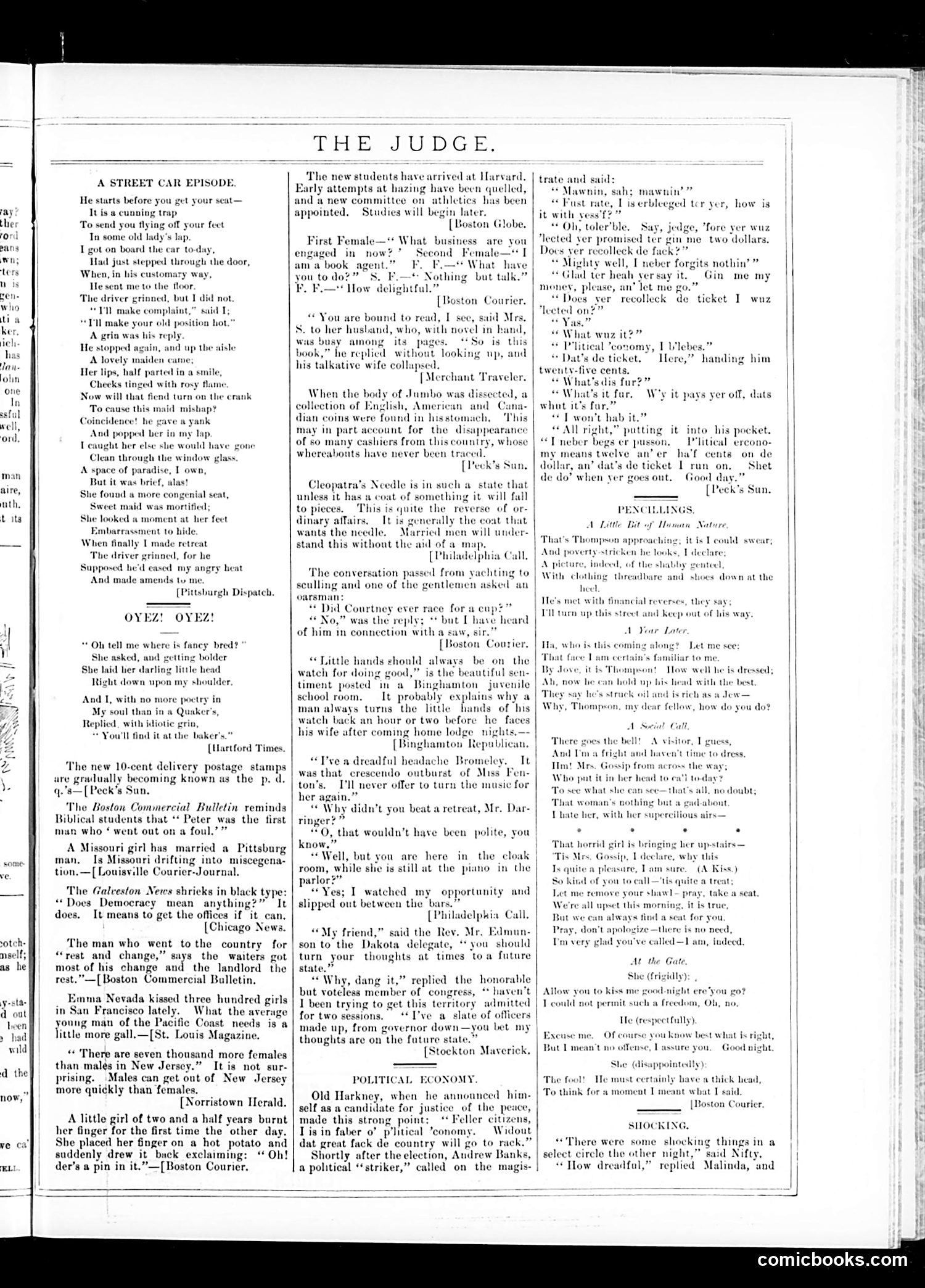
This page from the satirical magazine *Judge* contains several humorous short pieces and poems mocking everyday situations and contemporary social conventions. The main cartoon, "A Street Car Episode," satirizes rude streetcar conductors who deliberately jolt passengers by yanking the brake, causing them to stumble into other riders' laps. The protagonist attempts to flirt with an attractive woman but loses his chance when she's thrown into his arms involuntarily—then immediately finds a better seat elsewhere, humiliating him. The joke targets both the conductor's boorishness and the narrator's failed romantic presumption. Additional short humor pieces mock various targets: new Harvard students, overly sentimental greeting cards, women's literary pretensions, and general social awkwardness. The page reflects *Judge's* typical formula of satirizing middle-class manners and the minor indignities of urban American life in the late 19th century.
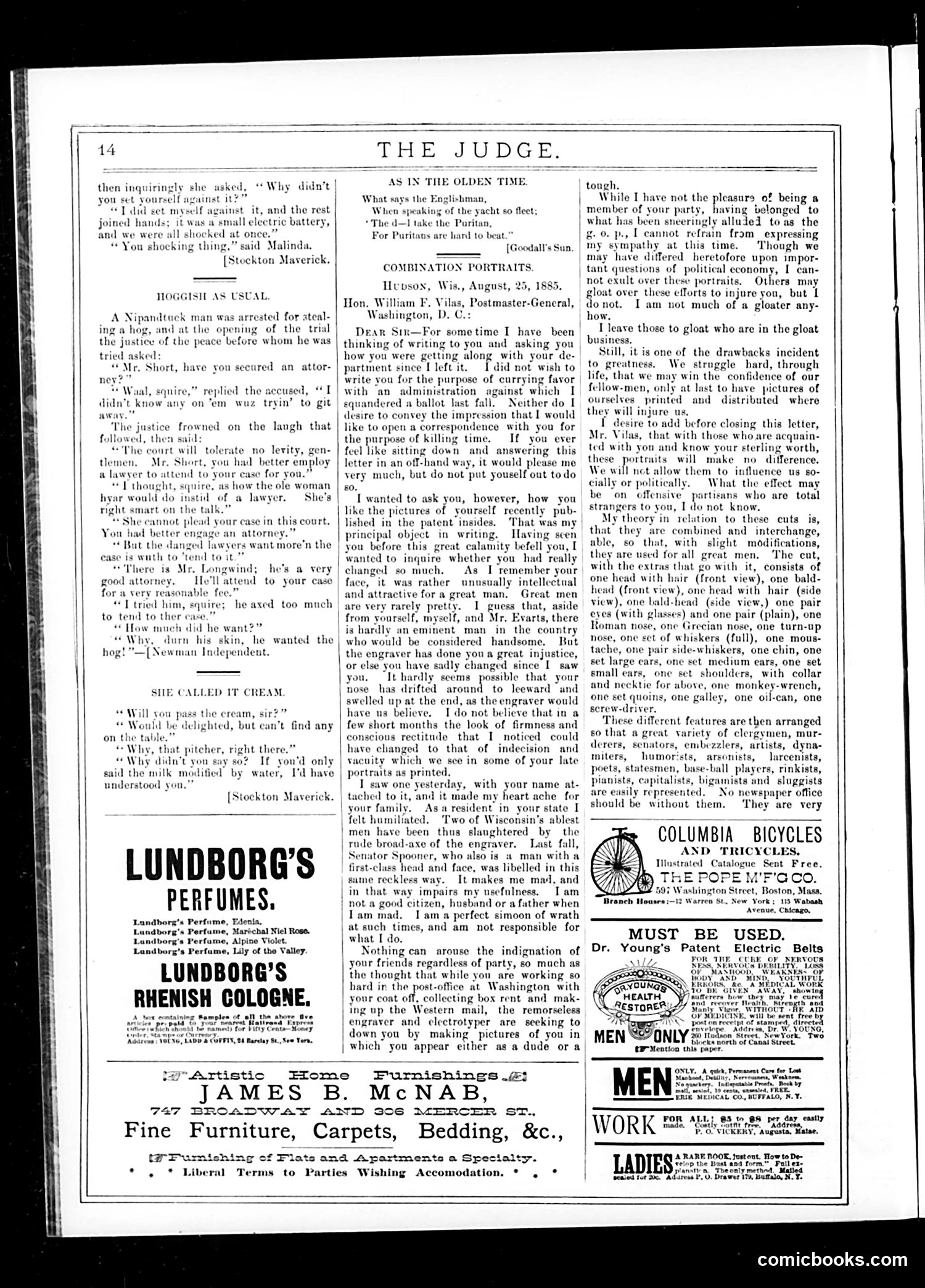
This page contains brief humorous anecdotes and a substantial letter, but **no visible political cartoon**. The main content is a letter from a Wisconsin resident to Postmaster-General William F. Vilas, commenting on recently published "combination portraits" of Vilas in newspapers. The writer satirizes the practice of newspapers using interchangeable facial features and components (different hair styles, eyes, noses) to create multiple images of public figures from a single base illustration—a cost-saving measure in printing. The satire's point: newspapers were lazily recycling composite features rather than commissioning original portraits, and this reflected poorly on the dignity of prominent officials like Vilas. The shorter anecdotes above ("Hoggish as Usual," "She Called it Cream") are unrelated joke pieces with no political content. The remainder of the page is **advertisements** for perfumes, cologne, bicycles, furniture, and patent medicines.
This Judge magazine page is primarily **advertising**, not political satire. It features Victorian-era commercial ads for medical products (Pond's Extract healing salve, hay-fever remedies, truss supports), services (piano rentals, book binding, lithography), and patent medicines—typical of late-19th-century magazines. The only notable editorial content is "The Modern Shakspere," a humorous dialogue parodying Shakespeare's flowery language. Two characters (apparently sailors, based on nautical references) speak in faux-Elizabethan style about mundane matters—cups, pudding sticks, and boats—creating comedy through the contrast between archaic, romantic diction and trivial subjects. This was a common Victorian humor format. A brief letter from Bill Nye (a famous humorist of the era) discusses photography and crime prevention, unrelated to any visible cartoon on this page.
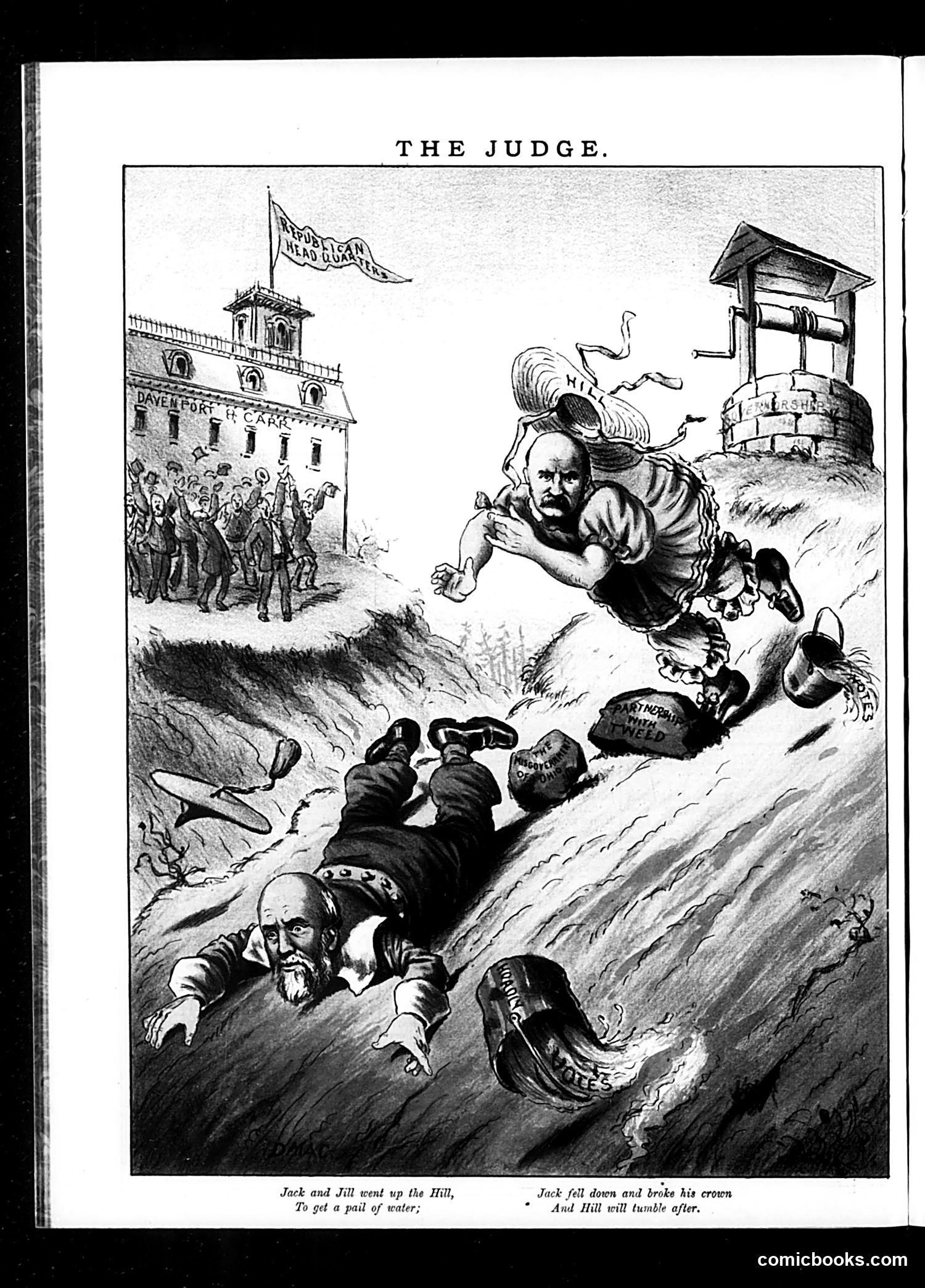
This cartoon adapts the nursery rhyme "Jack and Jill" as political satire. The image shows a bearded man tumbling down a hillside while figures at a fort (labeled "Davenport Clark") observe from above. The altered rhyme warns that "Jack fell down and broke his crown / And Hill will tumble after." This appears to be commentary on a political figure named "Jack" and another named "Hill," likely from late 19th-century American politics. The fort setting and military imagery suggest conflict or political upheaval. The nursery rhyme adaptation—a common Judge magazine technique—transforms children's verse into biting political commentary about the inevitable downfall of these figures, with the implication that one's collapse will trigger another's. Without clearer historical dating, the specific identities remain unclear.