
Judge, 1885-10-31 · page 10 of 16
Judge — October 31, 1885 — page 10: what you’re looking at
What you’re looking at
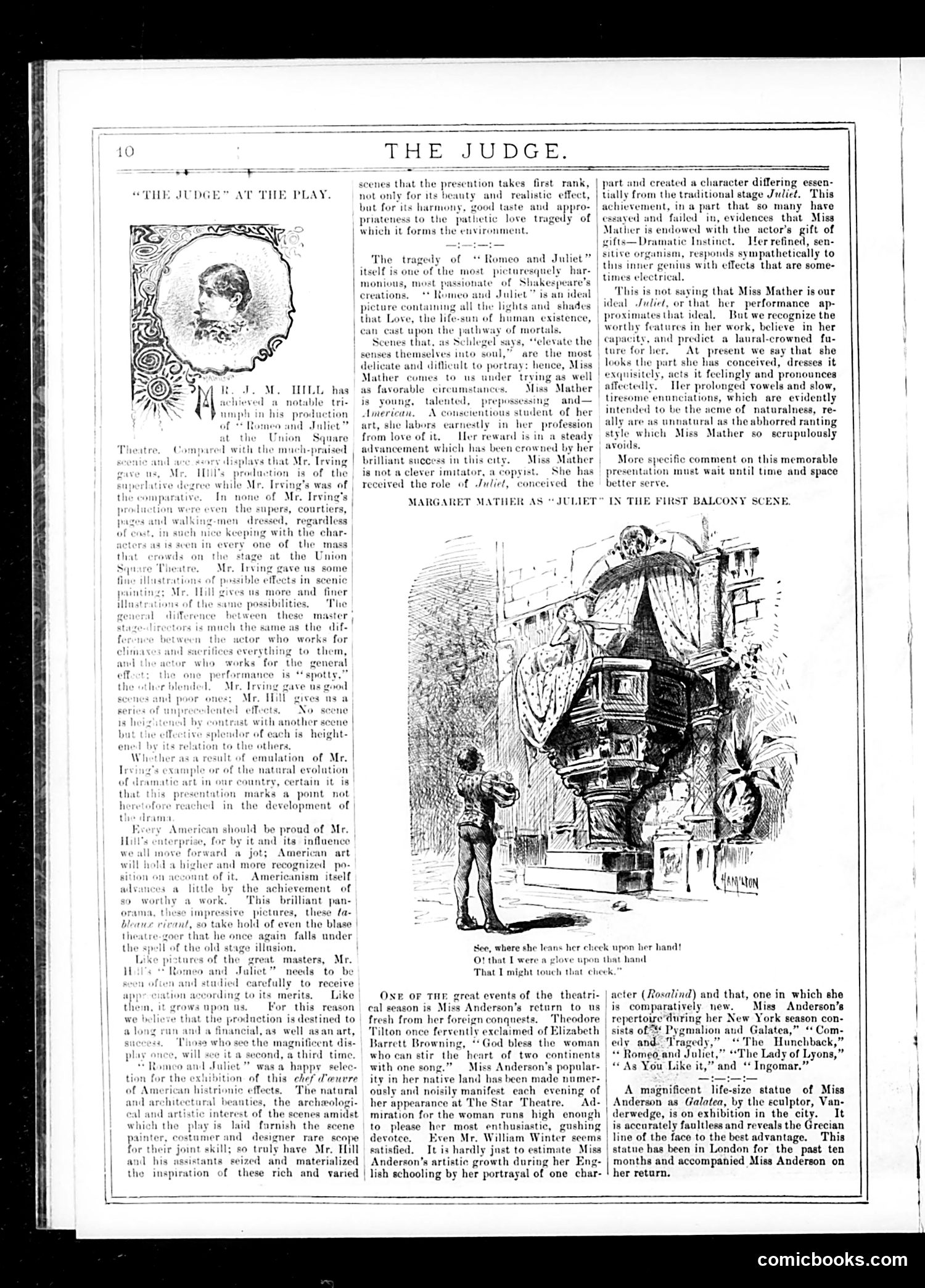
This page reviews a theatrical production of *Romeo and Juliet*, likely from the 1880s-90s. The text discusses Mr. Irving's production design and Margaret Mather's performance as Juliet. **Key figures:** - Mr. Irving: appears to be the production designer/director whose scenic work is praised - Margaret Mather: the actress playing Juliet, described as young, talented, and earnest **The critique:** The reviewer praises the production's visual beauty and architectural design but offers mixed assessment of Mather's acting. While acknowledging her talent and promise, the critic faults her "prolonged vowels" and affected delivery—she's criticized for artificial theatrical mannerisms, though the reviewer notes she avoids excessive "ranting." **The satire/point:** Rather than sharp satire, this appears to be serious theatrical criticism celebrating American dramatic achievement while maintaining critical standards. The illustrated scene shows Juliet on the balcony, the play's most famous moment. The page represents Judge magazine's cultural coverage—positioning American theater as worthy of serious artistic discussion.
📄 Transcribed text from this page (OCR, searchable)
Machine-transcribed from the original scan — historical spelling and the odd misread are preserved.
“THE JUDGE” AT THE PLAY. HILL has able tri- uetion 1 Juliet” Square mmpared with the much-praised ws that Mr. Irving oduction is of the » Mr. Irving’s was of with the char- of the mass t the Union ave us some ts in scenic s much who works for ices everything to them, works for the oral who performance is Mr. Irving gave us of each is height- others, emulation or of the natir to th of Mr. 1 evolution rtain it is tation marks a point not e reached in the development of uma American should be proud of Mr. . for by it and its influence ward a jot; American art and more recognized po- mint of it. Americanism itself by the achievement of a work. ‘This brilliant pan- im ve pictures, these fa- mi, so take hold of even the blase n our country, ¢ | theatre-goer that he once again falls under the spell of the old stage illusion, Like pictures of the masters, Mr. Hal's Romeo and Juliet” needs to be seon often and stadied carefully to. receive | rding to its merits. Like | us. For this reason | production is destined to | along anda financial, as. wel an art, 1 10 see the magni vent dis- it a second, a third time was a happy v of this chef Cauvre fects. The natural hitectural beauties, the archiwole «d artistic interest of the sc play is laid farnish the scene ican histrionie nt ner and designer rare scope t int skill; so truly have Mr. Hill and his stants seized and materialized the inspiration of these rich and varied THE JUDGE. scenes that the presention takes first’ rank, not only for its beauty and reali but for its harmony, good taste and priateness to the pathetic love tra which it forms the environment, ppro- ly of dy of ‘Romeo and Juliet” f the most picturesquely ionate of Shakespeare's id Juliet” is an ideal he lights and shades of human existence, of n moniou creations, icture conta the nselves into, licate and difficult to Mather comes to us under trying as wel as favorable circumstances s Mather is young, talented, prepossessing — and— A conscientious ent of her art, she labors earnestly in her profession from love of it. Mer reward is in a steady advancement which has been crowned by her brilliant success in this city. Miss Mather is not a clever imitator, »pyist. She has received the role of Juliet, conceived the MARGARET MATHER AS “JULIET American, part : ic effect, | tia d created a character differing essen- ly from the traditional stage Juliet. This achievement, ina part that so many have sitive Matha gifts—Dram ayed and in, evidences that Miss is endowed with the actor's gift of ic Instinct. er refined, sen- responds sympathetically to this inner genius with effects that are some- times electrical, ‘This is not saying that Miss Mather is our ideal Juliet, or that her performance ap- proxim worthy featur capacity ture fe looks the part she has conceived, dresses it tiresome intended to be the ally sty presen! better serve. sthat ideal. But we recognize the s in her work, believe in her and predict a laural-crowned fu- her, At present we say that she xquisitely, 8 it feclingly and pronounces affected|y. Her prolonged vowels and slow, snunciations, which are evidently me of naturalness, re- eas unnatural as the abhorred ranting which Miss Mather so scrupulously avoids. comment on this memorable jon must wait until time and space More speci IN THE FIRST BALCONY SCENE. See, where she leans her cheek upon her hand! O! that I were ve upon that hand That I might touch that cheek.” oF THF. great events of the theatri- ‘on is Miss Anderson’s return to us rom her foreign conquests. ‘Theodore Tilton once fervently exclaimed of Elizabeth Barrett Browning, od bless the woman who can stir the irt of two continents with one song.” Miss Anderson's popular- ity in her native land has been made numer- ously and noisily manifest each evening of her appearance at The Star Theatre. Ad to please her most enthusiastic, gushin devotee. n Mr. William Winter seems satisfied. It is hardly just to estimate Miss Anderson’s artistic growth during her lish schooling by her portrayal of one char- acter (Rosalind) and that, one in which she is comparatively new. Miss Anderson’s repertoue’during her New York season con- sists of Pygmalion aud Galatea,” ‘Com. edy and “The Hunchback,” *Romeo.and Juliet,” “The Lady of Lyons,” “As You Like it,” and “ Ingomar.” A magnificent statue of Miss | Anderson as Galatea, by the sculptor, Van- miration for the woman runs high enough | is accurately faultless and reveals the Grecian derwedge, is on exhibition in the city. It line of the face to the best advantage. This statue has been in London for the past ten months and accompanied Miss Anderson on her return. comicbooks.com