
A complete issue · 16 pages · 1885
Judge — October 24, 1885
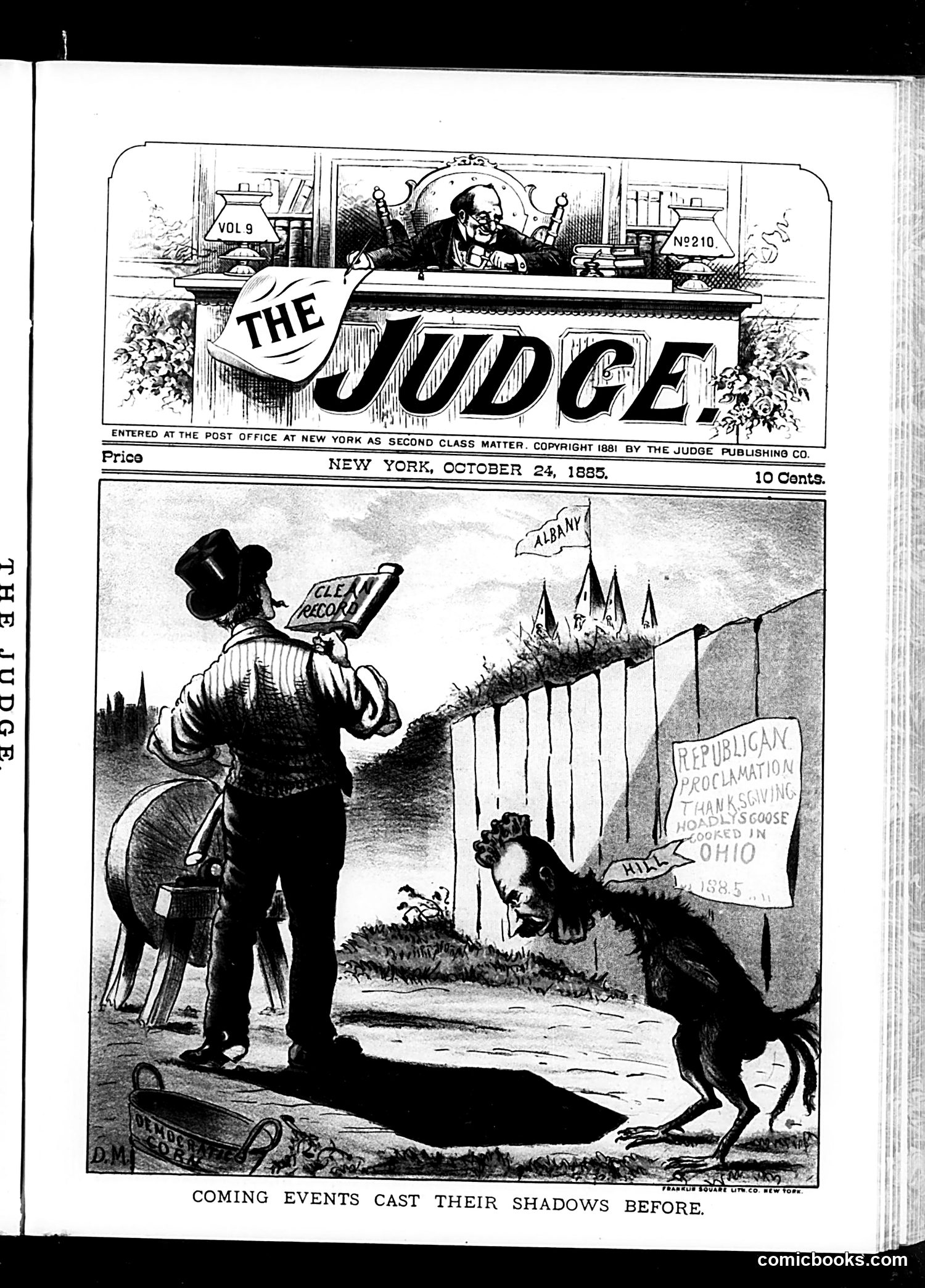
**Main Cartoon: "Coming Events Cast Their Shadows Before"** This political cartoon depicts a man holding a "Clean Sweep" broom approaching Albany, New York, while a donkey (symbol of the Democratic Party) recoils in fear. A sign references the "Republican Proclamation" regarding a "Toadying Goose Cooked in Ohio" from 1885. The cartoon satirizes Republican political ambitions, suggesting they're preparing to "sweep clean" Democratic control. The donkey's fearful reaction implies Democrats anticipate electoral defeat. The obscure Ohio reference likely concerns a specific 1885 state political scandal or controversy, though the exact incident is unclear without additional historical context. The overall message: Republicans are coming for power.
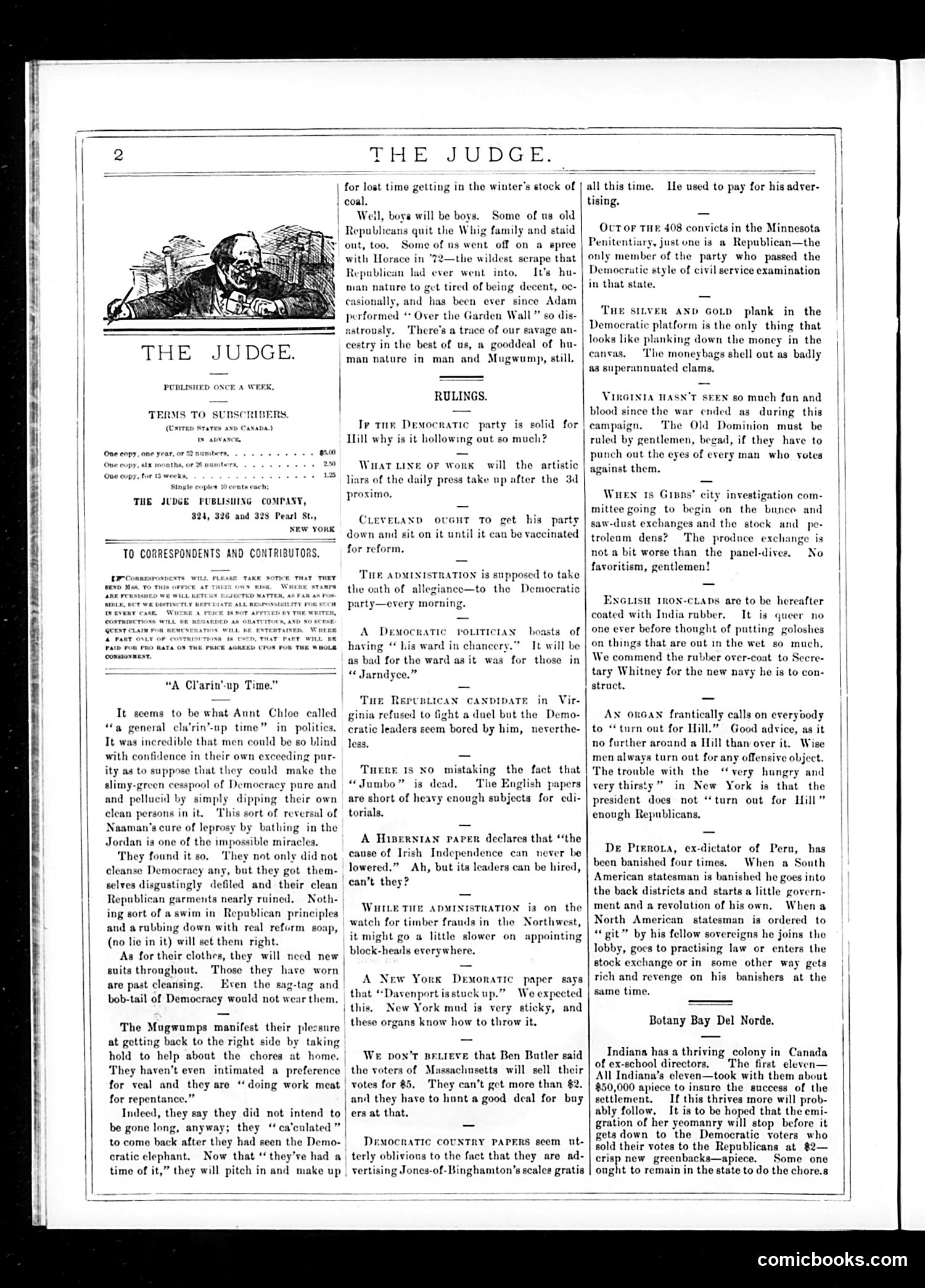
This page contains political commentary rather than a cartoon. The main illustration shows a pile of debris labeled "THE JUDGE," functioning as the masthead. The "Rulings" section offers satirical political jabs at both parties: mocking Democratic solidarity, criticizing Republican press behavior, and commenting on administrative loyalty oaths. A notable item references "Jumbo" being dead, suggesting an elephant mascot reference. The longer article "A Claris'up Time" attacks what the writer calls Democratic hypocrisy—comparing their public morality claims to their actual conduct. It critiques their garments being "nearly ruined" and suggests they're attempting to restore their image. Additional brief items mock Democratic county papers and reference Massachusetts voters potentially selling their votes cheaply. The satire targets Democratic political inconsistency and corruption during what appears to be the Reconstruction or Gilded Age era.
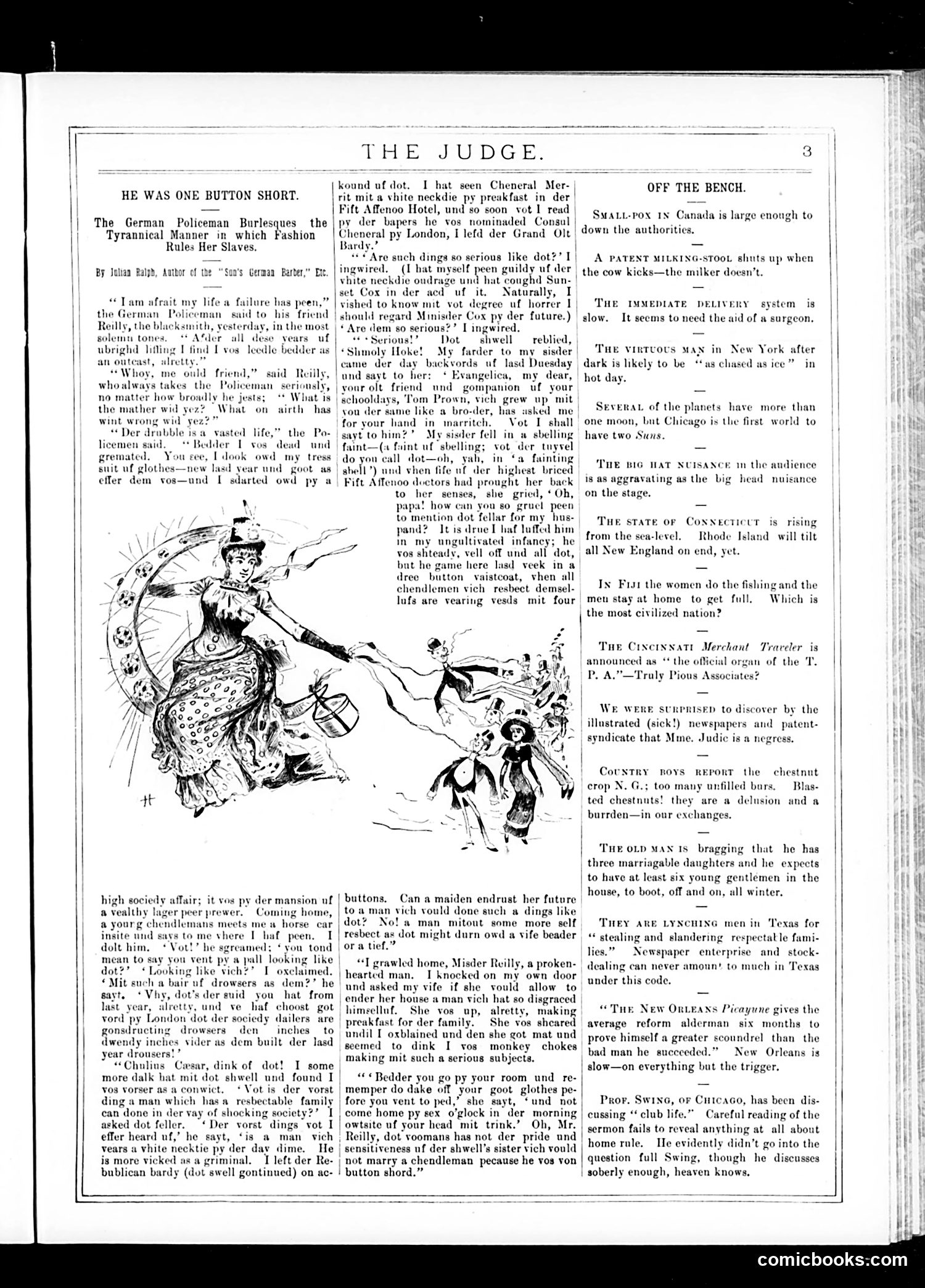
This page satirizes the tyranny of fashion through a German policeman's monologue. The joke: rigid fashion rules dictate social acceptability to an absurd degree. The officer describes how wearing an outdated three-button waistcoat—instead of the current four-button style—caused him social humiliation and ruined a family's marriage prospects. When he wore it to a society event, a wealthy peer mocked him. His daughter rejected a respectable suitor solely because the man wore an unfashionable waistcoat. The satire targets how arbitrarily fashion enslaves people, particularly the working and middle classes who fear social judgment over trivial details. The German dialect character, common in Judge magazine for comedic effect, amplifies the absurdity: a serious man is reduced to despair over button count. The cartoon illustrates fashion's irrational power—people destroy reputations and relationships over clothing styles that change constantly, making respectability impossible to maintain.
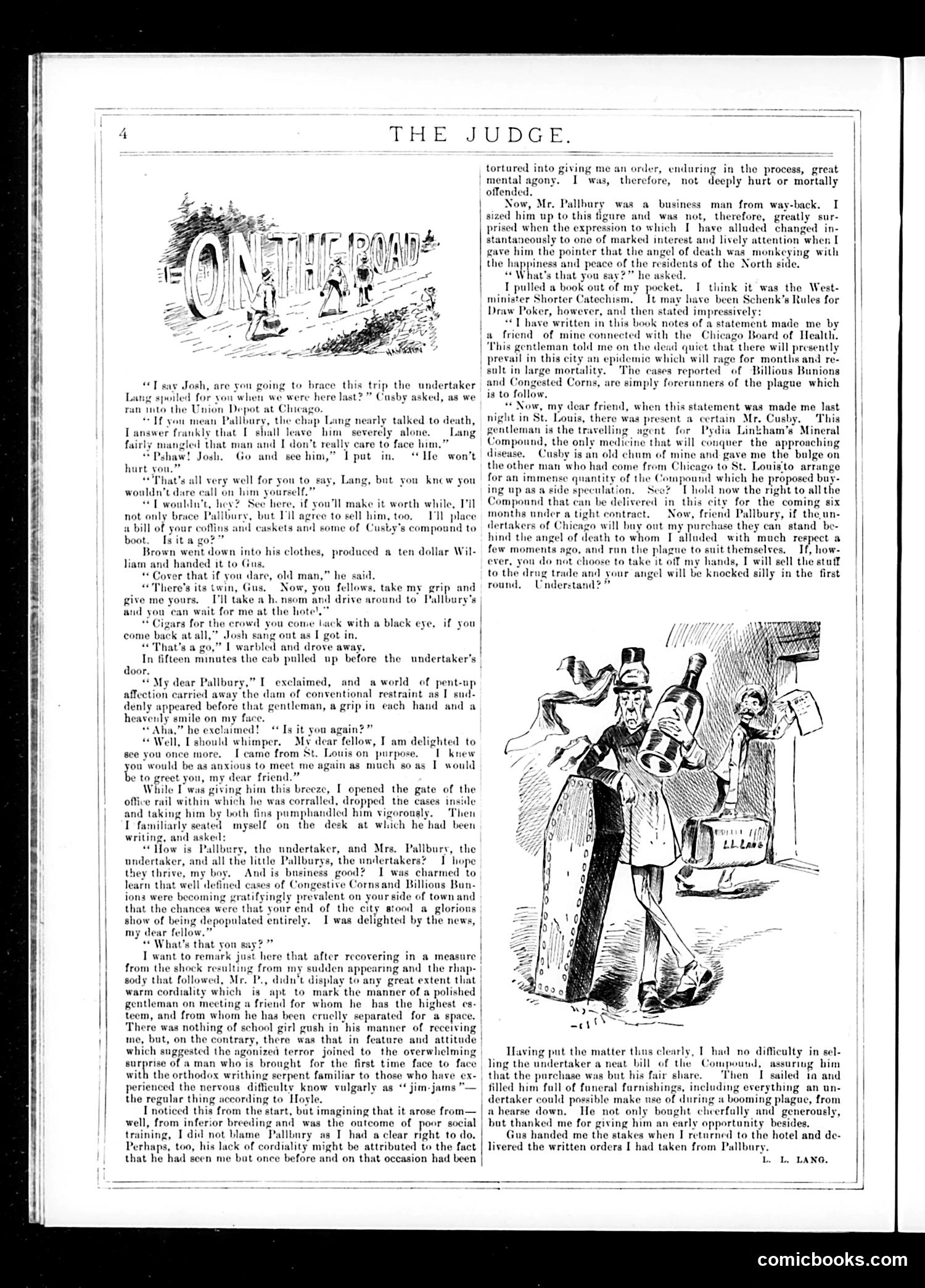
This page presents a humorous narrative about a traveling salesman's prank. The story involves three men: the narrator, "Lang," and "Gus." While visiting Chicago, they wager money that Gus will dare to visit an undertaker named Pallbury—apparently someone who had been difficult or unpleasant in a previous encounter. Gus accepts the bet, drives to Pallbury's funeral home, and greets the undertaker with exaggerated warmth and familiarity, physically manhandling him while discussing the undertaker's business and family in mock-sympathetic terms. The narrator notes Pallbury's visible terror and discomfort during this unwanted reunion. The satire targets the aggressive, intrusive behavior of traveling salesmen of the era—their relentless cheerfulness, boundary-crossing familiarity, and willingness to exploit business relationships for personal amusement. The illustration shows Gus's chaotic arrival at the funeral home, capturing the disruption he causes.
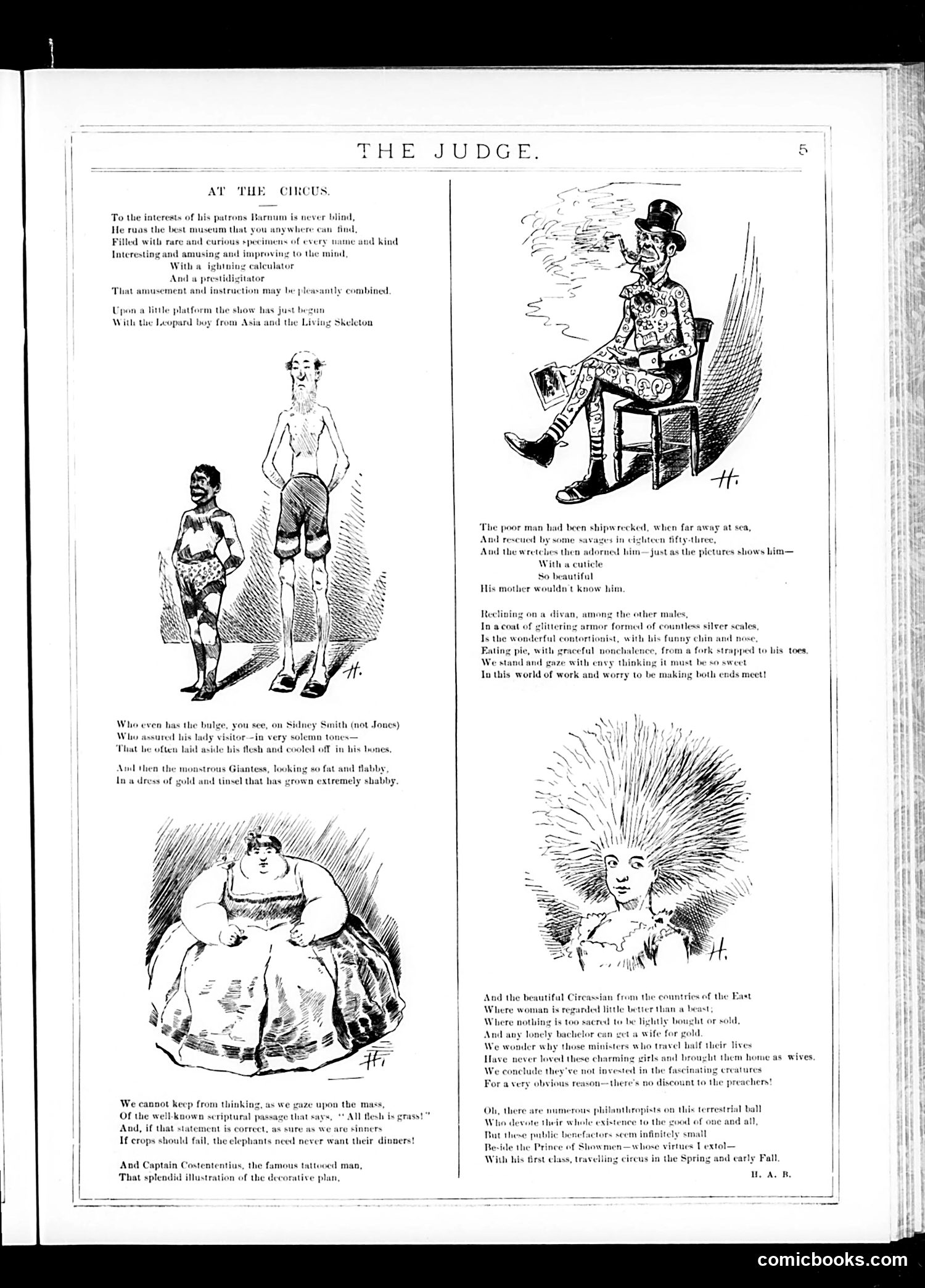
This page satirizes **P.T. Barnum's traveling circus**, mocking both the exotic attractions and the wealthy patrons who gawk at them. The cartoon critiques the era's obsession with human curiosities and "freak shows." The illustrated performers include: a "Living Skeleton," a tattooed man, a "Giantess" in gaudy costume, and a "Circassian" woman from Eastern Europe (presented as exotic). The text mocks Barnum's marketing genius while ridiculing society's fascination with these displays. A key joke: the verse sardonically suggests that viewing circus performers—people reduced to spectacle due to poverty or misfortune—is morally uplifting compared to actual charitable work. The closing lines name Barnum a "Prince of Showmen," praising his "traveling circus" while implying his success comes from exploiting human suffering for entertainment and profit. The satire targets both Barnum's showmanship and the hypocrisy of audiences who view themselves as cultured while consuming such exploitation.
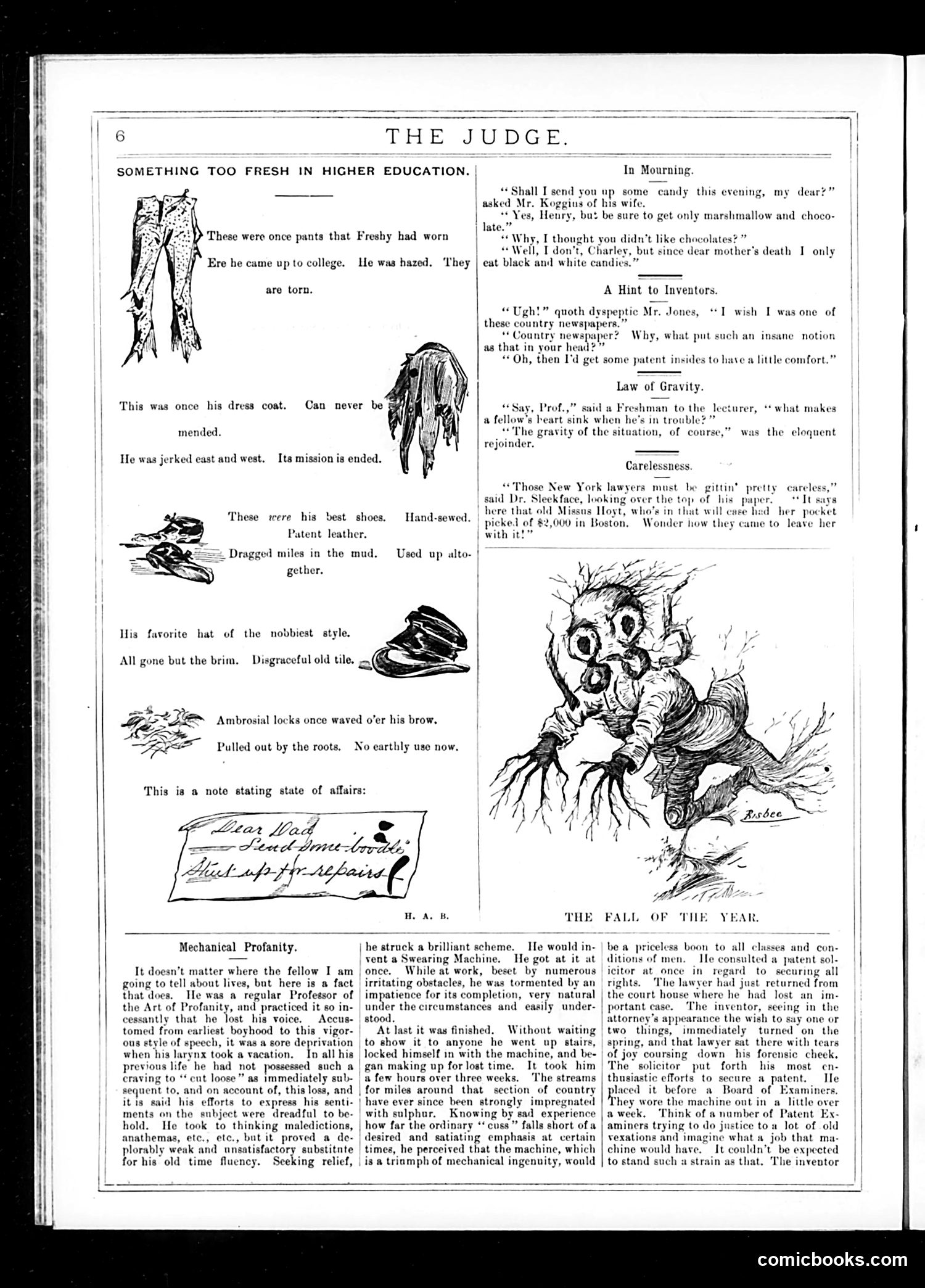
This page from *Judge* satirizes college hazing and higher education's physical toll on students. **"Something Too Fresh in Higher Education"** depicts a freshman's destroyed belongings—torn pants, ruined coat, worn shoes, damaged hat—cataloging the brutal hazing rituals of the era. The phrase "He was hazed" explains the damage; the worn items represent the violent initiation practices college students endured. **"Mechanical Profanity"** describes a man who invents a "Swearing Machine" after losing his voice from excessive cursing. The joke mocks both his profanity habit and the era's absurd mechanical inventions. The ending satirizes lawyers' greed: when the machine is activated near a lawyer, he "sits there with tears of joy"—implying even a profanity machine would benefit from legal counsel's billable hours. The smaller humor pieces mock college life, parental naïveté about student expenses, and New York lawyers' carelessness with client money. The overall tone is gentle mockery of educational pretension and contemporary social foibles.
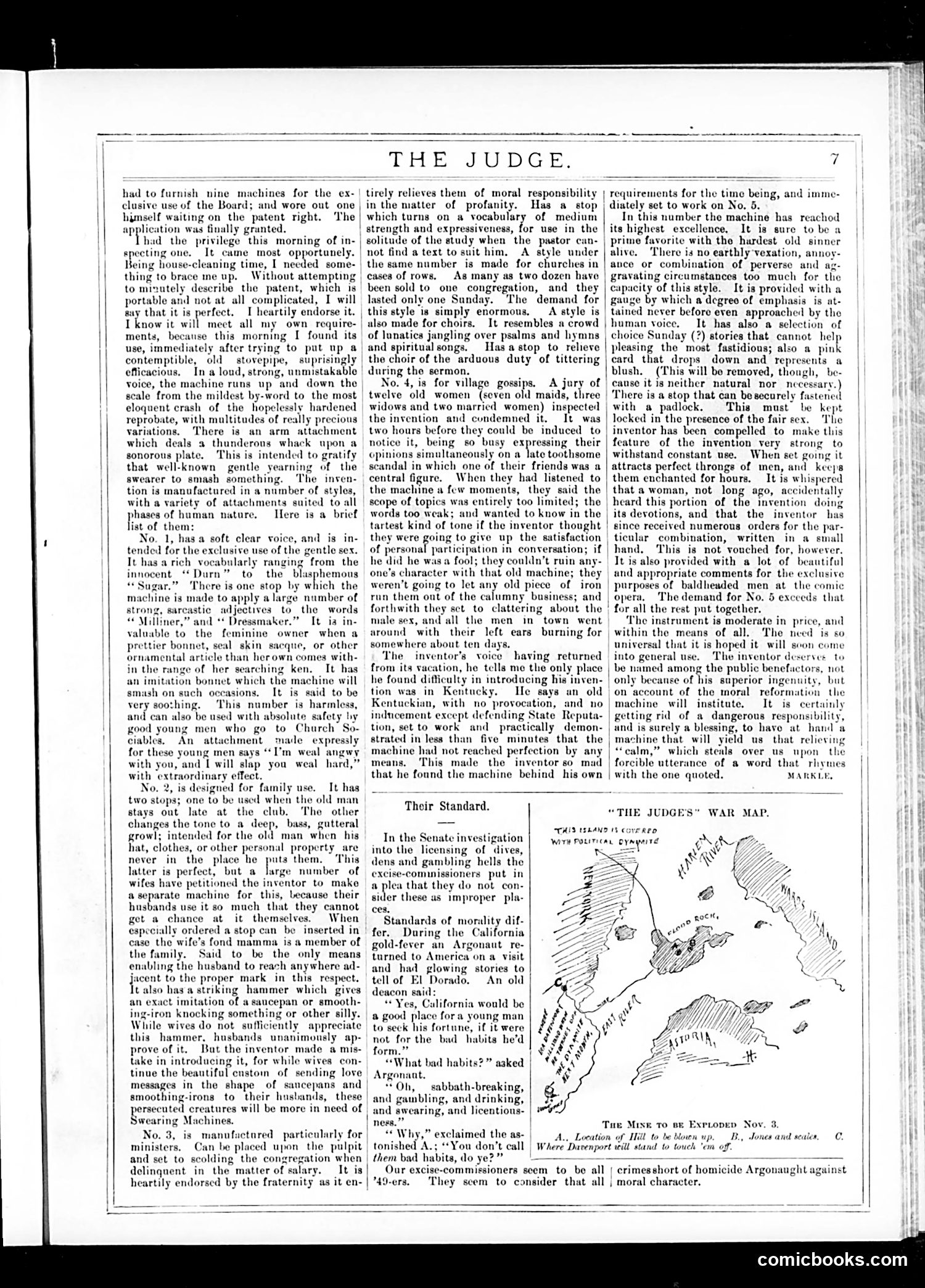
This page satirizes Victorian-era social hypocrisy around profanity and emotional expression. The article describes a fictional "Swearing Machine"—a mechanical device designed to allow different social classes to curse without moral responsibility. The satire targets multiple groups: women (limited to mild oaths like "Durn"), young churchgoers (given pre-approved angry phrases), wives (permitted to "smash" imitation bonnets when frustrated about fashion), and ministers (who can scold congregants about unpaid salaries without personal guilt). The joke exposes the era's repressive social codes: respectable people couldn't openly swear, so the invented machine absolves them of moral accountability for profanity. By literalizing this desire to curse while remaining "proper," the cartoonist mocks society's pretense that emotional outlets can be mechanized without hypocrisy. The included war map appears unrelated, likely from another article.
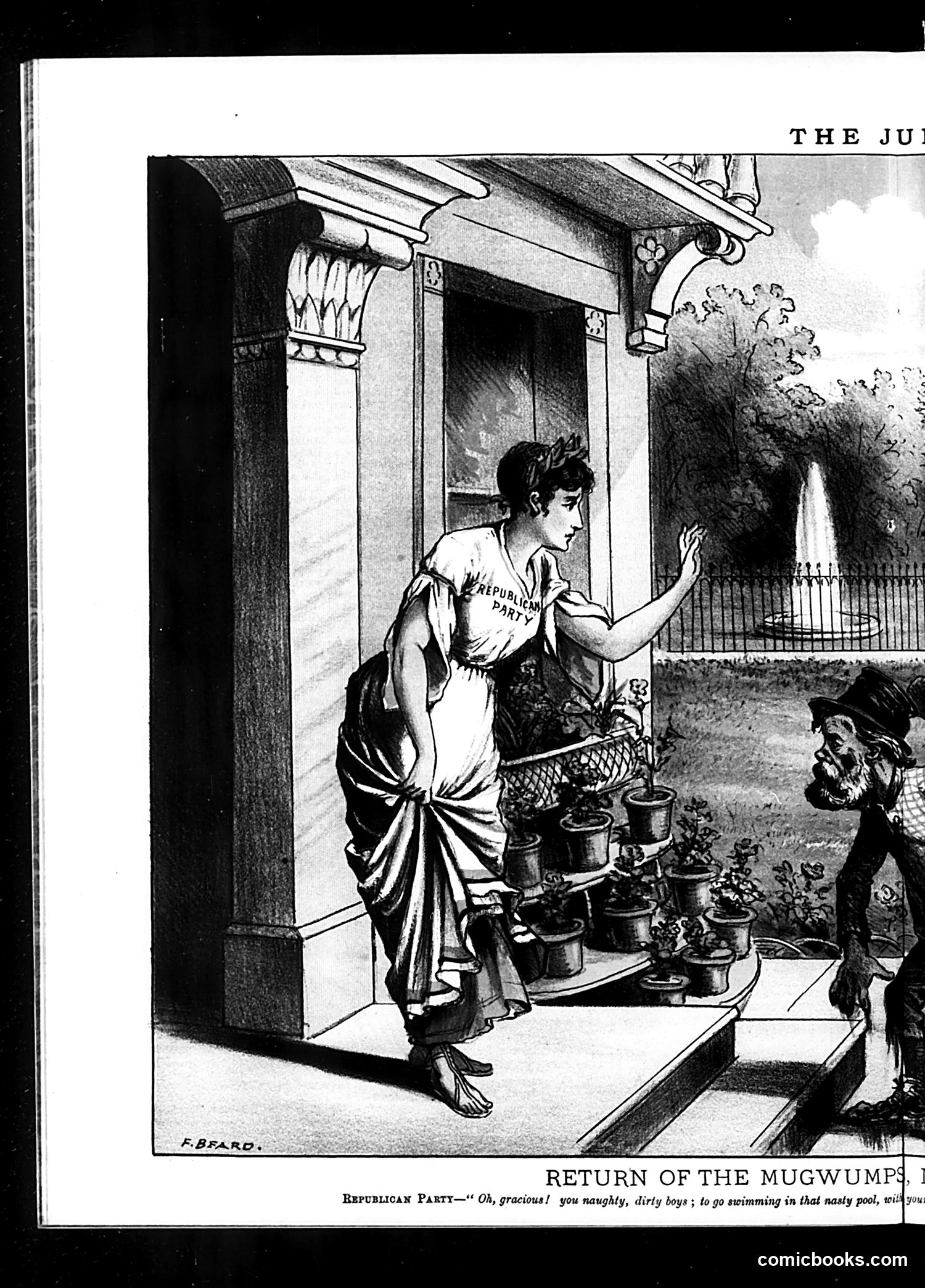
This cartoon satirizes the Republican Party, depicted as a scandalized woman scolding men (the "Mugwumps") for swimming in a "nasty pool." **Mugwumps** were Republican dissidents who abandoned the party—historically over corruption issues. The "nasty pool" likely represents either corrupt Republican practices or Democratic politics the Mugwumps were accused of joining. The cartoon mocks Republican leadership's disapproval of party defectors while using the feminized "gracious" woman figure to suggest weakness or ineffectual scolding. The tone implies Republicans are hypocritically lecturing wayward members rather than addressing underlying problems. The exact historical moment is unclear without a date, but this reflects internal Republican fracturing, likely from the Gilded Age when Mugwumpism was significant political phenomenon.
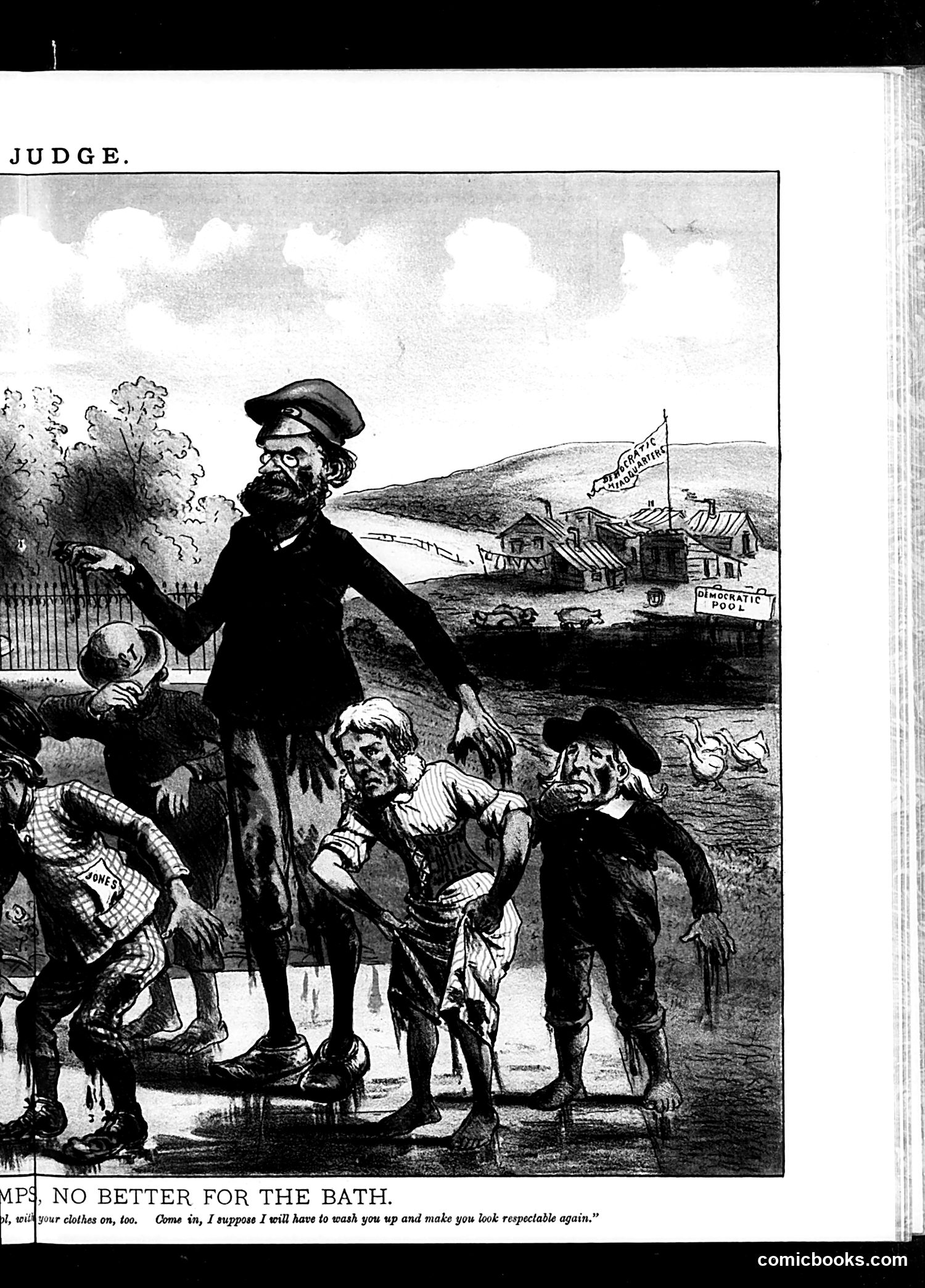
This cartoon depicts a bearded authority figure (labeled "JUDGE") addressing a group of ragged, dirty children near a waterfront. The figure appears to be a judicial or governmental official overseeing what looks like impoverished immigrant children or street urchins. The caption indicates the Judge is reluctantly agreeing to "wash you up and make you look respectable again," suggesting social commentary about judicial responsibility toward poor or marginalized children. The contrast between the official's respectable appearance and the children's squalid condition critiques either inadequate child welfare systems or judicial neglect of vulnerable populations. The "Democratic Pool" sign visible in the background may reference Democratic Party policies or institutions regarding social welfare, making this likely a Republican-leaning satirical critique of Democratic approaches to poverty and child welfare.
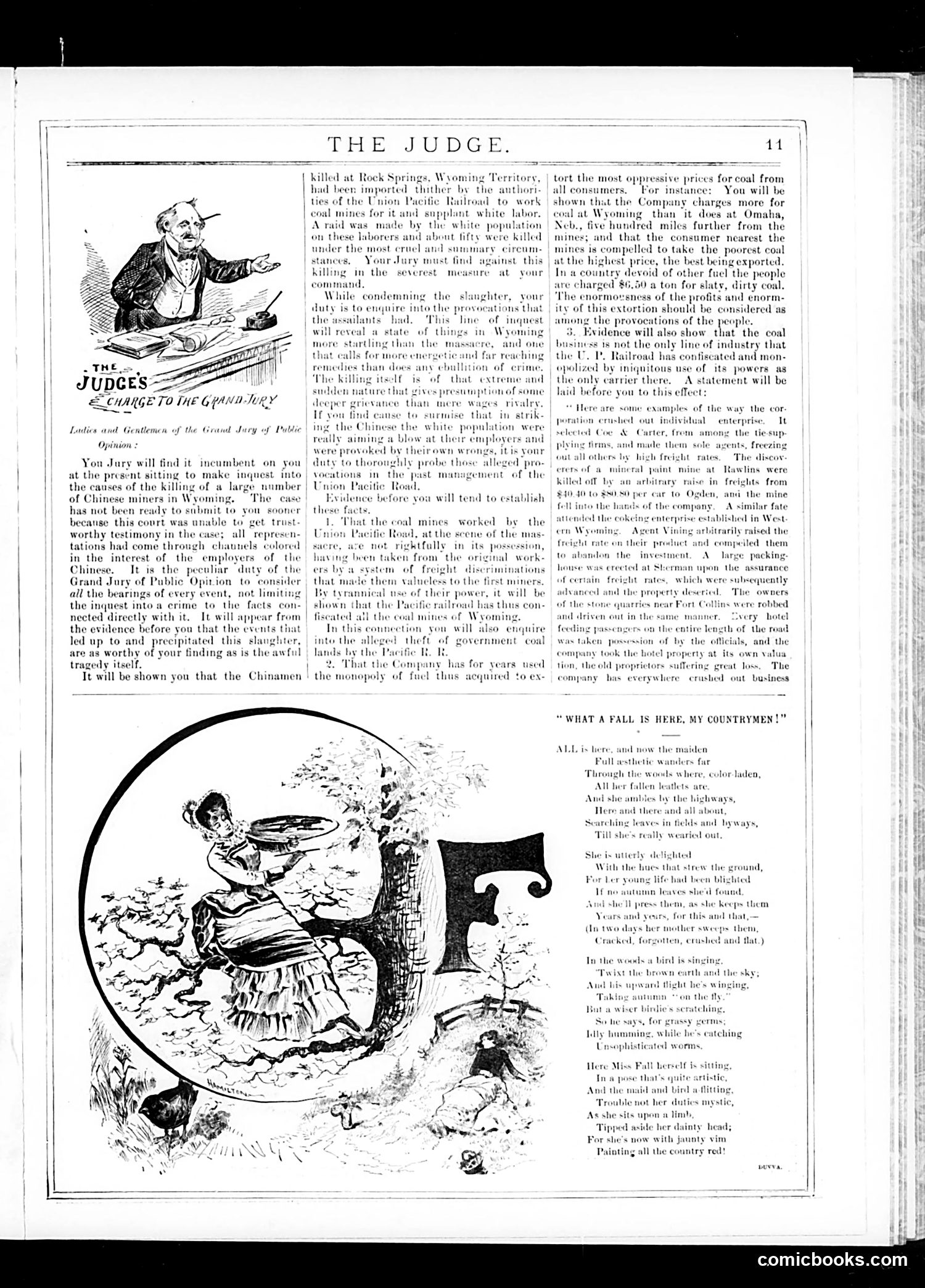
This page addresses the **Rock Springs Massacre of 1885**, when white workers killed Chinese miners in Wyoming Territory. The top cartoon depicts a judge addressing a grand jury about investigating not just the killings, but their underlying causes. The text argues the Chinese were brought in by the **Union Pacific Railroad** to undercut white labor. However, the real villain, Judge contends, is the railroad itself—which exploits everyone through monopolistic practices: charging Wyoming miners more for coal than distant consumers pay, using discriminatory freight rates to crush competing businesses, and using its economic power to eliminate individual enterprise. The satire targets **corporate monopoly abuse** more than xenophobia. While acknowledging white workers' grievances about Chinese labor displacement, Judge insists the Railroad Corporation—not Chinese workers—deserves blame for systematically crushing competition and controlling fuel supplies. The decorative illustration below (unrelated to the main text) is a whimsical poem about a country maiden, appearing to be filler content typical of the era's magazines.
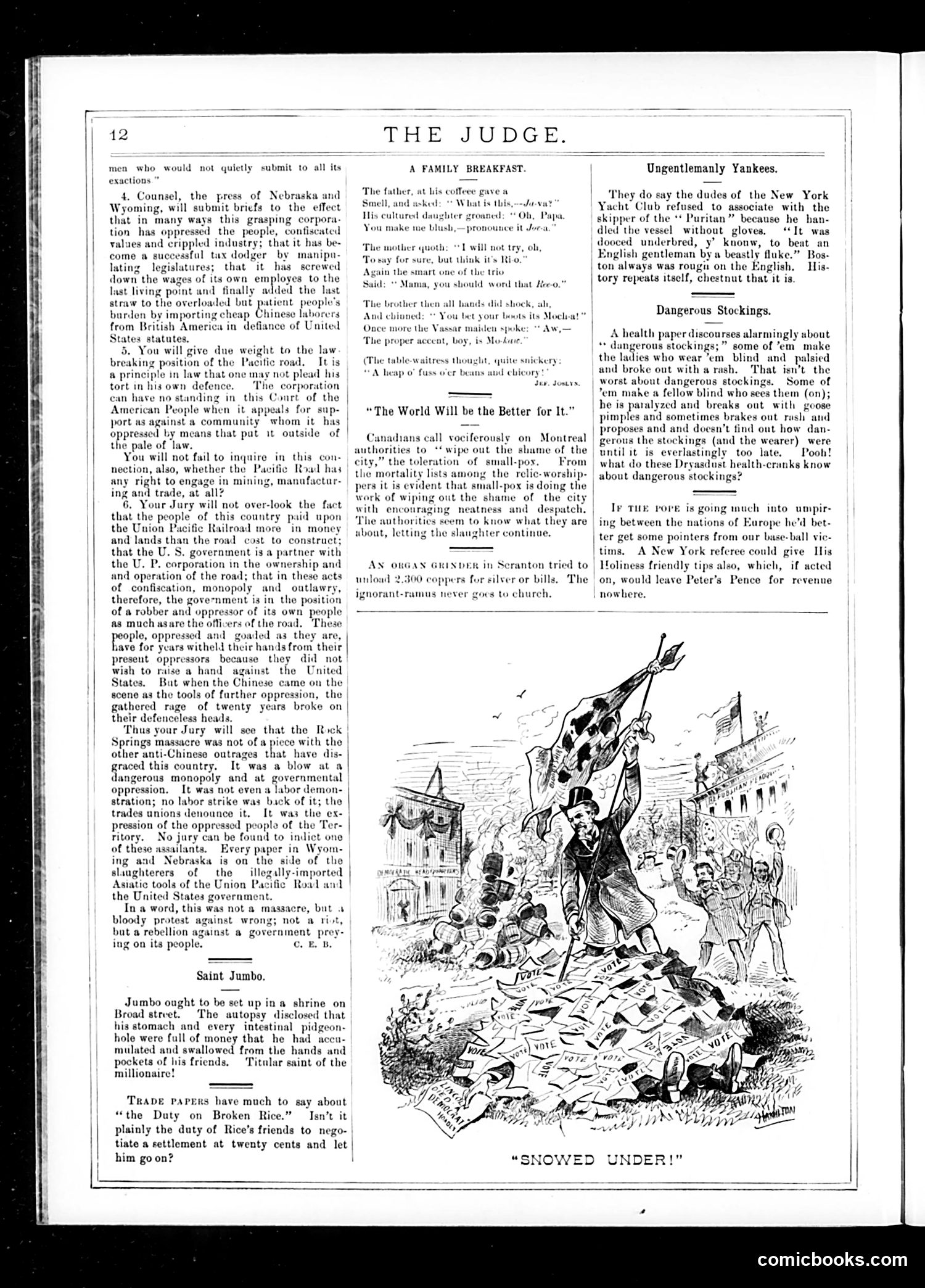
This page contains three separate satirical pieces: **"Snowed Under!" (Main Cartoon):** The large illustration depicts the **Rock Springs Massacre** of 1885, when white workers in Wyoming attacked Chinese laborers employed by the Union Pacific Railroad. The cartoon shows Chinese workers being violently overwhelmed. The accompanying text (a legal argument) frames the violence not as a "massacre" but as justified rebellion against corporate and governmental oppression—positioning Chinese workers as tools of an exploitative monopoly that had impoverished American workers. **"A Family Breakfast":** A brief comedic dialogue about mispronouncing "Rio" (likely referring to Rio coffee), playing on class pretensions and proper accent. **"Saint Jumbo" and trade items:** Brief satirical notes—one mocking an elephant's accumulated wealth, another making a pun about rice tariffs and a person named Rice. The page reflects 1880s American anxieties about monopolies, labor exploitation, immigration, and anti-Chinese sentiment—treating violent xenophobia as understandable (if not justified) working-class frustration.
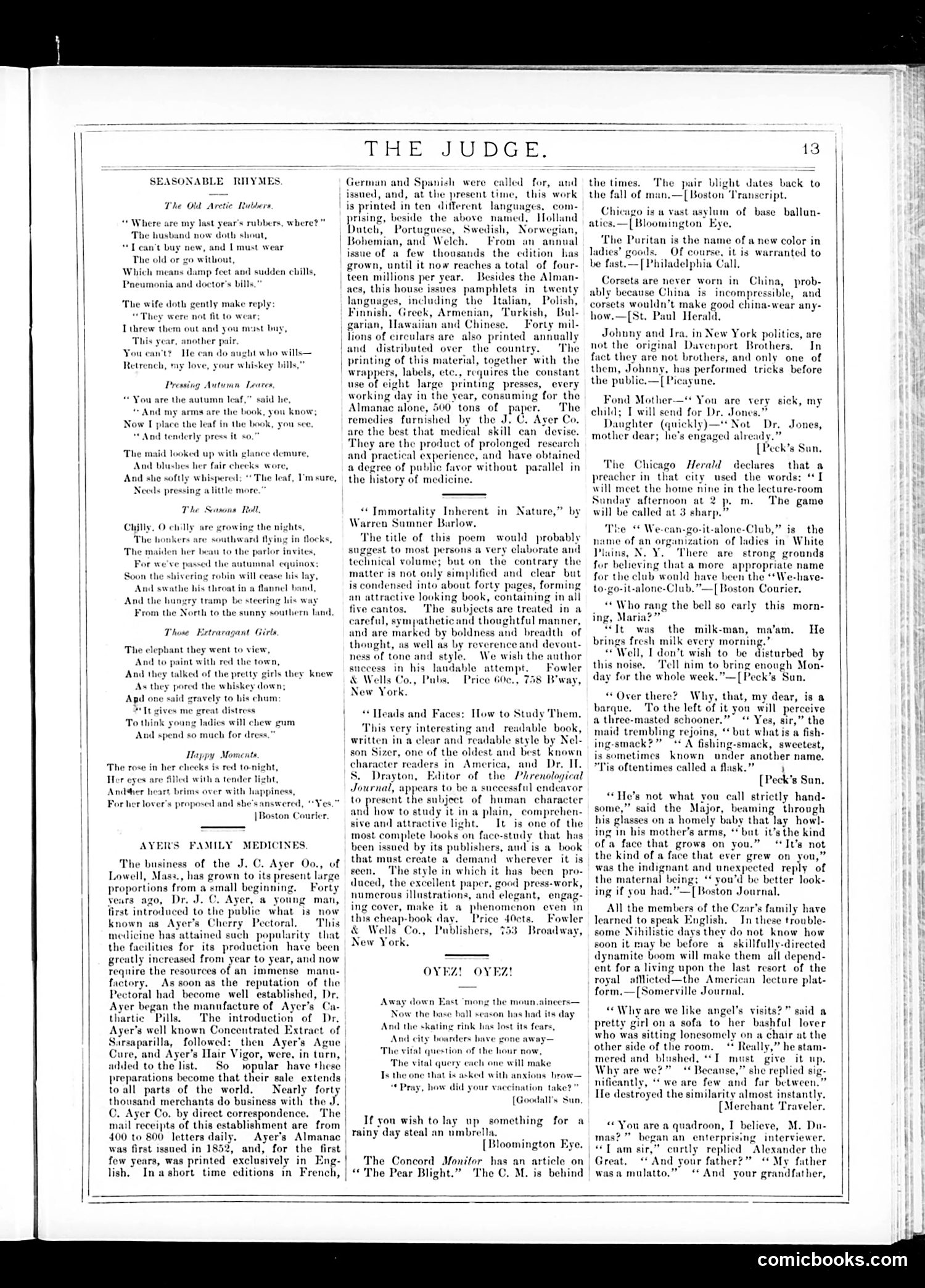
This page from *Judge* is primarily **advertising and literary content**, not political satire. **The main content consists of:** 1. **"Seasonable Rhymes"** — Several humorous poems about domestic life: a husband complaining about old rubber boots his wife discarded; a flirtation involving pressing autumn leaves in a book; observations on seasonal changes; young men gossiping about extravagant girls who chew gum and spend on clothes; and a woman accepting a marriage proposal. 2. **"Ayer's Family Medicines"** — A lengthy advertisement for J.C. Ayer & Co.'s patent medicines (Cherry Pectoral, Ague Cure, Hair Vigor, etc.). It details the company's growth from its founding 40 years prior, its massive distribution network (40,000 merchants), and the Ayer's Almanac's expansion from English-only to 14 languages with 14 million annual copies printed. **No political cartoon or satire appears on this page.** The humor is light domestic comedy. The advertising reflects 19th-century American business expansion and the era's widespread patent medicine industry.
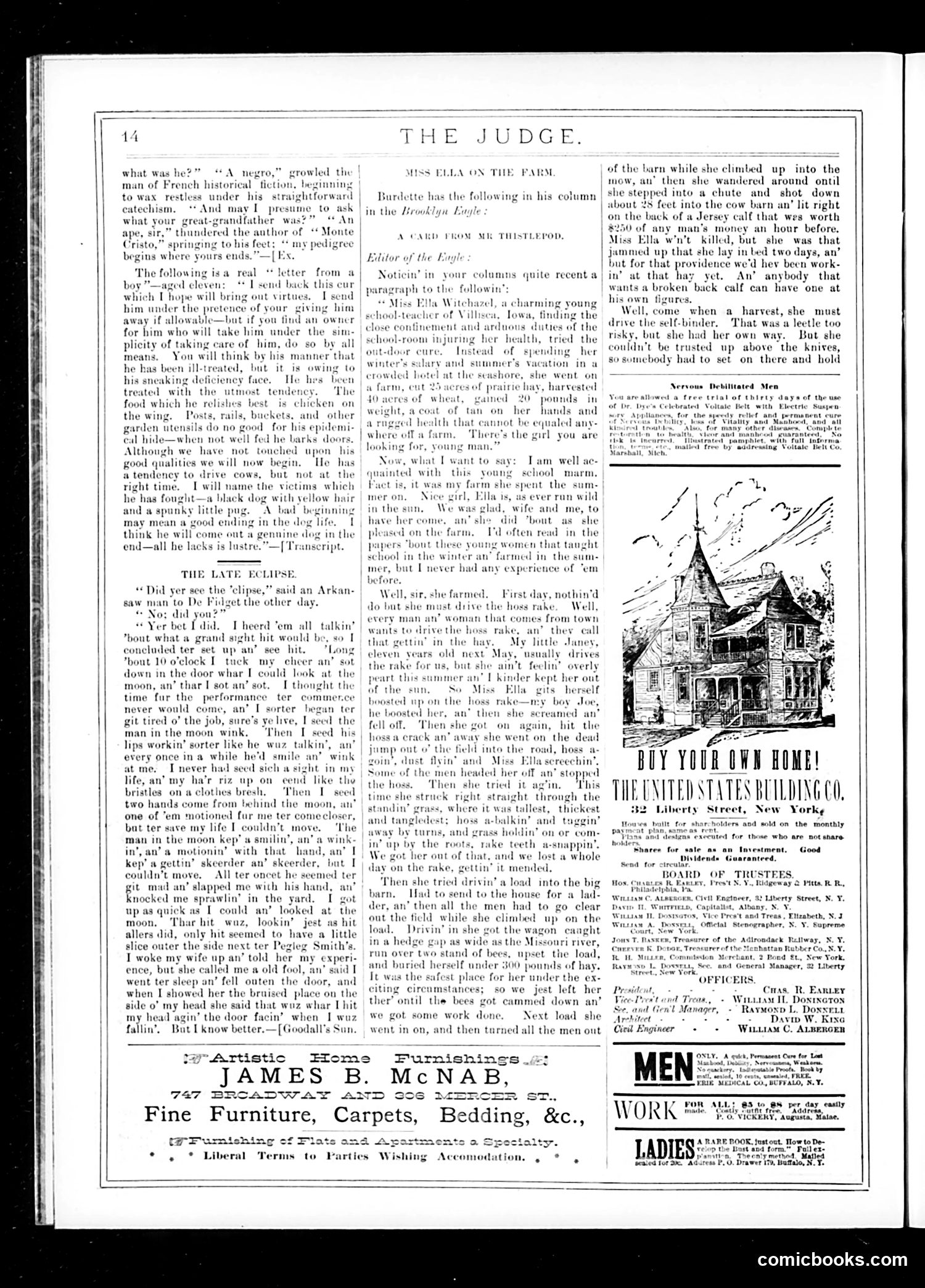
This page contains two humorous rural sketches typical of Judge magazine's satirical humor. **"Miss Ella on the Farm"** depicts a schoolteacher from town attempting farm work with disastrous results. The joke relies on the contrast between refined, educated urbanites and practical rural life. Miss Ella's repeated accidents—getting stuck in a hay chute, falling off the horse rake, screaming—illustrate the satirical point: city people are incompetent at farm labor. The farmer narrator's deadpan recounting ("That was a leetle too risky") emphasizes rural people's pragmatism versus urban inexperience. **"The Late Eclipse"** features an Arkansas man describing witnessing a lunar eclipse. The humor derives from his malapropisms and folksy dialect ("performan'" for performance), mocking rural speech patterns—common satirical fodder in the period. Both sketches employ exaggerated dialect and physical comedy to portray rural/urban cultural divides, reflecting late-19th-century attitudes about class and education differences.
This page is primarily **advertising**, not political satire. It contains multiple commercial advertisements for patent medicines, printing services, pianos, trusses, and other products typical of late 19th-century publications. The only substantial editorial content is a lengthy humorous story (titled "The Judge") about a young woman named Ella who visits a farm. The narrative presents rural stereotypes and gender humor: Ella is portrayed as an impractical city girl whose well-intentioned but naive actions create comic mishaps—she destroys crops trying to preserve flowers, faints at a snake, decorates workers with ribbons, and accidentally harms livestock. The story's joke centers on the contrast between romantic, idealized depictions of farm life in contemporary newspapers versus the messy reality. Despite her incompetence, the narrator notes rural men still admire her, and she'll make a good wife—reflecting period assumptions about female value regardless of practical ability. The humor is gentle rather than biting satire, relying on rural-versus-urban cultural differences common to American humor of this era.
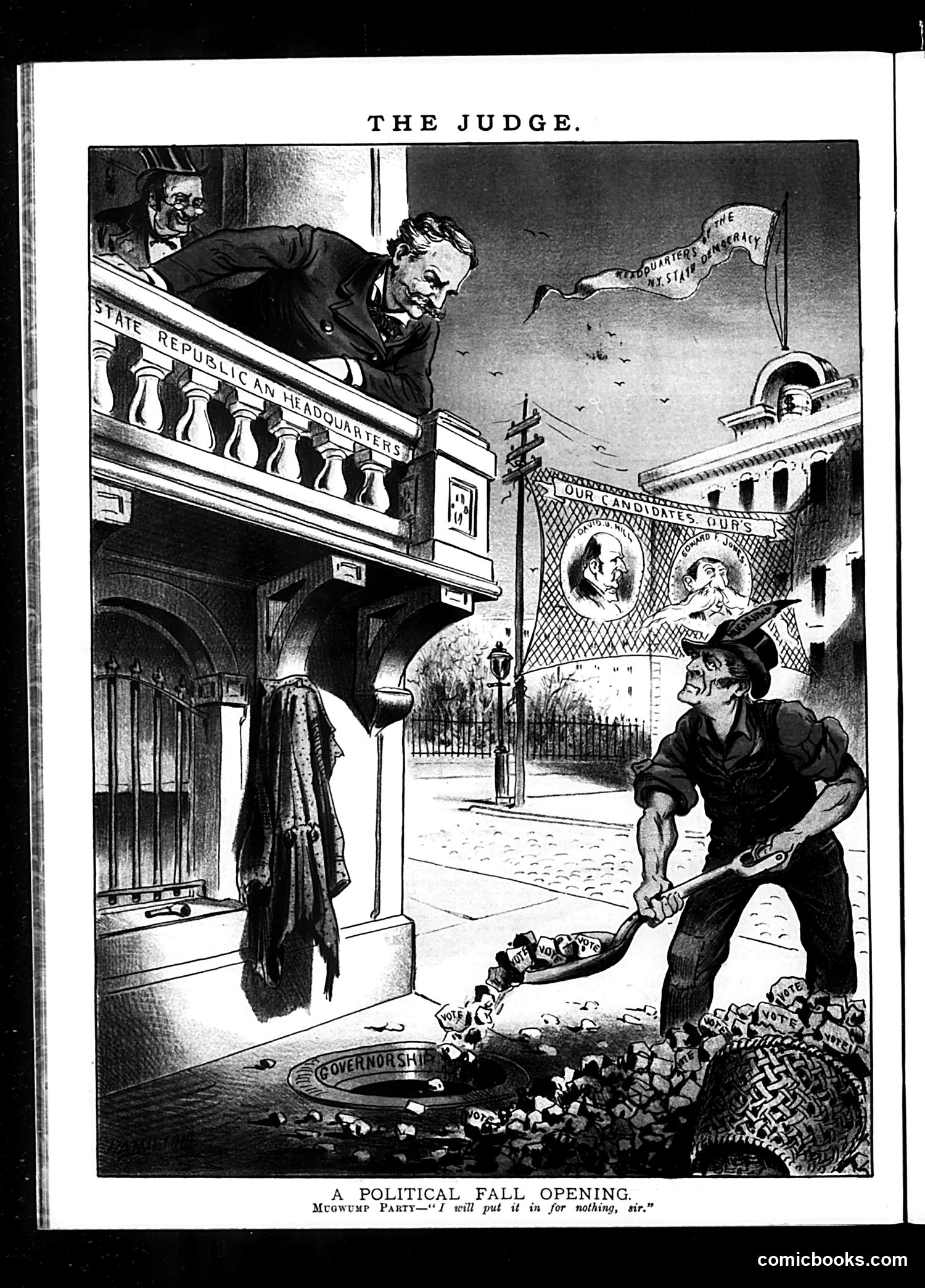
This cartoon satirizes the McCormick Party (likely referring to a political faction or candidate associated with that name) as opportunistic and self-serving. The image shows a man in working-class dress holding a club labeled "Votes," standing before the "State Republican Headquarters." Above, a Republican official leans from a window, apparently dismissing him. The caption's quote—"I will put it in for nothing, sir"—suggests the McCormick Party operative is offering support without expectation of payment or legitimate political engagement. The scattered "votes" on the ground and the overall composition mock McCormick supporters as willing to work for free or minimal gain, implying they lack genuine political principles. The cartoon criticizes what it presents as cynical, self-interested political maneuvering masquerading as grassroots support.