
Judge, 1885-10-24 · page 10 of 16
Judge — October 24, 1885 — page 10: what you’re looking at
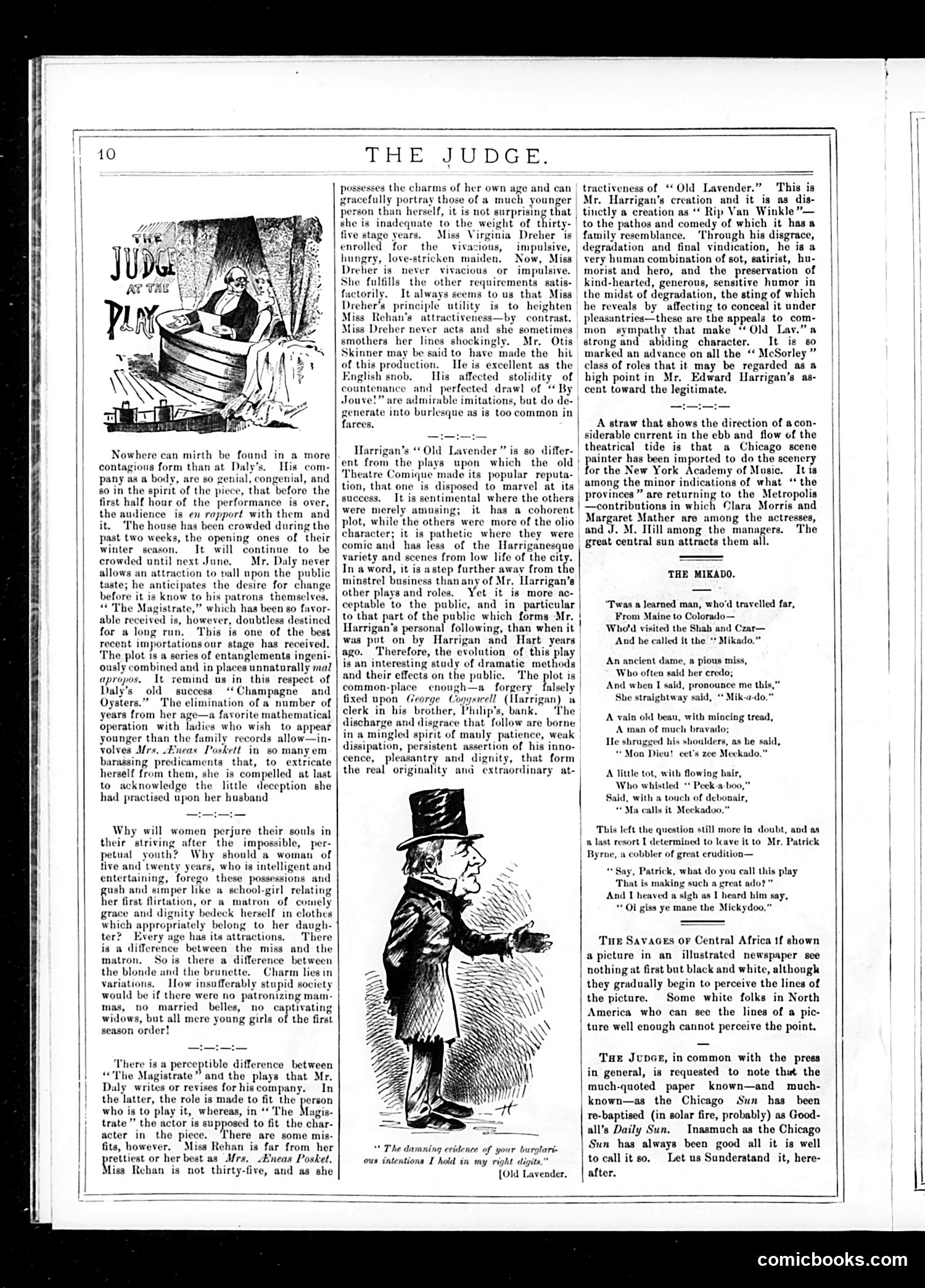
A restored page from Judge, 1885-10-24. Page through the whole issue in the reader above.
📄 Transcribed text from this page (OCR, searchable)
Machine-transcribed from the original scan — historical spelling and the odd misread are preserved.
THE § a hi Par Nowhere can mirth be found in a more contagious form than at Daly’s. His com- pany as a body, are so genial, congenial, and so in the spirit of the piece, that before the first half hour of the performance is over, the audience is en rapport with them and it. The house has been crowded during the past two weeks, the opening ones of their winter season, It will continue to be crowded until next June. Mr. Daly never allows an attraction to pall npon the public taste; he anticipates the desire for change before it is know to his patrons themselve: “The Magistrate,” which has been so favor- able received is, however, doubtless destined for a long run, This is one of the best recent importations our stage has recei ‘The plot is a series of entanglements ingeni- ously combined and in places unnaturally ma? apropos. It remind us in this respect of Daly’s old success “Champagne and Oysters.” The elimination of a number of years from her age—a favorite mathematical operation with ladies who wish to appear younger than the family records allow—in- volves Mrs, Eneas Poskett in so manyem barassing predicaments that, to extricate herself from them, she is compelled at last to acknowledge the little deception she had practised upon her husband Why will women perjure their souls in their ‘striving after the impossible, per- petual youth? Why should a woman of tive and twenty years, who is intelligent and entertaining, forego the: ions and pot and simper like « school-girl relating h g er first flirtation, or a matron of come and dignity bedeck herself in clothes appropriately belong to her daugh- Every age has its attractions. There is a difference between the miss and the matron. So is there a difference between the blonde and the brunette. Charm lies in variations. Ilow insufferably stupid society would be if there were no patronizing mam- mas, no married belles, no captivating widows, but all mere young girls of the first season order! There is a perceptible difference between ‘The Magistrate” and the plays that Mr. Daly writes or revises for his company. In the latter, the role is made to fit the person who is to play it, whereas, in “Tho bi gis- trate” the actor is supposed to fit the char- acter in the piece. ‘There are some mis- fits, however. Miss Rehan is far from her prettiest or her best as Mrs. Eneas Posket. iss Rehan is not thirty-five, and as she THE JUDGE ses the charms of her own age and can gracefully portray those of a much younger person than herself, it is not surprising that she is inadequate to the weight of thirty- five stage years. Miss Virginia Dreher is enrolled for the vivacious, impulsi hungry, love-stricken maiden. Now, Miss | Dreher is never vivacious or impulsiv She fulfills the other requirements sat: factorily. It always seems to us that Miss Dreher’s principle utility is to heighten Miss Rehan’s attractivene Miss Dreher never acts and she sometimes smothers her lines shocking]. Mr. Otis Skinner may be said to have made the hit of this production. He is excellent as the English snob. His affected stolidity of countenance and perfected drawl of ** By Jouve!” are admirable imitations, but do de- generate into burlesque as is too common in farces. | pos Marrigan’s ‘* Old Lavender” is so _differ- ent from the plays upon which the old Theatre Comique made its popular reputa- tion, that one is disposed to marvel at its success, It is sentimental where the others were merely amusing; it has a cohorent plot, while the others were more of the olio character; it is pathetic where they were comic and has less of the Harriganesque variety and scenes from low life of the city. In a word, it is astep further away from the minstrel business than any of Mr, Harrigan’s | other plays and roles, Yet it is more ac- | ceptable to the public, and in particular | to that part of the public which forms Mr. | Harrigan’s personal following, than when it was put on by Harrigan and Hart. years ago. Therefore, the evolution of this play is an interesting study of dramatic methods and their effects on the public. The plot is common-place enough—a forgery falsely | fixed upon orge Coggswell (Marrigan) a clerk in his brother, Philip’s, bank. ‘The discharge and disgrace that follow are borne in a mingled spirit of manly patience, weak dissipation, persistent assertion of his inno- cence, pleasantry and dignity, that form the real originality and extraordinary at- " The damning evidence of your burglar. ous intentions I hold in my right digits.” nder. tractiveness of ‘Old Lavender.” This is Mr. Harrigan’s creation and it is as dis- tinctly a creation as‘ Rip Van Winkle ”— to the pathos and comedy of which it has a family resemblance. ‘Through his disgrace, degradation and final vindication, he is a very human combination of sot, satirist, hu- morist and hero, and the preservation of kind-hearted, generous, sensitive humor in the midst of degradation, the sting of which he reveals by affecting to conceal it under pleasantries—these are the appeals to com- mon sympathy that make ‘Old Lay.” a strong and abiding character. It is so marked an advance on all the ‘‘ McSorley ” class of roles that it may be regarded as 9 high point in Mr. Edward Harrigan’s as- cent toward the legitimate. A straw that shows the direction of acon- siderable current in the ebb and flow of the theatrical tide is that a Chicago scene painter has been imported to do the scenery for the New York Academy of Music. Itis among the minor indications of what “ the provinces” are returning to the Metropolis —contributions in which Clara Morris and Margaret Mather are among the actresses, and J. M. Ifill among the managers. The great central sun attracts them all. THE MIKADO. ‘Twas a Jearned man, who'd travelled fa From Maine to Colorado— Who'd ited the Shah and Czar— And he called it the ‘* Mikado, An ancient dame, a pious miss, Who often said her credo; And when I said, pronounce me this,”* She straightway said, “Mikado.” A vain old beau, with mincing tread, A man of much bravado; He shrugged his shoulders, as he said, “Mon Dieu! eet’s ce Meckado.” A little tot, with flowing hai Who whistled ** Peck-a-boo,”" Said, with a touch of debonair, calls it, Meckadoo,” This left the question still more fa doubt, and as a last resort I determined to Icave it to Mr. Patrick Byrne “Say, Pat ‘That is making such a g1 And I heaved a sigh as I heard him say, * Oi giss ye mane the Mickydoo.” Tue SavaGes or Central Africa 1f shown apicture in an illustrated newspaper see nothing at first but black and white, although they gradually begin to perceive the lines of the picture. Some white folks in North America who can sec the lines of a pic- ture well enough cannot perceive the point. Tar JunGe, incommon with the press in general, is requested to note thut the much-quoted paper known—and much- known—as the Chicago Sun has been re-baptised (in solar fire, probably) as Good- all’s Daily Sun. Inasmuch as the Chicago Sun has always been good all it is well to call it so. Let us Sunderstand it, here- after. comicbooks.com | | |