
A complete issue · 16 pages · 1885
Judge — October 17, 1885
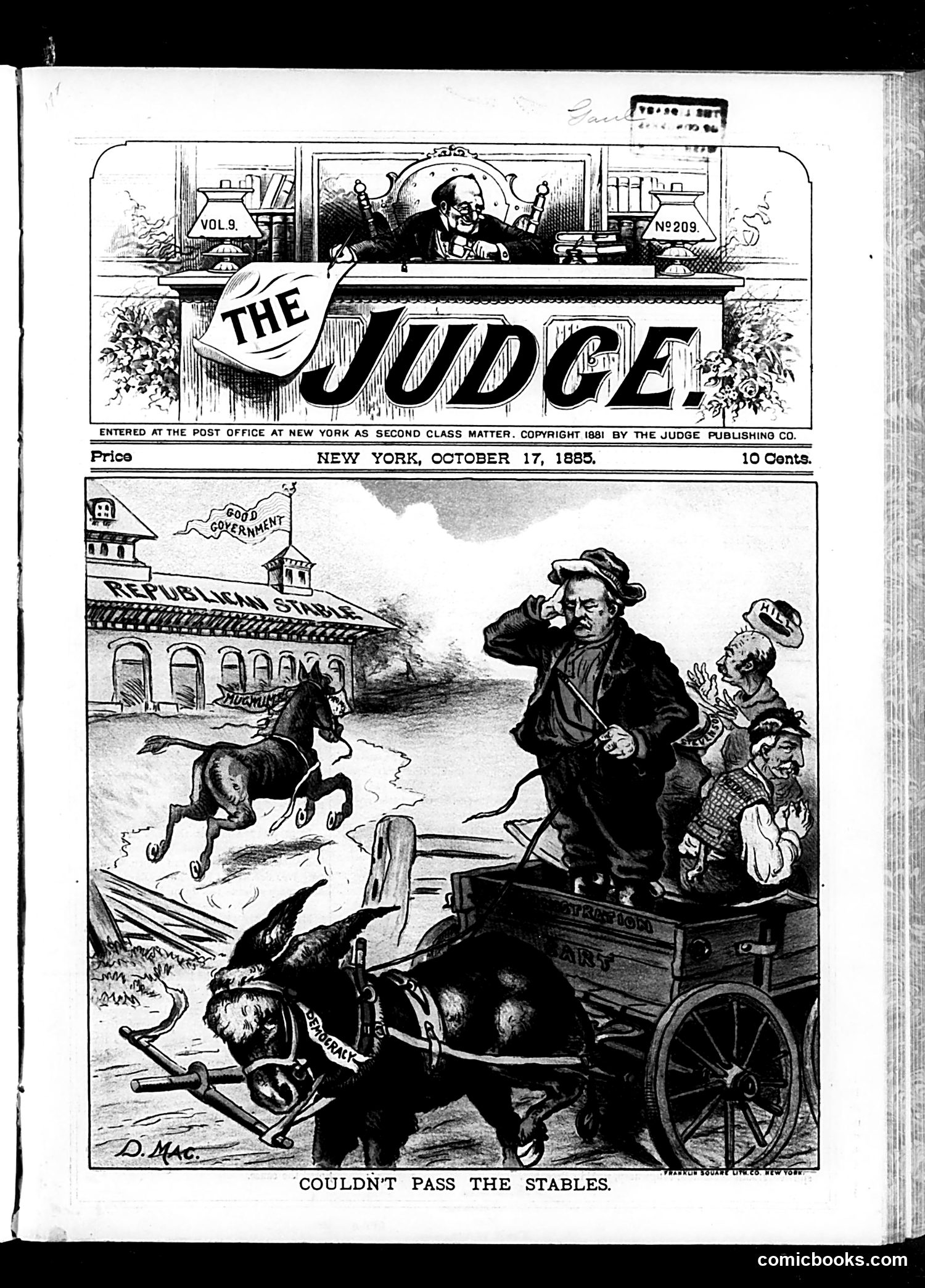
**Title:** "Couldn't Pass the Stables" **Visual Elements:** The cartoon shows a man in a cart pulled by a donkey, blocked from entering a building labeled "Republican" with a "Good Government" flag. A dog chases the donkey while other figures observe. **Political Context:** This appears to satirize Republican Party politics during the Arthur or Cleveland administrations (1885 context). The "stables" reference likely mocks Republican political machine corruption—the metaphor treating political headquarters as literal stables where unsuitable candidates or policies cannot gain entry. **The Satire:** The donkey-drawn cart suggests a foolish or unqualified figure attempting to join the Republican Party but being blocked by the party's gatekeepers, who maintain some minimal standards of "good government." The cartoon critiques both Republican corruption and the irony of claiming moral standards.
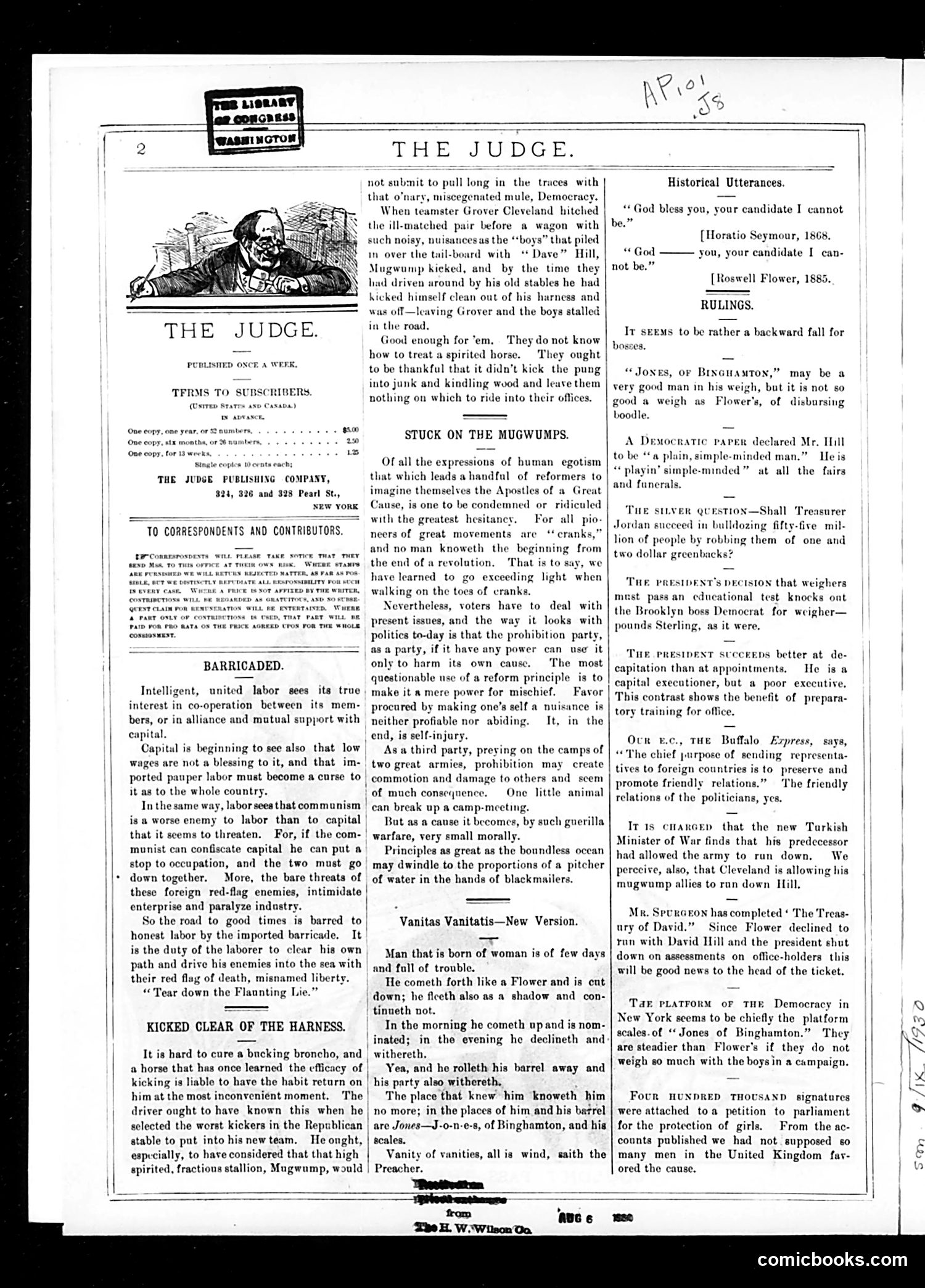
The main cartoon depicts a man being thrown from a horse, illustrating the article "Stuck on the Mugwumps." The piece satirizes reformers who present themselves as apostles of a great cause but are actually obstructionists hindering progress. The text criticizes the "prohibition party" and reform movements generally, arguing they create more damage than benefit. It suggests reformers are self-serving rather than genuinely motivated by principle. References to "Grover Cleveland" and "David Hill" indicate this likely addresses Democratic Party divisions in the 1880s-90s. The mugwumps were actual Republican reformers who bolted their party, making them targets for satirical ridicule about ineffectual activism. The cartoon's imagery emphasizes the chaos and impracticality these political figures supposedly created.
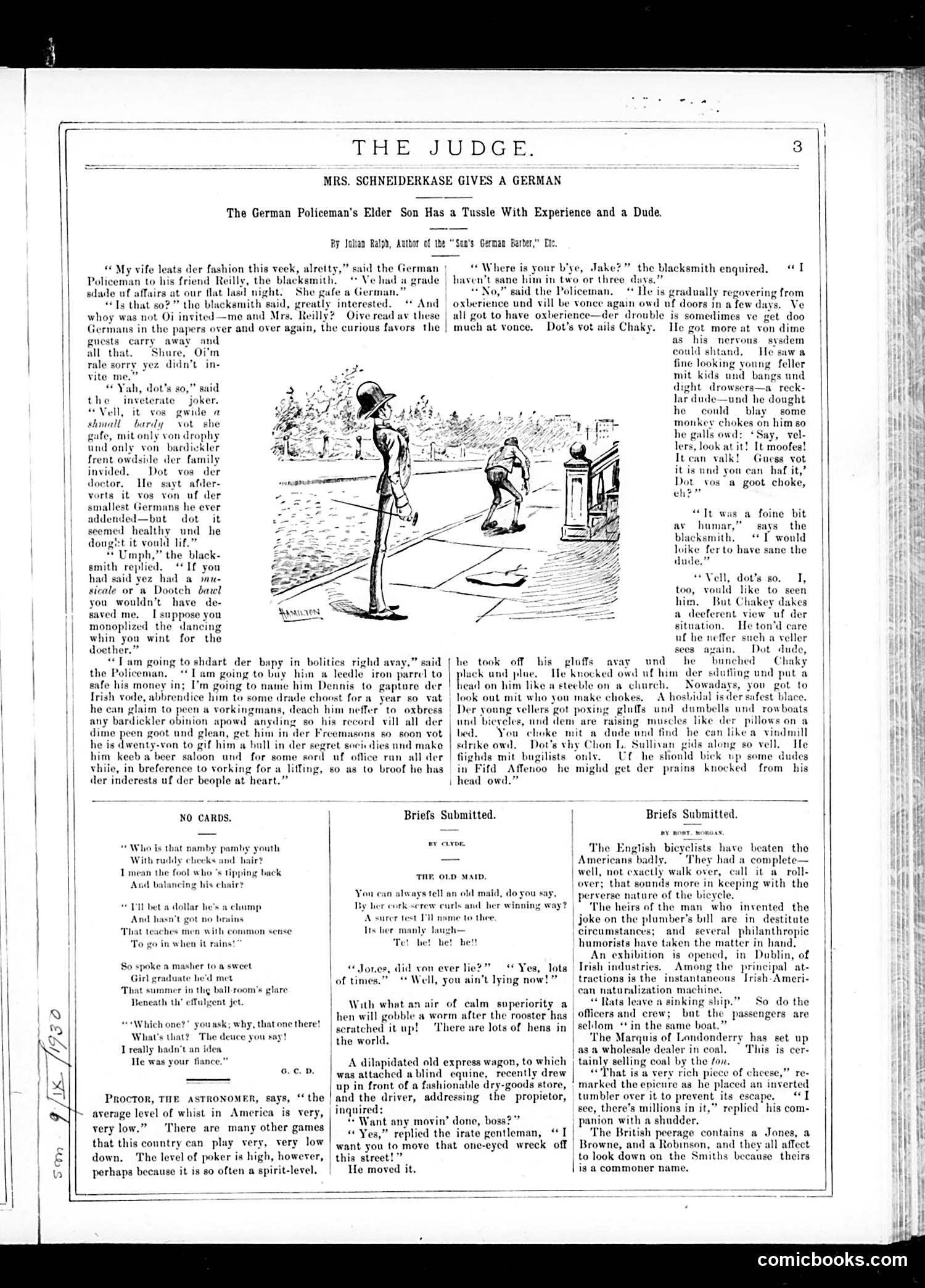
This 1890s Judge magazine piece satirizes German-American immigrants through dialect humor and social commentary. The main cartoon depicts a German policeman recounting to an Irish blacksmith (Reilly) his son Chakey's misadventure with a "dude"—a fashionably dressed young man. The satire operates on multiple levels: the exaggerated German dialect mocks immigrant speech patterns; the policeman's absurd plan to groom his son for politics (buying him an iron piggy bank, naming him "Dennis" to appeal to Irish voters, apprenticing him to "capture der Irish") lampoons political manipulation and ethnic pandering; and Chakey's humiliating encounter with the dude—who beats him after Chakey plays pranks on him—ridicules German-American youth as naive and physically outmatched. The joke ultimately targets both German and Irish immigrants as crude, unsophisticated, and mutually exploitative in pursuing American success.
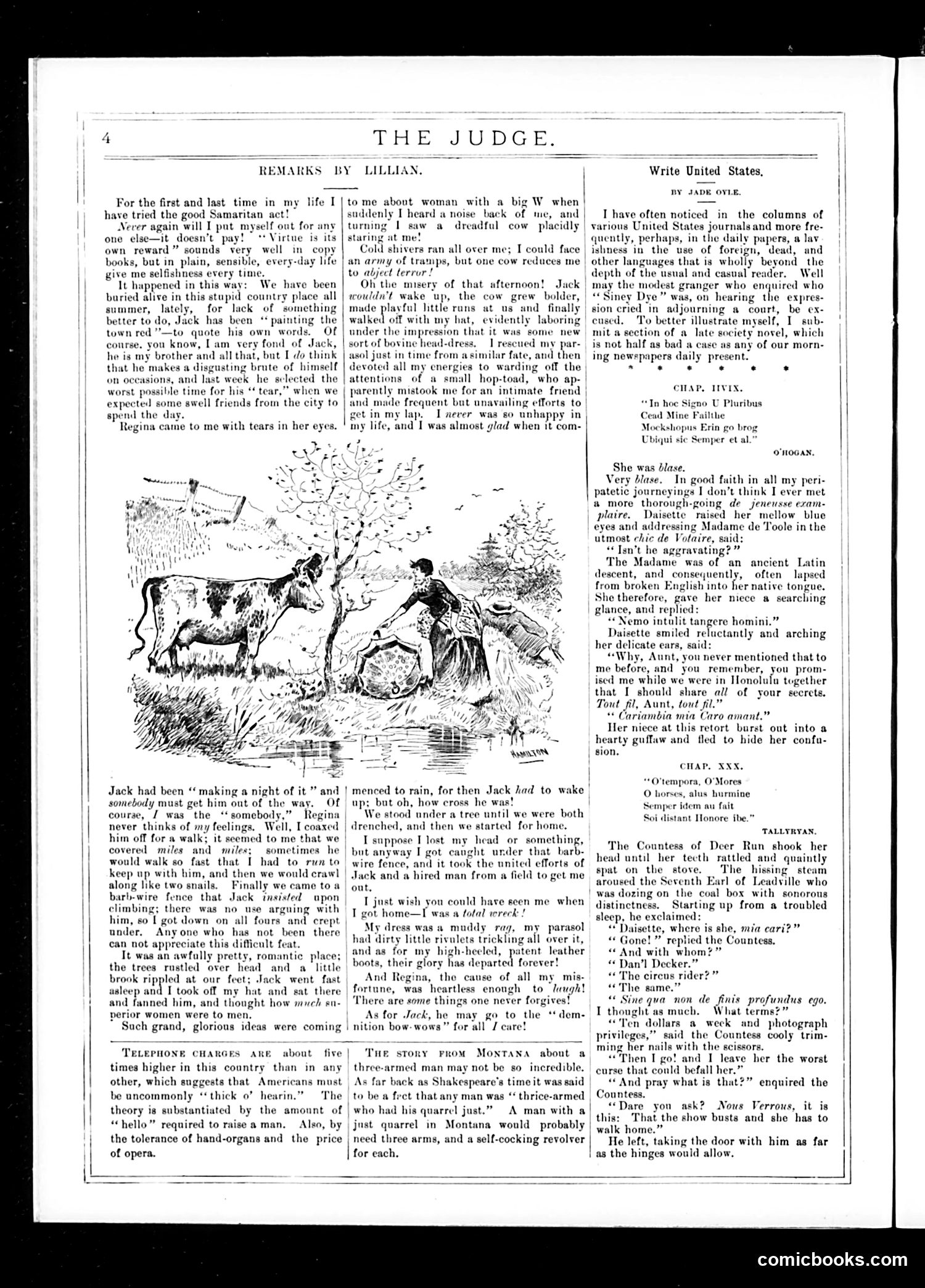
This page from *Judge* magazine contains humorous personal essays rather than political cartoons. The main piece, "Remarks by Lillian," is a comedic first-person narrative about the author's misadventure while chaperoning her lazy brother Jack. **The Satire:** Lillian attempts a good deed (removing Jack from the house so his sister Regina can entertain guests) but suffers comically for her virtue. The joke targets the era's sanctimonious moral advice ("Virtue is its own reward") by showing its impracticality in real life. Lillian ends up muddied, exhausted, and attacked by farm animals—all while Jack sleeps through it. **The Point:** The piece mockingly attacks Victorian sentimentality about selflessness and female sacrifice. Lillian's closing declaration that she'll never help anyone again satirizes the gap between idealized morality and messy reality. The illustration shows the cow encounter that drives the narrative's chaos. The additional text includes unrelated short humor pieces and notes on expensive American telephone charges.
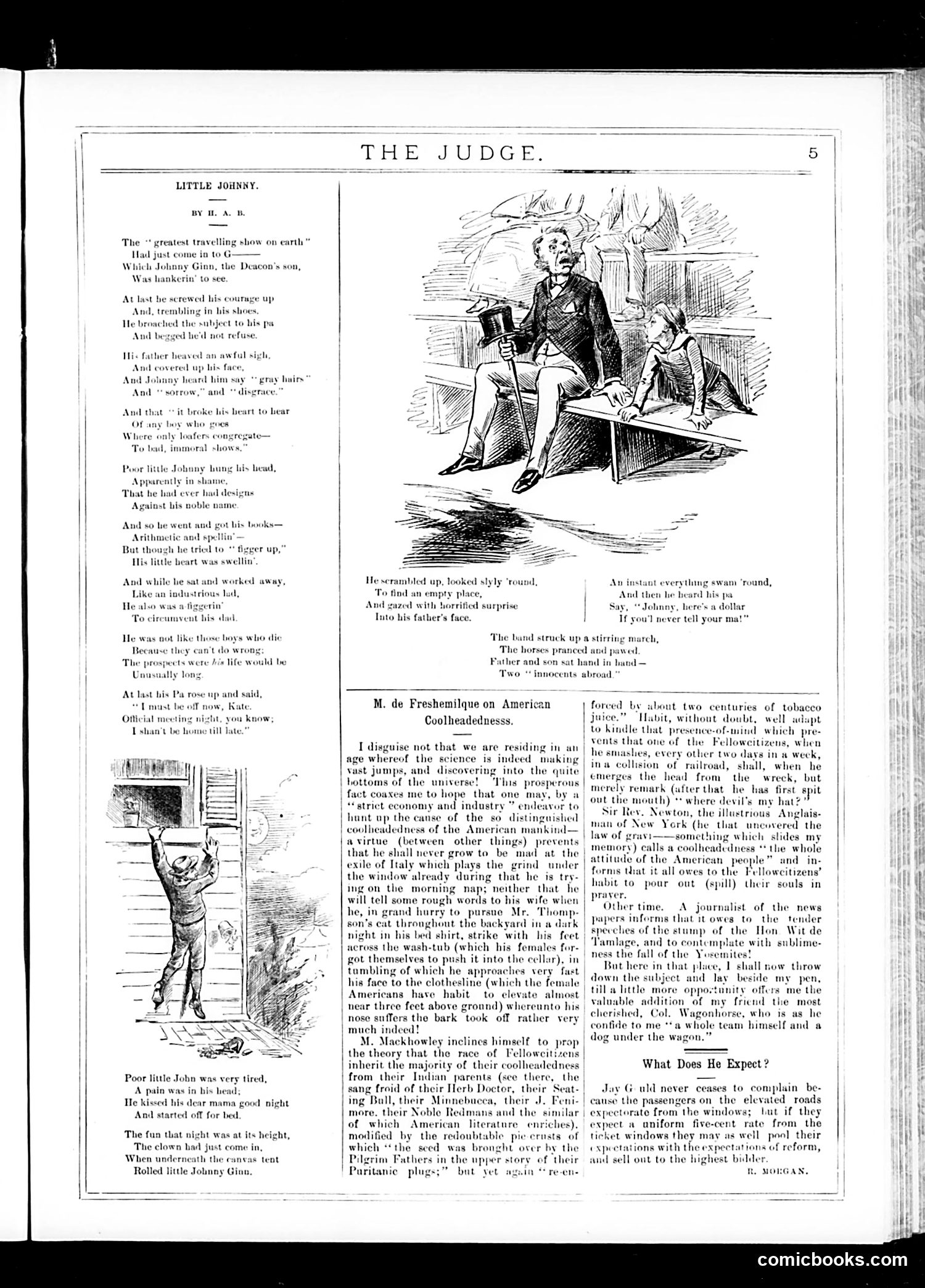
This page contains **"Little Johnny,"** a morality poem by H.A.B., satirizing parental hypocrisy about entertainment and moral instruction. **The Satire:** Johnny's strict, religious father preaches against "immoral shows" and warns that circus attendance leads to ruin. The boy obeys, studying arithmetic instead while his father attends a business meeting. However, Johnny sneaks into the circus tent and discovers his father already there—enjoying the show. When caught, the father bribes him to silence with a dollar, hypocritically abandoning his moral stance. **The Point:** The cartoon mocks Victorian-era parental double standards, where fathers publicly espouse rigid morality for their children while privately indulging in the same "forbidden" pleasures they condemn. It's gentle social satire on adult hypocrisy and selective virtue-signaling. The secondary article on "American Coolheadedness" appears to be satirical foreign commentary (perhaps mock-French) about American stoicism and composure, though the OCR is too corrupted to parse clearly.
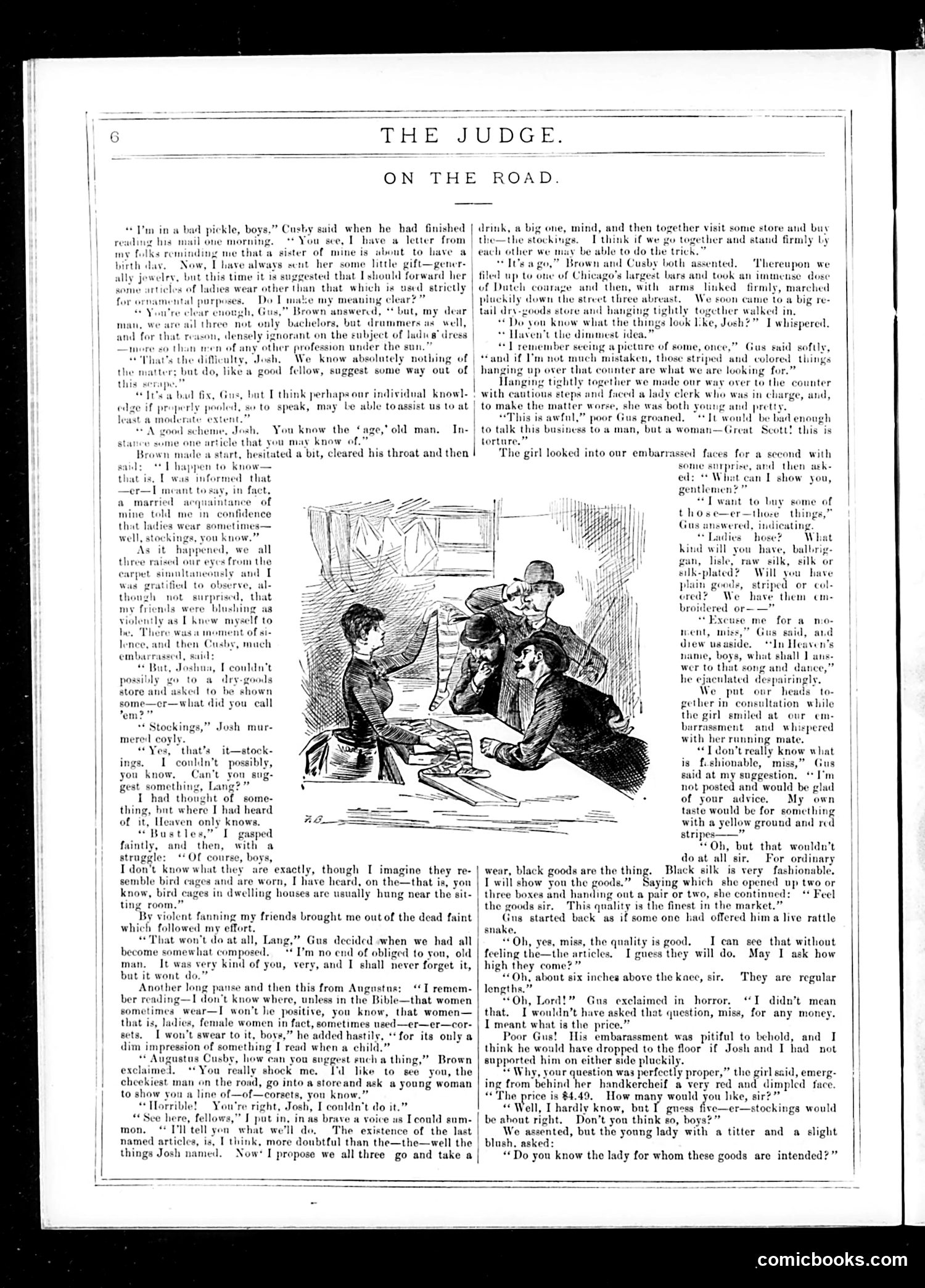
This is a humorous piece from *Judge* satirizing Victorian-era masculine prudishness about women's clothing and shopping. Three male friends—Cushy, Brown, and Joshua—must purchase stockings as a gift for Cushy's sister. Despite their bravado, all three are deeply embarrassed by the task. The satire mocks the absurd social conventions of the period: grown men cannot comfortably discuss or shop for basic female garments without elaborate justifications, strategic drinking for "courage," and conspicuous discomfort. When they finally approach a female shop clerk, they resort to vague gestures and euphemisms ("those things") rather than simply naming stockings. The humor derives from exposing the contradiction between men's authority in public life and their complete helplessness regarding everyday women's commerce. The clerk's patient amusement at their embarrassment underscores how ridiculous these conventions appear to women themselves.
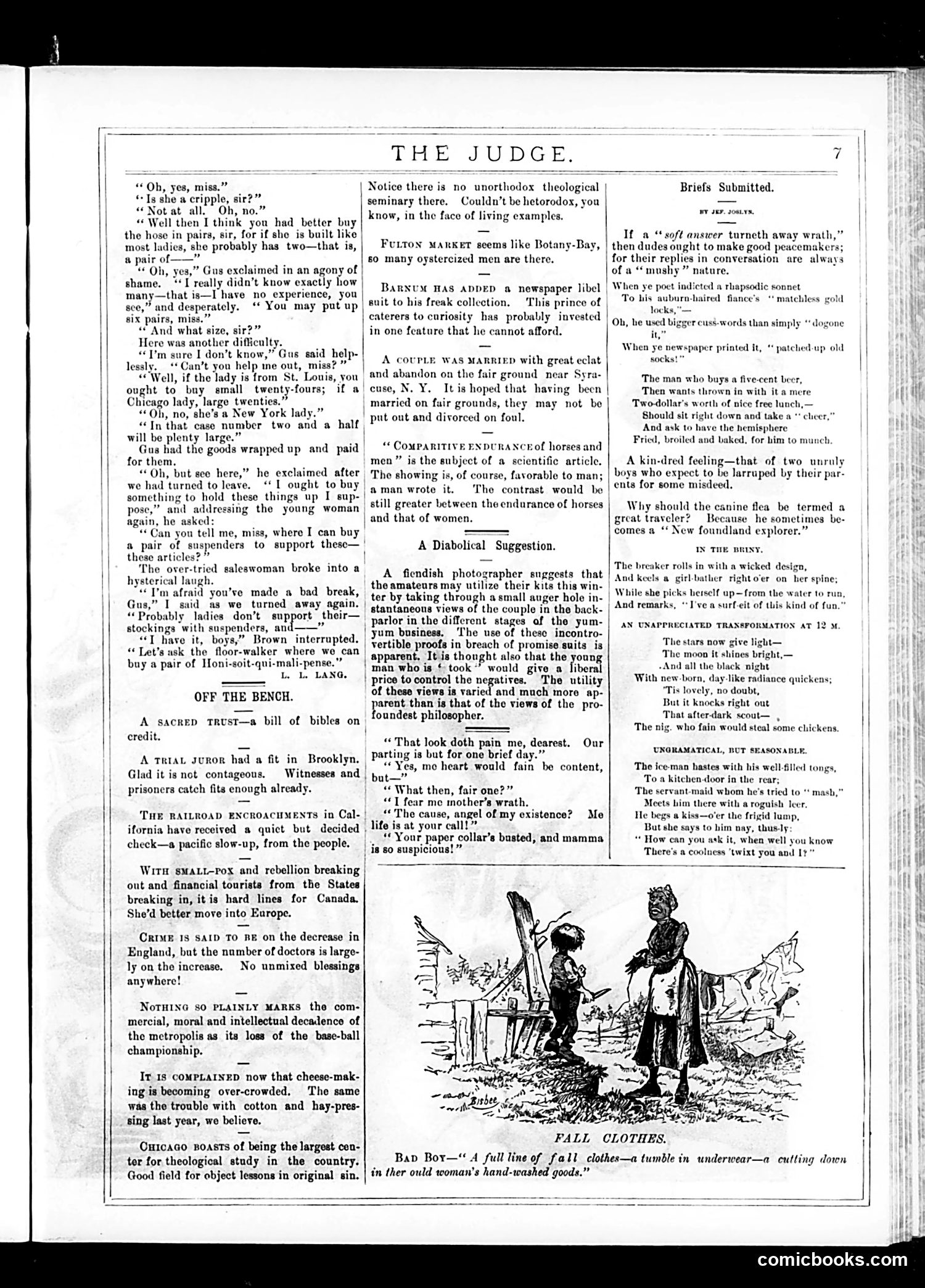
This page from *Judge* magazine contains a humorous anecdote about a young man named Gus awkwardly purchasing hosiery (stockings) for a woman, followed by brief satirical commentary. **The main cartoon** depicts a "Bad Boy" selling fall clothing—described as "a tumble in underwear—a cutting down in her old woman's hand-washed goods." The image shows a street vendor hawking reduced-quality garments, likely satirizing end-of-season clearance sales or poverty-level commerce. **The text above** relates Gus's embarrassment when a clerk helps him buy stockings by size. The joke hinges on mid-Victorian prudishness: Gus cannot directly discuss women's legs or undergarments with a saleswoman, so he stammers and fumbles. The punchline involves him asking about "suspenders to support" stockings—apparently an ignorant or inappropriate question that makes the saleswoman laugh. The surrounding "Off the Bench" section offers typical *Judge* editorial quips mocking current events (railroad politics, Chicago theology, Barnum's lawsuits, etc.) in pithy, cynical prose.
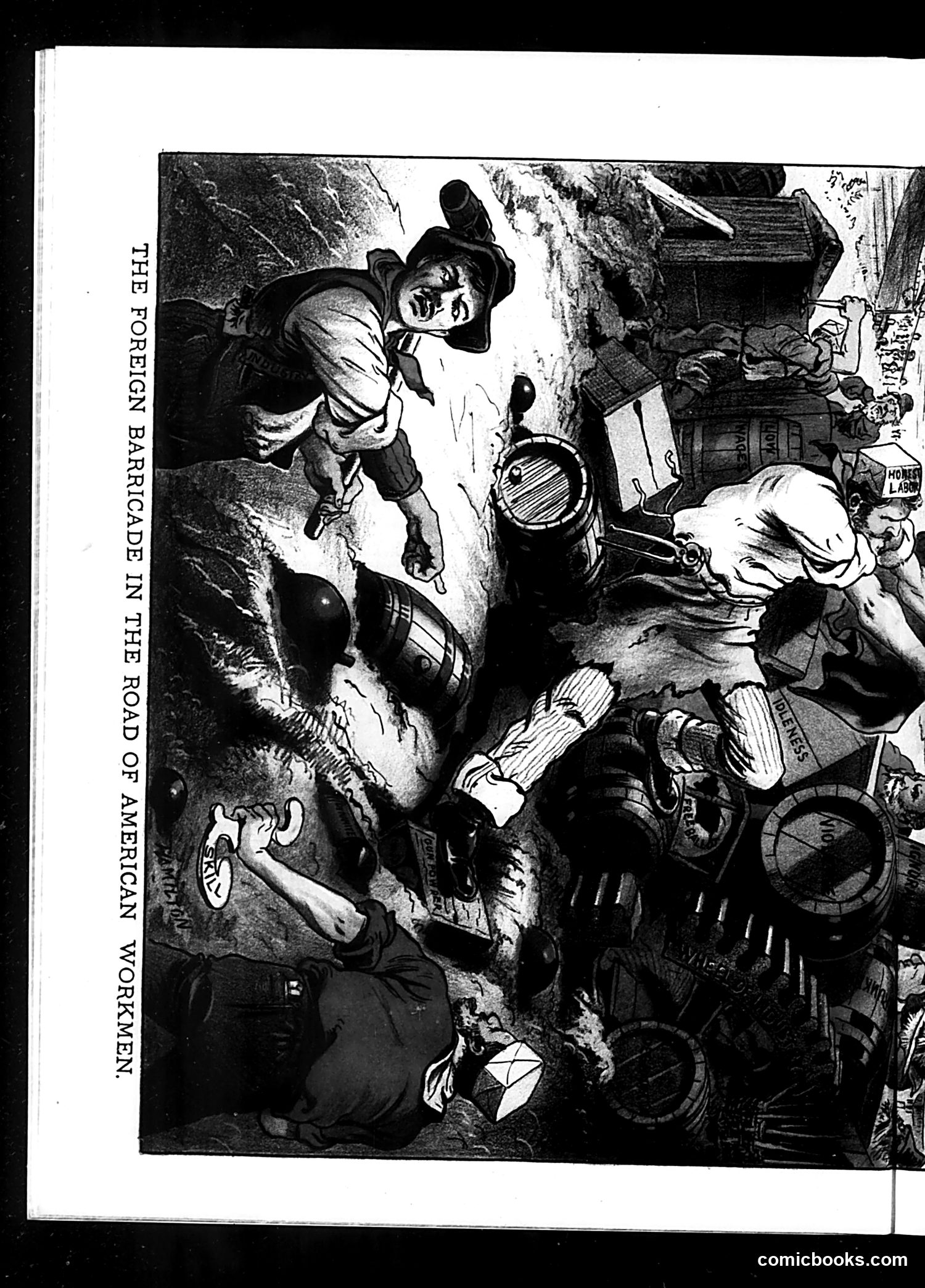
This political cartoon expresses anti-immigration sentiment targeting foreign workers. The image depicts what appears to be immigrant laborers as an obstacle blocking the path of American workers (shown as native-born citizens). The "barricade" metaphor suggests immigrants are literally blocking economic opportunity and employment for Americans. This reflects early 20th-century nativist concerns—the belief that foreign workers undercut wages and jobs for citizens by accepting lower pay. The cartoon advocates for immigration restriction, a major political issue of the era. The caricatured foreign figures (their exaggerated features suggest ethnic stereotyping) are portrayed as a hostile force rather than individuals seeking opportunity. This represents the protectionist labor sentiment that would eventually influence restrictive immigration legislation.
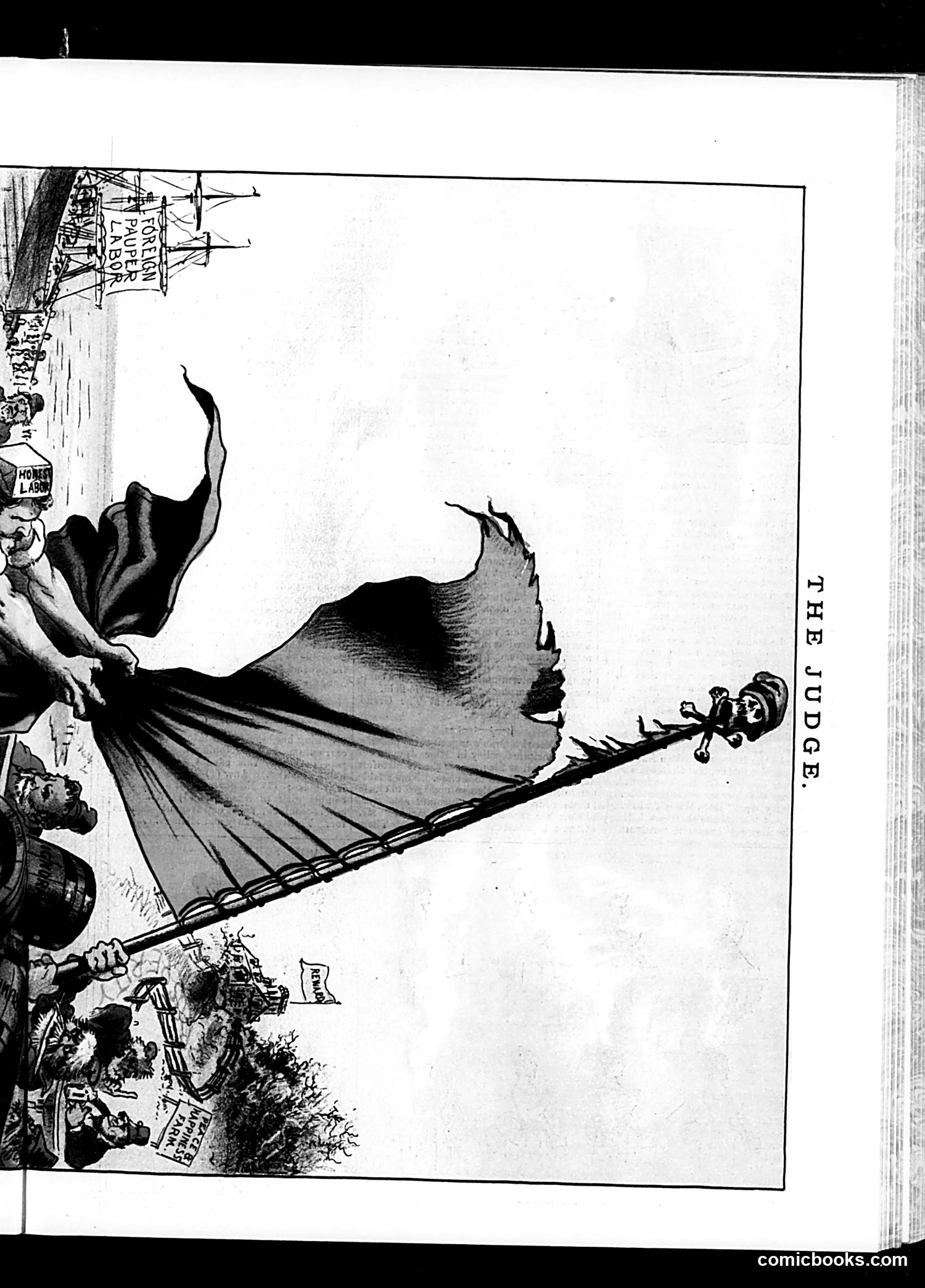
This is a political cartoon titled "The Judge" showing a figure in judicial robes being lifted or suspended by what appears to be a large sail or fabric. The figure appears small and powerless relative to the billowing fabric, suggesting they are being manipulated or controlled by external forces. The cartoon likely satirizes judicial authority or a specific judge's lack of independence—the imagery suggests the judge is a puppet being moved by unseen powers rather than exercising genuine authority. The sail metaphor may reference being "blown" in different directions or lacking firm principles. Without clearer text or specific historical dating visible, the exact judge or legal case referenced remains unclear, but the core satire critiques compromised or manipulated judicial power.
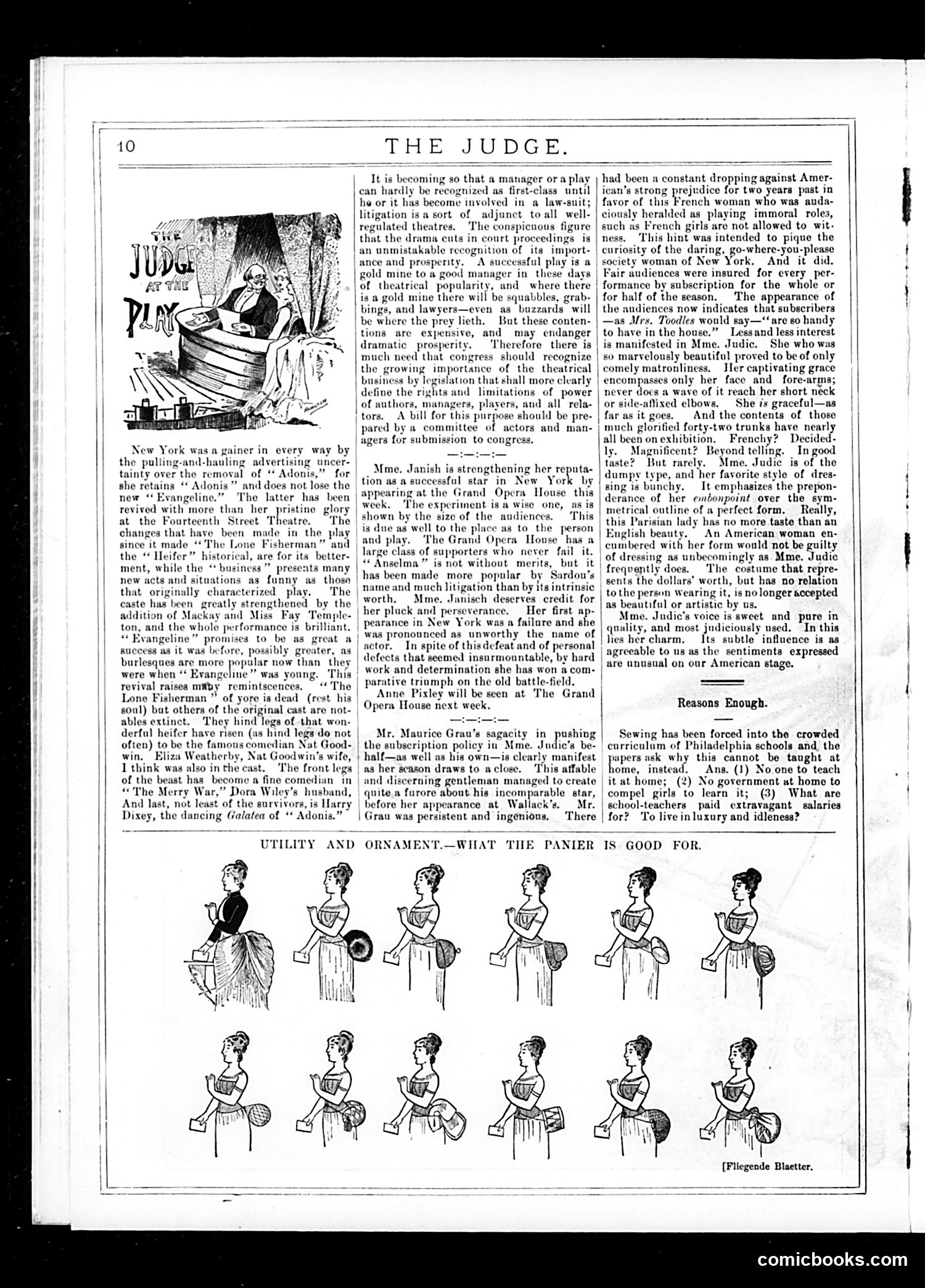
This page critiques the French actress **Mme. Judic**, who appeared in the play "Adonis" at New York's Grand Opera House. The text reveals she was heavily promoted as a daring performer of "immoral roles"—designed to scandalize American audiences and draw curious society women. The satire mocks both Judic and American taste: while her voice and grace merit praise, her physical appearance disappoints. The author ridicules her as dumpy, unfashionably dressed in "bunchy" styles, and lacking the refined taste of either French or American women. Her elaborate wardrobe (the famous "forty-two trunks") has proven unremarkable. **Bottom section**: The illustration titled "Utility and Ornament—What the Panier Is Good For" satirizes the fashionable panier (side panniers) by showing twelve identical women in various poses, all similarly adorned. It mocks this impractical fashion accessory's prevalence. The overall message: European pretension disappoints when examined closely; American audiences are gullible but ultimately discerning.
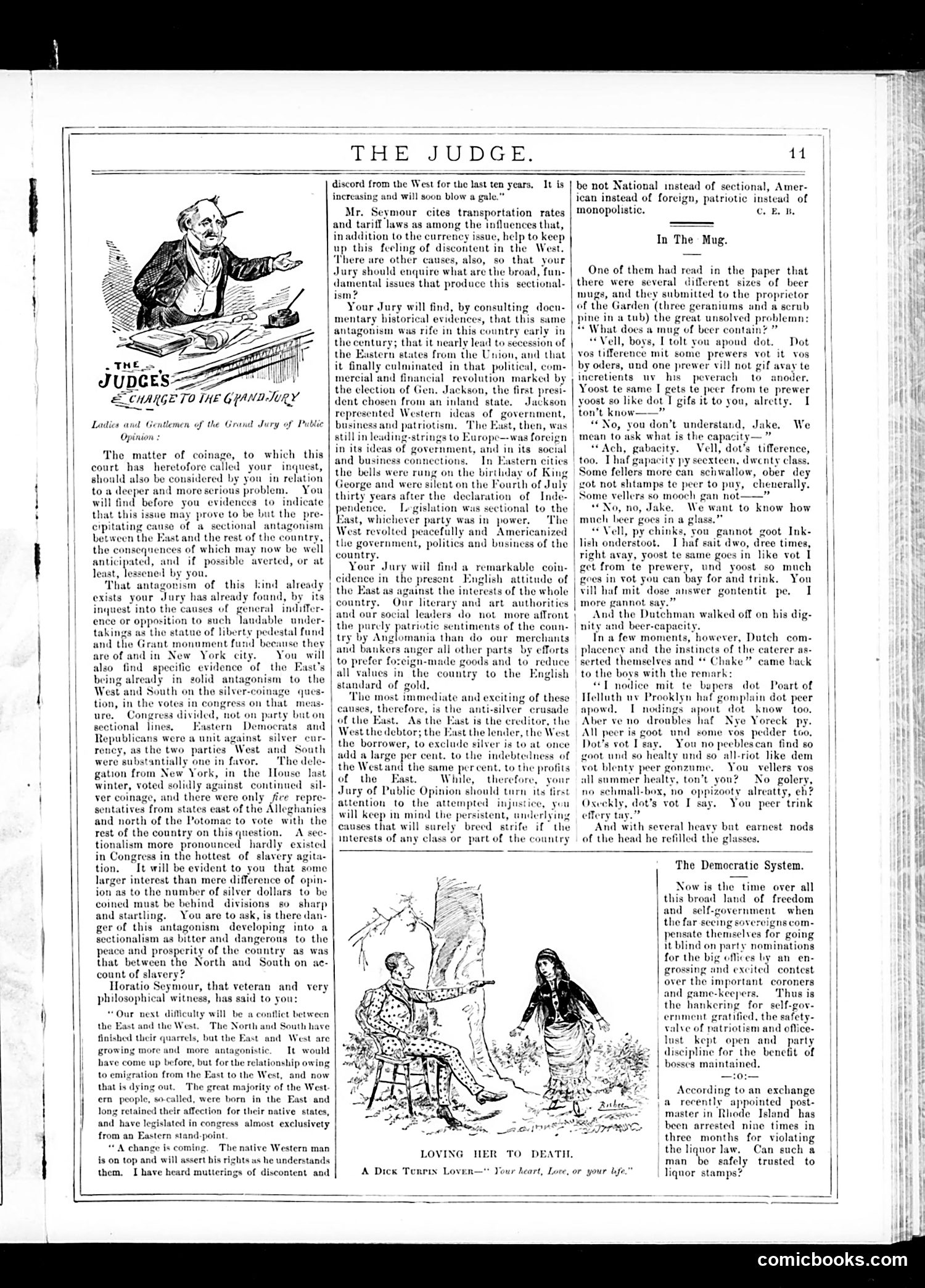
This page presents editorial commentary on sectional tensions between East and West in America, framed as a judge's charge to a grand jury. The central concern is **currency policy**—specifically silver coinage—which the text argues masks deeper East-West antagonism. The piece cites **Horatio Seymour** (a prominent Democratic politician and New York governor) warning that Western resentment of Eastern economic dominance (through tariffs, transportation rates, and monetary policy) threatens national unity as severely as pre-Civil War slavery tensions did. The text references **Andrew Jackson's presidency** as a turning point when Western interests finally challenged Eastern control of government. The lower cartoon, captioned "Loving Her to Death" with the subtitle "A Dick Turpin Lover—'Your heart, love, or your life,'" depicts a figure threatening another—likely satirizing predatory economic relationships or coercive political pressure. The satire warns that ignoring Western grievances risks repeating the sectional crisis that nearly destroyed the Union.
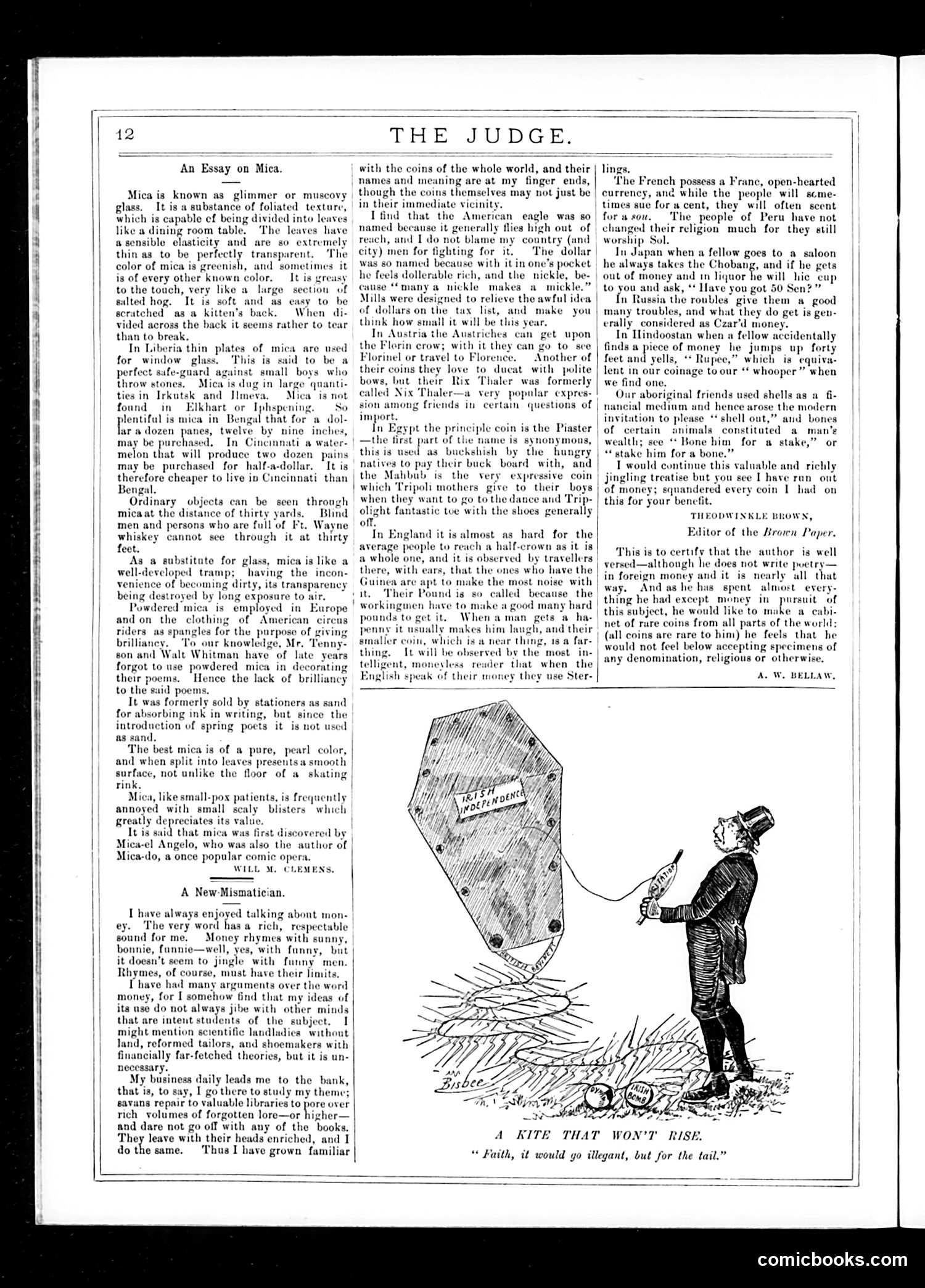
This page from *Judge* magazine contains two distinct pieces of satirical content: **"An Essay on Mica"** (left column): A humorous pseudo-scientific essay that uses mica (a mineral) as a vehicle for absurdist jokes. The author makes deliberately false or nonsensical claims—comparing mica to a "dining room table," suggesting it's cheaper to live in Cincinnati than Bengal based on melon prices, and making puns on the mineral's name ("Mica-el Angelo," "Mica-do"). The essay mocks pretentious scientific writing by maintaining an earnest tone while discussing obvious absurdities. The final jab at Walt Whitman and another poet (possibly Tennyson) suggests their work lacks "brilliancy" because they don't use powdered mica as decoration—satirizing their poetic styles. **"A Kite That Won't Rise"** (right side illustration): A cartoon showing a man struggling to fly a kite weighted down by a large anchor-like object labeled "Irish Votes." The caption quotes "Faith, it would go elegant, but for the tail." This appears to satirize how Irish-American political support weighs down or complicates a political figure's fortunes.
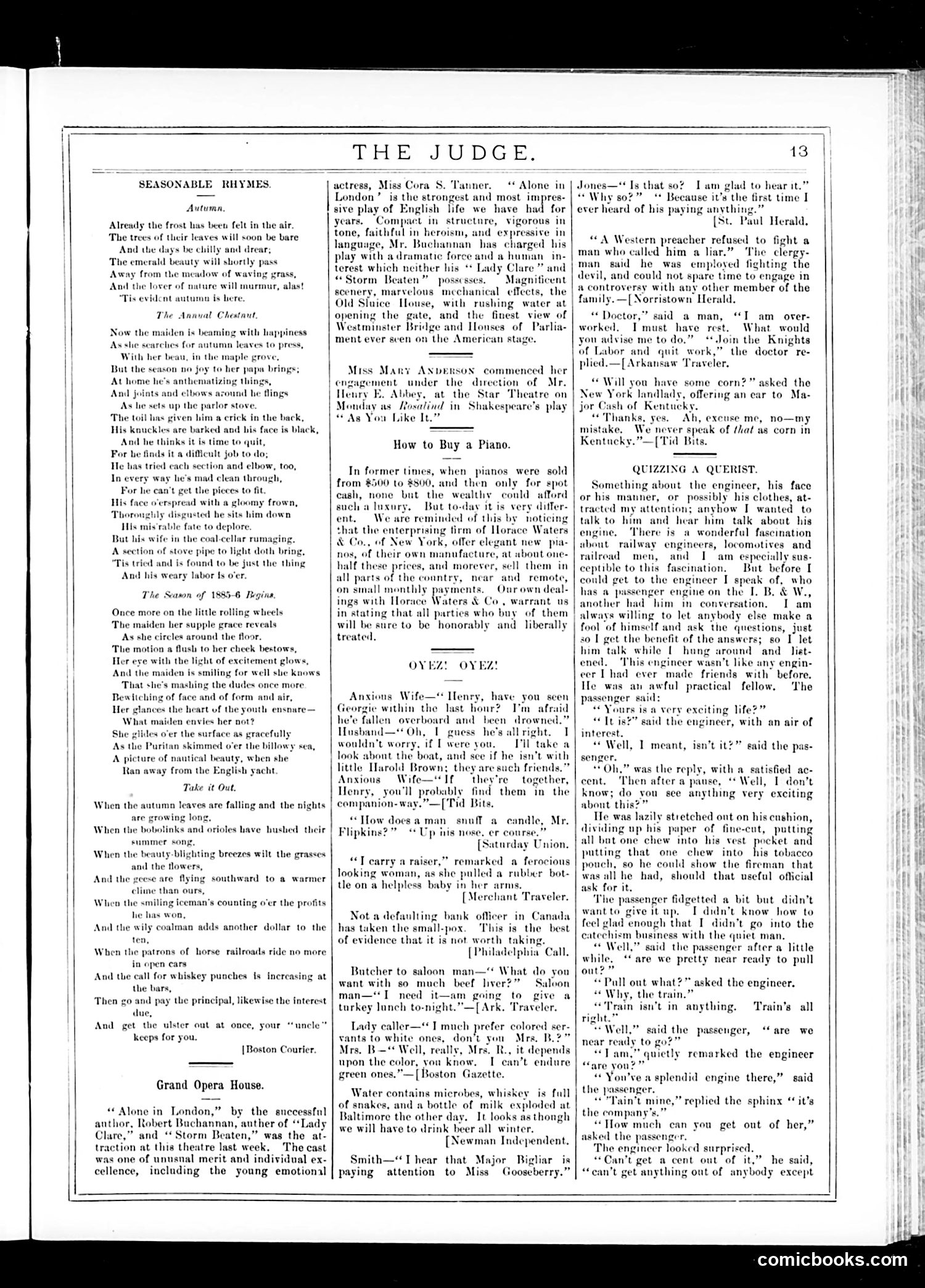
This page from *Judge* magazine contains primarily **text-based humor and social commentary** rather than visual cartoons. The content includes: **"Seasonable Rhymes"** — Poetry mocking autumn's inconveniences, particularly the messy chore of gathering fallen chestnuts, which leaves working-class men with scraped knuckles and dirty faces. **"Quizzing a Querist"** — A humorous advice column featuring anecdotes about engineers, train operations, and domestic life, using absurdist humor typical of the era (e.g., a man who snuffs a candle "up his nose"). **Theater reviews** praising actress Miss Cora S. Tanner in *"Alone in London"* and Miss Mary Anderson in *As You Like It*. **An advertisement** for affordable pianos from Horace Waters & Co., promoting installment payments—a novel concept for working-class consumers. **Brief satirical jokes** at the bottom targeting banks, medical practices, and marital situations. The page reflects late-19th-century *Judge* magazine's mix of genteel literary humor, theatrical coverage, and consumer culture commentary.
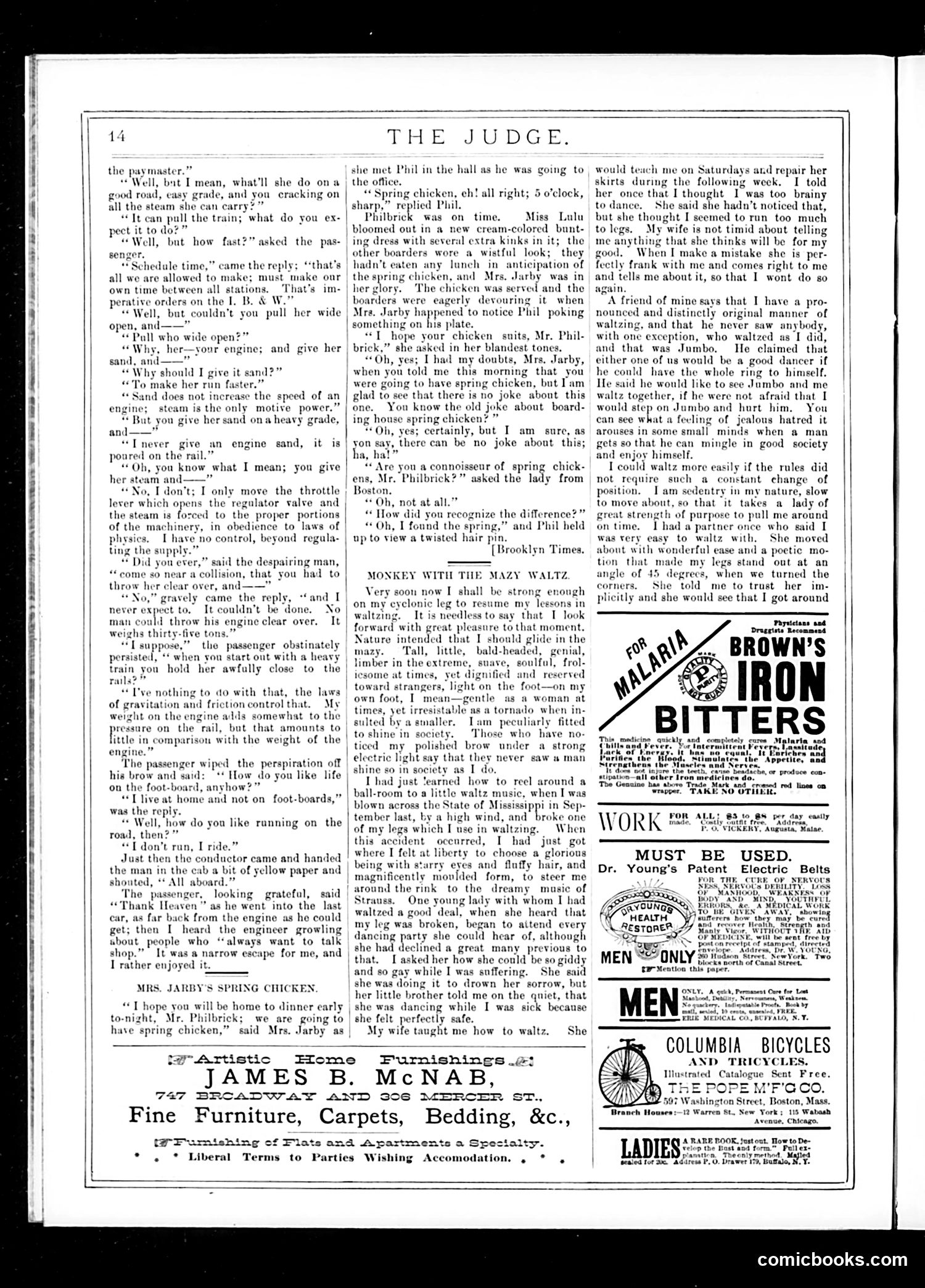
This page contains two humorous dialogues reflecting turn-of-the-century American life. **"The Engineer's Philosophy"** (main story) satirizes an earnest passenger attempting to discuss locomotive mechanics with a pedantic engineer. The joke relies on the engineer's literal, physics-based responses to the passenger's colloquial language about "giving her steam" and "sand." The engineer refuses to acknowledge practical railway terminology, instead citing "laws of physics" and "gravitation"—mocking both over-literal thinking and the gap between technical knowledge and common speech. **"Mrs. Jarby's Spring Chicken"** plays on a dated boarding-house joke: the term "spring chicken" referred both to young poultry AND to an old, tough bird (implying boardinghouse food was notoriously poor). When Phil discovers a "twisted hair pin" in the meat, he reveals the chicken is literally ancient, confirming the old joke's premise about cheap boarding-house provisions. The page is primarily **editorial/story content** with advertisements below (furniture, patent medicines, bicycles). These domestic comedies target middle-class readers familiar with trains, boarding houses, and social pretension.
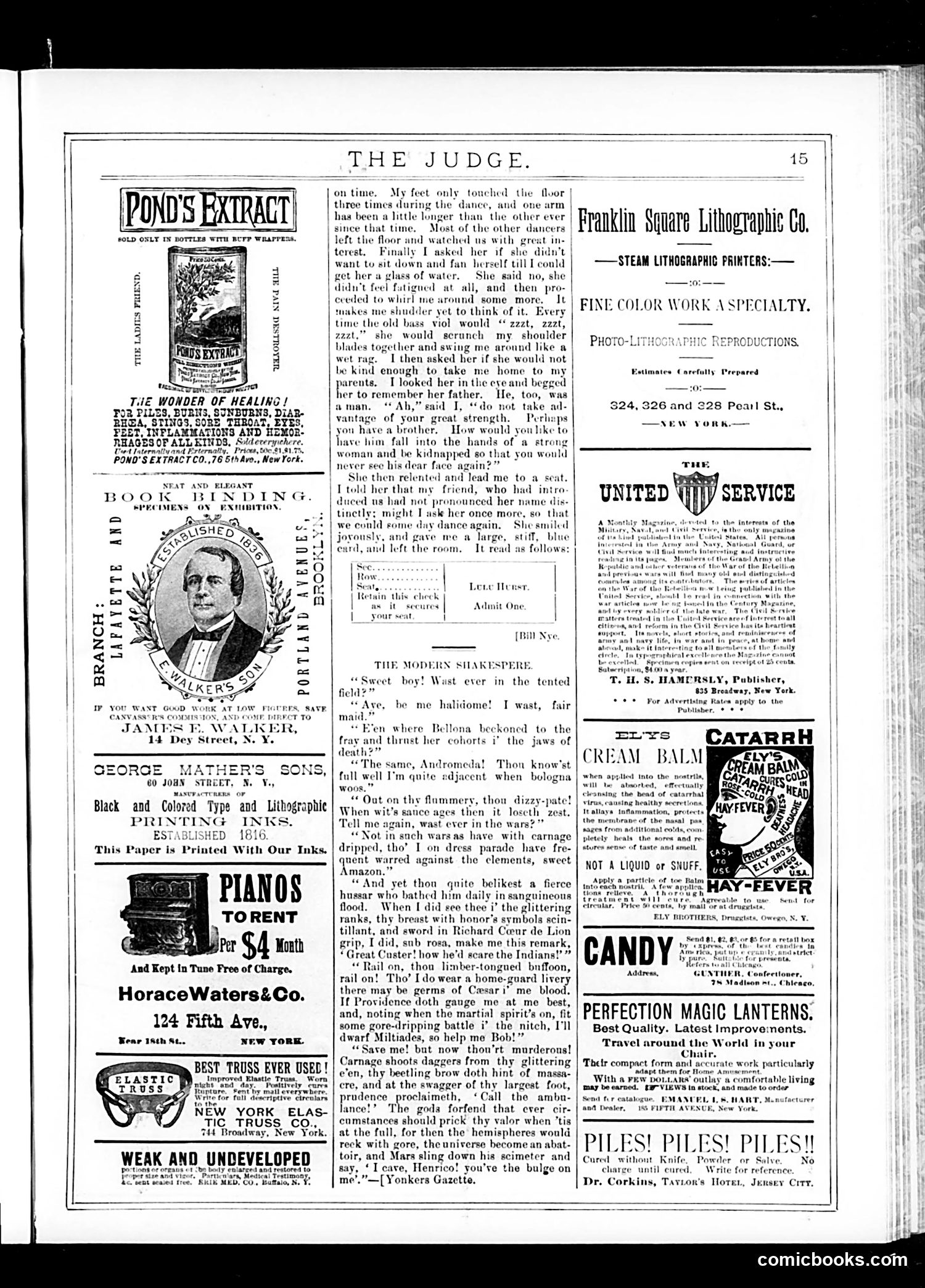
This page is primarily **advertisements and filler content** rather than political satire. The main text is "The Modern Shakespeare," a comedic sketch by Bill Nye (credited as "Bil Nye") about two men at what appears to be a military or formal gathering engaging in mock-heroic, overwrought Shakespearean dialogue. One boasts of his military service while the other playfully mocks his pretensions, culminating in warnings that the man's martial valor is so terrifying it might cause apocalyptic destruction. The humor derives from the exaggerated, archaic language and the deflation of military bombast—a common Victorian satirical technique. The lengthy buildup contrasts with the mundane reality of a "home-guard" rather than actual combat experience. The page is otherwise filled with period advertisements (Pond's Extract, pianos, trusses, printing inks) typical of 19th-century magazines.
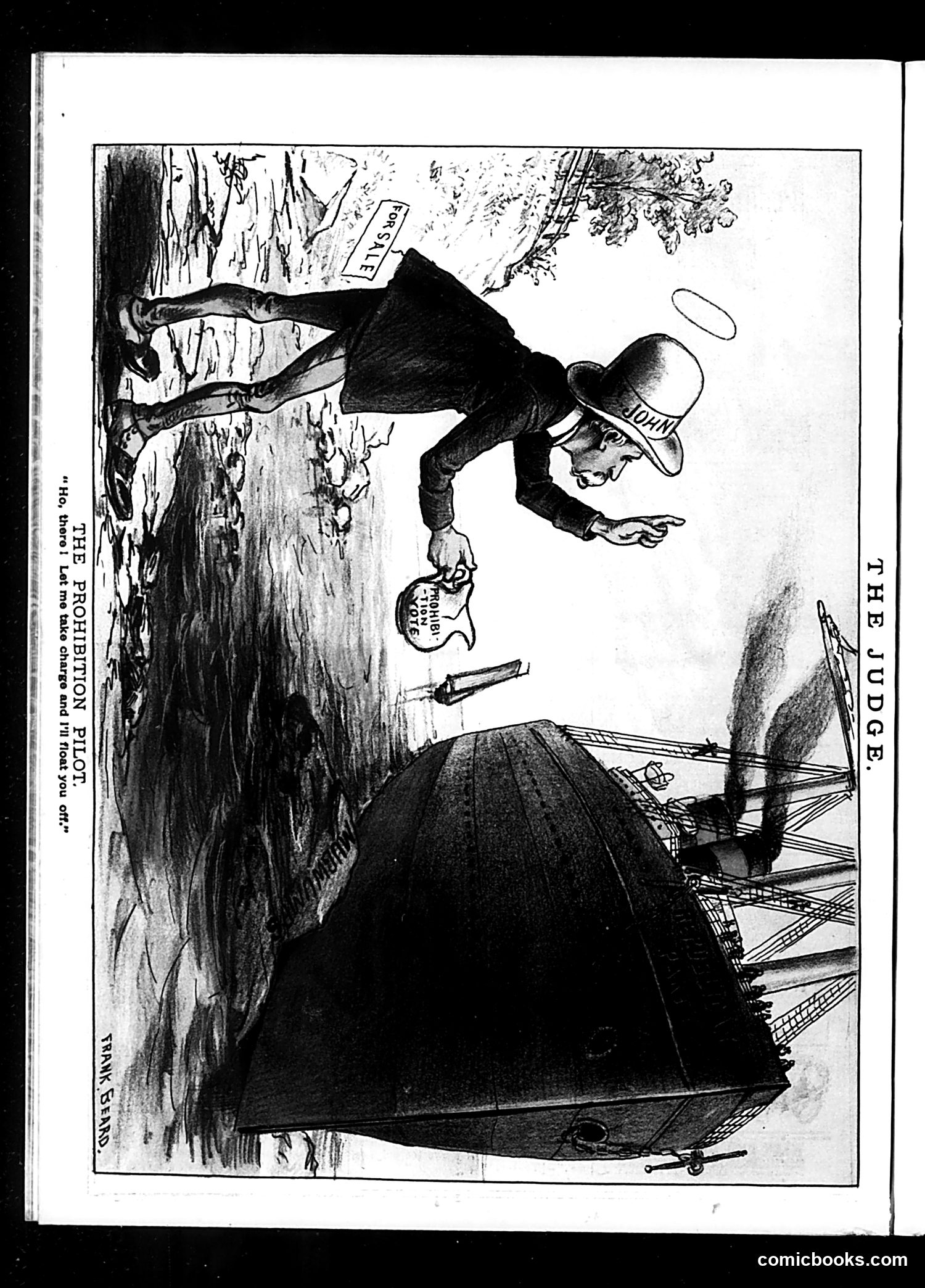
This cartoon satirizes Prohibition era politics. A well-dressed man in a top hat (labeled "The Judge") stands over a capsized boat labeled "The Prohibition Pilot," offering to help. The sunken vessel appears to represent the failed Prohibition policy itself. The satire suggests that Prohibition—presented as a pilot steering the ship of state—has wrecked the nation. The cartoon implies that Prohibition advocates promised smooth sailing but instead caused disaster. The "Judge" figure (likely representing sensible policy or public opinion) watches the wreckage, sardonically offering rescue. The cartoon's point: Prohibition has proven unmanageable and destructive, and whoever claims they can "float it off" is making empty promises. This reflects widespread public skepticism about Prohibition's actual effects during the 1920s-early 1930s.