
Judge, 1885-10-17 · page 11 of 16
Judge — October 17, 1885 — page 11: what you’re looking at
What you’re looking at
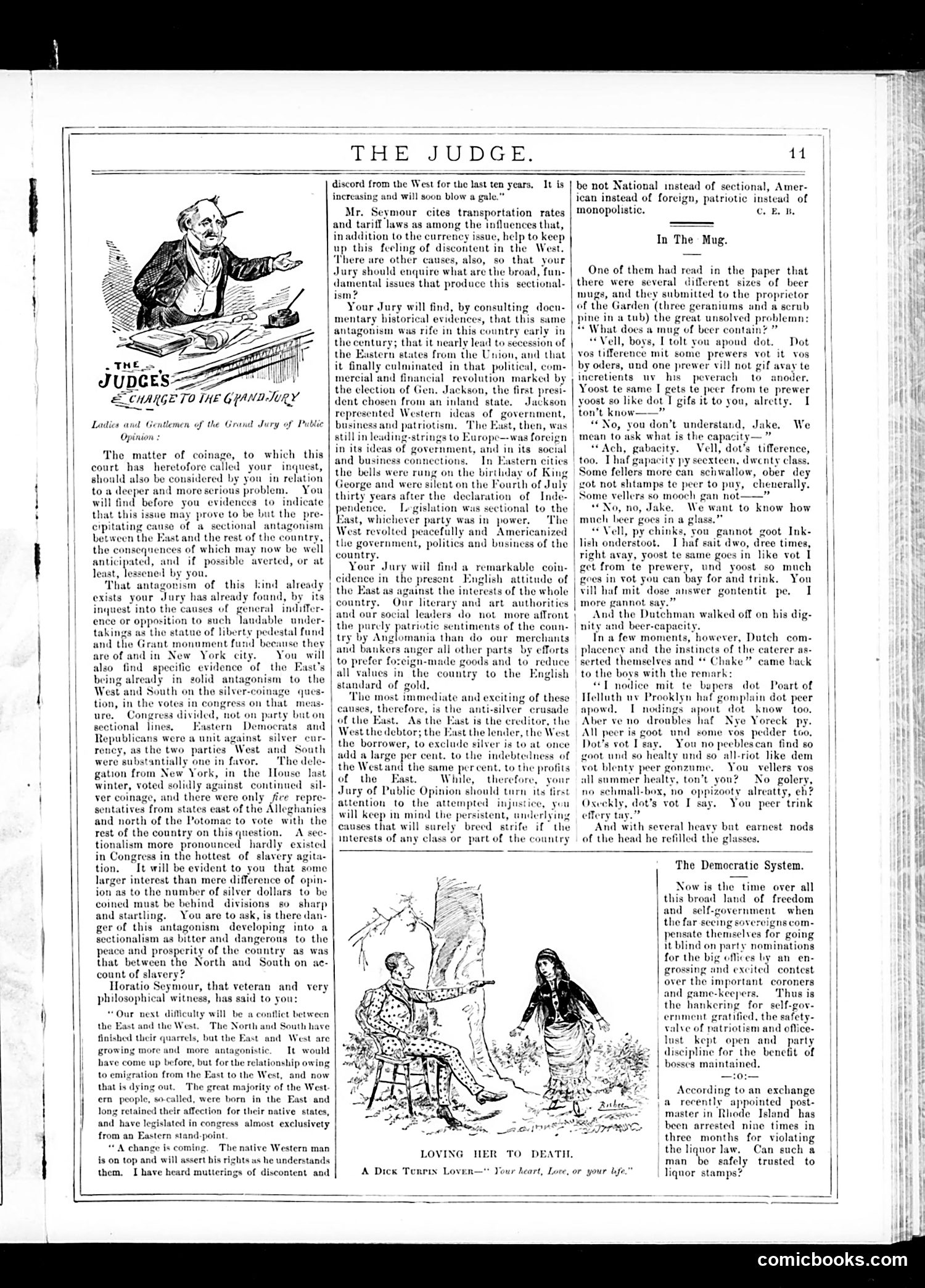
This page presents editorial commentary on sectional tensions between East and West in America, framed as a judge's charge to a grand jury. The central concern is **currency policy**—specifically silver coinage—which the text argues masks deeper East-West antagonism. The piece cites **Horatio Seymour** (a prominent Democratic politician and New York governor) warning that Western resentment of Eastern economic dominance (through tariffs, transportation rates, and monetary policy) threatens national unity as severely as pre-Civil War slavery tensions did. The text references **Andrew Jackson's presidency** as a turning point when Western interests finally challenged Eastern control of government. The lower cartoon, captioned "Loving Her to Death" with the subtitle "A Dick Turpin Lover—'Your heart, love, or your life,'" depicts a figure threatening another—likely satirizing predatory economic relationships or coercive political pressure. The satire warns that ignoring Western grievances risks repeating the sectional crisis that nearly destroyed the Union.
📄 Transcribed text from this page (OCR, searchable)
Machine-transcribed from the original scan — historical spelling and the odd misread are preserved.
THE JUDGE. 44 Ladies and Gentlemen of the Grand Jury ¢ Opinion The matter of coinage, to which this court has heretofore called your inquest, should also be considered by you in relation toa deeper and more scrious problem. You will find before you evidences to indicate that this issue may prove to be but the pre- cipitating cause of sectional antagonism between the East and the rest of the country, the consequences of which may now be well anticipated, and if possible averted, or at least, lessened by you. That an nism of this kind already exists your Jury has already found, by its inquest into the causes of general indiffer. ence or opposition to auch laudable under- takings as the statue of liberty pedestal fund and the Grant monument fund because they are of and in York city. You will find specific evidence ‘of the East's y in solid antagonism to the West and South on the silver-coinage qu tion, in the votes in congress on that _m ure.” Congress divided, not on party buton sectional line Eastern Democrats and Republicans were a unit against silver cur- ney, as the two ties West and South were substantially one in favor. ‘The dele gation from New York, in the House Inst winter, voted solidly against continued sil- ver coinage, and there were only five repre- sentatives from states east of the Alleghs and north of the Potomac to vote rest of the country on th tionalism more pronounced hardly ex in Congress in the hottest of slavery agita- tion. It will be evident to you that some larger interest than mere difference of opin- ion as to the number of silver dollars to be coined must be behind divisions so sharp and startling. You are to ask, is there dan- ger of this antagonism developing into a sectionalism as bitter and dangerous to the peace and prosperity of the country as was that between the North and South on ac- count of slave Horatio Seymour, that veteran and vei philosophical witness, has said to you: 3 with the question. A “Our next difficulty will the East and the West, The finished their quarrels, but the E: 1 conflict between are It would nship owing st to the West, growing more and more antagonistic have come up before, but for the relat to emigration from the E: that is dying out, and now The great majority of the West ern people, long re and have legislated in congress alm from an Eastern stand-point * A change is coming. The native Western man is on top and will assert his them. I have heard muttering ir native states, st exclusivety ts as he understands of discontent and * | cause discord from the West for the last ten years, increasing and will soon blow a gale." Mr. Seymour cites transportation rates and tariff laws as among the influences that, in addition to the currency issue, help to keep up this feeling of discontent in the West. ‘There are other causes, also, so that your Jury should enquire what are the broad, fun- mental issues that produce this sectional- ism? Your Jury will find, by consulting docu- mentary historical evidences, that this same | antagonism was rife in this country early in | thecentury; that it nearly lead tc prof the Eastern states from the Union, and that it finally culminated in that political, com- mercial and financial revolution marked by the clection of Gen, Jackson, the first pre dent chosen from an inland state. Jackson represented Western ideas of government, business and patriotism. The then, w still in leading-strings to Europe for in its ideas of government, and in its. social and business connections. In Eastern cities ths bells were rung on the birthday of King It is George and were silent on the Fourth of July Inde- thirty rs after the declaration of penide . Legislation was sectional t, whichever party in power. West revolted peacefully and Amer the government, politics and business of the country, Your Jury wiil find a remarkable coin- cidence in the present English attitude of | the East as against the interests of the whole j country, Our literary and art authorities | and our social leaders do not more affront the purcly patriotic sentiments of the coun- try by ‘Anelor than do our merchants and bankers anger all other parts by efforts to prefer fozeign-made goods and to reduce | all values in the country to the English standard of gold. | ‘The most immediate and exciting of th therefore, is the anti-silver eru | of the East. As the East is the creditor, tl West the debtor; the East the lender, the West the borrower, to exclude silver is to at once add a large per cent, to the indebtedness of the Westand the same percent. to the profits of the East. While, the Jury of Public Opinion should t | attention to the attempted inju: | will keep in mind the persistent, « causes that will surely le fore, you nits fir derlying, breed strife if’ the be not National instead of sectional, Amer- ican instead of foreign, patriotic instead of monopolistic. In The Mug. One of them had read in the paper that there were several different sizes of beer mugs, and they submitted to the proprietor of the den (three geraniums and a scrub | pine in a tub) the great unsolved problemn: ** What does a mug of beer contain? ” ) ‘Vell, boys, I tolt you apoud dot. Dot vos tifference mit some prewers vot it vos | by oders, und one prewer vill not gif avay te incretients uv his peverach to anoder, Yoost te same I gets te peer from te prewer 3 0 like dot I gifs it to you, alretty. I ton’t know——” “No, you don’t understand, Jake. We mean to ask what is the capacity—” | Vell, dot'’s tifference, dwenty class. Some fellers moré can low, ober dey got not shtamps te peer to puy, chenerally, Some vellers so mooch gan not——” “No, no, Jake. We want to know how much beer goes in a glass.” | ** Vell, py chinks, you gannot goot Ink- lish onderstoot, I eait dwo, dree times, right avay, yoost te same goes in like vot I get from te prewery, und yoost so much gees in vot you can bay for and trink, You | vill haf mit’ dose answer gontentit pe. I | more gannot say.” And the Dutchman walked off on his dig- | nity und beer-capacity Tn a few moments, however, Dutch placency and the instincts of the com- terer as- serted themselves and ** Chake” came back to the boys with the remark: “T nodice mit te bapers dot Poart of Melluth uv Prooklyn haf gomplain dot peer apowd. I nodings apout dot know too. Aber ve no droubles haf Nye Yoreck p All peer is goot und some vos pedder too, Dot’s vot say. You no peeblescan find so goot und so healty und so all-riot like dem vot blenty peer gonzume. You vellers vos all summer healty, ton’t you? No goler no schmnall-box, no oppizooty al Oxeckly, dot’s vot I say. You peer trink effery id And with sever: the head he refil heavy bat earnest ; nods d the glasses, LOVING HER A Dick Terrin Loven— TO DEATH. ir heart, Love, or your hfe.” The Democratic System. Now is the time over all this broad land of freedom and self-government when the far seeing sovereigns com- pensate themselves for going | it blind on party nominations for the big offices by an en- grossing and excited contest over the important coroners ‘and game-keepers. Thus is the hankering for self-ge ernment gratified, the safe valve of patriotism and oflice- lust kept open and party discipline for the benelit of | bosses maintained. According to an exchange recently appointed _post- master in Rhode Island has been arrested nine times in three months for violating the liquor law. Can such a man be safely trusted to liquor stamps comicbooks.com