A complete issue · 16 pages · 1885
Judge — August 29, 1885
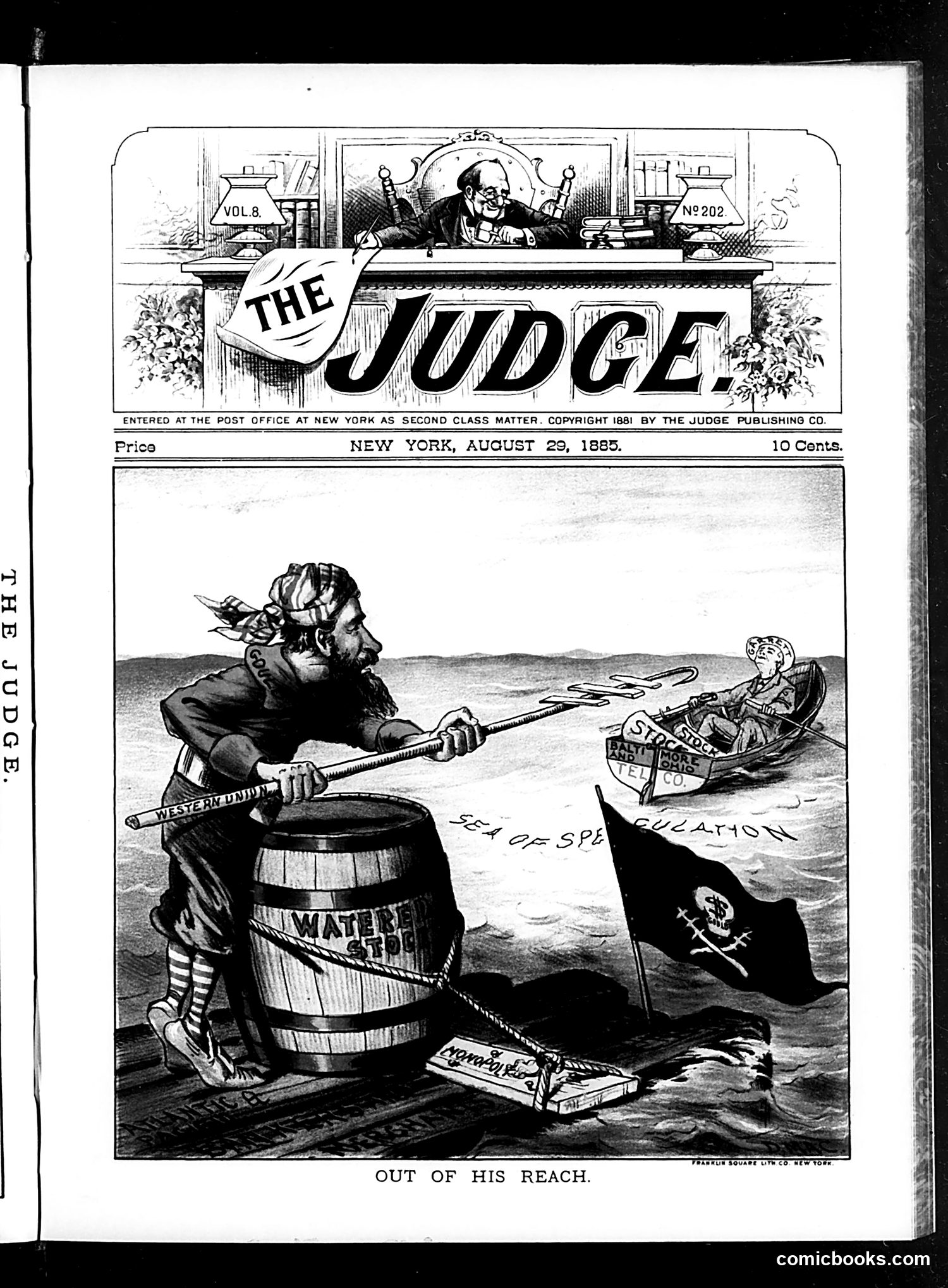
This political cartoon depicts a bearded man standing in water holding a long pole or oar, attempting to reach a small boat labeled "SPECULATION" that's drifting away. The figure stands in a barrel marked "WATER" (suggesting financial constraint or being "stuck"), while a pirate flag floats nearby, implying dishonest dealings. The caption "OUT OF HIS REACH" suggests the cartoon mocks someone's failed attempt to engage in speculation or financial schemes—the boat with its pirate flag represents illicit speculation, now beyond his grasp, likely due to regulatory restrictions or his own financial limitations. Without additional context from the issue, the specific figure's identity remains unclear, but the satire criticizes either failed speculation or blocked financial ambitions during the 1885 economic period.
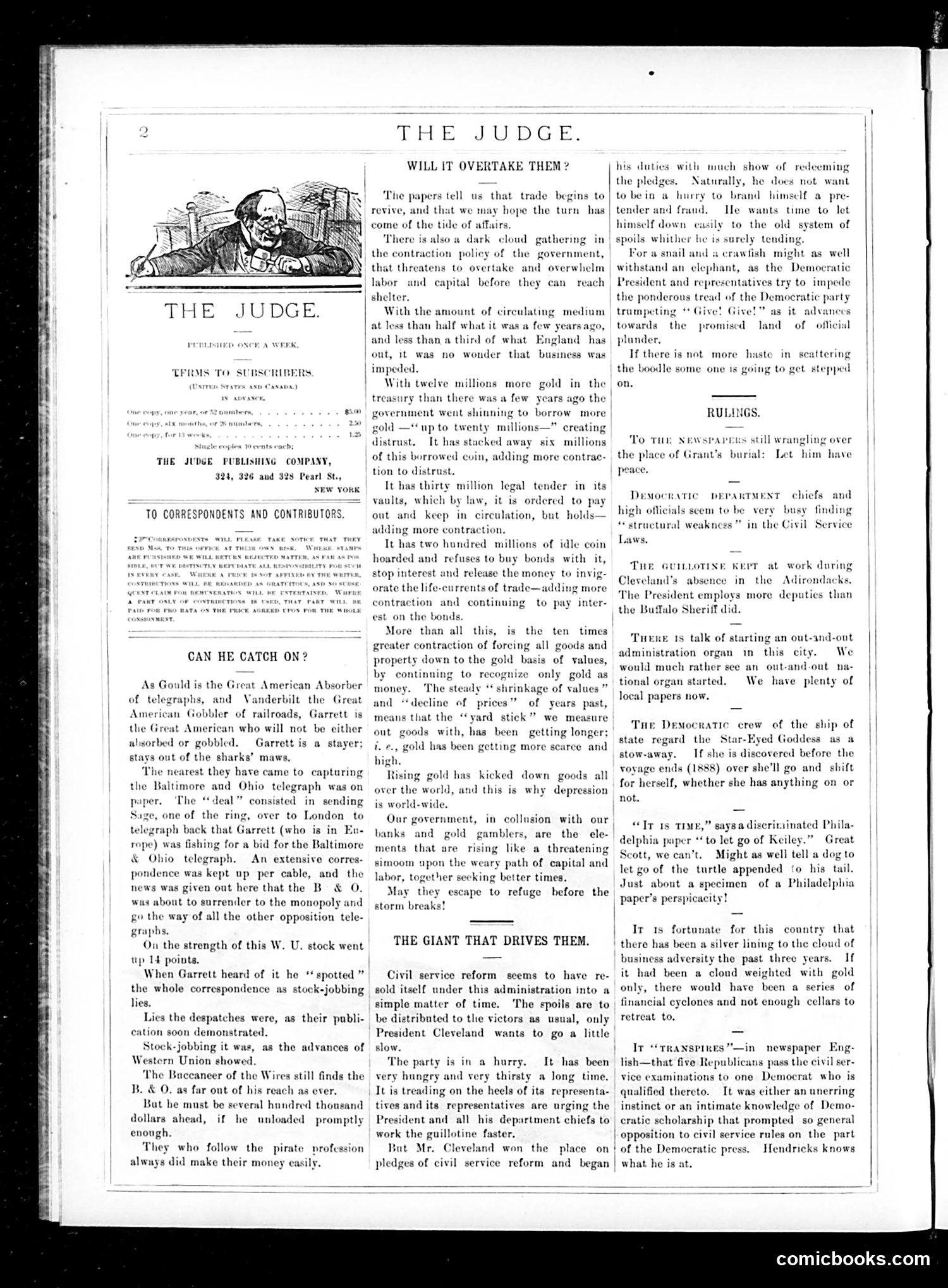
**The Main Cartoon ("The Judge"):** A caricatured figure sits among papers and documents, representing the magazine itself as social commentator and critic. **Key Political Content:** 1. **"Can He Catch On?"** critiques railroad magnate Jay Gould's attempted monopoly over telegraph systems. John Garrett of the Baltimore & Ohio Railroad resists absorption. The piece satirizes stock manipulation—Western Union spread false rumors to inflate their stock while secretly negotiating, then Garrett exposed the hoax. The satire: even corrupt schemes fail to catch their prey. 2. **"Will It Overtake Them?"** attacks government economic policy under President Cleveland. The critique: despite increased gold reserves, the administration paradoxically contracts the money supply, strangling business recovery. The satire targets contradictory Depression-era policies. 3. **"The Giant That Drives Them"** mocks Cleveland's civil service reform as hollow theater—the Democratic Party simply wants spoils distribution but moves slowly, frustrating hungry party members. **Overall:** This page satirizes Gilded Age corruption: monopolistic capitalists, contradictory government policy, and partisan hypocrisy.
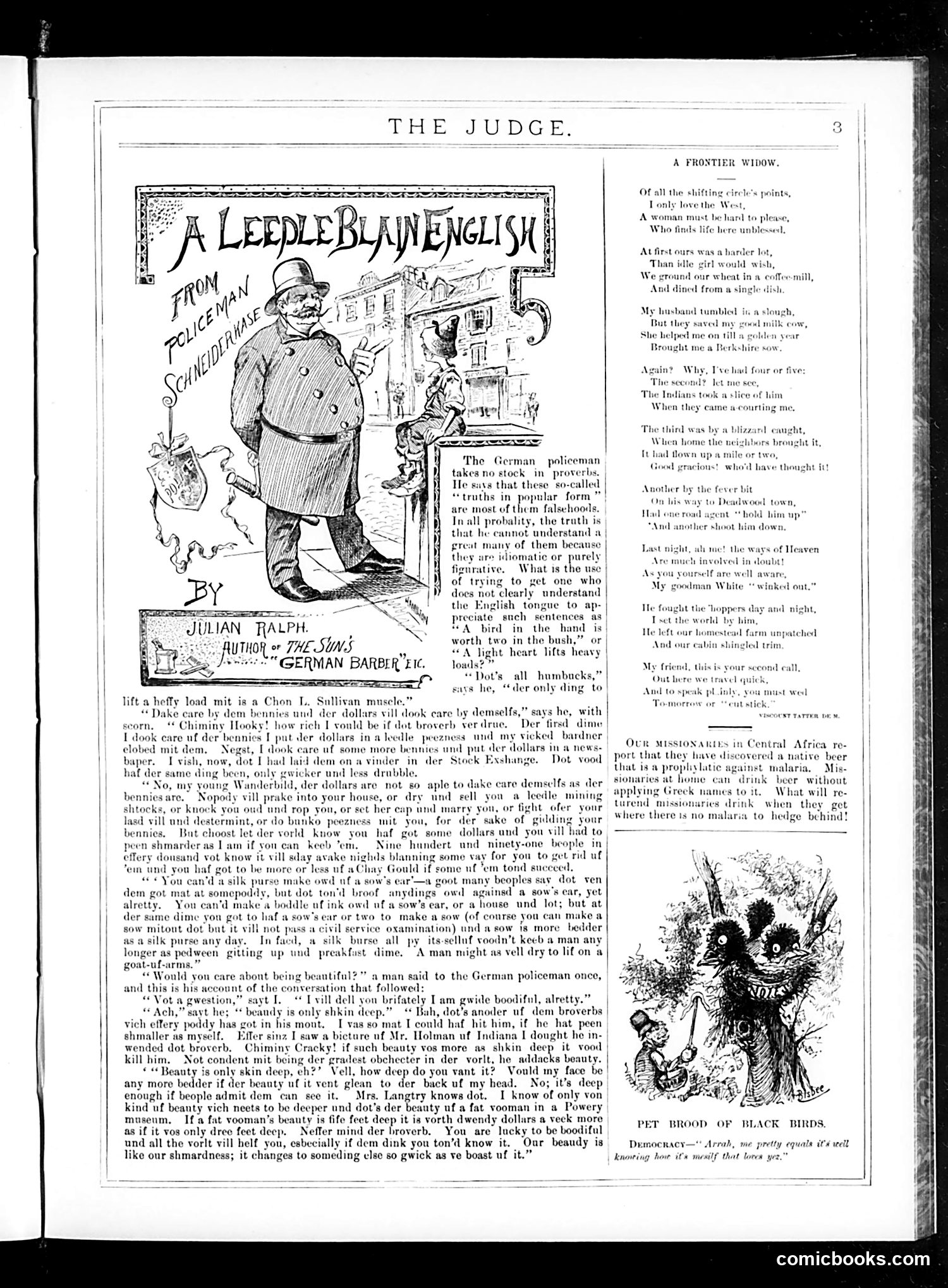
This page features two pieces satirizing German immigrants and frontier life in 1880s America. **"A Leedleblain English"** (main feature by Julian Ralph) mocks a German policeman's broken English and immigrant perspectives. The character butchers English idioms while dispensing cynical wisdom about American proverbs—particularly "a bird in the hand" and "you can't make a silk purse from a sow's ear." The satire ridicules both the character's speech patterns and his dismissive attitude toward American folk wisdom. **"A Frontier Widow"** (right column) presents a poem celebrating a pioneer woman's hardships: a dead husband, lost livestock to blizzards and Indian attacks, and struggles with grasshoppers. The contrast between the romanticized "frontier spirit" and actual frontier suffering suggests ironic commentary on westward expansion mythology. Both pieces reflect late-19th-century American attitudes: ethnic stereotyping of German immigrants and ambivalent fascination with the frontier myth.
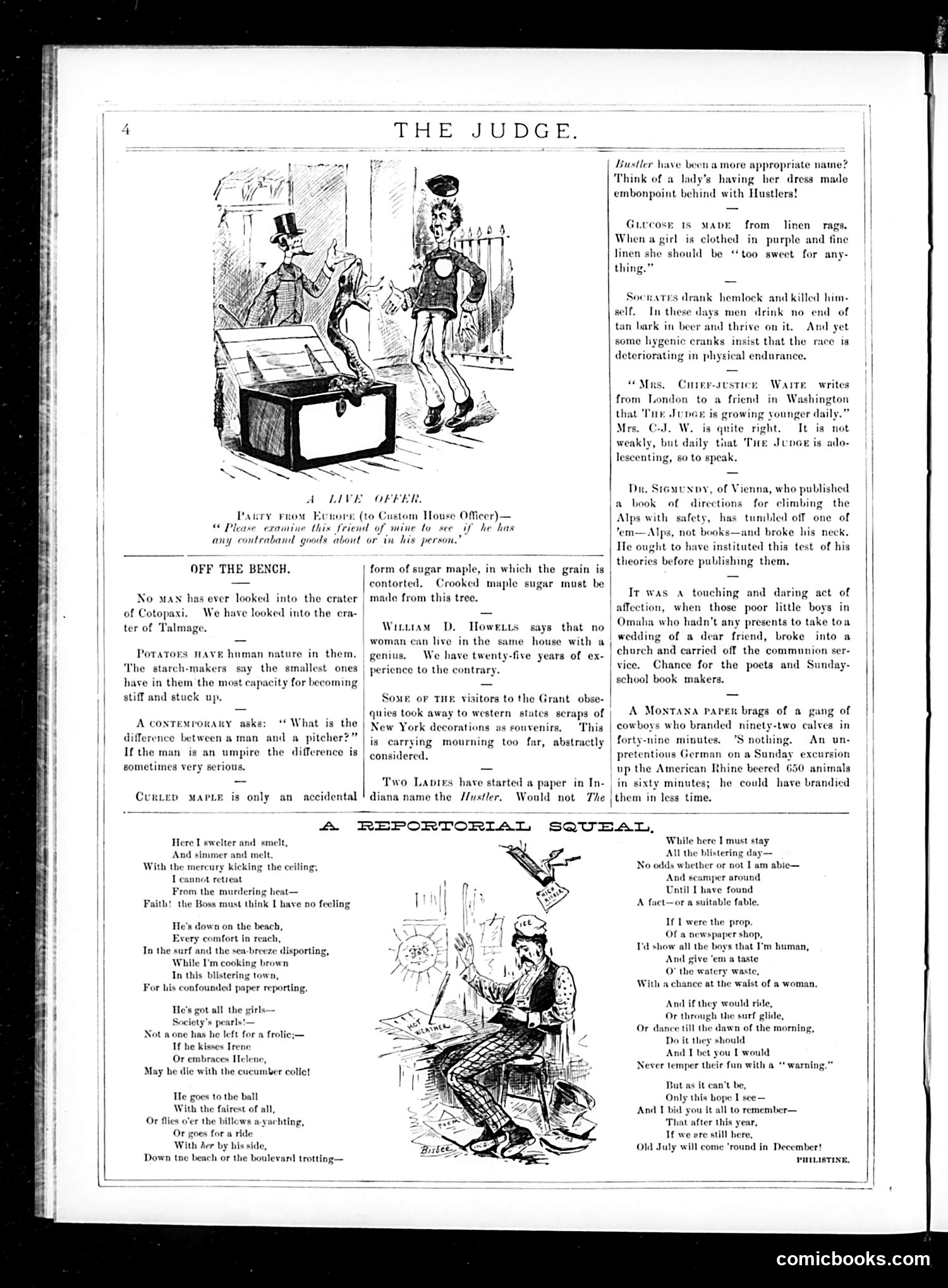
This page from *Judge* magazine contains satirical commentary on contemporary 1880s figures and social issues. **"A Live Offer"** (top cartoon): Depicts a customs official inspecting a European party arriving at the U.S., with a joke about contraband—likely satirizing elite travelers or immigration practices of the era. **"Off the Bench"** section: Contains brief satirical quips mocking public figures. References to "Talmage" (likely Thomas DeWitt Talmage, a prominent clergyman) and "Soquates" drinking hemlock suggest social/religious commentary. Other items mock maple sugar production, women in society, and German mountaineering mishaps. **"A Reportorial Squeal"** (bottom poem): A journalist's complaint about working in summer heat while editors enjoy beach leisure—a relatable workplace satire about editorial privilege and labor inequality. The overall tone is light mockery of contemporary society, public figures, and workplace conditions typical of late-19th-century American humor magazines.
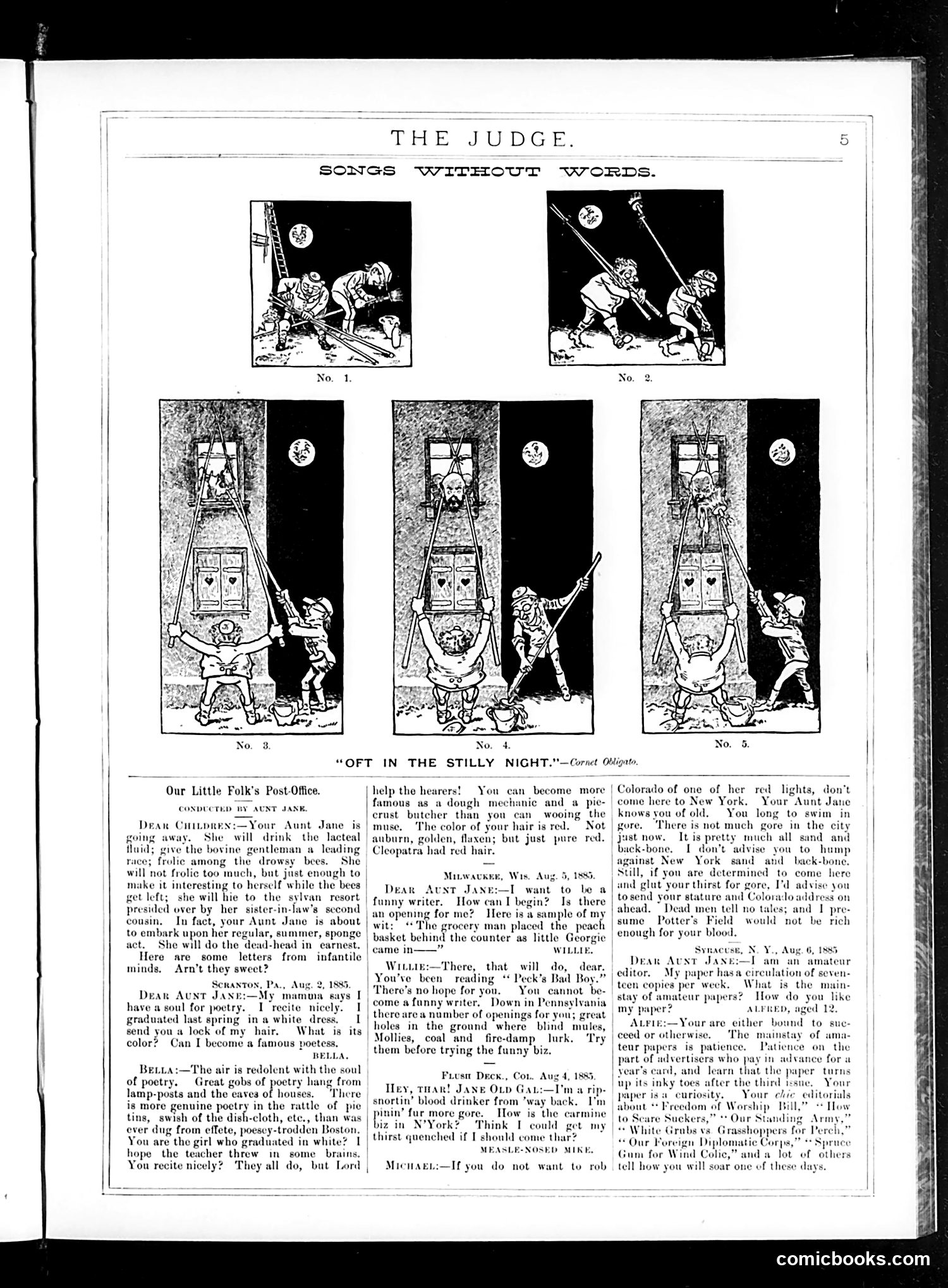
This page from *Judge* magazine contains a humor column called "Our Little Folk's Post-Office," where "Aunt Jane" responds to children's letters with sharp, satirical advice—the humor deriving from her deliberately discouraging and insulting replies. The five cartoon panels above ("Songs Without Words") depict scenes of children playing with what appears to be a hot-air balloon or similar apparatus, using visual gags rather than text. The column's jokes target: - **Aspiring poetess "Bella"**: Aunt Jane mocks her pretensions, suggesting she'd be better suited to practical kitchen work than poetry-writing - **Wannabe humorist "Willie"**: Told he has no talent and should seek coal-mining work instead - **"Measle-Nosed Mike"**: A character obsessed with gore and violence, advised to leave New York (crude period humor about violent desires) - **Amateur newspaper editors**: Mocked for their poor quality and brief lifespans The satire reflects late-19th-century attitudes toward youth ambition, offering deliberately unhelpful "advice" as comedy. The harshness would strike modern readers as mean-spirited rather than funny.
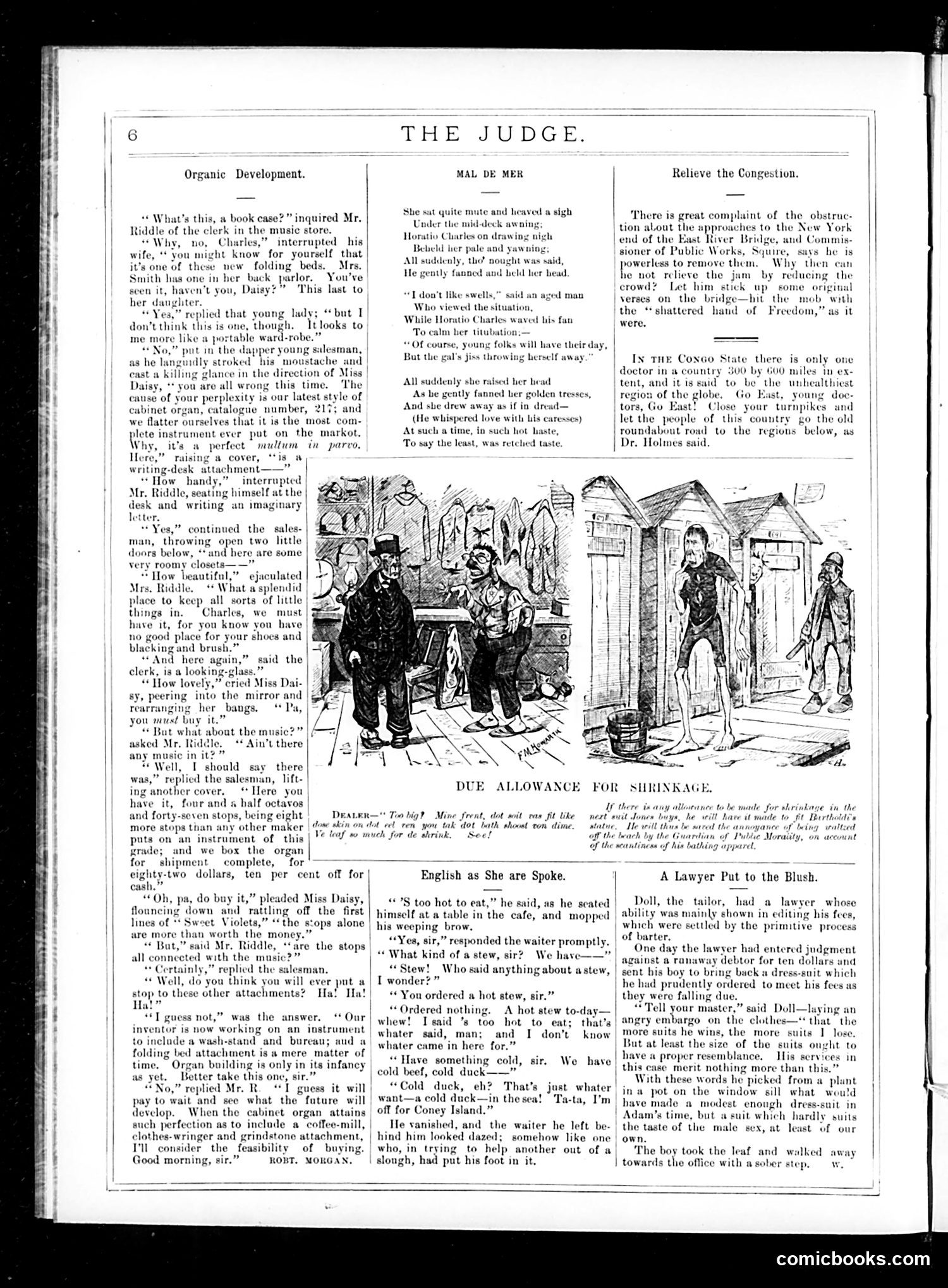
This page contains three distinct satirical pieces from the 19th-century American humor magazine Judge: **"Organic Development"** mocks the Victorian obsession with multi-functional furniture. A music store clerk persuades a couple that a cabinet organ is actually a folding bed, wardrobe, desk, and closet combined—a "mullum in parvo" (much in little). The joke satirizes both aggressive salesmanship and consumer gullibility regarding overly complicated, space-saving contraptions that were marketed as modern innovations. **"Mal de Mer"** appears to be a poem about seasickness and romantic awkwardness aboard a ship, likely mocking sentimental Victorian poetry and the incongruity of declaring love during someone's distress. **The three brief anecdotes** ("Relieve the Congestion," "Due Allowance for Shrinkage," "English as She are Spoke," "A Lawyer Put to the Blush") are humorous short sketches about bureaucratic incompetence, laundry mishaps, dialect confusion, and legal embarrassment—standard fare for period satire targeting everyday urban life and immigrant speech.
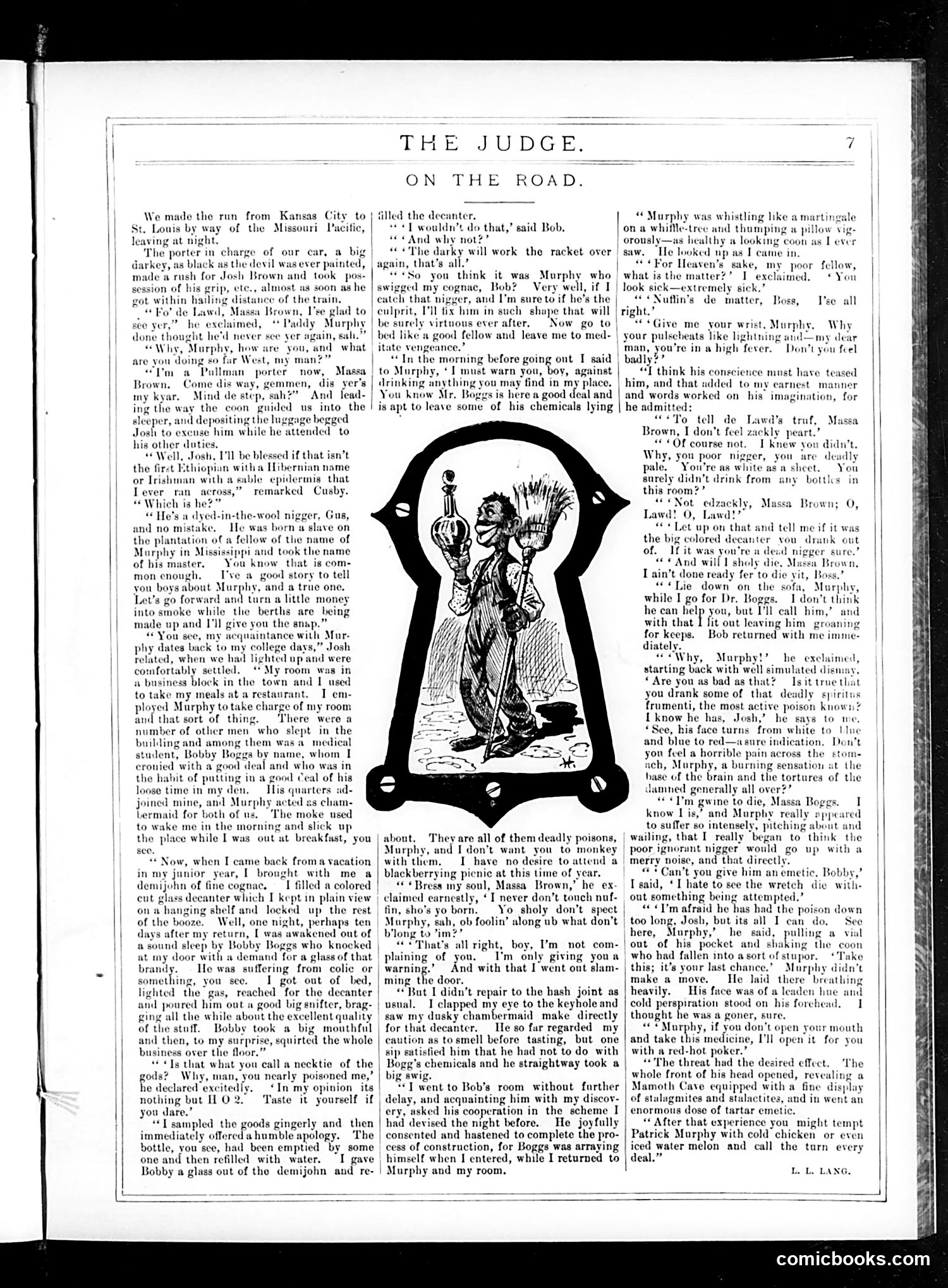
This page features a racist narrative story typical of late 19th-century American humor, centered on a Black Pullman porter named Murphy—a character who takes his name from his former enslaver, a common post-slavery practice. The story's "humor" derives from racial stereotypes: Murphy is portrayed as intellectually simple, superstitious, and prone to thievery. The plot involves a missing bottle of cognac and Murphy's subsequent illness, which the narrator interprets as guilt-induced conscience affecting Murphy's imagination. The central cartoon depicts Murphy in exaggerated caricature—large lips, distorted features—carrying luggage, visualizing a demijohn (large bottle), emphasizing the theft narrative. The satire appears directed not at racial injustice but at reinforcing period prejudices about Black workers' dishonesty and susceptibility to psychological manipulation. This reflects Judge magazine's editorial position during the Gilded Age: entertainment through dehumanizing racial caricature, presenting racism as comedic fact rather than social critique.
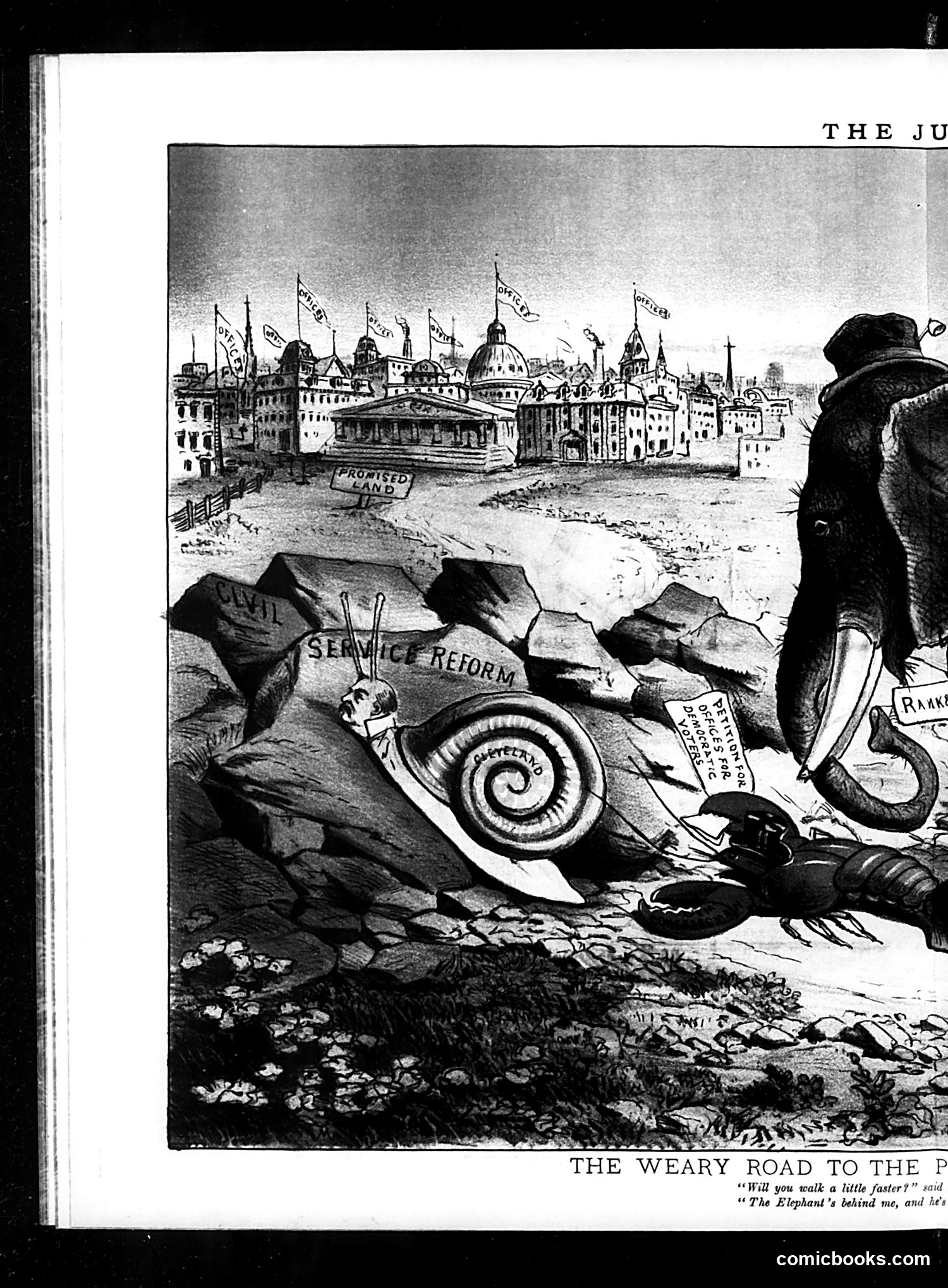
This is a satirical cartoon titled "The Weary Road to the P[eace]" depicting the journey toward peace negotiations. The foreground shows various obstacles—rocks labeled with terms like "Civil Service Reform"—blocking the path. A snail carrying a spiral shell labeled "Lobbying" moves slowly forward, while figures in the background (likely political leaders) observe from a distant cityscape. The cartoon satirizes the slow, arduous progress toward peace, hampered by bureaucratic obstacles and special interests. The snail metaphor emphasizes tedious delay. The quoted text references Lewis Carroll's "Alice in Wonderland" ("Will you walk a little faster?"), suggesting the slow pace is frustratingly absurd. The elephant reference remains unclear without additional context, but likely refers to either a political party or powerful influence impeding progress.
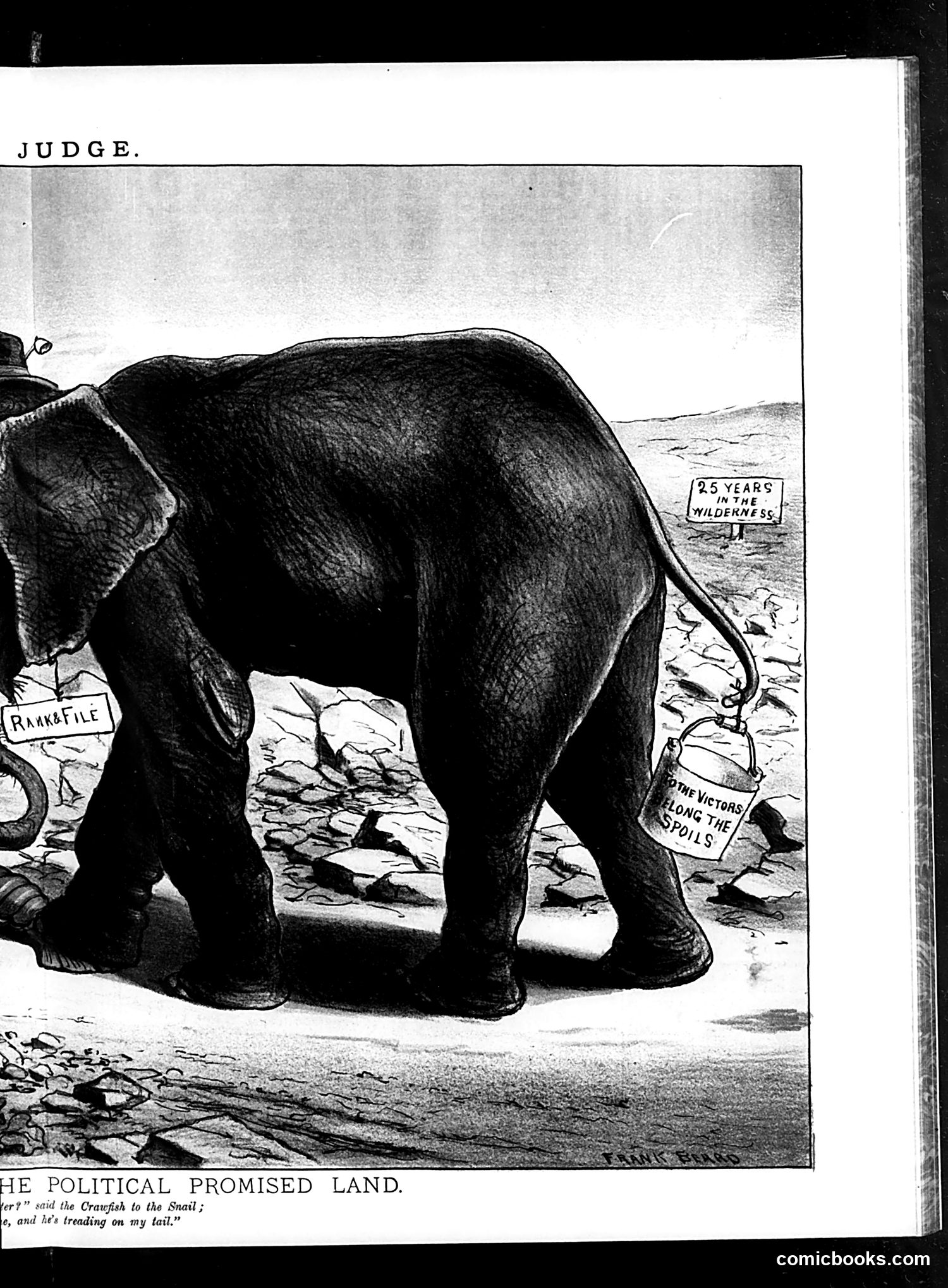
This political cartoon titled "The Political Promised Land" depicts a large elephant labeled "Rampfile" trampling through rocky, barren terrain marked "25 Years in the Wilderness" and "The Victors Along the Spoils." The elephant appears to represent the Republican Party (the GOP's traditional symbol), while the landscape suggests a period of political exile or exclusion from power. The smaller creatures being stepped on—identified as a crawfish and snail in the accompanying verse—represent political opponents or those displaced by Republican dominance. The "Promised Land" reference suggests the GOP's return to power after years of Democratic control. The satirical point critiques the Republicans' aggressive assertion of authority and their treatment of political opponents upon regaining prominence, portraying their victory as destructive rather than constructive.
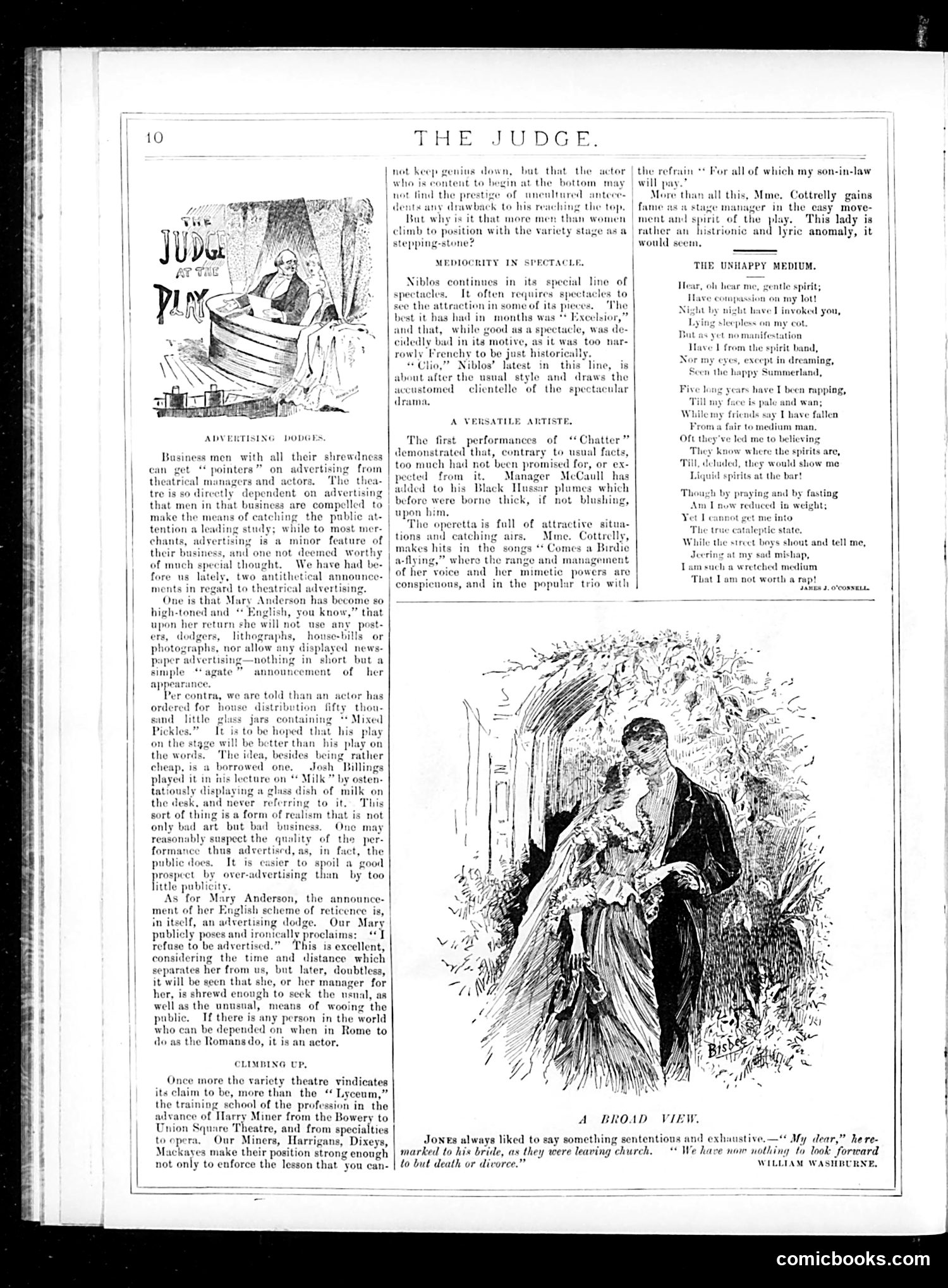
This page from Judge satirizes theatrical advertising and performance practices of the era. The main cartoons and articles critique: **"Advertising Dodges"**: Managers' desperate advertising stunts are mocked—one actor distributed 50,000 jars of "Mixed Pickles" to promote his play, while Mary Anderson ironically advertises her refusal to advertise. The satire suggests such tactics cheapen theatrical art and signal poor quality productions. **Theatre Reviews**: Brief critiques of current shows—Niblos' spectacles (like "Excelsior" and "Clio") are called mediocre despite impressive staging; an operetta with Mme. Cottrelly is deemed "histrionic" anomaly; McCaull's production receives mixed assessment. **"The Unhappy Medium"**: A poem (right column) expresses romantic melancholy in period verse style. **Illustration**: "A Broad View" shows a couple leaving church with the caption about a husband remarking his bride will pay for everything—typical period marital humor. The overall message: theatrical managers oversell mediocre productions through gimmicks rather than genuine merit.
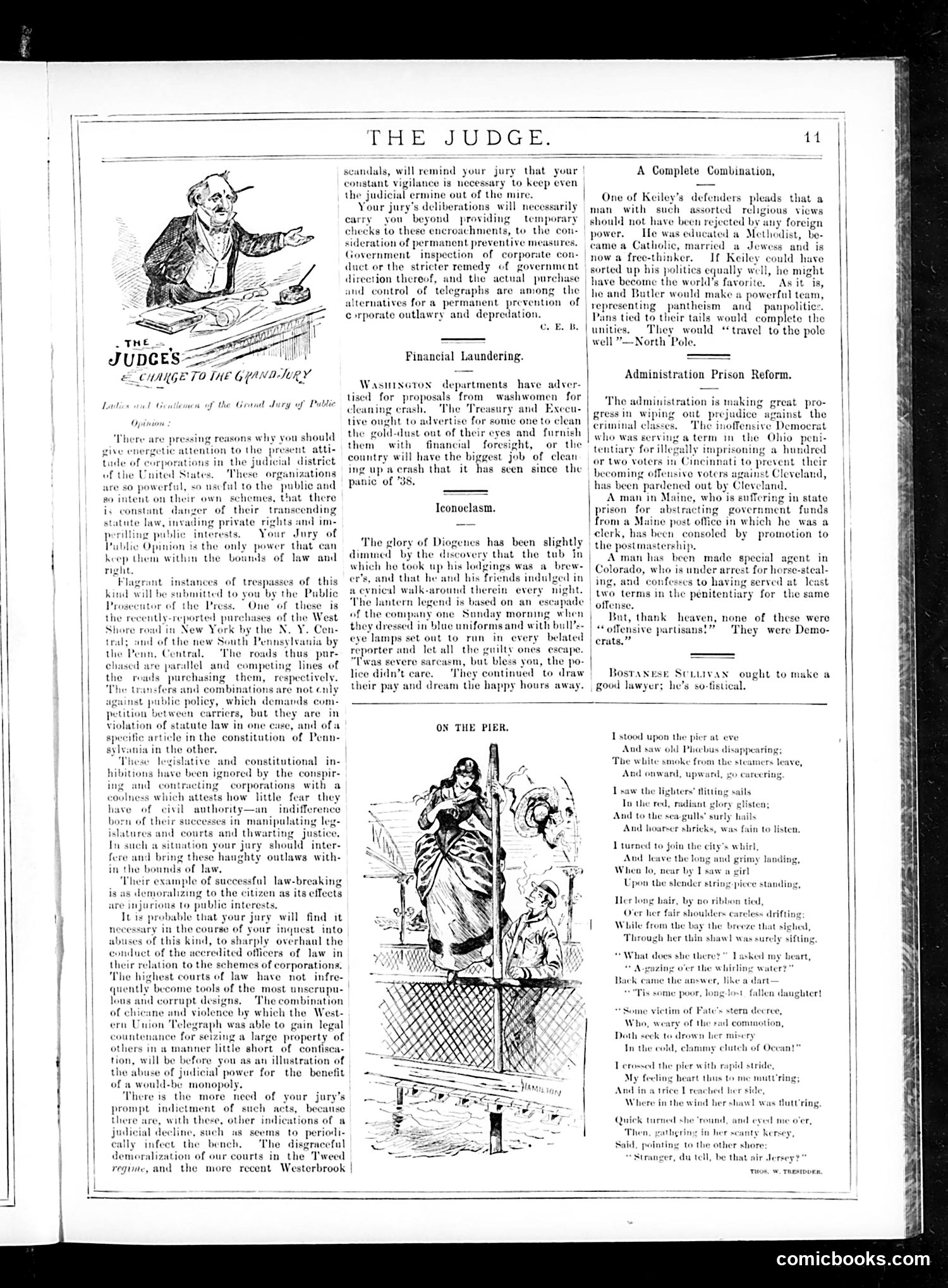
This page contains a lengthy editorial cartoon addressing corporate malfeasance in the Gilded Age. The central figure appears to be a judge addressing a jury about the dangers of unchecked corporate power—particularly railroad monopolies like the New York Central and Pennsylvania Central purchasing competing lines (the West Shore and South Pennsylvania roads). The satire targets corporations that violate state laws and constitutional protections while manipulating courts and legislatures. The cartoon criticizes both the corporations' "law-breaking" and the judiciary's complicity, referencing scandals like Western Union's alleged use of corrupt judicial power and recent courthouse corruption (the "Tweed regime" and "Westerbrook scandals"). The piece advocates jury vigilance and suggests permanent preventive measures: government inspection, direction, or actual public ownership of infrastructure like telegraphs. It's fundamentally an anti-monopoly, pro-regulation argument wrapped in judicial rhetoric.
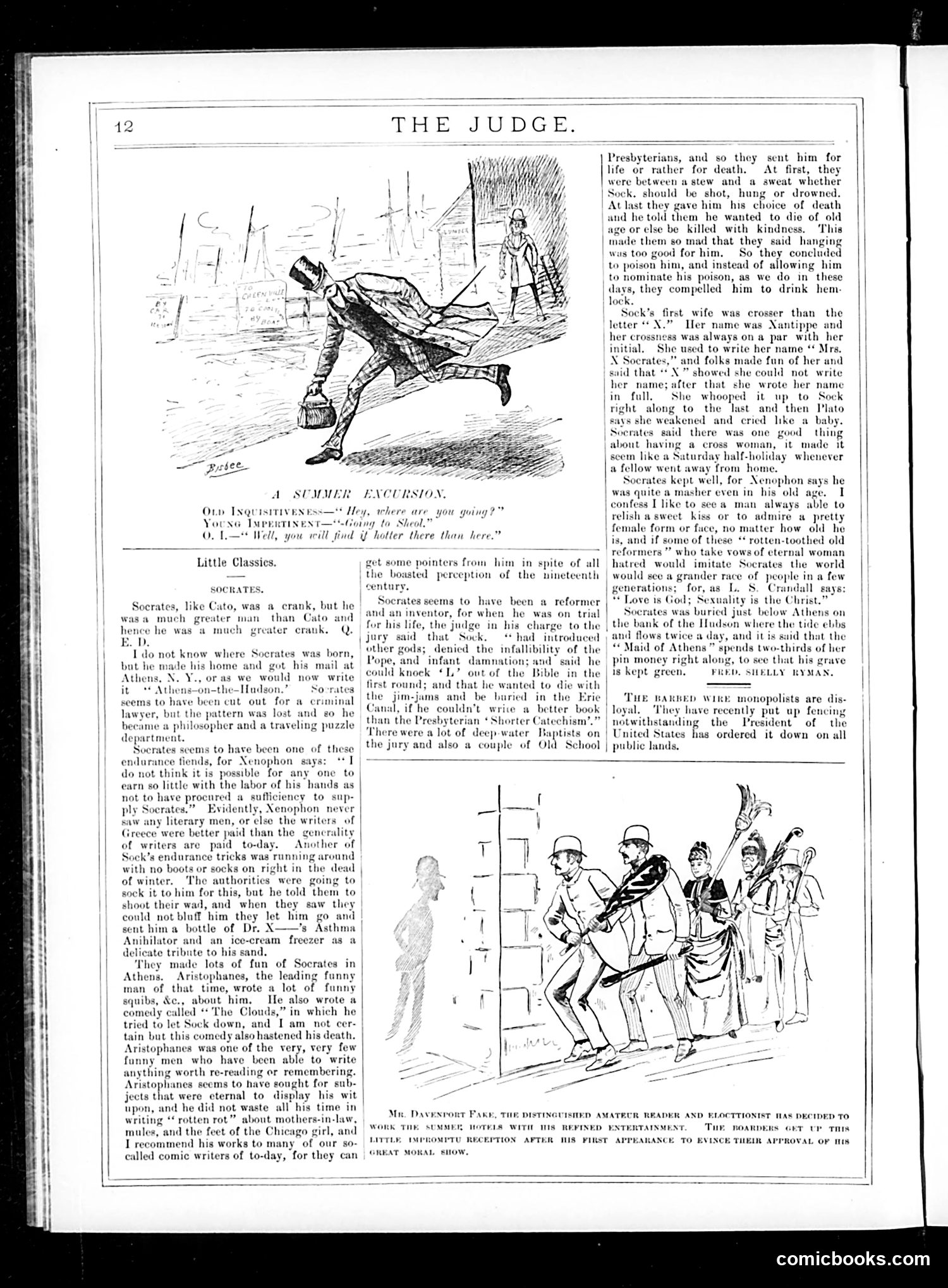
This page from the satirical magazine *Judge* uses the classical philosopher Socrates as a vehicle for contemporary American social commentary, likely from the late 19th century. **The Setup:** The text humorously reimagines Socrates' trial and execution, but relocates him to "Athens, N.Y." and references American concerns—Presbyterian theology, the Erie Canal, and reformers. **The Satire's Points:** 1. **Mock-heroic treatment of philosophers**: Socrates is portrayed as an eccentric "crank" who challenges authority (denying Biblical infallibility), mirroring contemporary reformers and free-thinkers that *Judge's* conservative readers likely viewed skeptically. 2. **Criticism of reformers**: The text suggests these "rotten-toothed old reformers" are disagreeable zealots, contrasting them with Socrates' charm and ability to admire beauty. 3. **Americanization of classics**: By placing ancient philosophy in upstate New York, *Judge* mocks both pretentious classical allusions and American provincial life. The cartoons illustrate humorous anecdotes about Socrates' domestic life and a summer excursion, maintaining the irreverent, educational-comedy tone characteristic of *Judge's* "Little Classics" series.
This page from *Judge* magazine contains primarily humorous short items and witticisms rather than political cartoons. The content reflects late 19th-century American humor. The opening poem "Love and Cards" is a sentimental joke: a young man declares his love to a maiden, then reveals his true confidence comes from holding "a lovely hand to-night"—a card-playing pun. The remaining items are brief jokes satirizing contemporary American life: Chicago's divorce industry, Irish banking failures, agricultural disasters (grasshoppers), and editor compensation. References to "Sitting Bull" and Cleveland's election suggest 1880s dating. The humor is largely domestic and observational—mocking lawyers, wives who nag like teakettles, and the contrast between European and American journalism practices. The satire targets no specific political figures but rather social absurdities: ineffective politicians, financial instability, and marital discord. This represents *Judge*'s typical mix of gentle social commentary and wordplay rather than sharp political attack.
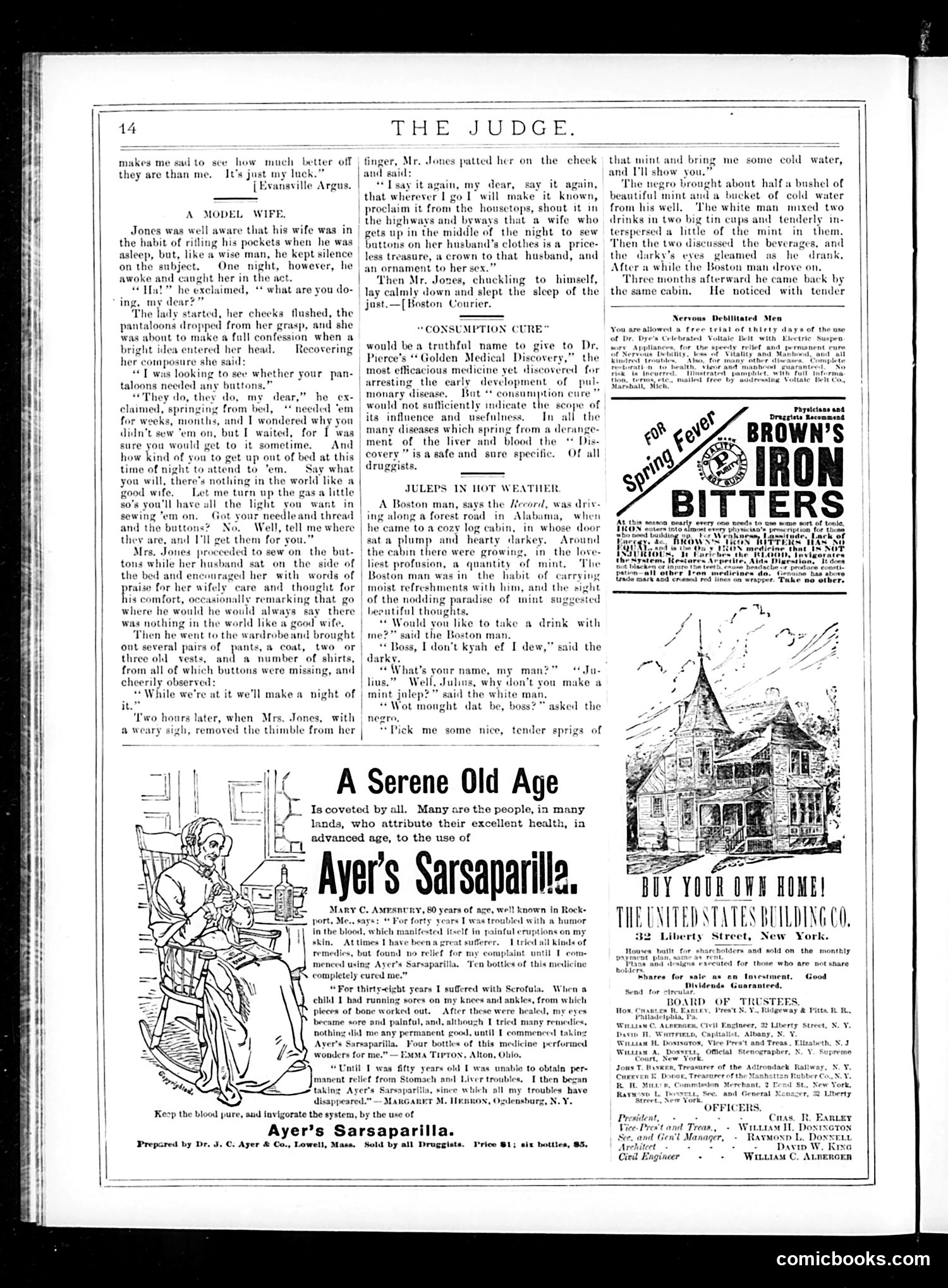
This story satirizes the performance of domestic virtue. A husband catches his wife stealing from his pockets at night—a clear violation of trust. Rather than confront her, she quickly improvises an excuse (checking for missing buttons), and he seizes upon this fabrication, publicly praising her devotion while conveniently producing multiple other garments needing repair. The satire targets both parties: the wife's dishonesty and the husband's willful self-deception. By loudly celebrating her as "a priceless treasure," he avoids marital conflict while she avoids consequences. The joke suggests that "a model wife" isn't actually virtuous—she's simply skilled at managing her husband's expectations through convenient lies, and he's complicit in the performance. This reflects Victorian-era anxieties about the gap between domestic ideals and household reality.
This page is primarily **advertisements and filler content** rather than political cartoons. The main text pieces are light satirical stories typical of *Judge* magazine's humor: **"A Youthful Penitent"** mocks naive philanthropy: a well-meaning lady lectures two fighting boys about kindness, and they agree—but one admits he'd "druther break his durn back" than kiss the other. The joke is the boys' hypocrisy and the lady's ineffectual moralizing. **"The Modern Shakespeare"** parodies flowery Shakespearean language through jealous lovers' complaints. One man accuses a rival (Senor Adula) of winning a woman through excessive poetic flattery, comparing his "verbal caramels" unfavorably to his own tribute. It satirizes overwrought romantic speech and the absurdity of competing through increasingly ridiculous compliments. The rest is vintage advertising for medical devices (trusses, hemorrhoid cures), printing services, pianos, and book binding—typical of period magazines' revenue model.