
A complete issue · 16 pages · 1885
Judge — July 25, 1885
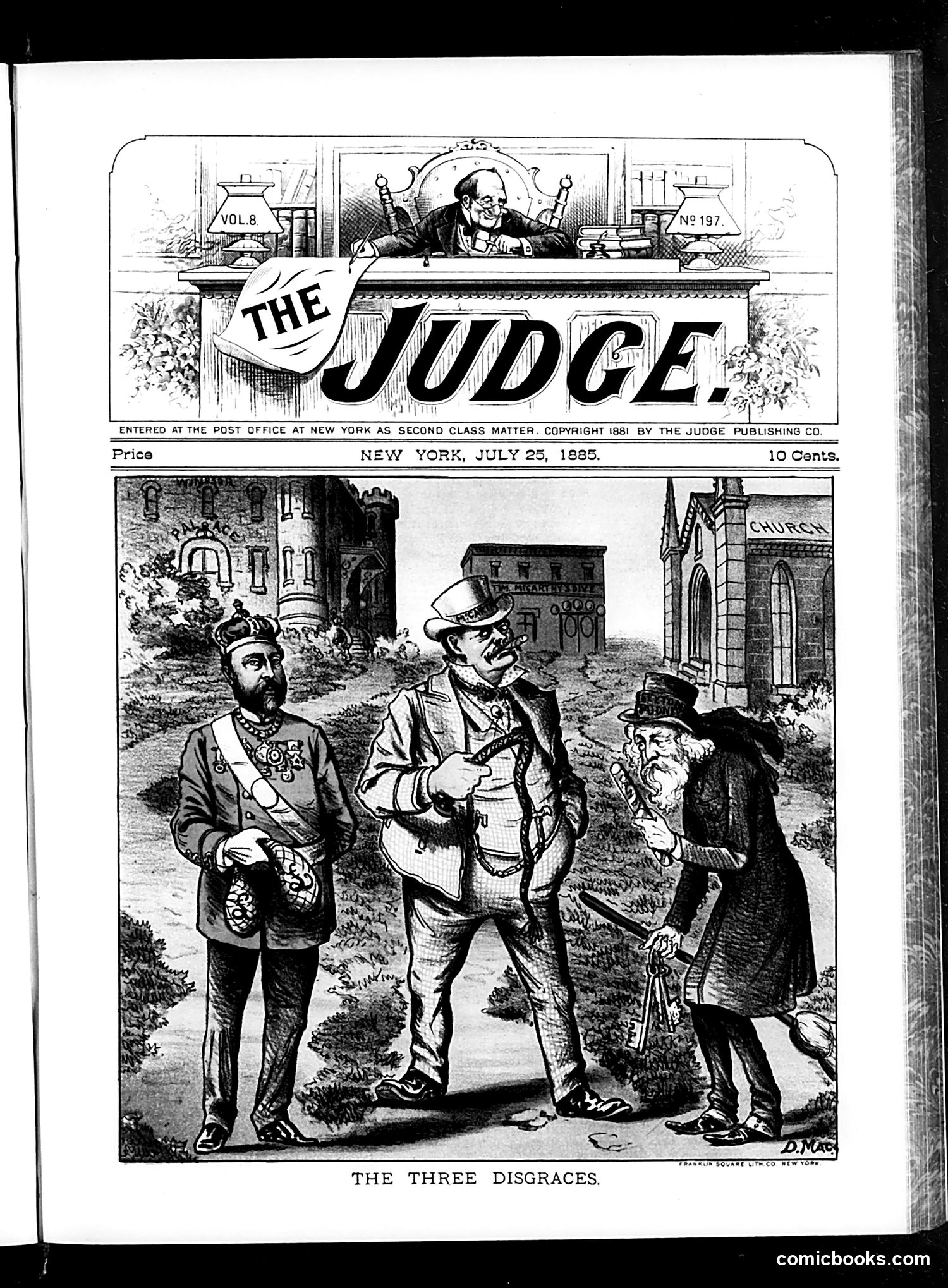
This political cartoon satirizes three contemporary figures through caricature. The image shows three men in a European setting (suggested by castle architecture), depicting what the caption labels "The Three Disgraces." The leftmost figure wears formal military regalia with decorations, suggesting a European monarch or high official. The central character appears to be a military or political leader in lighter clothing. The right figure is rendered as an elderly man in dark clothing. Without additional historical context from this specific 1885 issue, I cannot definitively identify these three individuals or the specific political scandal being referenced. However, the formal dress and European setting indicate this likely concerns prominent European political or royal figures involved in some contemporary controversy that Judge's American readership would have recognized.
This page from *Judge* satirizes police corruption and hypocrisy in 1800s New York. The main cartoon, "An Ophthalmic Phenomenon," mocks Metropolitan police for selective blindness: they mysteriously cannot see illegal establishments ("dives") operating openly across the street, yet can spot minor infractions from blocks away. The satire suggests officers are deliberately ignoring vice dens—likely because they're receiving bribes or protection money from criminals. The piece uses mock-scientific language ("ophthalmic defect," "congenital") to ridicule the implausible explanations for this pattern. It references Captain or Superintendent officials being equally blind, implicating corruption at higher levels. The secondary article, "Civilizing the World," sarcastically critiques American imperialism in Mexico, mocking the hypocrisy of spreading "Christian civilization" through military force and cannons while promoting slavery. Both pieces employ Judge's characteristic acidic wit to expose institutional corruption and American imperial pretensions.
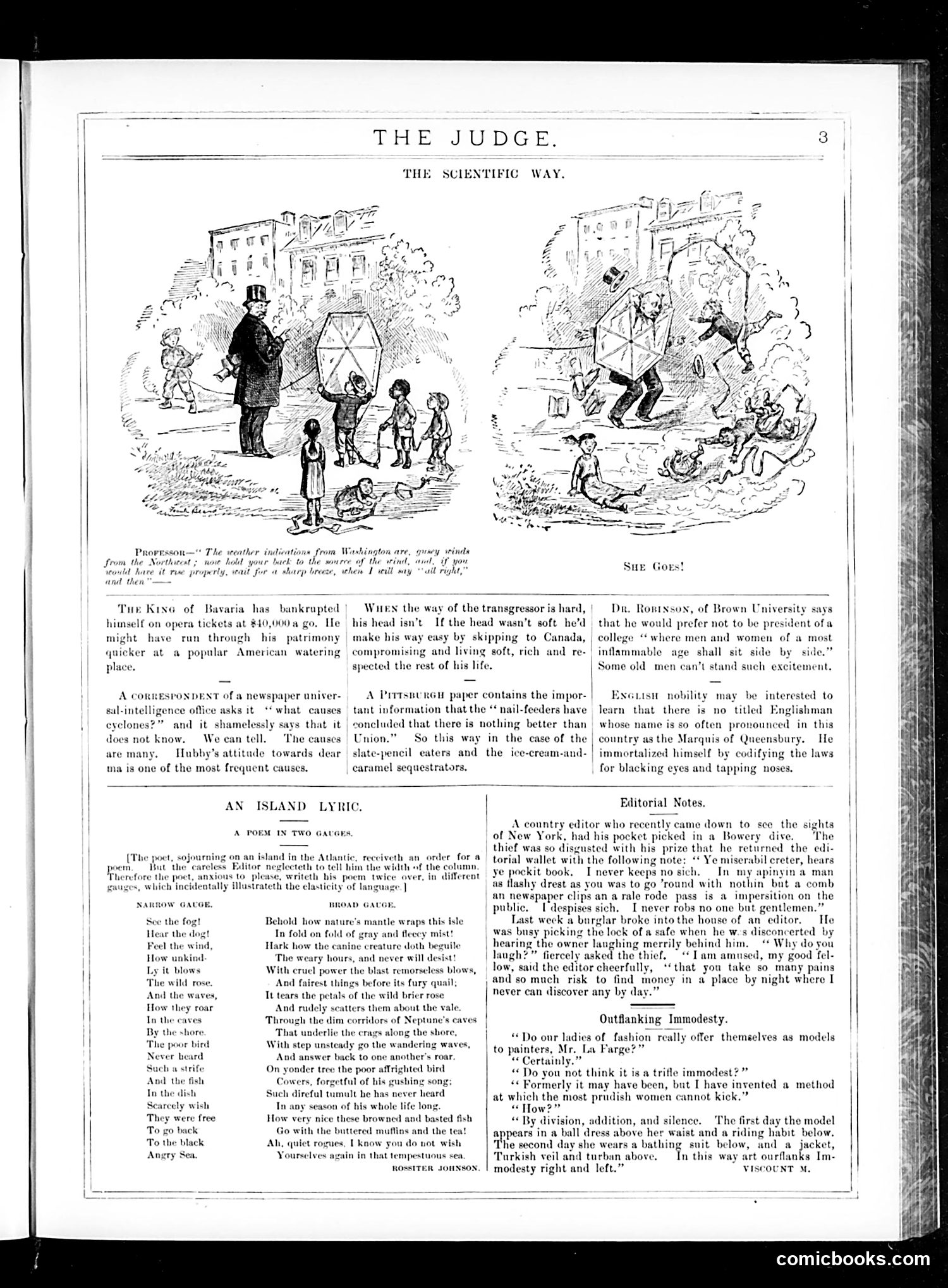
This page features two cartoons satirizing late 19th-century American life. The left cartoon shows a pompous professor demonstrating weather prediction to children using an umbrella and compass—mocking pseudoscientific pretension and charlatans passing themselves off as experts. The caption's reference to "Washington" suggests critique of government weather forecasting claims. The right cartoon ("She Goes!") depicts a man with an umbrella being blown away by wind, illustrating the futility of the professor's methods—situational irony highlighting how abstract "science" fails against practical reality. The page's miscellaneous notes mock various contemporary absurdities: Bavaria's king bankrupting himself on opera tickets, newspaper editors being robbed (implying they're worthless targets), and a satirical exchange about whether society ladies posing for painters compromises morality. The overall tone ridicules pretension, incompetence, and social hypocrisy typical of *Judge's* satirical approach.
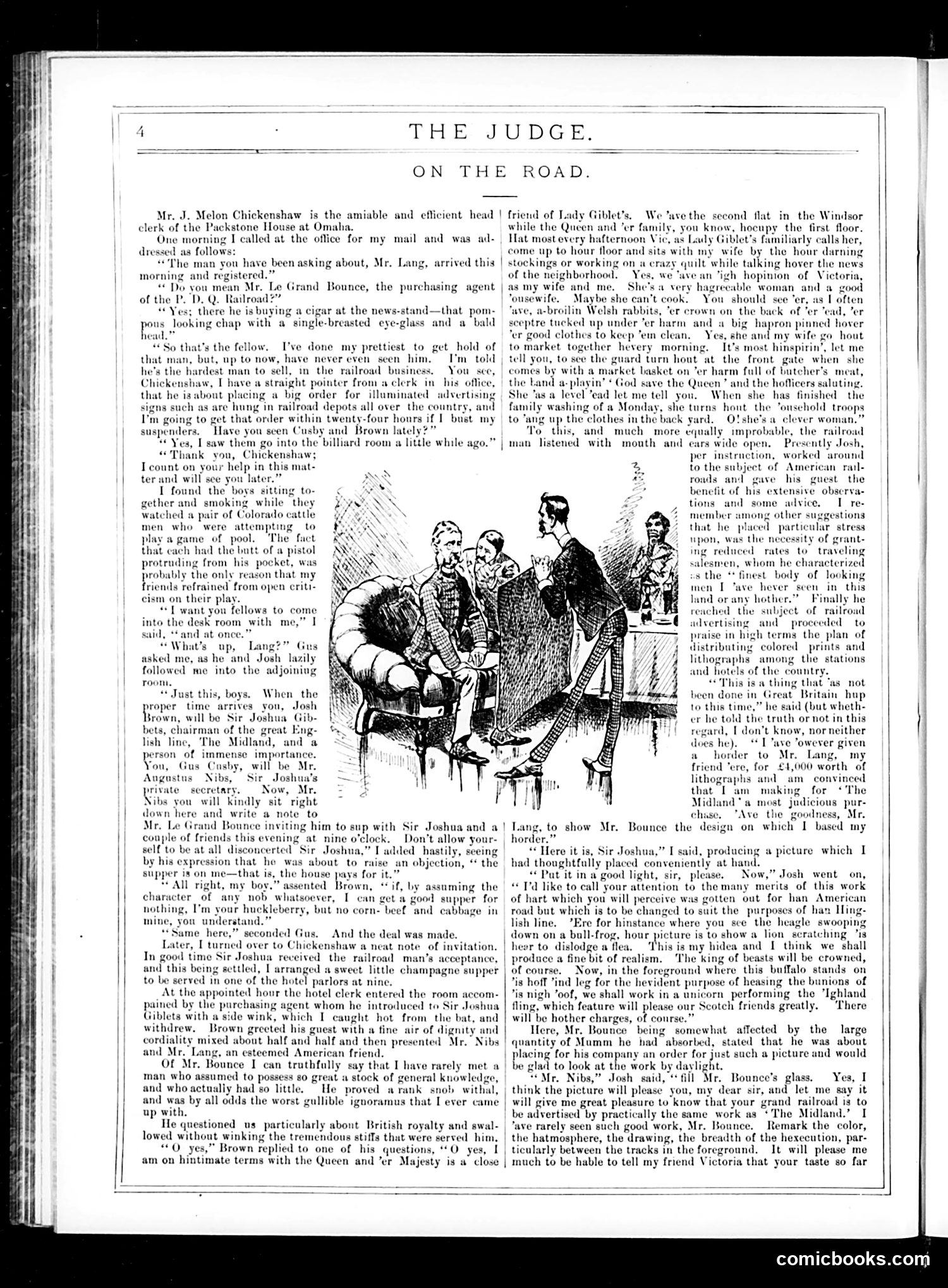
This page satirizes American railroad business culture and social pretension in the late 19th century. The narrator describes an elaborate practical joke: he convinces two con men (Josh Brown and Gus Cusby) to impersonate a prestigious British railroad executive ("Sir Joshua Giblets") and his secretary to impress Mr. Le Grand Bounce, a railroad purchasing agent known for being difficult to sell to. The joke exposes Bounce's gullibility and snobbish reverence for British aristocracy—he's easily fooled by fake titles and assumes British nobility possess superior knowledge. The accompanying illustration shows the moment of introduction, with the "British gentlemen" meeting their mark. The satire critiques American business culture's infatuation with European prestige and mocks both the charlatan salesmen and the easily-duped purchaser who can be manipulated through social climbing and false status.
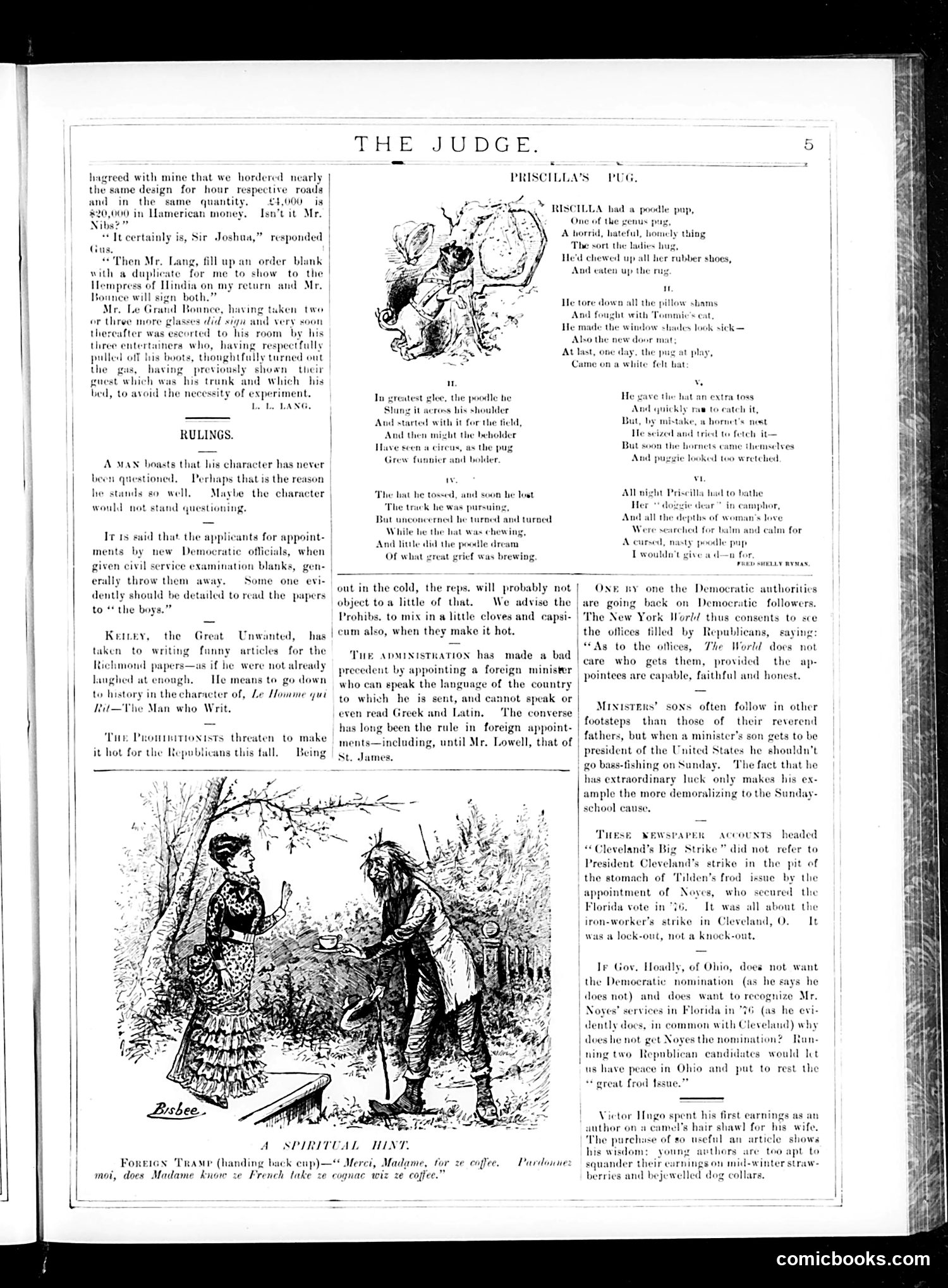
This page contains two satirical pieces typical of *Judge* magazine's political humor: **"Priscilla's Pug"** (top): A humorous poem with accompanying illustration about a mischievous poodle causing domestic chaos—tearing furniture, fighting cats, and destroying household items. It's lighthearted social satire about pet ownership rather than political commentary. **"Rulings" and political commentary** (bottom): Brief satirical items targeting Democratic officials and reform efforts. One mocks the appointment of a foreign minister who cannot speak Greek or Latin (departing from diplomatic tradition). Another criticizes Democratic civil service practices. A third jokes about a minister's son (likely President Cleveland) fishing on Sunday—seen as hypocritical given his religious constituency. The page also includes a sketch labeled "Spiritual Hint" showing what appears to be a social encounter, likely satirizing contemporary manners or class pretension. Overall, this represents *Judge*'s typical mix of domestic humor and pointed political criticism of the Cleveland administration and Democratic Party policies.
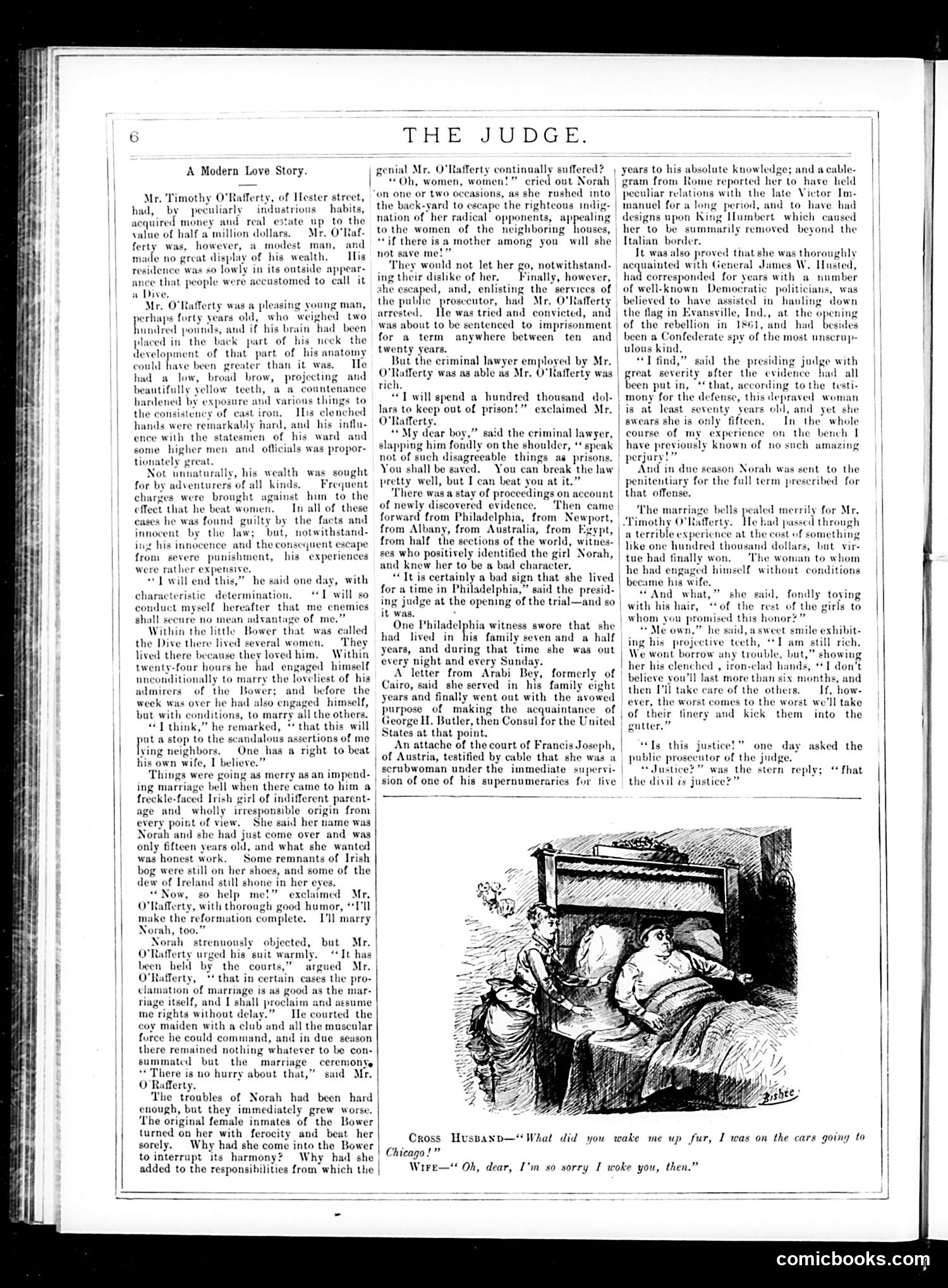
This story satirizes Irish immigrant stereotypes and urban social problems of the late 19th century. Timothy O'Rafferty, a wealthy Irish immigrant from the tenement district ("the Dive"), represents the crude, violent nouveau riche. Despite his fortune, he remains brutish and abusive toward women. The satire's central joke: O'Rafferty, facing accusations of beating women, decides to marry *all* his lovers simultaneously to legitimize his violence—claiming husbands have "rights" to beat wives. He then pursues the innocent, newly-arrived Irish girl Norah, "courting" her with a club. The story mocks both O'Rafferty's logic and the legal/social climate that enabled domestic abuse. The accompanying cartoon depicts marital violence as darkly comedic. Judge uses this tale to critique urban corruption, immigrant criminality, and the law's failure to protect vulnerable women—particularly impoverished Irish immigrants.
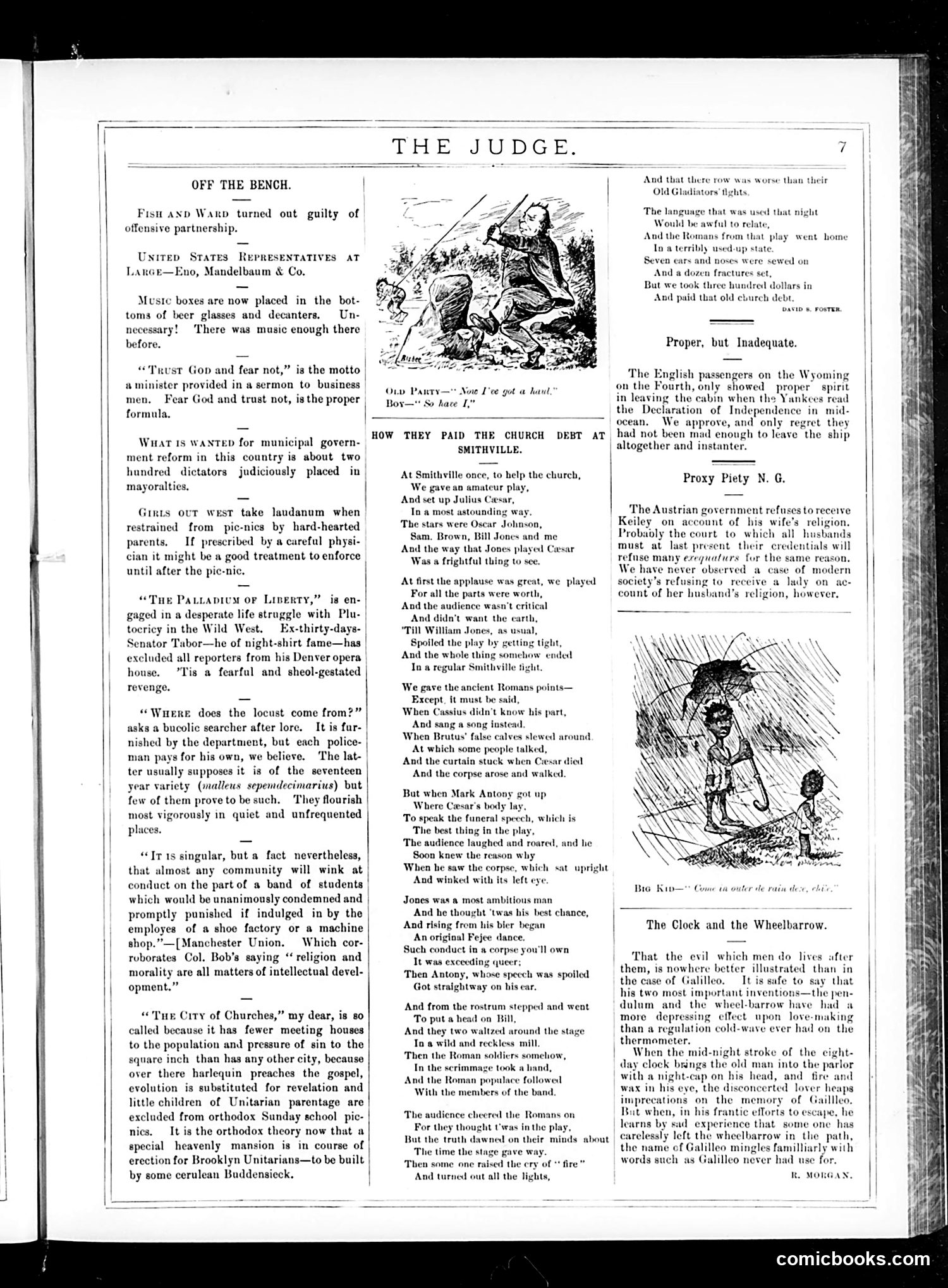
This page contains several brief satirical commentaries typical of Judge's format, plus two illustrated pieces. **"Off the Bench"** consists of short jabs at contemporary issues: municipal corruption (referencing Representatives at Lane, Mandelbaum & Co.), business ethics ("Trust God and fear not"), and social hypocrisy (students getting away with behavior that would scandalize factory workers). **The main cartoon** depicts a theatrical disaster: an amateur production of Julius Caesar staged to raise church funds in "Smithville." The satire mocks how the performance descended into chaos—actor William Jones got drunk, the staging was chaotic, and yet they still raised three hundred dollars for the church debt. The humor lies in the contrast between high classical drama and small-town amateur theatricality gone wrong, and the irony that despite everything falling apart, the fundraising succeeded. **"The Clock and the Wheelbarrow"** (lower right) appears to be a separate poetic piece about Galileo's scientific discoveries and their emotional impact, unrelated to the satire above. The page exemplifies Judge's mix of political commentary and domestic American humor.
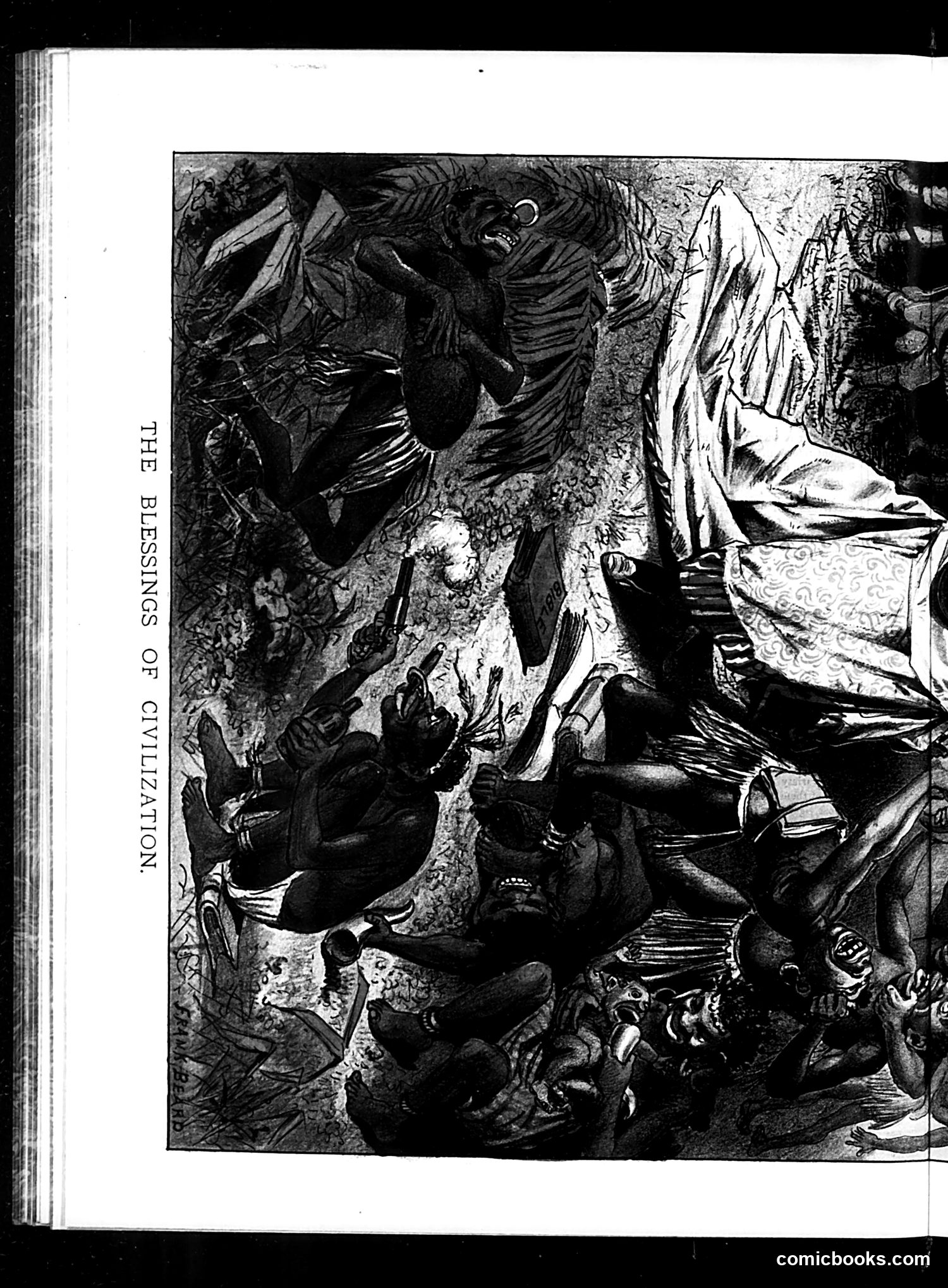
This appears to be a satirical engraving depicting European colonialism in Africa. The title "The Blessings of Civilization" uses ironic language—a common Judge magazine technique—to critique imperial expansion. The image shows European colonizers (likely identifiable by their clothing and weapons) interacting with African people and resources. The visual irony contrasts the caption's claim of "blessings" with imagery suggesting exploitation, violence, or domination. This reflects late 19th/early 20th-century American editorial commentary on European imperialism, particularly during the "Scramble for Africa." Judge often employed such satire to critique colonial practices while entertaining American readers, though the satire's actual political stance remains ambiguous from the image alone.
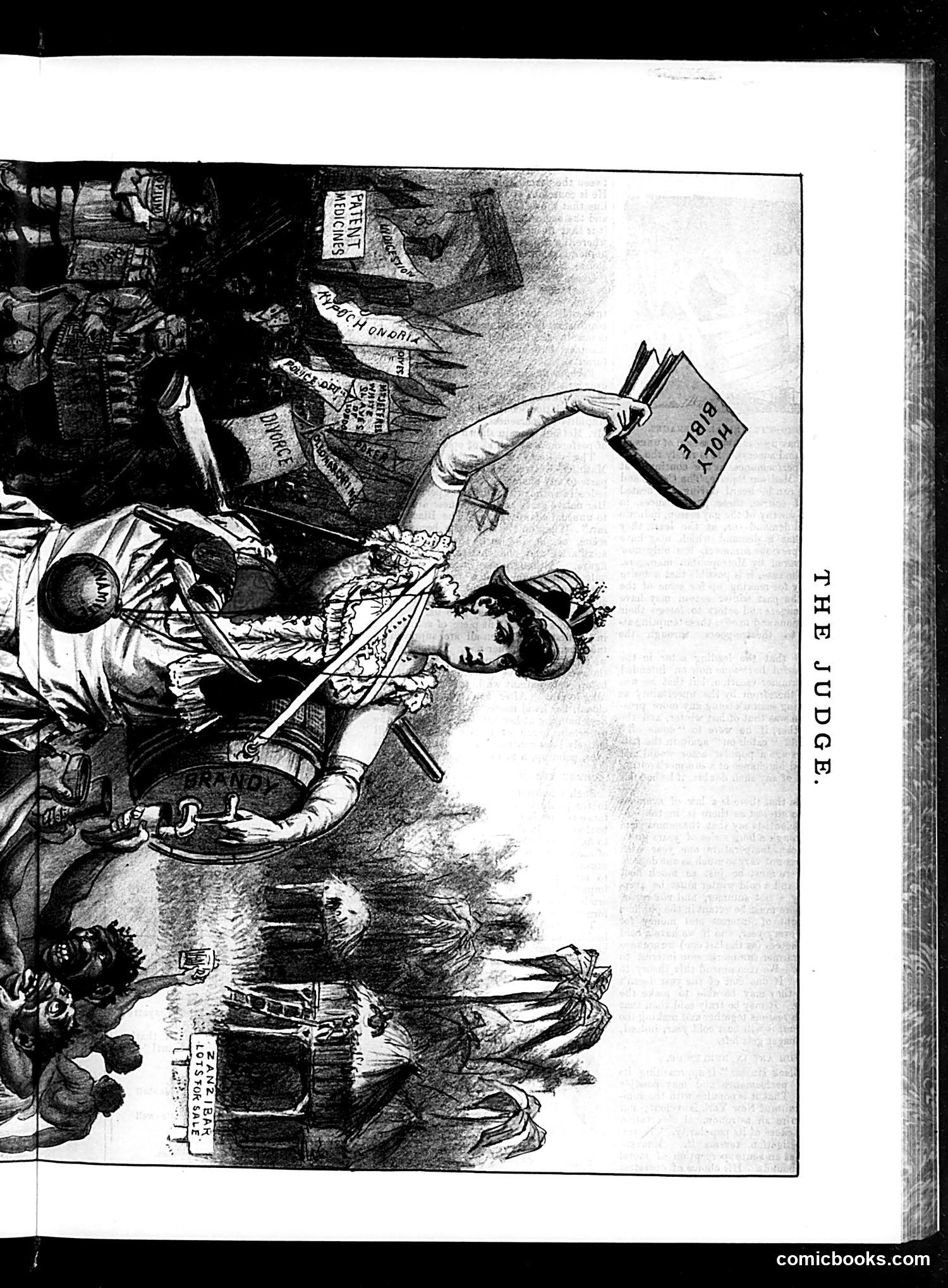
This appears to be a political cartoon titled "The Judge," though the image quality makes specific details challenging to discern with certainty. The cartoon depicts a figure in judicial robes holding what appears to be a large book or tablet labeled "JUDGE" or similar, positioned above a chaotic scene below. The composition suggests satire about judicial authority or legal judgment, with various labeled elements (text on banners/signs is partially illegible in this reproduction) surrounding the central judicial figure. The style is consistent with late 19th or early 20th-century American political cartooning. Without clearer text visibility, I cannot definitively identify which specific political figures, events, or social issues this particular cartoon satirizes, though the hierarchical positioning suggests commentary on power and authority.
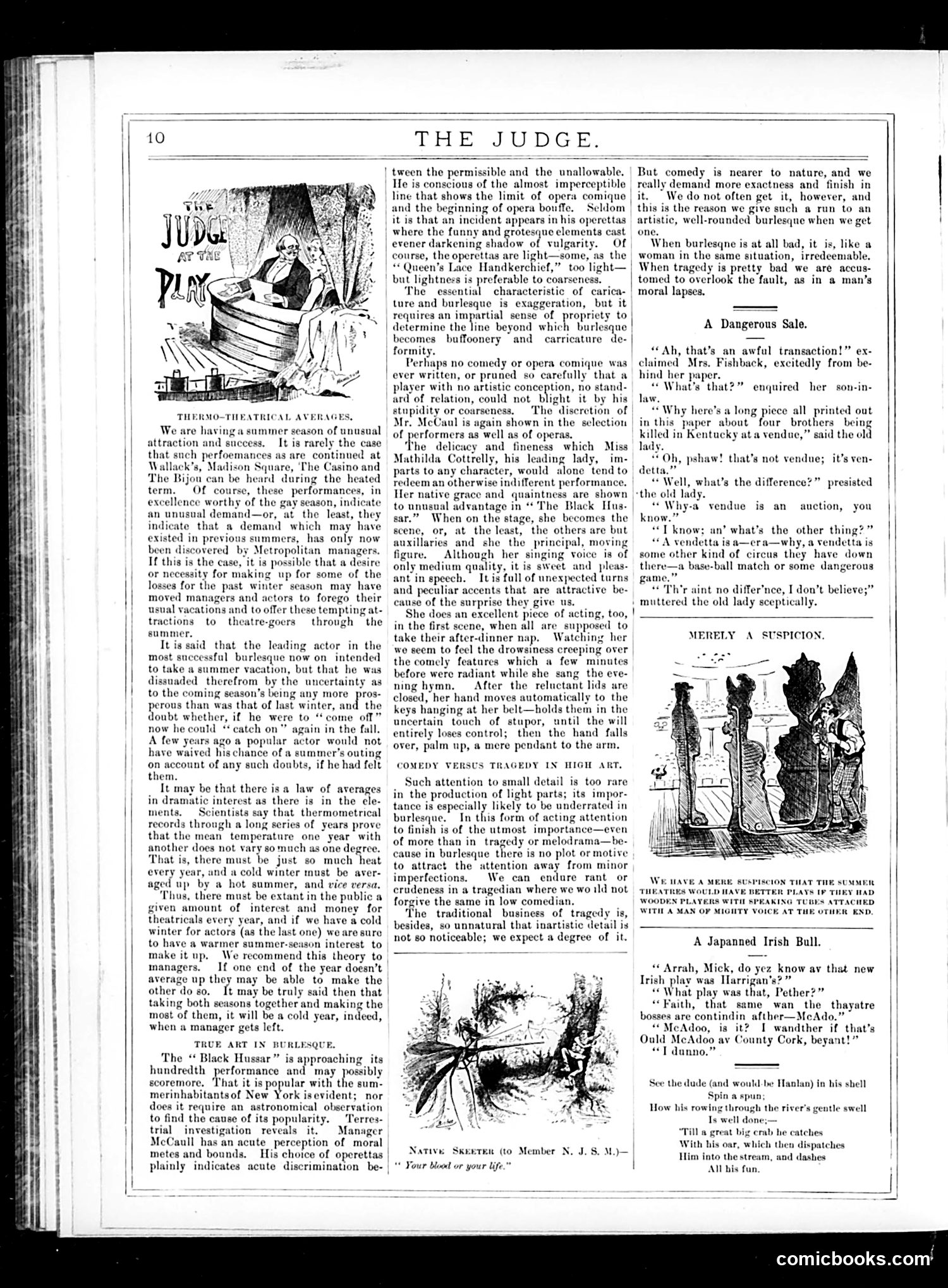
This page contains theater criticism rather than political cartoons. The main article discusses summer theatrical performances in New York, arguing that there's a "law of averages" in public interest and spending—if winter theater seasons fail financially, summer must compensate to balance the yearly total. The critic praises Manager McCaull's "Black Hussar" operetta for maintaining artistic standards: it's light and comedic without crossing into vulgarity or "buffoonery." The piece argues that successful burlesque requires a careful eye for the line between acceptable exaggeration and coarse deformity. The accompanying sketches appear to illustrate theatrical scenes, though their specific references are unclear from the image quality. The overall point: good theatrical management means understanding audience taste, selecting appropriate material, and maintaining moral restraint—even in comedy.
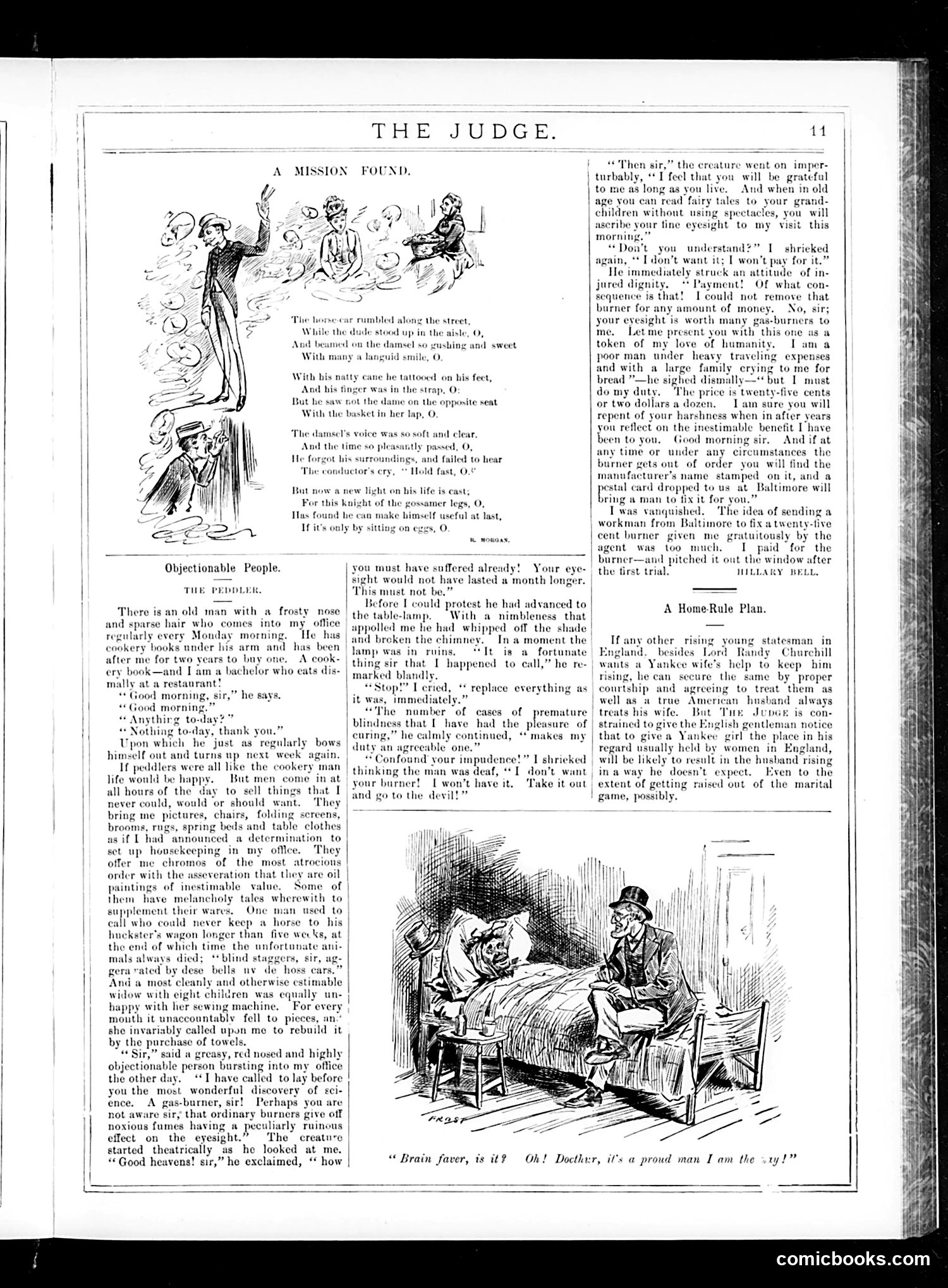
This page from *Judge* magazine contains two satirical pieces mocking annoying social types. **"A Mission Found"** (top): A poem and illustration satirizing a street musician/entertainer (likely a dancer or performer) who is so absorbed in charming his female audience that he fails to notice a woman with a basket sitting across from him—until he realizes he can make himself "useful" by sitting on eggs. The joke mocks oblivious performers seeking attention. **"The Peddler"** (main text): The narrator, a bachelor, is repeatedly harassed by a persistent salesman hawking cookery books. When a new "objectionable" visitor arrives with a gas-burner lamp, claiming it prevents blindness, the salesman actually breaks the narrator's existing lamp to prove his point—then bill him for replacement. The satire targets aggressive, unethical door-to-door salesmen who use manipulative tactics and damage property to make sales. Both pieces ridicule common urban nuisances of the era: intrusive salesmen and performers who exploit public spaces without regard for others' wishes.
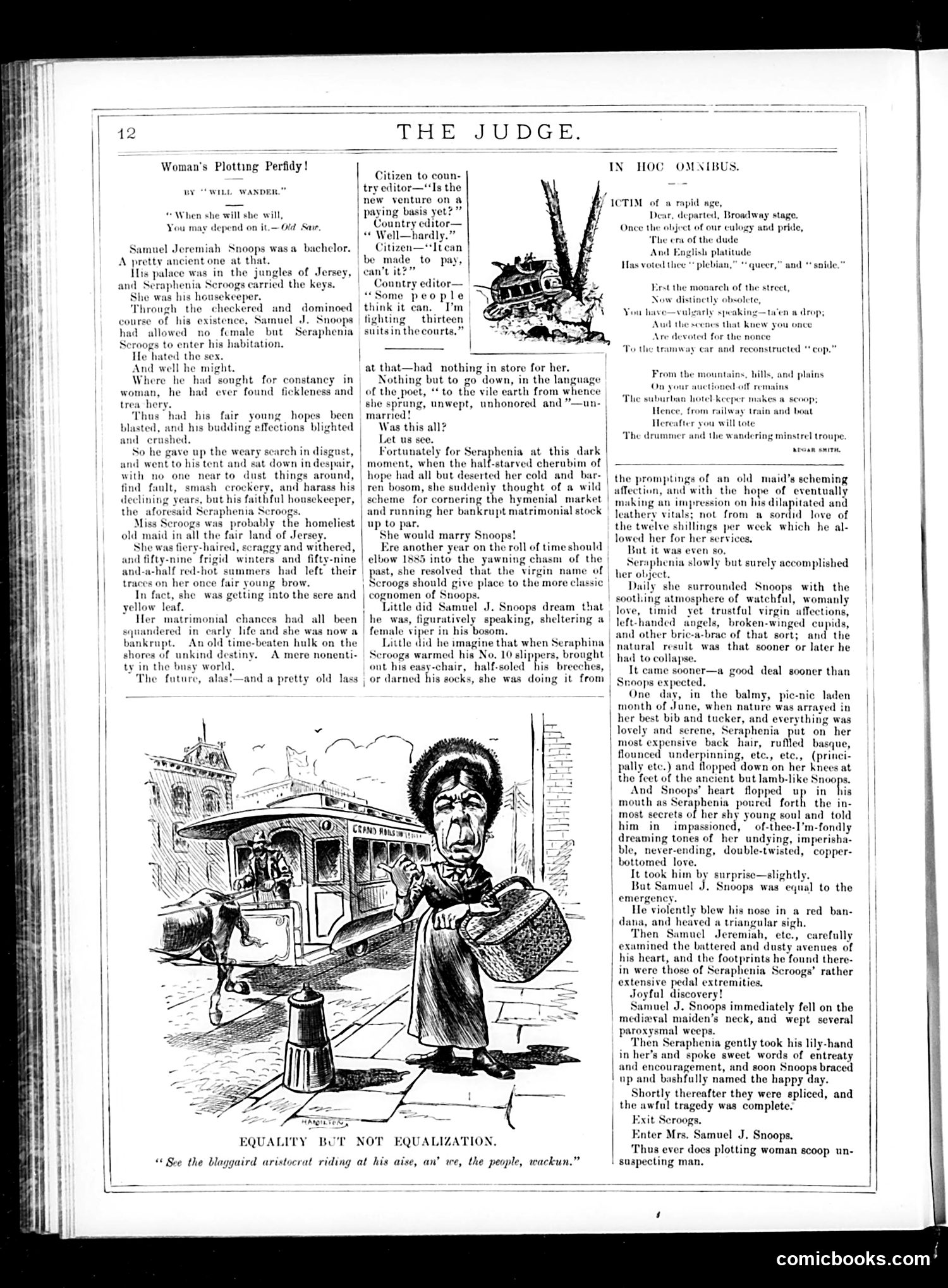
This page contains a serialized satirical story titled "Woman's Plotting Perfidy!" about Samuel J. Snoops, a confirmed bachelor, and his elderly housekeeper Seraphenia Scroogs, who plots to marry him. The main cartoon (center-left) illustrates the story's premise: a wealthy but miserly old man with an unattractive female servant. The satire targets both characters—Snoops for his vanity and emotional coldness, and Scroogs for her scheming opportunism. The caption "Equality But Not Equalization" suggests commentary on class pretension: despite her lowly status, the housekeeper manipulates her way toward marriage and social elevation. The humor relies on period stereotypes: the homely, aging spinster desperate for marriage; the miserly bachelor; and the theme of women's "plotting" and "perfidy" (betrayal). For Judge's readers, this represented typical anxieties about female ambition and matrimonial manipulation—coded social critique wrapped in comedy. The accompanying poetry and advertisements fill remaining space, typical of 19th-century magazine layouts.
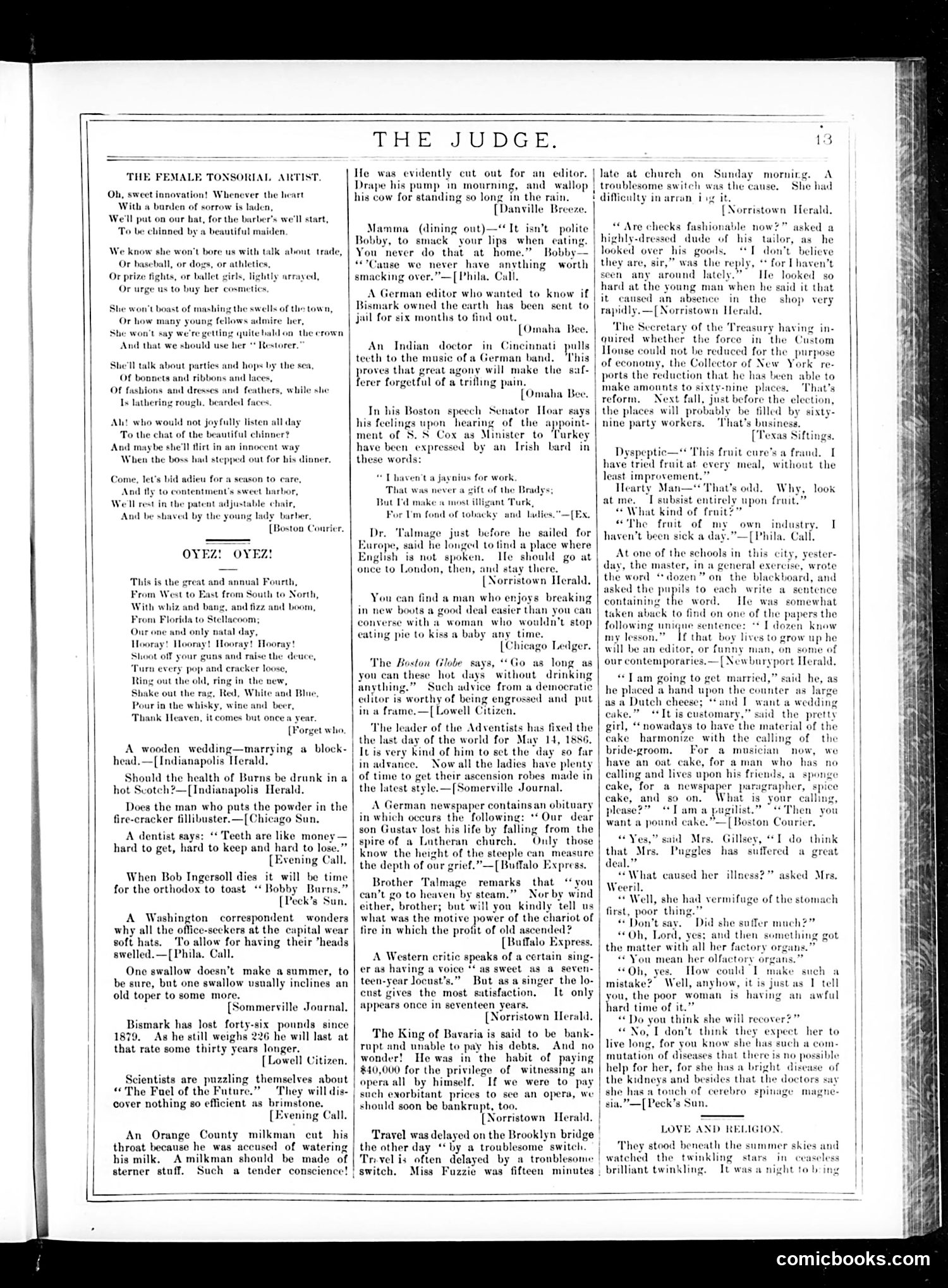
This page satirizes the emerging phenomenon of women barbers in late 19th-century America. The main poem celebrates a romantic innovation: having an attractive woman cut one's hair instead of a male barber. The satire works through contrast. The speaker lists what this female barber won't do—she won't bore customers with talk of trade, athletics, or prize fights; won't boast about conquering wealthy clients; won't pitch hair-restoration products. Instead, she offers pleasant conversation and innocent flirtation. The joke lies in the speaker's relief that she'll be *different* from presumed female stereotypes (vanity, gossip, manipulation), while simultaneously picturing her in flirtation scenarios. It mocks both anxieties about women entering traditionally male professions and the transparent male fantasies surrounding "progress." The surrounding miscellaneous jokes and snippets are typical Judge filler content—puns and brief satirical jabs at contemporary figures like Bismarck and Senator Hoar.
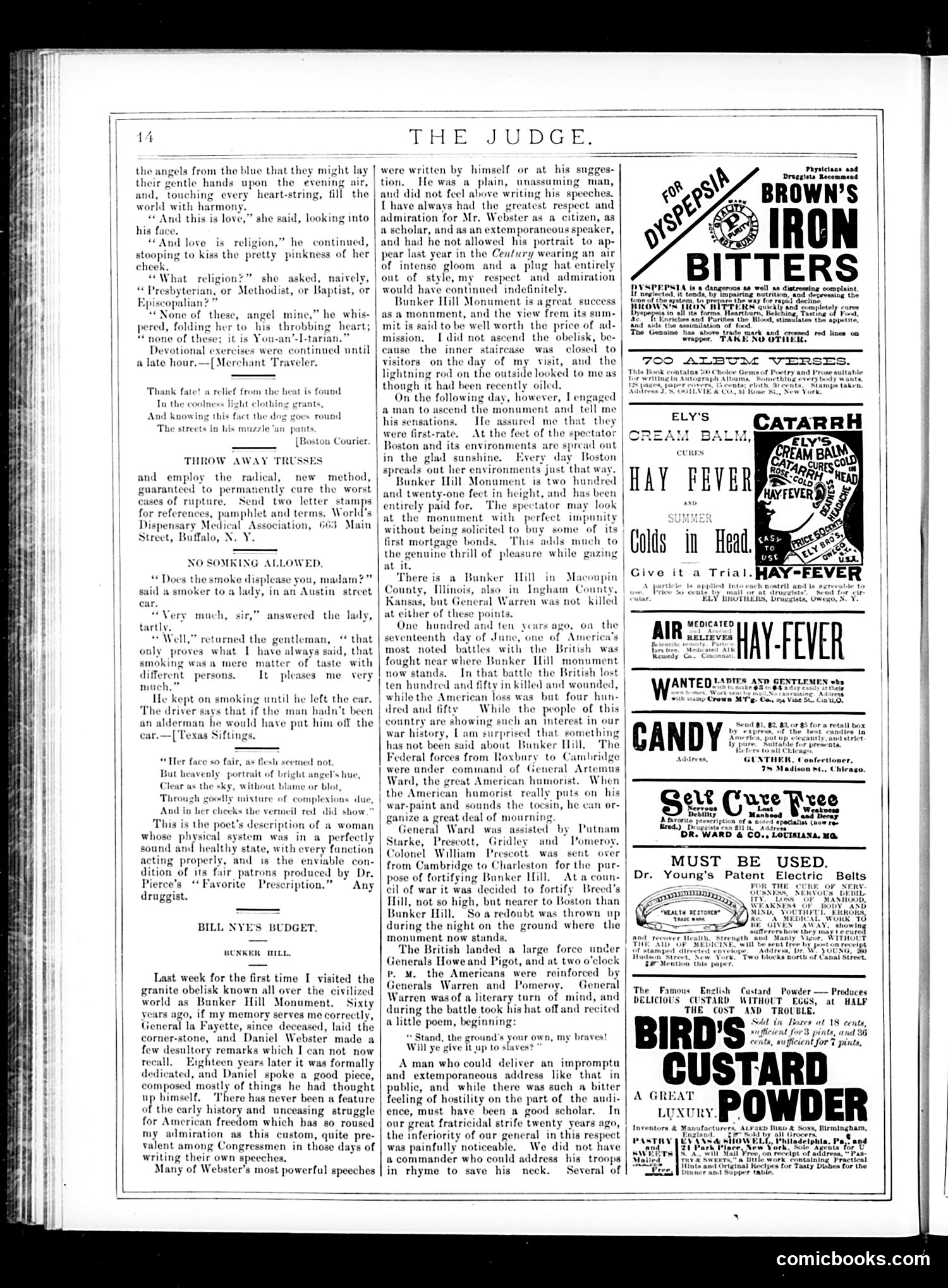
This page from *Judge* magazine contains primarily **advertisements and filler content** rather than editorial cartoons. The main text is **Bill Nye's humorous essay "Bunker Hill,"** a tongue-in-cheek account of visiting Bunker Hill Monument in Boston. Nye's satire targets: - **Daniel Webster's vanity**: Nye mocks Webster's allowing his portrait to appear in *Century* magazine wearing an unfashionable plug hat and "gloom," which damages Nye's otherwise deep respect for the statesman and orator. - **Monument tourism**: Nye humorously notes he didn't climb the obelisk (the inner staircase was closed; the lightning rod looked recently oiled—implying danger), so he hired someone else to ascend and report back, finding it pleasant. The surrounding **advertisements** hawk patent medicines (Dr. Pierce's Favorite Prescription, Dr. Young's Electric Belts), bird custard powder, and remedies for rupture—typical late-19th-century magazine fare. The page reflects *Judge's* mix of satirical commentary on public figures alongside commercial content.
This page is primarily **advertising** with some brief humorous anecdotes rather than political cartoons. The content includes: **Main features:** - Multiple product advertisements (Pond's Extract pain reliever, pianos, printing services, book binding) - Short comic sketches under "THE JUDGE" section, including anecdotes about Boston's Bunker Hill monument and local humor **The humor:** The "smart woman" and "thoughtlessness of youth" pieces are mild domestic jokes typical of late-19th-century magazines—playing on stereotypes about women's practicality and young people's recklessness. The Bunker Hill reference celebrates American Revolutionary history with gentle satire about Boston's civic pride. **Historical context:** This reflects Judge's format as a satirical weekly combining advertisements with light social commentary and jokes. The content lacks sharp political bite—it's entertainment for middle-class readers rather than pointed social criticism. The page offers little of historical significance beyond showing what popular humor and advertising looked like in Gilded Age America.
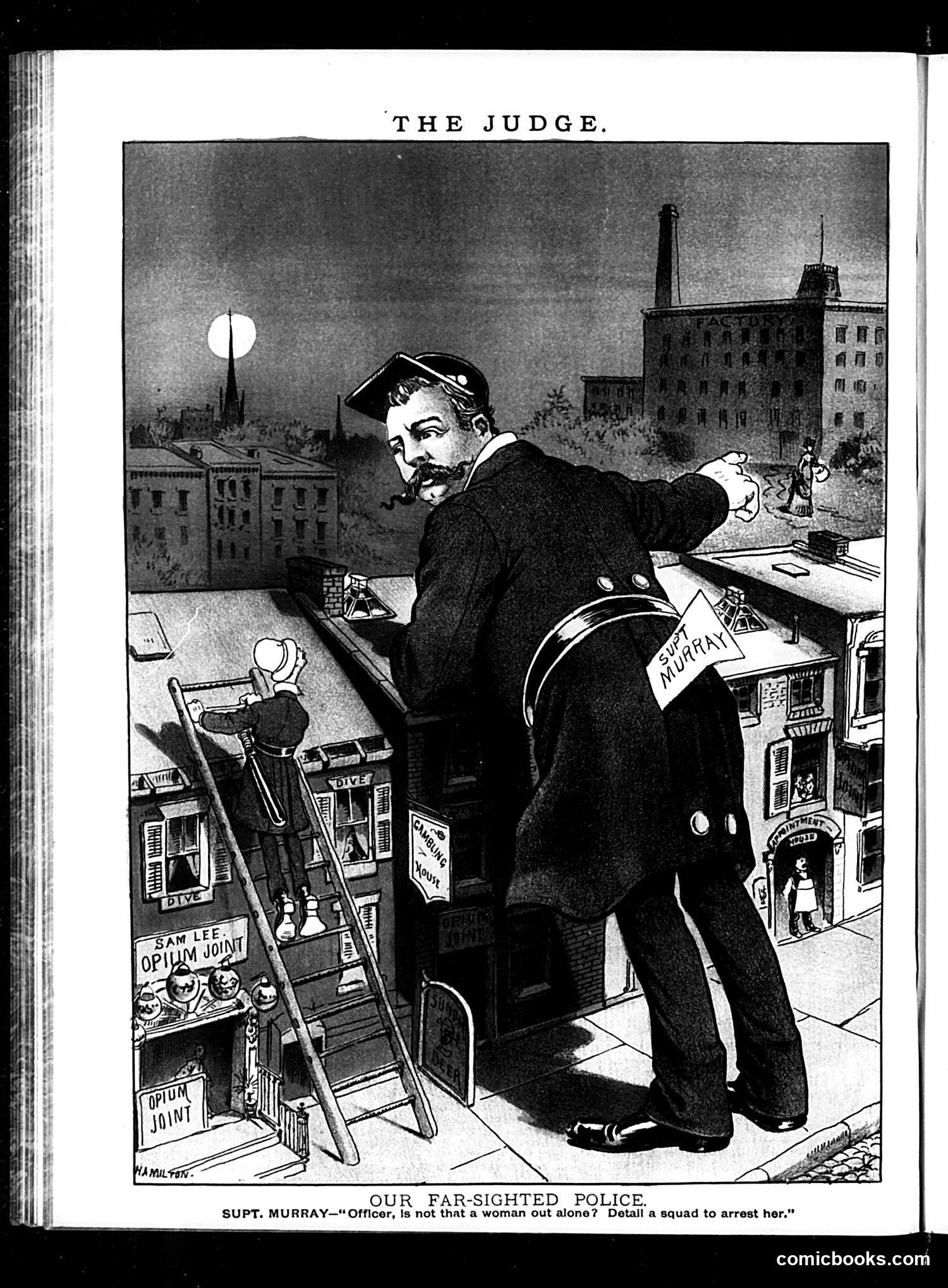
This cartoon satirizes Superintendent Murray's overzealous police enforcement, likely referencing New York City's controversial policies during the Progressive Era. The judge (depicted as a stern official at his desk) is mocking police priorities: they're so focused on arresting women found alone in public that they ignore actual crimes visible in the cityscape behind him—including establishments marked "Opium Joint" and "Sam Lee Opium Joint," plus what appears to be "S.F. Murray" signage suggesting corruption or complicity. The satire suggests the police are enforcing morality laws against women's independence while tolerating organized vice and drug trafficking. This reflects contemporary debates over women's freedom of movement and questions whether police resources were properly directed at serious crimes versus social control.