
Judge, 1885-07-25 · page 10 of 16
Judge — July 25, 1885 — page 10: what you’re looking at
What you’re looking at
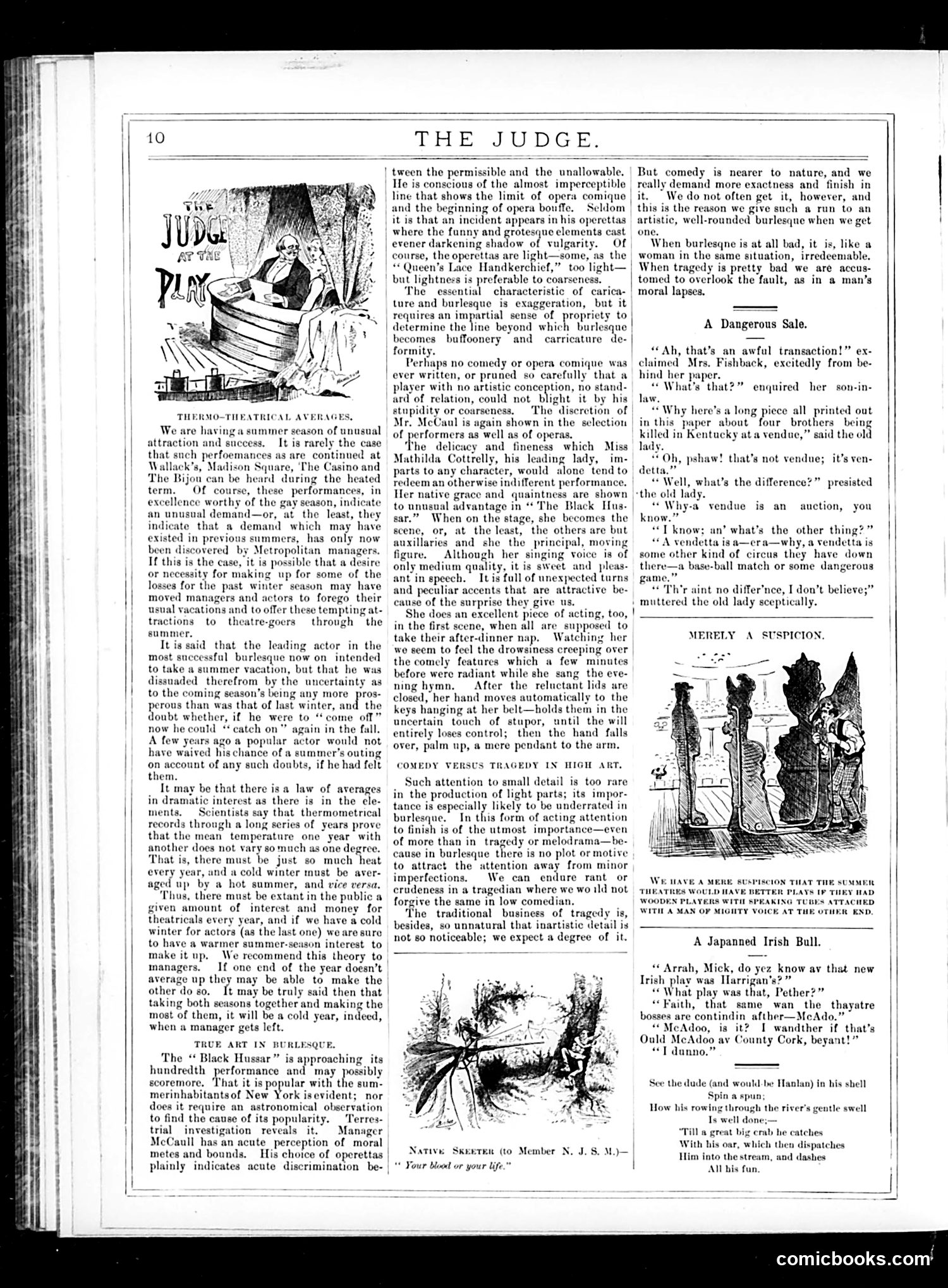
This page contains theater criticism rather than political cartoons. The main article discusses summer theatrical performances in New York, arguing that there's a "law of averages" in public interest and spending—if winter theater seasons fail financially, summer must compensate to balance the yearly total. The critic praises Manager McCaull's "Black Hussar" operetta for maintaining artistic standards: it's light and comedic without crossing into vulgarity or "buffoonery." The piece argues that successful burlesque requires a careful eye for the line between acceptable exaggeration and coarse deformity. The accompanying sketches appear to illustrate theatrical scenes, though their specific references are unclear from the image quality. The overall point: good theatrical management means understanding audience taste, selecting appropriate material, and maintaining moral restraint—even in comedy.
📄 Transcribed text from this page (OCR, searchable)
Machine-transcribed from the original scan — historical spelling and the odd misread are preserved.
j THE JUDGE. AP TALE THERMO-THEATRICAL AVERAGES, We are having a summer season of unusual ction and success, It is rarely the case it such perfoemances as are continued at Wallack’s, Madison Square, ‘The Casino and The Bijou can be heard during the heated term. Of course, these performances, in excellence worthy of the gay season, indicate an unusual demand—or, at the least, they indicate that a demand which may have existed in previous summers, has only now been discovered by Metropolitan managers. If this is the case, it is possible that a desire or necessity for making up for some of the losses for the past winter season may have moved managers and actors to forego their usual vacations and to offer these tempting tractions to theatre-goers through summer. It issaid that the leading actor in the most snecessful burlesque now on intended to take a summer vacation, but that he was dissuaded therefrom by the uncertainty as to the coming season’s being any more pros- perous than was that of last winter, and th doubt whether, if he were to ‘‘come now he could ** catch on” again in the fall. A few years ago a popular actor would not ave waived his chance of a summer's outing on account of any such doubts, if he had felt them. It m y be that there isa law of averages in dramatic interest as there is in the ele- ments. Scientists say that thermometrical records through a long series of years prove that the mean’ temperature one’ year with another does not vary 80 much as one degree. That is, there must be just so much heat every year, and a cold winter must be aver- aged up by a hot summer, and vice versa. ‘Thus, there must be extant in the public a given amount of interest and money for theatrical every year, and if we have a cold winter for actors (as the last one) we are sure to have a warmer summer-season interest to make it up. We recommend this theory to managers. If one end of the year doesn’t average up they may be able to make the other do go. It may be truly said then that taking both seasons together and making the most of them, it will be a cold year, indeed, when a manager gets left. TRUE ART IN BURLESQUE. The “ Black Hussar” is approaching its hundredth performance and may possibly scoremore. That it is popular with the sum- merinhabitantsof New York is evident nor does it require an astronomical observation to find the cause of its popularity. erres- trial investigation reveals it. Manager McCaull has an acute perception of moral metes and bounds. His choice of operettas plainly indicates acute discrimination be- | tween the permissible and the unallowable. He is conscious of the almost imperceptible line that shows the limit of opera comique | and the beginning of opera bouffe. Seldom it is that an incident appears in his operettas where the funny and grotesque elements cast evener darkening shadow of vulgarity. Of course, the operettas are light—some, as the **Queen’s Lace Handkerchief,” too light— | but lightness is preferable to coarsen | The essential characteristic of carica ture and burlesque is exaggeration, but it requires an impartial sense of propriety to determine the line beyond which burlesque becomes buffoonery ‘and carricature de formity. Perhaps no comedy or opera comique was ever written, or pruned so carefully that a player with no artistic conneptions no stand- ard of relation, could not blight it by his stupidity or coarseness, ‘The discretion of Mr. McCaul is again shown in the selection of performers as well as of operas. The delicacy and fineness which Miss Mathilda Cottrelly, his leading lady, im- parts to any character, would alone tend to redeem an otherwise indifferent performance. Her native grace and quaintness are shown to unusual advantage in “* The Black Hus- sar.” When on the stage, she becomes the scene, or, at the least, the others are but auxillaries and she the principal, moving figure. Although her singing voice is of only medium quality, it is sweet and_pleas- ant in speech. It is full of unexpected turns and peculiar accents that are attractive be- cause of the surprise they give us. She does an excellent piece of acting, too, | in the first scene, when all are supposed to take their after-dinner nap. Watching her wo seem to feel the drowsiness creeping over the comely features which a few minutes before were radiant while she the eve- ning hymn. After the reluctant lids ure closed, her hand moves automatically to the keys hanging at her belt—holds them in the uncertain touch of stupor, until the will entirely loses control; then the hand falls over, palm up, a mere pendant to the arm, COMEDY VERSUS TRAGEDY IN HIGH ART. Such attention to small detail is too rare in the production of light parts; its impor- tance is especially likely to be underrated in burlesque. In this form of acting attention to finish is of the utmost importance—even of more than in tragedy or melodrama—be- cause in burlesque there is no plot or motive to attract the attention away from minor imperfections. We can endure rant or crudeness in a tragedian where we wo ild not forgive the same in low comedian. The traditional business of tragedy is, besides, so unnatural that inartistic detail is not so noticeable; we expect a degree of it. Native Skeeten (to Member N. J. 8. M)— ** Your blood or your life.” | “the old lad But comedy is nearer to nature, and w really demand more exactness and ‘finish in it. “We do not often get it, however, and this is the reason we give such a run to an artistic, well-rounded burlesque when we get one. When burlesqne is at all bad, it is, like a woman in the same situation, irredeemable, When tragedy is pretty bad we are accus- tomed to overlook the fault, as in a man’s moral lapses, A Dangerous Sale. “Ah, that’s an awful transaction!” e: claimed Mrs. Fishback, excitedly from be- hind her paper. “ What's that?” enquired her son-in- law. Why here’s a long piece all printed out in this r about four brothers being killed in Kentucky at a vendue,” said the old lad Dh, pshaw! that’s not vendue; it’s ven- deta.” . “Well, what's the difference?” presisted “Why-a vendue is an know.” “IT know: un’ what’s the other thing?” “A vendetta is a—era—why, a vendetta is some other kind of circus they have down there—a base-ball match or some dangerous game “ Th’'r aint no differ’nce, I don’t believe;” muttered the old lady sceptically. auction, you MERELY A SUSPICION. WE HAVE A MERE sUsPiscto! THEATRES WOULD HAVE BETTER P WOODEN PLAYERS: WITH A MAN OF THAT THE SUMMER PAYS UP THE ITH SPEAKING TURES ATTAC GUTY VOICE AT THE OTHER END. A Japanned Irish Bull. ** Arrah, Mick, do yez know av that new Irish play was Harrigan’s?” “What play was that, Pether?” “Faith, that same wan the thayatre bosses are contindin afther—McAdo.” “*McAdoo, is it? I wandther if that’s Ould McAdoo av County Cork, beyant!” “T dunno.” See the dude (and would-be Hanlan) in his shell pin a spun How his rowing through the river's gentle sw Is well done; ‘Tila g h rab he With his oar, which then Him into the stre All bis fun atches ispatches m, and dashes comicbooks.com