
A complete issue · 16 pages · 1885
Judge — June 13, 1885
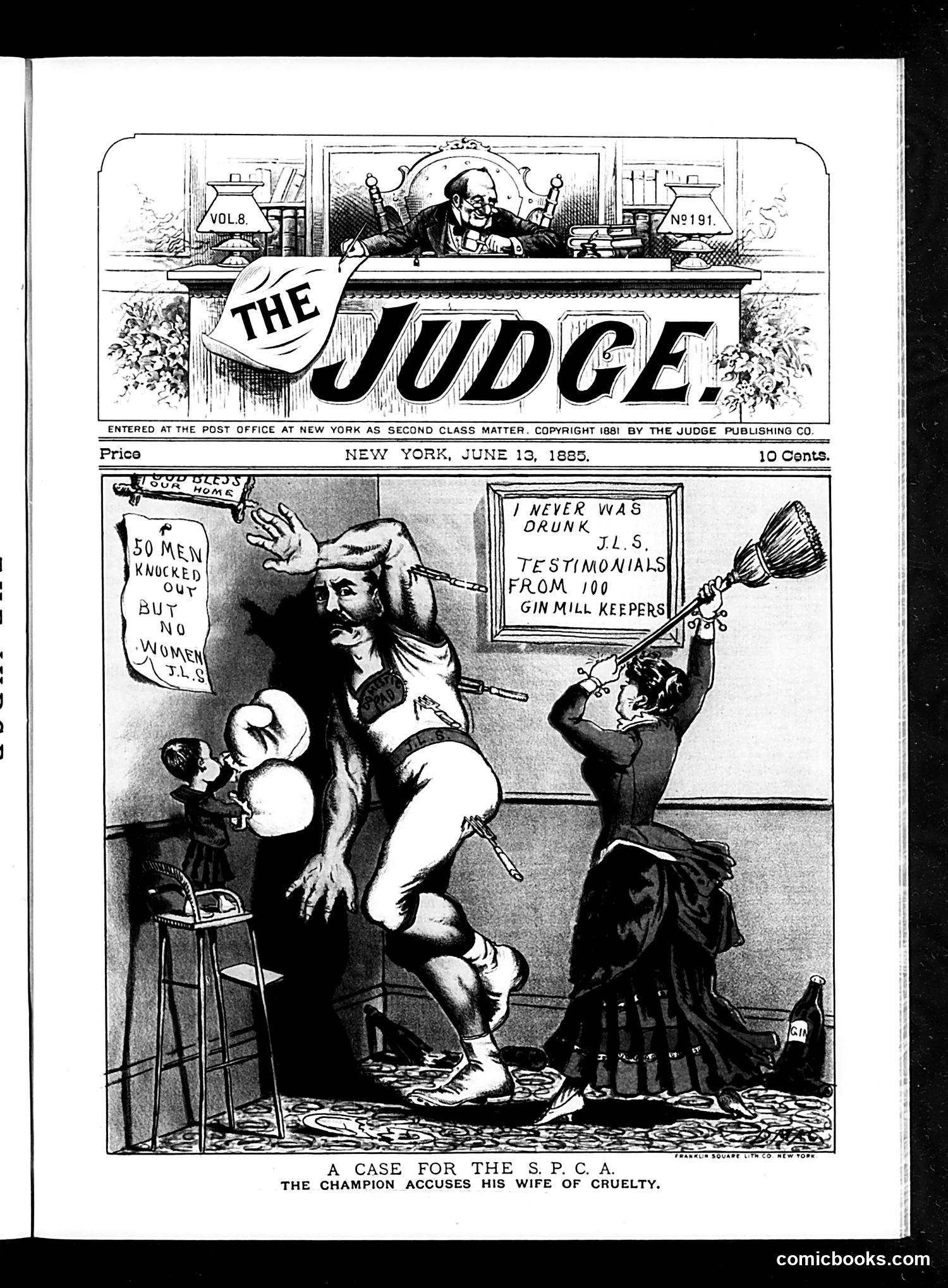
This 1885 *Judge* cartoon satirizes a boxing champion (depicted with exaggerated facial features) accused by his wife of cruelty. The caption "The Champion Accuses His Wife of Cruelty" reverses the expected narrative: instead of the wife seeking protection, the brutish husband claims victimization. The cartoon mocks the champion's absurd defense—a sign reading "50 Men Knocked Out But No Women" and a framed testimonial claiming "I Never Was Drunk"—presenting obviously false alibis. The S.P.C.A. (Society for Prevention of Cruelty to Animals) reference suggests the wife deserves animal-protection-level safeguards from her violent husband. The satire critiques both domestic violence and male dishonesty, using the boxing world's brutality as commentary on marital abuse.
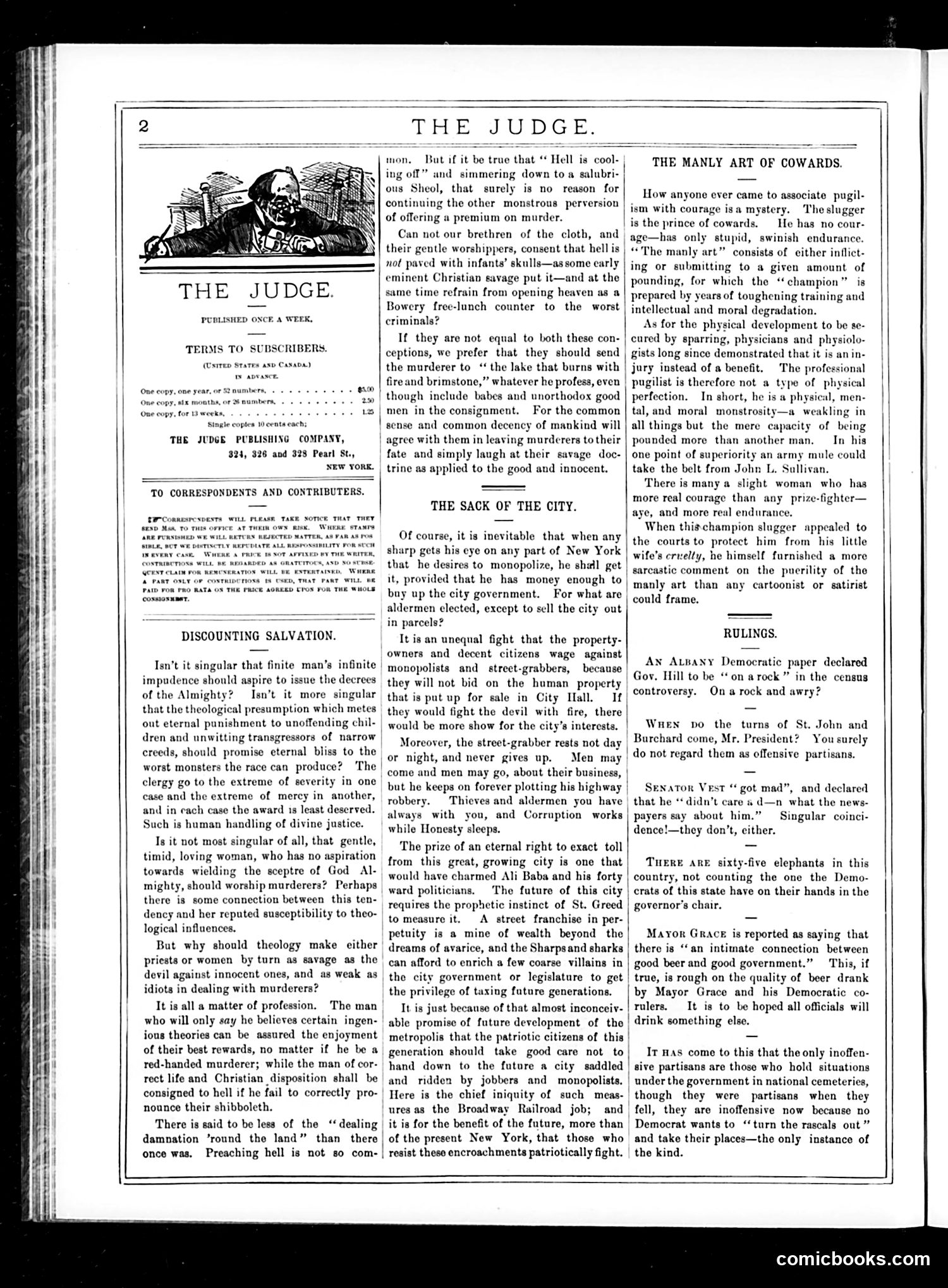
This page contains several opinion pieces critiquing American institutions and politics: **"Discounting Salvation"** attacks clergy for theological hypocrisy—condemning innocent children to hell while offering murderers a path to heaven through profession of faith. The author argues this contradicts basic morality and notes that women, despite being gentle and loving, paradoxically worship violent criminals, possibly due to "susceptibility to theological influences." **"The Sack of the City"** criticizes New York municipal corruption, specifically aldermen who sell city resources to monopolists and street-grabbers. The piece argues property owners cannot compete because they won't engage in bribery of city officials, while corrupt operatives work relentlessly. **"The Manly Art of Cowards"** (partially visible) discusses prize-fighting and physical development. The masthead cartoon depicts a judge or authority figure, likely representing judicial corruption or institutional failure. Overall, this represents Judge magazine's muckraking satirical tradition targeting religious hypocrisy and political corruption in Gilded Age America.
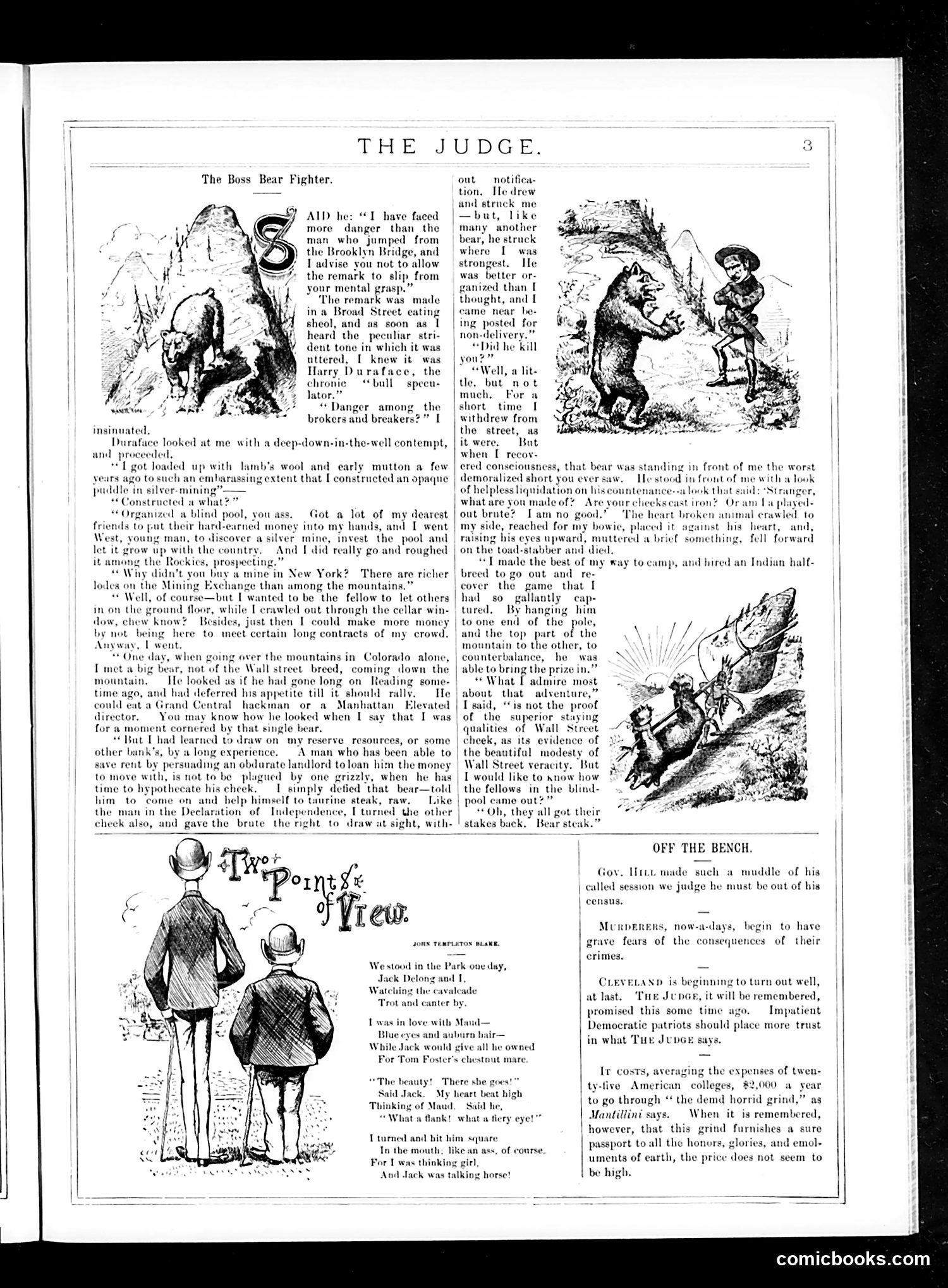
This page contains a satirical story mocking Wall Street speculators and their self-aggrandizing lies. **The Main Figure:** Harry Duraface, a chronic "bull speculator" who boasts of surviving dangers greater than a man jumping from Brooklyn Bridge. He's a caricature of the arrogant, dishonest Wall Street trader. **The Satire:** Duraface brags about financial schemes—organizing "blind pools" (fraudulent investment schemes), manipulating silver mines, and outmaneuvering other brokers—presenting himself as a daring adventurer. The narrator exposes these stories as exaggerations, noting Duraface actually made money through dishonest dealings and by withdrawing before losses hit. **The Point:** Judge ridicules the vanity and moral bankruptcy of Wall Street operators who dress up financial fraud as heroic enterprise. The secondary poem "Two Points of View" reinforces this by contrasting how Jack and the narrator interpret the same horse ride—a joke about perspective and self-serving narratives. The cartoon mocks Gilded Age financial culture and investor gullibility.
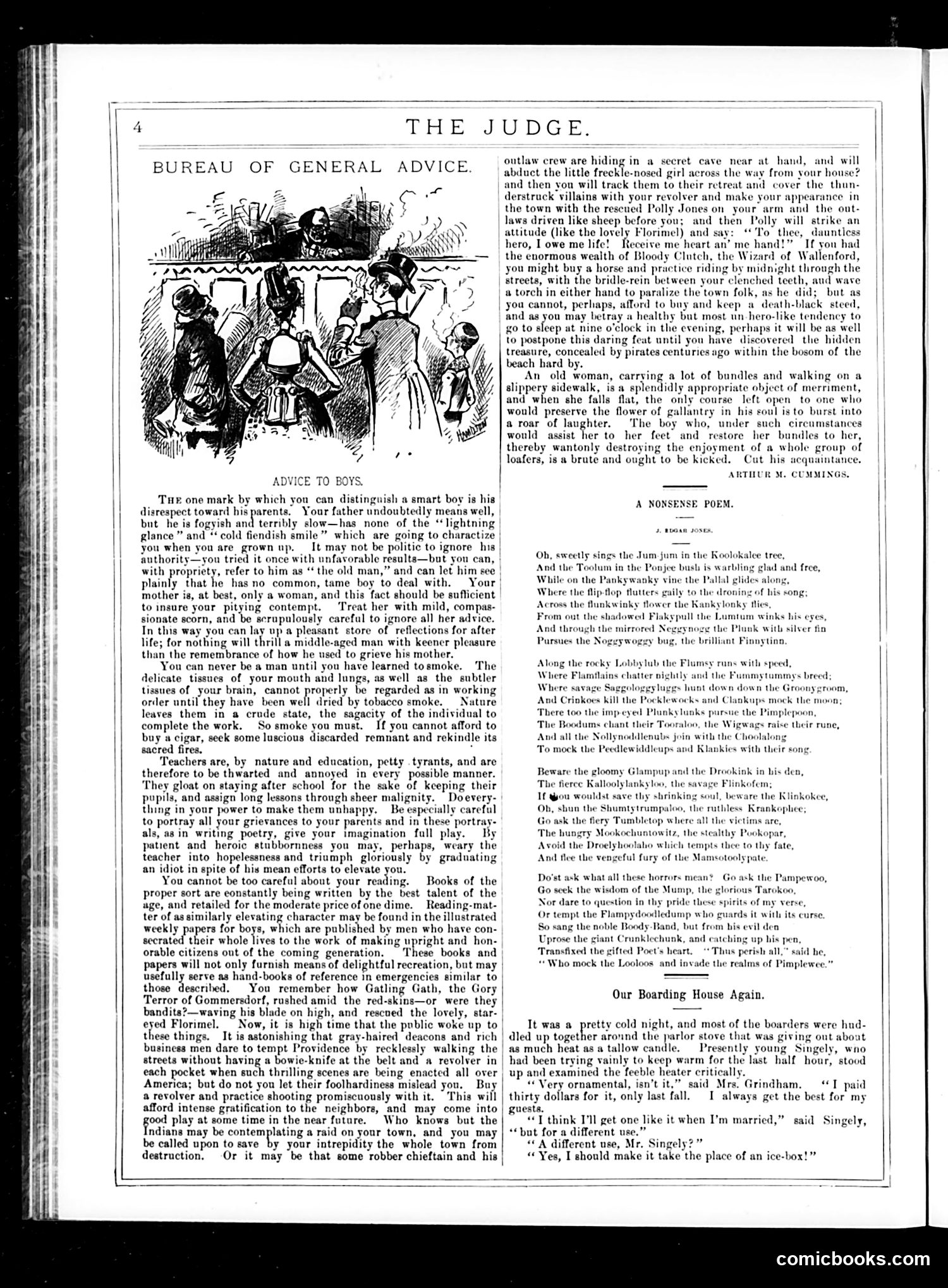
This is **satirical advice to boys** that inverts proper values to mock irresponsible parenting and sensational fiction. The satire works by presenting terrible guidance as earnest instruction. The cartoon depicts roughhousing children, accompanying text mocking adults who encourage disrespect toward parents, smoking, defying teachers, and reading cheap dime novels glorifying violence (referencing a fictional character "Gatling Gath"). The satire targets: - **Sensational literature** marketed to youth (dime novels, illustrated papers) depicting unrealistic gunslinging and Indian raids - **Adult negligence** in allowing boys to consume violent entertainment and develop disrespectful attitudes - **False masculinity** equating manhood with smoking, weapons, and insubordination By praising these behaviors ironically, Judge criticizes both the media promoting them and parents permitting them. The underlying message: actual smart boys should respect parents, avoid tobacco, obey teachers, and read quality literature—opposite of what's humorously "advised."
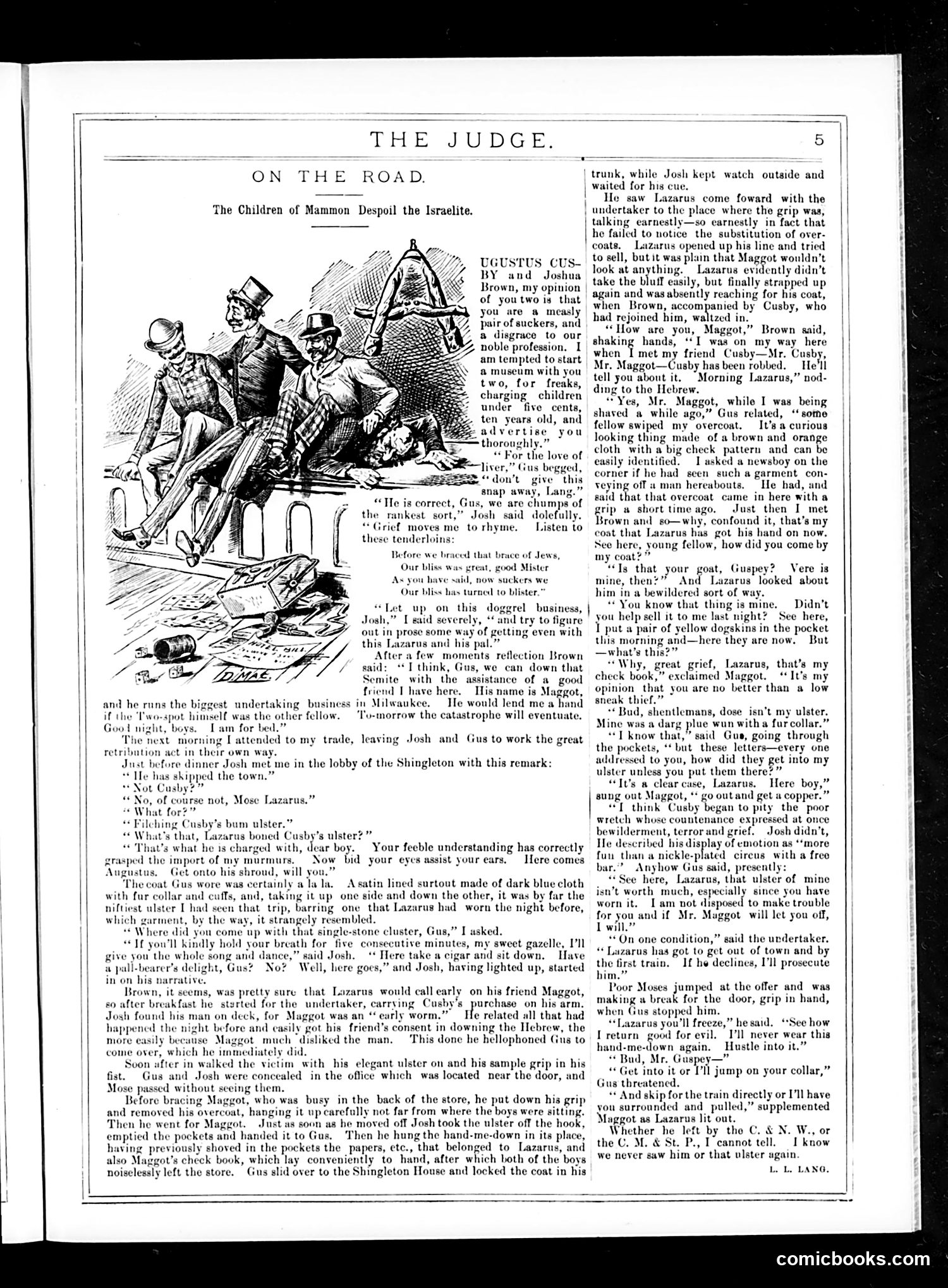
This page from *Judge* satirizes con artists and ethnic stereotyping in late 19th-century America. The narrative depicts two swindlers, Augustus Cushy and Joshua Brown, plotting revenge against Lazarus (clearly identified as Jewish through the headline "The Children of Mammon Despoil the Israelite") and his associate Maggot. The scheme involves stealing Lazarus's expensive ulster (overcoat) and replacing it with an inferior one, planting incriminating items in the pockets to frame him. The satire targets both the criminals' incompetence (they're called "suckers" and "freaks") and, problematically, relies on antisemitic caricature—depicting Jewish characters as money-focused and using dehumanizing language. The humor depends on slapstick con-game tropes common to the era, though the ethnic dimension reflects *Judge*'s frequent use of stereotyping as comedic material.
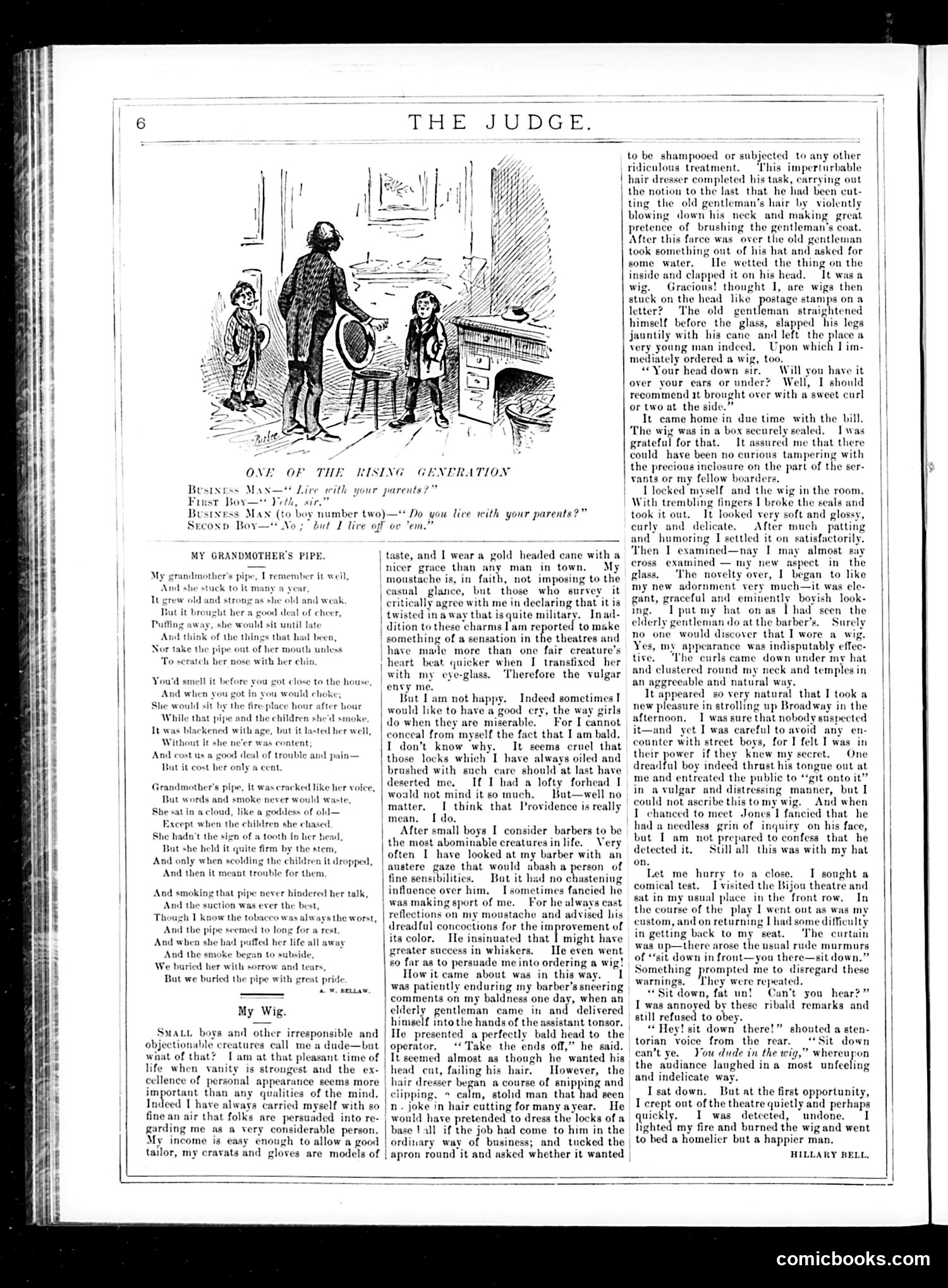
This *Judge* page contains three satirical pieces mocking contemporary social types: **"One of the Rising Generation"** ridicules young men's economic dependence. A businessman questions two boys about living with parents. The first admits he does; the second—the joke's target—says he doesn't live *with* them but lives *off* them, exposing parasitic adult children. **"My Grandmother's Pipe"** is sentimental verse celebrating an old woman's cherished pipe, contrasting her modest virtue with modern pretension. **"My Wig"** is the main satire. A vain, balding man obsesses over his appearance—his mustache, cane, and eye-glass—while secretly ashamed of his baldness. His barber exploits this vanity, eventually convincing him to buy a wig. The piece mocks masculine vanity and the commercial manipulation of insecurity, with the barber as cynical profiteer. The satire targets self-absorbed urban types and the emerging consumer culture that preys on them.
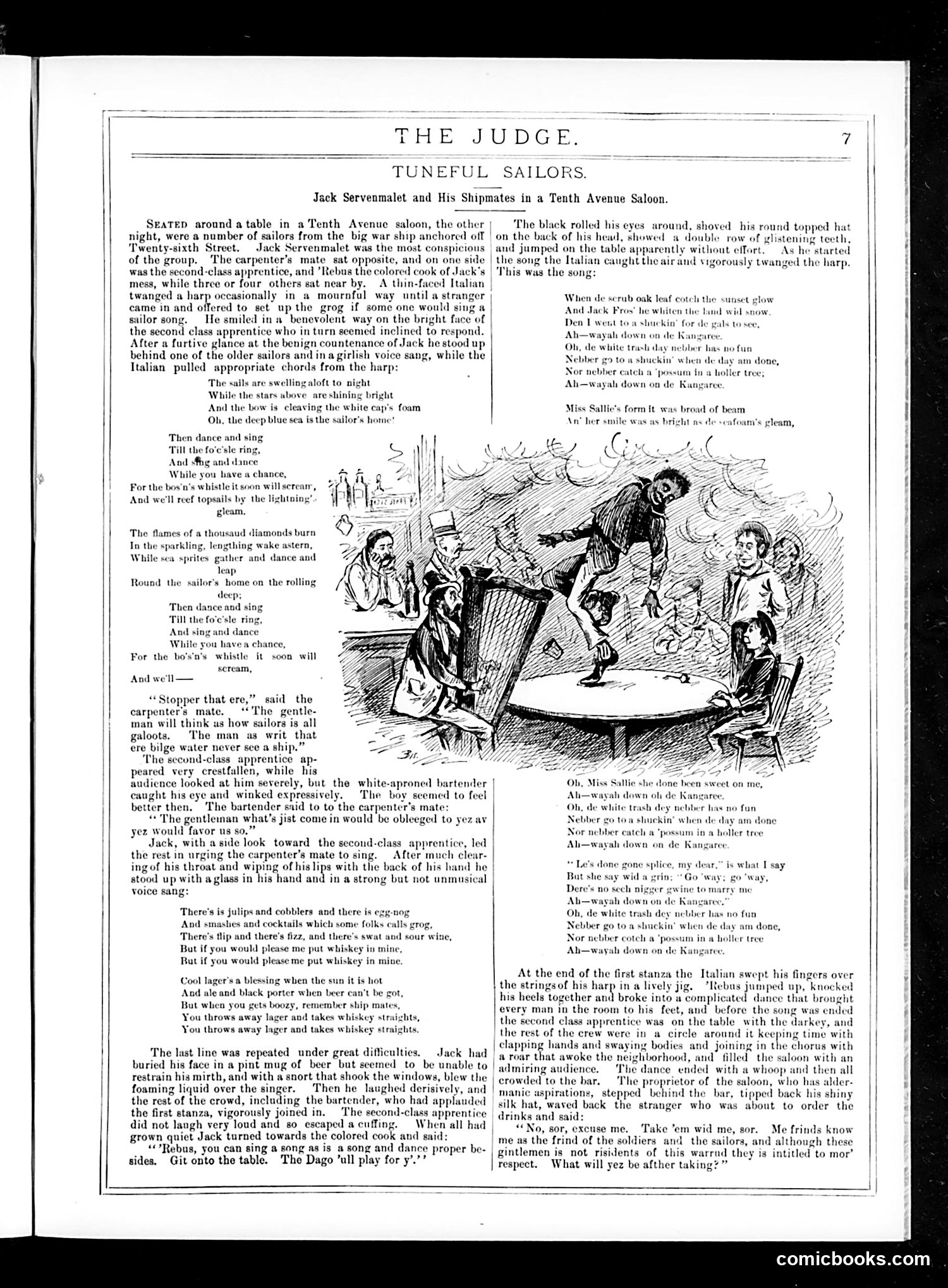
This page presents a humorous sketch of sailors in a Tenth Avenue saloon singing and drinking. The narrative depicts Jack Servenmulet and his shipmates entertaining themselves with songs. The satire operates on multiple levels: First, it mocks the romanticized "sailor songs" popular in literature—the carpenter's mate interrupts the apprentice's sentimental verse, complaining the writer "never see a ship," suggesting these idealized ballads don't reflect actual sailor culture. Second, the featured song (performed by "the black" cook) uses heavy dialect and references to slavery-era imagery ("shuckin'" corn, Miss Sallie), likely reflecting period attitudes rather than endorsing them. The humor derives partly from the contrast between refined expectations and crude reality. The illustration shows boisterous sailors dancing and carousing, emphasizing working-class revelry. Overall, Judge presents working sailors as rough, profane, and entertainingly uncivilized—a common late-19th-century American stereotype used for humor among middle-class readers.
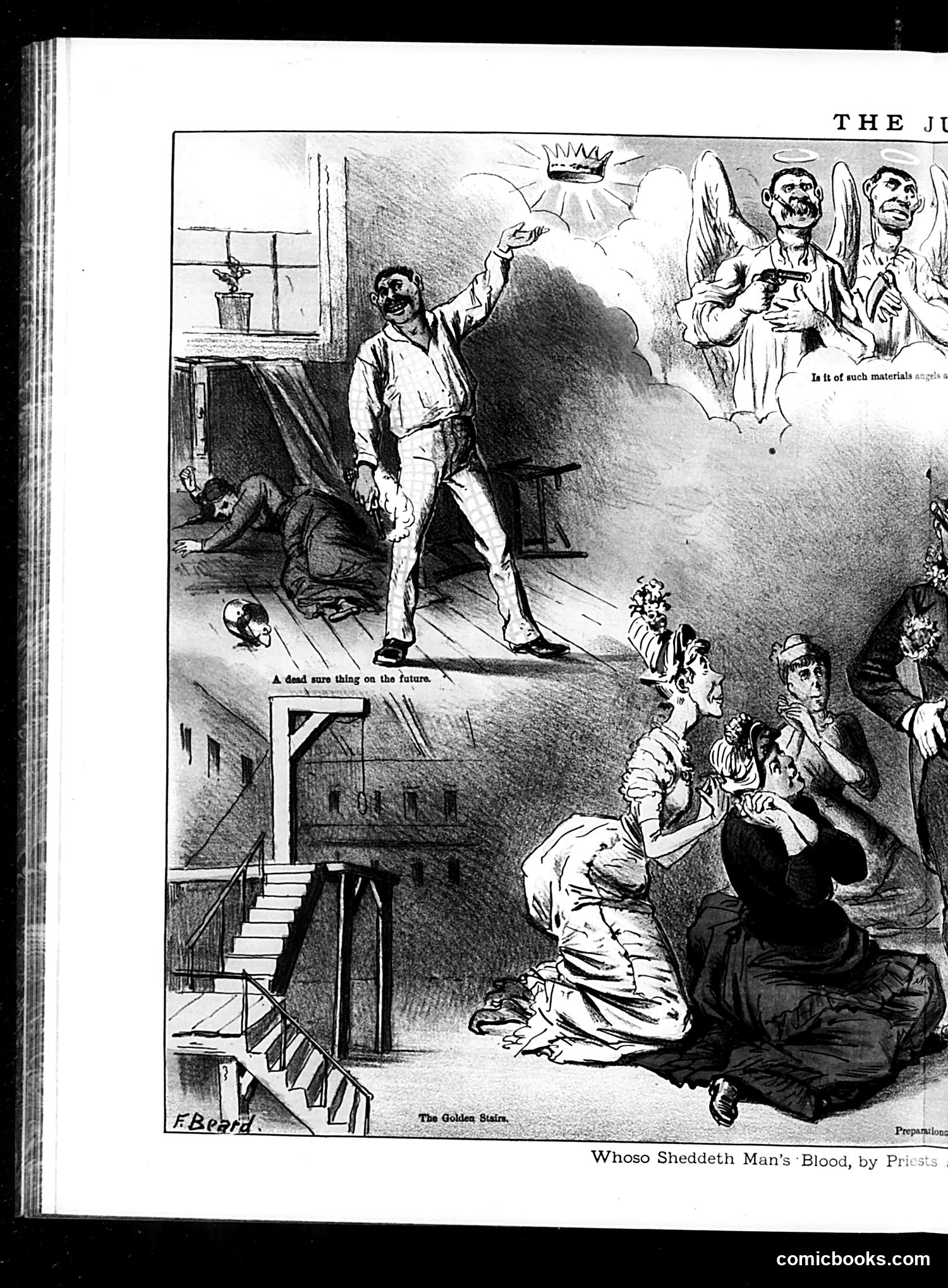
This appears to be a religious/moral satirical cartoon from *Judge* magazine, titled "Whoso Sheddeth Man's Blood" (a biblical reference to Genesis 9:6). The cartoon depicts an execution scene: a condemned man stands on a gallows while clergy and angels appear in a heavenly vision above, seemingly to witness or sanction the proceedings. Below, witnesses including women observe the execution. The satire appears to critique **capital punishment justified by religious authority**—the irony being that clergy bless or oversee an act of bloodshed despite biblical prohibitions. The title invokes God's command against murder, yet the scene shows religious figures apparently endorsing judicial killing. The artist is credited as "F. Beard" and notes "The Golden Stairs" at bottom. Without the publication date visible, the specific execution referenced remains unclear, though this reflects 19th-century debates over capital punishment and religious hypocrisy.
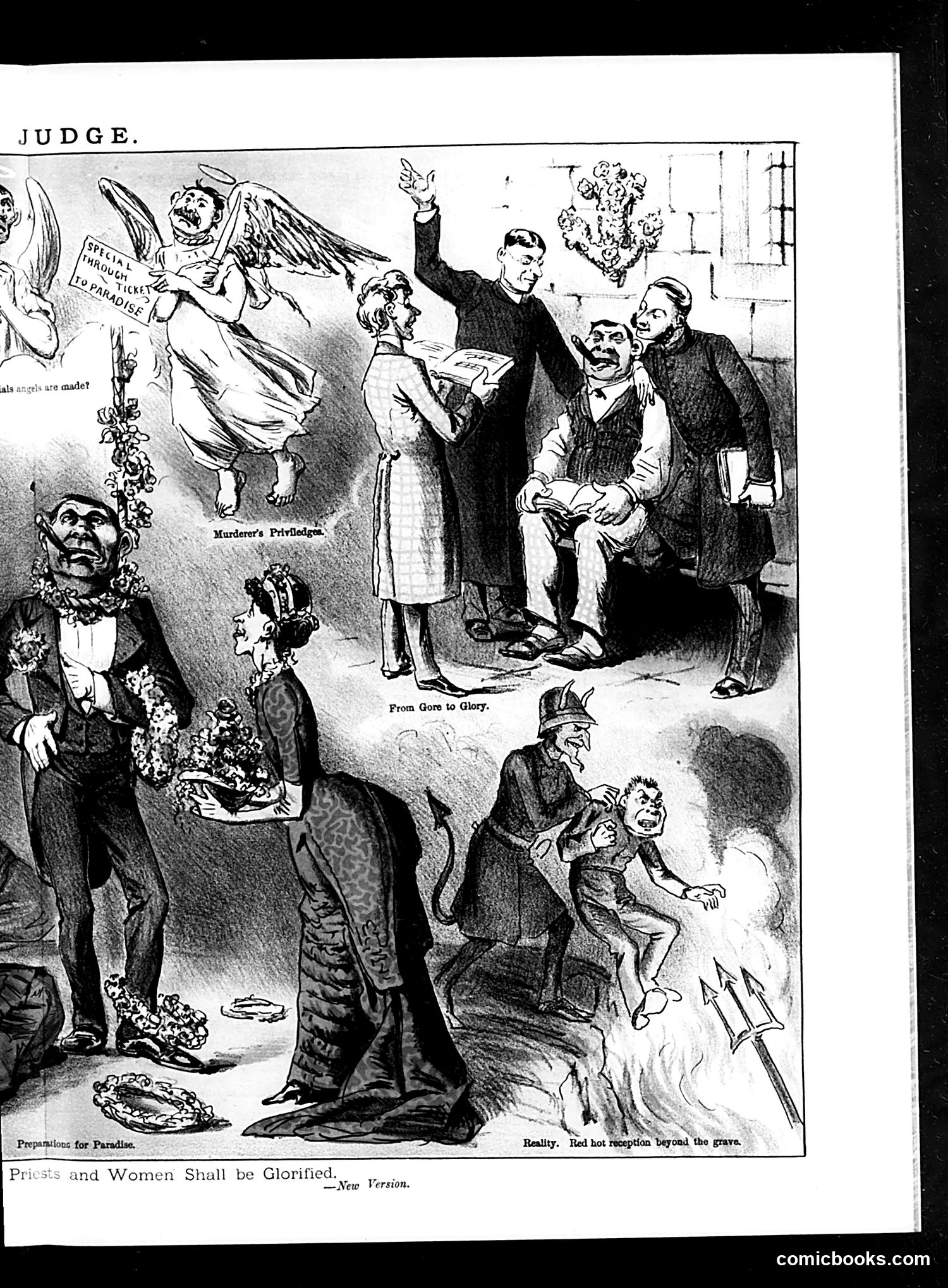
This page contains three interconnected satirical panels critiquing religious hypocrisy, particularly regarding clergy and women's status. The top panel ("From Gore to Glory") shows a woman being presented to officials, suggesting social elevation through questionable means. The left panel ("Preparations for Paradise") depicts priests and wealthy figures adorned with flowers and finery, mocking their self-importance. The bottom panel ("Reality: Red hot reception beyond the grave") shows the devil claiming a priest and woman, suggesting divine judgment contradicts earthly promises. The subtitle parodies scripture ("Priests and Women Shall be Glorified—New Version"), sarcastically inverting religious teaching. The overall satire attacks clergy corruption and the manipulation of women through false promises of spiritual elevation, implying both will face damnation regardless of earthly status or religious authority's claims.
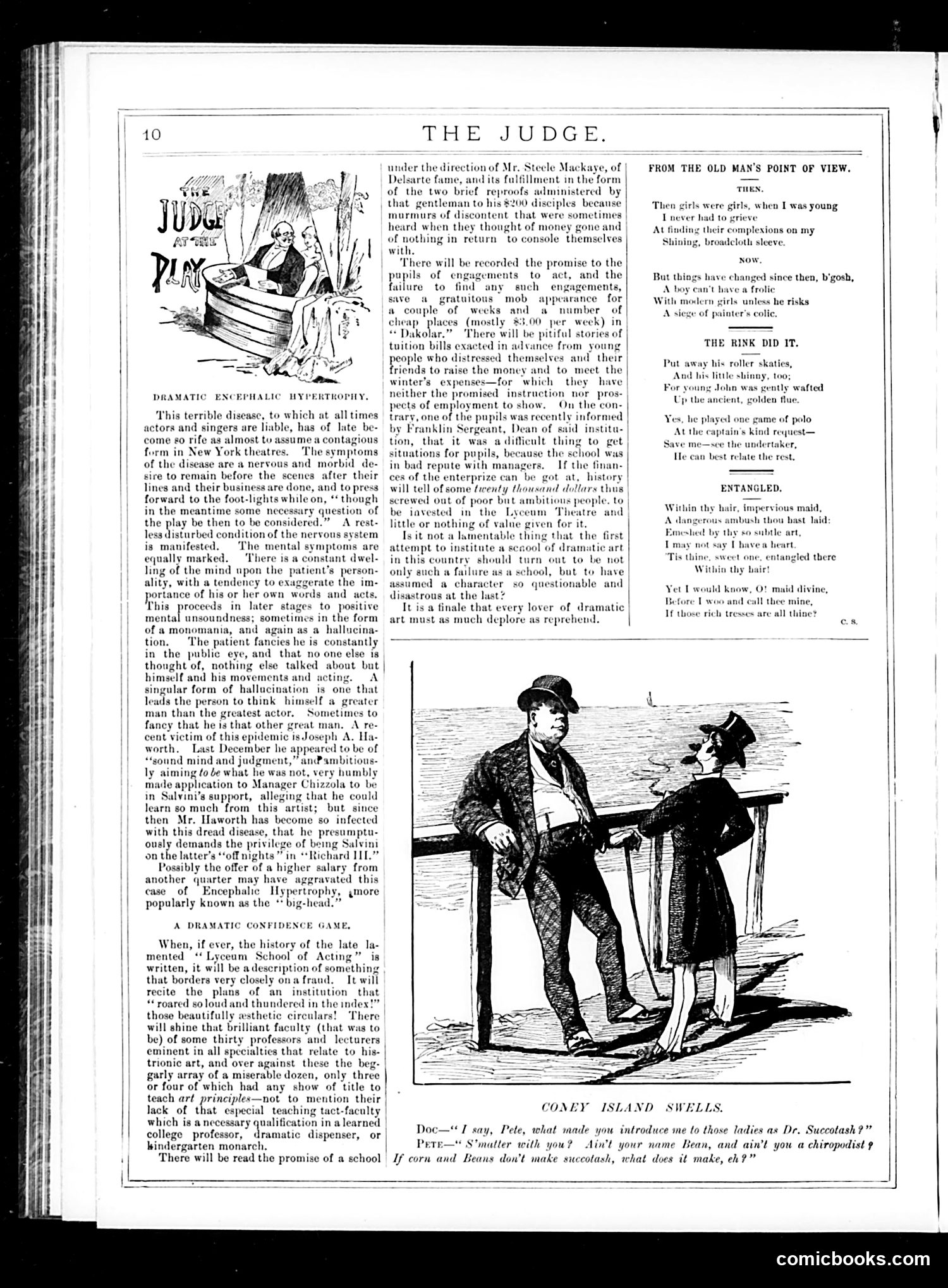
This page satirizes two theatrical scandals of the era: **"Dramatic Encephalic Hypertrophy"** (top left) mocks actors suffering from ego inflation—a "disease" causing performers to remain onstage unnecessarily and obsess over their own importance. It specifically targets **Joseph A. Haworth**, an actor who demanded starring roles (like Salvini's part in *Richard II*) despite lacking the talent, allegedly motivated by higher salary offers elsewhere. **"A Dramatic Confidence Game"** (bottom) attacks the **Lyceum School of Acting**, exposing it as fraudulent. The school promised ambitious students thirty distinguished faculty members, guaranteed stage engagements, and professional training—but delivered only a dozen mediocre instructors and offered students only unpaid or poorly-paid minor roles. The satire criticizes how the school extracted advance tuition payments from desperate young people seeking theatrical careers. Both pieces mock theatrical pretension and financial exploitation of aspiring performers in 1880s New York theater.
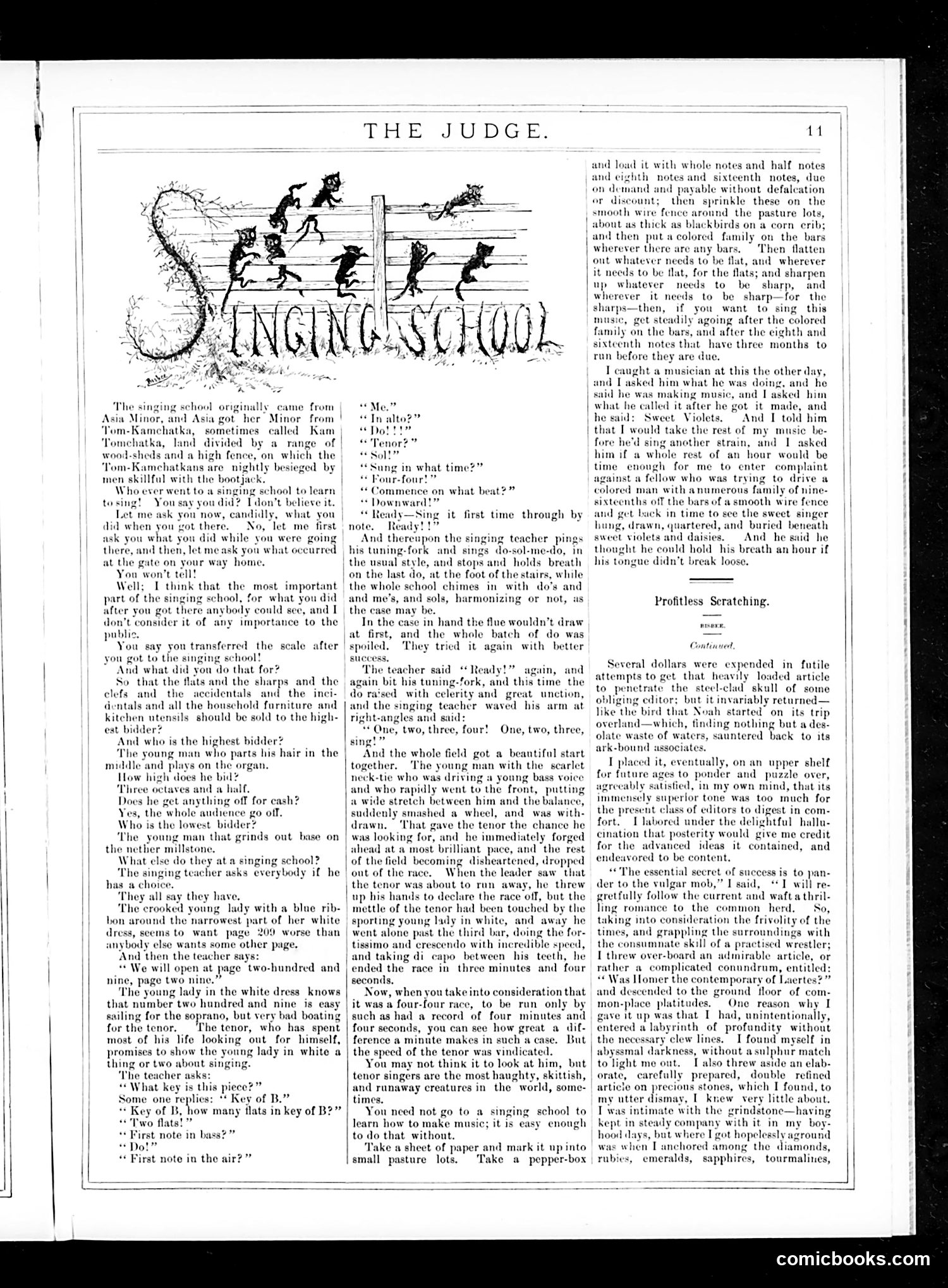
This page satirizes the pretentious absurdity of formal singing lessons. The illustration shows dogs attending "Singing School," a visual joke emphasizing how ridiculous the whole enterprise appears. The text mocks both the process and the people involved: the vain instructor, competitive students (particularly the "young man with the scarlet neck-tie" driving a bass voice), and the social climbing attendees. The author questions what students actually *learn* versus the theatrical performance of learning—asking what occurred "on your way home" rather than at the lesson itself. The satirical narrative follows a singing lesson where technical instruction (do-re-mi scales, page numbers, key signatures) becomes secondary to ego, competition, and romantic drama. A mechanical problem (a flue that won't draw) becomes the pretext for comedic chaos when singers compete to be heard. The satire targets pretension in American cultural institutions—the notion that formal training produces genuine musicianship when mostly it produces vanity and social posturing.
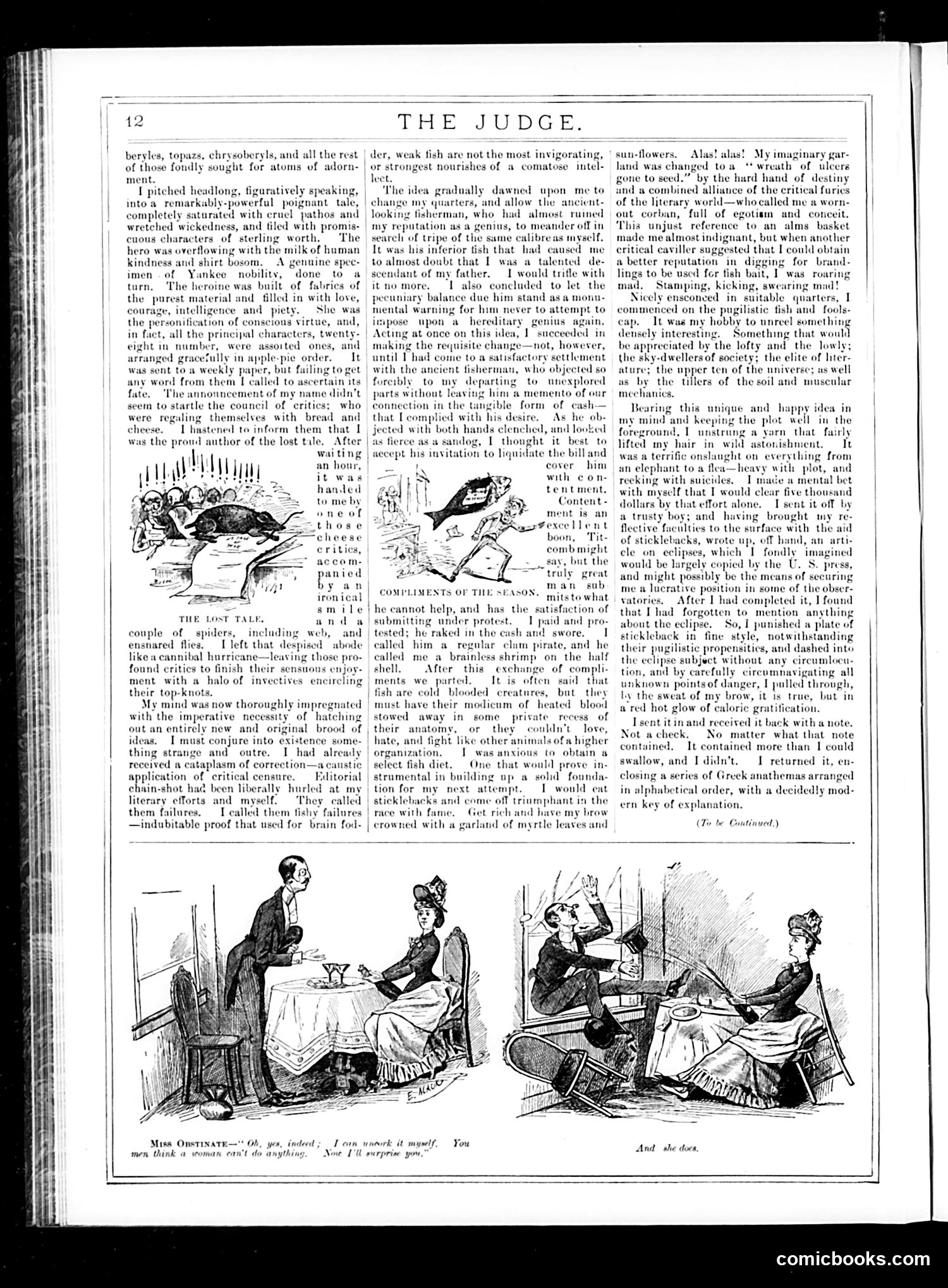
This page contains a serialized story titled "The Lost Tale" with accompanying satirical illustrations. The narrative follows a struggling writer who, after publishing an unsuccessful story filled with noble characters and moral themes, becomes frustrated with critical rejection. The two bottom illustrations depict social commentary through domestic scenes labeled "Miss Obstinate" and "And she does," showing interactions between a man and woman—likely satirizing gender relations and women's independence (note the caption about a woman doing as she pleases despite male disapproval). The main text mocks literary pretension and the publishing industry: the writer's earnest moral tale fails, yet when he later writes hastily about eclipses, it succeeds through newspaper syndication. The satire targets both the writer's inflated self-importance and the public's preference for shallow, easily-copied content over serious literature. This reflects Judge's typical late-19th-century critique of American culture's commercialism and intellectual decline.
This page from *Judge* magazine consists primarily of **humorous short anecdotes and jokes** rather than political cartoons. The content reflects late 19th-century American satirical humor. The jokes target various subjects: marital discord (Binks coming home drunk); political corruption (a boy's father pursuing the Austin post office through deception); regional stereotypes (Texas lawyers, elderly Black men); and contemporary technology (skepticism about the newly-invented typesetting machine). One anecdote mocks **Cleveland's administration**, referencing a politician's son whose father "fooled himself on Cleveland"—likely criticism of President Grover Cleveland's policies or broken promises. The humor relies on dialect jokes, puns, and observations about daily life. A notable section titled "The Victim of Laundries" discusses problems with commercial laundries marking linens with unclear symbols, a complaint about emerging industrial services. The page exemplifies *Judge*'s editorial approach: combining political jabs with domestic humor and social commentary aimed at urban, educated readers.
This page from **Judge** magazine contains primarily **humorous anecdotes and advertisements** rather than political cartoons. The text pieces mock everyday situations: A man with poor spatial memory constantly loses items in his own study; a German druggist's incomprehensible accent creates comic misunderstanding; various romantic entanglements among young people involve parlor matches and jealous rivals. The satire is **social rather than political**—targeting human foibles like pretension, romantic scheming, and linguistic confusion. The German druggist's exaggerated dialect humor reflects common period stereotypes. The page is dominated by **patent medicine advertisements** (Brown's Iron Bitters, Duffy's Whiskey, Bird's Custard Powder) making inflated health claims—typical of Gilded Age publishing. These ads ironically illustrate the very medical quackery Judge might mock editorially elsewhere. The overall tone is **genteel, middle-class humor** with no apparent broader social commentary.
This page is primarily **advertising**, with several brief humorous anecdotes interspersed—typical for Judge magazine's format. The cartoons/jokes include: **"Trials of the Roadways"**: A personified dialogue between carriage wheels and parts, making puns about being "full" and "slewed" (drunk). This is light wordplay without political content. **"An Editor Roused by the Gospel"**: A newspaper editor from the *Deadwood Roarer* complains he's missing war news while sitting in church during an Egyptian military story. The satire mocks sensationalist journalism and the editor's distraction during religious service. **"Not an American Game"**: A boy argues baseball isn't American because the Bible's Book of Numbers mentions the Israelites being ordered to "pitch" by their standards. This is a pun-based joke with no deeper satire. The rest of the page consists of period advertisements (Pond's Extract, pianos, trusses, bicycles, etc.)—reflecting how 19th-century magazines funded themselves through dense advertising.
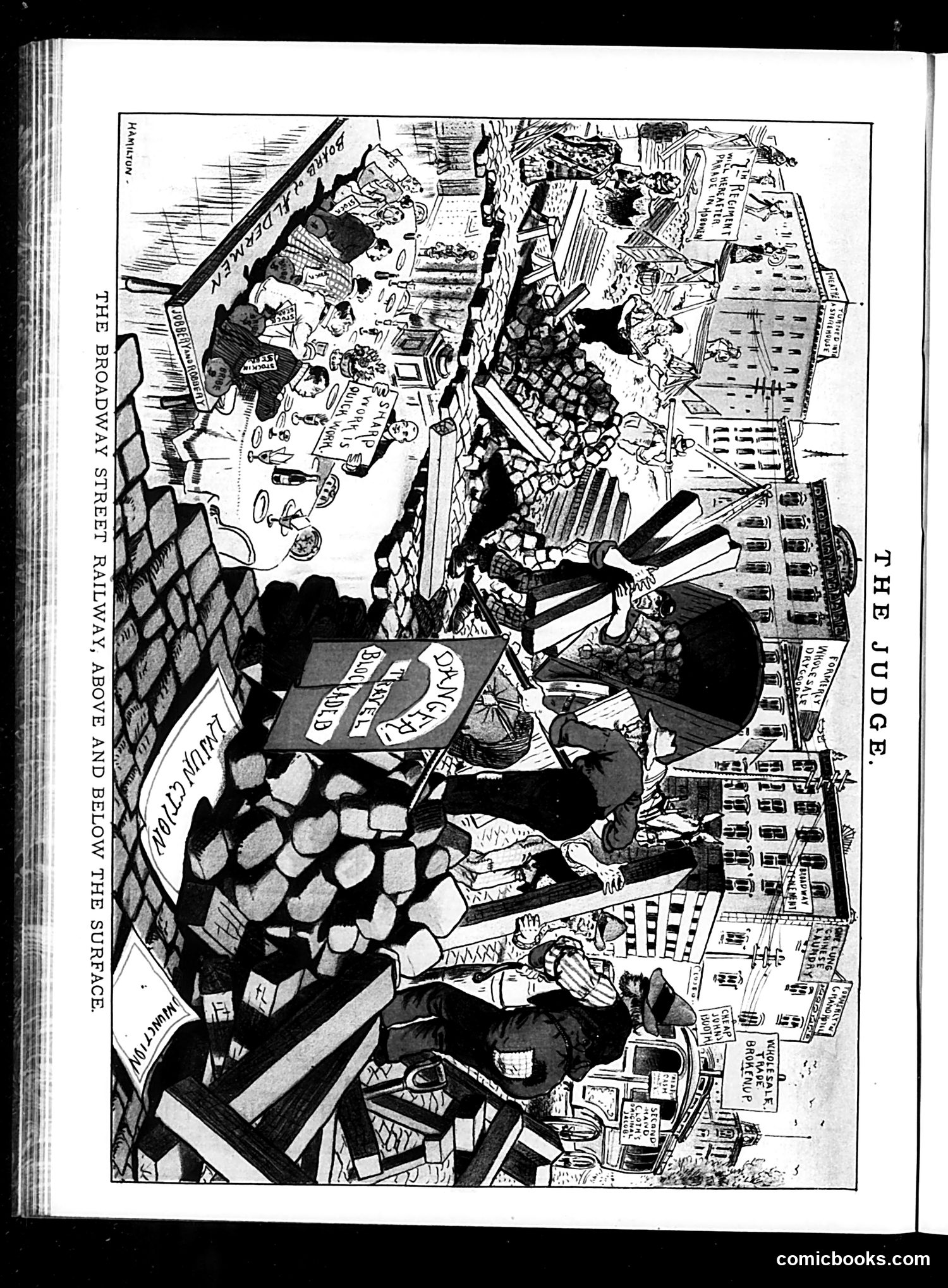
This appears to be a satirical illustration depicting **Broadway Street Railway** operations, as indicated by text visible in the image. The cartoon critiques urban transit conditions through an overhead perspective view of a crowded street scene. The satire targets **crowded, chaotic conditions** on public transportation and city streets—showing dense pedestrian traffic, congested buildings, and the general disorder of urban life. Various figures and architectural elements are rendered in detailed, busy linework typical of Judge magazine's style. The specific political or social figures being caricatured are **unclear from this image alone**. However, the overall point appears to be social commentary on **modernization's negative effects**: congestion, overcrowding, and the disorderly nature of rapid urban development. The OCR text is largely corrupted, preventing precise identification of any specific targets or dates. Without clearer text or caption information, the exact satirical intent remains partially obscured.