
Judge, 1885-06-13 · page 11 of 16
Judge — June 13, 1885 — page 11: what you’re looking at
What you’re looking at
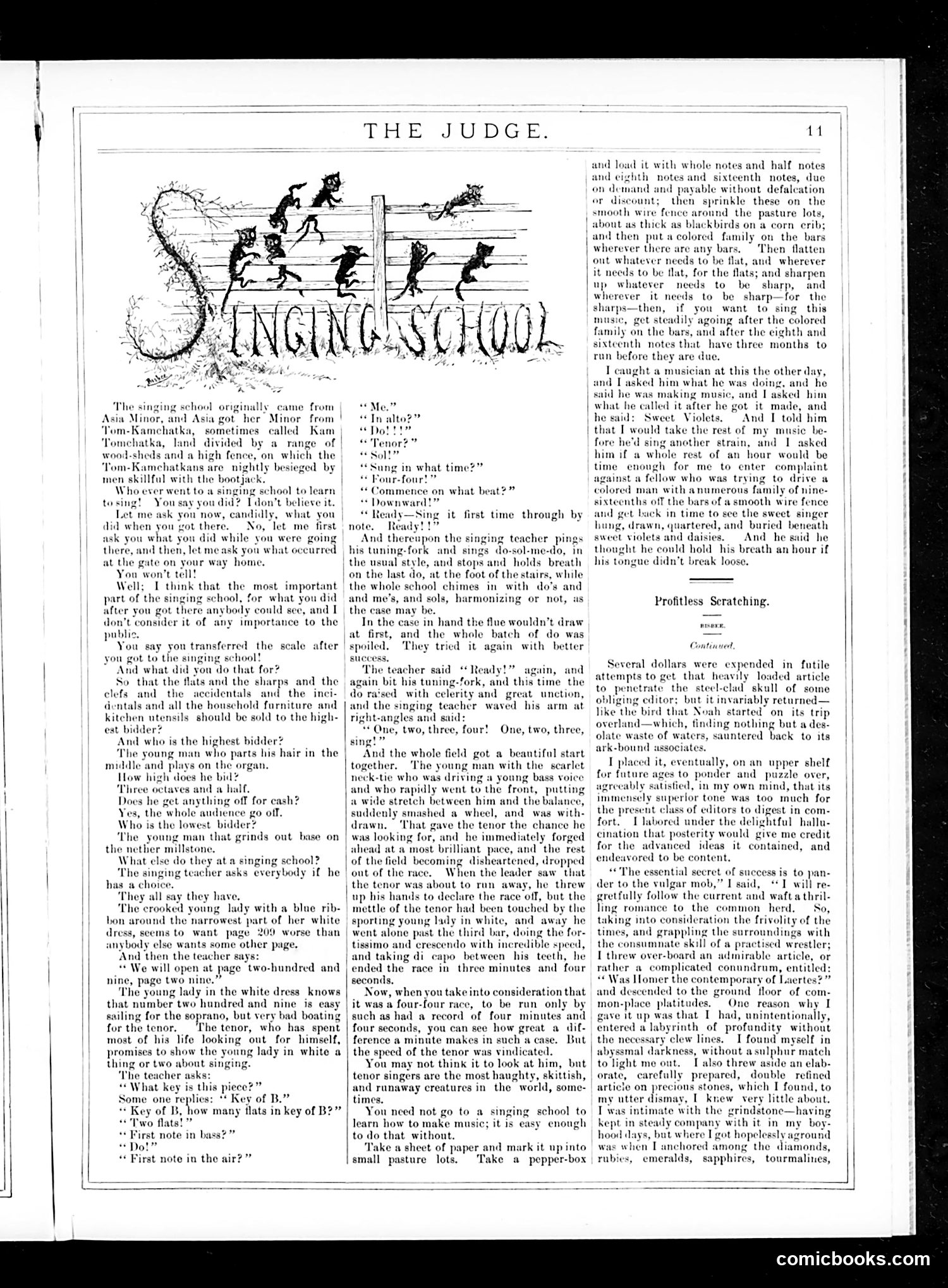
This page satirizes the pretentious absurdity of formal singing lessons. The illustration shows dogs attending "Singing School," a visual joke emphasizing how ridiculous the whole enterprise appears. The text mocks both the process and the people involved: the vain instructor, competitive students (particularly the "young man with the scarlet neck-tie" driving a bass voice), and the social climbing attendees. The author questions what students actually *learn* versus the theatrical performance of learning—asking what occurred "on your way home" rather than at the lesson itself. The satirical narrative follows a singing lesson where technical instruction (do-re-mi scales, page numbers, key signatures) becomes secondary to ego, competition, and romantic drama. A mechanical problem (a flue that won't draw) becomes the pretext for comedic chaos when singers compete to be heard. The satire targets pretension in American cultural institutions—the notion that formal training produces genuine musicianship when mostly it produces vanity and social posturing.
📄 Transcribed text from this page (OCR, searchable)
Machine-transcribed from the original scan — historical spelling and the odd misread are preserved.
inally came from nd Asia got. her Minor from | hatka, sometimes called Kam ‘Tomehatka, land divided by a range of i-sheds and a hi fence, on which the ‘Tom-Kamchatkans are nightly besieged by men skillful with the bootjack, Who ever went to a singing school to learn tosing! Yousay you did? Idon’t believe it. Let me ask you now, candidly, what you 1 when you got there. . Tet me first ask you what you did while you were going there, and then, let me ask you what occurred at the gate on your way home. You won't tell! Me.” In Do’ “Tenor?” Asia Minor, ‘Tom-Kam! at time?” “Sung in wi Four-four!” Commence Downward on what beat?” it first time through by note. And thereupon the singing teacher pings his tuning-fork and sings do-sol-me-do, in the usual style, and stops and holds breath on the last do, at the foot of the stairs, while Well; IT think that the most important | the whole school chimes in with do’s and part of the singing school, for what you did and me’s, and sols, harmonizing or not, i ufter you got there anybody could see, and I the ease may be. don't consider it of any importance to the | In the case in hand the flue wouldn’t draw publi at first, and the whole batch of do was You say yon transferred the scale after | spoiled. ‘They tried it again with better you got to the singing school! suiccess, “And what did you do that for? The teacher said “Ready!” again, and So that the flats and the sharps and the clefs and the accidental: nd the ine dentals and all the houschold furniture and kitchen utensils should be gold to the high- eat bidder? And who is the highest bidder? The young man who parts his hair in the And the whole field got a beantiful start middle and plays on the organ, | together. ‘The young man with the scarlet How high does he bid? neck-tie who was driving a young bass voice Three octaves and a half. and who rapidly went to the front, putting Does he get anything off for cash? a wide stretch between him and the balances again bit his tuning-fork, and this time the do raised with celerity and great unction, und the singing teacher waved his arm it-angles and sa One, two, three, four! One, two, three, Yes, the whole audience go off. suddenly hed a wheel, and was with- Who is the lowest bidder drawn. ‘That gave the tenor the chance he ‘The young man that grinds out base on the nether millstone, What else do they ata singing school? ‘The singing teacher has a choice. They all ss e. The ere ing lady with a blue rib- hon around the narrowest part of her white dress, seems to want page 209 worse than anybody else wants some other page, And then the teacher says: “We will open at page two-hundred and nine, page two nine.” ‘The young lady in the white dress knows that number two hundred and nine is easy sailing for the soprano, but very bad boating for the tenor. ‘The tenor, who has spent most of his life looking out for himself, promises to show the thing or two about sit ‘The teacher asks: “What key is this piece?” Some one replies: “ Key of B.” * Key of B, how many ilats in key of B?” | “Two flats!” ‘First note in bas “Do!” ** First note in the air?” was looking for, and he immediately forged ahead at a most brilliant pace, and the rest | of the field becoming disheartened, dropped asks everybody if he | out of the race. When the leader saw that | the tenor was about to run away, he threw | up his hands to declare the race off, but the mettle of the tenor had been touched by the sporting young la went alone past the third bar, doing th tissimo and crescendo with incredible s jand taking di capo between his teeth, he ended the race in three minutes and four seconds. Now, when you take into consideration that it was a four-four race, to be run only by such as had a record of four minutes and four seconds, you can see how great a dif- ference a minute makes in such a case. But nung lady in white a | the speed of the tenor was vindicated. ing. You may not think it to look at him, but tenor singers are the most haughty, skittish, and runaway creatures in the world, some- times. You need not go to a singing school to | learn how to make music; it Is easy enough to do that without. | Take a sheet of paper and mark it up into |emall pasture lots. Take a pepper-box 11 | and load it with whole note: and cighth notes and sixteenth notes, due on demand and payable without defalcation or discount; then sprinkle these on the smooth wire fence around the pasture lots, about us thick as blackbirds on a corn erib; jand then putacolored family on the bars wherever there are any bars. © Then flatten out whatever needs to be flat, and wherever | it needs to be flat, for the flats; and sharpen | up whatever needs to be’ sharp, and wherever it needs to be sharp—for the urps—then, if you want to this music, get steadily agoing after the colored family on the bars, and after the eighth and sixteenth notes that have three months to run before they are due. I caught a musician at this the other day, nd Tasked him what he was doing, and he said he was making music, and I asked him | what he called it after he got it made, and | he said: Sweet Violets. ~~ And I told him that I would take the rest of my music be- fore he'd sing another strain, and I asked him if a whole rest of an hour would be time enough for me to enter complaint nst a fellow who was trying to drive a colored man with anumerous family of nine- sixteenths off the bars of a smooth wire fence and get back in time to see the sweet singer hung, drawn, quartered, and buried beneath and daisies. And _ he said he puld hold his breath an hour if An’t break loose, nd half notes sweet viole thought he his to} ne C Profitless Scratching. Continued, al dollars were expended in futile to get that heavily loaded article to penetrate the steel-clad skull of some obliging editor: but it invariably returned— like the bird that Noah started on its trip overland—which, finding nothing but ades- | olate waste of waters, sauntered back to its ark-bound associate: D I placed it, eventually, on an upper shelf for future ages to ponder and puzzle over, reeably satisfied, in my own mind, that its | immensely superlor tone was too much for the present class of editors to digest in com- fort. I labored under the delightful hallu- cination that posterity would give me credit | | for the advanced ideas it contained, and | endeavored to be content, ‘The essential secret of su der to the vulgar mob. cess is to pan- | | »” Tsaid, “1 will re- | gretfully follow the current and waftathril- | ling romance to the common herd. — So, tuking into consideration the frivolity of the times, and grappling the surroundings with | | the consumnate skill of a practised wrestler; | | I threw over-board an admirable article, ot rather a complicated conundrum, entitled: Was Homer the contemporary of Laerte: and descended to the ground floor of com- mon-place platitudes. One reason why I gave it up was that I had, unintentionally, entered a labyrinth of profundity without — | the necessary clew lines. I found myself in | abysmal darkness, without asulphur match — | to light me out. I also threw aside an elab- orate, carefully prepared, double refined | article on precious stones, which I found, to my utter dismay, I knew very little about. I was intimate with the grindstone—havin kept in steady company with it in my boy- hood days, but where I got hopelessly aground was when [anchored among the diamond | rubies, emeralds, sapphires, tourmaline comicbooks.com