
A complete issue · 16 pages · 1885
Judge — May 9, 1885
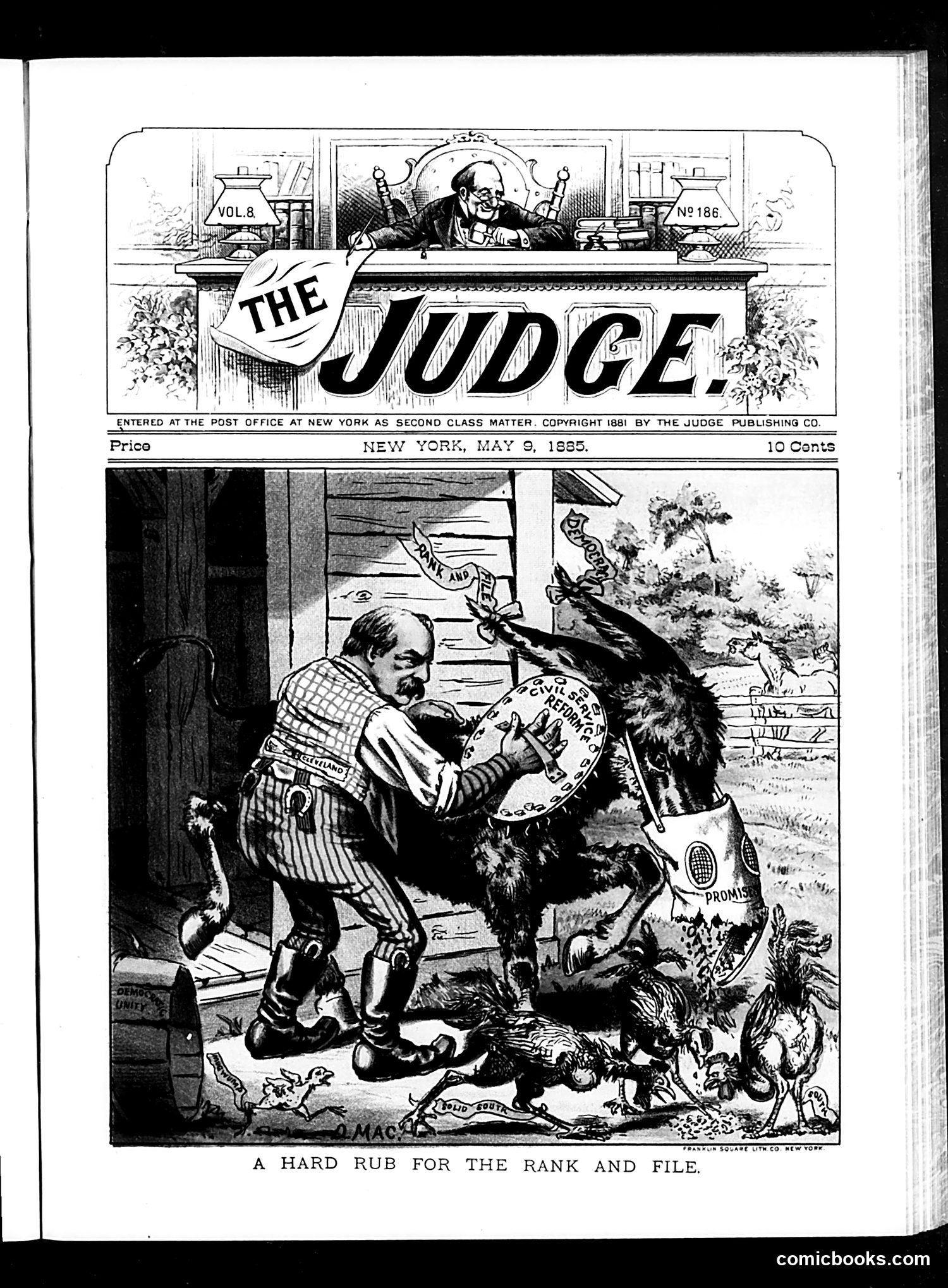
This political cartoon from May 9, 1885, depicts a man in pinstriped clothing scrubbing a donkey with a brush labeled "CIVIL SERVICE" (visible on the drum). The donkey wears a sash reading "PROMISES" and appears to be a Democratic Party symbol. The satire criticizes the gap between Democratic campaign promises and actual implementation of civil service reform. The "rank and file" refers to ordinary party members and voters who expected substantive reform after supporting the party, but instead received only superficial or painful "scrubbing"—symbolic of empty gestures or inadequate action. The cartoon mocks how political parties make grand promises during campaigns but deliver disappointing results once in power.
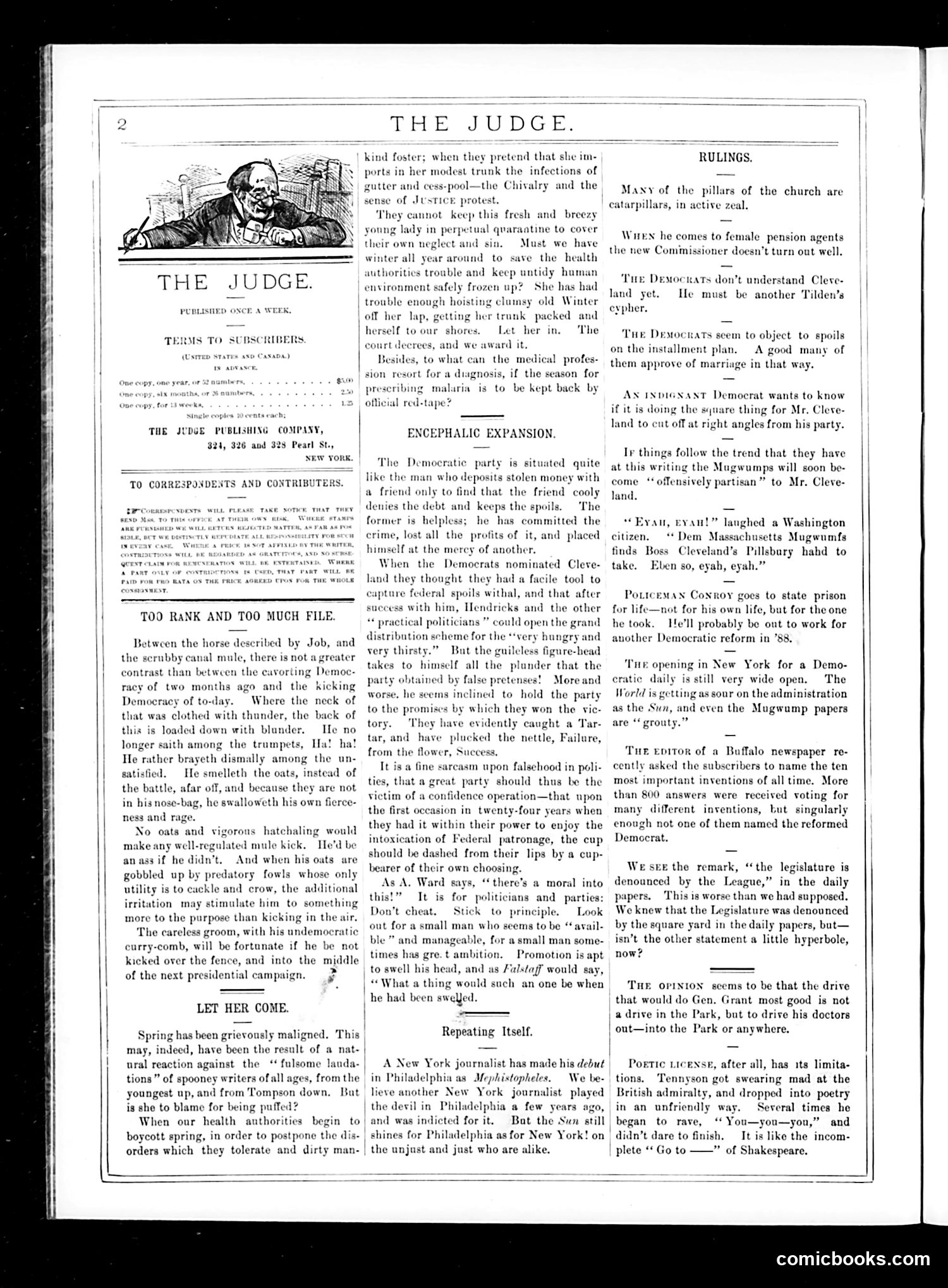
This page contains political satire attacking the Democratic Party and President Grover Cleveland (elected 1884). **Main Cartoon/Article: "Too Rank and Too Much File"** The opening compares the Democratic Party to a mule—once vigorous ("clothed with thunder") but now "loaded down with blunder," braying miserably rather than triumphantly. The satire suggests Democrats expected Cleveland to be a malleable tool for distributing federal patronage ("spoils"), but he instead refused to yield to party demands. **"Encephalic Expansion"** elaborates: Democrats deposited their political "stolen money" with Cleveland, expecting him to distribute patronage to loyal party members. Instead, Cleveland acted independently, keeping power and leaving party operatives ("Hendricks and other practical politicians") frustrated. The piece mocks this as poetic justice—a "confidence operation" backfiring on those accustomed to corrupt spoils-sharing. **Key Point**: Judge ridicules both Democratic corruption AND Cleveland's unexpected independence, suggesting partisan politicians deserve their disappointment. The other items are brief editorial "Rulings" on various political topics of the moment.
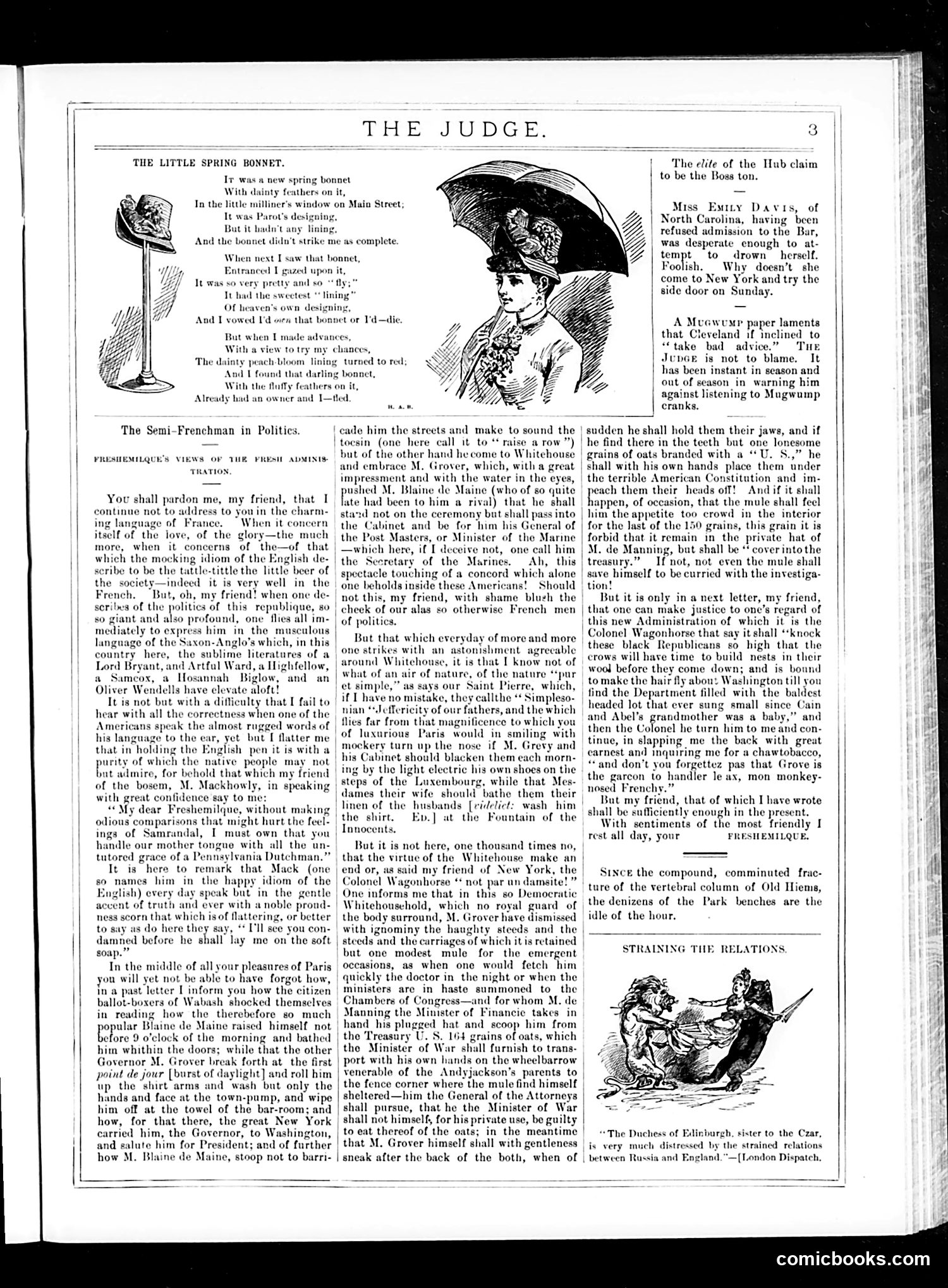
This page contains two satirical pieces from *Judge* magazine: **"The Little Spring Bonnet"** (top): A sentimental poem about a fashionable bonnet, likely gentle social satire about women's vanity and fashion obsession. **"The Semi-Frenchman in Politics"** (main article): The satire mocks a French observer attempting to explain American politics in broken English. The Frenchman contrasts James G. Blaine (who bathed luxuriously indoors) with Grover Cleveland (who washed at a public town pump), crediting Cleveland's "common man" image for winning New York and the presidency. The piece satirizes both the absurdity of such superficial campaign narratives and the pretentious Frenchman's mangled English—highlighting the ridiculous logic that voters chose Cleveland based on his humble hygiene habits rather than substantive policy differences.
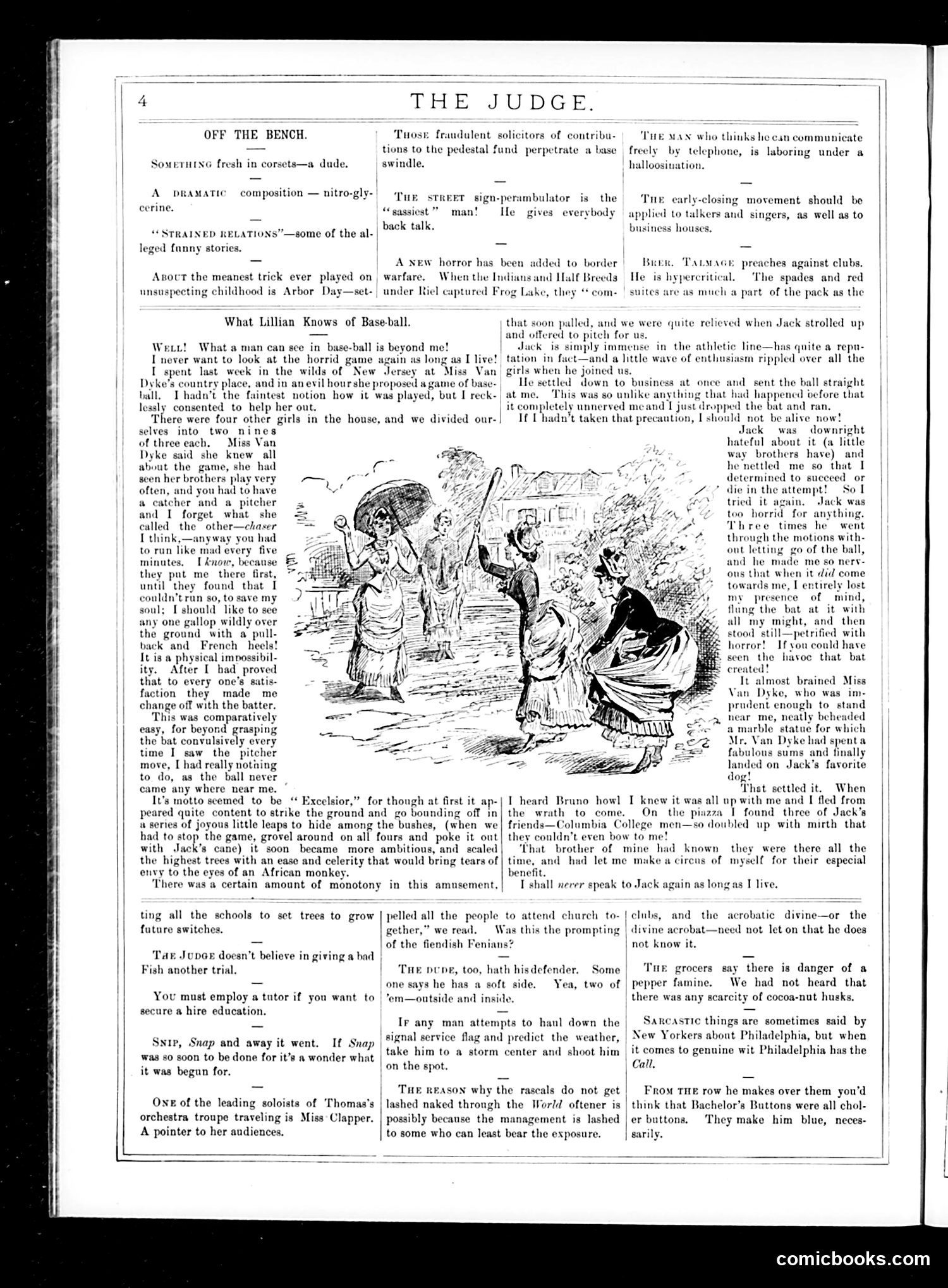
This page from Judge contains miscellaneous brief satirical items ("OFF THE BENCH") rather than a single political cartoon. The main featured content is "What Lillian Knows of Base-ball"—a humorous narrative about a woman's ignorance of baseball rules, illustrated with a sketch of women attempting to play the sport. The satire targets gender stereotypes: the female narrator and her friends are portrayed as comically inept at athletics, with detailed complaints about how their clothing (corsets, French heels) prevents participation. The joke relies on period assumptions about women's physical limitations and unfamiliarity with "masculine" sports. The remaining items are brief one-liners mocking various targets: fraudulent charity solicitors, street vendors, clergy (implied Fenian sympathizers), telephone users, and Reverend Talmage's criticism of clubs. These reflect typical late-19th-century American concerns and social commentary, though most references are too vague or obscure for confident interpretation without additional historical context.
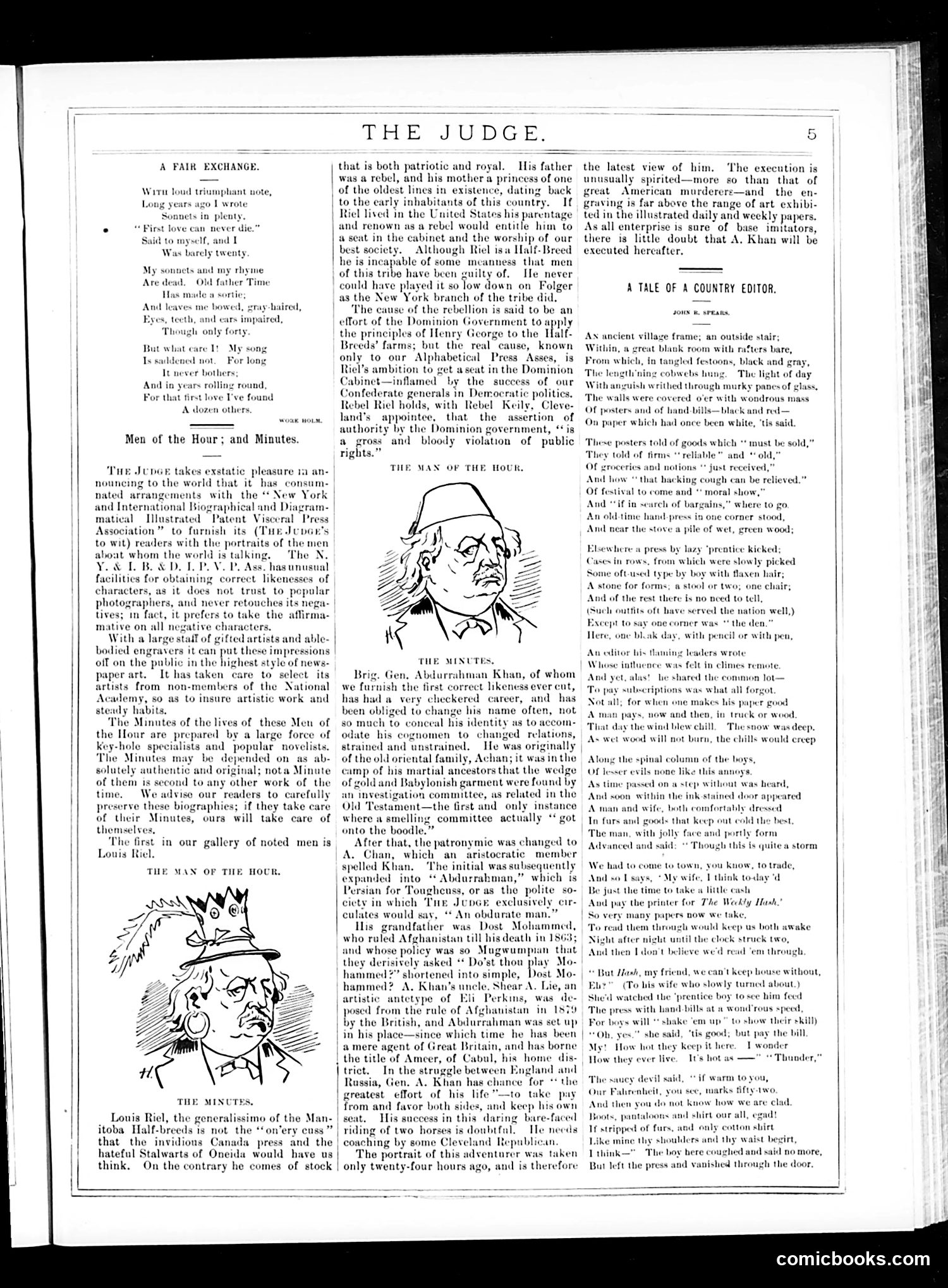
This page satirizes **Louis Riel**, leader of the 1885 Manitoba Rebellion, through two cartoon "portraits" labeled "The Man of the Hour" and "The Minutes." The satire targets Riel's mixed heritage and political ambitions. The text notes he's a "Half-Breed" with a rebel father and aristocratic mother, yet claims despite this pedigree, he lacks the "meanness" of other tribe members—a backhanded "compliment" mocking his pretensions to respectability. The real political jab: Judge reveals the rebellion's true cause wasn't land-reform grievances (Henry George principles) but Riel's personal ambition for a Dominion Cabinet seat, inflamed by Confederate generals' prior political success. The grotesque caricatures emphasize Riel's physical features in exaggerated, dehumanizing style—standard practice for satirizing non-white political figures in 1880s American publications. The accompanying "Minutes" section on Brigadier General Abdurrahman Khan extends this mockery to other colonial subjects. Judge uses invented "biographical" institutions to lend false authority while delegitimizing Riel's political legitimacy.
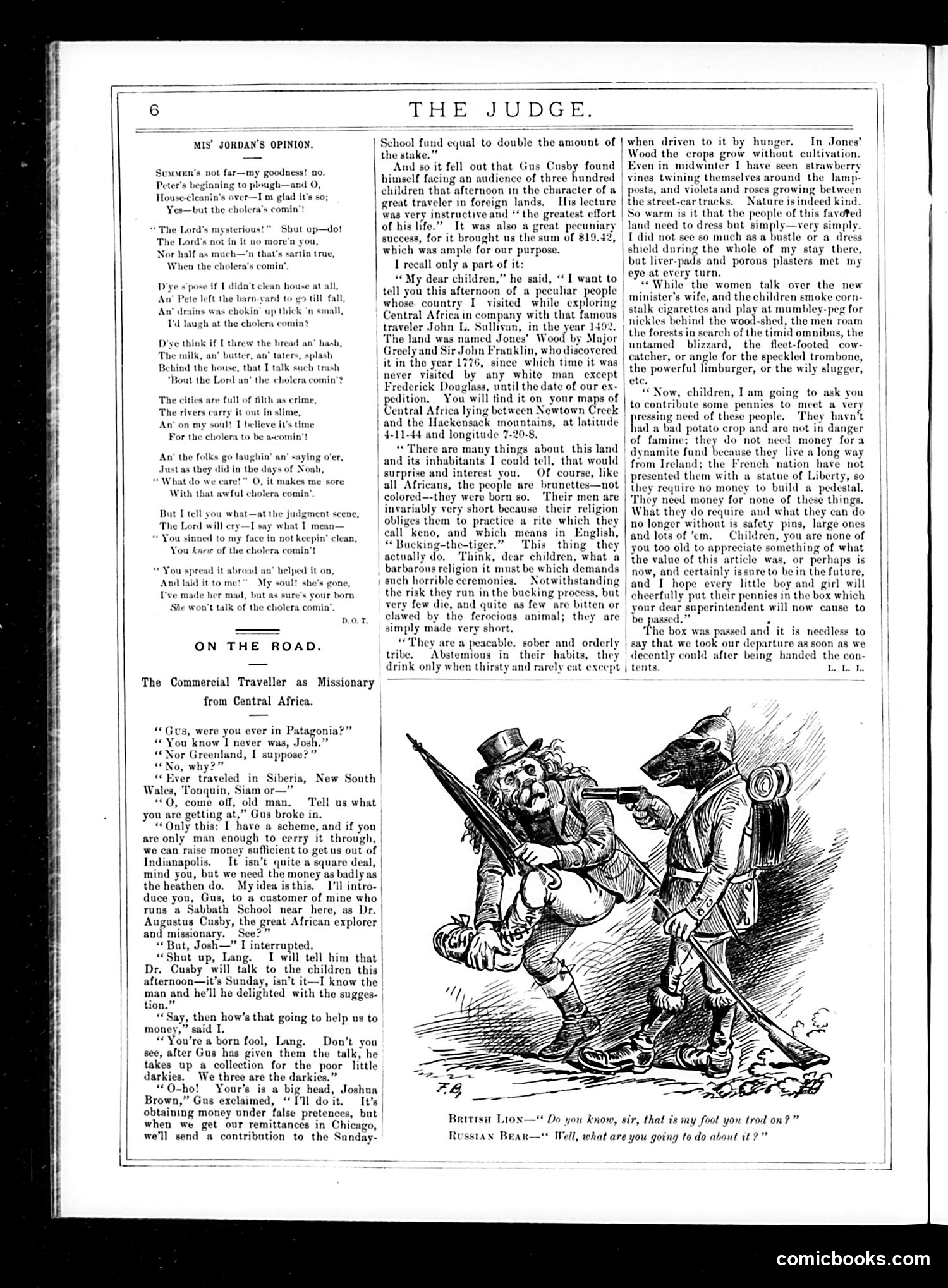
This page satirizes two distinct targets: **"On the Road" section:** A con scheme where two financially desperate men ("Josh" and "Lang") plan to pose "Gus" as Dr. Augustus Cusby, a fake African explorer. They'll have him give a fraudulent lecture at a local Sabbath School, then pass the collection plate under the pretense of helping African children. The con succeeds, raising $19.42. The satire mocks both the easy gullibility of charitable donors and the shameless opportunism of the schemers. Gus's lecture is deliberately absurd—claiming to have explored "Jones' Wood" in Africa with boxer John L. Sullivan and Frederick Douglass—yet it apparently convinces the audience. **"Jordan's Opinion" (upper section):** A rural character defends basic sanitation practices (cleaning house, maintaining drains, proper food storage) as cholera prevention, arguing that neglecting hygiene then blaming God for the disease is sinful hypocrisy. This reflects 19th-century debates over cholera transmission and personal responsibility for public health.
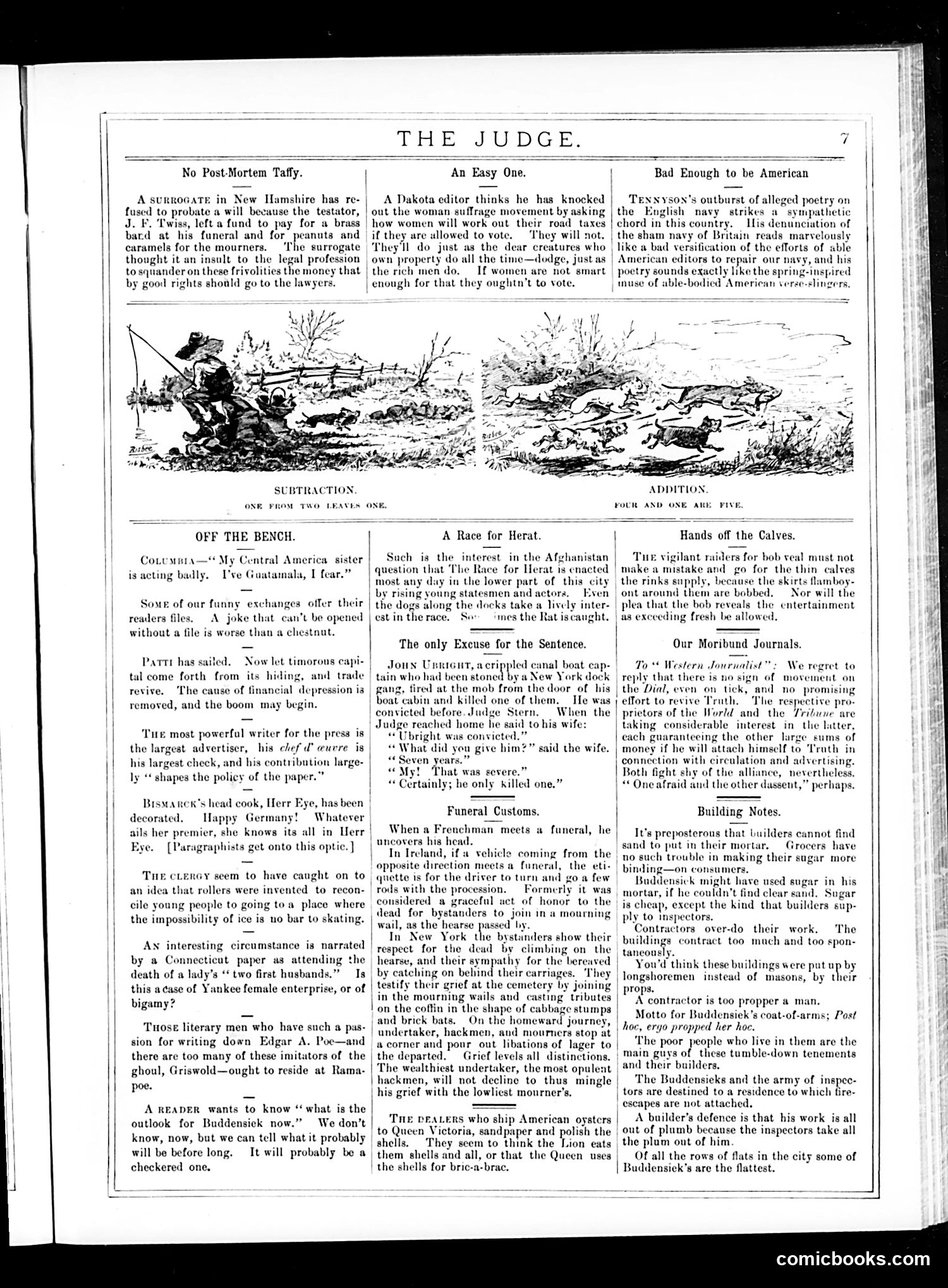
This page from *Judge* magazine contains brief satirical commentary on contemporary issues, paired with two cartoon panels illustrating mathematical concepts ("Subtraction" and "Addition"). The opening section mocks a New Hampshire surrogate judge who refused to probate a will funding a brass band and refreshments at a funeral—viewing such expenses as frivolous. The satire targets judicial self-interest: the judge preferred money go to lawyers instead. Other items mock women's suffrage (a Dakota editor's rhetorical question about women paying road taxes is turned against him), praise German efficiency, and joke about literary imitators of Edgar Allan Poe. The cartoons appear purely illustrative—showing basic arithmetic through nature scenes rather than political satire. The page reflects *Judge's* late-19th-century conservative stance on women's rights and its general irreverent humor toward institutions and public figures, though most references require historical context now lost.
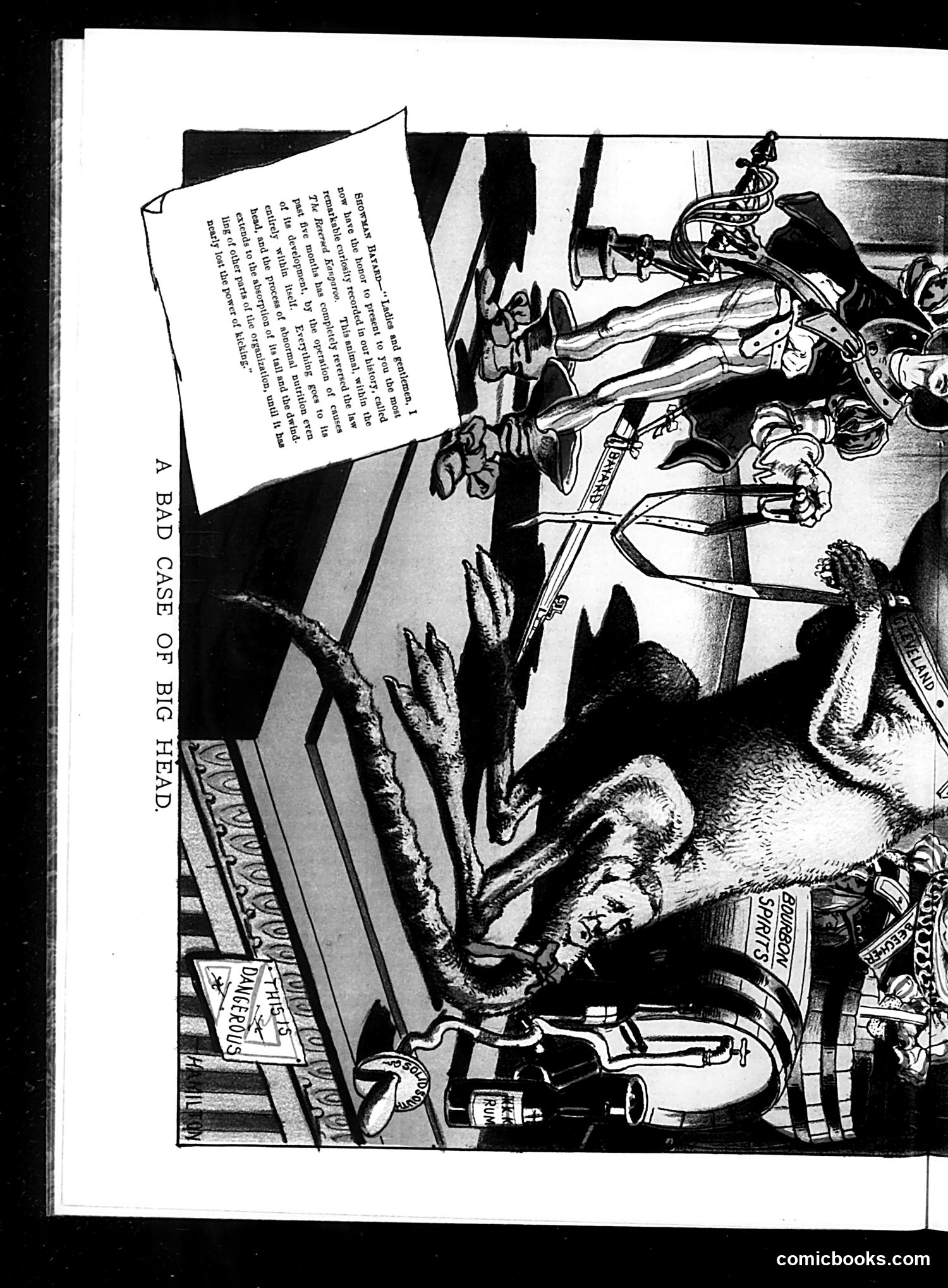
I can see this is a page from *Judge* magazine with the title "A BAD CASE OF BIG HEAD" printed vertically on the left side. The image shows a satirical cartoon, but the OCR text provided is essentially unreadable—it appears to be corrupted character data rather than actual article text. The cartoon itself depicts figures in what appears to be a political satire scene, but without legible accompanying text or clearer identifying labels, I cannot reliably determine which specific political figures or events are being referenced, or what the precise satirical point is. The "big head" reference suggests mockery of ego or inflated self-importance, but I cannot specify the target without more readable source material.
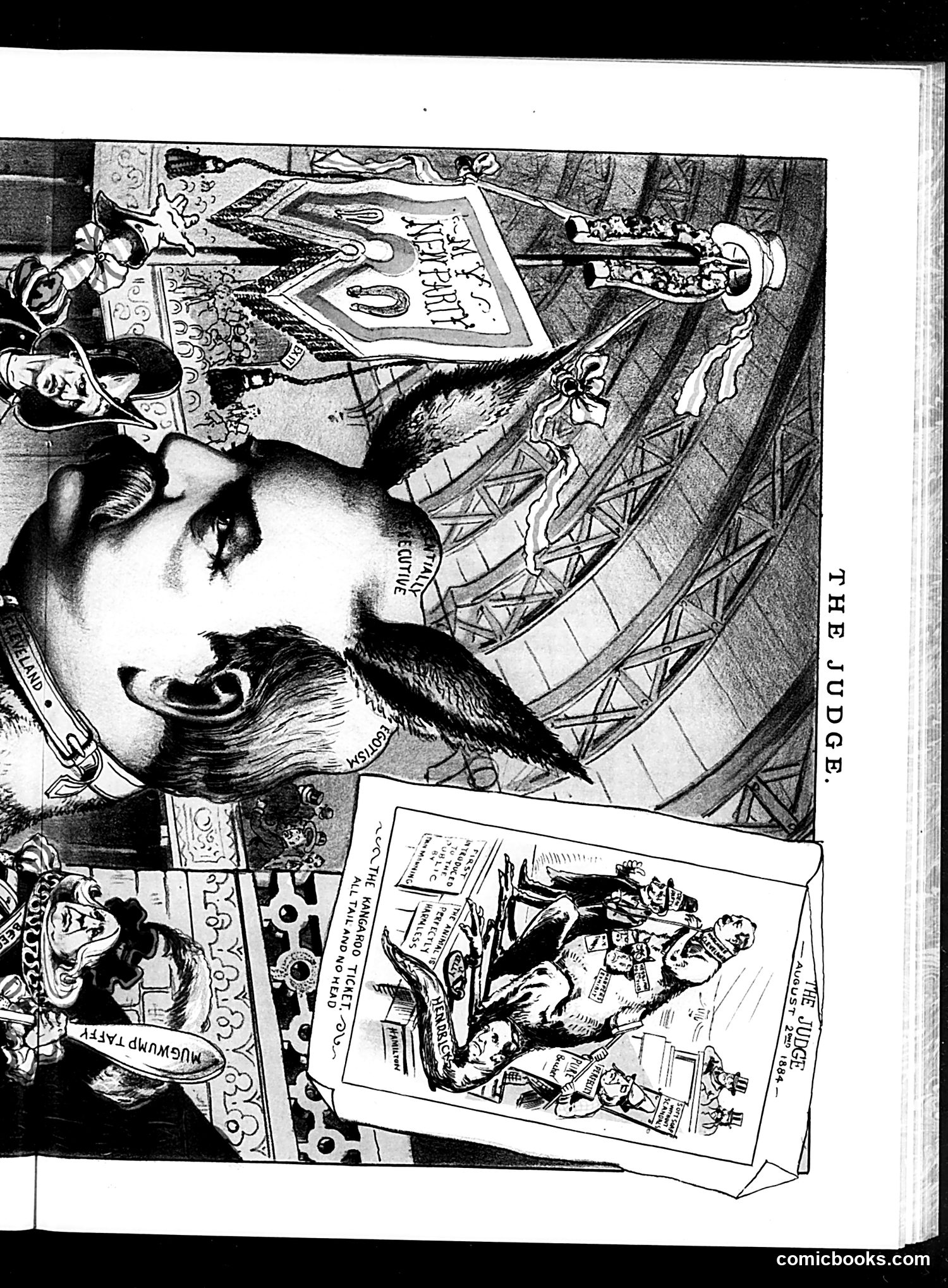
This page contains two cartoon illustrations shown upside-down relative to the text orientation (typical for Judge magazine layout). The main illustration depicts a figure in elaborate period dress examining what appears to be a legal document or proclamation. The ornate clothing and formal setting suggest satire of judicial or political authority. The smaller inset illustration at bottom shows multiple figures in what seems to be a courtroom or formal proceeding scene, with text boxes that are illegible in this reproduction. Without clearer text identification or visible date markings, I cannot definitively identify the specific figures, officials, or political events being satirized. The ornamental details and formal institutional setting suggest commentary on legal proceedings or government authority, but the precise target and satirical point remain unclear from this image alone.
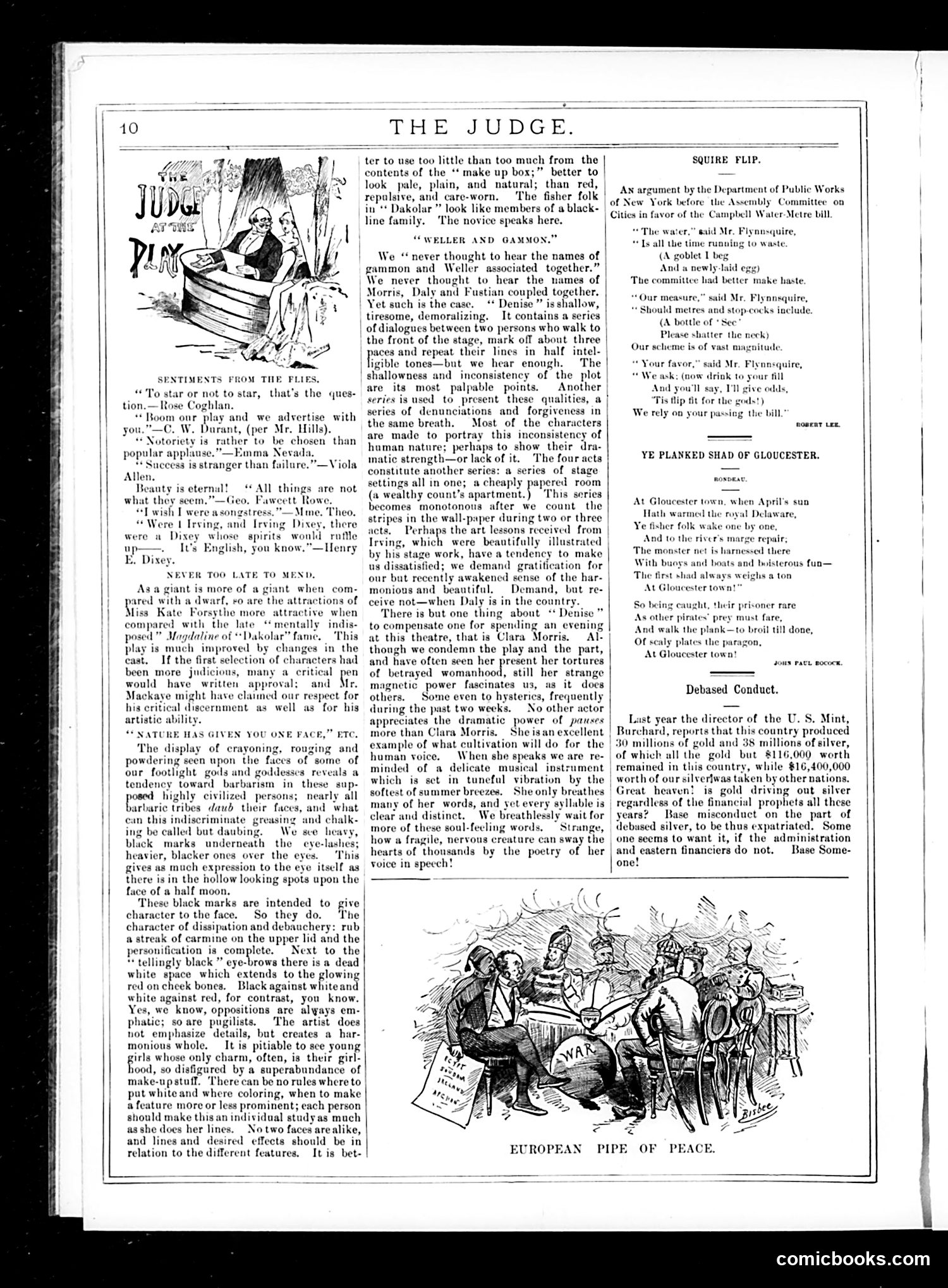
This page from *Judge* magazine contains theater criticism and a political cartoon titled "European Pipe of Peace." The cartoon depicts European political figures (likely representing major European powers) smoking together, suggesting diplomatic negotiations or peace talks. The "pipe of peace" is a metaphorical reference to reconciliation among fractious European nations. The surrounding theater reviews critique contemporary stage productions, particularly condemning excessive stage makeup and theatrical affectation. The critics attack artificial "crayoning, rouging and powdering" on actors' faces, advocating for natural beauty over theatrical artifice—a commentary on both artistic standards and, implicitly, authenticity versus deception in public presentation. The cartoon's placement alongside these reviews creates implicit satire: just as actors deceive audiences with false makeup, European diplomats may be engaging in theatrical performance rather than genuine peace-making.
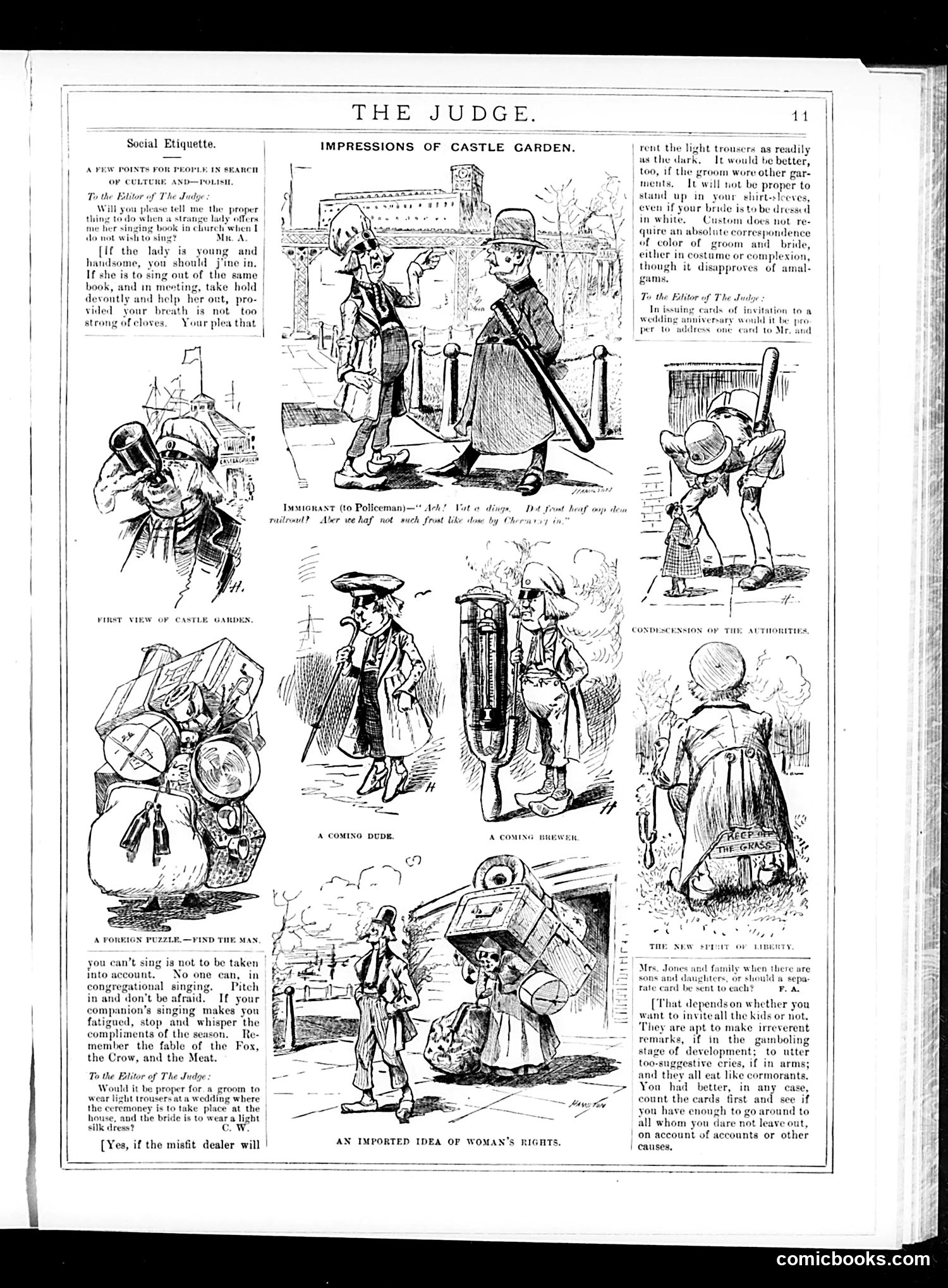
This page satirizes Irish and European immigrants arriving at Castle Garden (New York's immigration processing center before Ellis Island). The central cartoon shows an Irish immigrant being processed, with the caption mocking his accent: "Ach! Vat o' dings...Dot foust heaf ony dew railroad? Aber we haf not such frost like dose by Cheraviy [Galicia]." The surrounding vignettes—"A Coming Dude," "A Coming Brewer," "Imported Idea of Woman's Rights"—stereotype immigrants as poorly dressed, uneducated laborers and radicals with foreign ideas about women's equality. The visual humor relies on caricature: exaggerated features, shabby clothing, and comical malapropisms. The "Social Etiquette" advice column provides contrasting content about upper-class behavior, implicitly positioning refined American society against crude immigrant newcomers. Judge magazine's satire reflects late-19th-century nativist anxieties about immigration and assimilation.
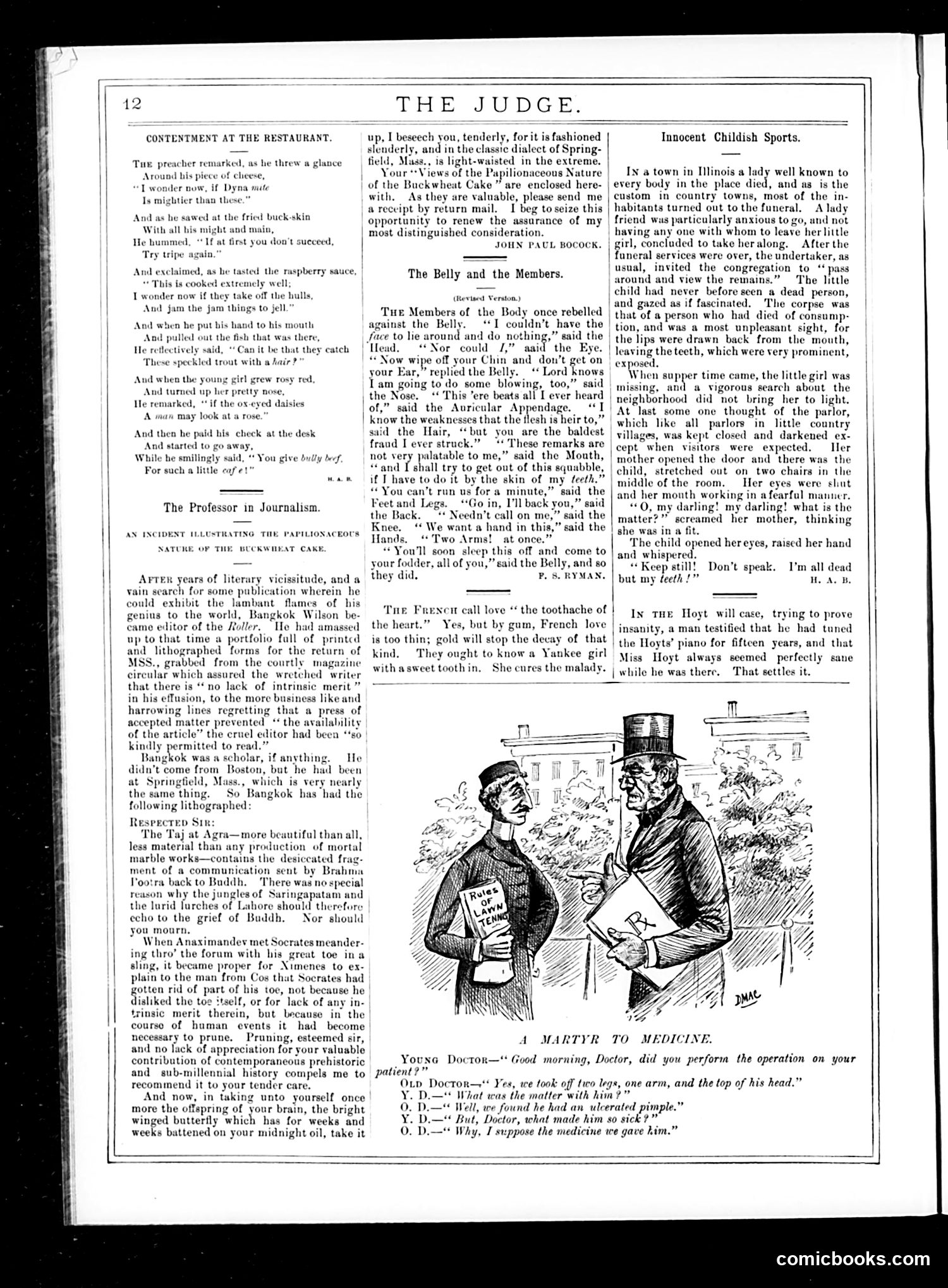
This page contains three distinct pieces of satire: 1. **"Contentment at the Restaurant"**: A humorous poem mocking a clergyman's pretentious dining experience. He struggles with tough food ("fried buck-skin," "tripe") while affecting sophisticated satisfaction, pretending to enjoy poorly prepared dishes. 2. **"The Professor in Journalism"**: Satirizes rejected manuscript rejection letters. "Bangkok Wilson," an editor, has collected standardized rejection forms from magazines. The satire highlights how editors use philosophical language (referencing Socrates, the Taj Mahal, Buddha) to politely reject worthless submissions—a scathing critique of both pompous literary culture and patronizing rejection practices. 3. **"The Belly and the Members"**: A revised Aesop's fable where body parts rebel against the stomach. This satirizes class conflict or political discord, suggesting those who think themselves important (eyes, nose, ears, hair) fail to recognize the belly's necessity—likely commentary on labor disputes or social hierarchy. The cartoon titled **"A Martyr to Medicine"** shows a young doctor proudly displaying a patient missing limbs, mocking quack medicine or incompetent physicians.
This page contains satirical poetry and theatrical pieces typical of Judge's late 19th-century content. **"The Office Seekers' Inquiry"** is a lengthy poem mocking job-seekers pestering President Cleveland for government posts—a recurring problem during the spoils system era. The supplicant pathetically asks "winged winds," the Potomac River, and even Cleveland himself if positions exist, receiving only rejections. The satire targets both desperate office-seekers and the patronage system enabling their behavior. **"The Modern Shakespeare"** parodies ornate, pseudo-Elizabethan language while commenting on social mobility and newspaper economics. Characters discuss how Senor Scissori, despite wearing rags, now rides in golden chariots because he owns the "Semi-Weekly Maccaroon" (a fictional newspaper). The satire suggests newspapers generate wealth but "doth bear no fruit"—implying they're economically hollow or morally worthless. **"Oyez! Oyez!"** is a brief satirical poem about what women need to survive, culminating in jokes about women's gossip ("chinning"). The page is primarily text-based social/political commentary rather than visual cartoons.
This page from *Judge* magazine contains several humorous anecdotes and advertisements typical of late 19th-century American satirical journalism. The cartoons/stories lack identifiable specific political figures, instead offering social commentary through everyday scenarios. **Key Content:** The main pieces mock middle-class American life: a San Antonio artist arrested for drawing; a woman (Miss Lillian Smith) breaking glass balls faster than a noted performer; an Austin man prioritizing dog discipline over a book agent; and a barber who cuts a customer so badly the customer forgives him after buying him a drink. The final anecdote, "A Woman's Will," presents men debating whether women can be controlled—a lawyer claims he's "broken" a woman's will, generating curiosity about his method. **The Satire:** These pieces ridicule masculine pride, provincial attitudes, and social pretense through exaggeration and unexpected reversals. The humor relies on recognizing absurd human behavior rather than topical political references. The page is substantially filled with patent medicine and theatrical advertisements, which were *Judge*'s primary revenue source.
This page is primarily **advertisements and humorous anecdotes** rather than political cartoons. The main content consists of: **The Humor Pieces:** Several brief jokes satirizing everyday American life: 1. **"The Judge"** – A Black defendant ("Webster") explains to a perplexed judge why stealing chickens was easier than the judge could accomplish, sarcastically suggesting the judge commit crimes "on de bench" instead. This relies on racial dialect humor typical of the era. 2. **"Scotch Dyspepsia"** – Ethnic stereotype humor about Scottish people eating oatmeal causing indigestion (the bagpipes being blamed instead). 3. **"Rather Rapid"** – A stenographer claims to report speeches faster than speakers can deliver them. 4. **"Respectability"** – A matrimonial agent claims to "warrant" a consumptive woman as if she were merchandise. **The Advertisements** dominate the page, promoting patent medicines (Pond's Extract), pianos, lithography services, magic lanterns, trusses, and bicycles—typical late-19th-century commerce. There's no identifiable political commentary.
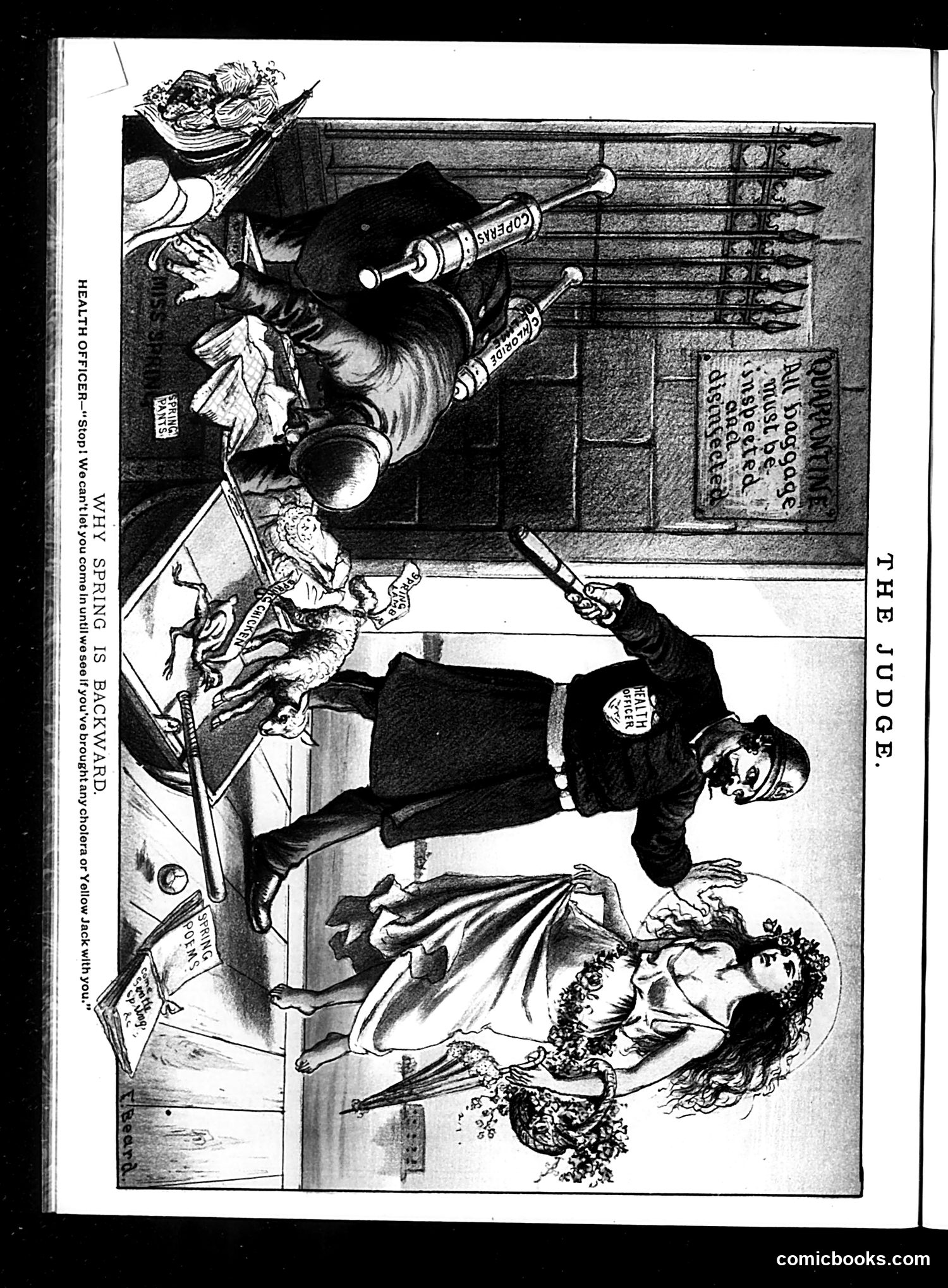
This political cartoon depicts a **Health Officer** blocking entry to someone arriving by ship, demanding inspection for cholera or yellow fever ("Yellow Jack"). The satire targets **immigration policy and disease anxiety**. In late 19th/early 20th-century America, immigrants—particularly those arriving by boat—were associated with disease outbreaks. The cartoon plays on contemporary public health fears used to justify restrictive immigration policies. The caricatured figure appears to represent an immigrant or foreign arrival being interrogated at a port of entry. The joke critiques how health concerns were weaponized as a pretext for discriminatory immigration control, portraying the Health Officer as overly zealous or using disease as a convenient excuse for exclusion. This reflects actual historical practices where immigration and public health policy intertwined.