
A complete issue · 16 pages · 1885
Judge — May 2, 1885
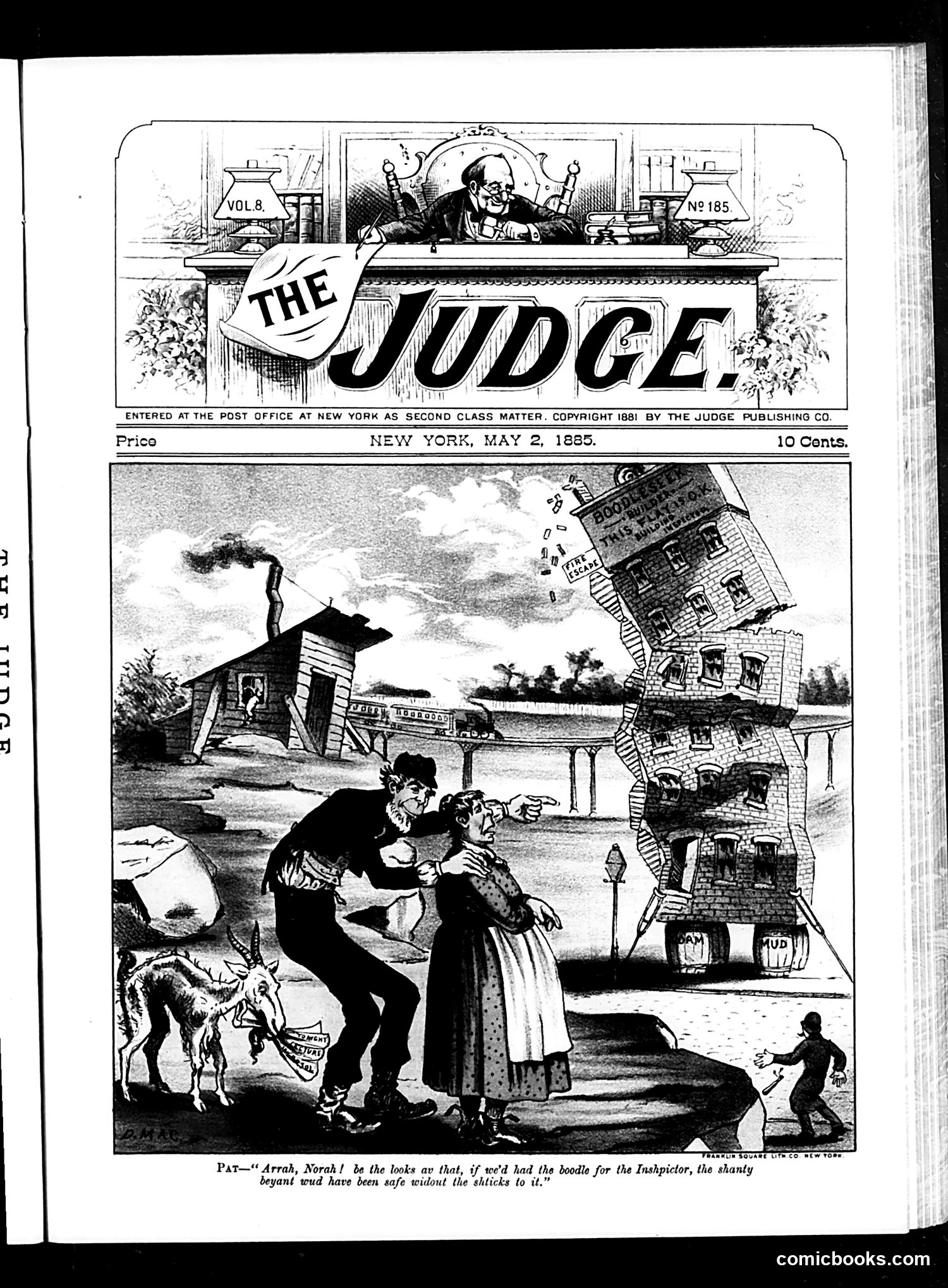
The main cartoon depicts a domestic scene with caricatured figures and a grotesquely tilted house. A man appears to be restraining a woman while pointing at a dog, with a child visible on the right. The caption reads: "Pat—'Arrah, Norah! be the looks av that, if we'd had the hoodie for the Inspicktor, the shanty begad wud have been safe widout the shticks to it.'" The exaggerated Irish dialect and caricatures suggest this is an ethnic joke typical of 1880s American humor. The tilted, ramshackle house labeled with signs appears to represent poor Irish-American housing conditions. The reference to an "Inspector" and makeshift structural supports suggests commentary on tenement housing standards or building code enforcement. The "hoodie" (likely "hoodoo," meaning bad luck or curse) implies blaming supernatural forces rather than acknowledging structural inadequacy—satirizing Irish immigrants' attitudes toward poverty and housing.
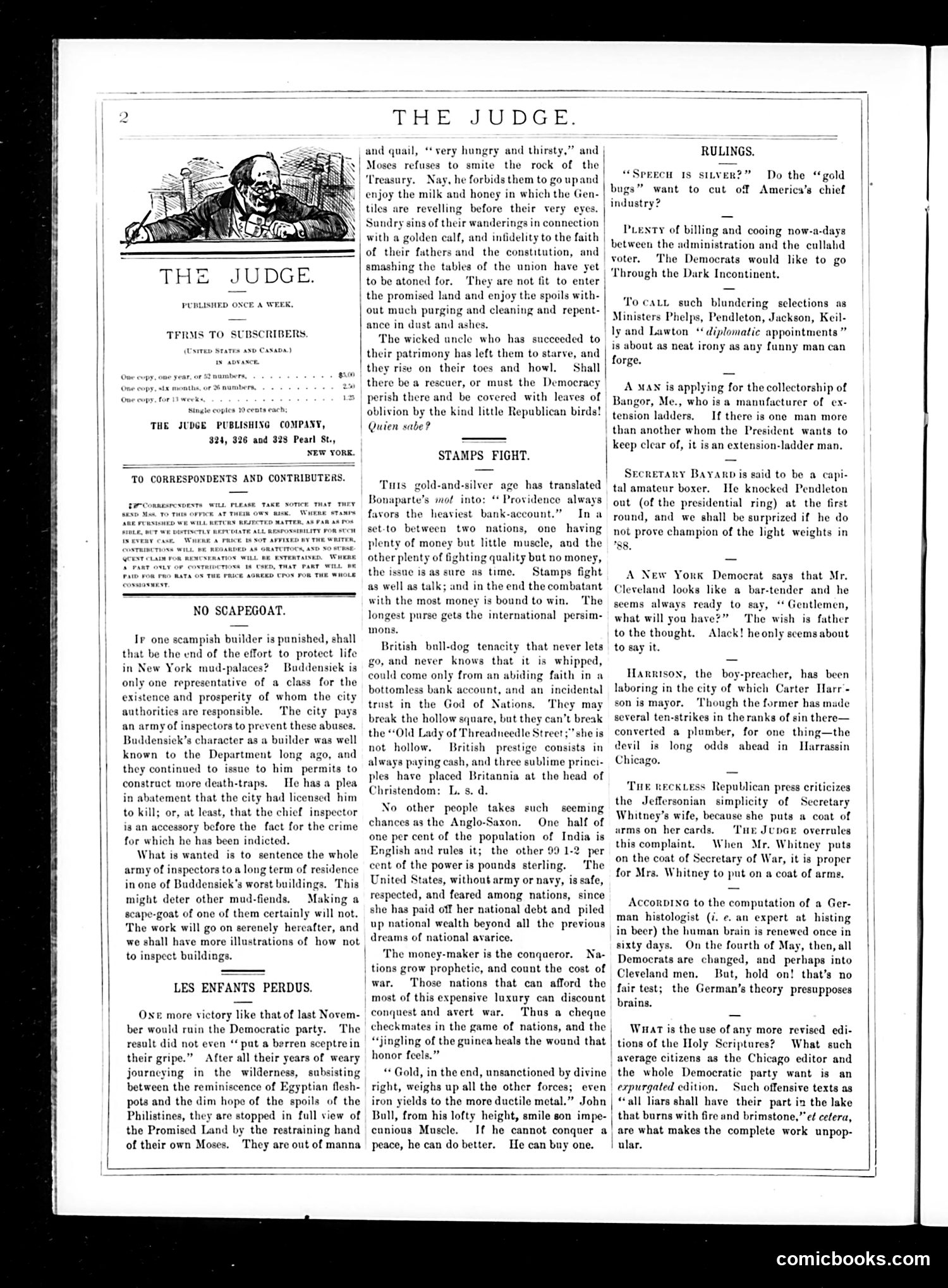
This page from *Judge* contains three political editorials lampooning Democratic failures and Republican/British financial superiority. **"No Scapegoat"** criticizes the punishment of builder Buddensiek (likely for a tenement collapse) as insufficient. The piece argues that corrupt city inspectors who enabled deadly construction are equally culpable—punishing one builder won't fix systemic corruption. **"Les Enfants Perdus"** uses biblical metaphor to mock Democrats. Comparing them to Israelites denied entry to the Promised Land, it suggests they've been blocked from political power (likely referencing a recent electoral loss) by their own "Moses" (appears to reference Democratic leadership refusing to unlock the "Treasury" spoils of office). **"Stamps Fight"** argues that in international conflicts, financial resources trump military prowess. It celebrates British imperial power, attributing Britain's global dominance to its banking strength (the "Old Lady of Threadneedle Street"—the Bank of England) and consistent payment of debts ("L. s. d."—pounds, shillings, pence). The page reflects Gilded Age anxieties about corruption, Democratic weakness, and Anglo-Saxon financial supremacy.
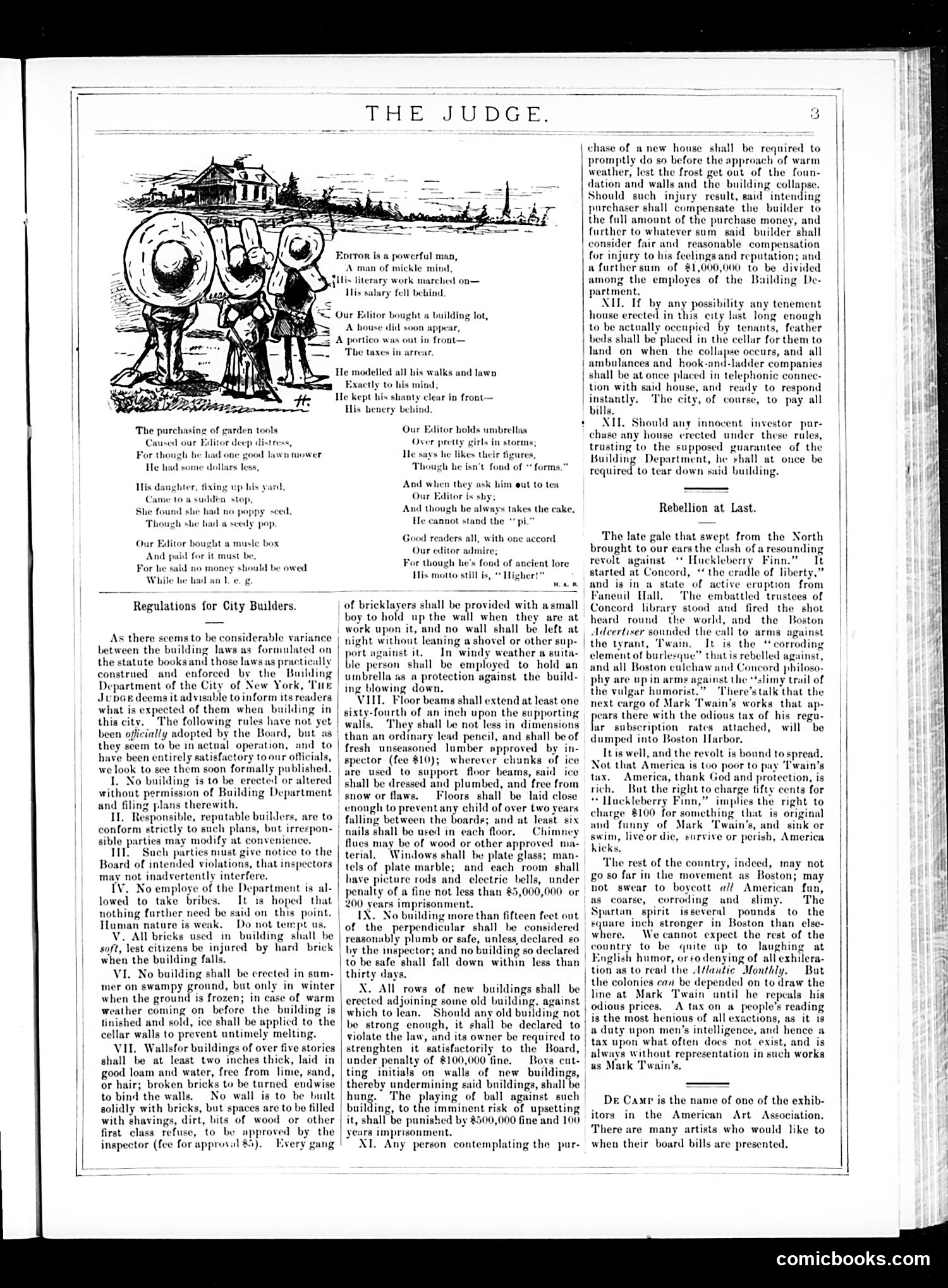
This page satirizes New York City's building regulations and corruption. The cartoon critiques lax enforcement of construction standards by the Building Department. The mock "Regulations for City Builders" are absurdist rules that expose actual problems: builders can violate approved plans with impunity if they notify the Board first (Rule III); inspectors accept bribes (Rule IV); walls are built with inadequate materials like dirt and refuse instead of proper mortar (Rule VII); and poorly constructed tenement buildings are expected to collapse, with the city liable for ambulances and compensation (Rule XII). The accompanying poem about "Edrtor" (the magazine's editor) humorously shows him buying property and tools—illustrating how even respectable people get caught in this corrupt system. The satire targets systemic negligence: buildings designed to fail, with financial consequences shifted to innocent buyers and taxpayers rather than negligent builders or officials.
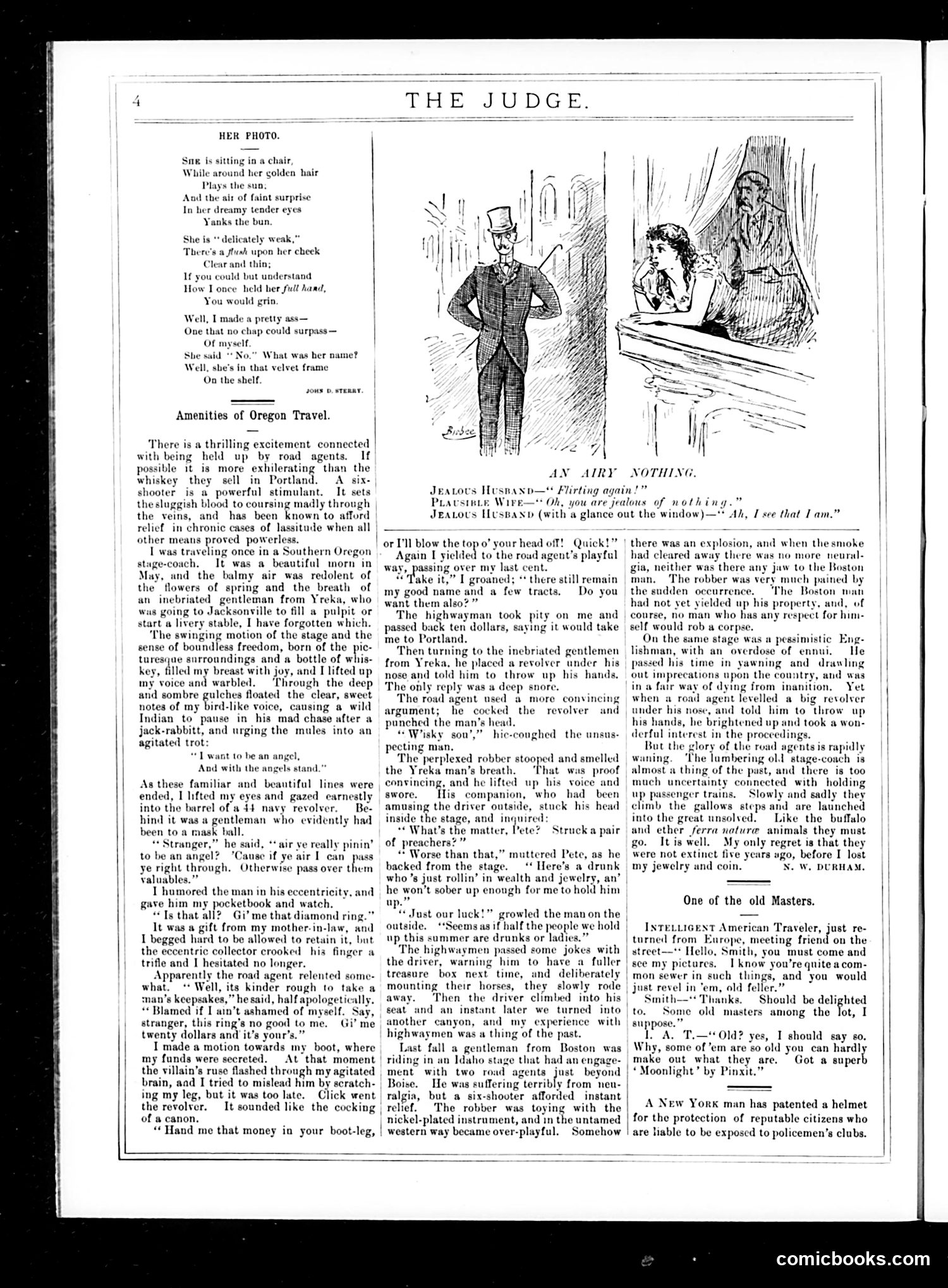
This page contains two distinct pieces from *Judge* magazine: **"Her Photo"** (top left): A sentimental poem about a man pining over a photograph of a woman he once knew. The humor lies in his self-deprecating admission that he "made a pretty ass" of himself with her—a common Victorian trope of romantic regret. **"Amenities of Oregon Travel"** (main article): A humorous tall tale about a stagecoach robbery in Southern Oregon. A traveler singing hymns is held up by a masked road agent who steals his valuables. The satire targets both the violence of frontier lawlessness and the eccentric, almost gentlemanly etiquette of the robber (who actually returns some money out of sympathy). The punchline involves an drunk man from Yreka whose alcoholic breath is so potent it bewilders the robber—mocking both frontier excess and Oregon's reputation for lawlessness and rough characters. The pieces together showcase *Judge*'s satirical treatment of American frontier mythology and Victorian sentimentality.
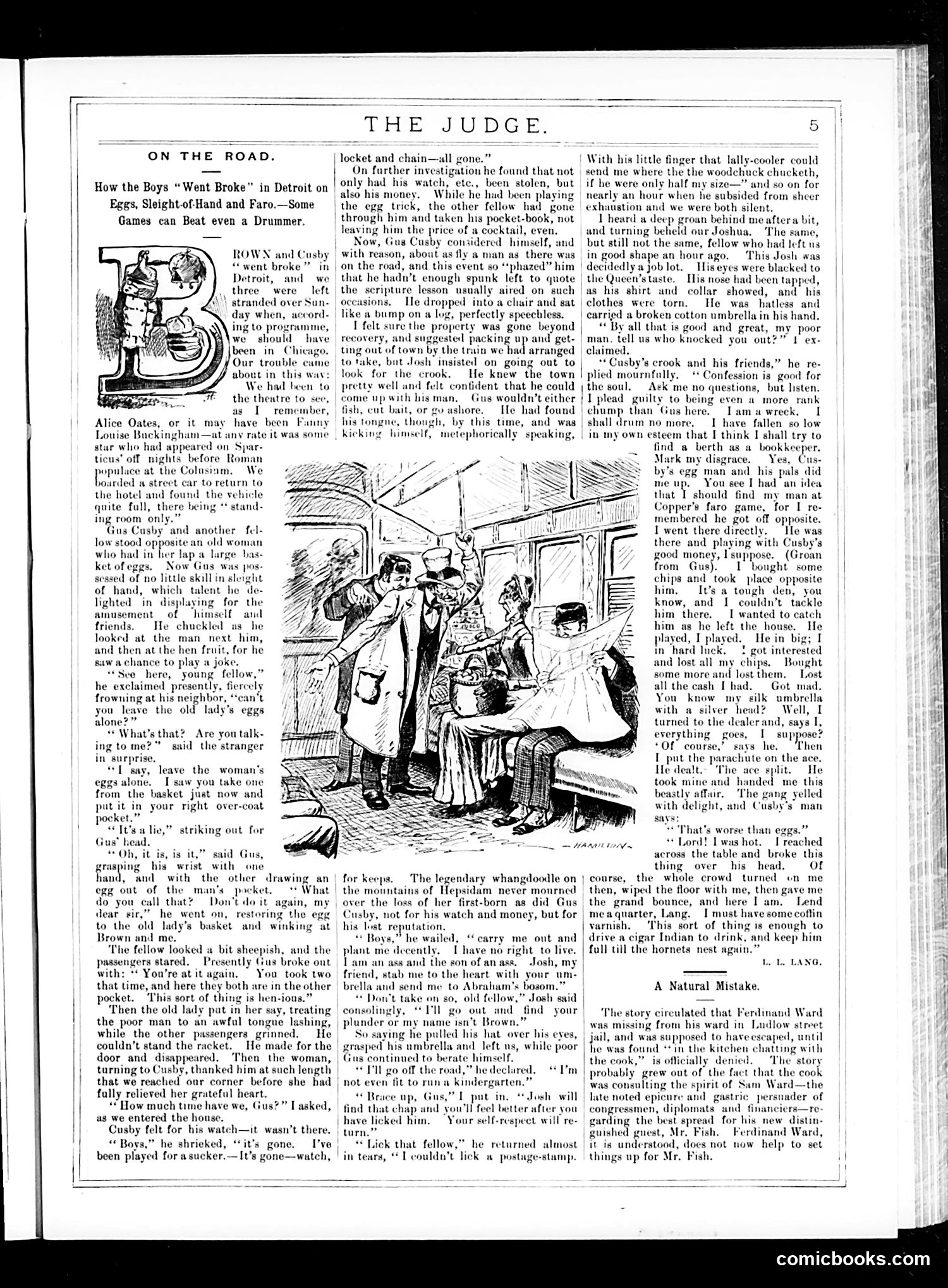
This is a humorous anecdote about traveling salesmen ("drummers") being duped by a classic con game. Gus Cusby, a skilled sleight-of-hand artist, performs an elaborate trick on a street car: he falsely accuses a stranger of stealing eggs from an old woman's basket, creating a public scene that distracts everyone. While Cusby has the crowd's attention mocking the innocent man, an accomplice picks Cusby's pocket—stealing his watch, chain, money, and pocket-book. The irony is sharp: Cusby, who prided himself as "fly" (clever), falls victim to the very scheme he likely used to swindle others. The story satirizes traveling salesmen as both con artists and marks—they live by deception but remain vulnerable to it. The moral: in a world of hustlers, even the sharpest can be played for a sucker.
This poem satirizes a young naval midshipman who, despite strict ship rules, smokes a forbidden cigarette while on duty. The spark ignites the ship, causing a catastrophic fire. The narrative parodies the famous poem "Casabianca" (about a boy loyally staying at his post), but inverts it: instead of noble duty, the midshipman hides in cowardice while the captain heroically searches for him. The satire mocks: - **Naval hierarchy**: Officers enforcing rules while youth brazenly break them - **Irresponsible behavior**: A small act of rule-breaking causes disaster - **False heroism**: The midshipman survives by cowardice, not bravery, yet shows no genuine remorse—only lamenting lost insurance money and parental punishment The ending reveals the joke's cynicism: the boy escapes drowning through luck, not virtue, and worries mainly about being "lammed" (beaten) by authorities rather than acknowledging the tragedy he caused.
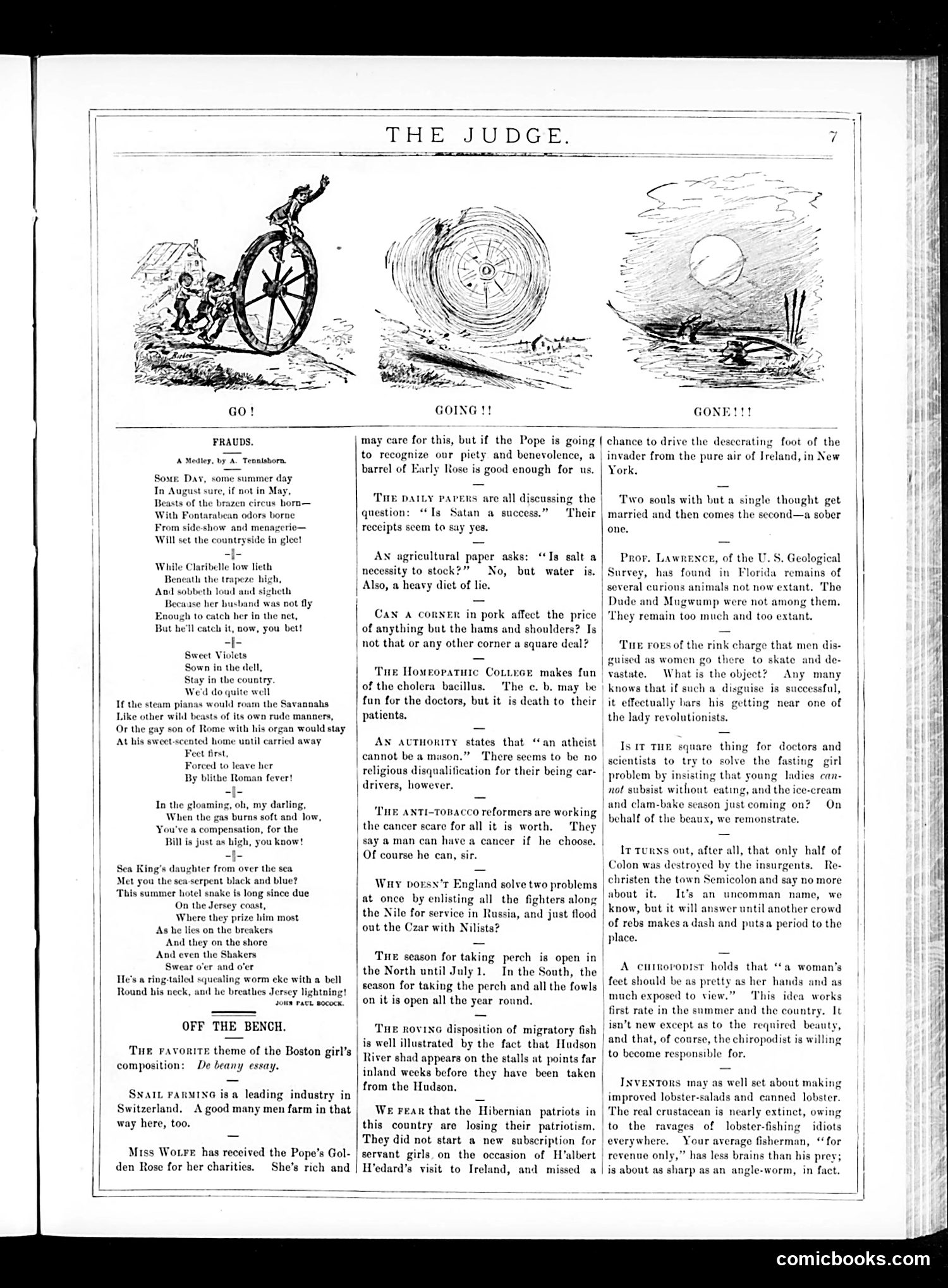
This page from *Judge* magazine contains satirical commentary on contemporary issues rather than political cartoons. The three small illustrations at the top ("Go! Going!! Gone!!!") appear to depict a circus or carnival scene in progressive stages of departure. The text consists of humorous short takes on various topics: - **"Frauds"** is a poem mocking traveling circuses and their noise - Items mock minor absurdities: whether salt is necessary for livestock, a homeopathic college's claims, atheists as Masons - References to Irish patriotism suggest mockery of Irish-American organizations raising funds for Ireland - Jabs at anti-tobacco reformers, England's colonial problems, and seasonal perch-fishing - Criticism of women disguising themselves as men at skating rinks The satire targets small hypocrisies and social foolishness rather than major political figures. Most items are brief, sardonic observations on fads, reformers, and everyday contradictions—typical of *Judge*'s general satirical approach during this period.
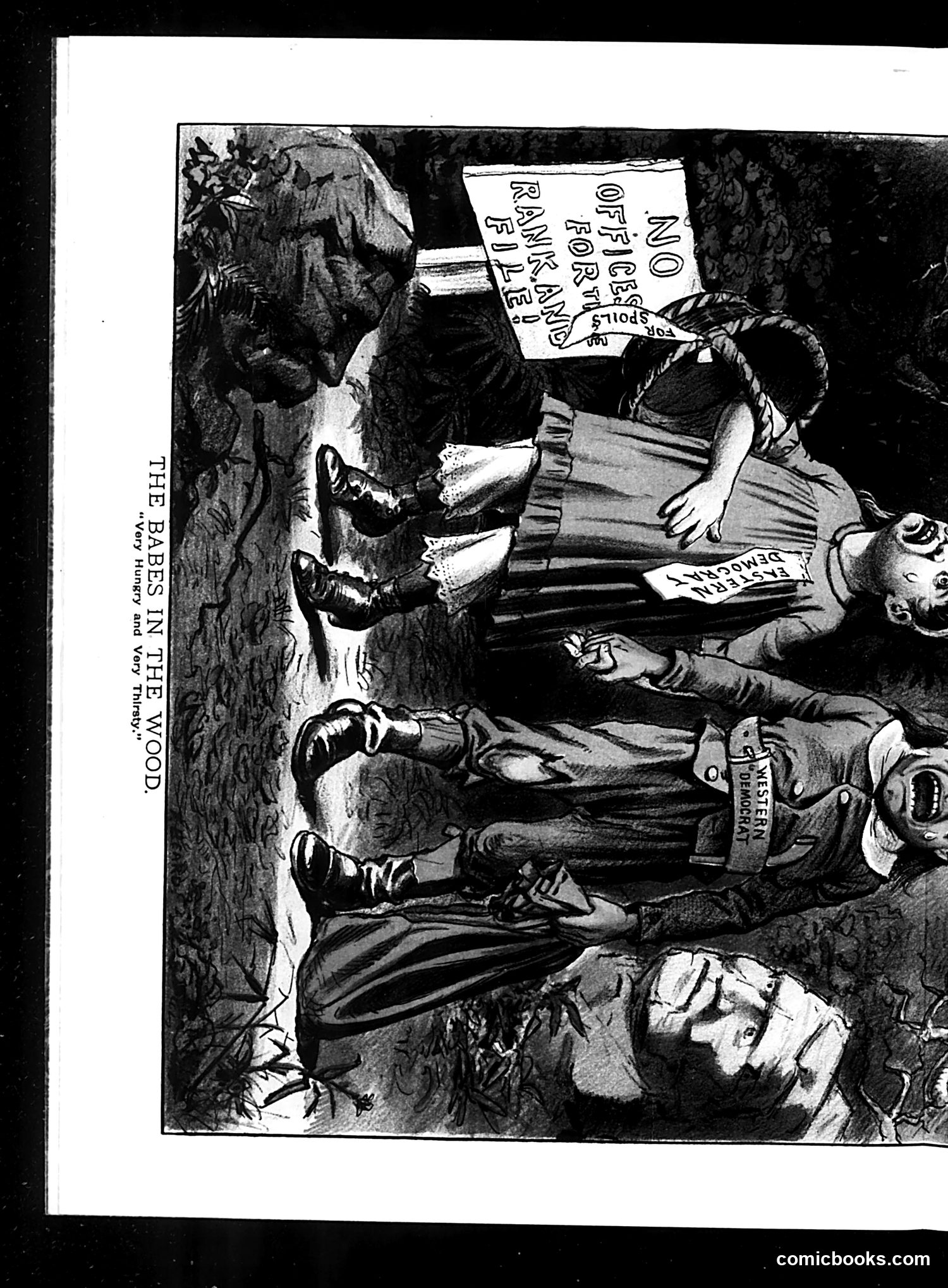
This appears to be a Judge magazine satirical illustration showing children holding a sign that reads "NO OFFICE FOR SPOILS" and "RANK AND FILE" with additional text about office positions. The image depicts what seems to be young figures in a woodland setting, likely representing political commentary on patronage and spoils system politics—a major 19th-century reform issue. The satire appears to criticize the practice of distributing government jobs as political rewards ("spoils") rather than based on merit. The children holding protest signs suggest innocence or idealism confronting a corrupt system. However, without clearer visibility of specific caricatures or identifiable political figures, I cannot definitively identify which particular politicians or events this references. The title "The Babies in the Wood" likely uses the classic fairy tale as a metaphor for naive figures exposed to danger.
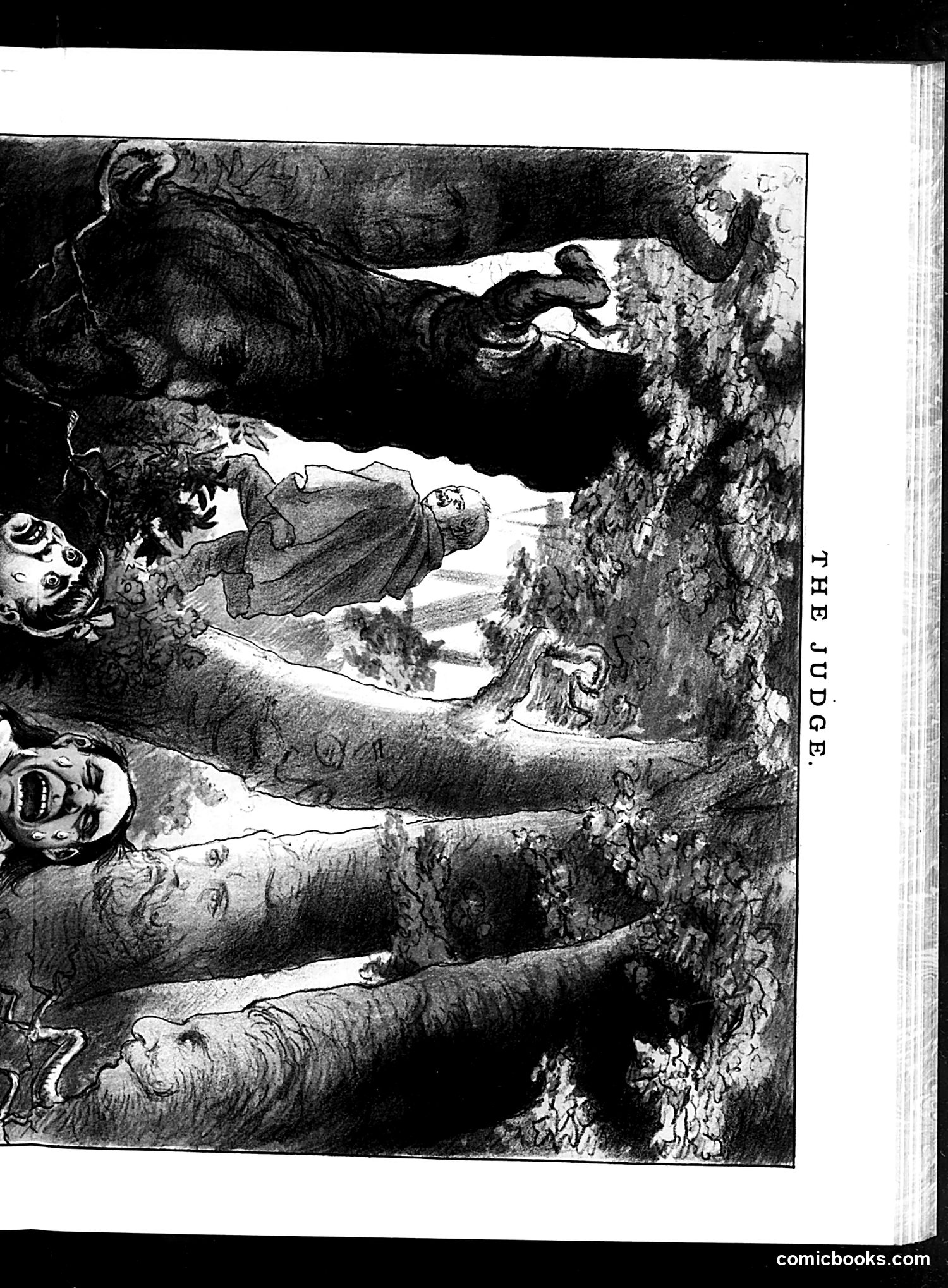
This is a satirical illustration titled "THE JUDGE," though the OCR text is too corrupted to extract meaningful content. The image appears to be a social or political cartoon depicting multiple figures in what looks like a cave or underground setting, rendered in dramatic black and white. The composition suggests a judgment scene or allegory—possibly referencing Plato's Cave or a similar philosophical/moral concept about perception and truth. Without clearer text or additional context about the publication date, I cannot identify the specific figures or determine what contemporary political/social issues this cartoon addressed. The artistic style and printing quality suggest late 19th or early 20th century origin, but the specific satirical target remains unclear from this page alone.
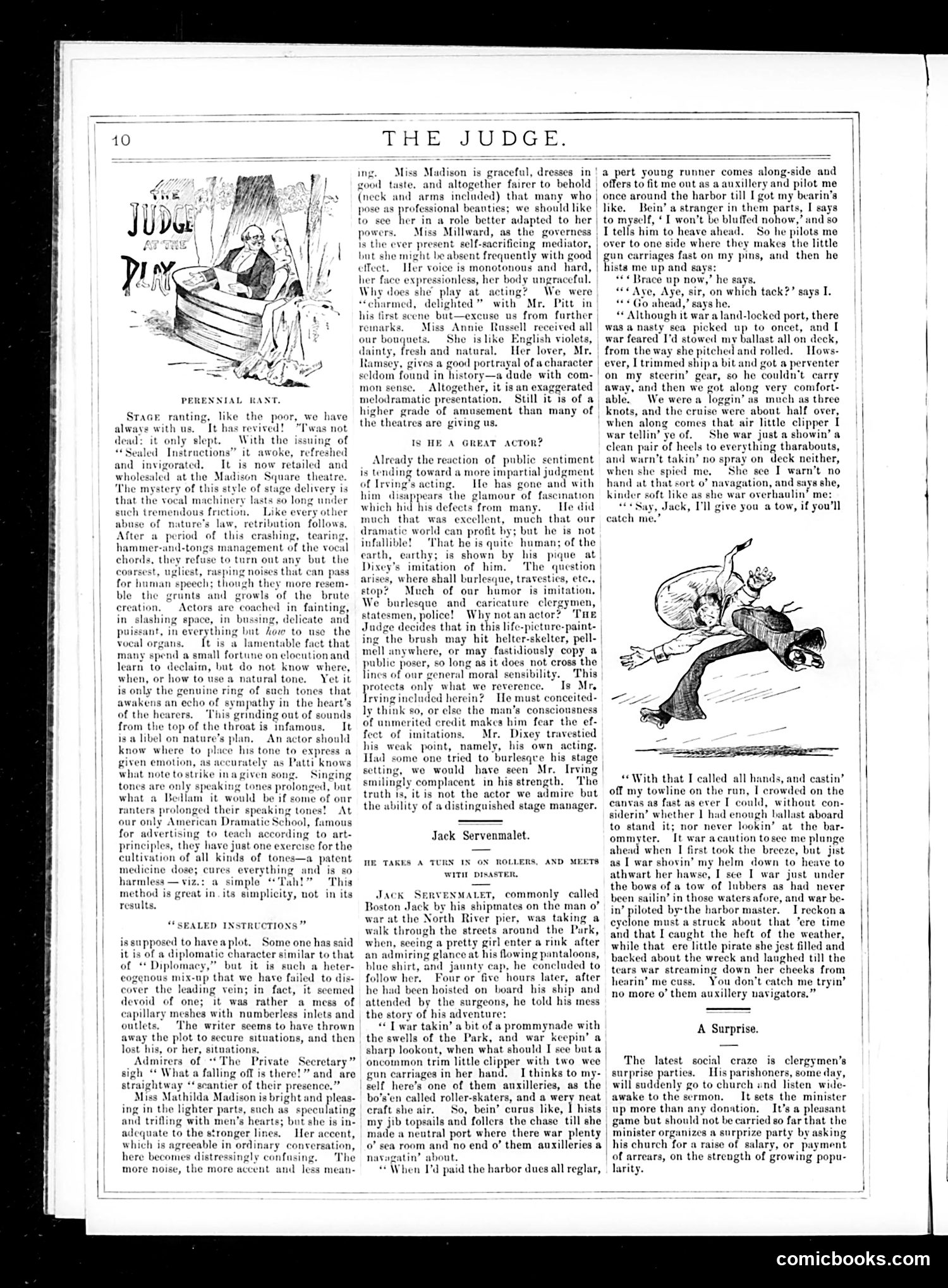
This page from *Judge* magazine contains theater criticism of the play "Sealed Instructions" at Madison Square Theatre. The main article critiques the production and its cast, particularly attacking the acting style of "ranting"—excessive, emotional vocal delivery that damages performers' voices. The cartoon (top left, titled "Perennial Rant") illustrates this theatrical excess through exaggerated caricature. The critic argues this style is harmful and unnatural, contrasting it with proper training. He praises actress Annie Russell while criticizing others like Miss Madison and Miss Millward for inadequate performances. A secondary item, "Jack Seryeymalet," describes a humorous incident involving Boston Jack and a young woman at a harbor—lighthearted social commentary typical of *Judge's* humor section. The satire targets both theatrical pretension and poor acting technique—mocking performers who substitute noise and melodrama for genuine skill and vocal control.
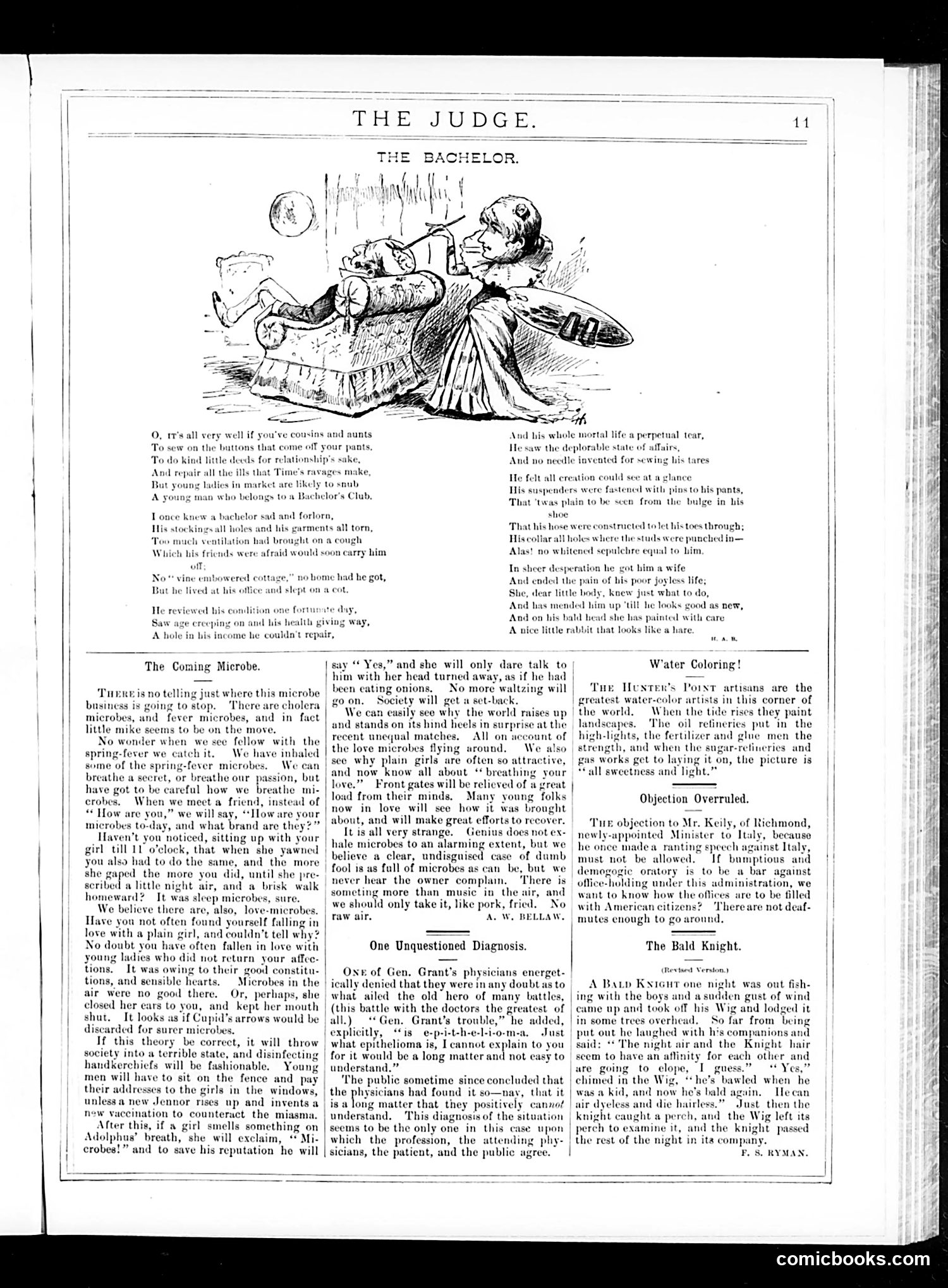
**The Main Cartoon:** Depicts a disheveled bachelor being attended to by a woman (likely his wife or caretaker). He's shown in a sorry state—torn clothing, holes in his stockings—lounging passively while she works to restore him. **The Satire's Point:** The accompanying poem mocks unmarried men's incompetence at self-care. The bachelor lives miserably in his office on a cot, his health deteriorating, until marriage "saves" him. His wife mends his clothes and even paints a decorative rabbit on his bald head—suggesting both the absurdity of her remedial efforts and the comic transformation marriage supposedly provides. **Social Context:** This reflects Victorian-era attitudes about bachelor life as inherently pathetic and incomplete, and marriage (specifically a wife's domestic labor) as the solution to male dysfunction. The humor targets both the incompetent bachelor and perhaps also the sentimental notion that women exist to fix broken men.
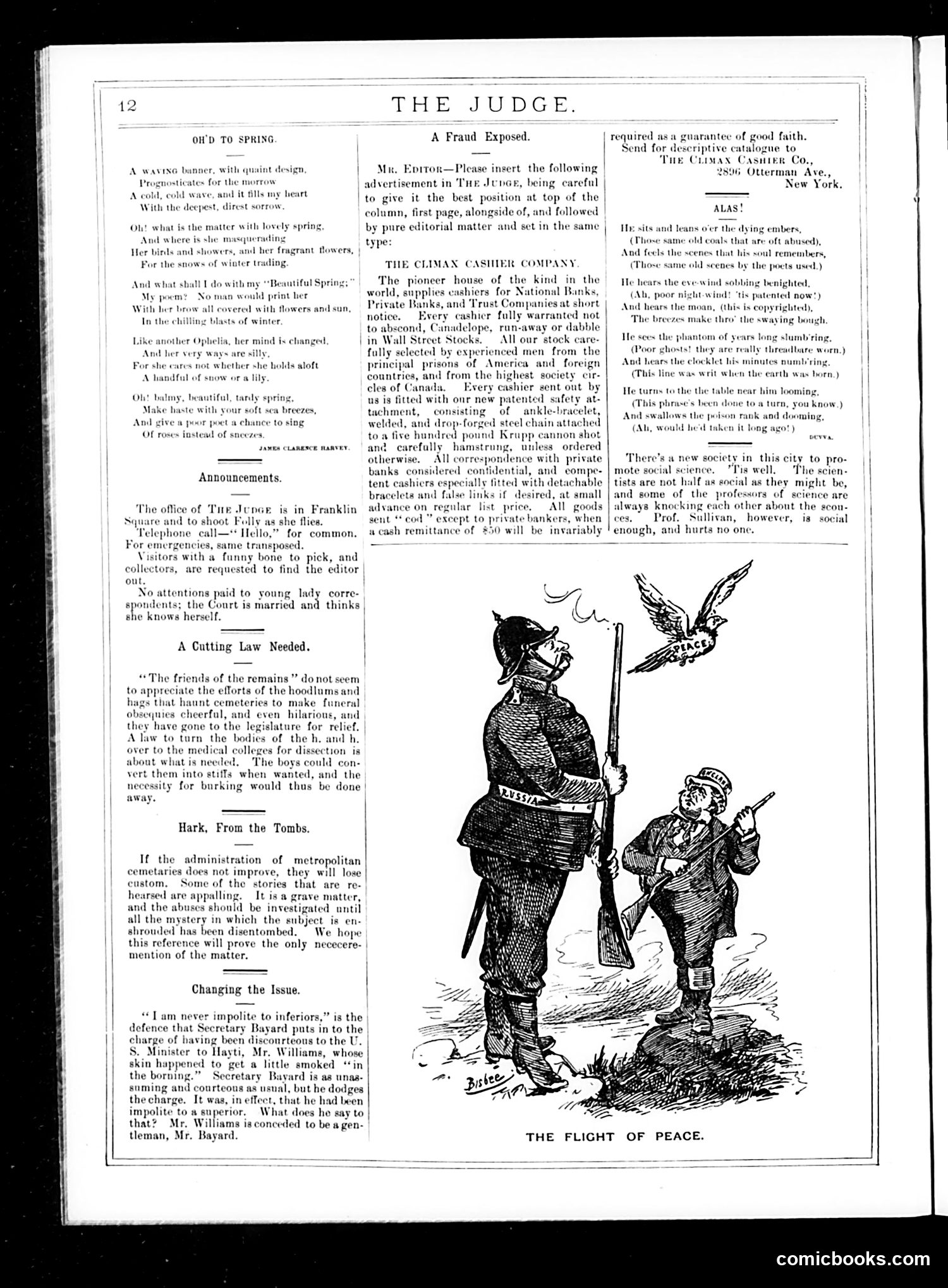
This cartoon depicts a military officer and a smaller soldier/figure shooting at a dove (representing peace), with the dove fleeing upward. The image satirizes militaristic attitudes and the failure to maintain peace. The page also contains a satirical advertisement for "The Climax Cashier Company," which mock-advertises bank cashiers sourced from prisons and foreign countries, fitted with shackles and cannons. This exposes fraud and incompetence in banking—likely referencing real embezzlement scandals of the era when bank cashiers absconded with funds. Additionally, there's political commentary on Secretary of State Bayard's handling of a dispute with the U.S. Minister to Haiti (Mr. Williams), accusing Bayard of dodging accusations of discourtesy by reframing the issue. The piece suggests political evasion and changing the subject rather than addressing substantive diplomatic failures. The overall page critiques military aggression, banking corruption, and political dishonesty.
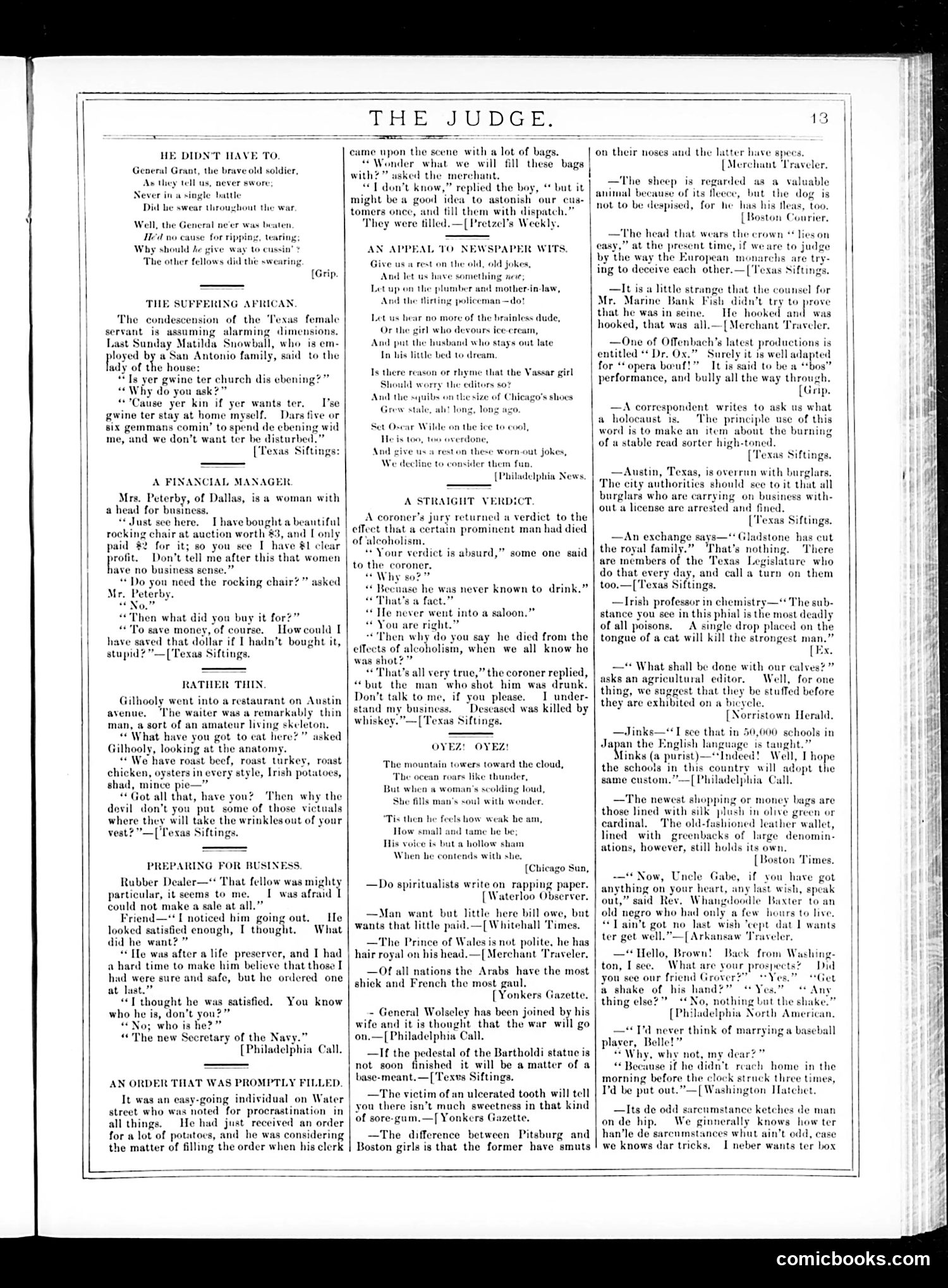
This page contains several short satirical pieces typical of late 19th-century American humor magazines: **"A Financial Manager"** mocks women's business acumen through a Dallas woman who bought a $3 rocking chair for $2, claiming a "$1 profit" by preventing herself from spending that dollar—circular logic presented as female financial wisdom. **"The Suffering African"** reproduces a stereotypical dialect piece where a Black servant named Matilda requests the evening off to entertain "gentlemen," played for comic effect through exaggerated speech patterns. **"Rather Thin"** jokes about a skeletal waiter's appearance. **"A Straight Verdict"** satirizes legal absurdity: a coroner rules a man died of alcoholism despite never drinking or visiting saloons—because the man who shot him was drunk, therefore the victim "died by whiskey." The page reflects Judge's satirical approach: mocking business incompetence, displaying casual racial stereotypes common to the era, and skewering legal/bureaucratic illogic. The humor relies on wordplay, exaggeration, and period assumptions about gender and race that modern readers would find offensive.
This page from **Judge** magazine is primarily an **advertising and humor collection** rather than a coherent political cartoon. It contains: **Content:** - Short humorous anecdotes attributed to regional sources (Arkansaw Traveler, Norristown Herald, Detroit Free Press)—folksy jokes about marriage, drunkenness, and social awkwardness - Multiple patent medicine advertisements (Brown's Iron Bitters, Dr. Pierce's Favorite Prescription, Duffy's Malt Whiskey, Hay-Fever Cream Balm)—typical late 19th-century quack remedies **Social Context:** These remedies promised cures for vague ailments (weakness, consumption, backaches) without scientific basis. The humor pieces reflect period attitudes: marital friction, excessive drinking played for laughs, and women's domestic roles. **No clear political satire** is visible. The page exemplifies how Judge mixed satirical commentary with commercial advertising, relying on readers' familiarity with regional dialect humor and contemporary medical frauds.
This page is primarily **advertisements and filler material** rather than political satire. The main column contains brief humorous anecdotes labeled "THE JUDGE"—scattered jokes rather than a unified cartoon. The few jokes present are mild social observations: one mocks a Galveston doctor's complaint about lack of monuments (implying doctors aren't honored like statesmen), another makes gentle fun of Phil Armour the pork magnate (suggesting an "Armour in hogs" crest), and several rural dialect stories mock rural characters' stubbornness or naïveté. The bulk of the page comprises period advertisements for patent medicines (Pond's Extract, Bird's Custard), pianos, bicycles, and various dubious health products—typical of late 19th-century magazine advertising. **No major political figures or events are caricatured.** This appears to be a lighter editorial section designed mainly to fill space between advertisements rather than deliver pointed satire.
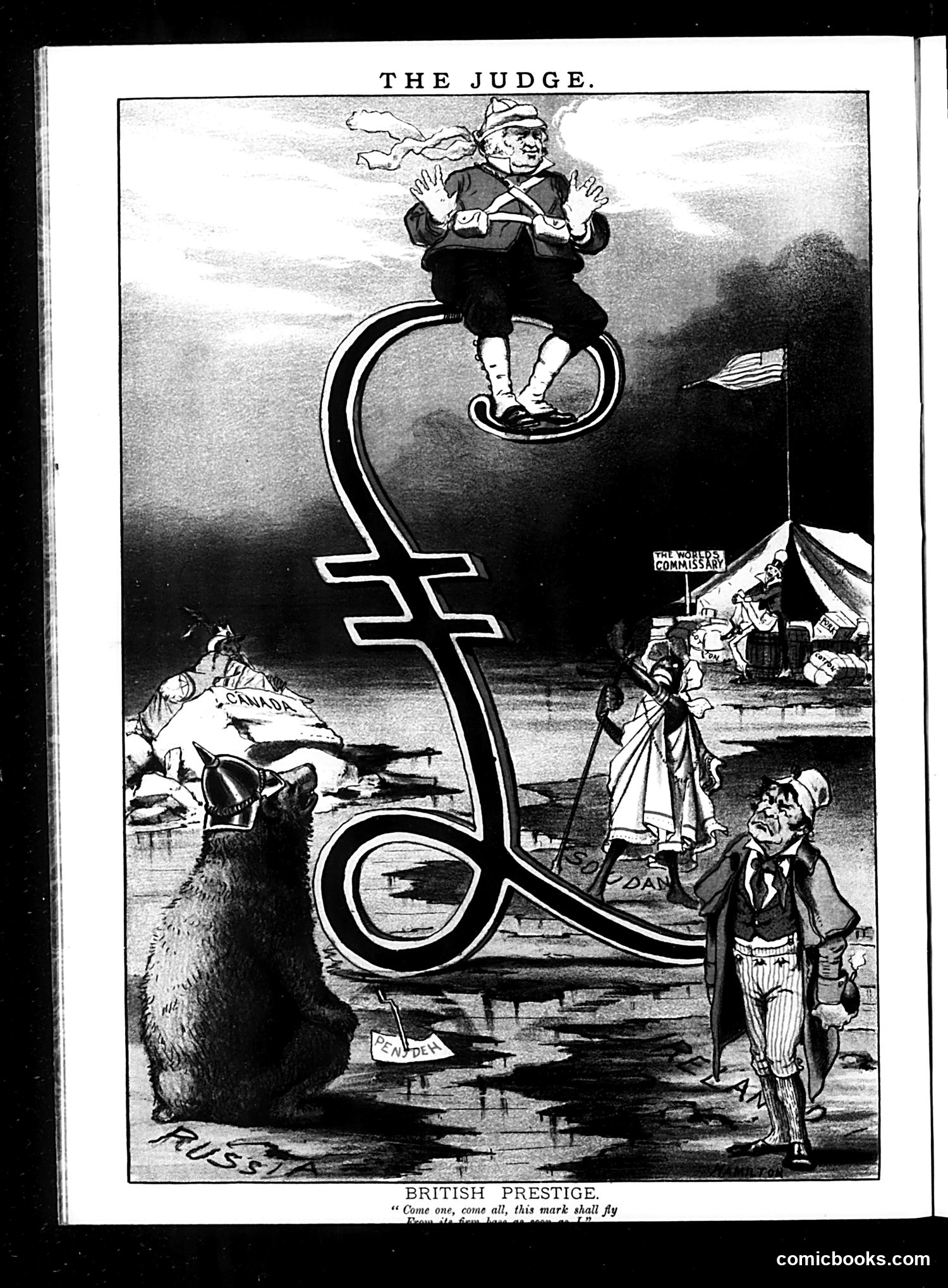
This political cartoon satirizes British imperial authority during what appears to be a military or colonial crisis. A smug British judge balances precariously atop a large question mark—a visual pun suggesting British credibility itself is unstable and questionable. Below, various figures labeled with national identities (including "Canada" visible on the left) observe skeptically. A military commissary tent flies the American flag, suggesting Allied operations or American influence in a British-dominated sphere. The cartoon mocks how Britain's traditional prestige and authority are now dubious, undermined by recent events or military setbacks. The precarious perch and the onlookers' expressions suggest the world no longer automatically accepts British leadership. The quote "this mark shall fly" likely references the British flag, ironically commenting on Britain's ability to maintain its symbolic power.