
A complete issue · 16 pages · 1885
Judge — March 21, 1885
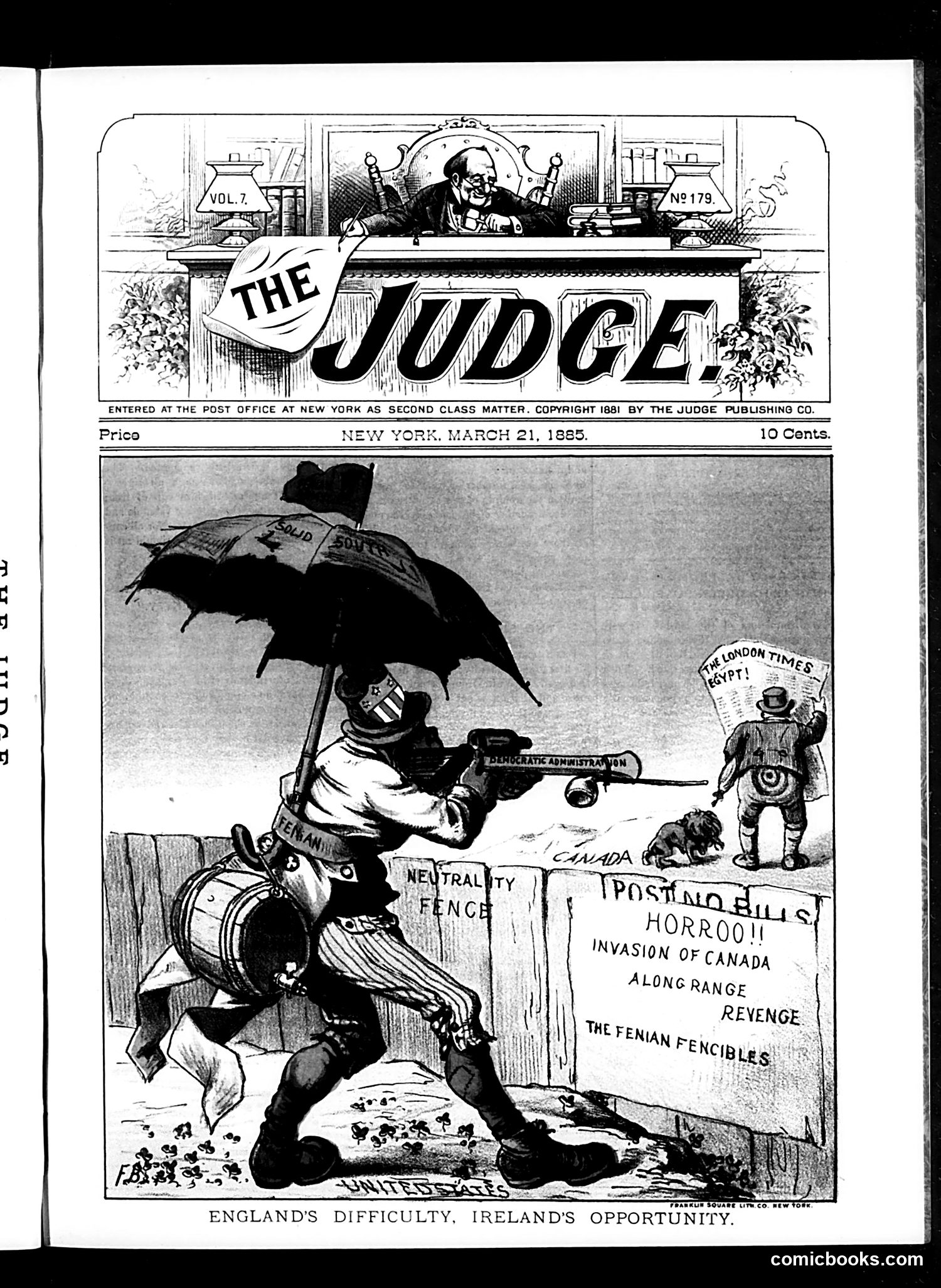
This March 21, 1885 *Judge* cartoon satirizes Anglo-Irish tensions. The central figure represents **Ireland** (labeled), armed with a rifle labeled "Democratic Administration," taking advantage of England's weakness. The "Neutrality Fence" separates Canada from the conflict, while a figure holding "The London Times" watches from the right—representing British media attention to potential Irish-American invasion threats along the Canadian border. The poster references **Fenian Fencibles** (Irish-American nationalist raiders who historically attempted Canadian invasions in the 1860s-70s), suggesting renewed fears of similar attacks. The cartoon implies the Democratic Party's Irish-American support might embolden Irish nationalists toward militant action against British interests, particularly threatening Canada. The satire critiques both American political opportunism and Irish-American radicalism.
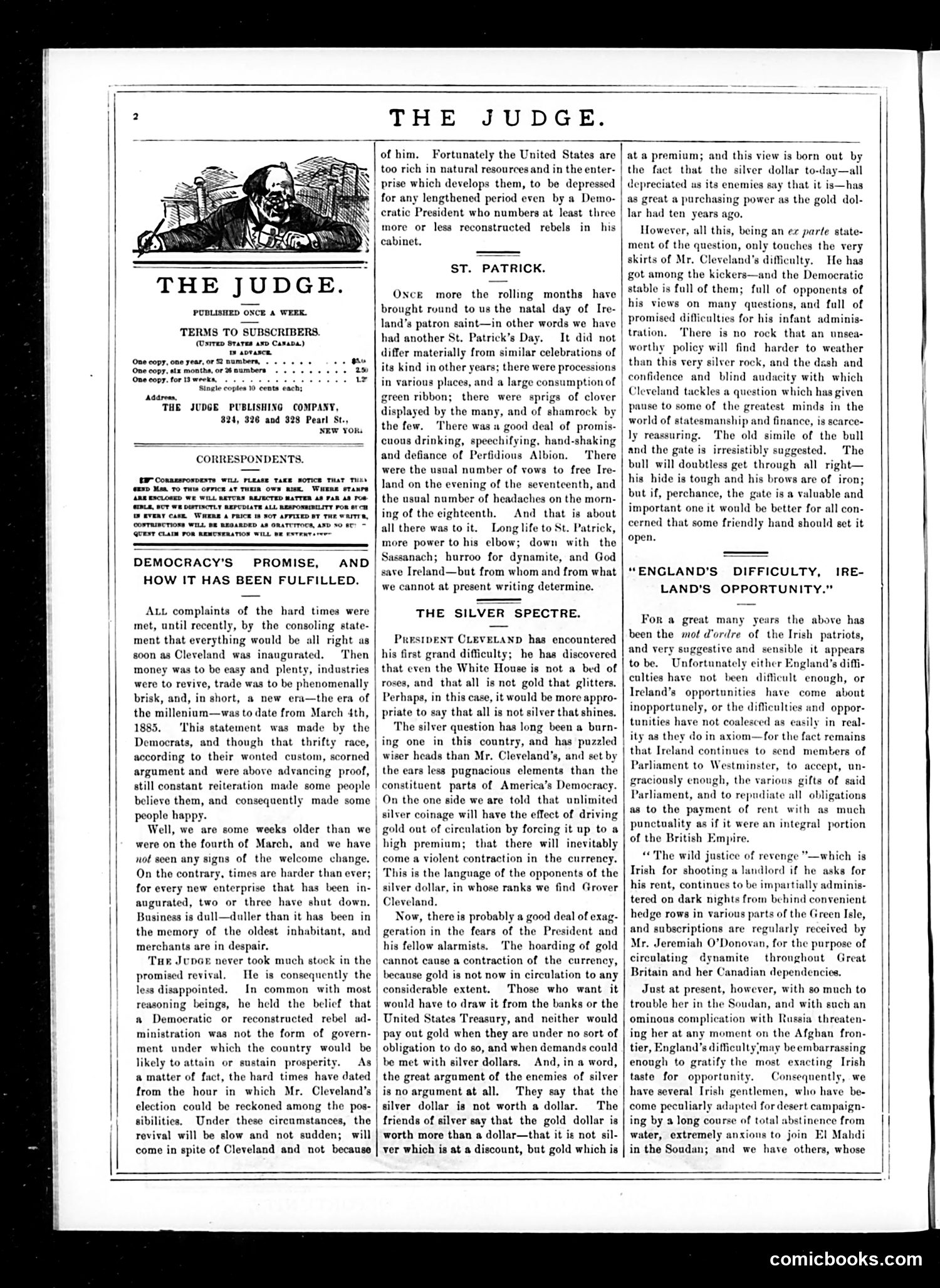
This page from Judge magazine (circa 1885) contains three satirical pieces attacking the Cleveland administration: **"Democracy's Promise"** mocks Democrats' pre-election promises of prosperity under President Grover Cleveland. The piece sarcastically notes that despite Democratic assurances, economic conditions have *worsened* since his March 4th inauguration, with businesses closing rather than thriving. Judge claims it never believed Democratic claims anyway. **"St. Patrick"** humorously describes St. Patrick's Day celebrations—parades, green ribbons, drinking, and vows to "free Ireland"—dismissing them as performative ritual. The closing line cynically notes Irish Americans swear vengeance on "Perfidious Albion" (Britain) but it's unclear from whom aid might actually come. **"The Silver Spectre"** (partially visible) appears to address Cleveland's monetary policy difficulties, particularly silver coinage—a major political controversy of the 1880s. The overall tone is Republican ridicule of Democratic incompetence and empty promises.
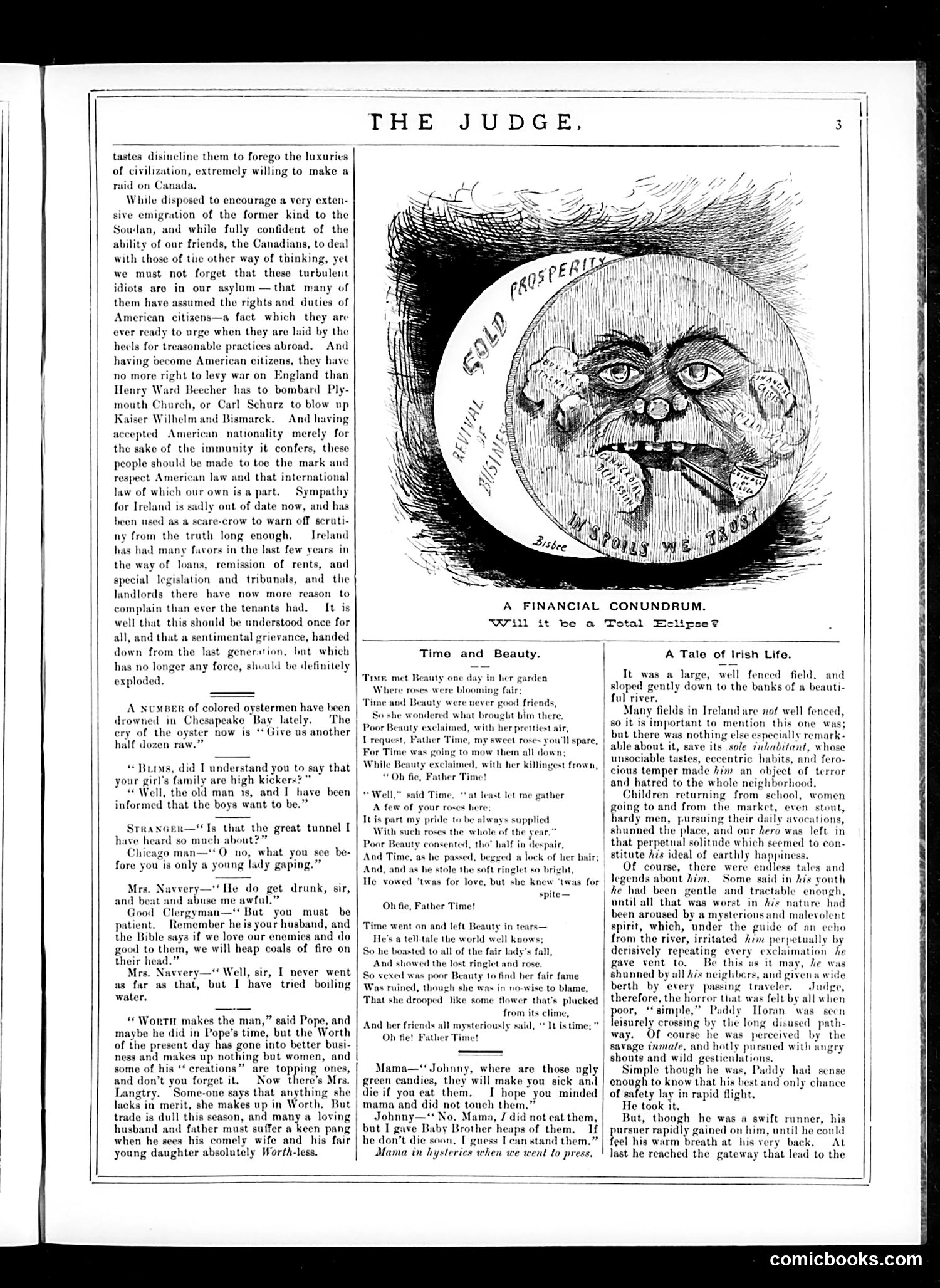
## Main Cartoon: "A Financial Conundrum" The large cartoon depicts a face labeled with financial terms ("Gold," "Prosperity," "Silver," "Bonds We Issue") arranged around distressed facial features. The caption asks "Will it be a Total Eclipse?" This appears to satirize American financial anxiety—likely referencing late 19th-century currency debates between gold and silver standards, or banking/economic crises of the period. The grotesque face suggests economic uncertainty creating public distress. ## Supporting Content The page includes political commentary criticizing Irish-American sympathy for Ireland and Irish immigration. The text argues Irish-Americans shouldn't claim American citizenship protections while supporting anti-British activities. This reflects contemporary nativist tensions. The poetry "Time and Beauty" and assorted short jokes fill remaining space—typical filler content for satirical magazines. **Note:** Without specific dating visible, the exact financial crisis referenced remains unclear, though the gold/silver imagery suggests 1890s-era monetary policy debates.
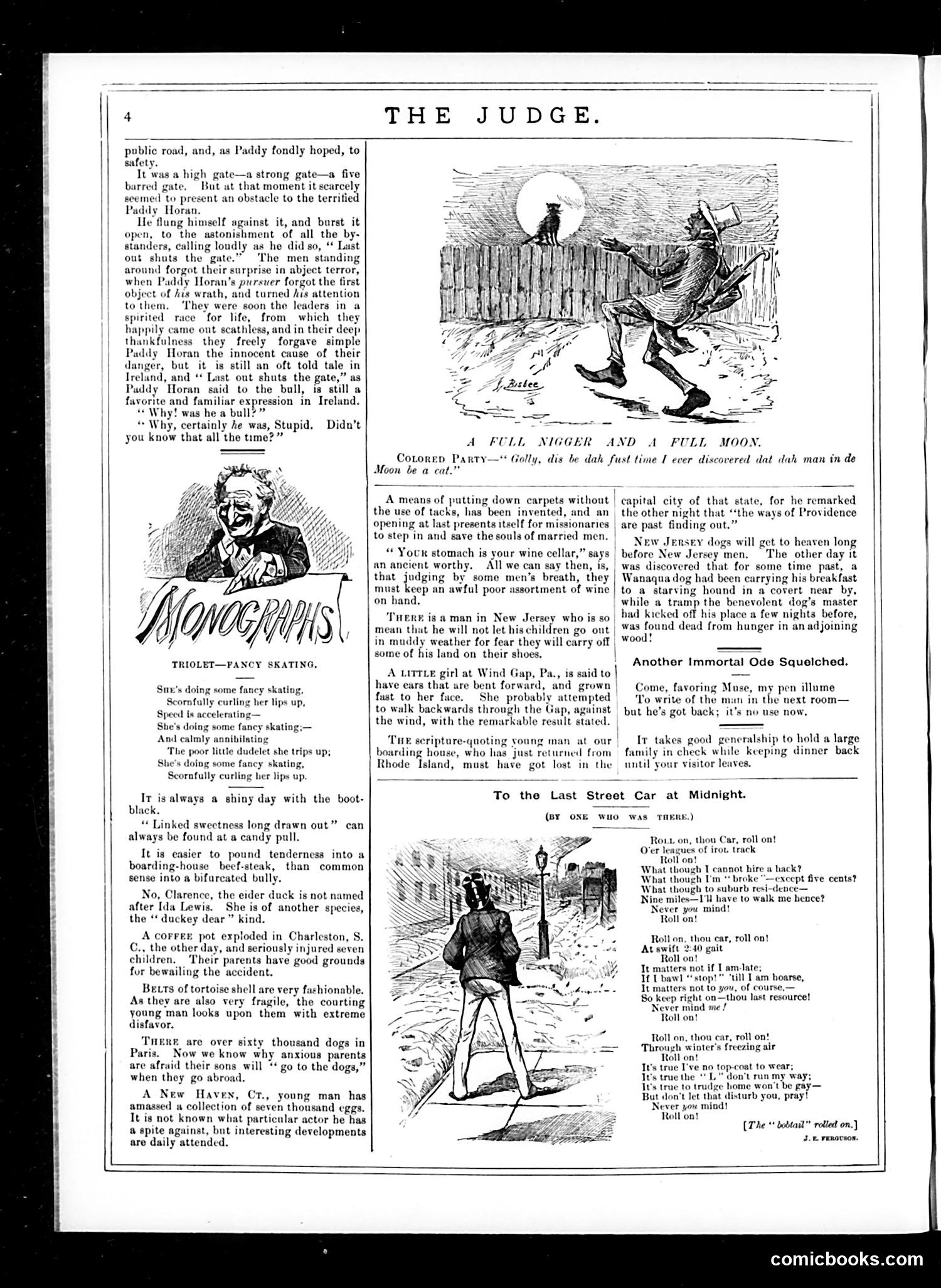
This page contains several satirical pieces typical of 19th-century American humor: **Main Story**: A humorous Irish anecdote about "Paddy Horan" fleeing a bull through a gate. The joke relies on ethnic stereotyping common to the era—portraying Irish immigrants as simple-minded, with characteristic speech patterns and superstitions. **"Monographs" Section**: Brief satirical commentary on contemporary life, including observations about fashion (tortoise-shell belts), urban problems (stray dogs in Paris), and human behavior. These are generic social jokes without specific political targets. **"Triolet—Fancy Skating"**: A poem mocking young women who perform showy ice skating while being unkind to less accomplished peers. **"To the Last Street Car at Midnight"**: A poem about someone rushing to catch the last streetcar, capturing urban transit anxieties. The page lacks overt political satire or identifiable caricatures of specific public figures. Instead, it offers general humor about immigrant stereotypes, social etiquette, and urban life—reflective of Judge's role as entertainment for middle-class readers.
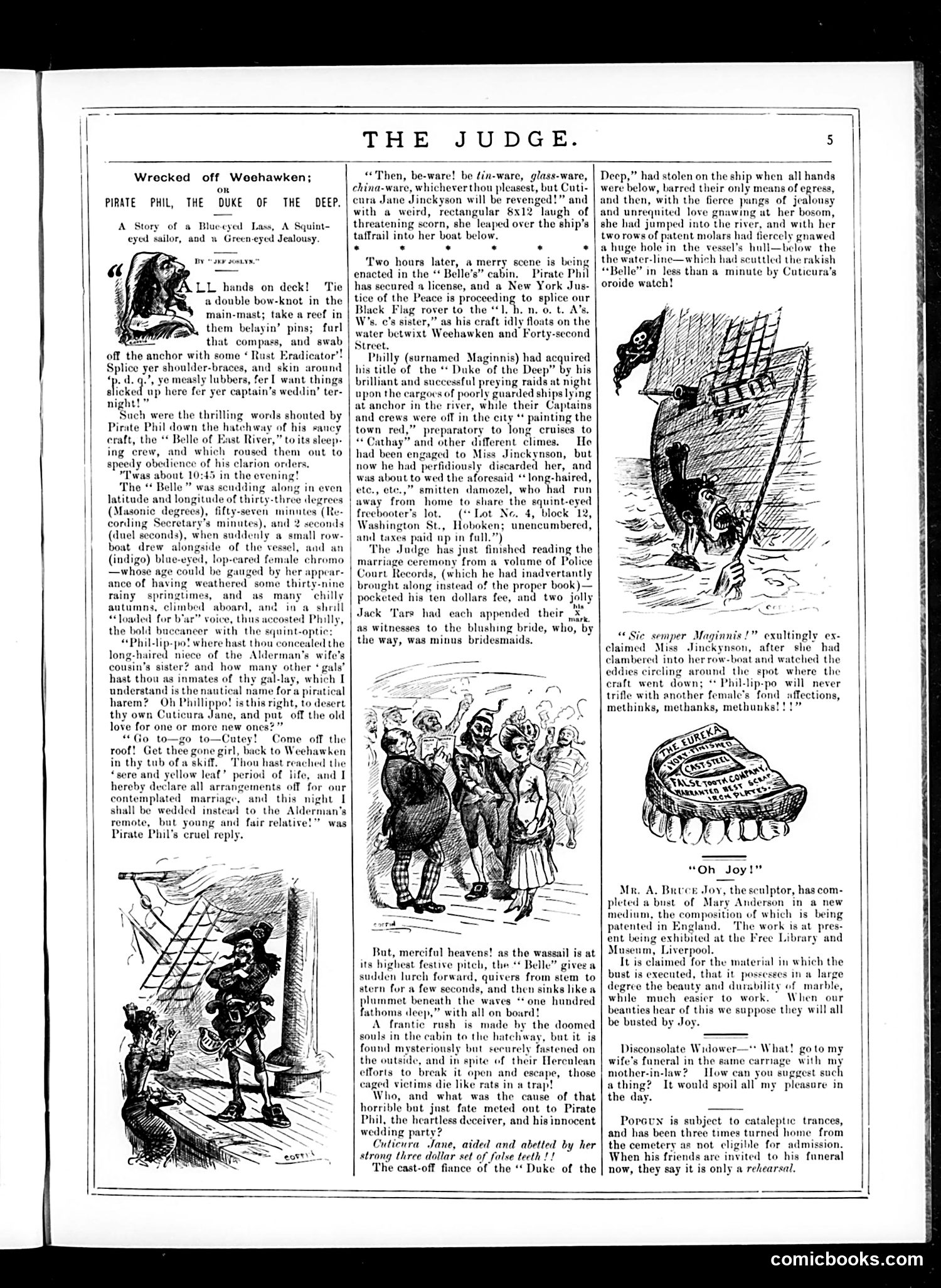
This is a serialized humorous story (not political satire) about a mock-pirate character named Pirate Phil who operates on the East River near New York. The narrative satirizes melodramatic romantic fiction: Phil abandons his aging fiancée Cuticura Jane Jinckson to marry a younger woman, prompting the jilted lover's vengeful threat. The setup parodies overwrought nautical tales with absurd details (coordinates given in "Masonic degrees," a Justice of the Peace conducting the ceremony from Police Court Records). The story appears designed purely for entertainment, poking fun at serialized adventure stories and sentimental romance narratives popular in the era. The illustrations show ship scenes and characters typical of dime-novel illustrations. The satirical target is literary convention itself rather than contemporary politics or social figures.
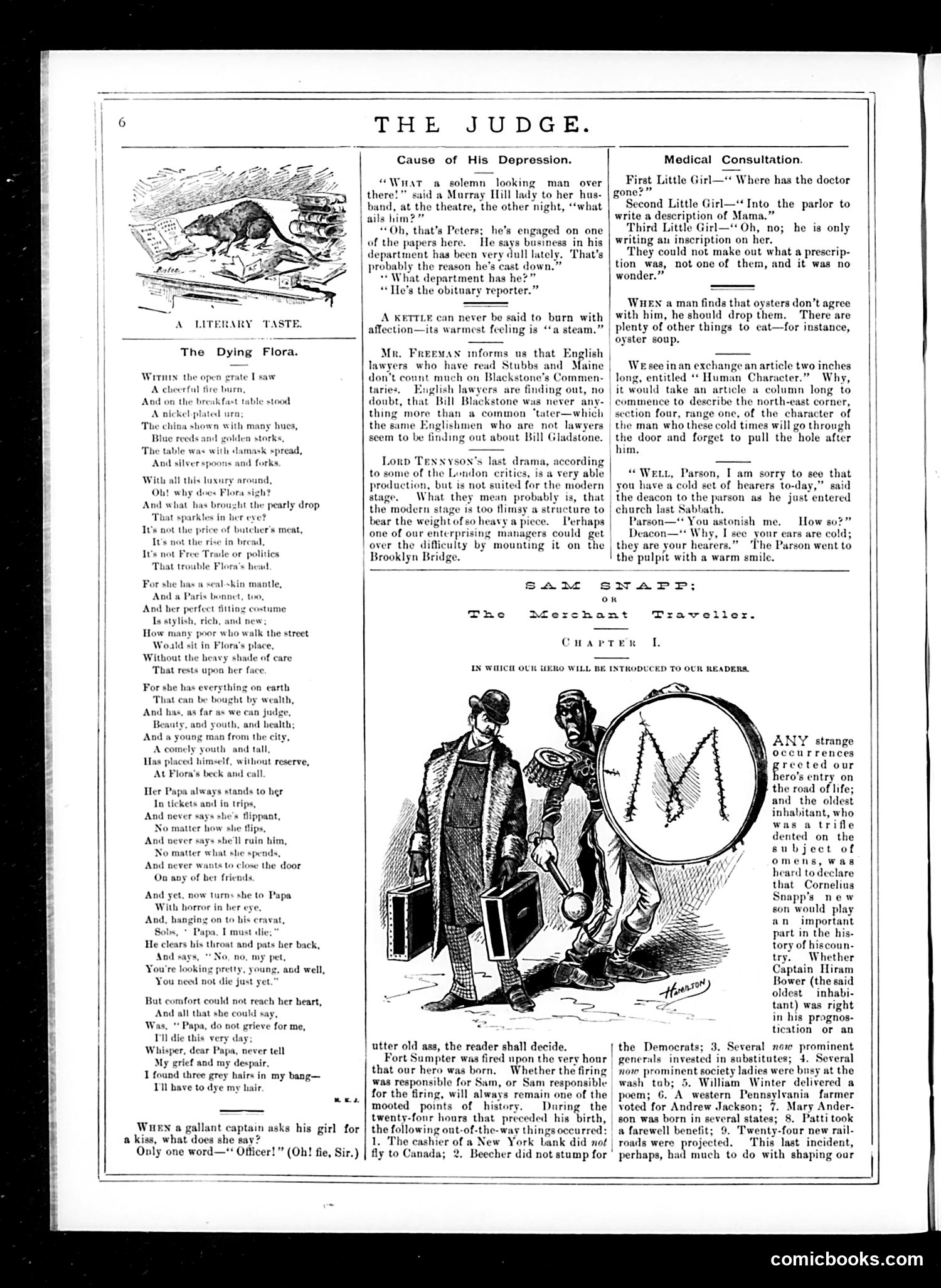
This page from the satirical magazine *Judge* contains several brief humor pieces mocking contemporary American life and society. **"The Dying Flora"** (left column): A lengthy poem satirizing upper-class anxiety. Flora, a wealthy woman with a seal-skin mantle and Paris bonnet, suffers existential despair—but the punchline reveals her crisis is discovering three gray hairs and needing to dye them. The satire mocks the superficiality and vanity of privileged women. **"Cause of His Depression"** (right column): A brief anecdote about a newspaper writer looking melancholy at the theatre. The joke: he works as an obituary reporter, so he's professionally invested in death and decline—a dark joke about journalism. **Other jokes** include wordplay about kettles, British legal scholars, and Lord Tennyson's drama being too "heavy" for modern stages. The **illustration** shows two well-dressed men with travel cases, likely introducing a serialized story "The Merchant Traveller." Overall, this reflects *Judge's* formula: satirizing the wealthy and their pretensions, contemporary literature and law, and general human folly through short quips and illustrations.
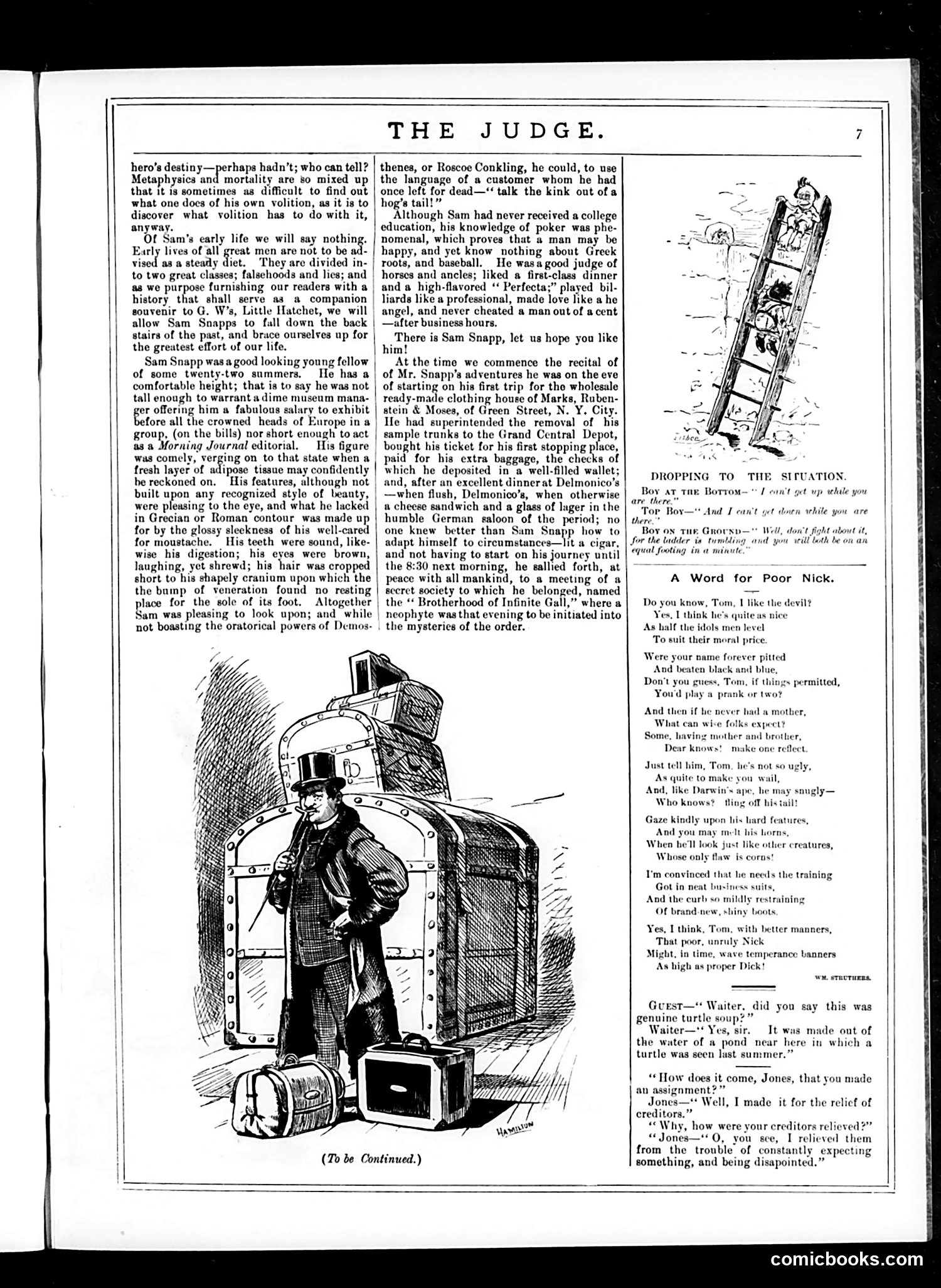
This page contains the opening of a serialized story about "Sam Snapp," a young salesman for a New York clothing company preparing for his first business trip. The text humorously describes Sam's unremarkable but pleasant appearance and character—good-looking, excellent at poker and billiards, able to charm customers despite lacking classical education. The main cartoon shows Sam at a train station with his luggage, departing for work. The small joke at bottom ("Dropping to the Situation") depicts two boys on a ladder—one at top, one climbing up—unable to proceed because the other is in the way, a simple visual pun about being stuck. The page also includes "A Word for Poor Nick," a moralizing poem about a homely boy who needs better manners and training—typical Victorian-era advice poetry. The content reflects Judge magazine's mix of serialized fiction, visual humor, and moral lessons aimed at 19th-century readers.
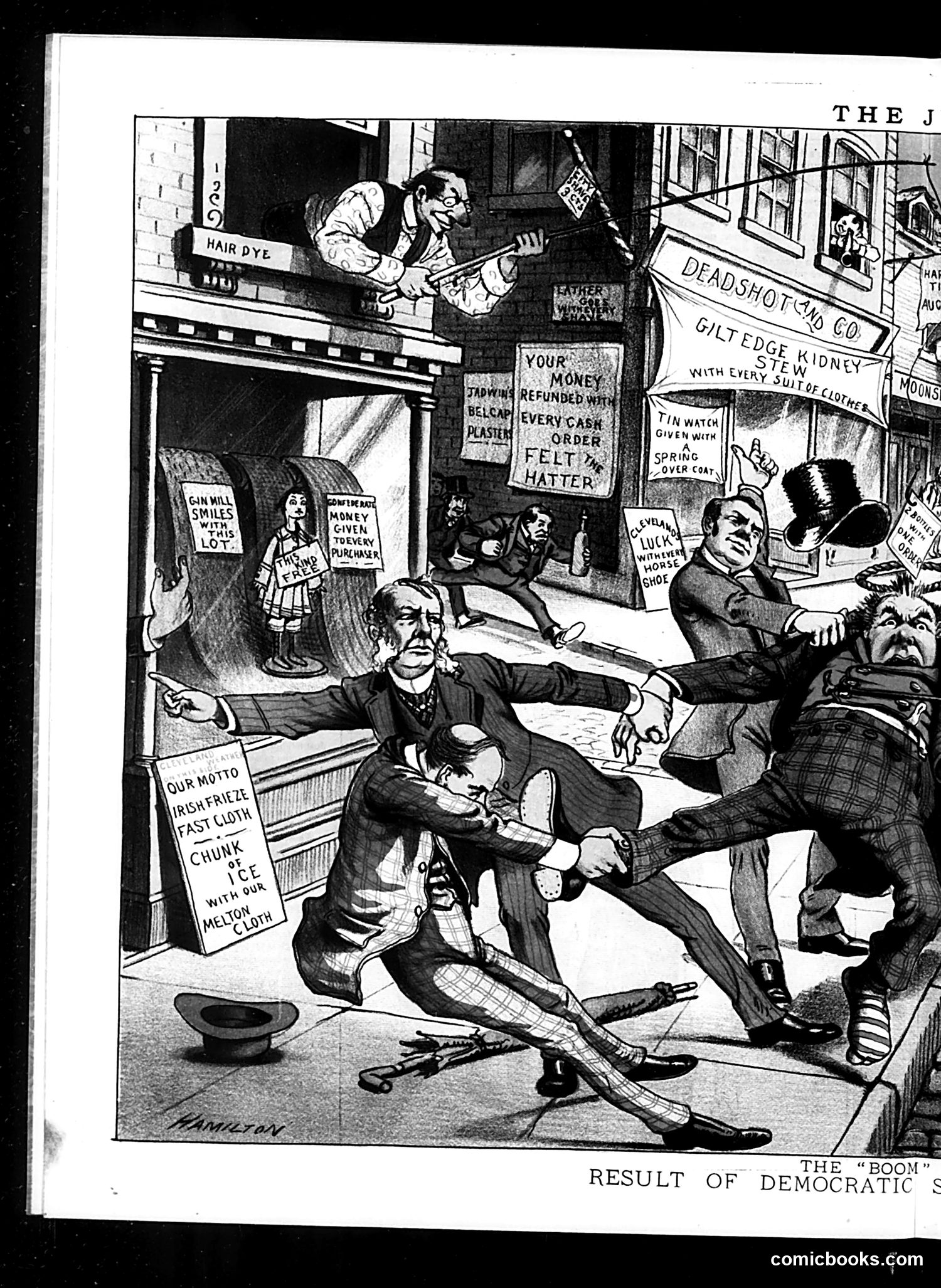
This satirical cartoon from *Judge* magazine depicts the aftermath of a Democratic political "boom"—likely referencing economic prosperity or a political surge during the Democratic party's rise. The title "Result of Democratic &" (text cuts off) suggests commentary on Democratic policies or leadership. The scene shows street-level chaos: well-dressed men engaged in physical conflict over what appears to be money or financial matters, while storefront signs advertise various goods ("Hair Dye," "Deadshot," "Gilt Edge Kidney Stew"). A child and working-class figures populate the street. The cartoon satirizes the gap between promised Democratic prosperity and actual street-level economic struggle, suggesting that while wealthy elites fight over profits, ordinary citizens and children suffer amid continued poverty and vice.
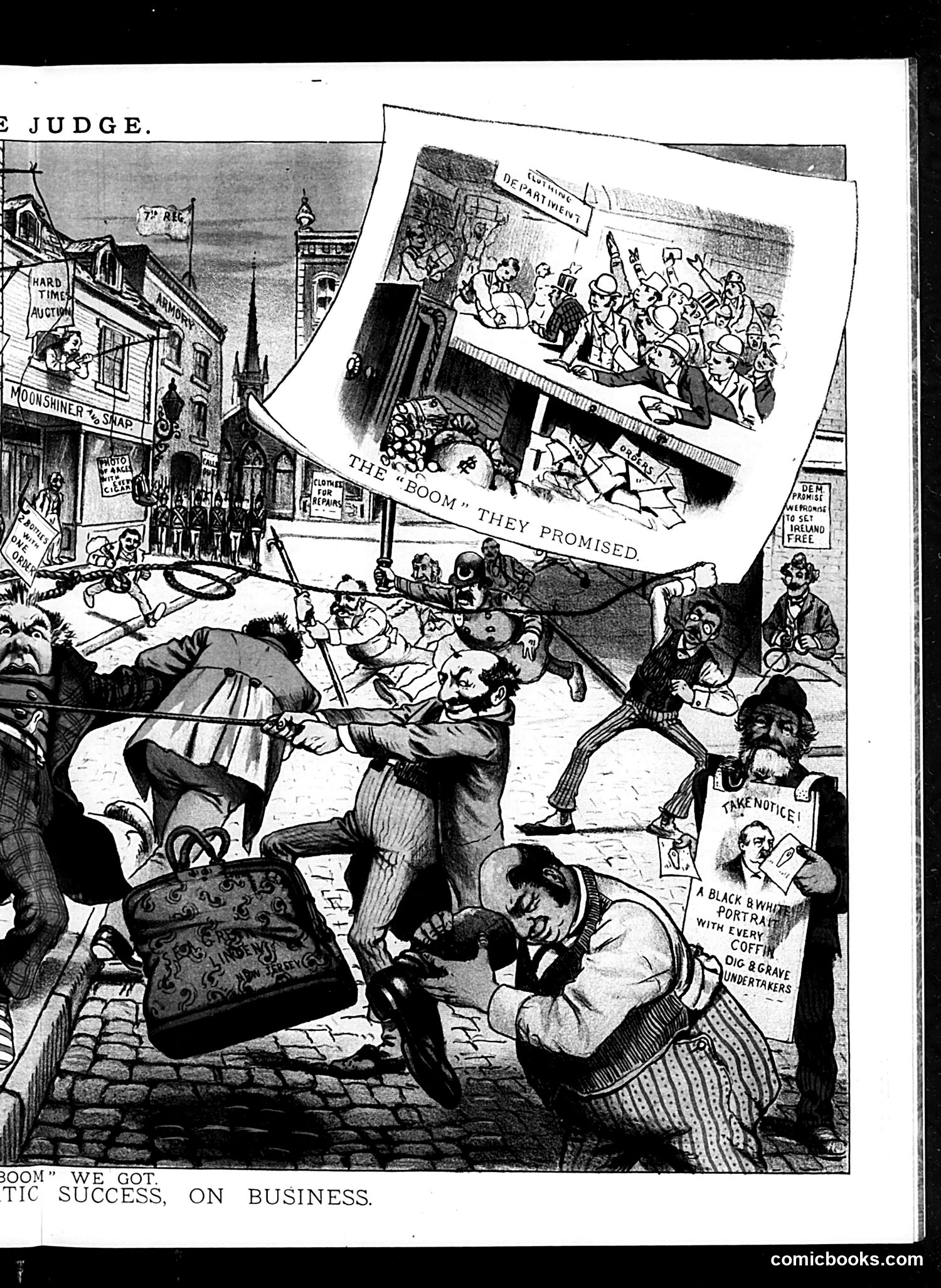
This satirical cartoon depicts chaos and violence in a street scene, with a prominent inset showing what appears to be a political rally or "boom" meeting promising prosperity. The contrast between the promised prosperity (shown in the inset labeled "THE 'BOOM' THEY PROMISED") and the violent street disorder below suggests the cartoon mocks failed political promises of economic success. The street scene shows fighting, theft, and general lawlessness among working-class figures. Shop signs advertising "Hard Times" and "Moonshiner" suggest economic hardship contradicts political rhetoric about business success. The caption "BOOM WE GOT TIC SUCCESS ON BUSINESS" appears sarcastic—claiming politicians delivered prosperity while reality shows social disorder and economic struggle. Without a specific date visible, the exact political figures and context remain unclear, though this appears to critique Gilded Age or Progressive Era political promises about economic booms that didn't materialize for ordinary citizens.
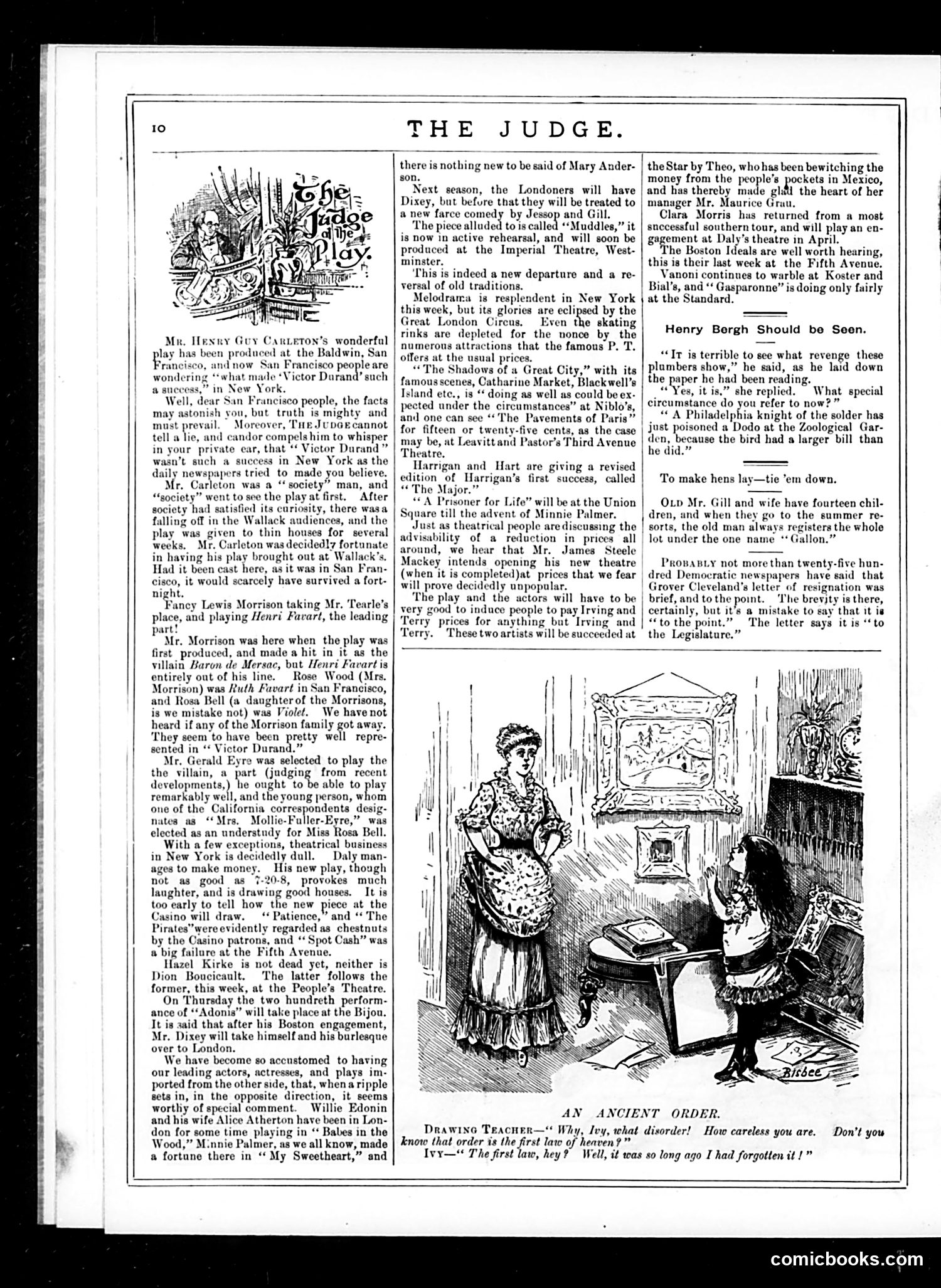
This page's main cartoon depicts a drawing teacher scolding a student named Ivy for disorder and forgetfulness, then revealing she's forgotten the "first law of heaven" from long ago. The joke plays on generational tension and the pretense of refined education—the teacher represents Victorian propriety enforcing classical rules ("order is the first law"), while the student's careless attitude suggests modern irreverence. The humor lies in the ironic gap between the teacher's pompous invocation of eternal principles and the trivial domestic chaos she's addressing. The "ancient order" refers sarcastically to old-fashioned moral and aesthetic rules that the younger generation supposedly ignores. This reflects broader 1880s anxieties about declining respect for tradition among youth, a common satirical theme in *Judge* magazine's social commentary.
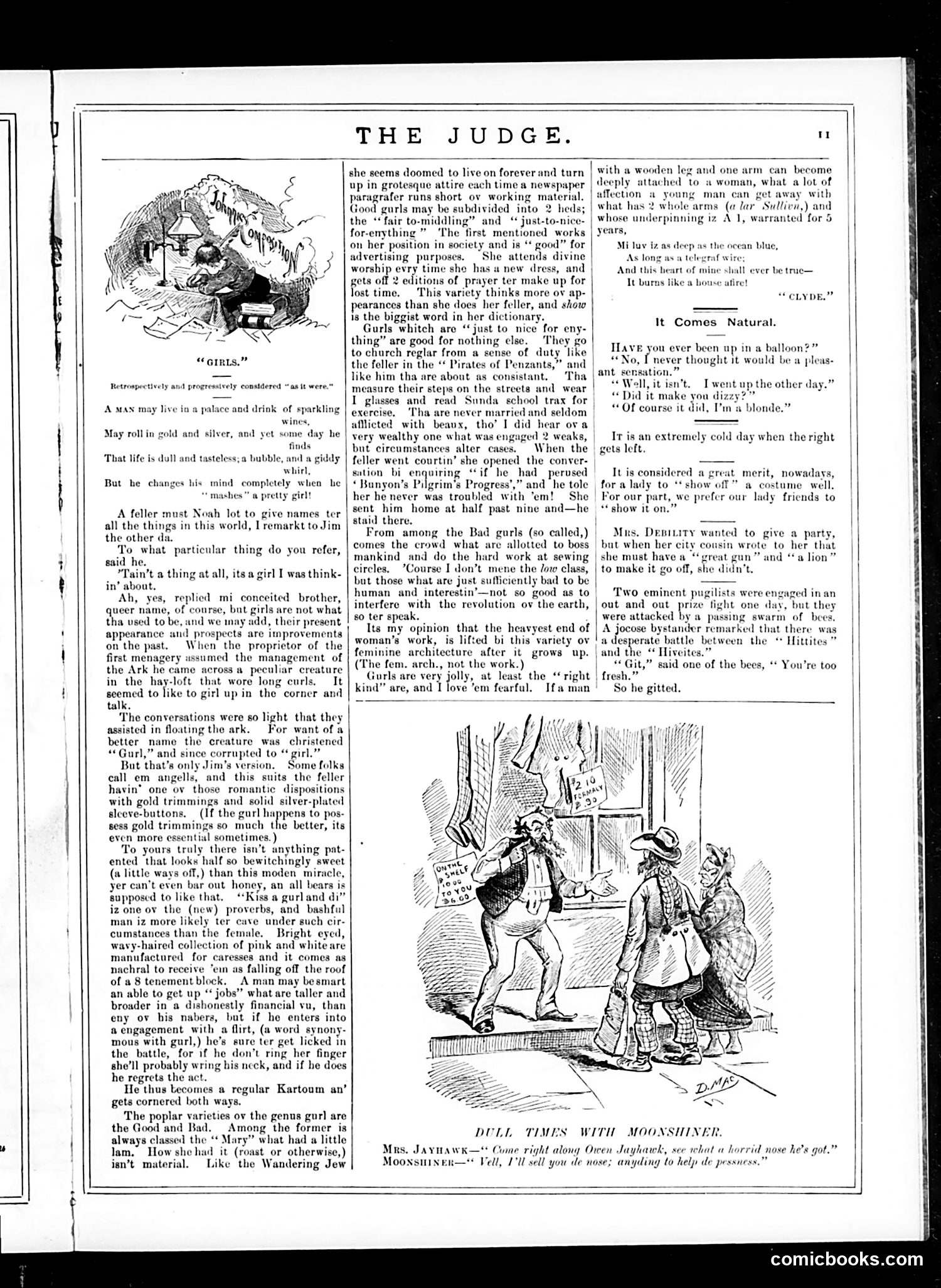
This page contains two distinct humorous pieces satirizing courtship and gender relations in late 19th-century America. **"Girls" (top):** A rambling, dialect-heavy column humorously categorizes women into two types: the socially-conscious "fair to middling" girl obsessed with appearances and church attendance, and the frivolous "just-to-nice-for-anything" girl good for nothing else. The satire mocks both male romanticism about women and female superficiality. The crude language and exaggerated dialectal writing style (common in period humor) suggests working-class male perspective critiquing women's behavior. **"Dull Times with Moonshiner" (bottom cartoon):** The illustration shows a confrontation involving a "moonshiner" (illegal whiskey maker) and a woman. The dialogue references "Owen Jayhawk" and violent retribution, depicting rural Appalachian lawlessness around illegal alcohol production—a recurring social concern of the era. Both pieces employ period-typical stereotyping and crude humor to satirize contemporary social anxieties about gender roles and frontier criminality.
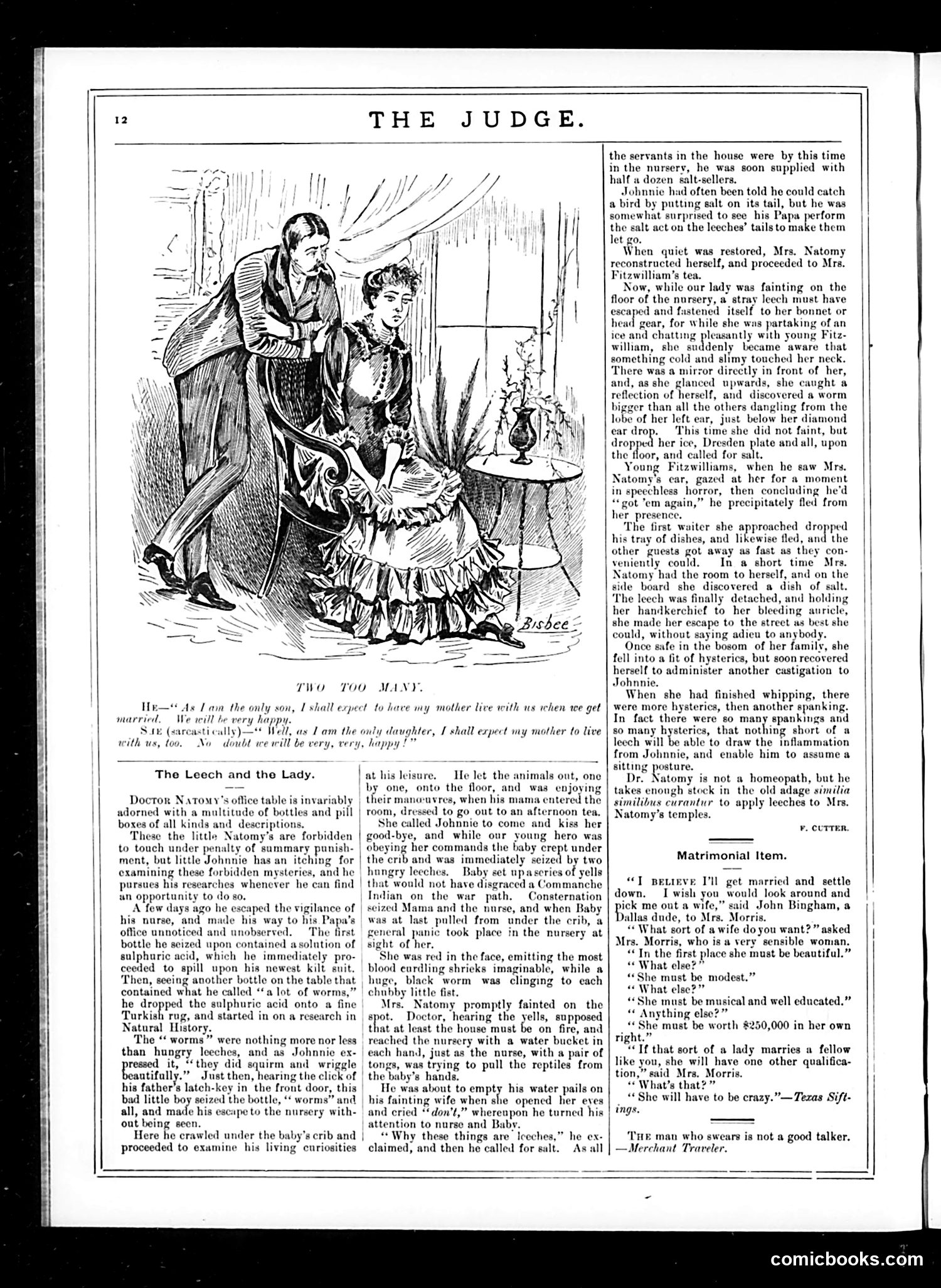
This page contains an illustrated story (not political satire) about Doctor Natomy's mischievous son Johnnie, who finds a bottle of leeches in his father's medical office and releases them in the nursery. When the baby crawls under a crib, leeches attach to her hands, causing panic. The doctor applies salt to make them release—referencing folk wisdom about catching birds by salting their tails. The cartoon shows the chaotic scene: the frantic mother, nurse, and doctor responding to the baby's distress while Johnnie observes from below. The page also includes unrelated humor: a "Two Too Many" domestic joke about a newlywed couple expecting in-laws, and advertisements for matrimonial and general advice columns. This is domestic/family humor typical of *Judge* magazine, not political commentary.
This page is primarily **advertisements and filler humor** typical of Judge magazine's format. The cartoons are minimal; instead, the page contains: **Humor pieces:** Brief jokes mocking contemporary life—a Boston girl confusing "Spitz" dog breed with "Expectoration," a boy preferring fun to the moral tales in Sunday school books, and workplace misunderstandings (a new employee claiming it's "half-past 37 o'clock"). **Testimonials:** A lengthy letter praising Duffy's Malt Whiskey as a cure for hemorrhage—representing the era's widespread patent medicine advertising, often making dubious health claims. **Patent medicine ads:** Brown's Iron Bitters, consumption cures, and pile treatments dominate the page, reflecting 1880s medicine's unregulated marketing of largely ineffective remedies. The satire is gentle and situational rather than political. The page documents how 19th-century magazines mixed journalism with aggressive advertising for dubious medical products.
This page is dominated by a large advertisement for a publisher's "Battle of the Books"—a competitive pricing announcement. The metaphor compares the publisher's price reductions to military victory: they've won a "Waterloo" against competitors by slashing book prices from $8 to as low as $5. The ad highlights reduced-price editions of classic literature across multiple nations: *Froude's History of England*, *Schiller's History of Germany*, *Gibbon's Rome*, and histories of Egypt, Spain, and France. Each section emphasizes how their edition is "really a better edition than the one sold at higher prices." The surrounding content consists of typical Judge magazine humor—brief jokes about marriage, misfortune, and social mishaps—and various business advertisements (pianos, trusses, bicycles, lithography). This reflects late 19th-century publishing wars when competition drove prices down, making literature increasingly accessible to middle-class readers.
This is primarily an **advertising page** from Judge magazine, a satirical weekly publication. Rather than containing editorial cartoons, it showcases period advertisements alongside promotional material for Judge itself. **Notable advertisements:** - **Pond's Extract**: A widely-marketed patent medicine, endorsed by temperance lecturer John Gough, claiming benefits for sore throats and general ailments - **Young's Patent Electric Belts**: Another popular pseudo-medical device - **Duffy's Malt Whiskey**: Ironically claiming to be a health cure for consumption, malaria, and bronchitis—a common contradiction in 19th-century advertising, where alcohol was marketed as medicinal despite temperance advocates opposing it **The satire emerges from context alone**: The page juxtaposes temperance lecturer endorsements with whiskey advertisements, and lists quips about money becoming "cheap as drugs"—highlighting Judge's role mocking fraudulent patent medicines and dubious commercial claims. **For modern readers**: This reflects the chaotic world of pre-FDA regulation, where virtually any product claimed medical benefits without evidence. Judge's readers understood the humor: the magazine satirized exactly these kinds of dubious claims.
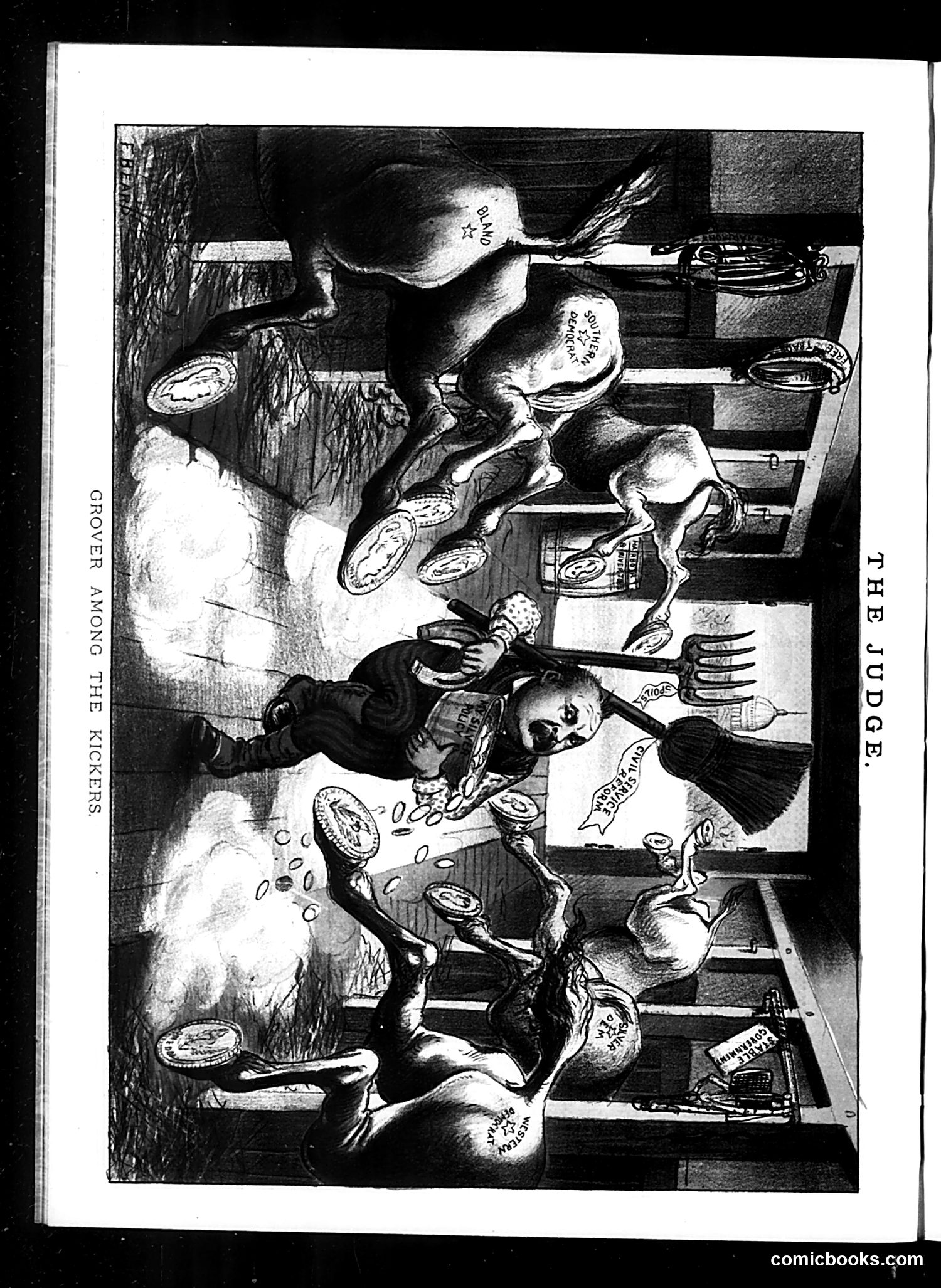
This satirical cartoon titled "The Judge" depicts a courtroom scene where a judicial figure presides over what appears to be anthropomorphized animals or grotesque figures in a trial setting. The caption "Grover Among the Kickers" suggests this references Grover Cleveland (likely during his presidency or political career). The cartoon appears to satirize Cleveland's judicial or executive decisions, with the "kickers" (political opponents or critics) surrounding him in the courtroom. The animals and caricatures likely represent different political factions or interest groups opposing his policies. Without clearer text or additional context visible in the image, the specific political issue being mocked remains unclear, though it evidently critiques Cleveland's handling of some judicial or administrative matter.