
Judge, 1885-03-21 · page 2 of 16
Judge — March 21, 1885 — page 2: what you’re looking at
What you’re looking at
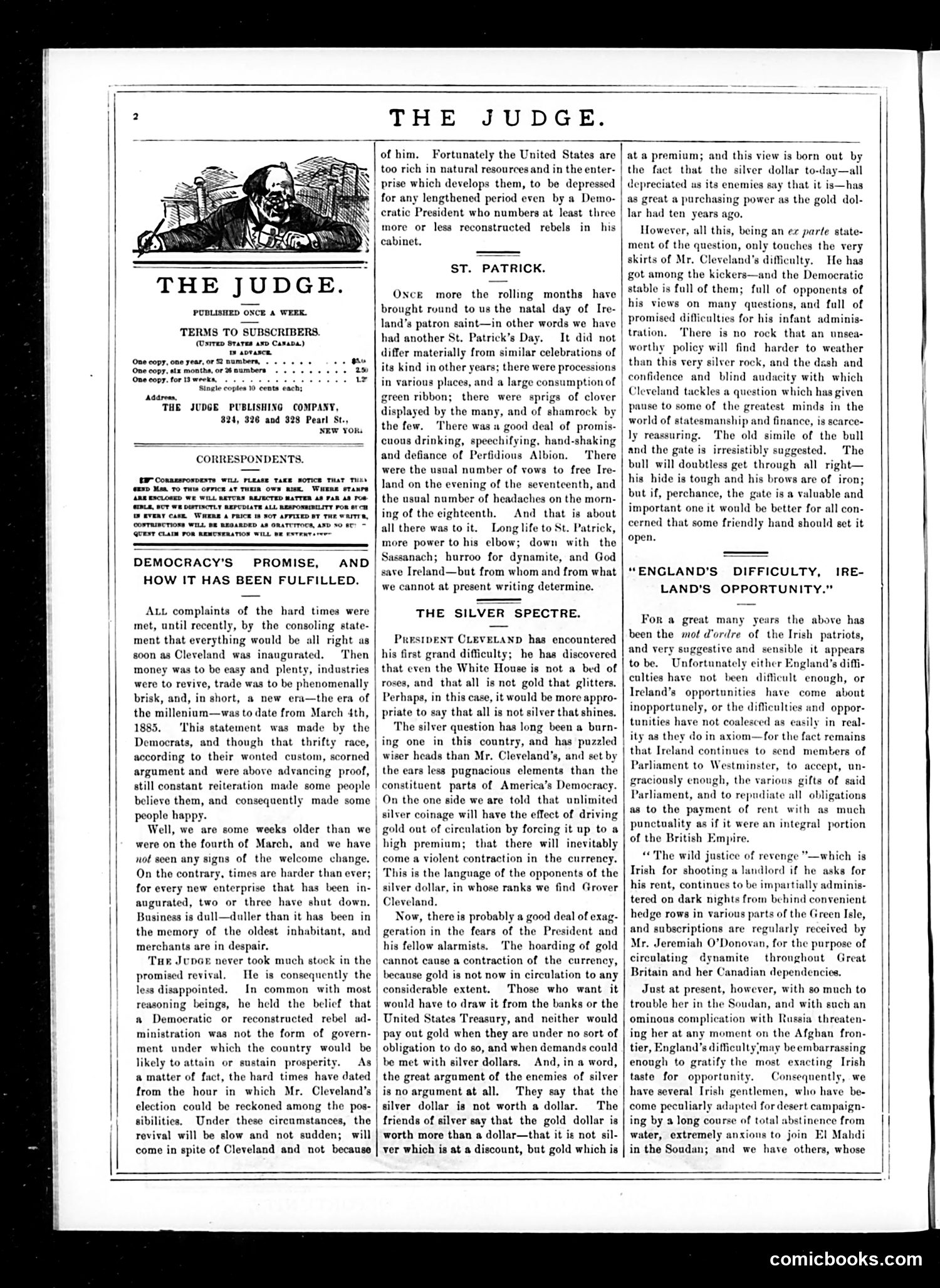
This page from Judge magazine (circa 1885) contains three satirical pieces attacking the Cleveland administration: **"Democracy's Promise"** mocks Democrats' pre-election promises of prosperity under President Grover Cleveland. The piece sarcastically notes that despite Democratic assurances, economic conditions have *worsened* since his March 4th inauguration, with businesses closing rather than thriving. Judge claims it never believed Democratic claims anyway. **"St. Patrick"** humorously describes St. Patrick's Day celebrations—parades, green ribbons, drinking, and vows to "free Ireland"—dismissing them as performative ritual. The closing line cynically notes Irish Americans swear vengeance on "Perfidious Albion" (Britain) but it's unclear from whom aid might actually come. **"The Silver Spectre"** (partially visible) appears to address Cleveland's monetary policy difficulties, particularly silver coinage—a major political controversy of the 1880s. The overall tone is Republican ridicule of Democratic incompetence and empty promises.
📄 Transcribed text from this page (OCR, searchable)
Machine-transcribed from the original scan — historical spelling and the odd misread are preserved.
THE JUDGE. THE JUDGE. PUBLISHED ONCE A WEEK. TERMS TO SUBSCRIBERS. (Onrrep Staves arp Casapa) by ADtAsCR One copy, one year, or 52 numbers, One copy, atx months, or 3 pumbers One copy. for 13 weeks, Single coptes 19 ceata each; Adare, THE JUDGE PUBLISHING COMPANY, 824, 326 and 928 Pearl NEW YOR CORRESPONDENTS. fy ConamsrospEsTs wit. PLEASE TAKE NOTICE THAT TH exxp Maa To Tins orice at THEIR OWN mink. WHERE ST4w ARE ENCLOSED WE WILL RETURN REJECTED MATTER AS FAR AS FO GUL, BUY WE DISTINCTLY REFUDIATE ALL REAFONRIBILITY FOR OCH (EVERY CASE WHERE A PRICE @ ROT AFVIZED BY THE WRITTR, CONTRIRCTIONS WHLL BE REGARDED 48 DEMOCRACY’S PROMISE, HOW IT HAS BEEN FULFILLED. ALL complaints of the hard times were met, until recently, by the consoling state- ment that everything would be all right as soon as Cleveland was inaugurated. Then money was to be easy and plenty, industries were to revive, trade was to be phenomenally brisk, and, in short, a new era—the era of the millenium—was to date from March 4th, 1885. ‘his statement was made by the Democrats, and though that thrifty race, according to their wonted custom, scorned | argument and were above advancing proof, still constant reiteration made some people believe them, and consequently made some people happy. Well, we are some weeks older than we were on the fourth of March, and we have not seen any signs of the welcome change. On the contrary, times are harder than ever; for every new enterprise that has been in- augurated, two or three have shut down. Business is dull—duller than it has been in the memory of the oldest inhabitant, and merchants are in despair. Tur JupGe never took much stock in the promised revival. He is consequently the less disappointed. In common with most reasoning beings, he held the belicf that a Democratic or reconstructed rebel ad- ministration was not the form of govern- ment under which the country would be likely to attain or sustain prosperity As a matter of fact, the hard times have dated | from the hour in which Mr. Cleveland’s election could be reckoned among the pos- sibilities, Under these circumstances, the revival will be slow and not sudden; will come in spite of Cleveland and not because AND of him. too rich in natural resources and in the ente: prise which develops them, to be depressed for any lengthened period even by a Demo- cratic President who numbers at least three more or less reconstructed rebels in his cabinet. ST. PATRICK. Oxce more the rolling months have brought round to us the natal day of Ire- land’s patron saint—in other words we have had another St. Patrick’s Day. It did not differ materially from similar celebrations of its kind in other years; there were processions in various places, and a large consumption of green ribbon; there were sprigs of clover displayed by the many, and of shamrock by | the few. ‘There was u good deal of promis- cuous drinking, speechifying, hand-shaking and defiance of Perfidious Albion. There were the usual number of vows to free Ire- land on the evening of the seventeenth, and the usual number of headaches on the morn- ing of the eighteenth. And that is about all there was to it. Long life to St. Patrick, more power to his elbow; down with the Sassanach; hurroo for dynamite, and God ave Ireland—but from whom and from what we cannot at present writing determine. THE SILVER SPECTRE. PurstpeENT CLEVELAND has encountered his first grand difficulty; he has discovered that even the White House is not a bed of roses, and that all is not gold that glitters. Perhaps, in this case, it would be more appro- priate to that all is not silver that shines. The silver question has long been a burn- ing one in this country, and has puzzled wiser heads than Mr. Cleveland’s, and set by the ears less pugnacious elements than the constituent parts of America’s Democracy. On the one side we are told that unlimited silver coinage will have the effect of driving gold out of circulation by forcing it up to a high premium; that there will inevitably come a violent contraction in the currency. This is the language of the opponents of the silver dollar, in whose ranks we find Grover Cleveland. ow, there is probably a good deal of exag- geration in the fears of the President and his fellow alarmists, The hoarding of gold cannot cause a contraction of the currency, because gold is not now in circulation to any considerable extent. Those who want it would have to draw it from the banks or the United States Treasury, and neither would pay out gold when they are under no sort of obligation to do so, and when demands could be met with silver dollars. And, in a word, the great argument of the enemies of silver is no argument at all. They say that the silver dollar is not worth a dollar. The friends of silver say that the gold dollar is worth more than a dollar—that it is not sil- ver which is at a discount, but gold which is Fortunately the United States are | at a premium; and this view is born out by | the fact that the silver dollar to-day—all | depreciated us its enemies say that it is—has | as great a purchasing power as the gold dol- lar had ten years ago. ment of the question, only touches the very skirts of Mr. Cleveland's difficulty. He has got among the kickers—and the Democratic stable is full of them; full of opponents of his views on many questions, and full of promised difficulties for his infant adminis- tration. There is no rock that an unsea- worthy policy will find harder to weather than this very silver rock, and the dash and and blind audacity with which Cleveland tackles a question which has given | pause to some of the greatest minds in the world of statesmanship and finance, is scarce- | ly reassuring. The old simile of the bull | and the gate is irresistibly suggested. The bull will doubtless get through all right— his hide is tough and his brows are of iron; but if, perchance, the gate is a valuable and important one it would be better for all con- cerned that some friendly hand should set it open. | However, all this, being an ez parte state- | confidence “ENGLAND'S DIFFICULTY, LAND’S OPPORTUNITY.” IRE- For a great many years the above has been the mot d'ordre of the Irish patriots, and very suggestive and sensible it appears to be. Unfortunately either England’s diffi- culties have not been difficult enough, or Ireland’s opportunities have come about inopportunely, or the difficulties and oppor- tunities have not coalesced as easily in real- ity as they do in axiom—for the fact remains | that Ireland continues to send members of Parliament to Westminster, to accept, un- graciously enough, the various gifts of said Parliament, and to repudiate all obligations as to the payment of rent with as much punctuality as if it were an integral portion of the British Empire. “The wild justice of revenge "—which is Irish for shooting a landlord if he asks for his rent, continues to be impartially adminis- tered on dark nights from behind convenient hedge rows in various parts of the Green Isle, and subscriptions are regularly received by Mr. Jeremiah O'Donovan, for the purpose of circulating dynamite thronghout Great Britain and her Canadian dependencies, Just at present, however, with so much to trouble her in the Soudan, and with such an ominous complication with Russia threaten- ing her at any moment on the Afghan fron- tier, England’s difficulty’may be embarrassing enough to gratify the most exacting Irish taste for opportunity. Consequently, we have several Irish gentlemen, who have be- come peculiarly adupted for desert campaign- ing by a long course of total abstinence from water, extremely anxious to join El Mahdi in the Soudan; and we have others, whose comicbooks.com