
A complete issue · 16 pages · 1885
Judge — February 28, 1885
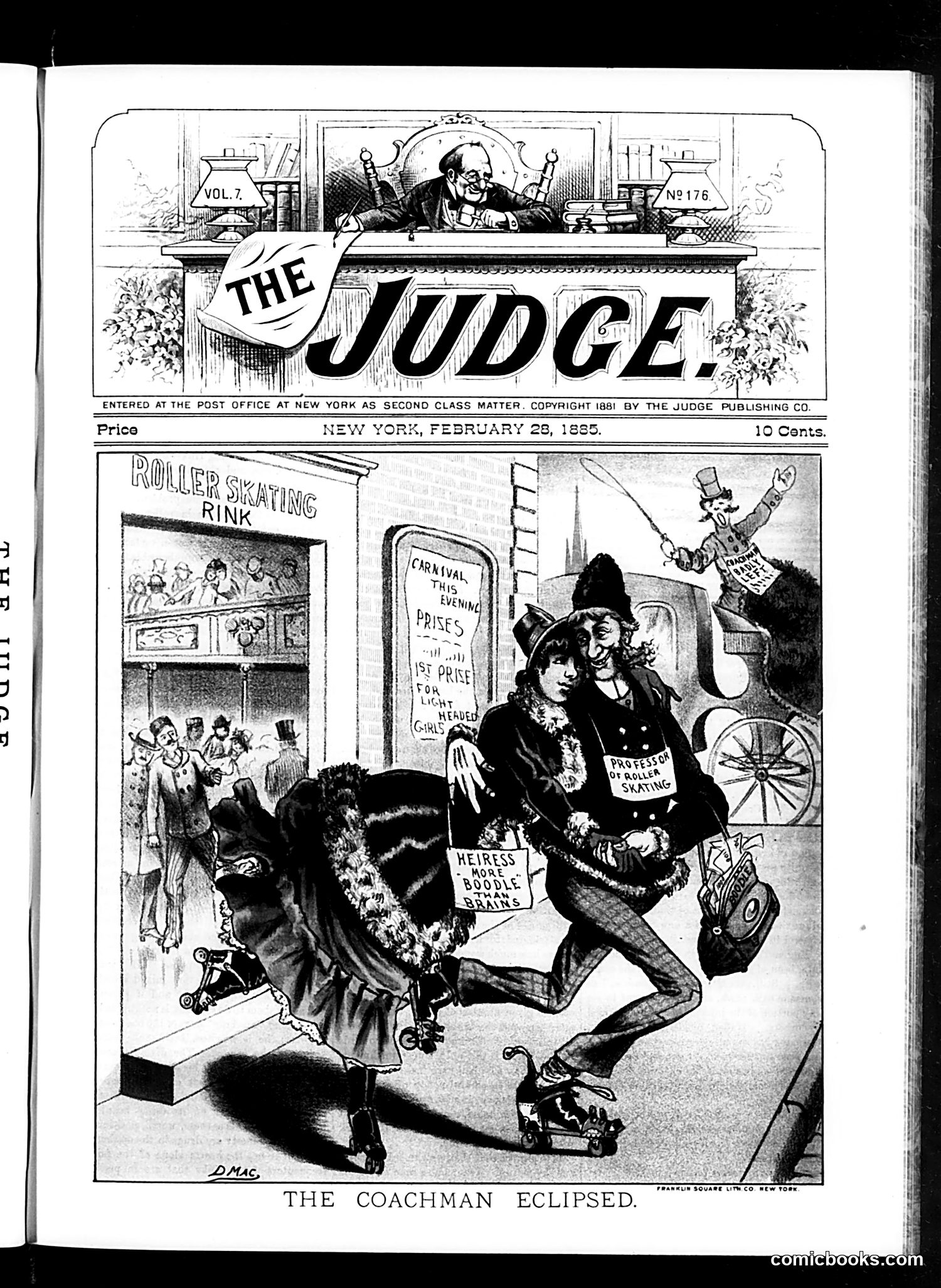
This February 1885 *Judge* cartoon satirizes the craze for roller skating that was sweeping America. The title "The Coachman Eclipsed" suggests that professional coachmen—traditional hired drivers—are being displaced or made obsolete by this new fad. The image shows fashionably dressed figures roller skating near a roller skating rink, while a coachman (the man in the top hat) appears bewildered or displaced. Signs advertise skating events and prizes. The cartoon mocks how roller skating mania has captivated the public, treating it as a cultural phenomenon significant enough to threaten established professions. The satire reflects late-19th-century anxiety about technological and social change rapidly reshaping urban life and employment.
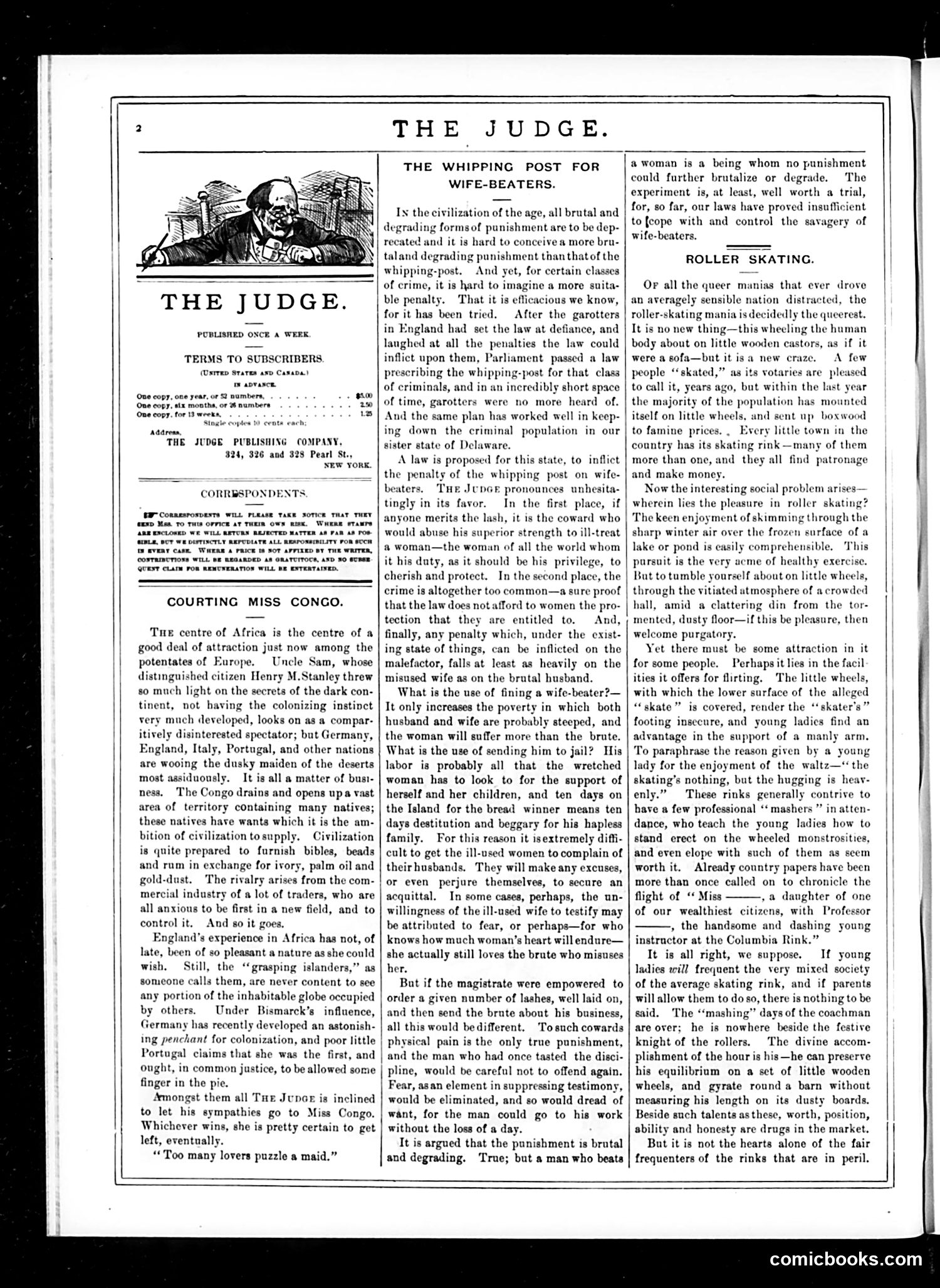
This Judge magazine page contains two main editorials: **"The Whipping Post for Wife-Beaters"** argues for flogging as punishment for domestic violence. The editorial claims the whipping post is brutal but effective—citing its success against English garrotters (muggers) and Delaware criminals. It contends wife-beaters "merit the lash" and that such punishment would deter abuse better than existing laws. **"Courting Miss Congo"** satirizes European imperial competition for African colonial territory. It depicts the Congo as a desirable woman being courted by Germany, England, Italy, and Portugal, while the U.S. (Uncle Sam) remains uninvolved. The editorial cynically notes that "civilization" exchanges bibles and beads for ivory and gold, with various nations competing for profit. The closing line—"Too many lovers puzzle a maid"—suggests Congo will be exploited regardless of who "wins." Both pieces reflect late 19th-century American attitudes: acceptance of corporal punishment and endorsement of European colonialism with ironic detachment.
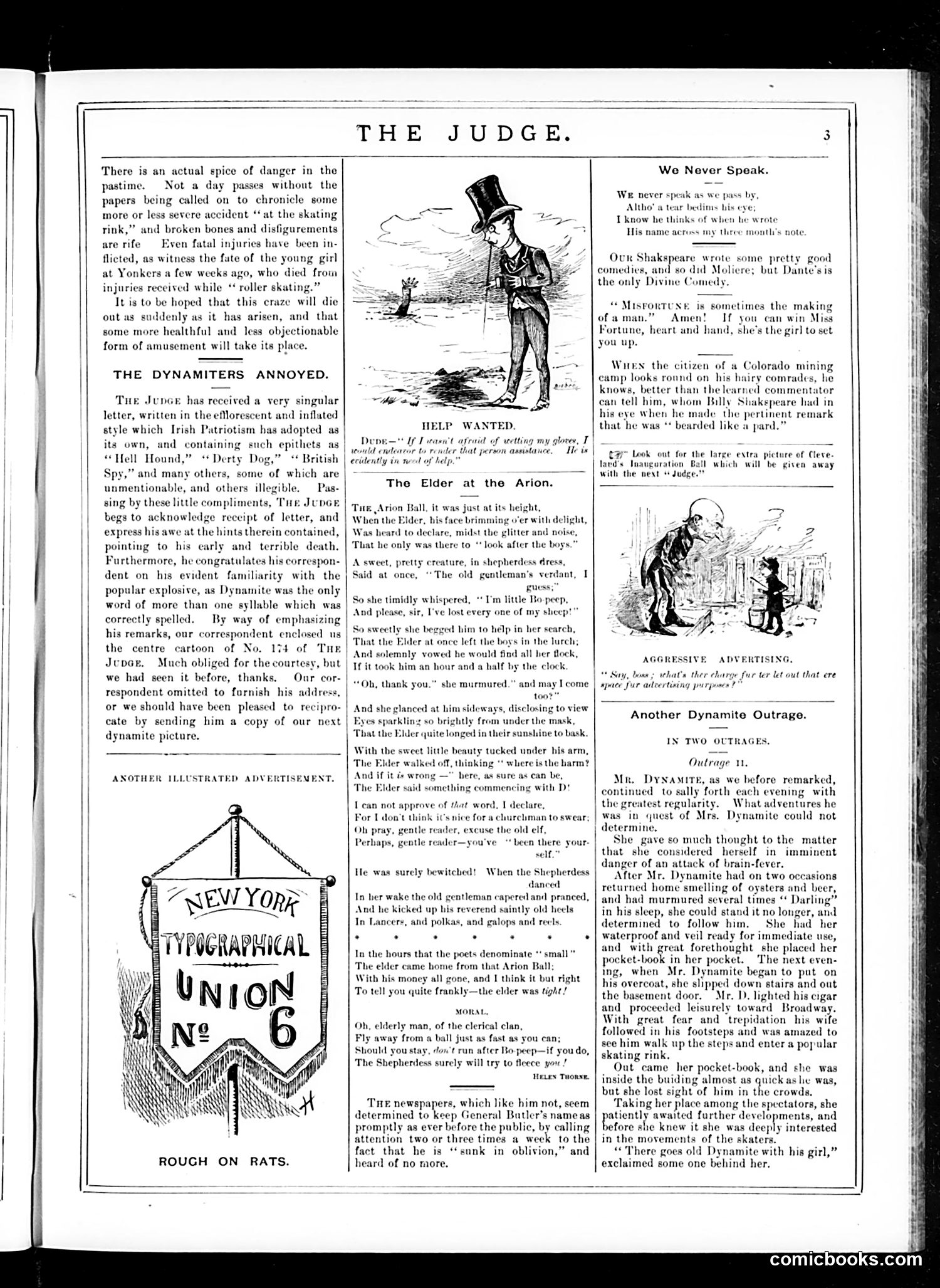
This page contains multiple satirical pieces. **"The Dynamiters Annoyed"** mocks Irish-American Fenian activists who used dynamite for political violence, with Judge celebrating that newspapers are finally refusing to cover their bombings. The Judge editor congratulates himself for denying them publicity. **"The Elder at the Arion"** appears to be a humorous domestic sketch about an elderly gentleman at the Arion (likely a music hall), involving lost sheep and confusion—typical light social satire. **"Another Dynamite Outrage"** continues ridiculing Fenian dynamite attacks through Mrs. Dynamite's romantic entanglements, suggesting these activists are absurd figures. The **New York Typographical Union advertisement** is genuine commercial content. Overall, the page reflects late-19th-century American anxiety about Irish-American anarchist and Fenian violence, treated here with dismissive humor rather than serious concern.
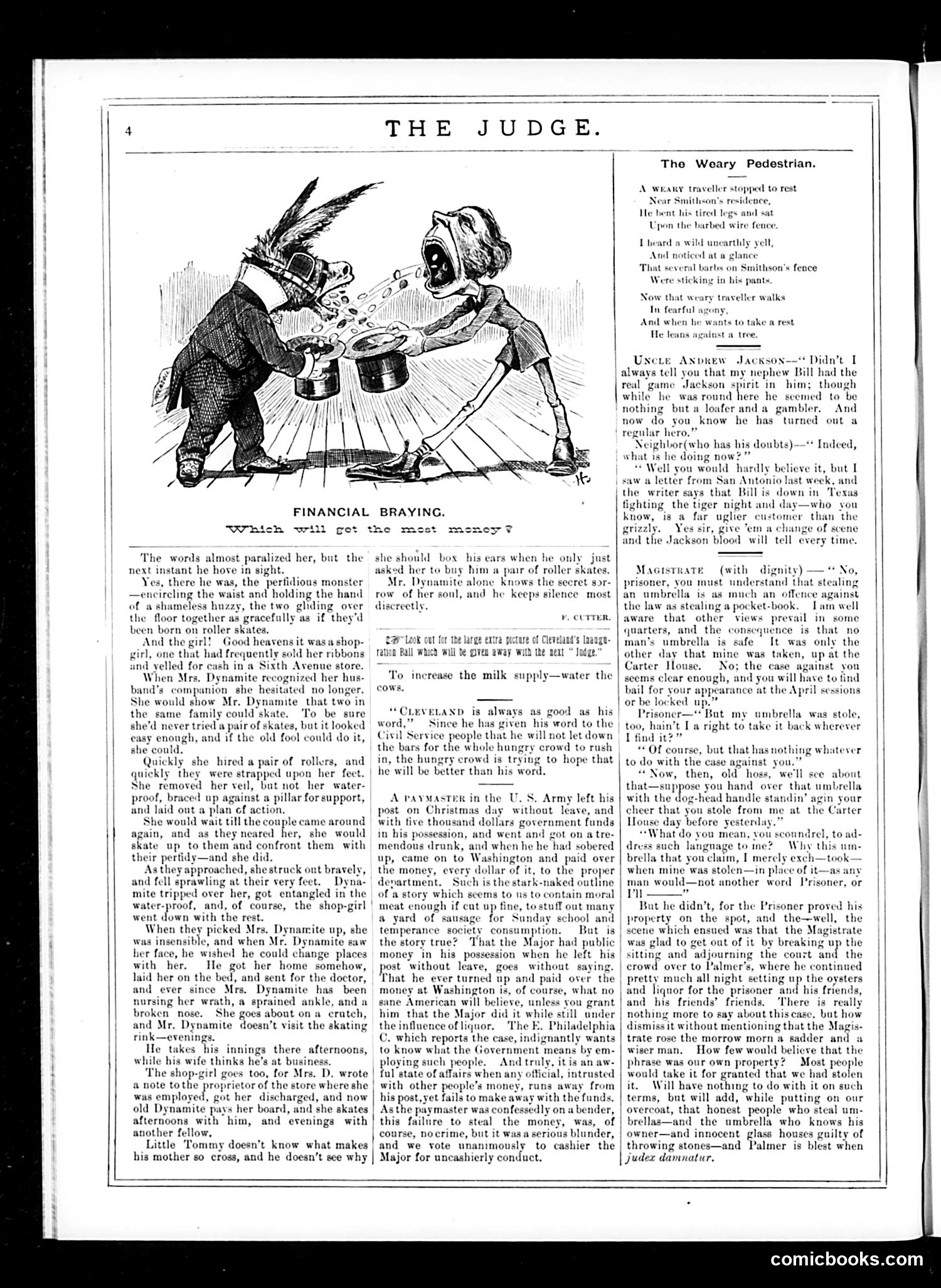
**The Main Cartoon:** "Financial Braying" depicts a woman confronting a man over money, likely representing a domestic dispute about finances. The title suggests mockery of financial arguments or economic incompetence. **The Story Content:** The accompanying narrative describes Mrs. Dynamite discovering her husband flirting with a shop girl at a skating rink. In revenge, she attempts to confront them on skates despite never having skated before, falls spectacularly, and injures herself. The husband then secretly supports both women—his wife and the shop girl—while avoiding the skating rink during evenings. **The Satire:** This is domestic humor satirizing: marital infidelity, foolish revenge schemes, and the absurdity of the wife's plan backfiring entirely. The humor lies in her injury being self-inflicted rather than achieving her goal of embarrassing her husband. **Historical Context:** The references to "Dynamite" and roller skating place this in the late 19th century. The shop girl character represents working-class women of that era.
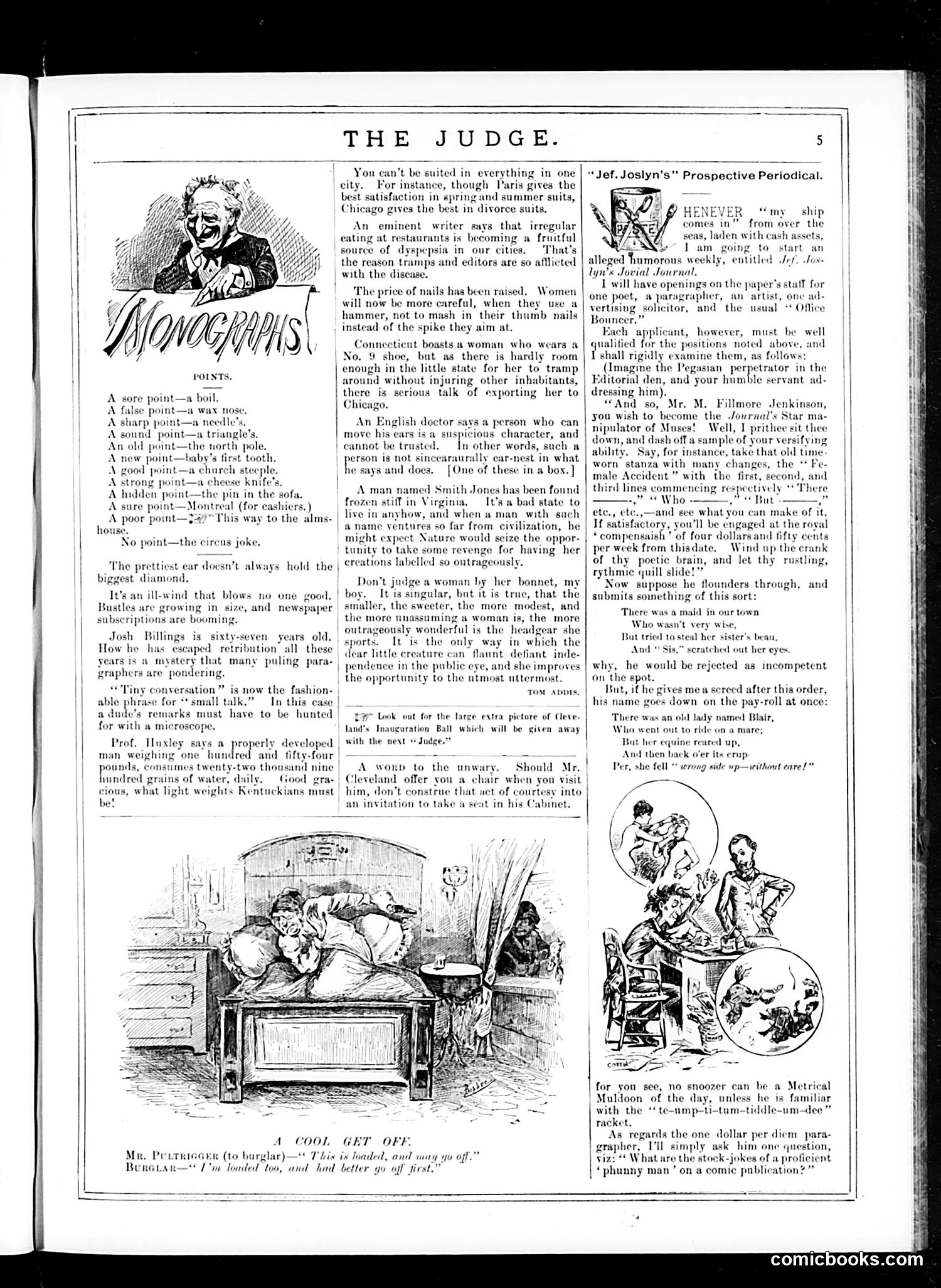
This page from *Judge* presents typical satirical humor of the Gilded Age. The main cartoon, "A Cool Get Off," depicts a burglar confronting a homeowner (Mr. Pettrigger), with a joke about mutual criminal confession—suggesting both have "loaded" situations and should "go off first." The "Monographs" section offers wordplay on "points" (boils, triangles, church steeples, cheese knives)—light humor requiring no specific context. The accompanying text mocks contemporary society: women's fashion excess (tiny shoes), restaurant dyspepsia, nail prices, and the absurdity of the name "Smith Jones." "Jef. Joslyn's Prospective Periodical" satirizes would-be humor magazine publishers, imagining an editor interviewing contributors—poking fun at the competitive, often mediocre humor industry itself. Overall, this reflects *Judge*'s formula: wordplay, social observation, and self-referential mockery of Victorian American life and media culture.
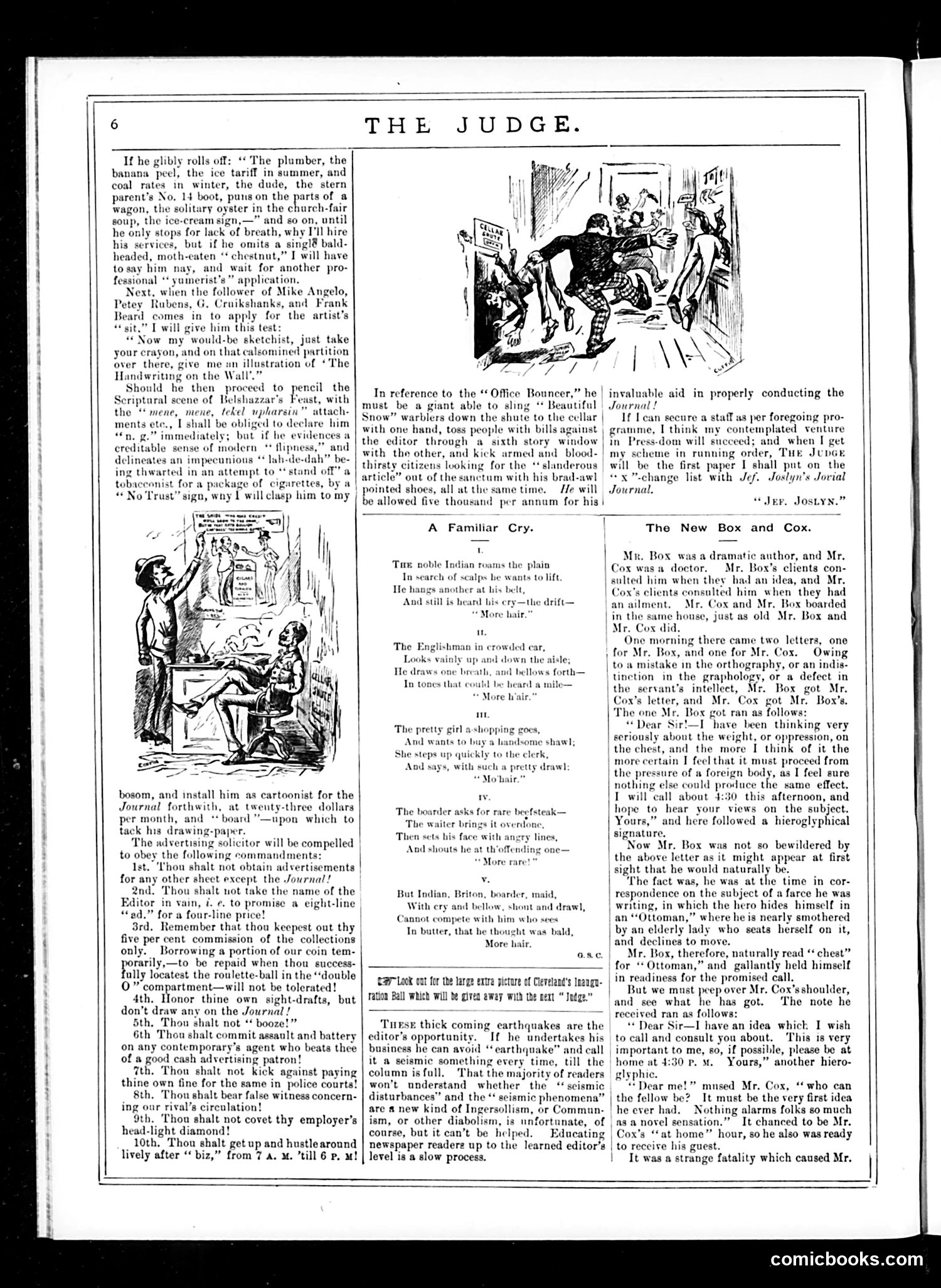
This is a *Judge* magazine page mixing satirical workplace rules with humorous verse about a recurring phrase. **The main cartoon** (top right) depicts an chaotic office scene, likely illustrating the demanding editorial standards described in the text—where applicants for cartoonist, sketch artist, and advertising positions must meet absurdly specific criteria or face rejection. **The "Ten Commandments" section** is satirical advice for *Judge* staff: cartoonists must draw modern, relatable subjects (not classical biblical scenes); advertising solicitors cannot work for competitors; employees must prioritize the publication's interests. This mocks both workplace hierarchies and *Judge*'s competitive rivalry with other satirical publications. **"A Familiar Cry"** is light verse mocking a contemporary speech pattern—the repeated phrase "More hair" (or similar). The poem suggests this phrase appears everywhere: Native Americans seeking scalps, crowded train passengers, shopping women, boarders requesting rare meat. It's observational humor about annoying verbal tics, likely referencing a recognizable accent or affectation of the era that modern readers would need historical context to identify.
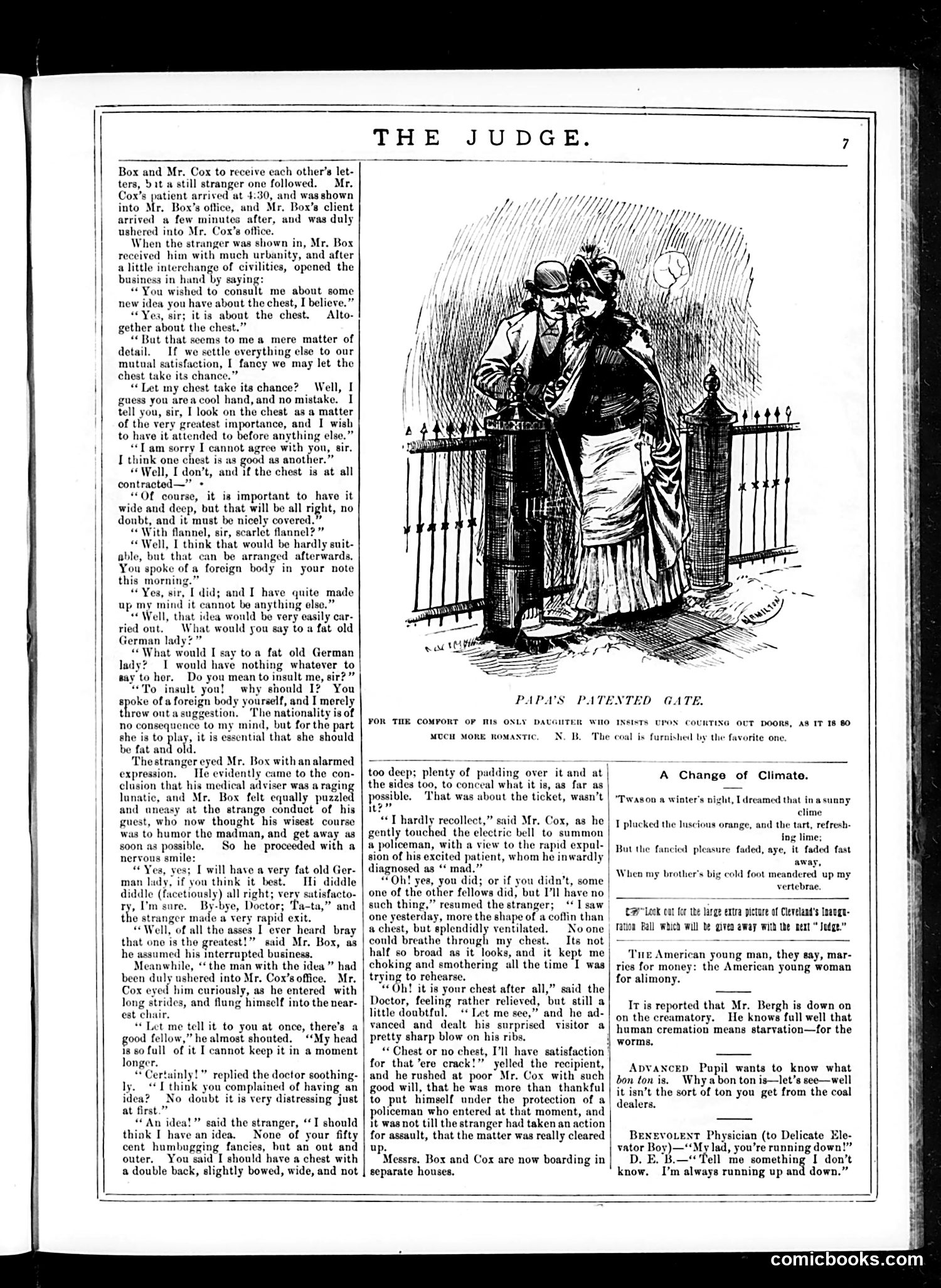
This page contains a satirical story-cartoon about two doctors, Box and Cox, who share an office and accidentally exchange patients. The humor derives from a classic misunderstanding: one patient discusses chest construction (likely for a piece of furniture or medical device), while each doctor interprets his visitor's obsession differently, suspecting madness. The titled illustration shows a man at an ornate gate, captioned "Papa's Patented Gate" — a romantic contraption designed so his daughter won't have to go outside. The satire mocks both paternal overprotectiveness and the contemporary American obsession with mechanical inventions and patents. The page reflects late-19th-century Judge magazine's typical blend of wordplay, mistaken identity comedy, and gentle mockery of professional pretension and sentimental domesticity. The chest-obsessed patient represents the period's earnest, somewhat absurd patent-seekers.
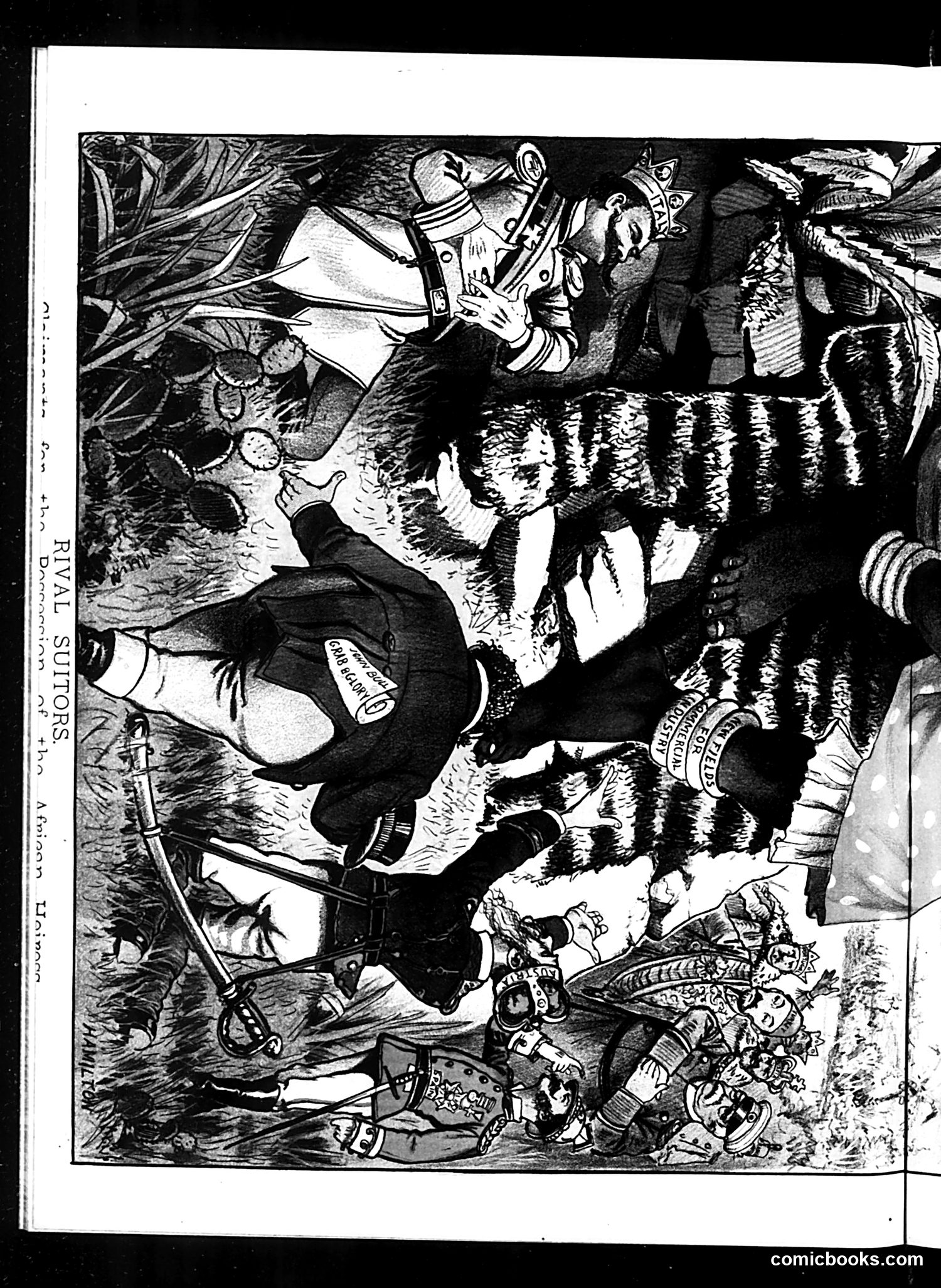
This political cartoon depicts a woman (representing a nation or political prize) surrounded by multiple male suitors in elaborate dress. The text "RIVAL SUITORS" suggests competition between different powers or factions for influence or control. The detailed period costumes and ornate uniforms indicate these represent foreign nations or political leaders courting favor. The woman appears to be the object of their pursuit, a common metaphor in 19th-century satire for depicting nations or territories as desirable prizes. Without seeing the complete OCR text or knowing the specific Judge publication date, I cannot identify the exact historical situation being satirized—whether this concerns trade agreements, territorial disputes, or diplomatic alliances. The cartoon likely comments on geopolitical competition of its era.
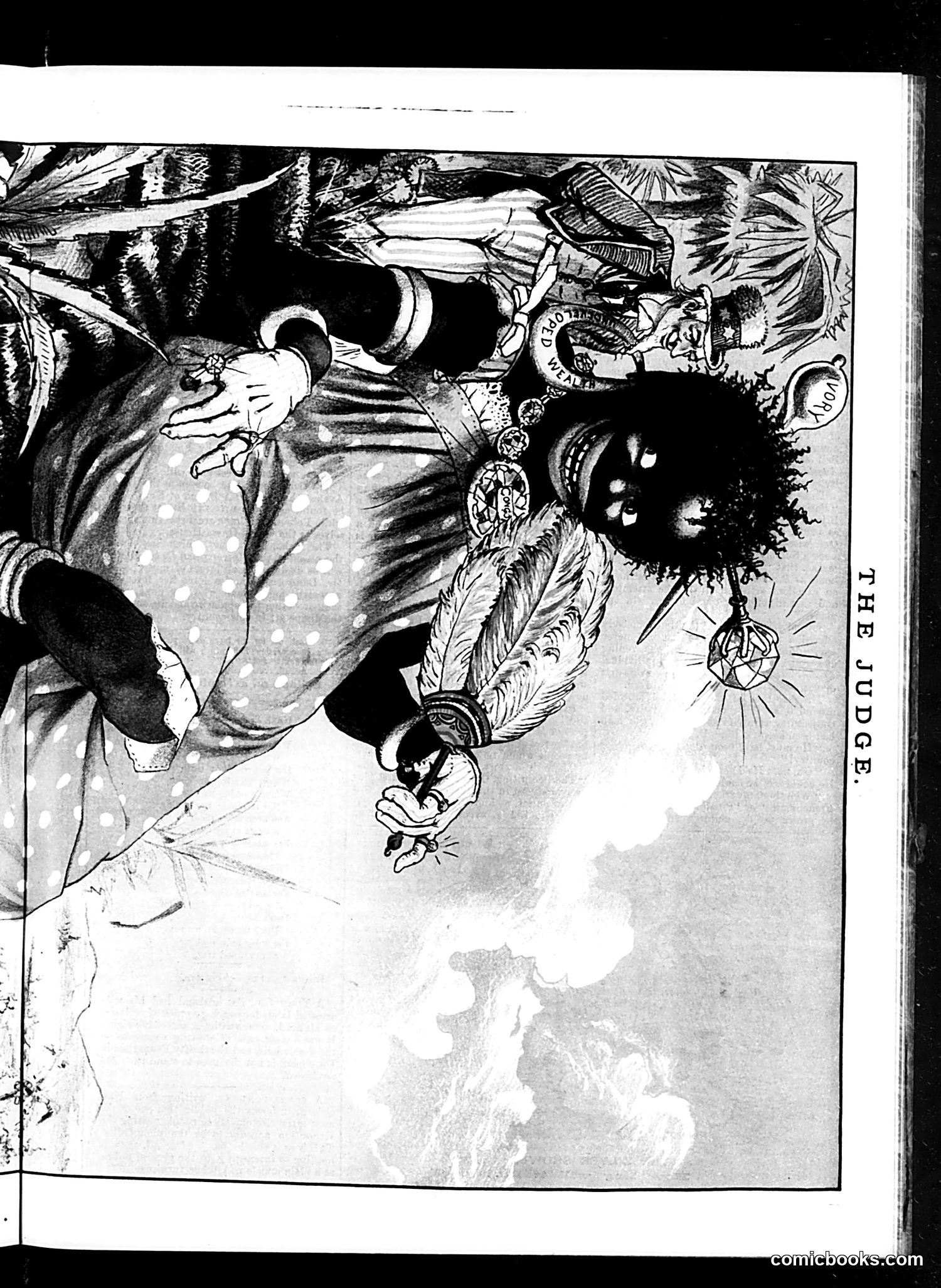
This appears to be a satirical illustration titled "The Judge" (visible on the right margin). The image depicts a heavenly or divine scene with an angel figure suspended above clouds, holding what appear to be religious medallions or badges of office. Below are various figures in period dress (late 19th/early 20th century), seemingly presenting themselves or their cases to this celestial judge. The satire likely comments on divine justice or judgment, possibly critiquing contemporary political or social figures by suggesting their cases are being heard in heaven rather than earthly courts. The ornate religious imagery and the positioning of figures suggests commentary on morality, corruption, or the adequacy of earthly justice systems. Without clearer identification of specific figures, the exact political reference remains unclear.
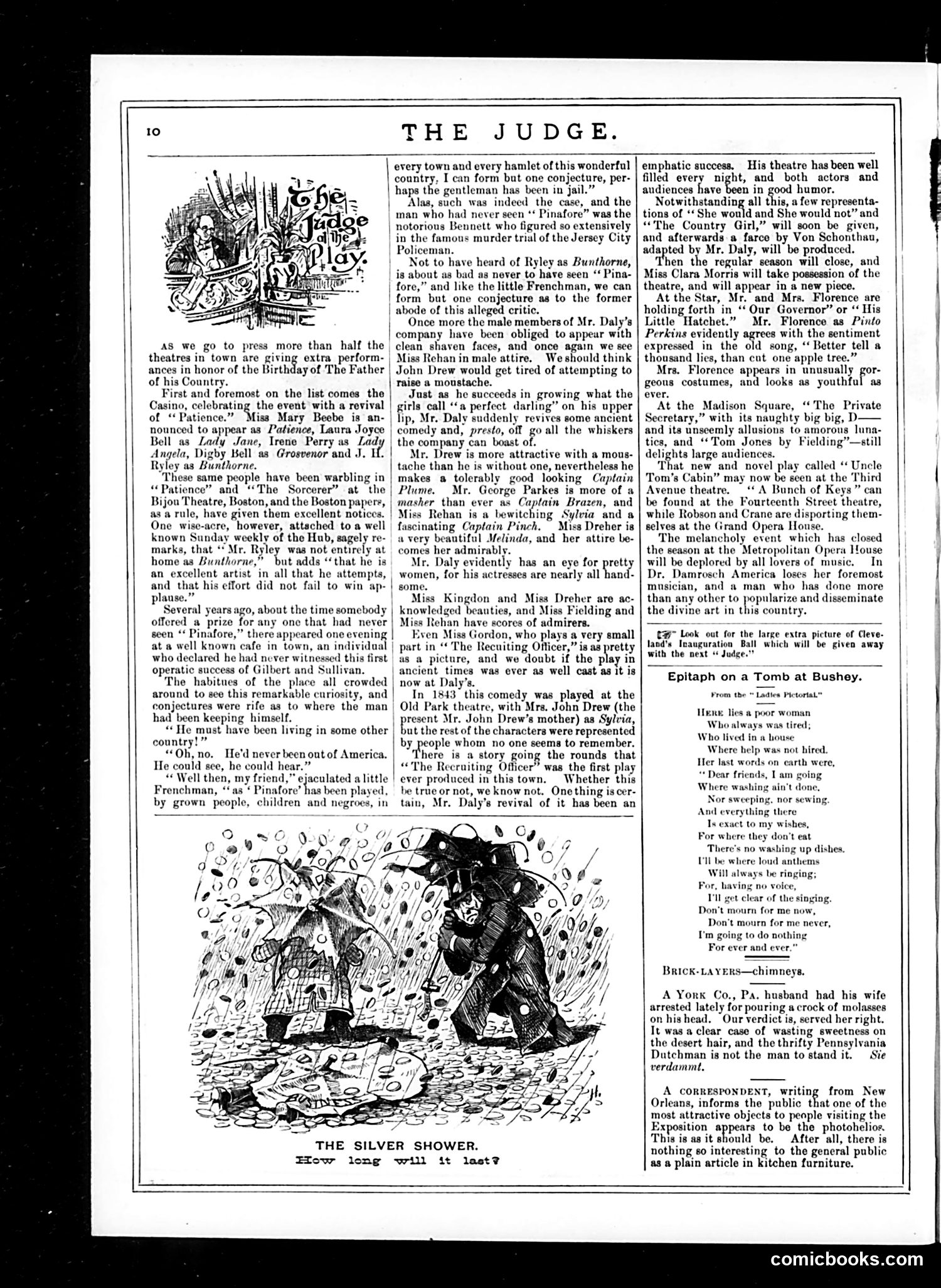
This page from the satirical magazine *Judge* discusses theatrical productions celebrating George Washington's birthday (February 22). The main article reviews productions at various theaters, particularly praising Ada Rehan's performances in plays like *Patience* and *The Recruiting Officer* at Daly's Theatre. The humor centers on theater critic incompetence: a story is told of a man claiming never to have seen *H.M.S. Pinafore*—by then ubiquitously performed across America. The implied joke: such ignorance suggests the man must have been imprisoned. The article references notorious criminal Bennett from a Jersey City policeman murder trial, sarcastically suggesting a critic who hasn't seen *Pinafore* must likewise have been jailed. The cartoon "The Silver Shower" (captioned "How long will it last?") depicts a man and woman in rain, likely satirizing some contemporary social or romantic situation, though the specific reference remains unclear from this page alone.
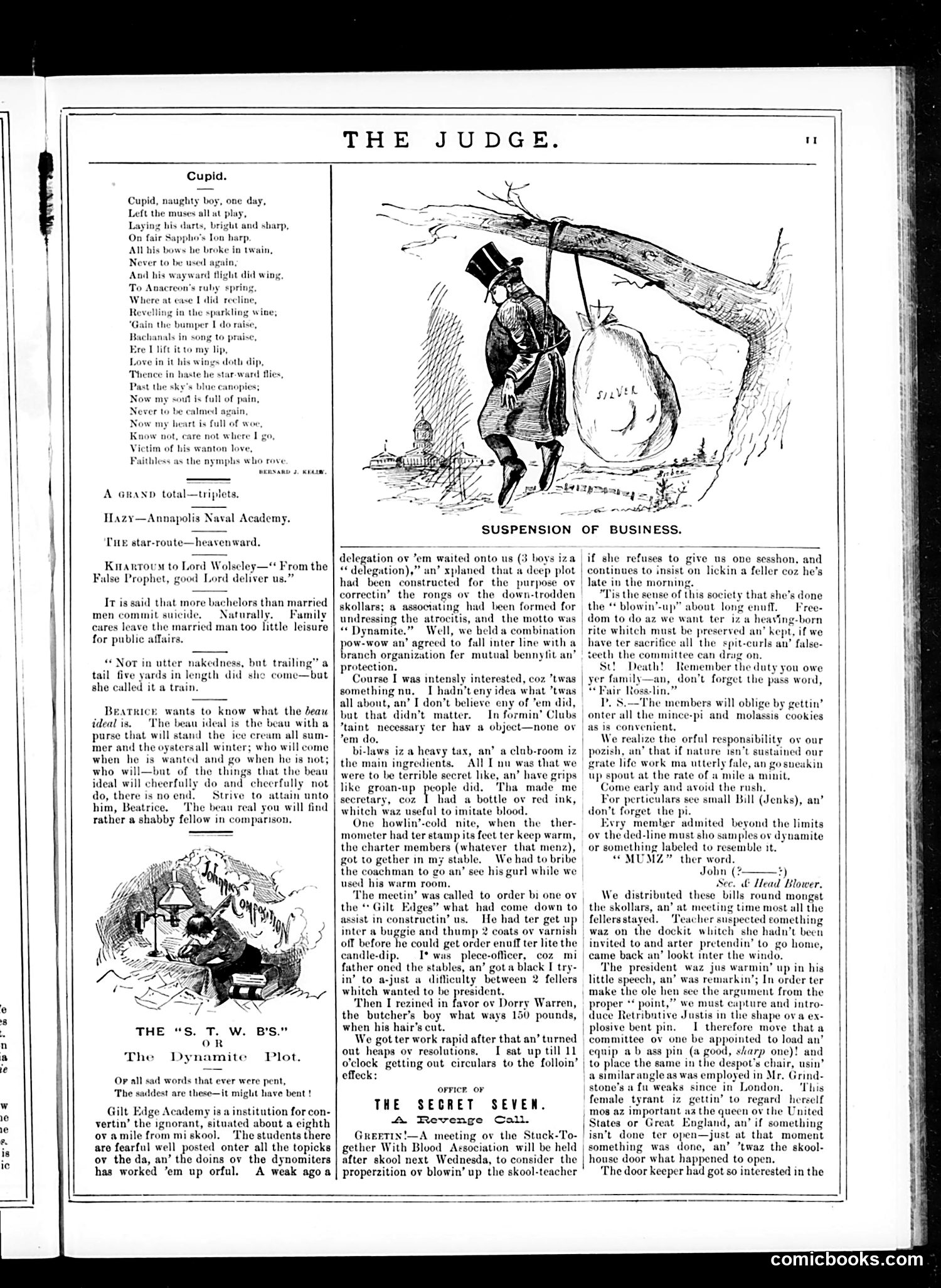
This page from *Judge* magazine contains satirical pieces poking fun at various subjects: **"Suspension of Business"** (main cartoon): Shows a well-dressed man halting before a street with the word "DAILY" painted on it. The surrounding text describes a supposed anarchist "dynamite plot" being formed at a nearby military academy. The joke appears to be mockery of exaggerated fears about anarchist/radical groups—the narrator forms a secret club more out of curiosity and wanting to play with secret handshakes than from any actual revolutionary commitment. It satirizes both the naive boys and contemporary anxiety about radical organizations. **Other items**: Brief humorous pieces include commentary on bachelor versus married men's suicide rates, a poem called "Cupid," and jokes about social matters. The overall tone is typical *Judge* magazine fare: satirizing contemporary anxieties, social pretensions, and current events through humor and illustration. The content reflects late-19th or early-20th century American concerns about anarchism, school conduct, and social life.
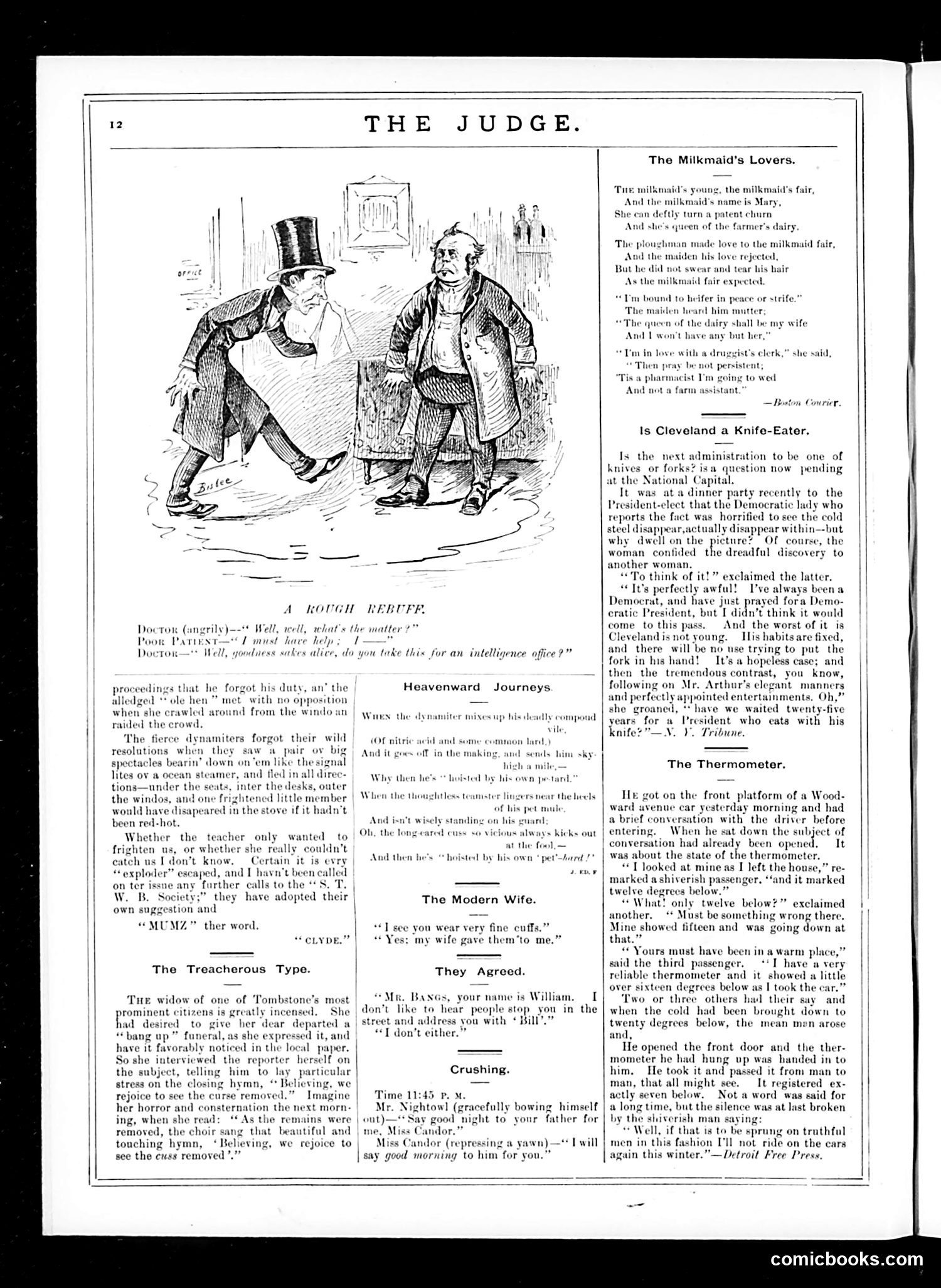
This page from **Judge** (a 19th-century American satirical magazine) contains multiple short cartoons and humorous pieces mocking social types and political figures. The main political cartoon, "A Rough Rebuke," depicts what appears to be a confrontation between two men—likely representing a Democratic and Republican figure or voter, given the era. The joke concerns political disagreement or debate. More significantly, **"Is Cleveland a Knife-Eater"** satirizes Grover Cleveland's election. The piece ridicules a Democratic woman horrified that Cleveland ate with a knife at a dinner party, contrasting his supposedly crude manners with President Arthur's "elegant manner." This is social/class-based satire: the joke mocks both Cleveland's reputation for rough behavior and the pretensions of upper-class Democrats worried about appearances. The remaining pieces ("The Milkmaid's Lovers," "The Modern Wife," etc.) are gentler humor about courtship, marriage, and everyday life—typical Judge fare satirizing social conventions rather than specific political figures. The cartoons overall target social hypocrisy and class anxiety of the Gilded Age period.
This page from Judge contains primarily **humorous short stories and jokes** rather than political cartoons. The content reflects late-19th-century American humor: **"The Difference"** contrasts courtship sleigh rides with married life — a common domestic humor theme. **"Next Week"** is a brief joke about a man seeking change for five dollars, with a punchline about delayed payment. **"Queer Customs"** presents a dialogue mocking Mexican servant culture and hat prices — reflecting period attitudes toward foreign customs as exotic/ridiculous. **"Another College Man"** satirizes an overeducated college reporter whose overly-formal, pretentious account of a fire impresses his editor. The page also includes advertisements (Iron Bitters tonic, corn sheller, printing services) typical of the era. **No specific political figures or events** are clearly referenced on this page — it's general social satire focused on courtship, class, education, and national stereotypes rather than current political commentary.
This page is primarily **advertising and humor snippets**, not a political cartoon. The main content consists of: **"The Judge" column**: Short anecdotes satirizing everyday life—a market reporter's romantic "decline," an Indianapolis dairyman whose milk can kills a goldfish (suggesting milk quality), and a preacher banning roller skating while acknowledging their appeal. These are gentle social observations rather than pointed political satire. **Notable reference**: Miss Cynthia Cleveland's temperance lecture is mocked for raising minimal funds—likely satirizing the temperance movement's ineffectiveness or Cleveland's limited drawing power (possibly related to President Cleveland's family). **Other content**: The page features advertisements for pianos, insurance, patent medicines, and comic songs typical of 1890s magazines. The "telephone connection" joke references the novelty of long-distance calling between Chicago and St. Louis. The page reflects *late-19th-century concerns*—consumption (tuberculosis), women's appearance, temperance debates—rather than major political events. It's mostly commercial space with light humor throughout.
This page is primarily a **title page and advertisement section** for *The Judge*, a satirical weekly magazine. The central content consists of brief humorous definitions and anecdotes—early "one-liners" poking fun at contemporary figures and situations. The jokes reference recognizable topics: perjury, demagogues, cornet players, and regional stereotypes (including a racist depiction of an Alabama man). The humor relies on wordplay and social observation typical of 1880s-90s satire. The page is heavily populated with **period advertisements**—Pond's Extract (a patent medicine), magic lanterns, lithography services, and Dr. Pierce's "Favorite Prescription" (a dubious female tonic). These ads reveal what concerned people then: medical treatments, entertainment technology, and printing services. The magazine itself is promoted as offering "clever, witty, sarcastic" illustrated content, positioning itself as sophisticated urban humor for educated readers willing to pay five dollars annually.
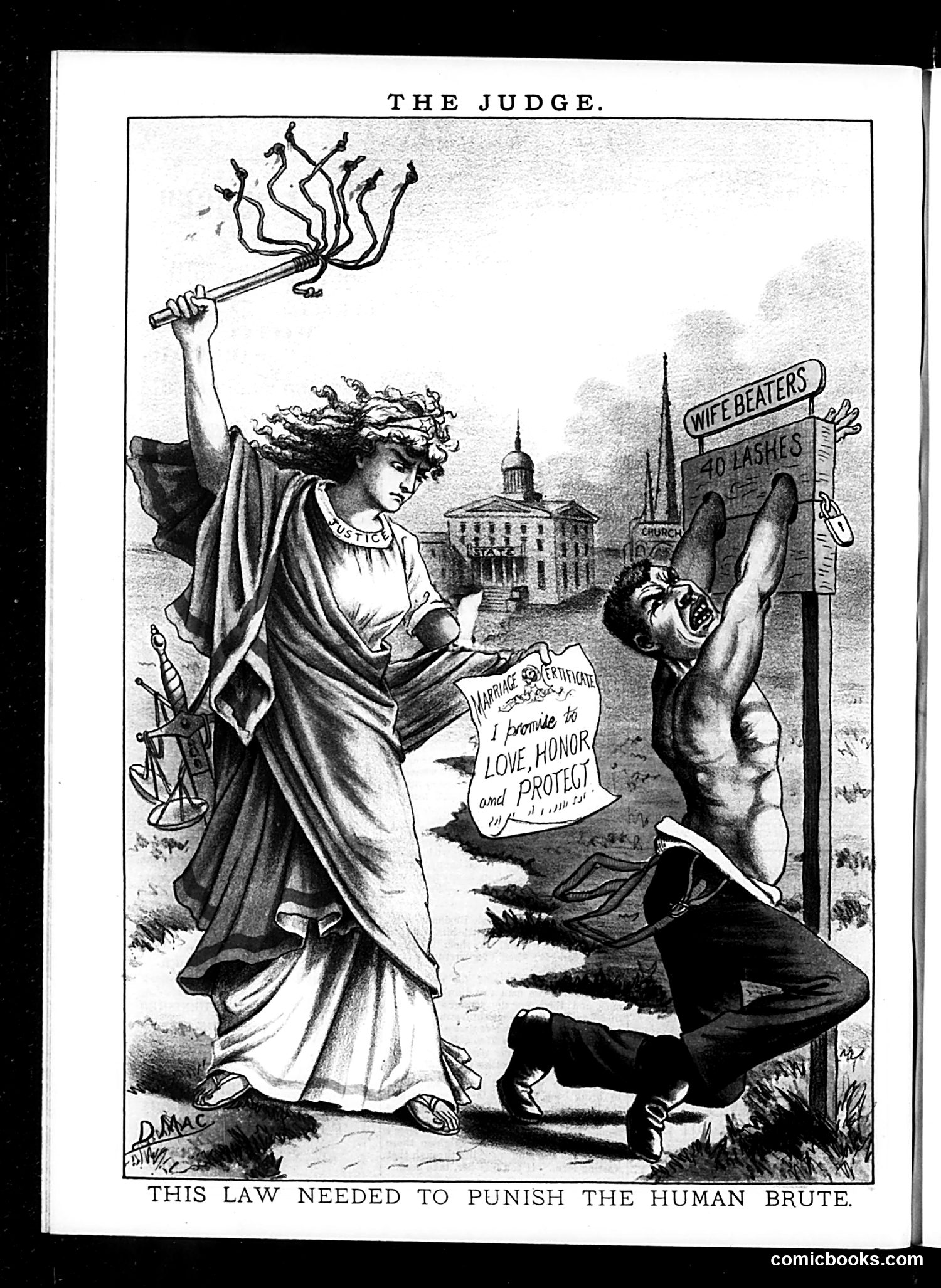
This satirical cartoon depicts **Lady Justice** (left, holding torch and scales) confronting a man labeled as "the human brute" (right, cowering). The man clutches a document reading "I promise to LOVE, HONOR and PROTECT"—a marriage vow. Behind him stands a sign advertising "WIFE BEATERS" with "100 LASHES," and a church appears in the background. The cartoon advocates for **laws against domestic violence**. The satire criticizes men who violate marriage vows by abusing their wives, despite swearing before God and law to protect them. Lady Justice, wielding her flaming torch, represents the legal punishment needed to deter such brutality. The caption confirms the message: this law was necessary "to punish the human brute." This reflects early advocacy for anti-domestic violence legislation in American history.