
A complete issue · 16 pages · 1885
Judge — February 7, 1885
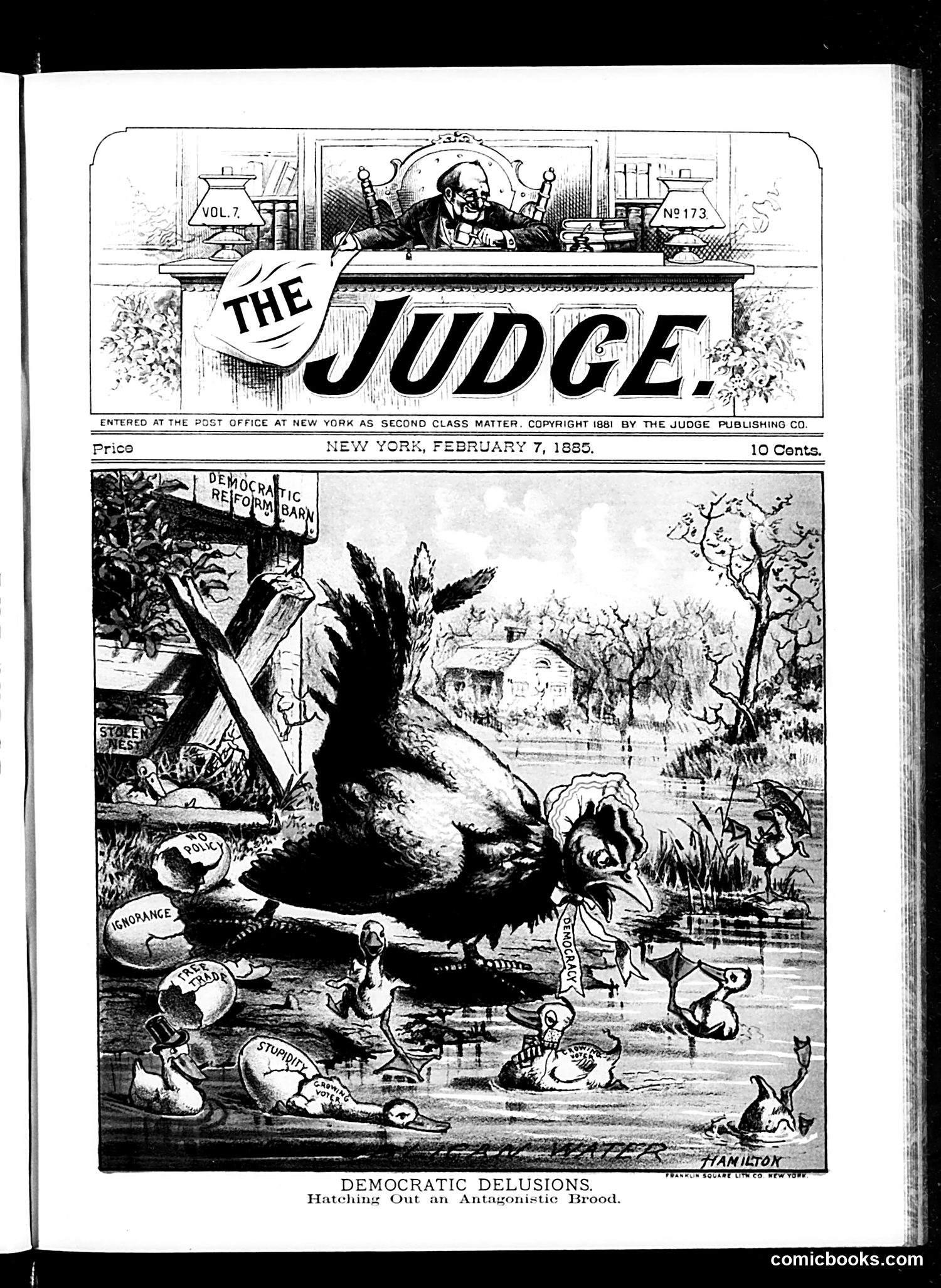
This cartoon satirizes the Democratic Party as a large black bird (likely a crow or vulture) sitting on eggs labeled with various negative traits: "Ignorance," "Stupidity," "Folly," and other vices. A "Democratic Reform Barn" sign appears in the background. Small creatures emerge from or surround the eggs. The satire suggests that Democratic policies and ideology will inevitably "hatch" or produce harmful social consequences—portrayed as base human failings. The antagonistic "brood" implies the party breeds conflict and division. Published February 7, 1885, during the Gilded Age, this reflects Republican-leaning *Judge* magazine's partisan attack on Democrats, using the extended metaphor of reproduction to argue their political platform is fundamentally corrupt and will only generate societal damage.
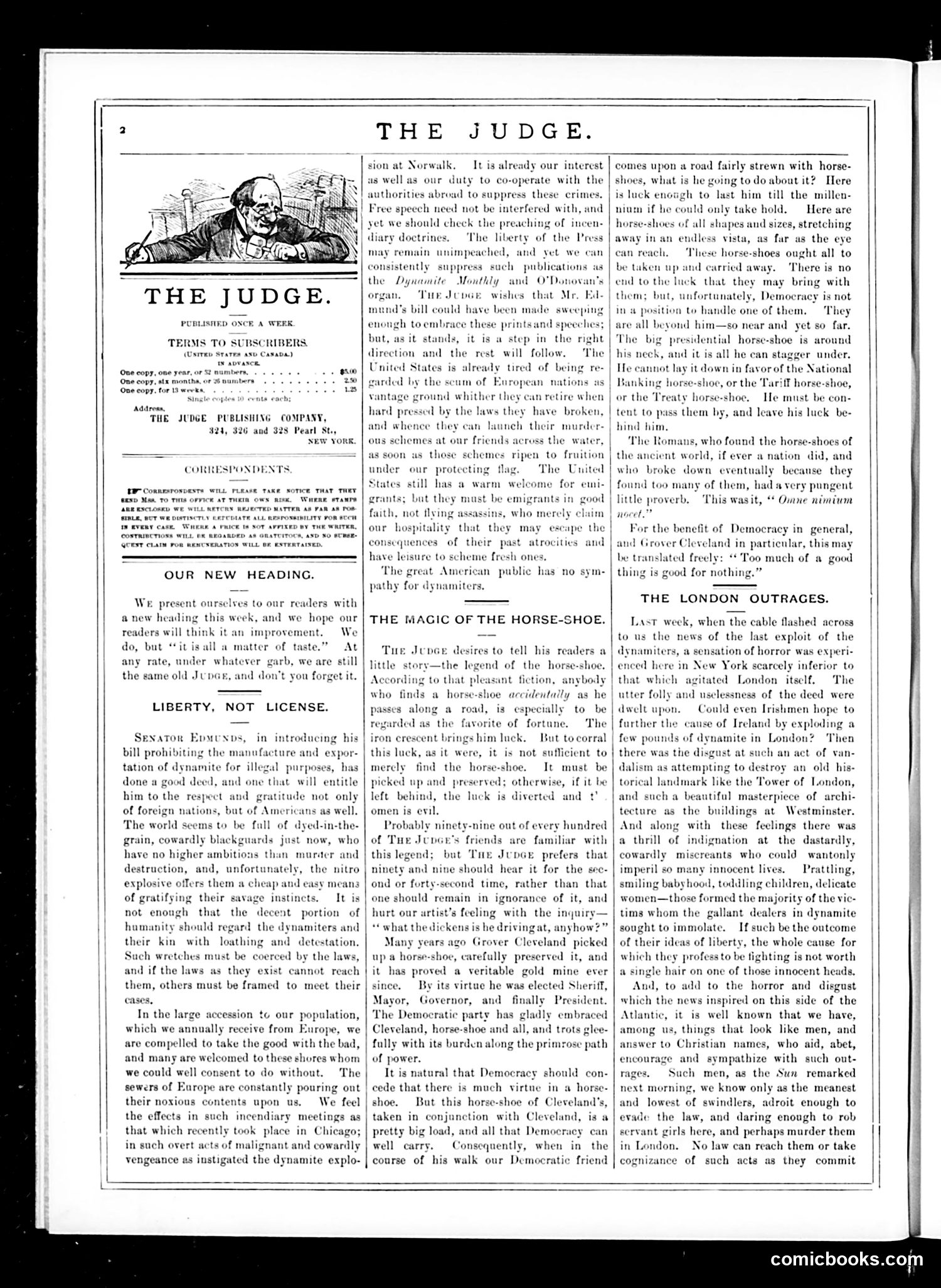
This page contains two main pieces of satirical commentary: **"Liberty, Not License"** addresses dynamite violence, likely referencing anarchist bombings of the 1880s (such as the Haymarket affair). The editorial praises Senator Edmunds's bill prohibiting dynamite manufacture for illegal purposes, arguing that while free speech must be protected, the U.S. shouldn't tolerate violent foreign agitators entering the country. It criticizes European immigrants who bring "atrocities" and use explosives. **"The Magic of the Horse-Shoe"** appears to be a lighter piece using the folk superstition about lucky horseshoes as an extended metaphor—likely satirizing political figures' attempts to capitalize on fortune or luck. The specific reference is unclear without seeing the full article, but it seems to mock how politicians, like those seeking the horseshoe's benefits, must preserve and properly manage opportunities or lose their advantage. The page reflects 1880s anxieties about immigration, labor violence, and political corruption.
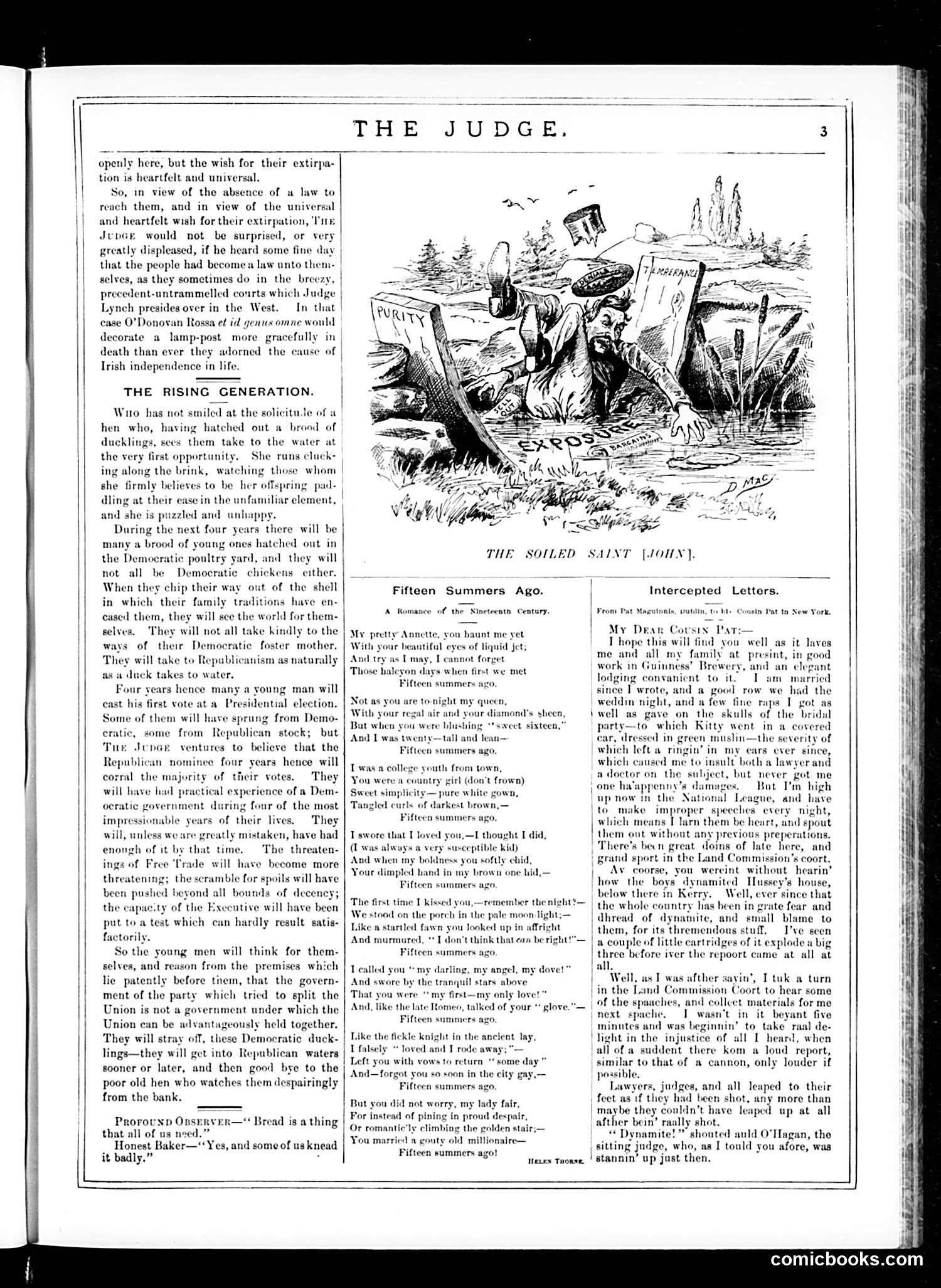
The main cartoon depicts a figure labeled "PURITY" sinking into mud alongside other concepts (appearing to include "IRELAND" and other terms), shown as tombstones or markers in a swampy landscape. This satirizes the corruption of Democratic Party ideals. The accompanying text discusses how young voters ("Democratic ducklings") will eventually abandon the Democratic Party after experiencing its governance firsthand—comparing them to ducklings leaving their mother hen for Republican "waters." The piece argues that Democratic mismanagement, spoils-seeking, and Free Trade policies will naturally convert young men to Republicanism. The cartoon's title, "The Soiled Saint [John]," likely references Irish-American Democratic voters and their political principles becoming corrupted or compromised. The satire suggests that Democratic governance inherently taints its own foundational values, while the accompanying article predicts a generational shift toward the Republican Party based on practical political experience rather than inherited party loyalty.
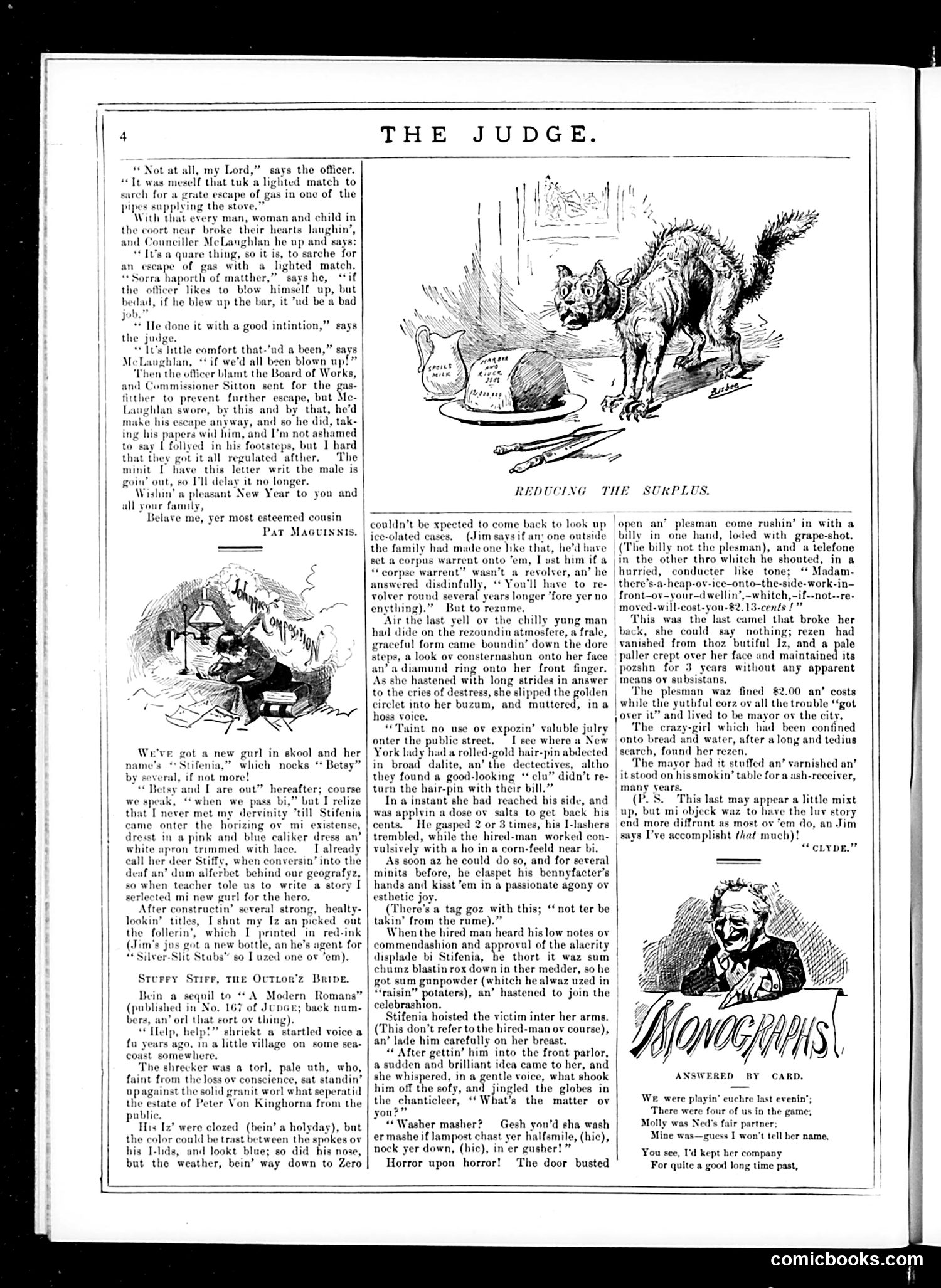
This page contains two satirical stories mocking Irish-American bureaucratic incompetence and melodramatic penny-dime novels. **Top section**: A humorous account of a Dublin court proceeding where an officer uses a lit match to search for a gas leak—an absurdly dangerous action that nonetheless goes unpunished because he had "good intention." Judge ridicules both the officer's stupidity and the lenient Irish judge and councilors who excuse it. **Bottom section**: A parody of overwrought Victorian serialized romance ("Stiferia, or the Outlaw's Bride"), written in deliberately fractured Irish-American dialect and misspellings. The story ridicules both the genre's melodrama and working-class Irish attempts at literary sophistication. The title "Reducing the Surplus" sarcastically suggests this sentimental fiction represents excess cultural output needing elimination. Both pieces target Irish-American social pretension and institutional dysfunction through caricature and exaggerated dialect—typical Judge editorial strategy of the era.
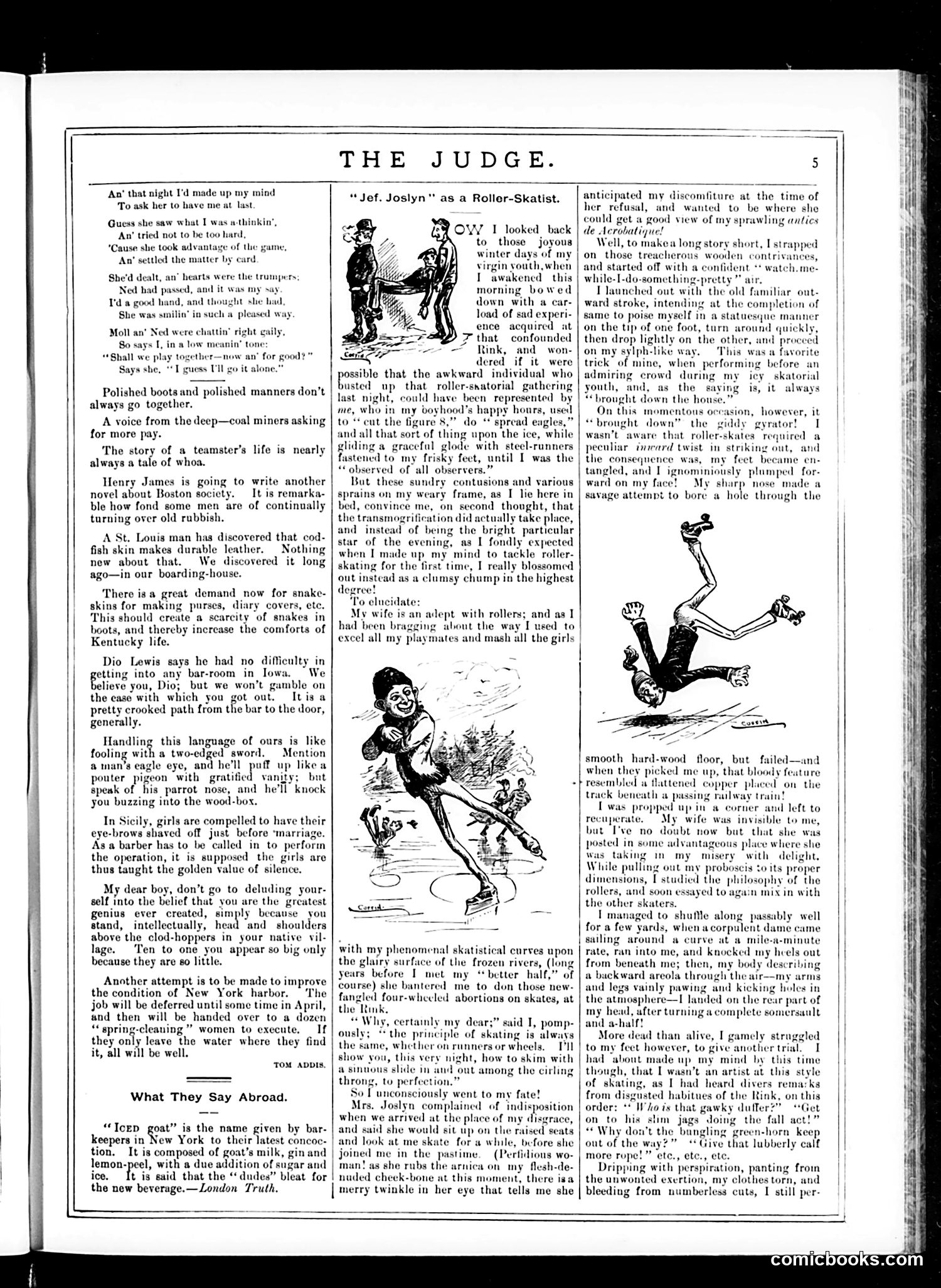
This is a humorous personal essay (not a political cartoon) by someone recounting an embarrassing roller-skating mishap. The narrator, apparently a man named Jef. Joslyn, recalls his youthful ice-skating prowess—executing fancy figures like "figure 8s" and "spread eagles"—then attempts roller-skating at a rink. The result: complete disaster. He crashes repeatedly, injuring himself badly enough that he wakes "bowed down with a car-load of sad experience." The satire targets masculine vanity: Joslyn's confidence in his skating skills proves completely unfounded when transferring to roller skates. The accompanying illustrations show him tumbling and falling in undignified positions. The joke plays on the gap between how men remember their youthful abilities versus present-day reality—a common Judge magazine theme.
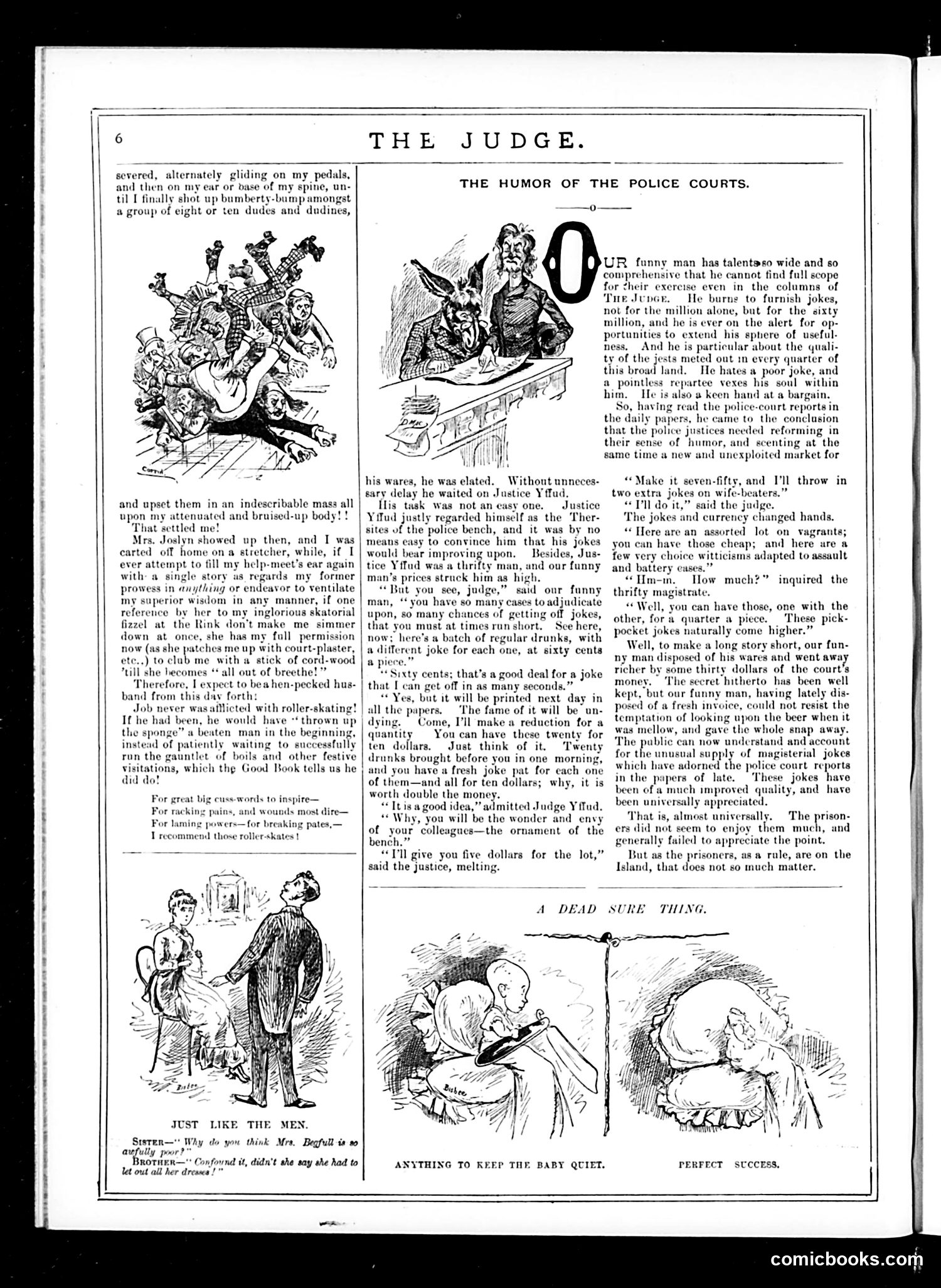
This satirical piece mocks both police court judges and a hustling joke-seller. The unnamed "funny man" (a professional joke writer) approaches Justice Yffud to sell him pre-written jokes for drunks and vagrants appearing in court. The satire operates on multiple levels: it ridicules judges who prioritize entertainment value over justice, suggests the judicial system is performative rather than serious, and portrays the joke-seller as an opportunistic entrepreneur exploiting every market niche—even courtroom proceedings. The humor reveals anxieties about American institutions: that magistrates prioritize appearing witty in newspapers over fair judgment, and that everything—even justice—has become commodified. The accompanying cartoons about baby-keeping and domestic life suggest broader themes about practicality and compromise in daily life. The piece criticizes both judicial frivolity and relentless American commercialism.
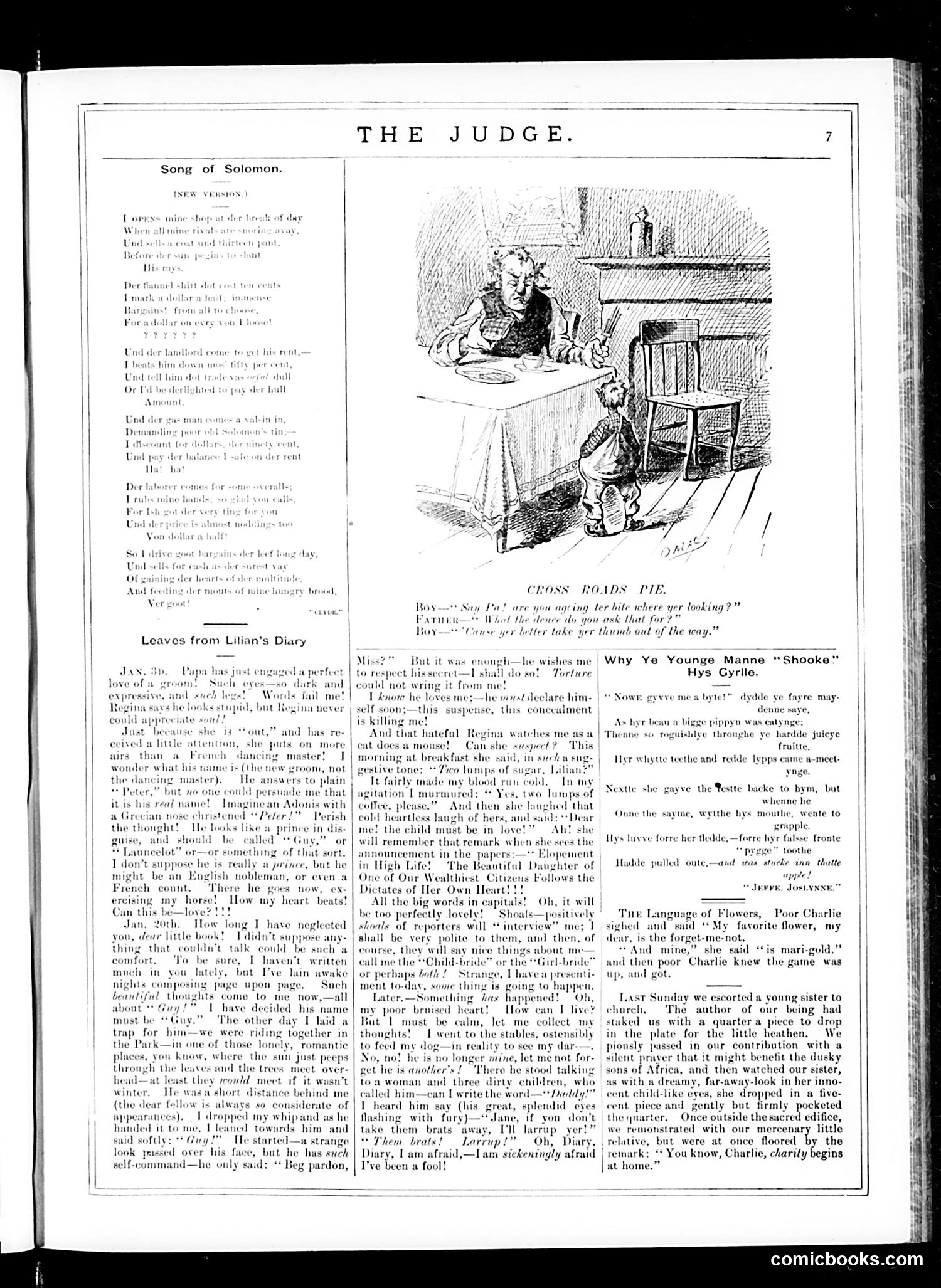
This page contains three distinct pieces of satirical humor: 1. **"Song of Solomon (New Version)"**: A mock-German dialect poem mocking Jewish landlords. The "Solomon" of the title is antisemitic caricature—the speaker complains about a landlord extracting exorbitant rent ("beats him down mos fifty per cent"). This reflects late-19th-century prejudice common in American magazines. 2. **"Cross Roads Pie"**: A simple joke cartoon showing a boy warning a man not to bite where he's looking, because the boy's thumb is in the pie. Basic visual humor. 3. **"Why Ye Younge Manne 'Shooke' Hys Gyrlle"**: A sentimental romance parody using archaic spelling ("wytthe," "teethe") and flowery language to mock sentimental courtship—likely satirizing romantic literature of the era. The page reflects Judge's mix of crude ethnic stereotyping, domestic humor, and literary parody typical of 1880s-90s American satirical magazines.
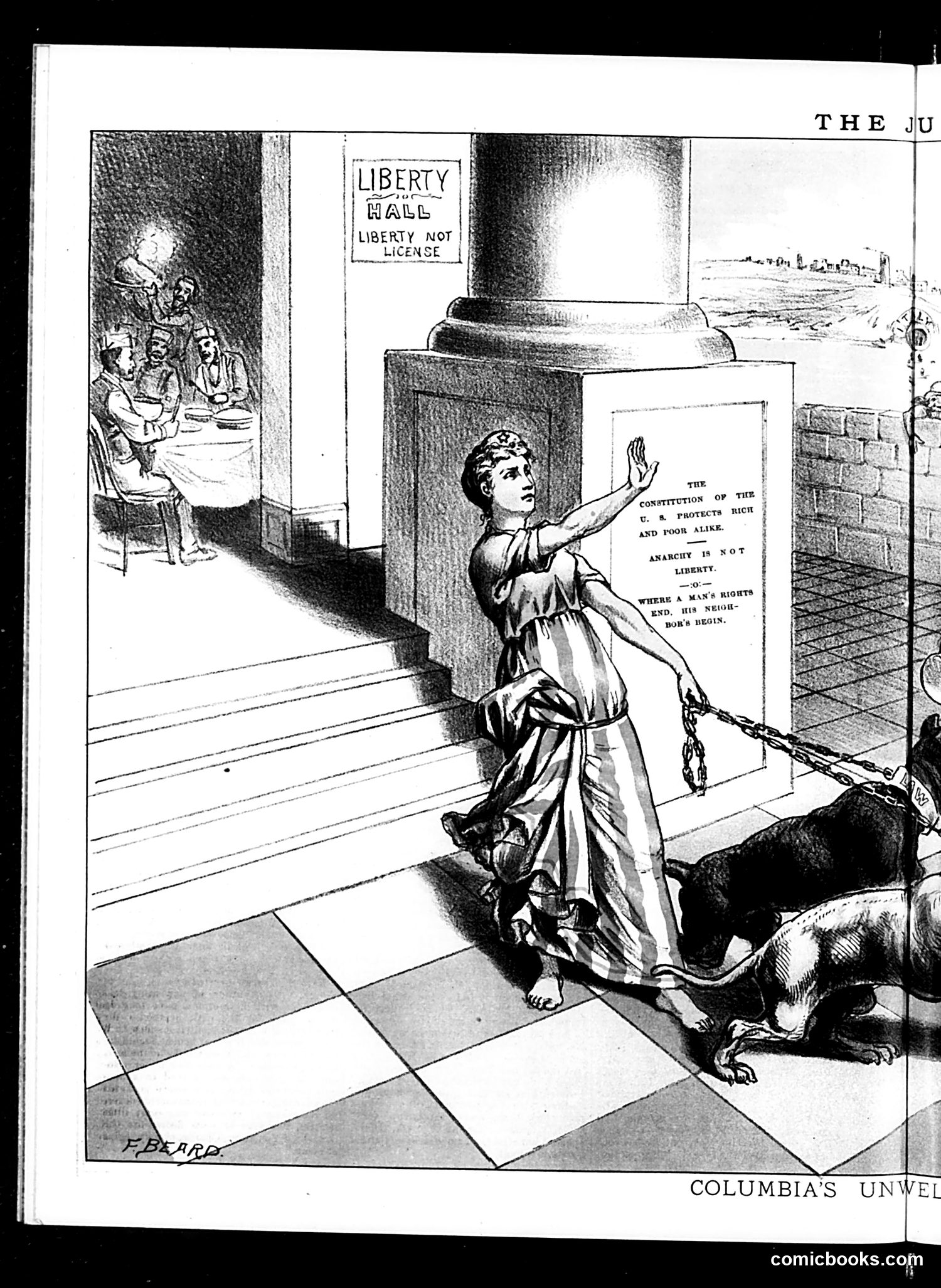
This satirical cartoon depicts **Columbia** (the female allegorical figure representing America) standing outside Liberty Hall, chained and unwelcome. The sign reads "Liberty not License," and text on the pillar states: "The Constitution protects rich and poor alike / Anarchy is not liberty / Where a man's rights end, his neighbor's begin." The cartoon criticizes what appears to be **restrictions on free assembly or political speech**, likely targeting late 19th or early 20th-century American policies that limited labor organizing, radical political activity, or immigrant rights under the guise of preventing "anarchy." The irony is sharp: Columbia, representing American ideals of freedom, is literally barred from entering her own Liberty Hall—suggesting the government has betrayed democratic principles by restricting liberty in the name of preventing chaos. The cartoonist (signed "F. BEARD") uses this contradiction to satirize hypocrisy in how "liberty" was selectively applied.
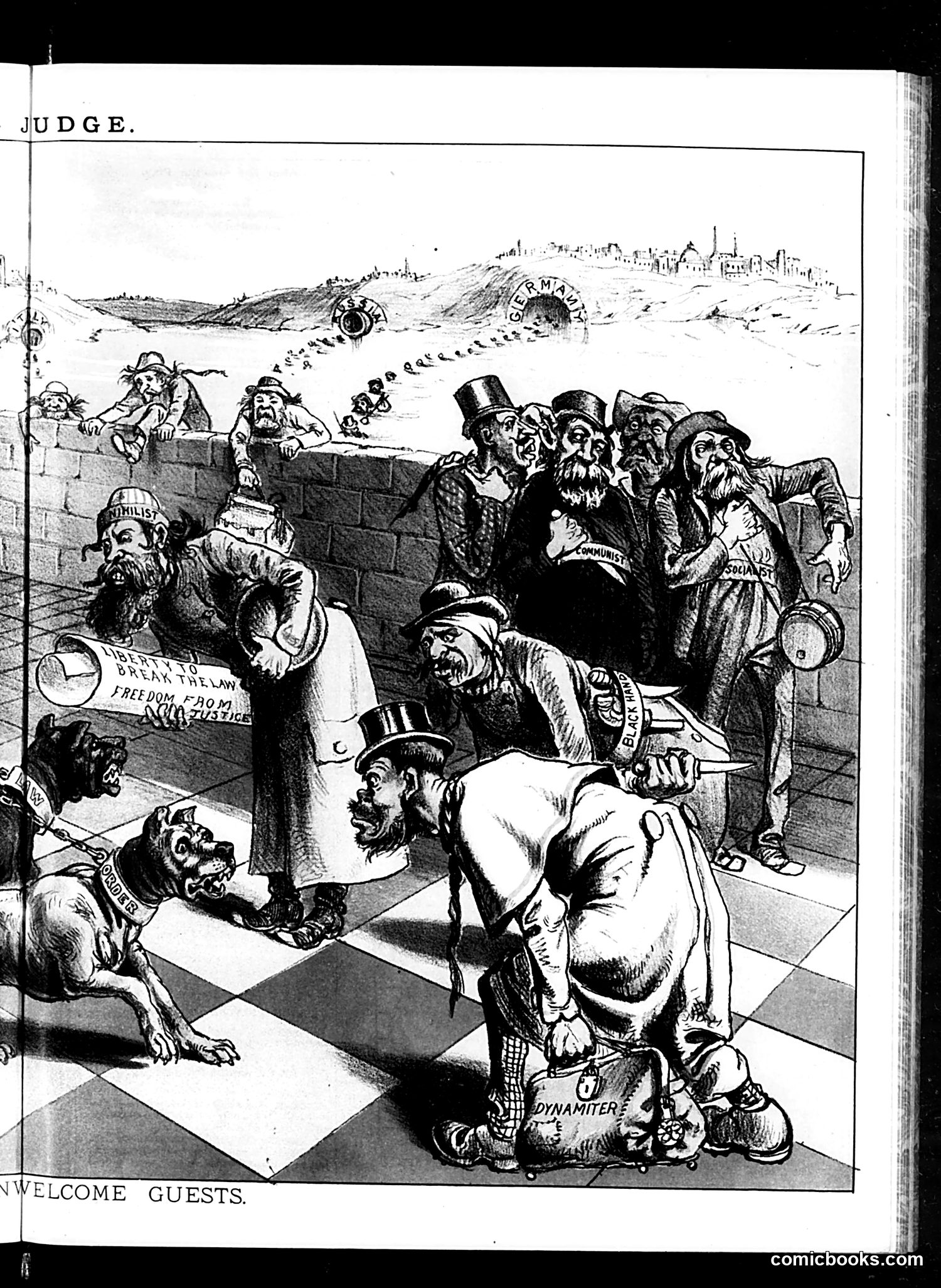
This Judge magazine cartoon satirizes political figures arriving at what appears to be a formal or governmental setting. The title "Welcome Guests" suggests ironic hospitality toward unwanted visitors. The cartoon depicts caricatured figures with exaggerated features typical of late 19th/early 20th-century political satire. Labels visible on some figures reference ideological positions—"SOCIALISM," "DYNAMITE," and other terms suggesting radical or foreign political movements. The dogs in the foreground may represent obstacles or opposition. The background shows fortified positions and military references ("GERMANY"), suggesting international tensions or invasion anxieties. The overall composition satirizes acceptance of dangerous political ideologies or foreign influences entering the country, presenting them as threatening "guests" the nation shouldn't welcome. Without specific dating or clearer labels, the precise historical moment remains unclear.
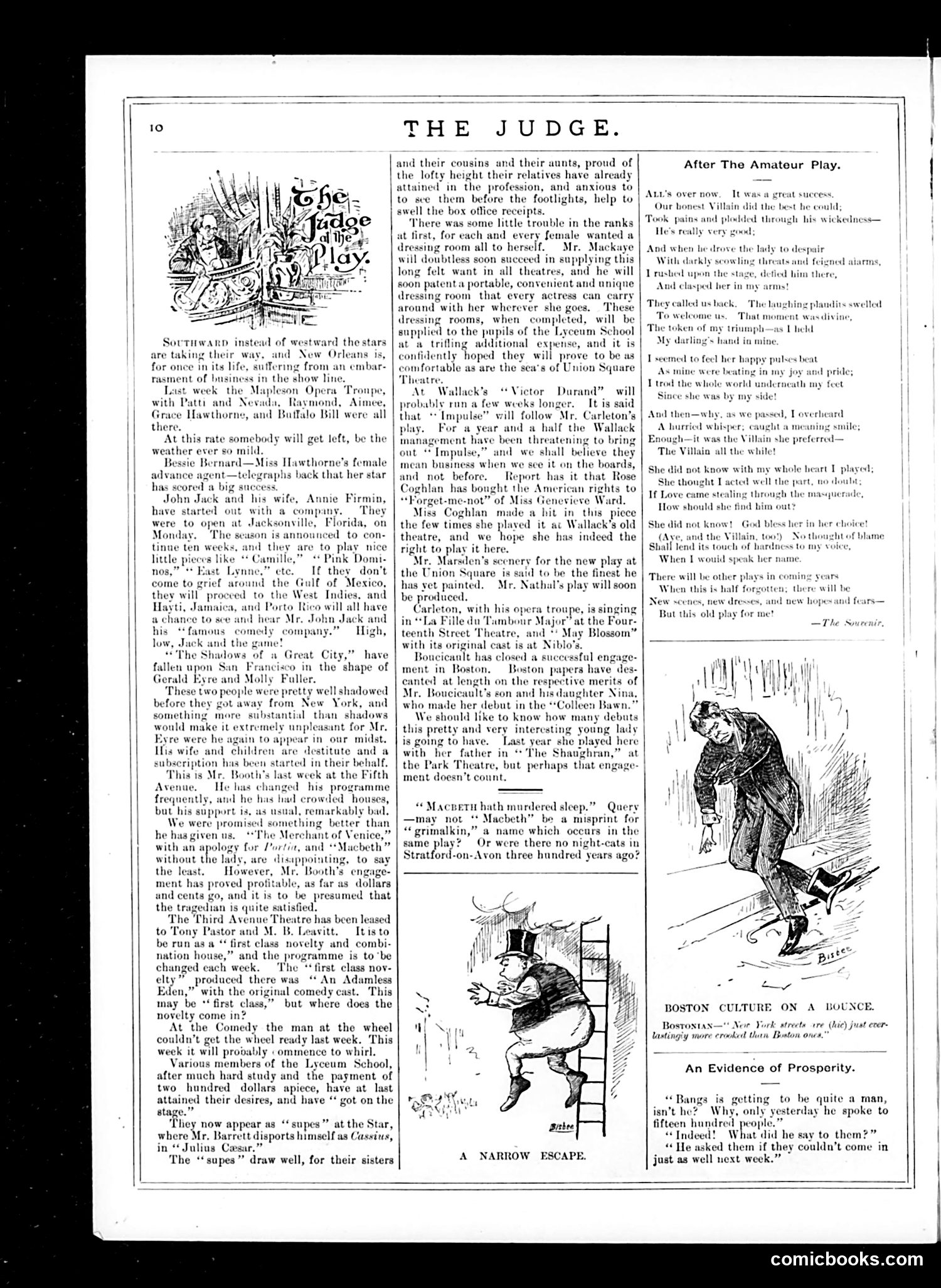
This page is primarily a **theater gossip and review column** from Judge magazine, not a political cartoon. The content covers Broadway and traveling theatrical productions of the era. The text discusses various theater companies and performers, including: - Opera troupes (Mapleson) touring southward to New Orleans - Edwin Booth's final week at the Fifth Avenue Theatre - The Third Avenue Theatre's new management and productions - Lyceum School graduates getting stage roles as "supes" (supernumeraries/extras) in a Julius Caesar production at the Star Theatre The three accompanying **illustrations** are theatrical vignettes: "After The Amateur Play" (showing romantic melodrama), "A Narrow Escape" (comedic peril scene), and "Boston Culture on a Bounce" (satirizing Boston audiences). **The satire** gently mocks theater business inefficiencies, ambitious but struggling theatrical ventures, and the social pretension of amateur theatrical performers and their proud relatives. This is entertainment journalism rather than political commentary.
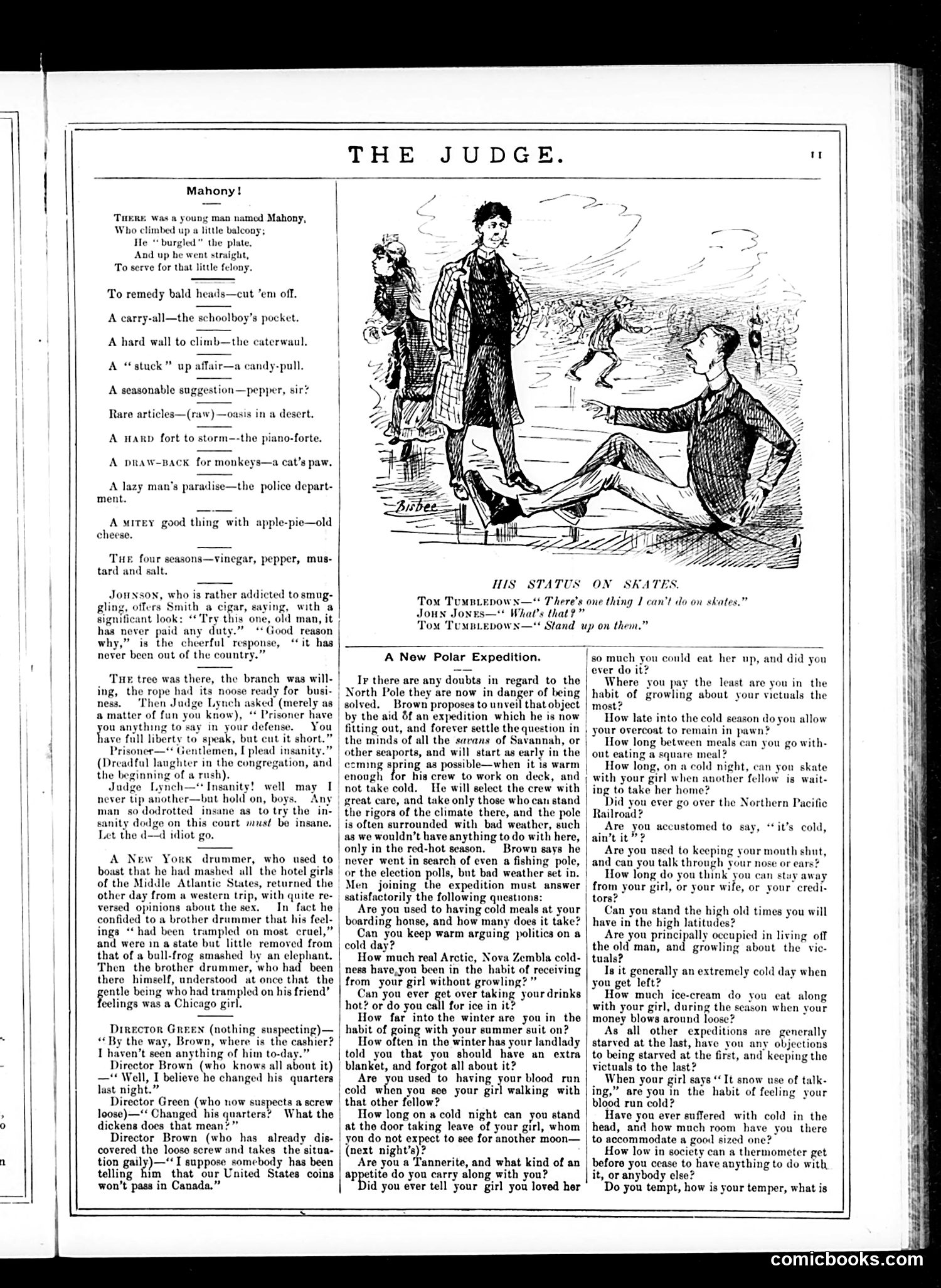
This page from the satirical magazine *Judge* contains multiple short humorous pieces mocking various contemporary figures and social types. The main cartoon depicts a man on ice skates struggling while others watch—captioned about his difficulty skating. This illustrates jokes about incompetence and social awkwardness. The text includes riddles with punchlines (Mahony the burglar, etc.), a joke about smuggling contraband that "never paid duty" because it "never left the country," and mockery of a lynch mob's rough justice ("Judge Lynch"). The longest piece satirizes an ambitious polar expedition proposed by "Brown," questioning whether expedition members can endure Arctic hardships—with sarcastic questions about eating cold food, arguing politics in freezing weather, and other privations. This appears to mock both overly ambitious exploration schemes and the hardy types attracted to them. The content reflects *Judge's* style: punching down at working-class figures, ethnic stereotypes (the "Chicago girl" who crushes a drummer's feelings), and absurdist humor typical of 1880s American satire.
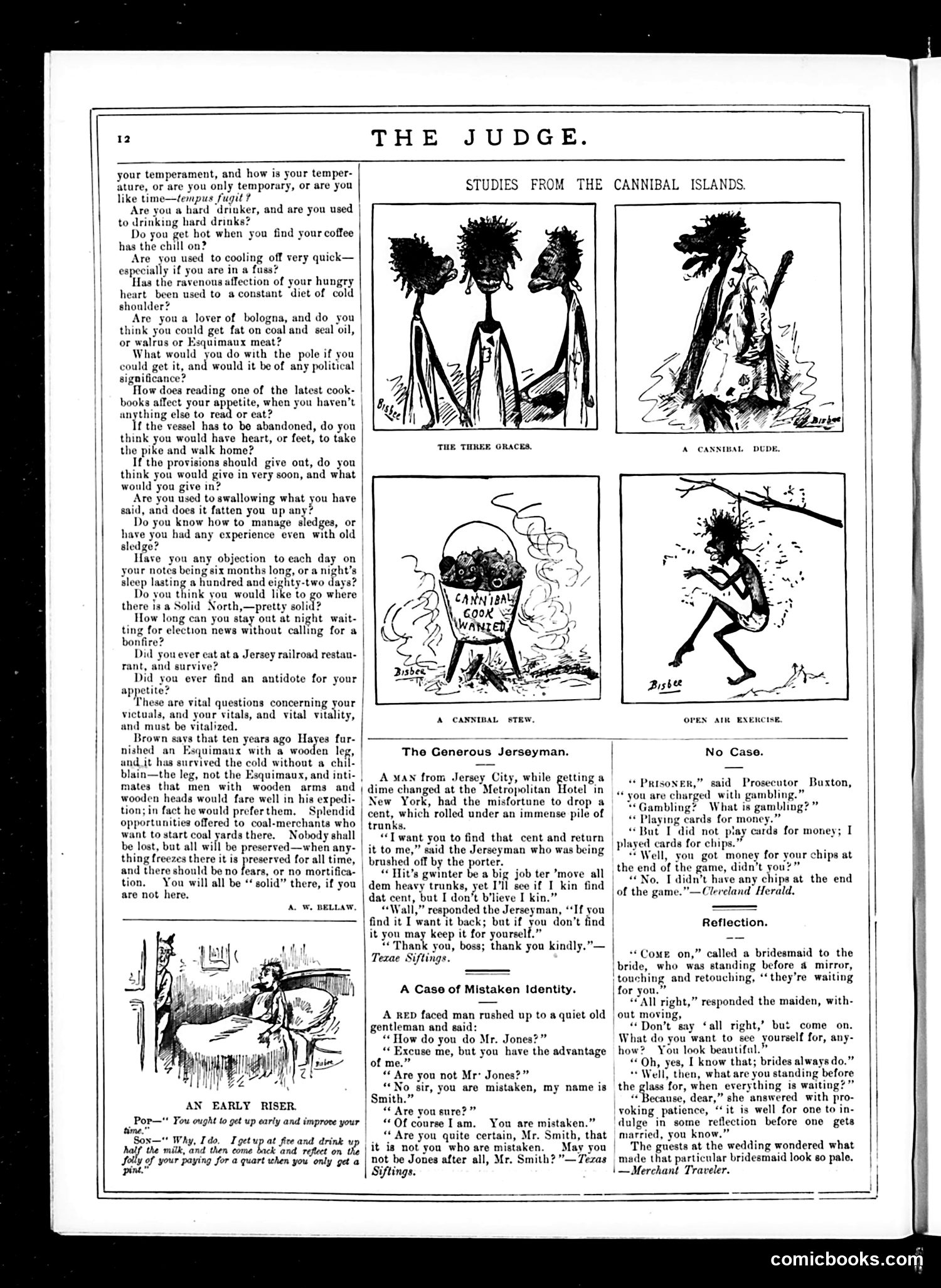
This page from the satirical magazine *Judge* contains several distinct pieces of humor targeting late 19th-century American society. ## "Studies from the Cannibal Islands" The cartoons mock both sensationalized colonial stereotypes and Arctic exploration expeditions (likely referencing contemporary polar expeditions). The crude depictions of Indigenous peoples alongside the "Cannibal Dude" figure use exaggerated racial caricature common to the era's "exotic" humor. ## "The Generous Jerseyman" A brief joke mocking working-class Jersey City residents as penny-pinching and unsophisticated—typical period regional stereotyping that portrayed New Jersey residents as uncultured. ## "A Case of Mistaken Identity" A simple confusion-of-names comedy sketch—a timeless comic format with no particular satirical edge. ## Left Column Contains domestic humor and an "Early Riser" joke about time-wasting and milk fraud—penny-ante concerns reflecting working-class anxieties. The page primarily reflects *Judge's* reliance on ethnic/regional stereotypes, colonial mockery, and class-based humor typical of 1880s-90s American satire.
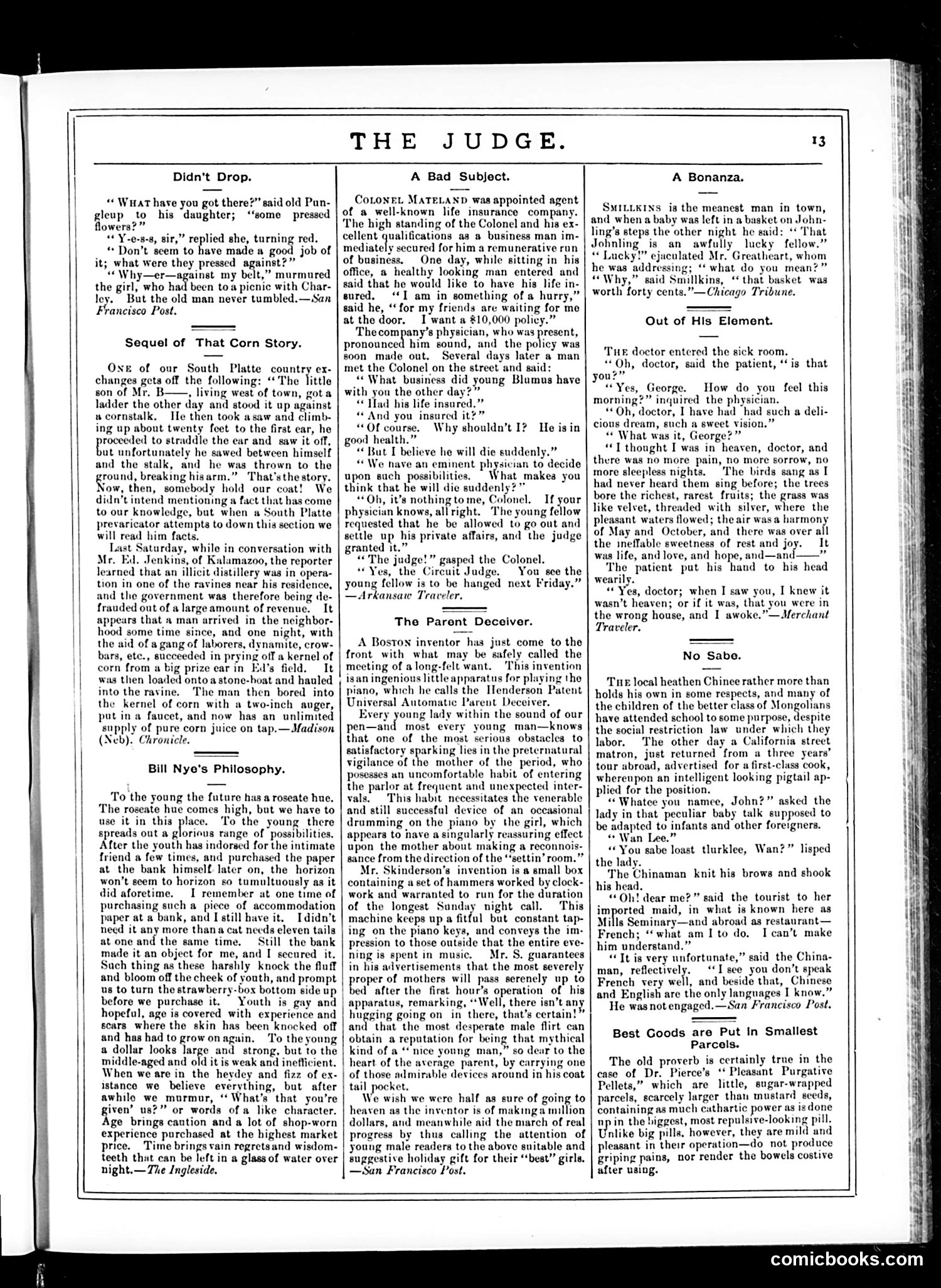
This page from Judge magazine (no specific date visible) contains several short humorous anecdotes typical of late 19th-century American satire: **"Didn't Drop"** - A mild joke about a girl caught with pressed flowers "against her belt" after a picnic with a boy; the father misses the innuendo. **"Sequel of That Corn Story"** - A tall tale about an absurdly improbable corn-farming accident, followed by an equally absurd counter-story about someone drilling into a corn kernel to create an illegal still. This mocks exaggerated frontier stories. **"Bill Nye's Philosophy"** - A cynical essay about how youth's optimism gets worn down by adulthood's harsh realities (failed loans, endorsements, inflation). It's a characteristic "grumpy wisdom" piece. **Right column items** - Additional brief anecdotes about insurance, doctors, and tourists, each making simple wordplay jokes. The page contains no political cartoons—it's purely text-based humor reflecting the magazine's satirical commentary on American life, social pretension, and frontier tall-tales.
This page from *Judge* magazine (appears to be late 19th century) contains primarily **short humorous anecdotes and advertisements** rather than political cartoons. ## Key Humor Pieces: **The Policeman's Sleep**: A joke about a policeman who sleeps constantly—humor derived from the stereotype that police officers are lazy or corrupt. **Soul vs. Body**: A schoolroom joke where a teacher asks about the difference; the child gives a correct but overly academic answer, poking fun at rote memorization in education. **The Coat and Assessors**: A man wears shabby clothes to property assessments to avoid taxes—satirizing tax evasion practices of the era. **The Woman and Cook**: Dark humor about a woman running away with a restaurant cook; the punchline assumes she'll either starve or face his poor cooking. **The Dairyman's Competency**: A riddle comparing wealthy vs. struggling farmers—commentary on agricultural economics. The page is primarily filled with **period advertisements** for products like Bird's Custard Powder, Brown's Iron Bitters, and "Catarrh Cream Balm," reflecting the magazine's reliance on patent medicine and consumer goods advertising.
This is primarily a **title/advertisement page** for *The Judge*, an illustrated satirical weekly magazine. The page contains minimal cartoons but substantial promotional content. The visible satirical content consists of brief **humorous quips** in the left column—short jokes about contemporary life mocking various groups: plumbers charging excessive bills, newspaper editors, doctors, roller skaters, and others. These are typical "short humor" filler common to 19th-century satirical magazines. The bulk of the page advertises **The Judge itself** (center-right), emphasizing its wit and sarcasm, and promoting it to advertisers as reaching educated, affluent readers—"the cream of the purchasing classes." Supporting advertisements for products like Pond's Extract, magic lanterns, and lithography services surround the masthead. **No major political figures or events are referenced** on this particular page. It's essentially promotional material showcasing the magazine's brand of humor rather than substantive political satire.
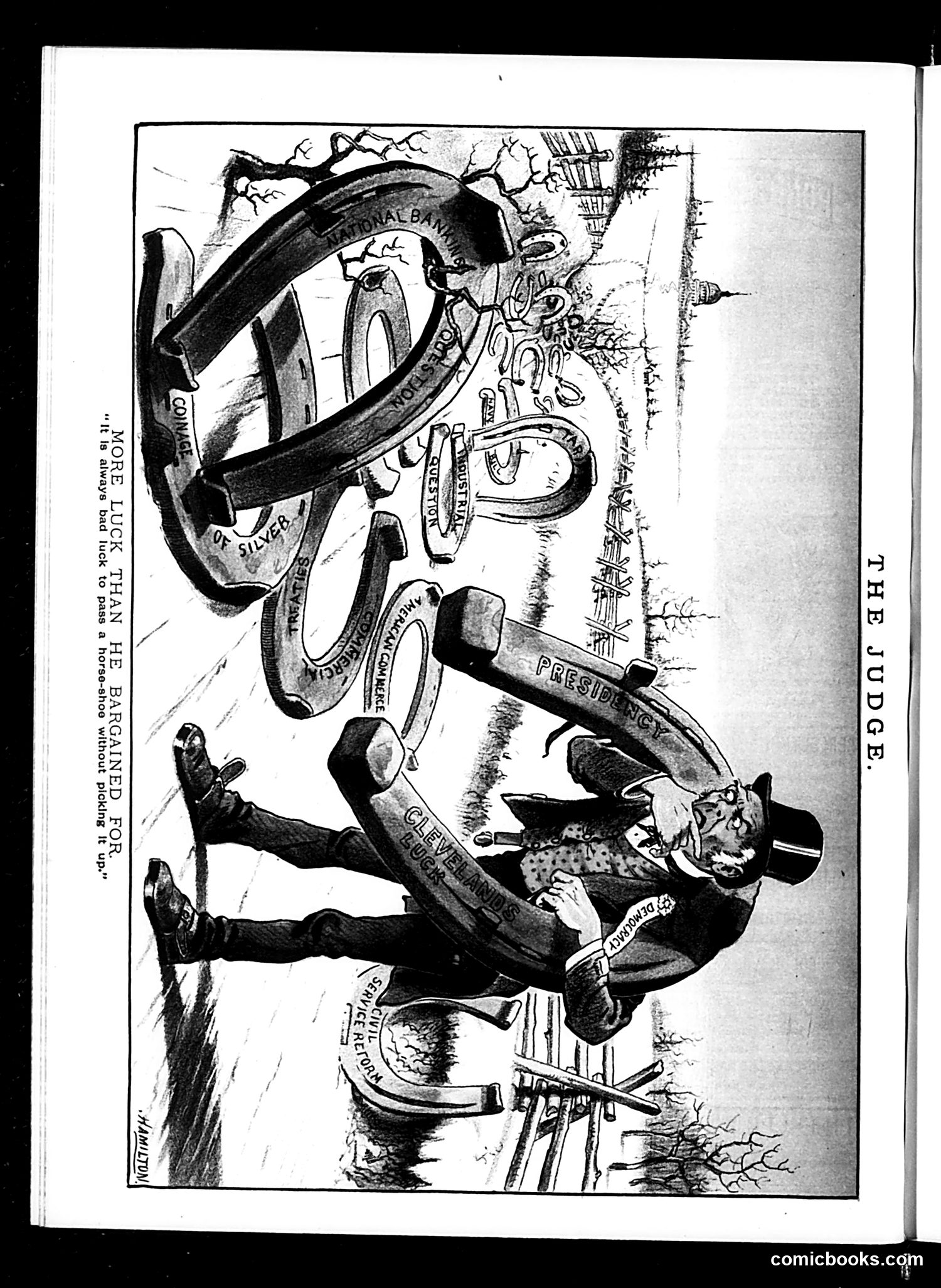
This political cartoon depicts a man in formal dress (top hat, suit) who has picked up a horseshoe, apparently seeking good luck. However, the satirical twist shows him being struck or affected by various horseshoes labeled with what appear to be political or social issues—they're swinging at him chaotically. The joke plays on the superstition that finding a horseshoe brings good fortune. Instead, this figure receives an overwhelming barrage of consequences, suggesting he got far more "luck" (or rather, problems) than he anticipated by meddling with something. Without clearer visible text on the horseshoes themselves, the specific political references remain uncertain, but the cartoon mocks the ironic outcome of pursuing what seems like a beneficial action.