
Judge, 1885-02-07 · page 13 of 16
Judge — February 7, 1885 — page 13: what you’re looking at
What you’re looking at
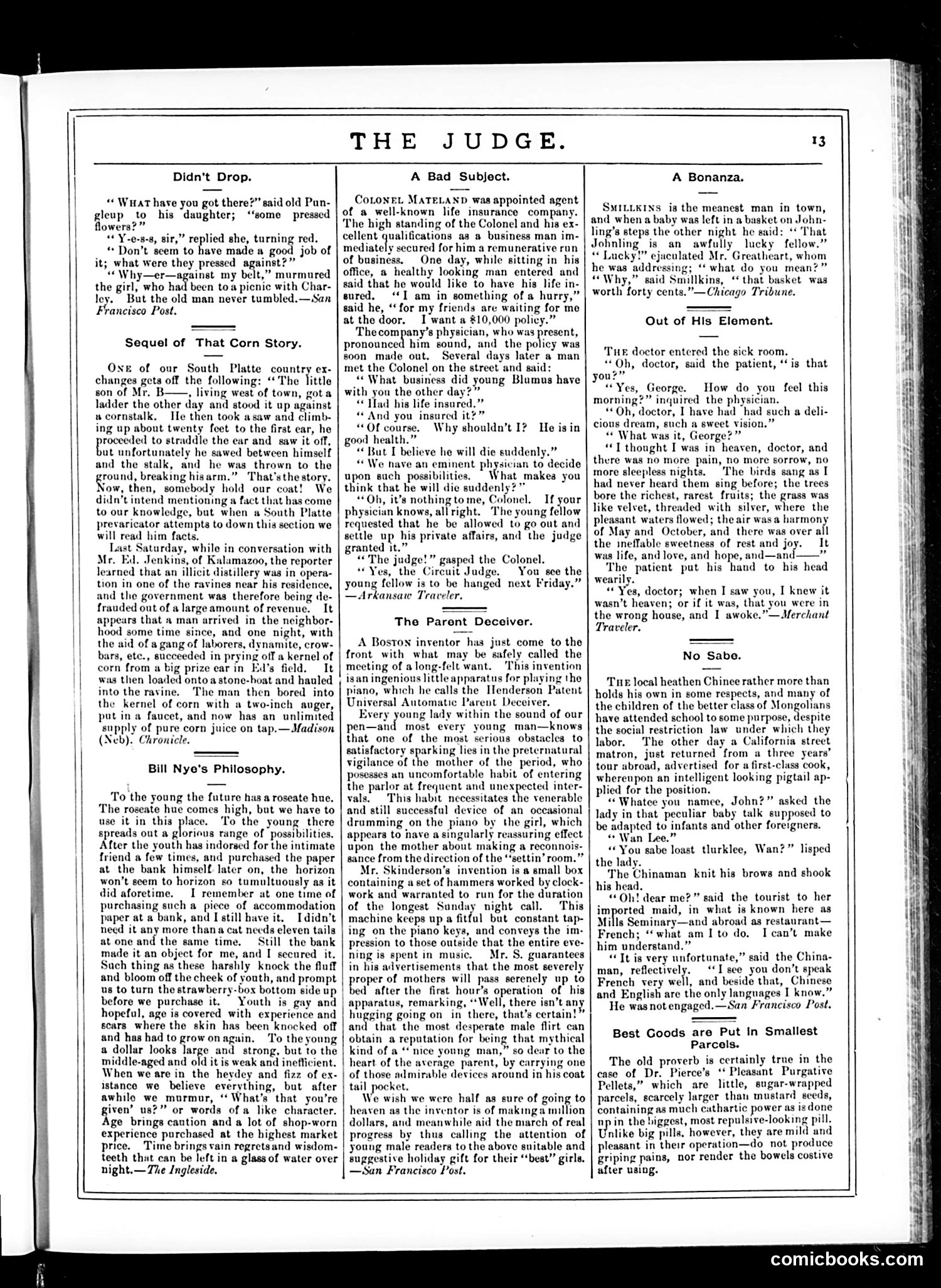
This page from Judge magazine (no specific date visible) contains several short humorous anecdotes typical of late 19th-century American satire: **"Didn't Drop"** - A mild joke about a girl caught with pressed flowers "against her belt" after a picnic with a boy; the father misses the innuendo. **"Sequel of That Corn Story"** - A tall tale about an absurdly improbable corn-farming accident, followed by an equally absurd counter-story about someone drilling into a corn kernel to create an illegal still. This mocks exaggerated frontier stories. **"Bill Nye's Philosophy"** - A cynical essay about how youth's optimism gets worn down by adulthood's harsh realities (failed loans, endorsements, inflation). It's a characteristic "grumpy wisdom" piece. **Right column items** - Additional brief anecdotes about insurance, doctors, and tourists, each making simple wordplay jokes. The page contains no political cartoons—it's purely text-based humor reflecting the magazine's satirical commentary on American life, social pretension, and frontier tall-tales.
📄 Transcribed text from this page (OCR, searchable)
Machine-transcribed from the original scan — historical spelling and the odd misread are preserved.
| THE JUDGE. Didn't Drop. “ Wut have you got there?” said old Pun- gleup to his daughter; ‘some pressed flowers?” “Y-e-8-8, sir,” replied she, turning red. “Don’t seem to have made a good job of it; what were they pressed against?” ““Why—er—against my belt,” murmured the girl, who had been toa picnic with Char- ley, But the old man never tumbled.—San Francisco Post. Sequel of That Corn Story. 0 of our South Platte country ex- changes gets off the following: “The little son of Mr. B , living west of town, gota ladder the other day and stood it up against acornstalk. Ife then took asaw and climb- ing up about twenty feet to the first ear, he proceeded to straddle the ear and saw it off, ut unfortunately he sawed between himself and the stalk, and he was thrown to the ground, breaking hisarm.” That’sthe story. Now, then, somebody hold our coat! We didn’t intend mentioning a fact that has come to our knowledge, but when a South Platte prevaricator attempts to down this section we will read him facts. Last Saturday, while in conversation with Mr. Ed. Jenkins, of Kalamazoo, the reporter learned that an illicit distillery was in opera- tion in one of the ravines near his residence, and the government was therefore being de- frauded out of a large amount of revenue. It appears that a man arrived in the neighbor- hood some time since, and one night, with the aid of a gang of laborers, dynamite, crow- bars, etc., succeeded in prying off a kernel of corn from a big prize ear in Ed’s field. It was then loaded onto a stone-hoat and hauled into the ravine. The man then bored into the kernel of corn with a two-inch auger, put ina faucet, and now has an unlimited supply of pure corn juice on tap.—Madison (Neb): Chronic! Bill Nye’s Philosophy. To the young the future has a roseate hue, The roseate hue comes high, but we have to use it in this place. To the young there spreads out a glorious range of possibilities. After the youth has indorsed for the intimate friend a few times, and purchased the paper at the bank himself later on, the horizon won't seem to horizon so tumultuously as it did aforetime. I remember ut one time of purchasing such a piece of accommodation paper at a bank, and I still have it, [didn’t need it any more than a cat necds eleven tails at one and the same time. Still the bank made it an object for me, and [ secured it. Such thing as these harshly knock the fluff and bloom off the cheek of youth, and prompt us to turn the strawberry-box bottom side up before we purchase it. Youth is gay and hopeful, age is covered with experience and scars where the skin has been knocked off and has had to grow onagain. To the young a dollar looks large and strong, but to the middle-aged and old it is weak and inefficient. When we are in the heydey and fizz of ex- istance we believe everything, but after awhilo we murmur, ‘What's that you’re given’ us?” or words of a like character. Age brings caution and a lot of shop-worn experience purchased at the highest market price. Time brings vain regretsand wisdom- teeth that can be left in a glass of water over night.— The Ingleside, A Bad Subject. CotoneL MATELAND was appointed agent of a well-known life insurance company. The high standing of the Colonel and his ex- cellent qualifications as a business man im- mediately secured for him a remunerative run of business. One day, while sitting in his office, a healthy looking man entered and said that he would like to have his life in- sured. ‘I am in something of a hurry,” said he, ‘for my friends are waiting for me at the door. I want a $10,000 policy.” Thecompany’s physician, who was present, pronounced m sound, and the policy was soon made out. Several days Jater a man met the Colonel on the street and said: “ What business did young Blumus have with you the other day?” “ Tfad his life insured.” “ And you insured it?” “Of course. Why shouldn’t 1? good health.” “But I believe he will die suddenly.” “We nave an eminent physician to decide upon such possibilities. What makes you think that he will die suddenly?” “Oh, it’s nothing tome, Colonel. If your physician knows, allright. ‘The young fellow requested that he be allowed to go out and settle up his private affairs, and the judge granted it.” “The judge!” gasped the Colonel. “Yes, the Circuit Judge. You see the young fellow is to be hanged next Friday.” —Arkansaw Traveler. He isin The Parent Deceiver. A Boston inventor has just come to the front with what may be safely called the meeting of along-felt want. ‘This invention isan ingenious little apparatus for playing the piano, which he calls the Henderson Patent Universal Automatic Parent Deceiver, Every young lady within the sound of our pen—and most every young man—knows that one of the most serious obstacles to satisfactory sparking lies in the preternatural vigilance of the mother of the period, who posesses un uncomfortable habit of entering the parlor at frequent and snaspectet inter- vals, This habit necessitates the venerable and still successful device of an occasional dramming on the piano by the girl, which appears to have a singularly reassuring effect upon the mother about making a reconnois- sance from the direction of the “‘settin’ room.” Mr. Skinderson’s invention is a small box containing a set of hammers worked by clock- work and warranted to run for the duration of the longest Sunday night call. ‘This machine keeps up a fitful but constant tap- ing on the piano keys, and conveys the im pression to those outside that the entire eve- ning is spent in music. Mr. S. guarantees in his advertisements that the most severely proper of mothers will pass serenely up to bed after the first hour’s operation of his apparatus, remarking, ‘‘Well, there isn’t any hugging going on in there, that’s certain!” and that the most desperate male flirt can obtain a reputation for being that mythical kind of a “ nice young man,” so dear to the heart of the average parent, by carrying one | of those admirable devices around in his coat tail pocket. We wish we were half as sure of going to heaven as the inventor is of makinga million dollars, and meanwhile aid the march of real progress by thus calling the attention of young male readers to the above suitable and suggestive holiday gift for their “best” girls. —San Francisco Post. 13 A Bonanza. SsiLtKrns is the meanest man in town, and when a baby was left in a basket on John: ling’s steps the other night he said: ** That Johnling is an awfully lucky fellow.” “ Lucky!” ejaculated Mr. Greatheart, whom he was ‘addressing; “ what do you mean?” “Why,” said Smillkins, ‘that basket was worth forty cents.”—Chicago Tribune. Out of His Element. Tue doctor entered the sick room. _ ‘Oh, doctor, said the patient, ‘is that George. How do you feel this morning?” inquired the physician. “Oh, doctor, I have had had such a deli- cious dream, such a sweet vision,” What was it, George?” “T thought I was in heaven, doctor, and there was no more pain, no more sorrow, no more sleepless nights. "The birds sang as I had never heard them sing before; the trees bore the richest, rarest fruits; the grass was like velvet, threaded with silver, where the pleasant waters flowed; the air was a harmony of May and October, and there was over all the ineffable sweetness of rest and joy. It was life, and love, and hope, and—anc “a ‘The patient put his hand to his head wearily. “Yes, doctor; when I saw you, I knew it wasn’t heaven; or if it was, that you were in the wrong house, and I awoke.”—AMerchant Traveler. No Sabe. Tne local heathen Chinee rather more than holds his own in some respects, and many of the children of the better class of Mongolians have attended school to some purpose, despite the social restriction law under which they labor. The other day a California street matron, just returned from a three years’ tour abroad, advertised for a first-class cook, whereupon an intelligent looking pigtail ap- plied for the position. “Whatce you namee, John?” asked the lady in that ‘peculiar baby talk supposed to be adapted to infants and other foreigners. * Wan Lee.” “You sabe loast tlurklee, Wan?” lisped the lady. The Chinaman knit his brows and shook his head, “Oh! dear me?” said the tourist to her imported maid, in what is known here as Mills Seminary—and abroad as restaurant— French; “what am I to do. I can’t make him understand.” “Tt is very unfortunate,” said the China- man, reflecti . Tee you don’t speak French very well, and beside that, Chinese and English are the only languages I know.” He wasnotengaged.—San Francisco Post. Best Goods are Put in Smallest Parcels. The old proverb is certainly true in the case of Dr. Pierce’s ‘‘ Pleasant Purgative Pellets,” which are little, sugar-wrapped parcels, scarcely larger than tnustard seeds, containing as much cathartic power as is done npin the biggest, most repulsive-looking pill. Unlike big pilla, however, they are mild and pleasant in their operation—do not produce griping pains, nor render the bowels costive after using. comicbooks.com