
A complete issue · 16 pages · 1885
Judge — January 24, 1885
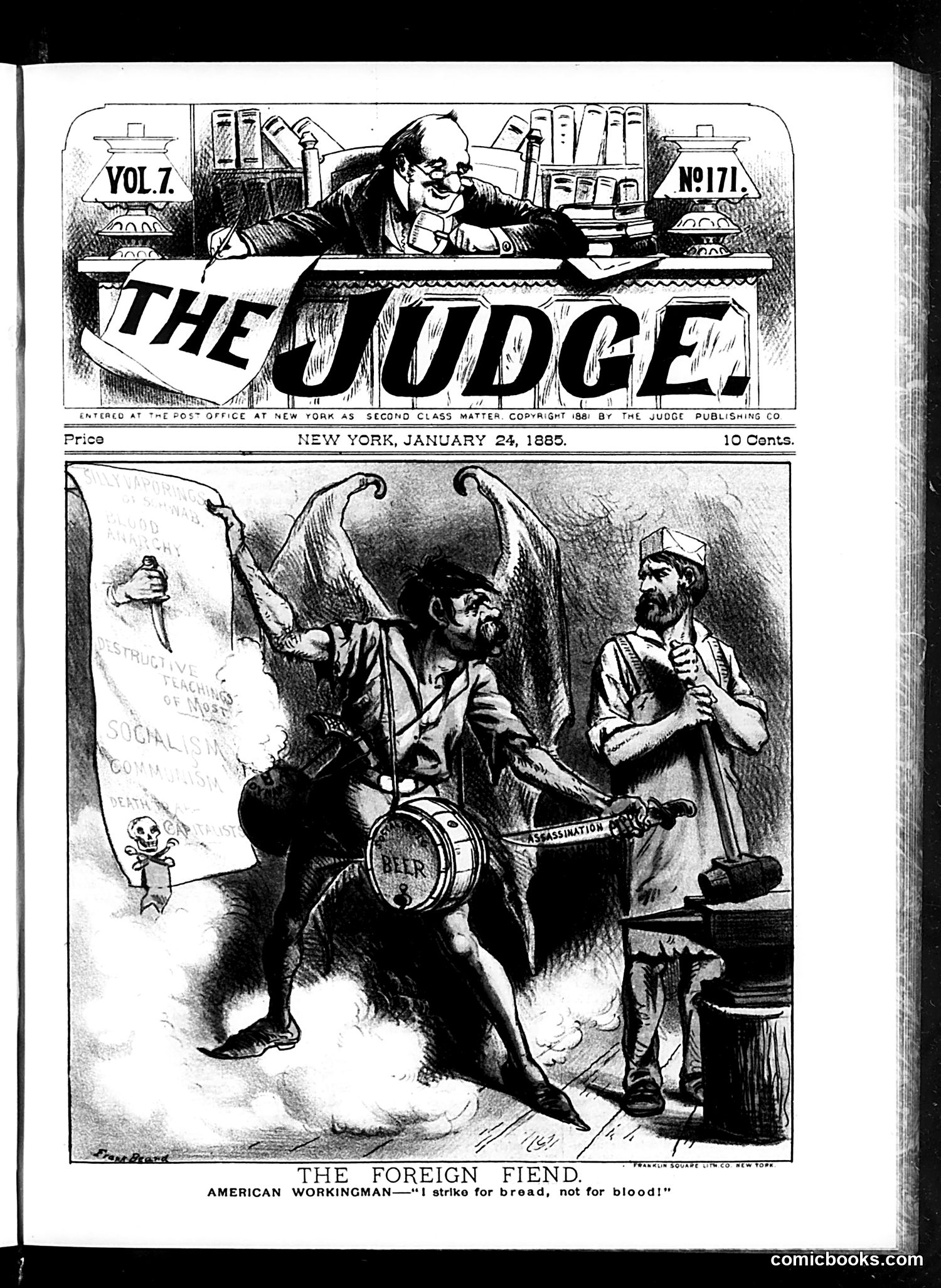
This political cartoon depicts an anarchist or radical socialist agitator (center, with distinctive pointed ears/horns suggesting demonic association) stirring up American workers. The figure holds a barrel labeled "BEER" while brandishing weapons, flanked by two working-class men. Behind them looms a document listing socialist/communist concepts including "DEATH TO CAPITAL." The caption—"American Workingman: 'I strike for bread, not for blood!'"—frames the satire: respectable workers seek fair wages, while foreign radicals cynically exploit labor discontent to promote violent revolution. The demonic imagery and foreign appearance suggest anxieties about European anarchist and socialist immigrants allegedly corrupting American labor movements. This reflects 1880s fears of radical foreign influence on domestic worker organizing.
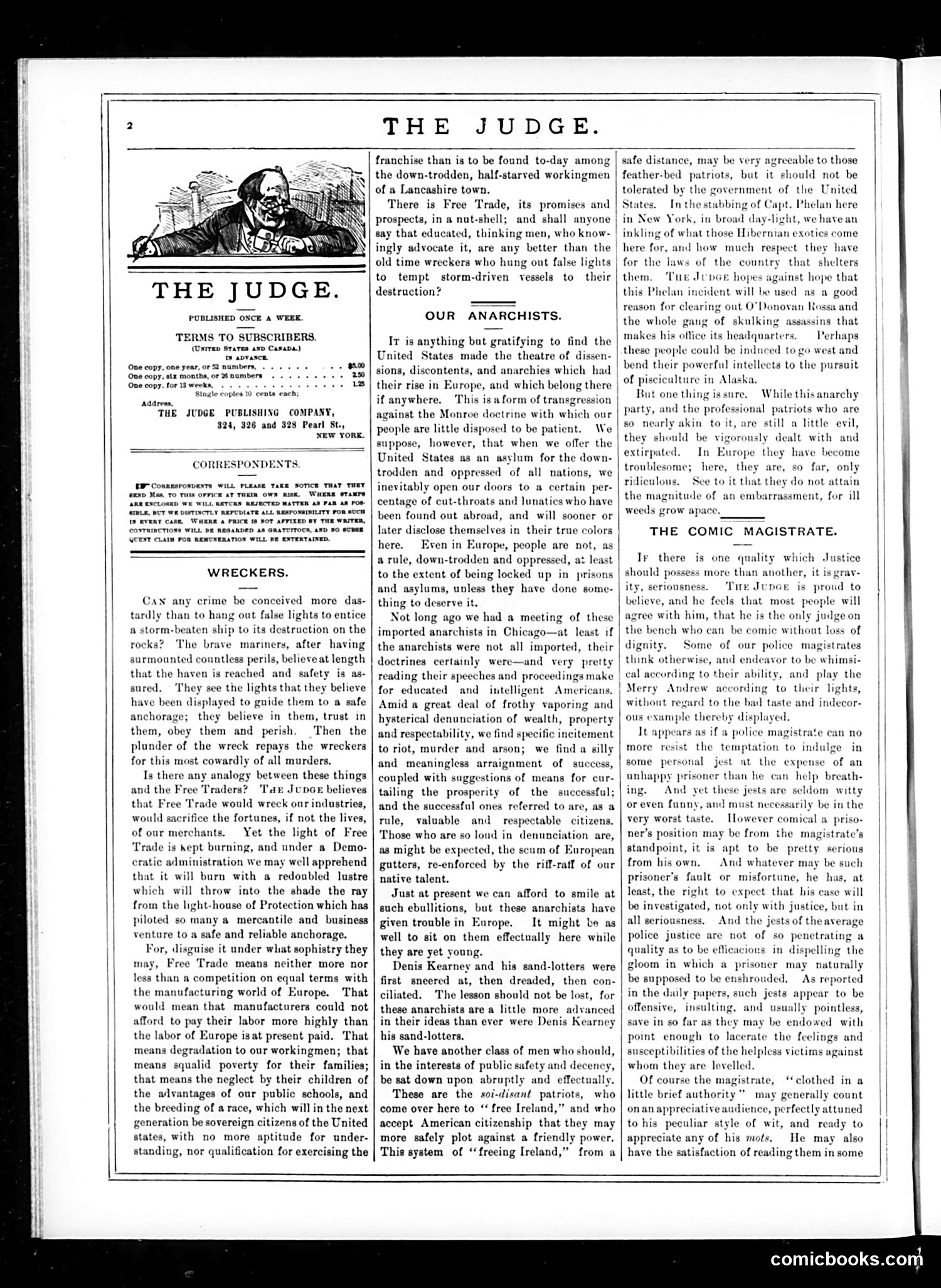
This page contains three editorials attacking political opponents through inflammatory metaphors: **"Wreckers"** compares Free Trade advocates to murderous wreckers who lure ships to destruction with false lights. The Judge argues Free Trade would "wreck our industries" and force American workers into European-level poverty. This protectionist argument frames trade liberalization as treacherous. **"Our Anarchists"** attacks European immigrants, particularly anarchists who fled political persecution abroad. The piece resents that America accepted "the down-trodden and oppressed," arguing this inevitably imports dangerous "cut-throats and lunatics." It invokes the Monroe Doctrine defensively, treating radical ideology as foreign contamination. **"The Comic Magistrate"** criticizes lenient judges who dismiss charges against prisoners without proper investigation, appearing to favor judicial severity over mercy. The overall tone reflects 1880s-90s anxieties: protectionist economics, anti-immigrant sentiment, and social conservatism. The magazine positions itself as defending American industry, order, and traditional justice against foreign radicalism and soft-on-crime judges.
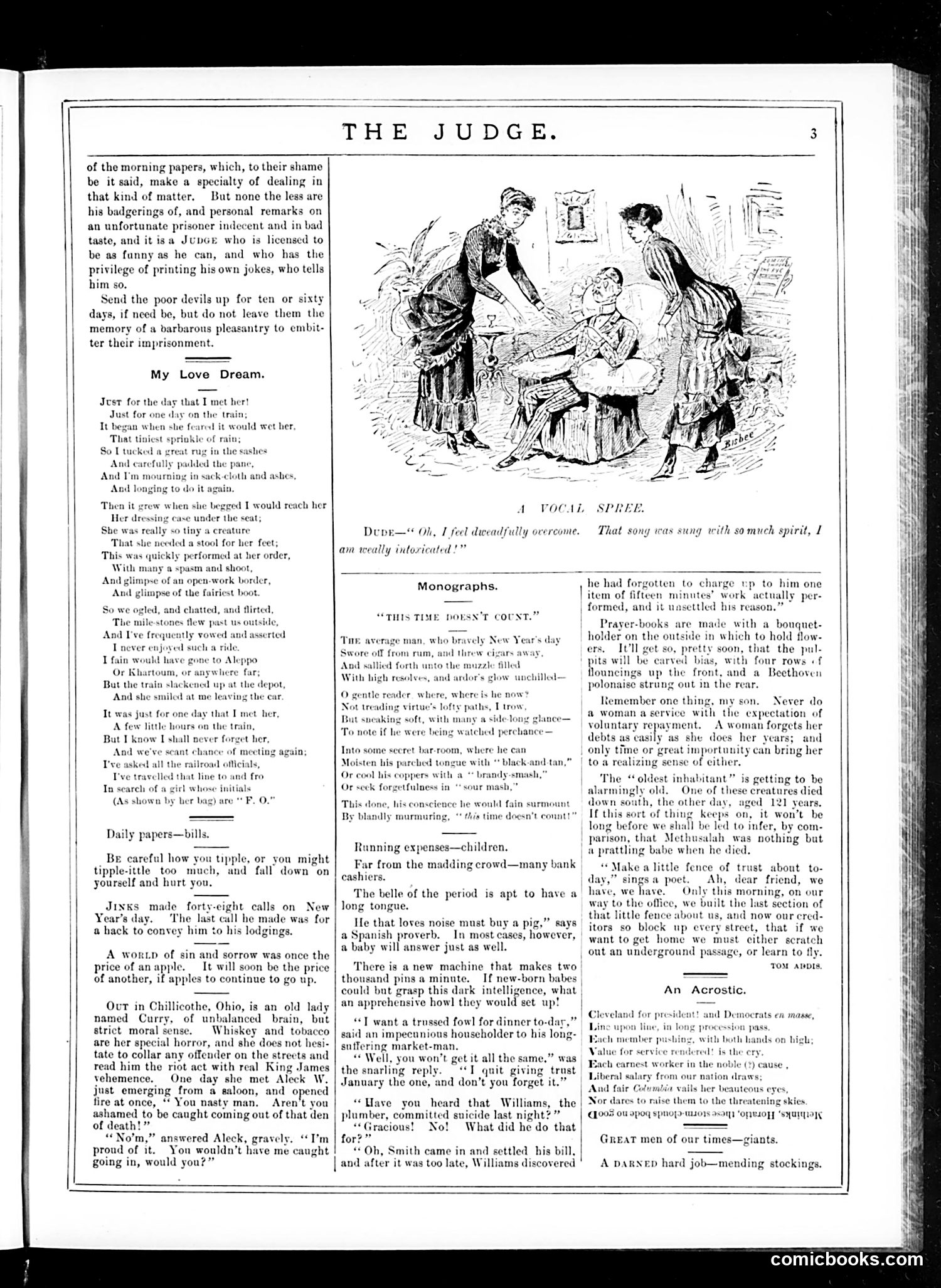
This page from the satirical magazine *Judge* contains multiple pieces of social commentary typical of late-19th-century American humor. **Main Cartoon ("A Vocal Spree")**: Depicts a drunk man being supported by women, illustrating the common Victorian theme of alcohol's degrading effects on respectability and family. **"This Time Doesn't Count"**: Satirizes New Year's resolutions, particularly men who swear off drinking but immediately backslide into bars and saloons—mocking the hypocrisy of temporary moral reformations. **Other Pieces**: The page includes various brief satirical observations on contemporary life: the absurdity of rising apple prices, criticism of a judge's harsh treatment of prisoners in newspaper coverage, commentary on women's fashion (women needing stools to reach things), and jabs at running expenses (particularly children). The overall tone reflects *Judge's* mission: mocking human weakness, particularly male indulgence in alcohol and moral inconsistency, while poking fun at social pretensions and economic anxieties of the era.
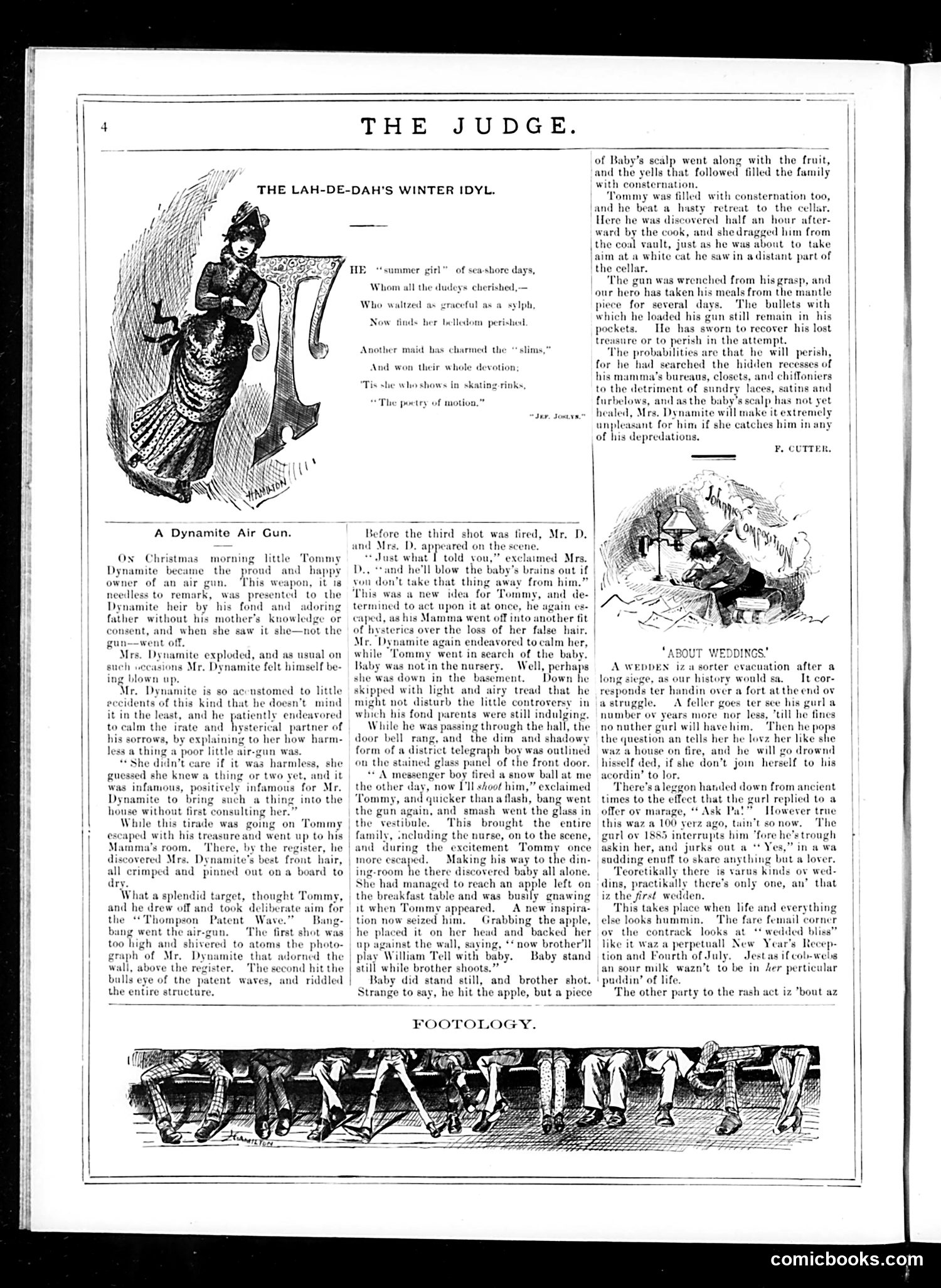
This story satirizes **negligent parenting and dangerous toys** in the Gilded Age. "Mr. Dynamite" (likely a wealthy industrialist, given the name) gives his son Tommy an air gun as a Christmas gift without his wife's knowledge—a reckless decision that sets off a chain of comedic disasters. The satire targets: 1. **Paternal irresponsibility**: The father dismisses his wife's legitimate safety concerns 2. **Class privilege**: Wealthy parents indulging children with dangerous playthings 3. **Escalating chaos**: Tommy shoots the family portrait, a telegraph boy's equipment, and finally—most outrageously—wounds his baby sister while reenacting William Tell The punchline is the absurdity of a child nearly killing a sibling with a toy gun, yet facing only meal restrictions as punishment. Judge uses hyperbolic domestic mayhem to mock both permissive parenting and the era's cavalier attitudes toward children's safety. The character name "Dynamite" reinforces the explosive, destructive consequences of such negligence.
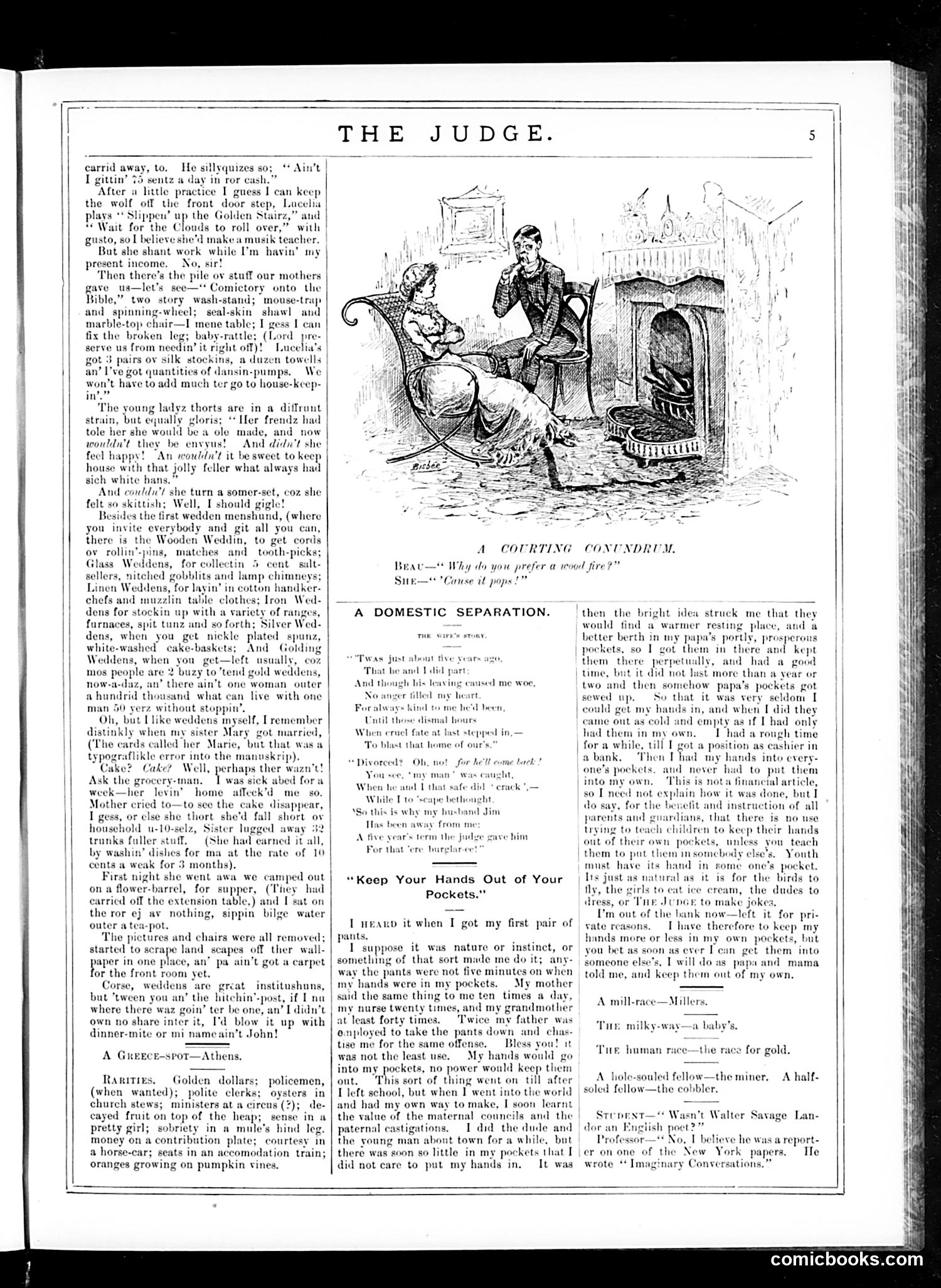
This page from *Judge* contains two distinct pieces of satirical humor aimed at middle-class American readers. **"A Courting Conundrum"** (top illustration) shows a courting couple; the joke plays on the woman's preference for a wood fire because "it pops"—a double entendre suggesting both the literal crackling of wood and flirtation. **"A Domestic Separation"** (main article) presents a husband's narrative about his marriage, focusing on how he keeps valuables in his wife's pockets because she never uses them. The satire mocks both women's perceived inability to manage money and husbands' condescending attitudes toward their wives. The piece ridicules domestic economics of the era while poking fun at marital dynamics and gender roles. The humor relies on contemporary assumptions about women's extravagance and incompetence with finances—attitudes that would strike modern readers as sexist, though period audiences found this standard domestic satire amusing.
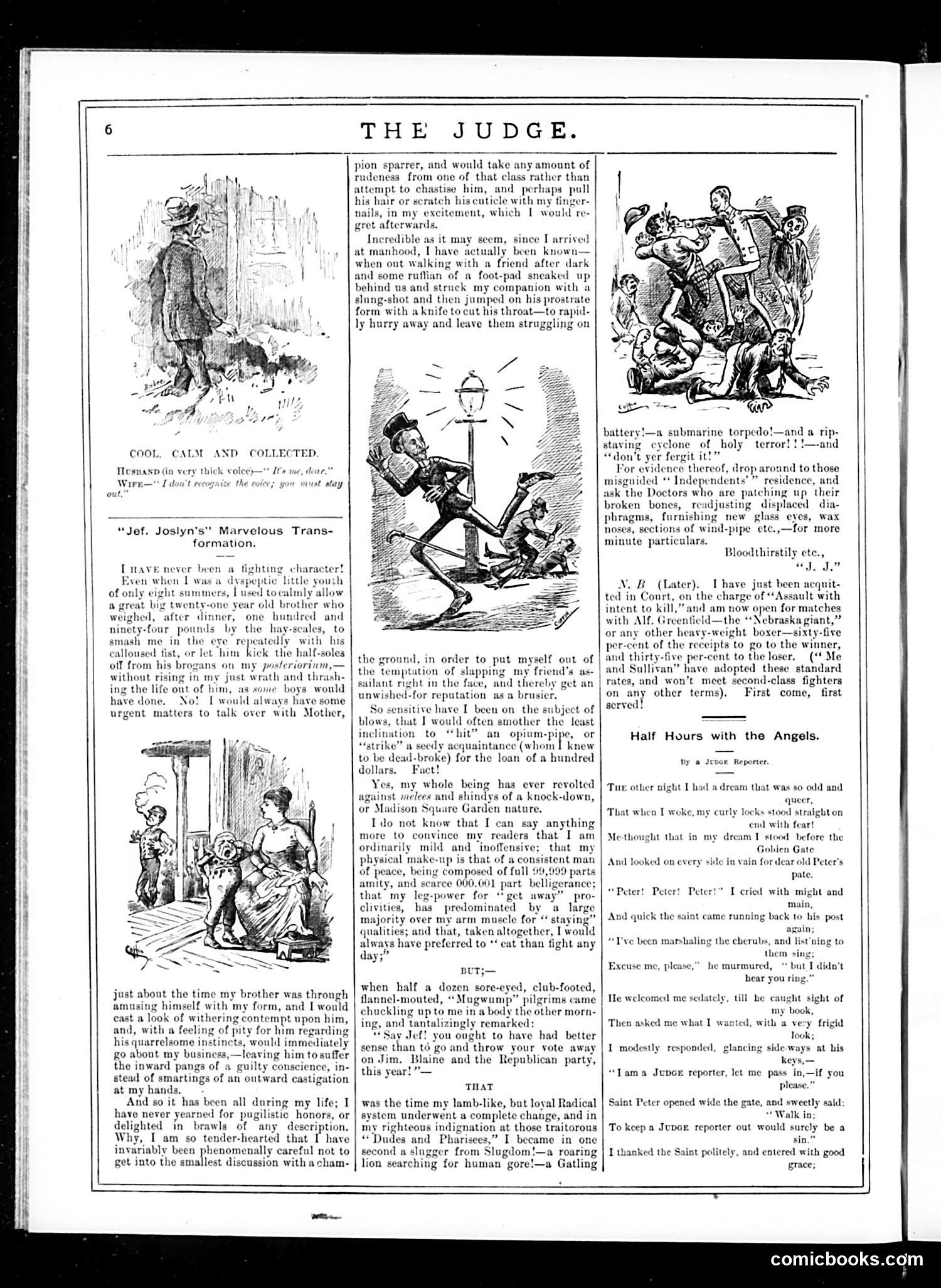
This satirical piece mocks "Mugwumps"—Republicans who abandoned James G. Blaine's 1884 presidential campaign to support Democrat Grover Cleveland. The author, "Jef. Joslyn," claims he's a pacifist who avoids violence, but when these political defectors ("sore-eyed, club-footed" Mugwumps) mock his loyalty to Blaine and the Republican party, he transforms into a violent fighter—"a roaring lion," a "Gatling" gun, a "submarine torpedo." The joke: his political convictions override his supposed gentleness. The cartoons illustrate this transformation from meek to aggressive. Judge, a Republican publication, uses exaggeration and absurdity to ridicule Mugwumps as deserters and to suggest that defending one's political principles justifies violence. The satire attacks both the Mugwumps' disloyalty and implicitly celebrates partisan passion.
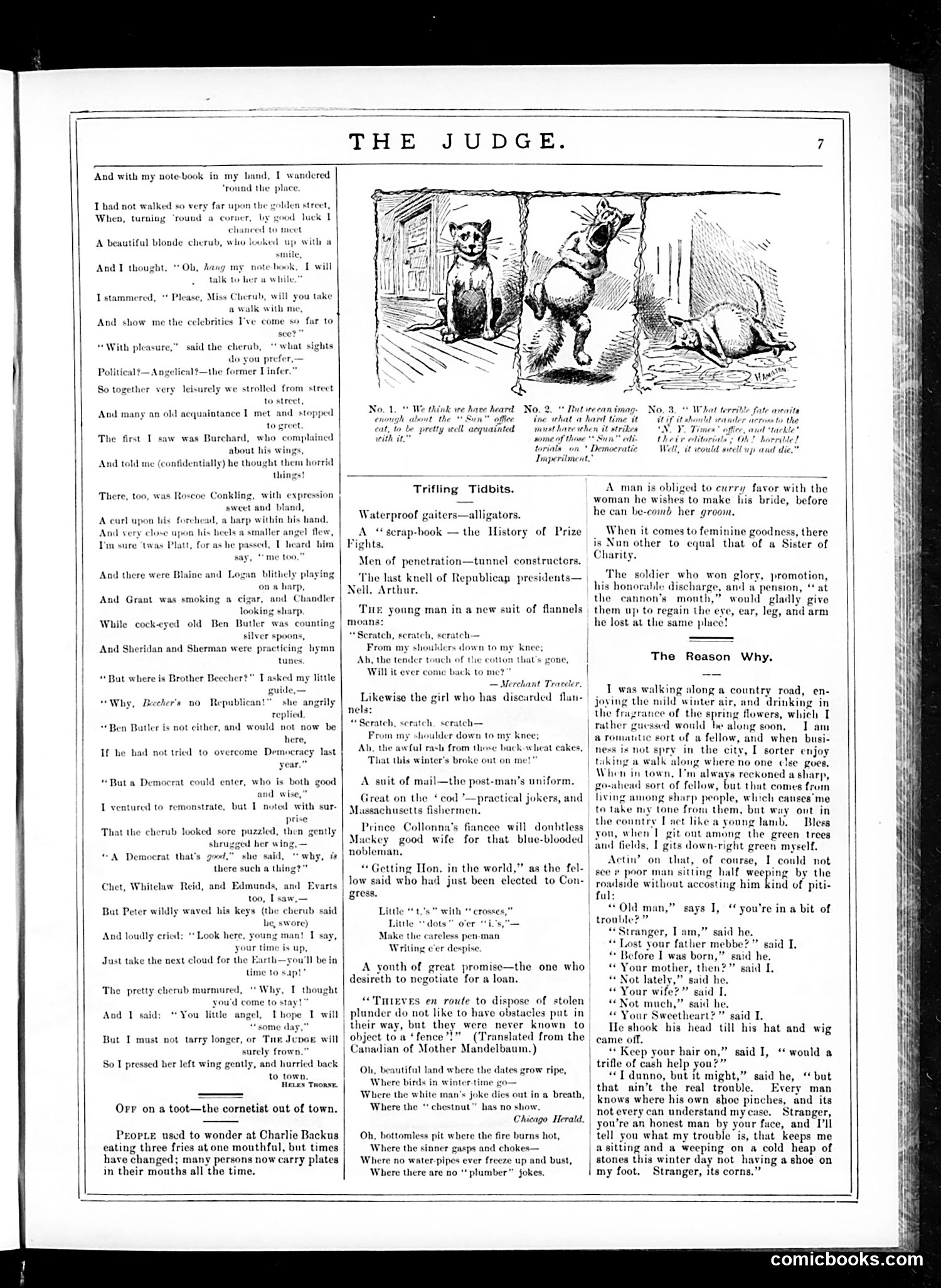
This page presents a satirical narrative where the author encounters prominent political figures in Heaven. The central cartoon depicts recognizable 1870s politicians including **Roscoe Conkling**, **Ulysses S. Grant**, **Ben Butler**, and **William Tecumseh Sherman**. The satire's point: a cherub guide expresses shock that **James G. Blaine** (a Republican presidential candidate) isn't present because he's "no Republican," while **Ben Butler** is excluded for having been a Democrat. When the narrator protests this arbitrary logic, the cherub becomes flustered—the joke satirizing the era's fluid party loyalties and hypocrisy among politicians who switched allegiances opportunistically. The page also includes "Trifling Tidbits"—brief wordplay jokes about contemporary figures like **Chester Arthur** and references to political scandals, typical of Judge magazine's blend of visual and textual political humor targeting Gilded Age corruption and inconsistency.
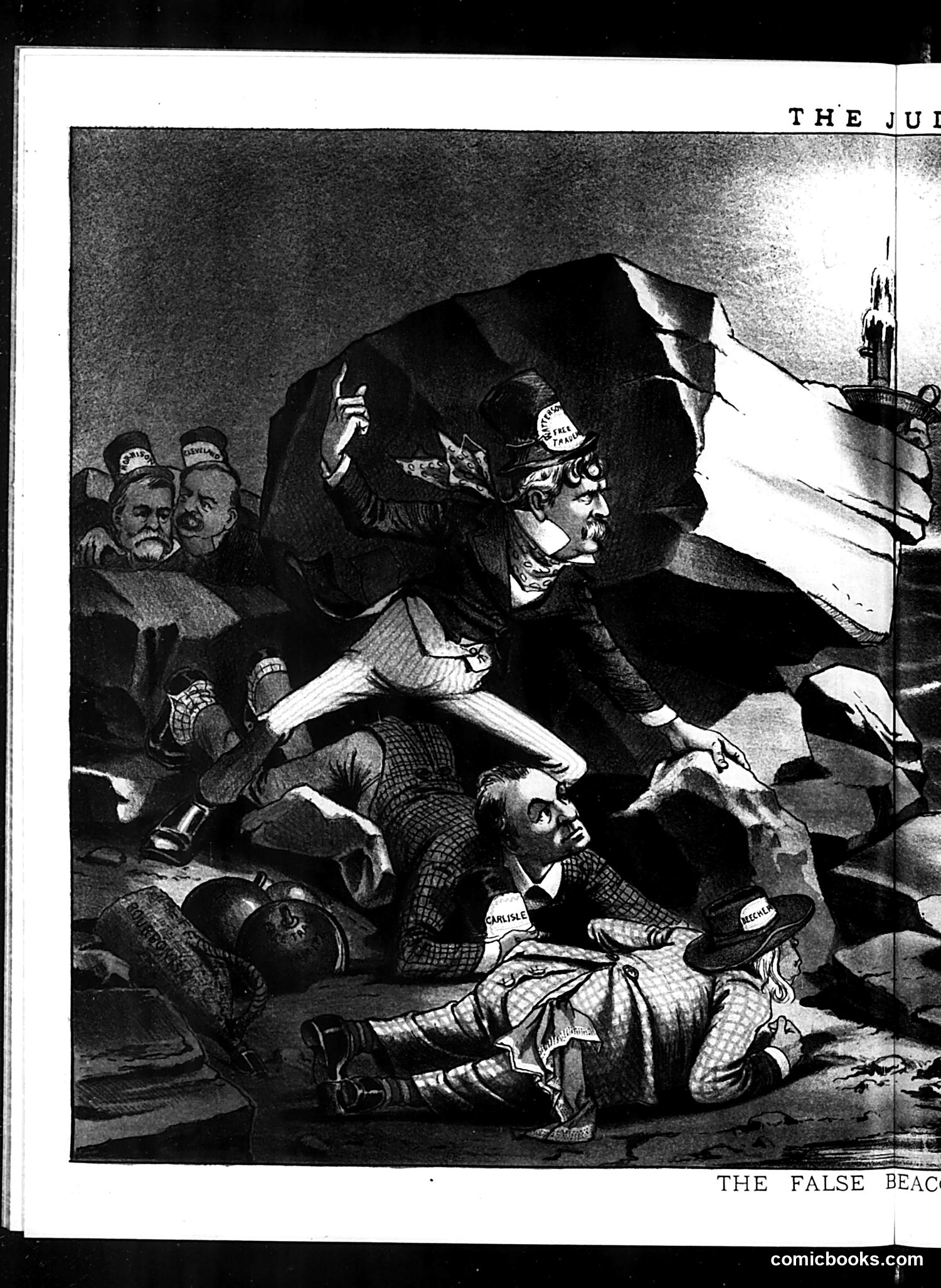
This political cartoon from *Judge* magazine depicts a grotesque caricature of what appears to be a European military or political figure (identifiable by the spiked helmet and military regalia) looming menacingly over fallen soldiers and casualties. The title "The False Beach" suggests commentary on a deceptive military operation or false promise of safety. The satire likely critiques European militarism or a specific conflict, with the authoritarian figure portrayed as responsible for the deaths below. The "false" element may reference propaganda or misleading military claims to soldiers about beachhead operations or security. Without a precise date visible, the specific historical event remains unclear, though the art style and subject matter suggest early-to-mid 20th century geopolitical tensions in Europe.
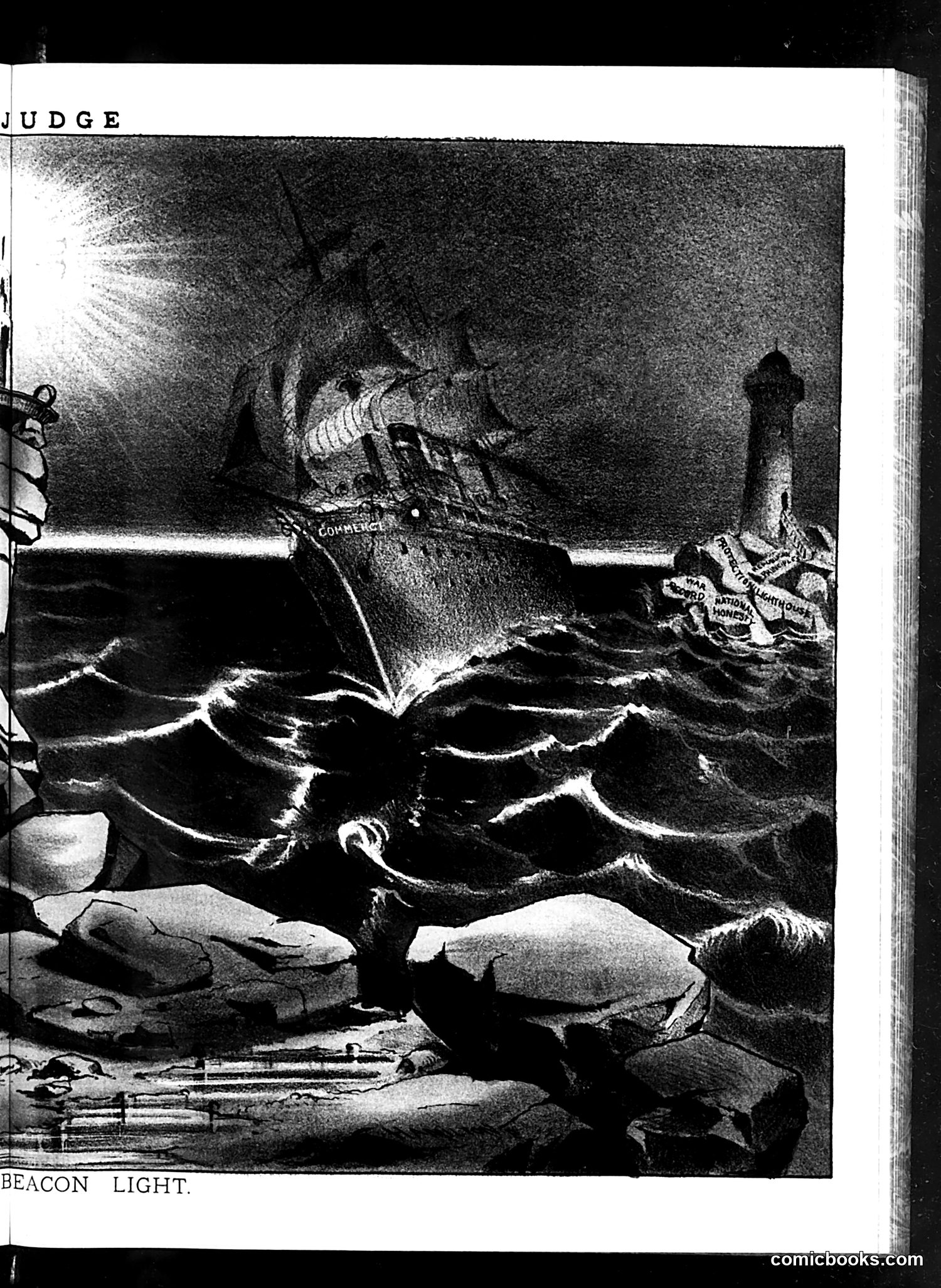
This page from *Judge* magazine shows a dramatic maritime illustration titled "Beacon Light." The image depicts a shipwreck scene with a damaged vessel in stormy seas and a lighthouse beacon shining in the distance. However, the OCR text provided ("comicbooks.com") appears to be a watermark rather than actual magazine content, making it impossible to identify the specific political or social satire intended. Without legible caption text or article content accompanying this illustration, I cannot reliably explain what figure or event this cartoon references, or what point the satire makes. The artistic quality suggests this is editorial content rather than advertisement, but the satirical meaning remains unclear from the image alone.
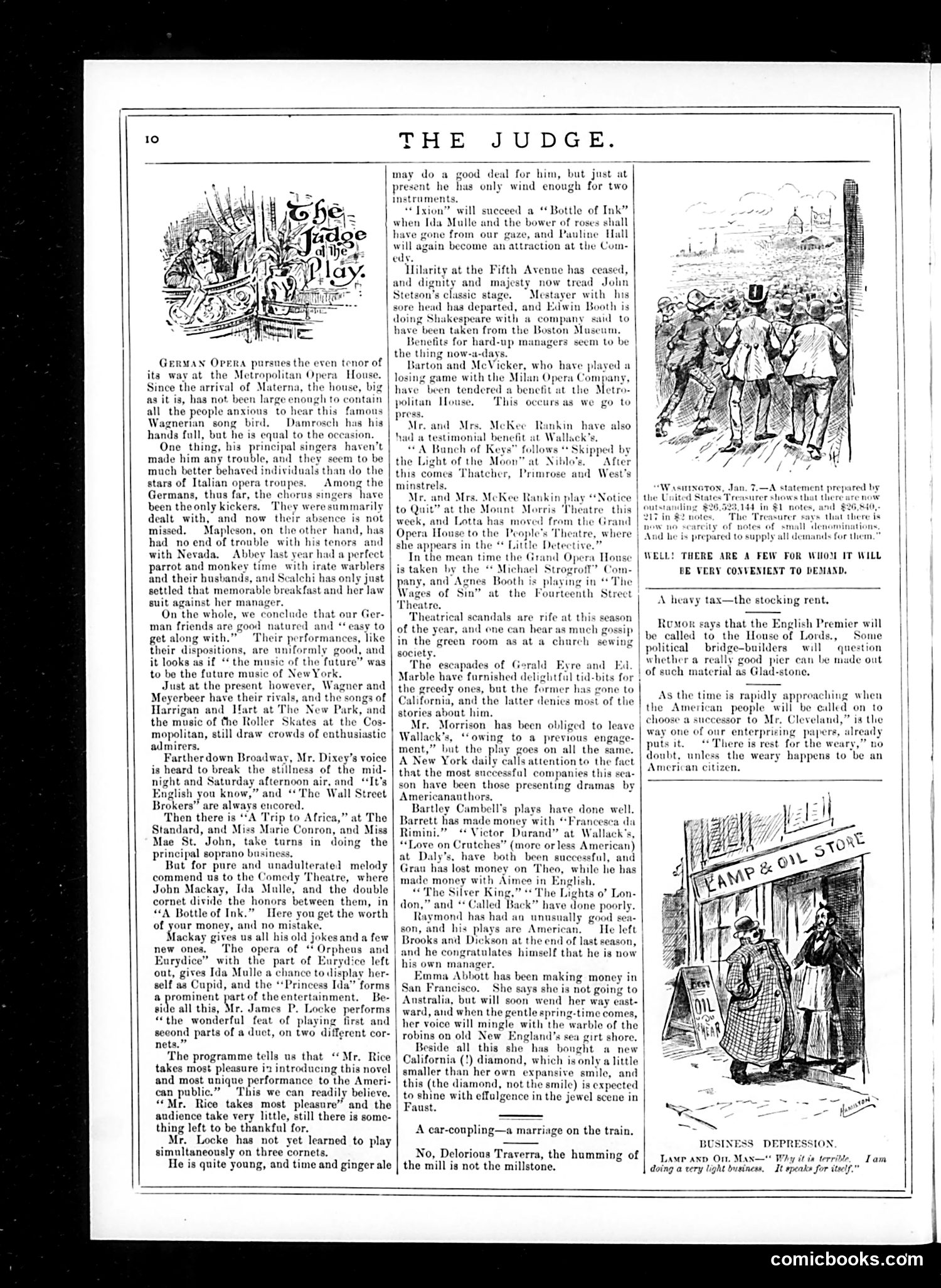
This page from Judge magazine (circa 1880s) reviews New York theatrical performances, with particular focus on opera and musical comedy. The main satirical targets are: **German Opera at the Metropolitan**: The text praises German opera's popularity under conductor Damrosch, noting audiences so large the venue can barely contain them. However, the piece gently mocks the genre's pretensions by contrasting it with more populist entertainments—roller skating at the Cosmopolitan and comedy shows drawing equally enthusiastic crowds. **"A Bottle of Ink" at Comedy Theatre**: Satirized as absurdist entertainment featuring John Mackay's recycled jokes, a cornetist attempting to play two instruments simultaneously (humorously failing), and Ida Mulle as "Cupid." The satire suggests audiences accept ridiculous novelty acts uncritically. **The cartoons** (right side) appear to depict theatrical scenes and business depression, likely commenting on financial instability affecting entertainment venues. The overall tone mocks both high-art pretension and lowbrow entertainment's willing audiences—suggesting New York's theater scene reflects broader social contradictions between cultural aspiration and commercial spectacle.
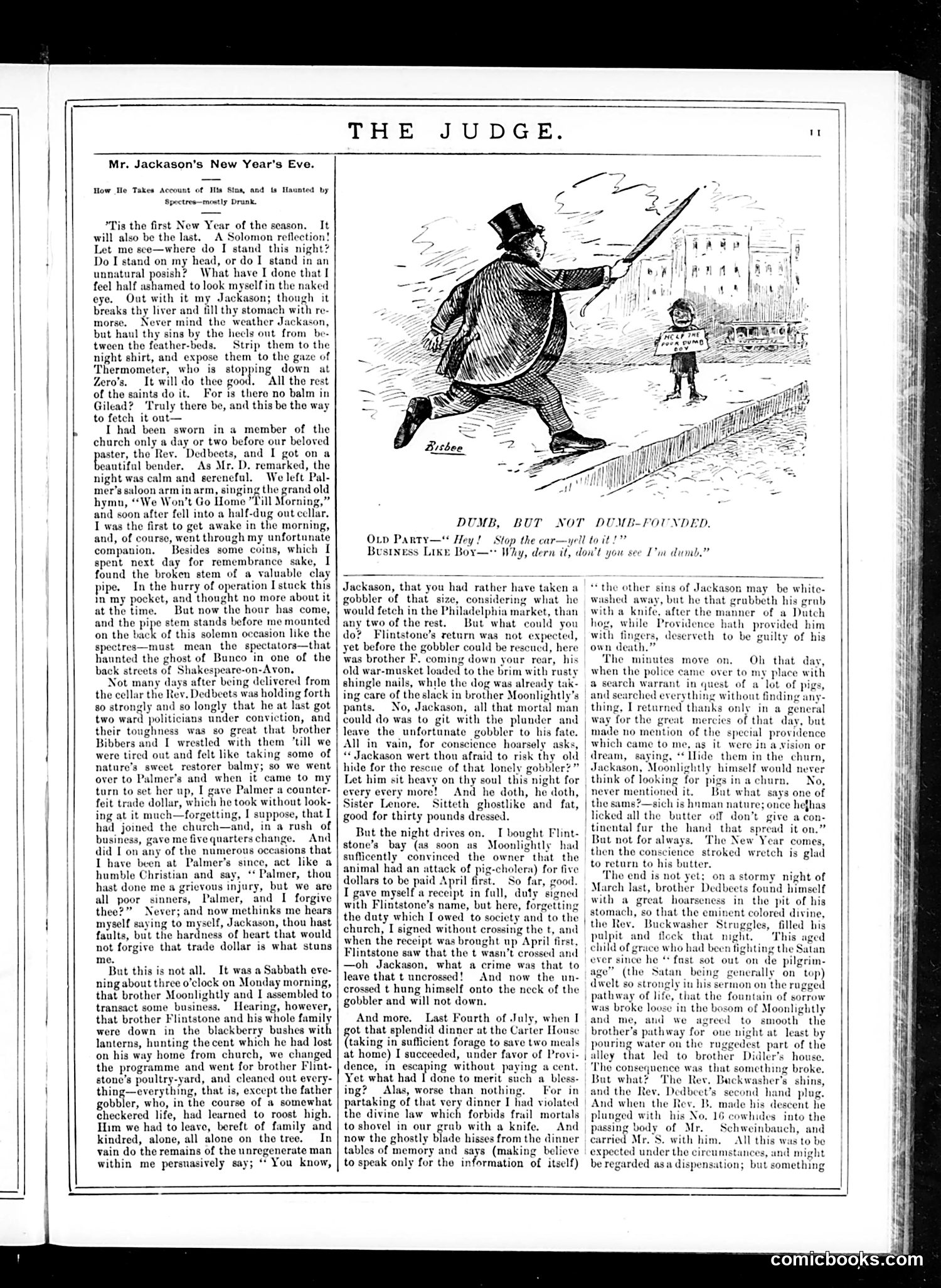
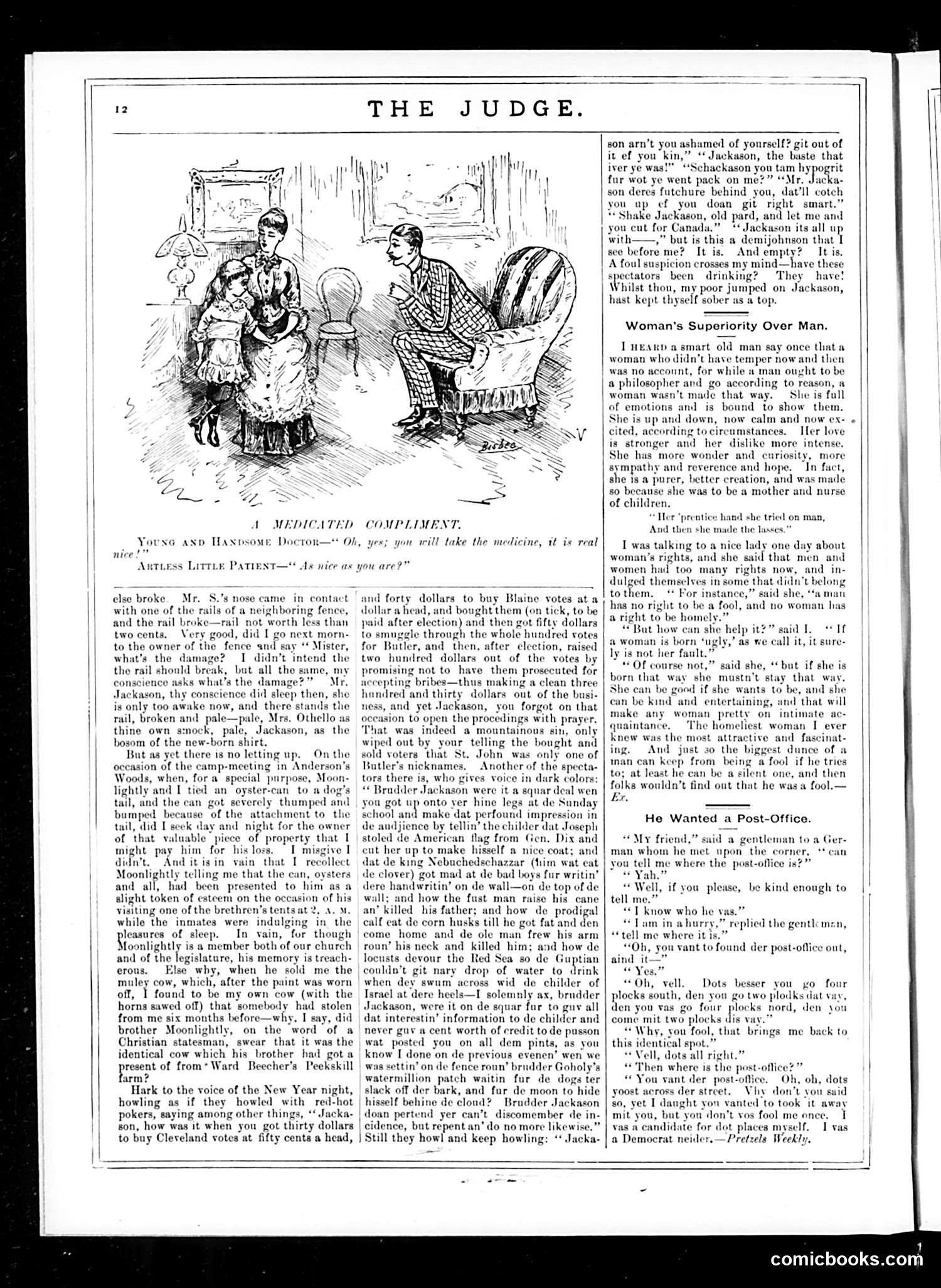
This satirical piece depicts a man named Jackson conducting a drunken moral inventory on New Year's Eve, confessing various misdeeds while intoxicated. The accompanying illustration shows him stumbling in the snow, disheveled and unsteady. The satire targets hypocrisy: Jackson recently joined a church but has committed petty crimes—stealing from a reverend companion, passing counterfeit currency to a barkeeper while withholding forgiveness, and poaching a neighbor's poultry. The text presents his drunken self-recriminations ironically; his "confessions" expose how easily nominal Christian virtue crumbles under alcohol and temptation. The joke suggests that New Year's resolutions and religious conversion are hollow when tested by moral weakness. Jackson represents the self-deceiving hypocrite who recognizes his sins only when drunk enough to articulate them—implying he'll return to the same behavior once sober.
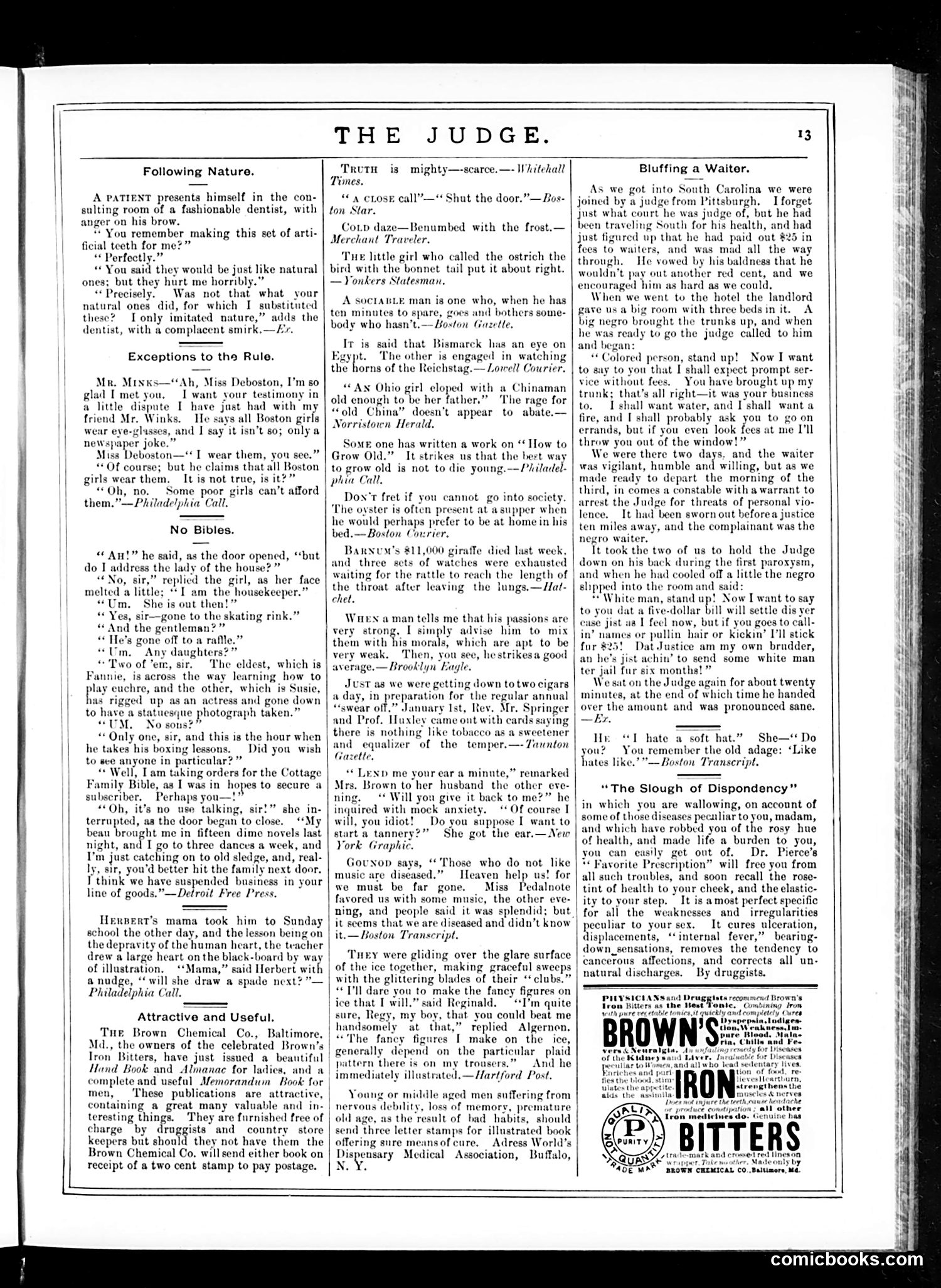
This page contains multiple satirical short pieces typical of Judge magazine's humor: **"Following Nature"** mocks a dentist who defends painful artificial teeth by claiming he's "imitating nature"—since real teeth hurt too. The satire targets both the dentist's circular logic and the era's tension between artificial improvement and natural authenticity. **"Exceptions to the Rule"** jokes about Boston girls wearing eyeglasses, playing on contemporary stereotypes about northeastern women and fashion. **"No Bibles"** features a Bible salesman unable to place an order because the household is too busy with modern entertainments (roller skating, dime novels, boxing lessons, euchre, theatrical photography). The satire critiques how entertainment and leisure were displacing traditional family religious practice in the Gilded Age. **"Herbert's Spade"** is a visual pun—a child's innocent misunderstanding during a Sunday school lesson about human depravity. The page concludes with an advertisement for Brown's Iron Bitters, a patent medicine marketed through almanacs—common in this era.
This page is predominantly **advertisements and filler content** rather than political satire. It contains numerous product ads (book binding, magic lanterns, pianos, medical treatments) interspersed with brief humor snippets. The jokes scattered throughout are mild social observations typical of the era: a poem about finding "my queen," observations about class differences and gossip, wordplay about a woman's dress rustling, a joke about a judge and bad company, and a anecdote about a washbasin and opera glasses left behind. There is **no identifiable political cartoon** on this page. The circular illustration appears to be an insurance company logo, not satire. The "Consumption Cured" section is a medical advertisement claiming to treat tuberculosis—reflecting 19th-century medical marketing before effective treatments existed. Overall, this is a typical late-19th-century magazine page mixing consumer advertising with light humor and social quips, rather than pointed political or social satire.
This is primarily a title page and advertising section for *The Judge*, a satirical weekly magazine issued Wednesday mornings. The page contains no political cartoons—rather, it showcases the publication itself alongside period advertisements. The left side features typical late-19th-century patent medicine and consumer ads (Pond's Extract, candy, watches), including a dubious "100,000 Royal Presents" scheme promoting loans at 4% interest. The right side promotes *The Judge* as "Clever; Witty; Sarcastic," targeting affluent readers. Several brief humorous anecdotes appear—jokes about young men, church fair pricing, left-handed newspaper writing, and courtship—exemplifying the magazine's tone of gentle social satire aimed at middle and upper-class audiences. The magazine cost ten cents per copy or five dollars annually and advertised itself as "best value" for discerning readers of "means and intelligence."
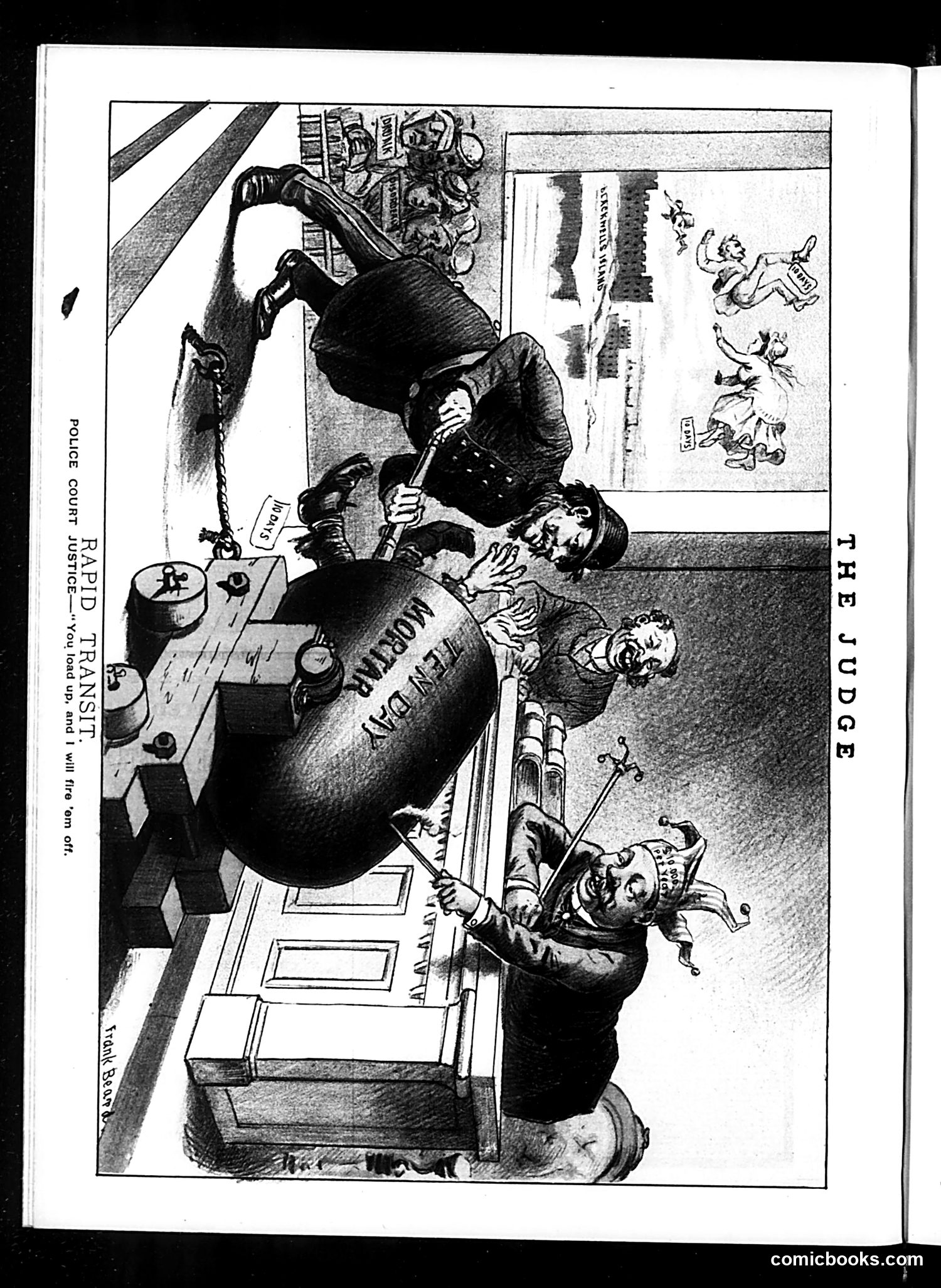
This political cartoon satirizes the speed and apparent carelessness of police court justice. The image shows a judge operating a large cannon labeled "AMMUNITION" pointed at three figures (likely defendants or prisoners), while saying he'll "fire 'em off." The cannon suggests judicial decisions are being dispensed as rapidly and indiscriminately as ammunition—implying that the court processes defendants hastily without proper deliberation or fair treatment. The title "Rapid Transit" reinforces this critique: justice moves too quickly through the system, more concerned with volume than individual cases. The cartoon appears to mock both the efficiency claims of the police court system and suggest its actual dysfunction—that defendants are being processed like ammunition rather than receiving thoughtful legal consideration.