
Judge, 1885-01-24 · page 2 of 16
Judge — January 24, 1885 — page 2: what you’re looking at
What you’re looking at
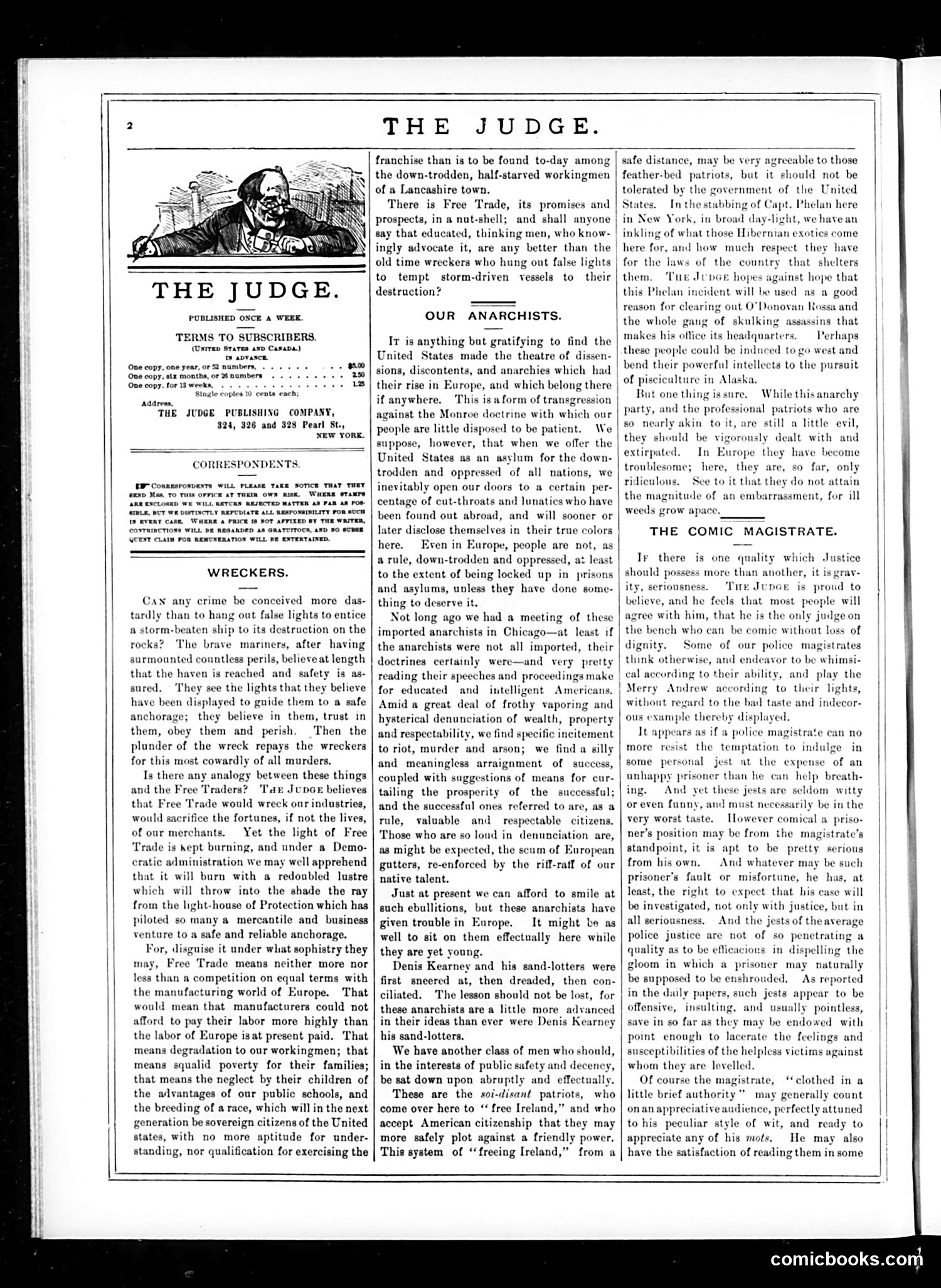
This page contains three editorials attacking political opponents through inflammatory metaphors: **"Wreckers"** compares Free Trade advocates to murderous wreckers who lure ships to destruction with false lights. The Judge argues Free Trade would "wreck our industries" and force American workers into European-level poverty. This protectionist argument frames trade liberalization as treacherous. **"Our Anarchists"** attacks European immigrants, particularly anarchists who fled political persecution abroad. The piece resents that America accepted "the down-trodden and oppressed," arguing this inevitably imports dangerous "cut-throats and lunatics." It invokes the Monroe Doctrine defensively, treating radical ideology as foreign contamination. **"The Comic Magistrate"** criticizes lenient judges who dismiss charges against prisoners without proper investigation, appearing to favor judicial severity over mercy. The overall tone reflects 1880s-90s anxieties: protectionist economics, anti-immigrant sentiment, and social conservatism. The magazine positions itself as defending American industry, order, and traditional justice against foreign radicalism and soft-on-crime judges.
📄 Transcribed text from this page (OCR, searchable)
Machine-transcribed from the original scan — historical spelling and the odd misread are preserved.
THE JUDGE. THE JUDGE. TERMS TO SUBSCRIBERS. (Usrrep Staves axp Casapa) fm aDTance, One copy, one year, or 52 numbers, . Ove copy, six months, of % numbers One copy. for 13 weeks re Sing 210 centa ¢ Address, THE JUDGE PUBLISHING COMPANY, $24, 326 and 323 Pearl St., NEW YORK. CORRESPONDENTS. EW-ConREsrONDENTS WILL FLEASE TAKE SOTICR THAT THEY exp Maa To Tite OFPicE AT THEI OWN AIGK. WHERE STAMre ARE EXCLOSED WHE WILL RETCRS REJECTED MATTER 48 FAR A8 FOS: IULE, BCT WH DUTINCTLY REFUDLATE ALL REATOMEIRILITY FOR SUCH tm every cate WHERE 4 PRICE 8 SOT AFTIXED BY THE WRITER, ‘CONTRINCTION® WILL BE REOARDED AM ORATCTTOCA, AND NO SUERE QCENT CLAIM FOR REMUNERATION WILL BE ENTERTAIXED, WRECKERS. CaN any crime be conceived more das- tardly than to hang out false lights to entice a storm-beaten ship to its destruction on the rocks? The brave mariners, after having surmounted countless perils, believe at length that the haven is reached and safety is as- sured. They sce the lights that they believe have been displayed to guide them to a safe anchorage; they believe in them, trust in them, obey them and perish. Then the plunder of the wreck repays the wreckers for this most cowardly of all murders. Is there any analogy between these things and the Free Traders? Tae JupGeE believes that Free Trade would wreck our industries, would sacrifice the fortunes, if not the lives, of our merchants. Yet the light of Free ‘ade is kept burning, and under a Demo- cratic administration We may well apprehend that it will burn with a redoubled lustre which will throw into the shade the ray from the lght-house of Protection which has piloted so many a mercantile and business venture to a safe and reliable anchorage. For, disguise it under what sophistry they may, Free Trade means neither more nor less than a competition on equal terms with the manufacturing world of Europe. That would mean that manufacturers could not afford to pay their labor more highly than the labor of Europe isat present paid. That means degradation to our workingmen; that means squalid poverty for their families; that means the neglect by their children of the advantages of our public schools, and the breeding of a race, which will in the next generation be sovereign citizens of the United states, with no more aptitude for under- standing, nor qualification for exerci franchise than is to be found to-day among the down-trodden, half-starved workingmen of a Lancashire town. There is Free Trade, its promises and prospects, in a nut-shell; and shall anyone | say that educated, thinking men, who know- ingly advocate it, are any better than the old time wreckers who hung out false lights to tempt storm-driven vessels to their destruction? OUR ANARCHISTS. Ir is anything but gratifying to find the United States made the theatre of dissen- sions, discontents, and anarchies which had their rise in Europe, and which belong there if anywhere. This is a form of transgression against the Monroe doctrine with which our people are little disposed to be patient. We suppose, however, that when we offer the United States as an asylum for the down- trodden and oppressed of all nations, we inevitably open our doors to a certain per- centage of cut-throats and lunatics who have been found out abroad, and will sooner or later disclose themselves in their true colors here. Even in Europe, people are not, as a rule, down-trodden and oppressed, at least to the extent of being locked up in prisons and asylums, unless they have done some- thing to deserve it. Not long ago we had a meeting of these imported anarchists in Chicago—at least if the anarchists were not all imported, their doctrines certainly were—and very pretty reading their speeches and proceedings r for educated and intell Amid a great deal of frothy vaporing and hysterical denunciation of wealth, property and respectability, we find specific incitement to riot, murder and arson; we find a silly and meaningless arraignment of succe coupled with suggestions of means for cur- tailing the prosperity of the successful; and the successful ones referred to are, as a rule, valuable and respectable citizens, ‘Those who are so loud in denunciati as might be expected, the scum of gutters, re-enforced by the riff-ratf of our native talent. Just at present we can afford to smile at such ebullitions, but these anarchists have given trouble in Europe. It might be as well to sit on them effectually here while they are yet young. Denis Kearney and his sand-lotters were first sneered at, then dreaded, then con- ciliated. The lesson should not be lost, for these anarchists are a little more advanced in their ideas than ever were Denis Kearney his sand-lotters. We have another class of men who should, in the interests of public safety and decenc be sat down upon abruptly and effectuall These are the soi-disant patriots, who come over here to ‘free Ireland,” and who accept American citizenship that they may more safely plot against a friendly power. This system of “freeing Ireland,” from a extirpated. In E | without r safe di: e, may be very sable to those feather-bed patriots, but it should not be tolerated by the government of the United States. Inthe stabbing of Capt. Phelan here in New York, in broad day-light, w ink rome here for, and how much respect they have for the laws of the country that shelters them, ‘The det this Phelan incident will be used as a good havean g of what those Hibernian exotic hope tinst hope that reason for clearing out O'Donovan wand the whole gang of skulking assassins that makes his office its headquarters. the: bend their powerful intellects to the pursuit of pisciculture in Alaska. But one thin, ure. While thisanarehy party, and the p ional patriots who are so nearly akin to it, are still a little evil, they should be v usly dealt with e they have become : > far, only that they do not attain agnitude of an embarrassment, for ill Perhaps people could be induced to go west and and troublesome; here ey are, rid the 1 weeds grow a| ulous. See to THE COMIC MAGISTRATE. Ir there should poss is one quality which Justice s more than another, it is grav- Tie Jupce is prov believe, and he feels that most people will ce with him, that he is the only judge on the bench who can be comic without loss of dignity. Some of our police magistrates think otherwise, and endeavor to be whimsi- play the cording to their lights, rd to the bad tast thereby displayed. It appears as if a police magistrate can no more resist the temptation to indulge personal jest at the expense of an unhappy ner than he can help breath- ing. And yet these jests are or even funny, and must nece ity, serionsne 1 according to their ability, ar Merry Andrew » and indecor- ous cxampl some iom witty arily be in the However c very worst taste. mical a priso- ner’s position may be from the magistrate’s standpoint, it is apt to be pretty serious from his own, And whatever may be such prisoner’s fault or misfortune, he has, at least, the right to expect that his case will be investigated, not only with justice, but in all seriousness. And the jests of theaverage police justice are not of so penetrating a quality as to be efficacious in dispelling the gloom in which a prisoner m be supposed to be enshrouded. naturally ‘As reported in the daily papers, such jests appear to be offensive, insulting, and usually. pointl save in so fa point enot they may be endowed with to lacerate the feelings and susceptibilities of the helpless victims against whom they are levelled. Of course the magistrate, ‘clothed in a little brief authority” may generally count onan appreciative audience, perfectly attuned to his peculiar style of wit, and ready to appreciate any of his mots. He may have the satisfaction of reading them in some also comicbooks.co