
A complete issue · 16 pages · 1885
Judge — January 10, 1885
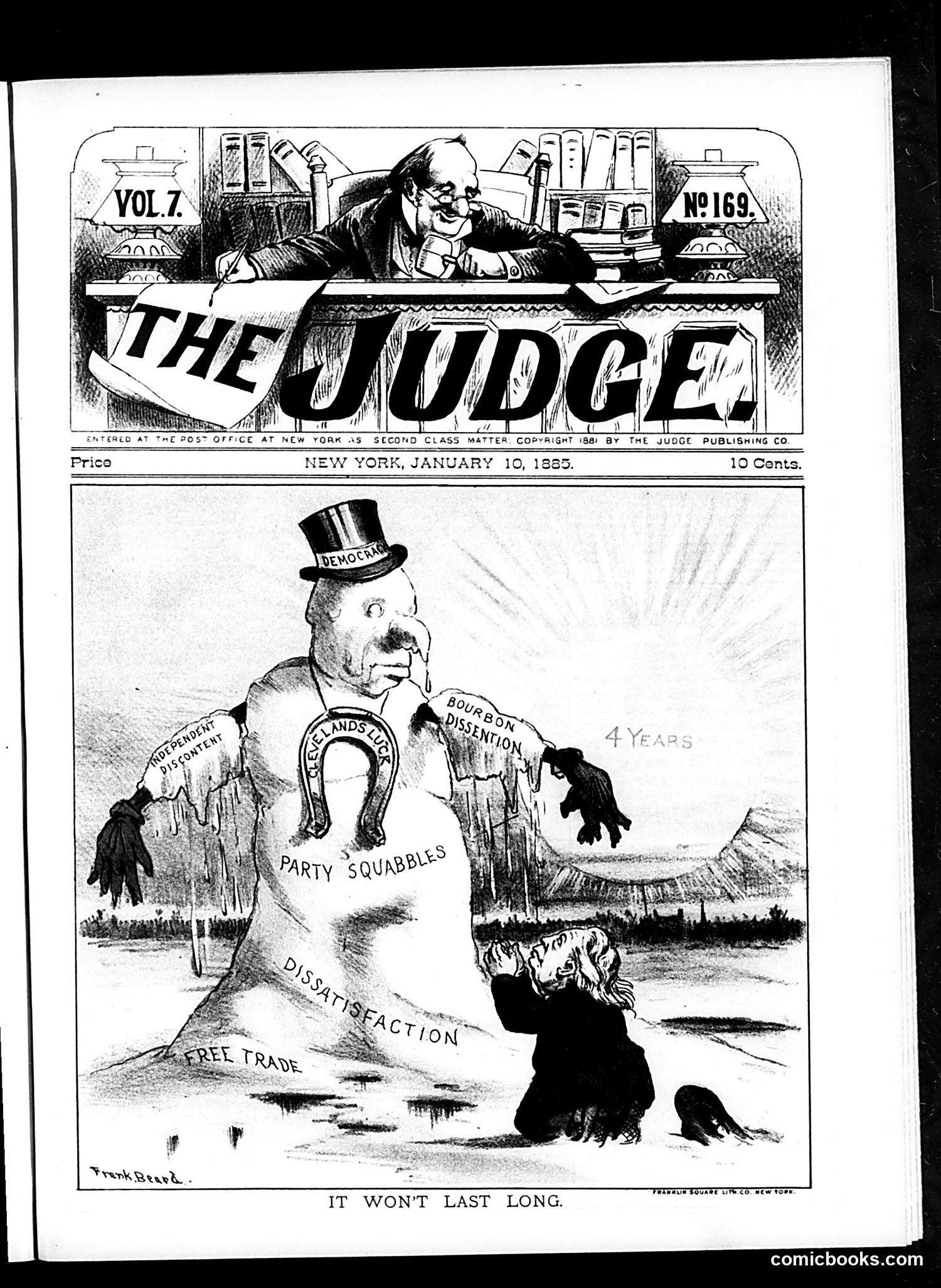
This political cartoon depicts **Democracy as a fragile figure** wearing a top hat labeled "DEMOCRACY," being steadily undermined by various problems. The figure appears weakened, with labels identifying threats: "Party Squabbles," "Bourbon Dissention," "Free Trade," and "Dissatisfaction" eating away at its foundation. A man (likely representing a concerned citizen or political observer) kneels beside the crumbling figure in despair, marked "4 YEARS," suggesting this commentary occurs during a specific presidential term. The satire warns that **American democracy faces internal collapse** from partisan conflict and ideological divisions—particularly between Democratic factions (referenced by "Bourbon" Democrats and "Free Trade" advocates). The title suggests this unstable political state cannot endure. The cartoon reflects 1880s anxieties about governmental dysfunction.
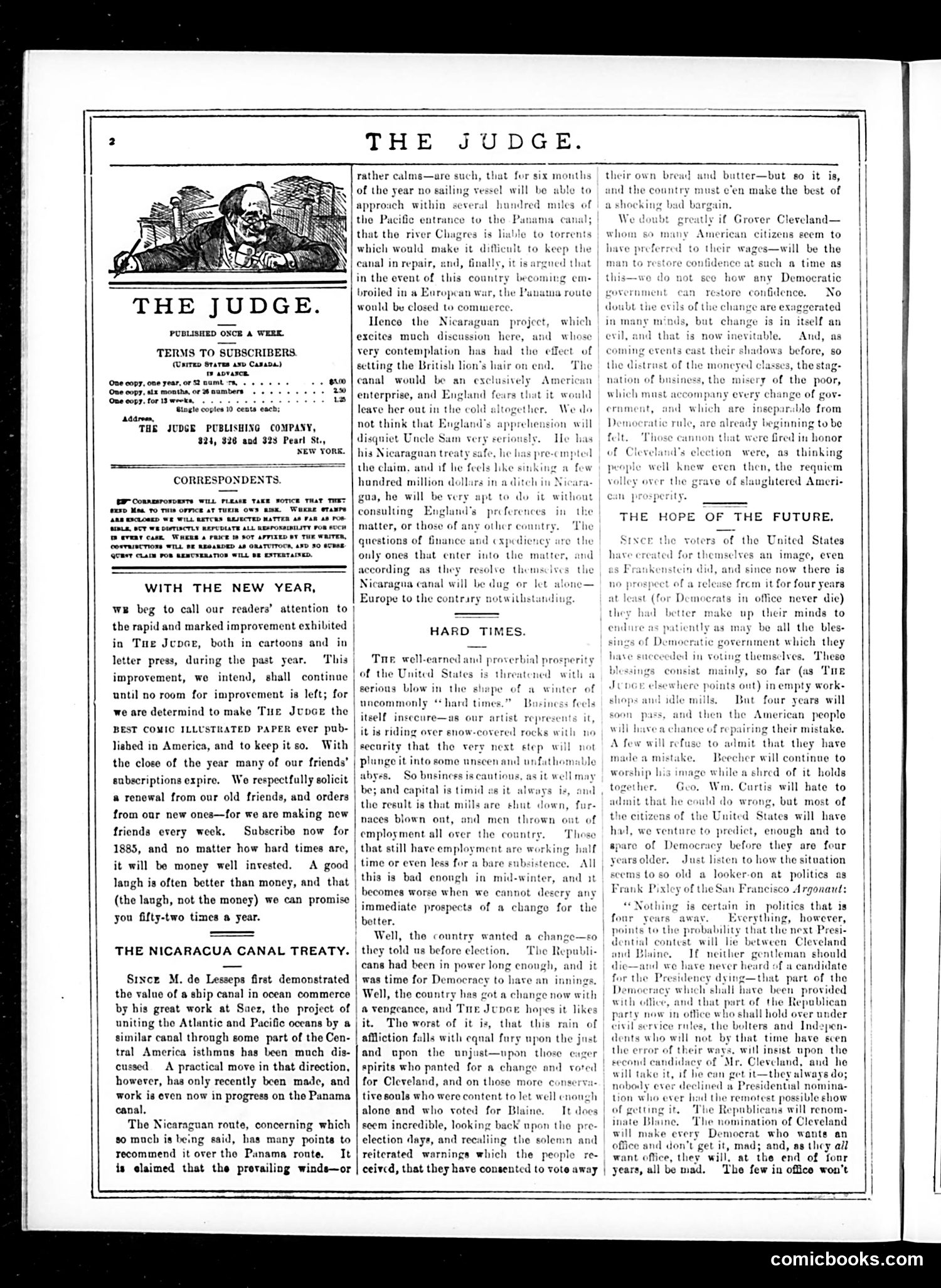
This page from Judge magazine (circa 1883-1885) contains no prominent political cartoon on the visible portion—instead it features editorial content and subscription information. The main article, "The Nicaragua Canal Treaty," discusses the proposed Nicaraguan canal route as an alternative to the Panama canal being developed by Ferdinand de Lesseps. The piece expresses American nationalist sentiment, asserting that a Nicaraguan canal would be "an exclusively American enterprise" and that England shouldn't worry about U.S. intentions, as Secretary of State (likely referring to James G. Blaine) has "pre-empted the claim." The "Hard Times" section addresses economic recession, describing business uncertainty, mill closures, and unemployment—reflecting the late 19th-century economic depression. The masthead announces Judge's commitment to improving its comic illustrations and cartoon quality in the new year, soliciting subscriptions at $1 per copy or $3 for six months.
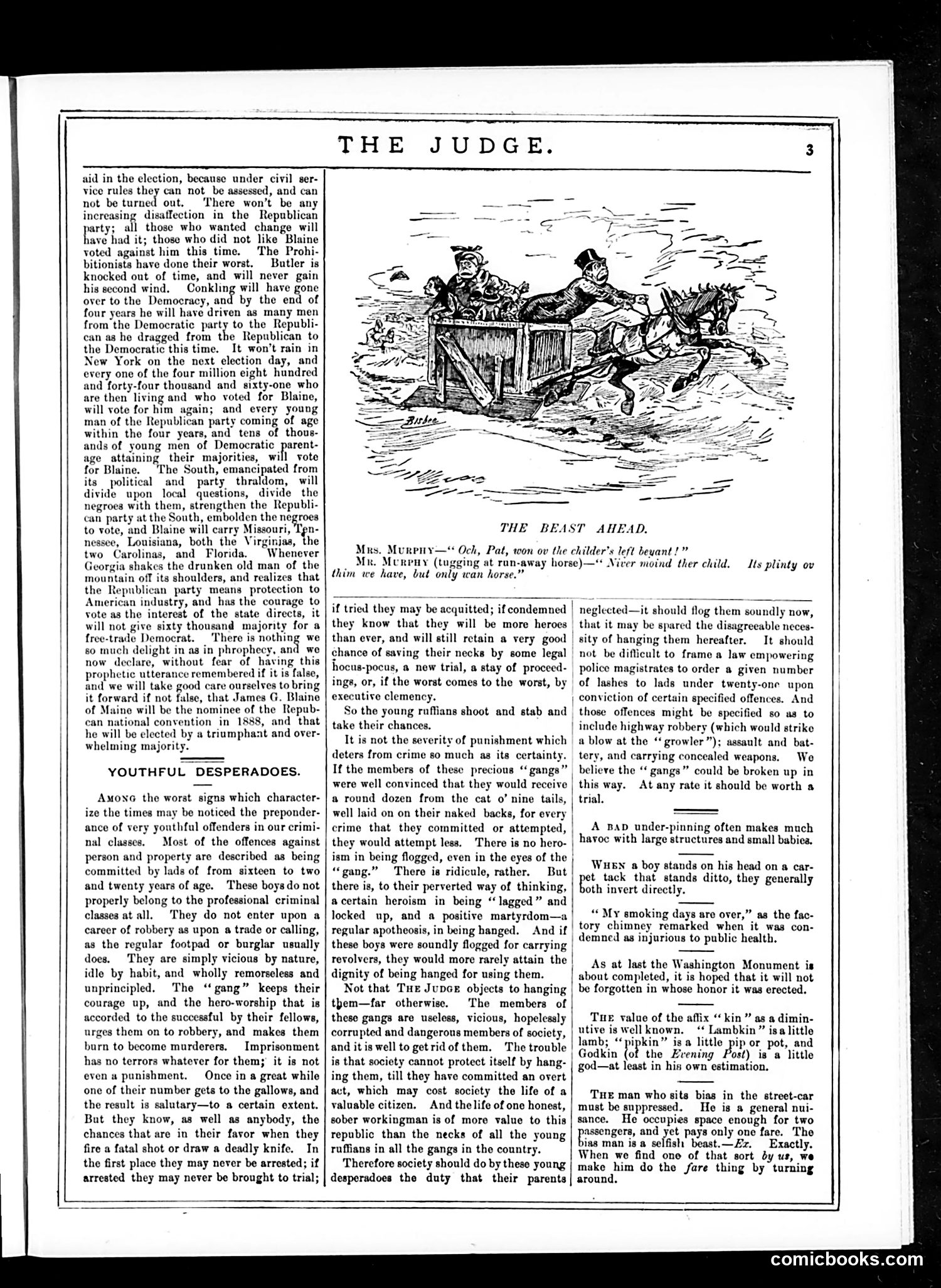
This page contains two distinct pieces: **The Cartoon ("The Beast Ahead"):** A simple domestic scene showing Irish immigrants (identified by dialect and names: Mrs. and Mr. Murphy) struggling with a runaway horse. The caption presents their predicament as humorous—they've lost their children but still have the horse. This reflects late-19th-century anti-Irish sentiment common in American satire, portraying Irish families as chaotic and their concerns as inverted or absurd. **The Editorial Text:** Discusses two topics: (1) optimistic predictions about James G. Blaine's political future and Republican dominance through 1888, and (2) concern about youth crime and gang violence, arguing that lenient justice system outcomes encourage young criminals rather than deter them. The author advocates for harsher penalties and swift execution as solutions. Both pieces reflect typical Judge magazine concerns: nativist attitudes toward immigrants and anxieties about crime and social order in Gilded Age America.
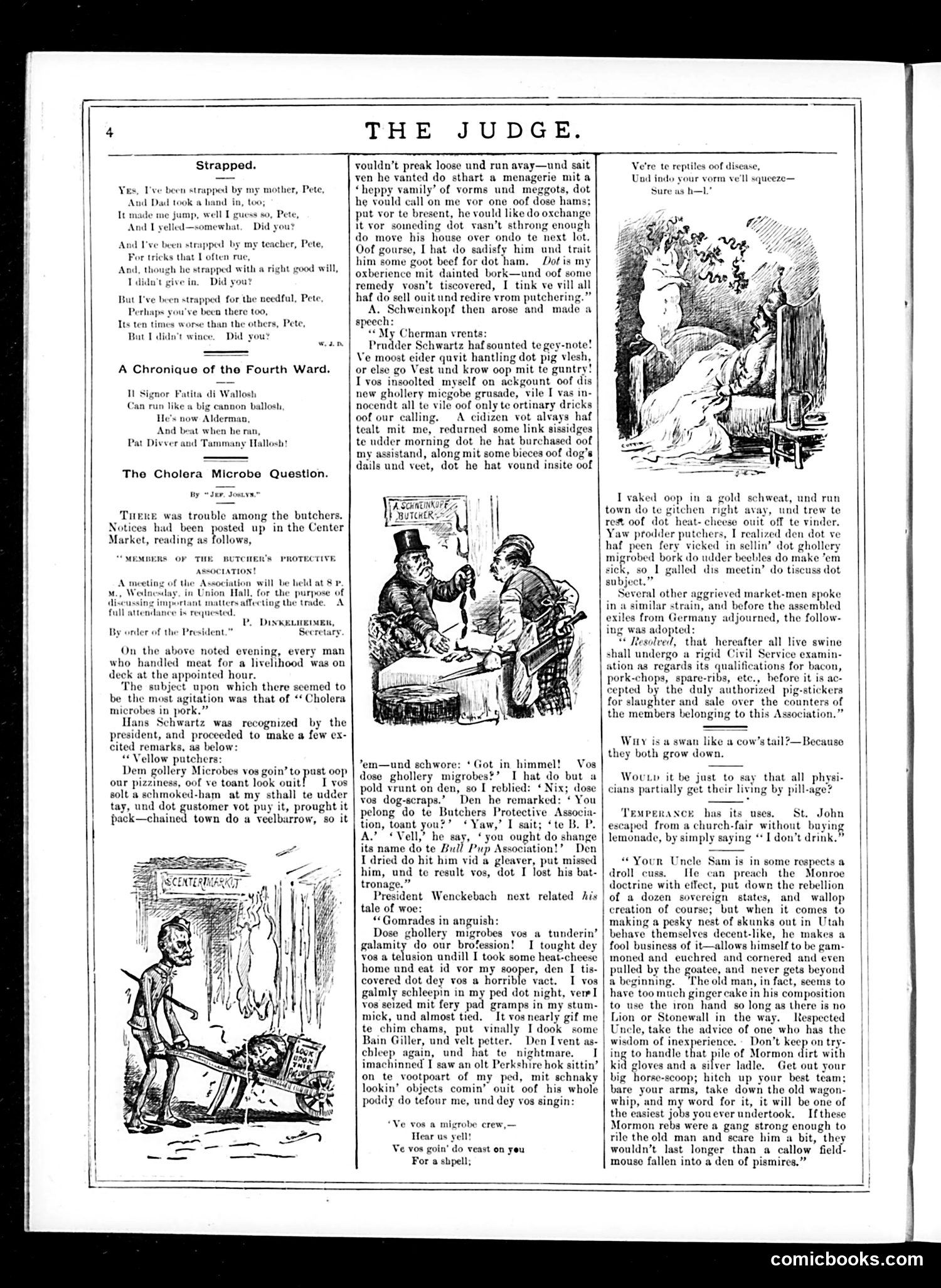
This page contains three satirical pieces targeting German-American butchers and immigrants in New York City's Fourth Ward. **"Strapped"** is a humorous poem contrasting physical punishment (from parents/teachers) with financial hardship—the "needful" being money. **"A Chronique of the Fourth Ward"** mocks Signor Fatita di Wallosh (an Italian alderman), using exaggerated dialect to suggest ethnic political corruption in Tammany Hall. **"The Cholera Microbe Question"** is the main satire. German butchers (Hans Schwartz, A. Schweinkopf, President Wenckebach) speak in heavy, mocking German-American dialect about public fears of cholera contamination in pork. They worry this "microbe crusade" will destroy their business. The butchers' defensive reactions—claiming innocence, blaming customers—satirize both immigrant anxiety over public health concerns and contemporary suspicions about immigrant food safety practices during the late-19th-century cholera panic. The satire targets both xenophobic fear-mongering and immigrant defensiveness over food quality.
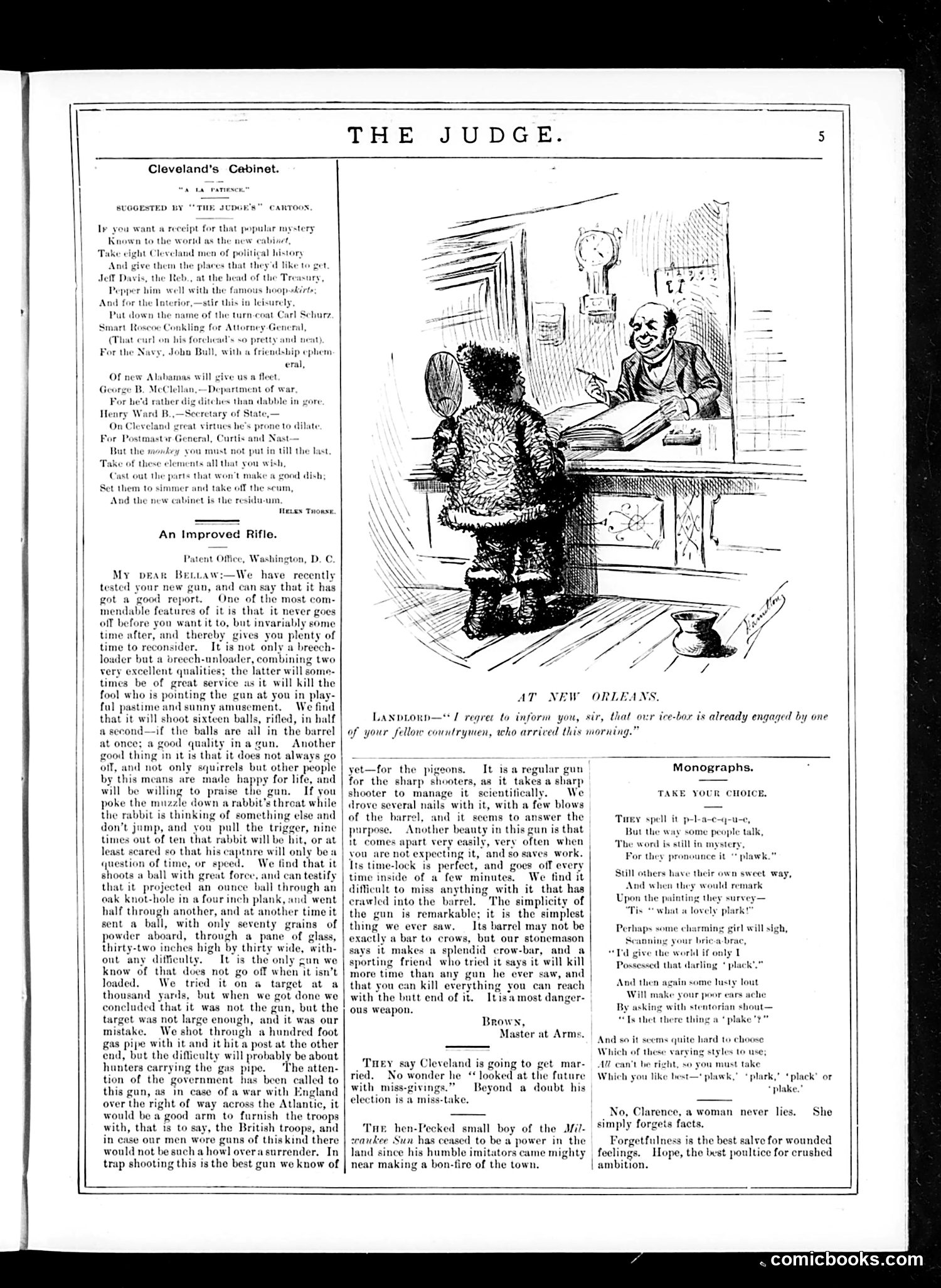
## Cleveland's Cabinet This poem mocks President Grover Cleveland's newly-formed cabinet by proposing absurd appointees. It suggests controversial figures like Jefferson Davis (Confederate leader) for Treasury and references scandals involving real politicians. The satire implies Cleveland's actual cabinet choices are equally ridiculous or suspect. The casual, recipe-like format ("take eight Cleveland men...") lampoons the arbitrary nature of political appointments. ## An Improved Rifle This mock patent office letter sarcastically praises a dangerously defective rifle. The humor comes from describing obviously terrible flaws as features—it kills the operator ("the fool who is pointing the gun"), shoots randomly, and is generally unpredictable. The closing reference to potential war with Britain over Atlantic shipping rights suggests this useless weapon exemplifies American military unpreparedness. The satire critiques either actual military procurement or broader American incompetence. Both pieces use absurdist humor typical of Judge's political commentary.
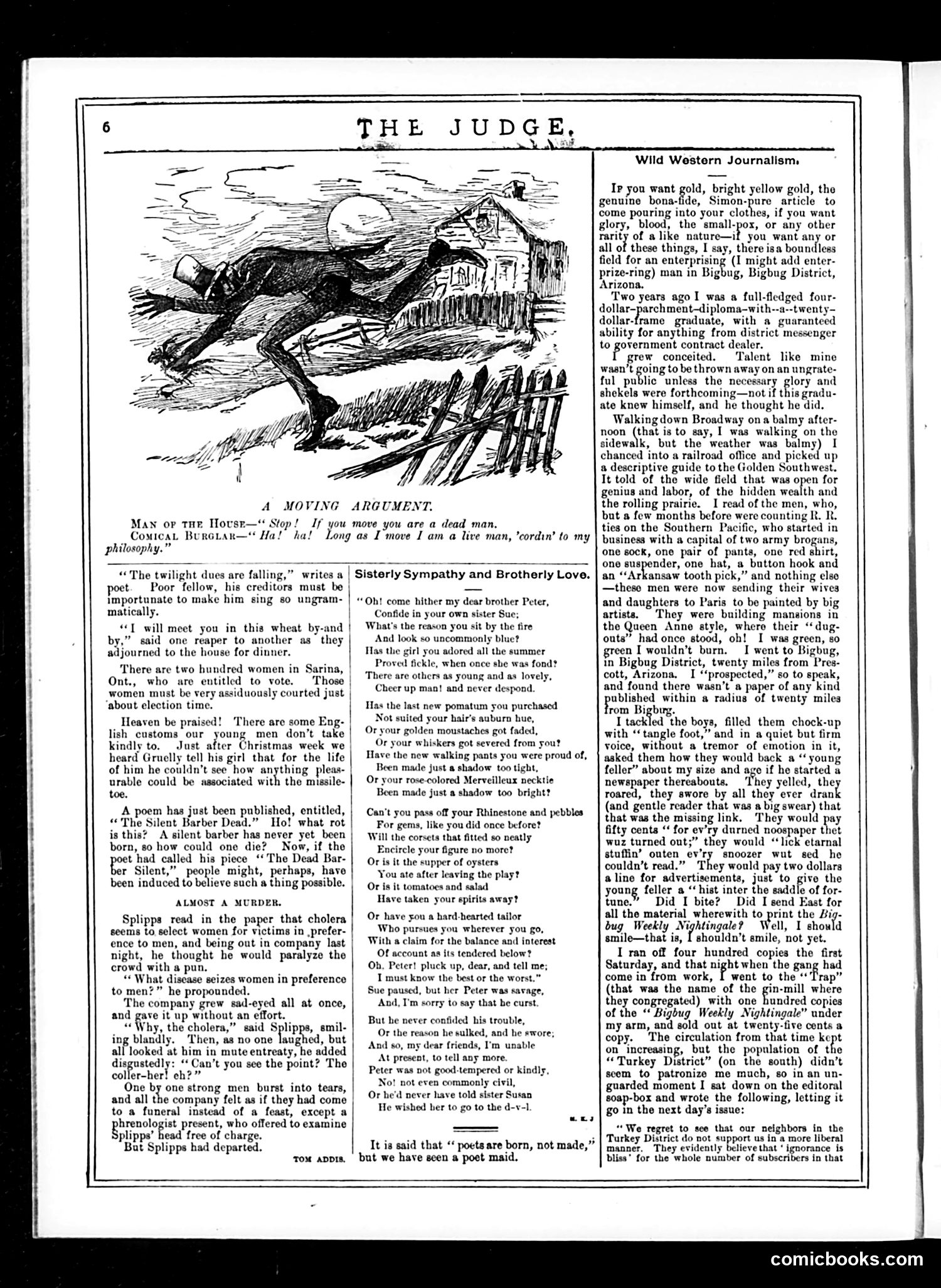
This page contains several satirical pieces typical of Judge's humor: **"A Moving Argument"** (main cartoon): A humorous debate between a "Man of the House" and a "Comical Burglar." The burglar claims that as long as he's moving/stealing, he's alive according to his "philosophy," while the homeowner threatens him with death if he moves. It's a simple pun-based joke playing on the double meaning of "move." **Other brief satirical items**: - Jokes about voting women in Ontario - Mockery of a poem titled "The Silent Barber Dead" (absurd because silent barbers don't exist) - "Almost a Murder": A painful pun about cholera selecting women ("coller-her") that fails to amuse the audience **"Sisterly Sympathy and Brotherly Love"**: A longer poem where sister Sue tries various explanations for brother Peter's bad mood—failed romance, grooming mishaps, tight pants, unpaid tailor bills—but Peter refuses to explain himself. The humor mocks both Sue's fussiness and Peter's surliness. **"Wild Western Journalism"**: A brief anecdote about frontier newspapers and get-rich-quick schemes, likely poking fun at exaggerated Western journalism.
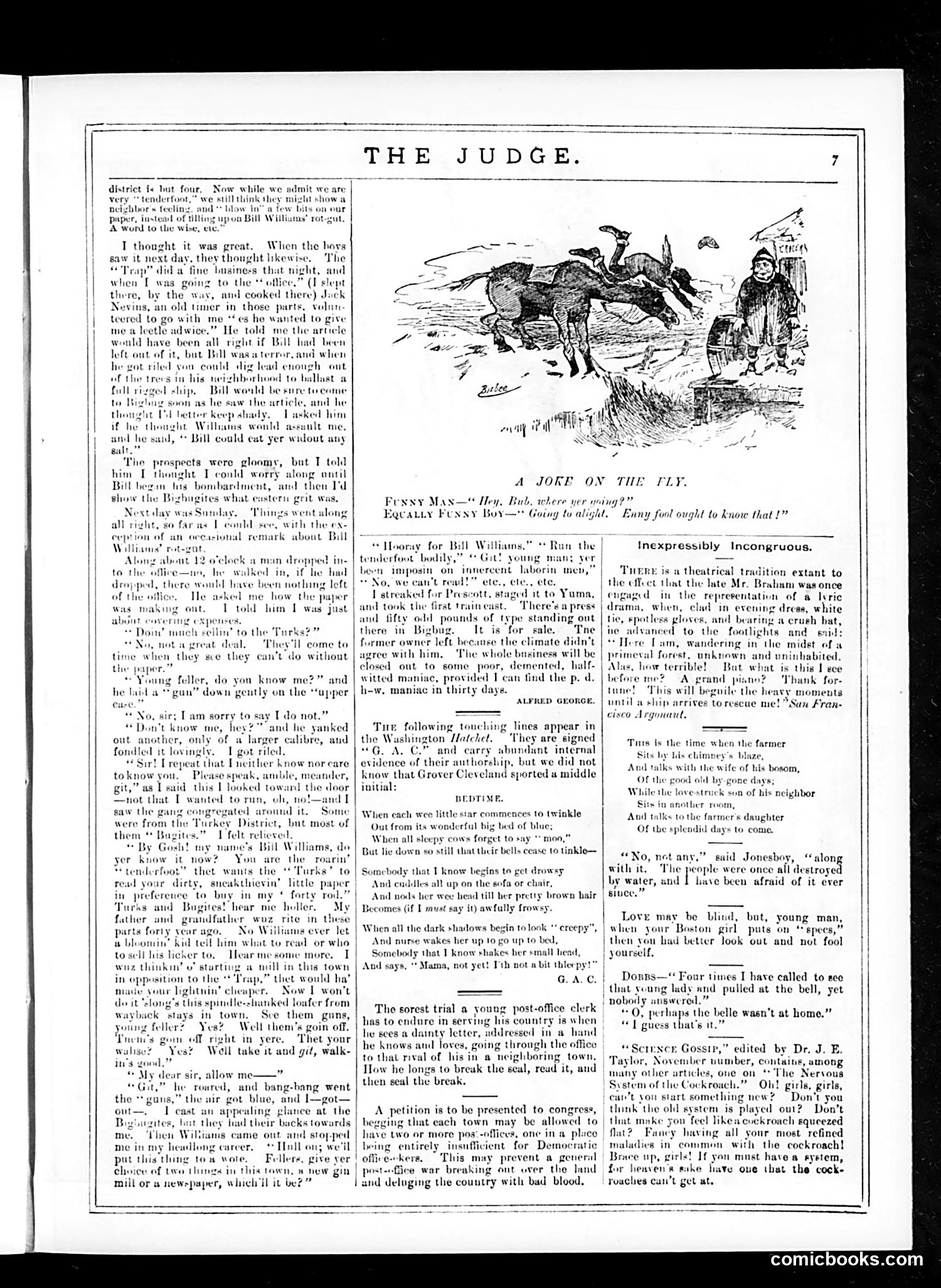
This page from *Judge* magazine contains humor pieces about frontier life, centered on a character named Bill Williams, a rough, violent man from Arizona mining country. **Main Cartoon ("A Joke on the Fly"):** The illustrated sketch shows a man swatting at a fly—likely depicting the punchline about Bill Williams, described in text as someone so crude and dangerous that even insects should avoid him. **Textual Satire:** The lengthy narrative mocks the "tenderfoot" (inexperienced Easterner) who attempts to start a newspaper in Bigbug, Arizona, only to discover the locale is dominated by the brutish Bill Williams. The joke turns on civilized aspirations—printing presses, journalism, refined society—colliding with violent frontier realities. Williams threatens the editor, forcing him to flee to Prescott. **Social Context:** This reflects late-19th-century American fascination with the "Wild West" as untamed, lawless, and hostile to Eastern refinement. The satire mocks both the naive tenderfoot and the brutish frontiersman. **Additional Content:** The page includes poetry ("Bedtime") and other filler typical of satirical magazines of the era.
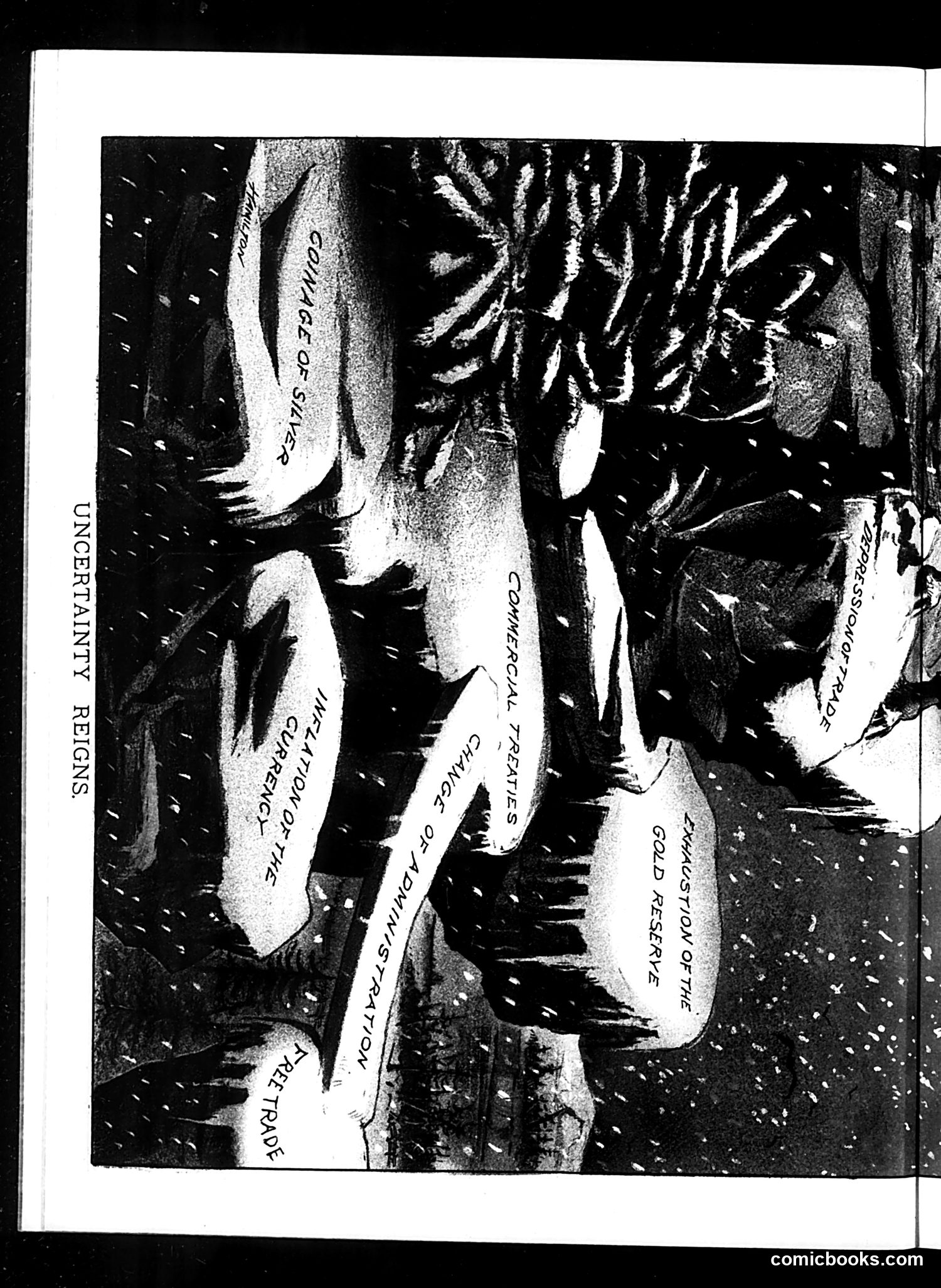
I can see this is a page from Judge magazine displayed upside-down, with "UNCERTAINTY REIGNS" as a visible heading on the left margin. The image shows what appears to be a political cartoon with labeled figures and branches or tree-like elements, though the inverted orientation makes specific details difficult to read with confidence. The visible text labels reference topics like "COMMERCIAL PANIC," "COLD RESERVE," and other phrases suggesting economic or political uncertainty, which aligns with the "Uncertainty Reigns" title. However, due to the image being rotated and the OCR quality being limited to "comicbooks.com," I cannot reliably identify the specific political figures, events, or satirical point being made without risking inaccuracy. The cartoon appears to address economic or political instability of its era.
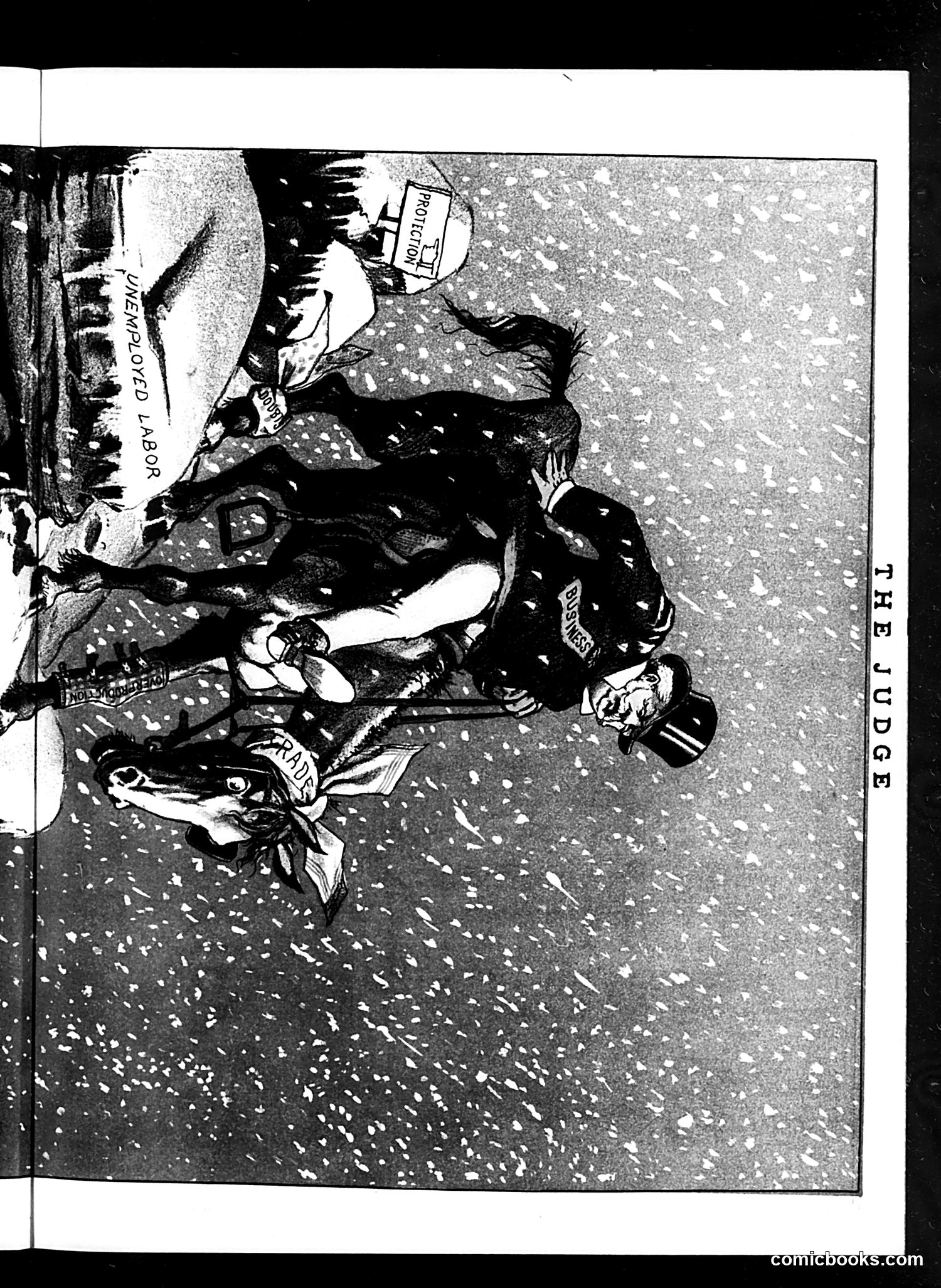
This page appears to be from a satirical cartoon in *Judge* magazine, though the OCR text provided is largely illegible or missing. The black-and-white image shows what appears to be a figure lying on ground covered with scattered objects or debris. There's a label visible at the top of the page, though its text is difficult to read clearly in this reproduction. Without legible OCR text or clearer visibility of any caption or title, I cannot confidently identify the specific political figures, events, or social commentary this cartoon targets. The image quality and orientation make it difficult to determine the precise subject matter or satirical point being made. More context would be needed for accurate interpretation.
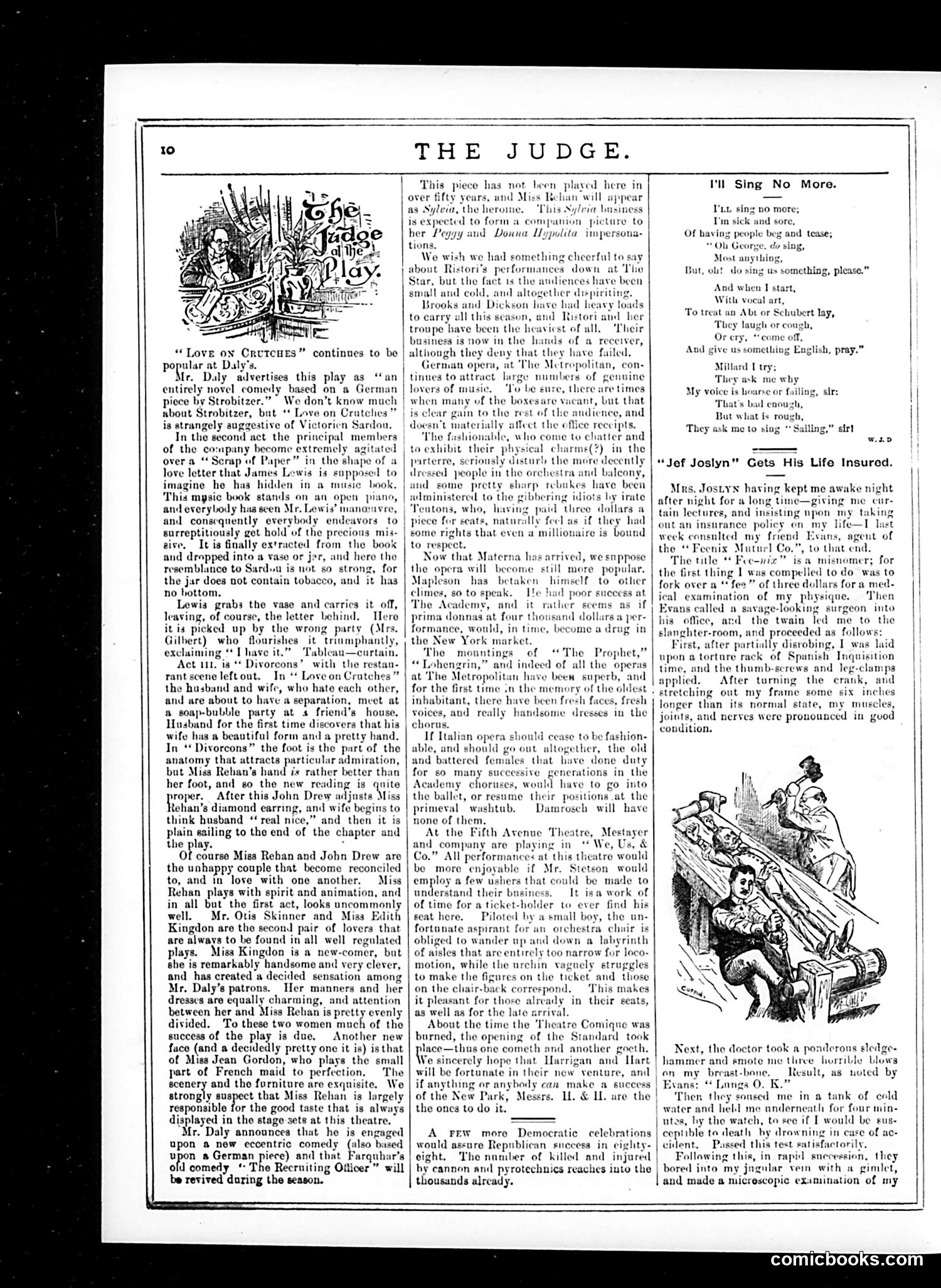
This page from *Judge* magazine reviews theatrical productions at Daly's Theatre, primarily discussing "Love on Crutches," a comedy adapted from a German play by Strobitzer. The satire mocks the plot's contrivance: a love letter hidden in a music book becomes the dramatic centerpiece, with characters frantically pursuing it—until it falls into a bottomless vase, allowing the letter to escape. The critic notes this awkward device resembles Victorien Sardou's play "Divorçons," but with inferior execution. The review praises actors Ada Rehan and John Drew as a reconciling couple, and notes newcomer Edith Kingdon's appeal. The critic suggests Rehan deserves credit for the production's tasteful scenery and staging. The satire's point: European-derived farces, while popular, rely on silly mechanical plot devices rather than genuine wit. The bottomless vase—literally—exemplifies the absurdity audiences tolerated in Victorian theater.
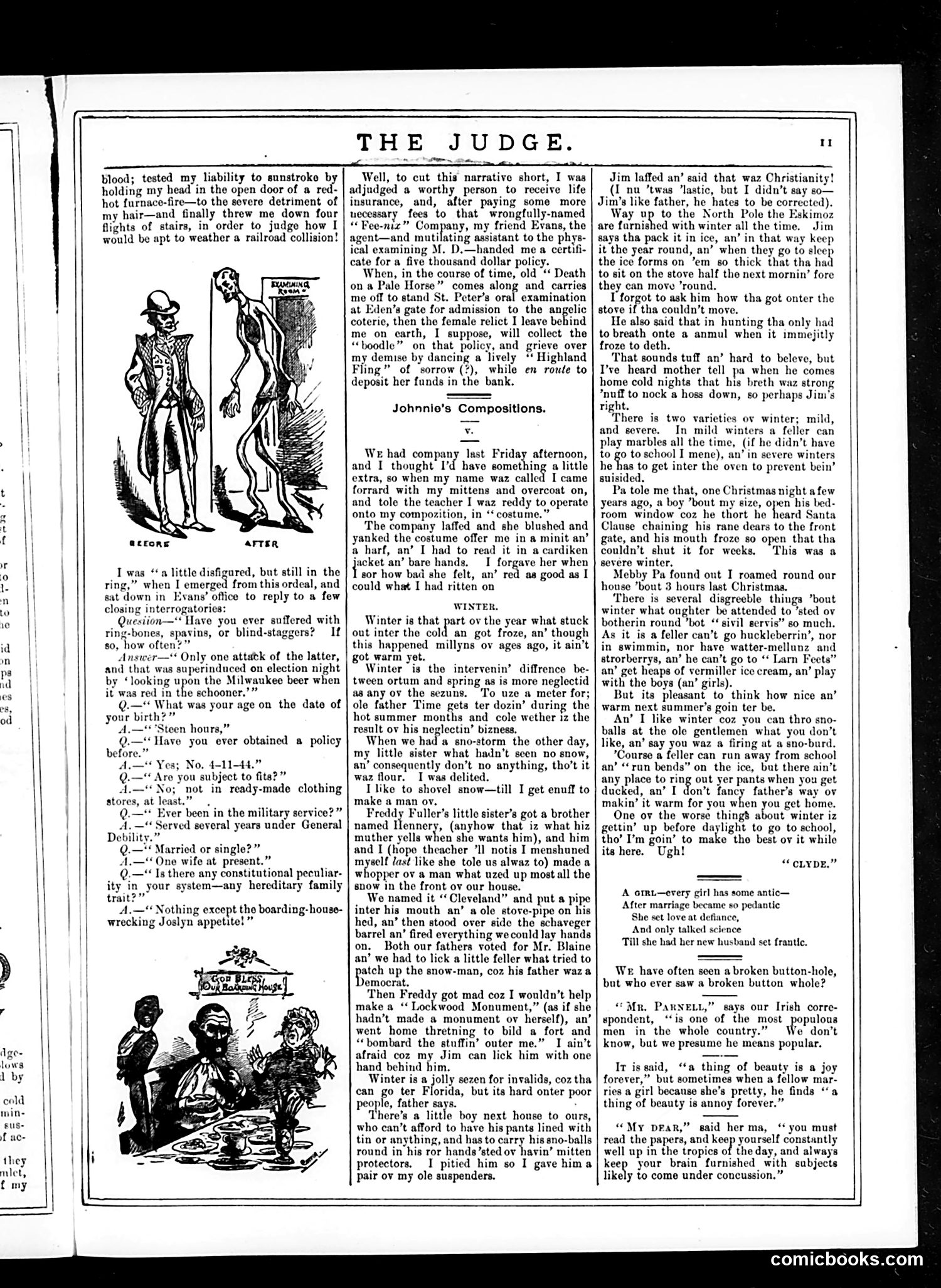
This page contains two satirical pieces mocking American life and institutions of the Gilded Age era. **Top Section - Insurance Company Satire:** A man recounts undergoing absurd physical tests (dunked in water, thrown down stairs, exposed to furnace heat) by an insurance company's doctor to assess his insurability. The satire targets the predatory practices of life insurance companies, which were notorious for invasive examinations and questionable claim denials. The narrator's cynical closing—expecting his widow will "dance a lively Highland Fling of sorrow" while depositing his death benefit—mocks both the insurance industry's callousness and stereotypical widow behavior. **Bottom Section - "Johnnie's Compositions":** A humorous student essay collection, particularly the "Winter" piece, satirizes both childhood innocence and adult negligence. The boy's misspellings and phonetic writing ("froze," "sno-storm," "Hennery") are played for laughs, while references to naming a snowman "Cleveland" likely mock President Grover Cleveland, though the exact political point remains unclear from this excerpt alone.
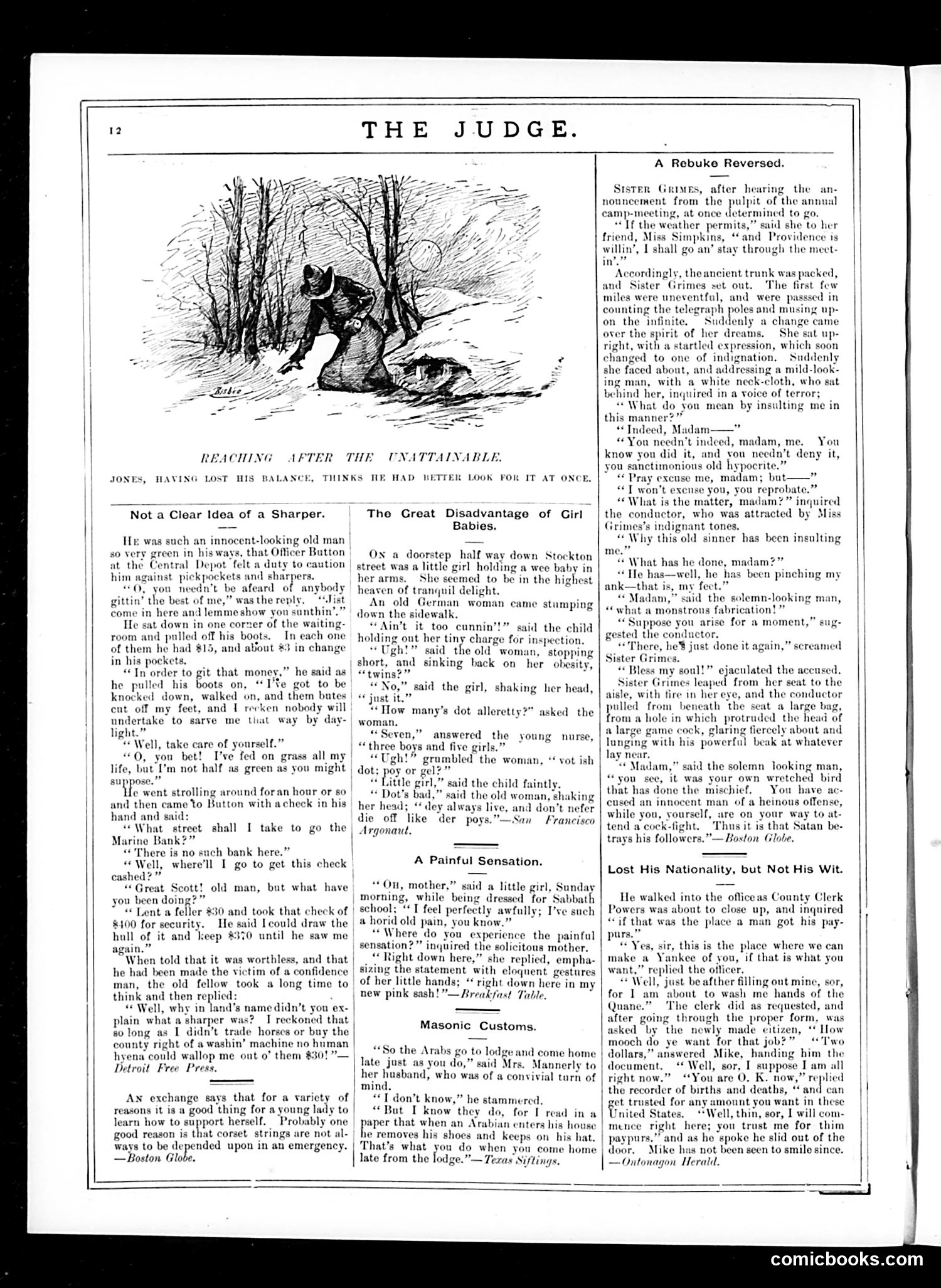
This page from *Judge* contains several short humorous anecdotes rather than political cartoons. The main illustration shows a man slipping on ice ("Reaching After the Unattainable"). **Key stories:** 1. **"Not a Clear Idea of a Sharper"**: An innocent old man boasts he can't be swindled, yet immediately falls victim to a confidence scam involving a fake $100 check. The satire mocks rural naïveté and the gap between perceived and actual street smarts. 2. **"The Great Disadvantage of Girl Babies"**: An old German woman expresses dismay that a newborn is female rather than male, reflecting period prejudices about girls' economic value and survival rates. 3. **"A Painful Sensation"**: A child complains of a pain in her "new pink sash"—humor arising from her inability to distinguish physical discomfort from her preoccupation with new clothing. 4. **"Masonic Customs"**: A wife jokes that her husband's lodge behavior mimics Arabs who remove shoes but keep hats indoors. These represent typical late-19th-century *Judge* humor: gentle social observation rather than sharp political satire.
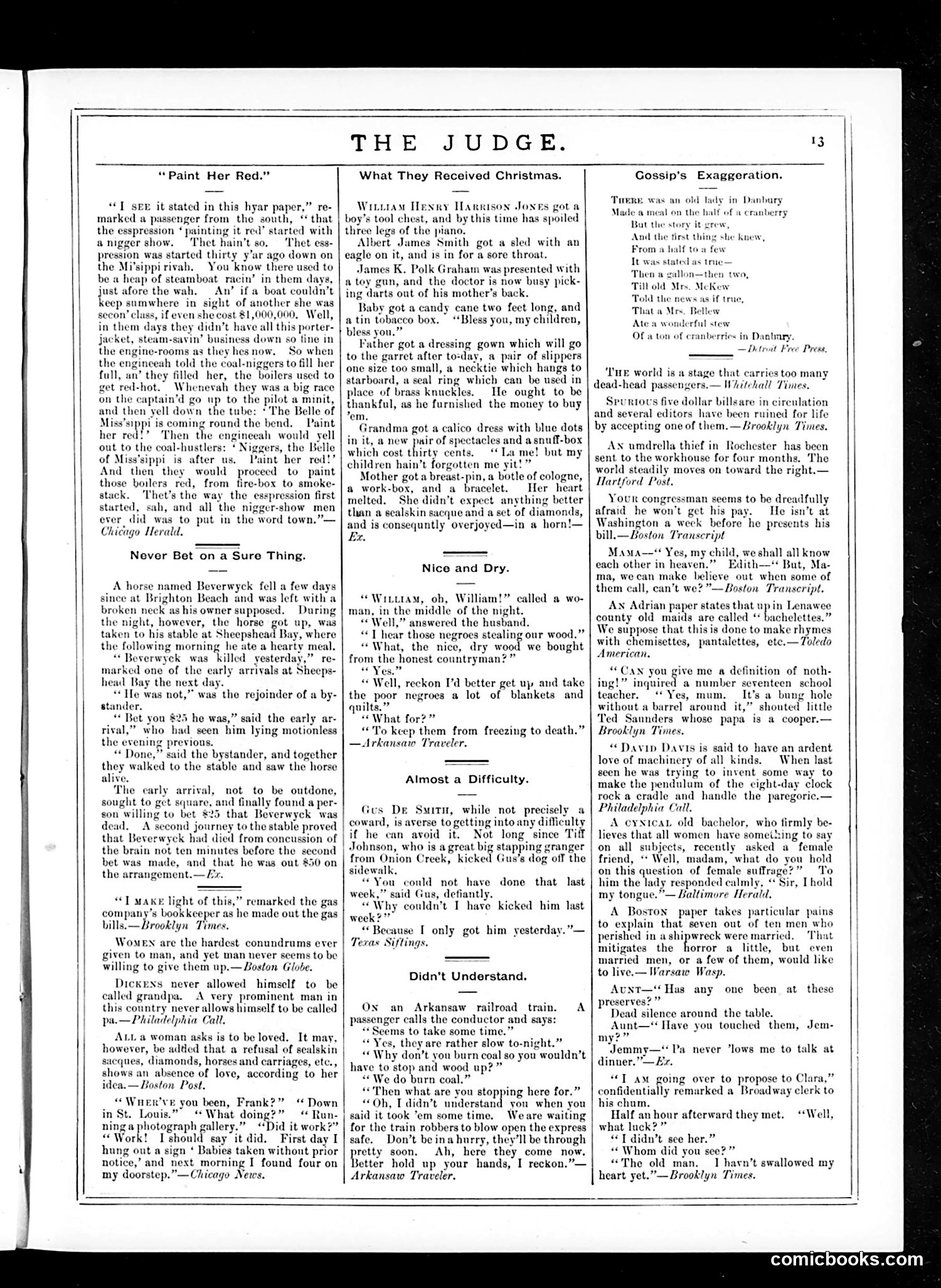
This page from *Judge* contains three distinct humor columns typical of the magazine's satirical style: **"Paint Her Red"** presents a pseudo-historical folk anecdote supposedly explaining the phrase's origin in pre-Civil War Mississippi steamboat racing, attributing it to engineers pushing boilers to dangerous heat levels. The racist dialect and casual use of slurs reflects the era's casual prejudice, though the piece ostensibly credits the expression to steamboat culture, not minstrelsy. **"Never Bet on a Sure Thing"** is a straightforward anecdote about a horse (Beverwyck) presumed dead that revived—illustrating the gambling lesson that nothing is certain. **"What They Received Christmas"** offers humorous vignettes of children and adults receiving gifts with ironically destructive or uncomfortable consequences—toy tools breaking pianos, toy guns injuring, ill-fitting clothes—satirizing both gift-giving and family life. The remaining columns ("Gossip's Exaggeration," "Nice and Dry," etc.) contain similar brief humorous observations about contemporary manners, relationships, and social absurdities typical of *Judge's* format.
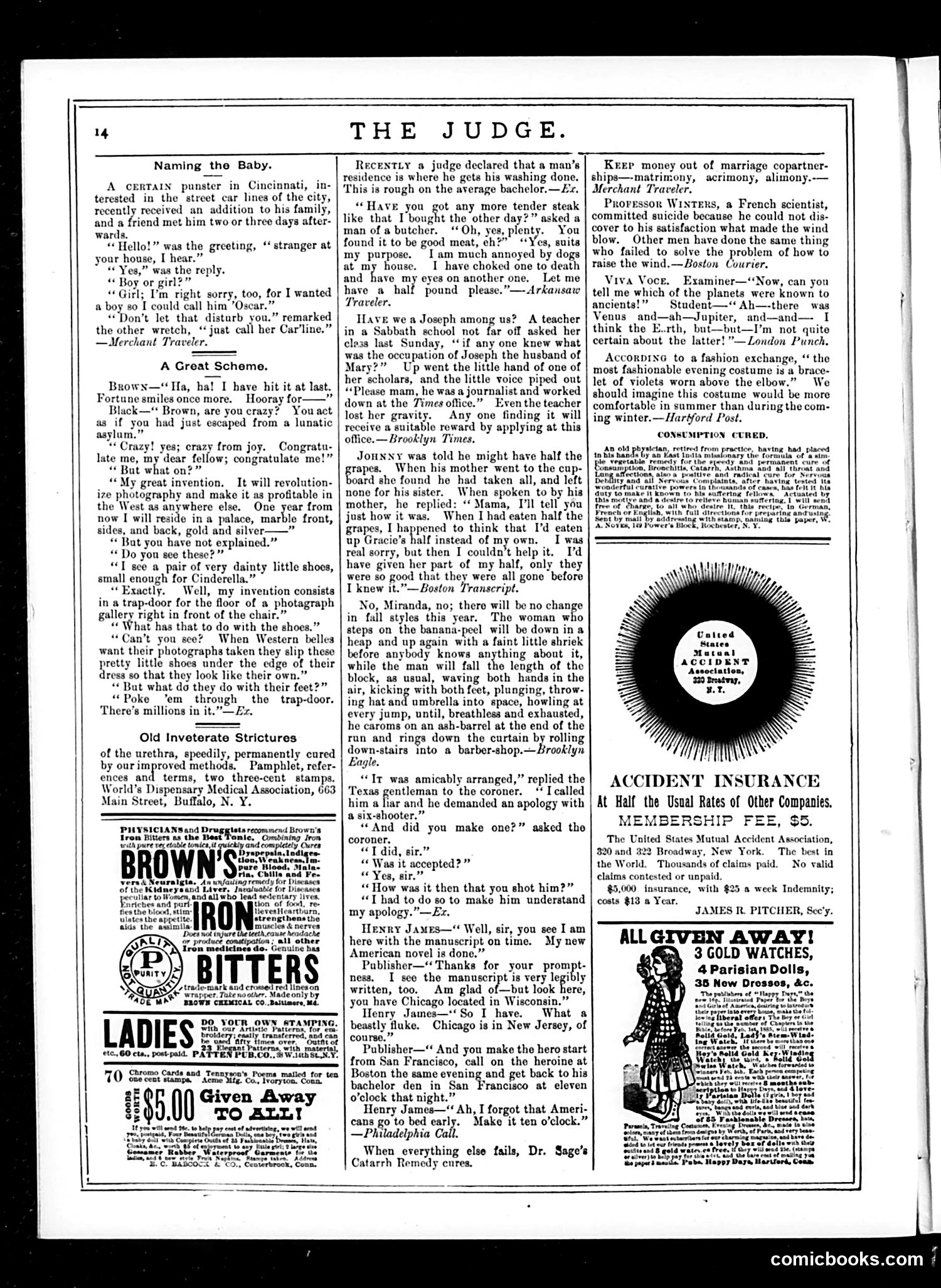
This page from *Judge* magazine contains several brief humorous anecdotes rather than a single cartoon. The jokes rely on wordplay and social observation typical of late-19th-century American humor: 1. **"Naming the Baby"**: A pun about streetcars—a man wanting to name his daughter "Oscar" (likely referencing streetcar lines) settles for "Car'line" instead. 2. **"A Great Scheme"**: Satirizes vanity in photography. A man invents a trap-door in photo studios so women can hide their feet and display smaller shoes, making themselves appear more delicate—a beauty standard of the era. 3. Other brief jokes mock a judge's ruling about residency, butchers' meat quality, and a child's misunderstanding of "Joseph" as a newspaper journalist. The page also contains period advertisements for medical treatments and various consumer goods. The satire targets contemporary anxieties about photography, fashion, and social pretension rather than specific political figures.
This page is primarily composed of advertisements and brief satirical aphorisms typical of *Judge* magazine, rather than a political cartoon. The content includes: **Advertisements** for commercial products: Pond's Extract (medicinal salve), Catarrh Cream Balm, Magic Lanterns, Behning pianos, lithography services, and remedies like Dr. Pierce's Purgative Pellets. **Satirical aphorisms** (short humorous observations), such as: - A joke about dentists abandoning politics - Commentary on the extreme cold in St. Paul, Minnesota - Observations about monopolies and labor restrictions ("A grinding monopoly, no wonder left them")—a veiled reference to worker discontent with employers controlling their lives The labor reference appears most socially pointed, suggesting contemporary anxieties about industrial monopolies exploiting workers. Overall, this is a typical 19th-century magazine page mixing advertising with light satirical commentary on everyday social and political annoyances, rather than featuring specific political cartooning.
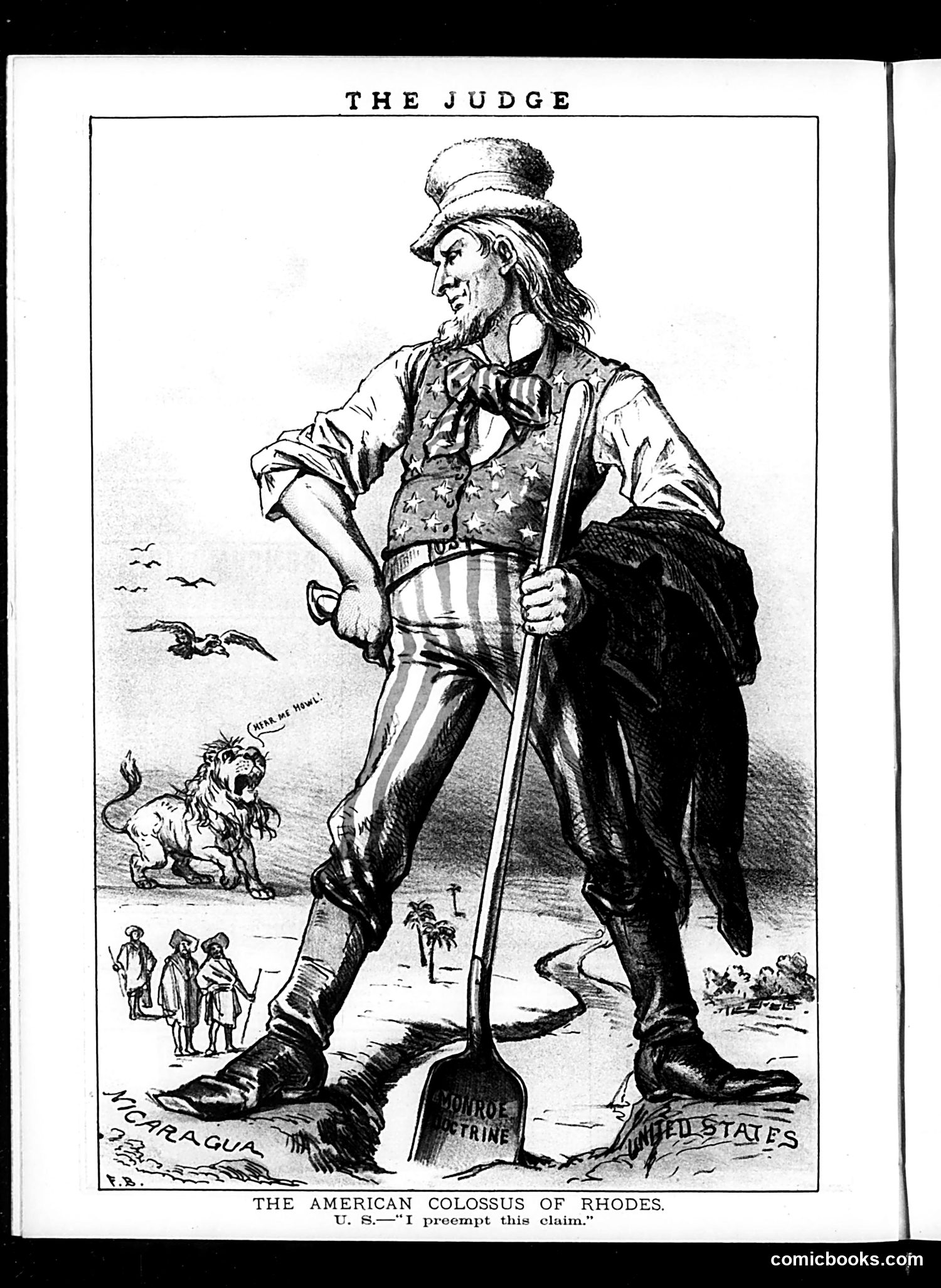
This political cartoon satirizes American imperialism in Central America, likely from the early 20th century. The giant figure represents the United States, styled as the ancient Colossus of Rhodes—a classical reference to overwhelming power. He straddles the region with one foot on Nicaragua and the other on the United States, holding a shovel labeled "Monroe Doctrine" (America's policy asserting dominance in the Western Hemisphere). The small figures below appear to be Central American citizens or nations. A dog labeled "Roar of Home" and various landscape elements suggest destabilized local populations. The caption "I preempt this claim" reveals the cartoon's critique: the U.S. is asserting territorial control and dominance over Central America under the guise of the Monroe Doctrine, treating the region as conquered territory rather than respecting sovereign nations.