
Judge, 1885-01-10 · page 3 of 16
Judge — January 10, 1885 — page 3: what you’re looking at
What you’re looking at
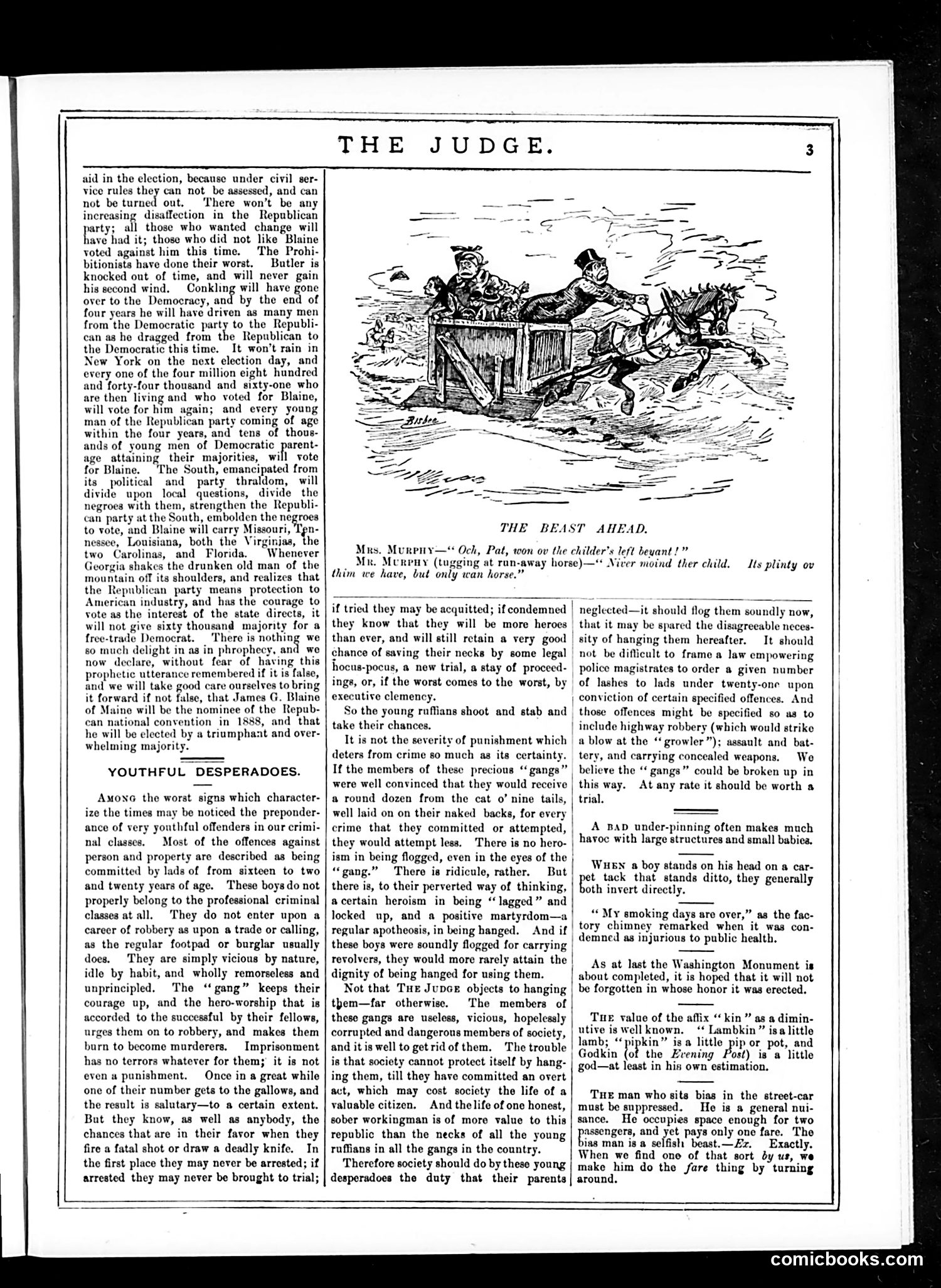
This page contains two distinct pieces: **The Cartoon ("The Beast Ahead"):** A simple domestic scene showing Irish immigrants (identified by dialect and names: Mrs. and Mr. Murphy) struggling with a runaway horse. The caption presents their predicament as humorous—they've lost their children but still have the horse. This reflects late-19th-century anti-Irish sentiment common in American satire, portraying Irish families as chaotic and their concerns as inverted or absurd. **The Editorial Text:** Discusses two topics: (1) optimistic predictions about James G. Blaine's political future and Republican dominance through 1888, and (2) concern about youth crime and gang violence, arguing that lenient justice system outcomes encourage young criminals rather than deter them. The author advocates for harsher penalties and swift execution as solutions. Both pieces reflect typical Judge magazine concerns: nativist attitudes toward immigrants and anxieties about crime and social order in Gilded Age America.
📄 Transcribed text from this page (OCR, searchable)
Machine-transcribed from the original scan — historical spelling and the odd misread are preserved.
vice rules they can not be assesset not be turned out, ‘There won’t be any increasing disaffection in the Republican party; all those who wanted change will have had it; those who did not like Blaine voted against him this time. The Prohi- bitionists have done their worst. Butler is knocked out of time, and will never gain his second wind. Conkling will have gone over to the Democracy, and by the end of four years he will have driven as many men fromthe Democratic party to the Republi- can as he dragged from the Republican to the Democratic this time. It won’t rain in New York on the next election day, and every one of the four million eight hundred and forty-four thousand and sixty-one who are then living and who voted for Blaine, will vote for him again; and every young man of the Republican party coming of age within the four years, and tens of thous- ands of young men of Democratic parent- age attaining their majorities, will vote for Blaine. ‘The South, emancipated from its political and party thrald divide upon local questions, je the negroes with them, strengthen the Republi- can party at the South, embolden the negroes to vote, and Blaine will carr: ¥ , Louisiana, both the o Carolinas, and Florida. Whenever Georgia shakes the drunken old man of the mountain off its shoulders, and realizes that the Republican party means protection to American industry, and has the courage to vote as the interest of the state directs, it will not give sixty thousand majority for a free-trade Democrat. | There is nothing we so much delight in as in phrophecy, and we now declare, without fear of having this prophetic utterance remembered if it is false, and we will take good care ourselves to bring it forward if not false, that James G. Blaine of Maine will be the nominee of the Repub- can national convention in 1888, and that he will be elected by a triumphant and over- whelming majorit; YOUTHFUL DESPERADOES. Asono the worst signs which character- ize the times may be noticed the preponder- ance of very youthful offenders in our crimi- nal classes, Most of the offences against person and property are described as being committed by lads of from sixteen to two and twenty years of age. These boys do not properly belong to the professional criminal classes at all. They do not enter upon a career of robbery as upon a trade or calling, as the regular footpad or burglar usually does. They are simply vicious by nature, idle by habit, and wholly remorseless and unprincipled. The “gang” keeps their courage up, and the hero-worship that is accorded to the successful by their fellows, urges them on to robbery, and makes them burn to become murderers, Imprisonment has no terrors whatever for them; it is not even a punishment. Once in a great while one of their number gets to the gallows, and the result is salutary—to a certain extent. But they know, as well as anybody, the chances that are in their favor when they fire a fatal shot or draw a deadly knife. In the first place they may never be arrested; if arrested they may never be brought to trial; THE BEAST AHEAD. Mrs. Murpny—* Och, Pat, won ov the childer’s Mn. Merpuy (tugging at ran-away horse)—‘ thim we have, but only wan horse.” if tried they may be acquitted; if condemned | they know that they will be more heroes than ever, and will still retain a very good chance of saving their necks by some legal hocus-pocus, a new trial, a stay of proceed ings, or, if the worst comes to the worst, by executive clemency, So the young ruffians shoot and stab and take their chances. It is not the severity of punishment which deters from crime so much as its certainty. If the members of these precious “gangs | were well convinced that they would receive | a round dozen from the cat o’ nine tails, | well laid on on their naked backs, for every | crime that they committed or attempted, they would attempt less. There is no hero- | ism in being flogged, even in the eyes of the | “gang.” There is ridicule, rather. But | there is, to their perverted way of thinking, | acertain heroism in being “lagged” and | locked up, and a positive martyrdom—a | regular apotheosis, in being hanged. And if | these boys were soundly flogged for carrying | revolvers, they would more rarely attain the | dignity of being hanged for using them. _| Not that Te JupcE objects to hanging | them—far otherwise. The members of | these gangs are useless, vicious, hopelessly | corrupted and dangerous members of society, | and it is well to get rid of them. The trouble | is that society cannot protect itself by hang- ing them, till they have committed an overt act, which may cost society the life of a valuable citizen. And the life of one honest, sober workingman is of more value to this republic than the necks of all the young ruffians in all the gangs in the country. Therefore society should do by these young desperadoes the duty that their parents left devant!” Niver moind ther child. Its plinty ov neglected—it should flog them soundly now, that it may be spared the disagreeable neces- sity of hanging them hereafter. It should not be dificult to frame a law empowering police magistrates to order a given number of lashes to lads under twenty-one upon | conviction of certain specified offences. And those offences might be specified so us to include highway robbery (which would strike a blow at the ‘growler”); assault and bat- tery, and carrying concealed weapons. We believe the “ gangs” could be broken up in this way. At any rate it should be worth s trial. A BaD under-pinning often makes much avoc with large structures and small babies. Wusw a boy stands on his head on a car- pet tack that stands ditto, they generally oth invert directly. “ My smoking days are over,” as the fac- tory chimney remarked when it was con- | demned as injurious to public health. As at last the Washington Monument is about completed, it is hoped that it will not be forgotten in whose honor it was erected. Tue value of the affix “kin ” as a dimin- utive is wellknown. ‘* Lambkin” isa little lamb; “pipkin” isa little pip or pot, and Godkin b the Evening Post) is a little god—at least in his own estimation. Tue man who sits bias in the street-car must be suppressed. He is a general nui- sance. He occupies space enough for two assengers, and yet pays only one fare. The jias man is a selfish beast.—£z. Exactly. When we find one of that sort dy us, we make him do the fare thing by turning around. comicbooks.com