
A complete issue · 16 pages · 1884
Judge — December 6, 1884
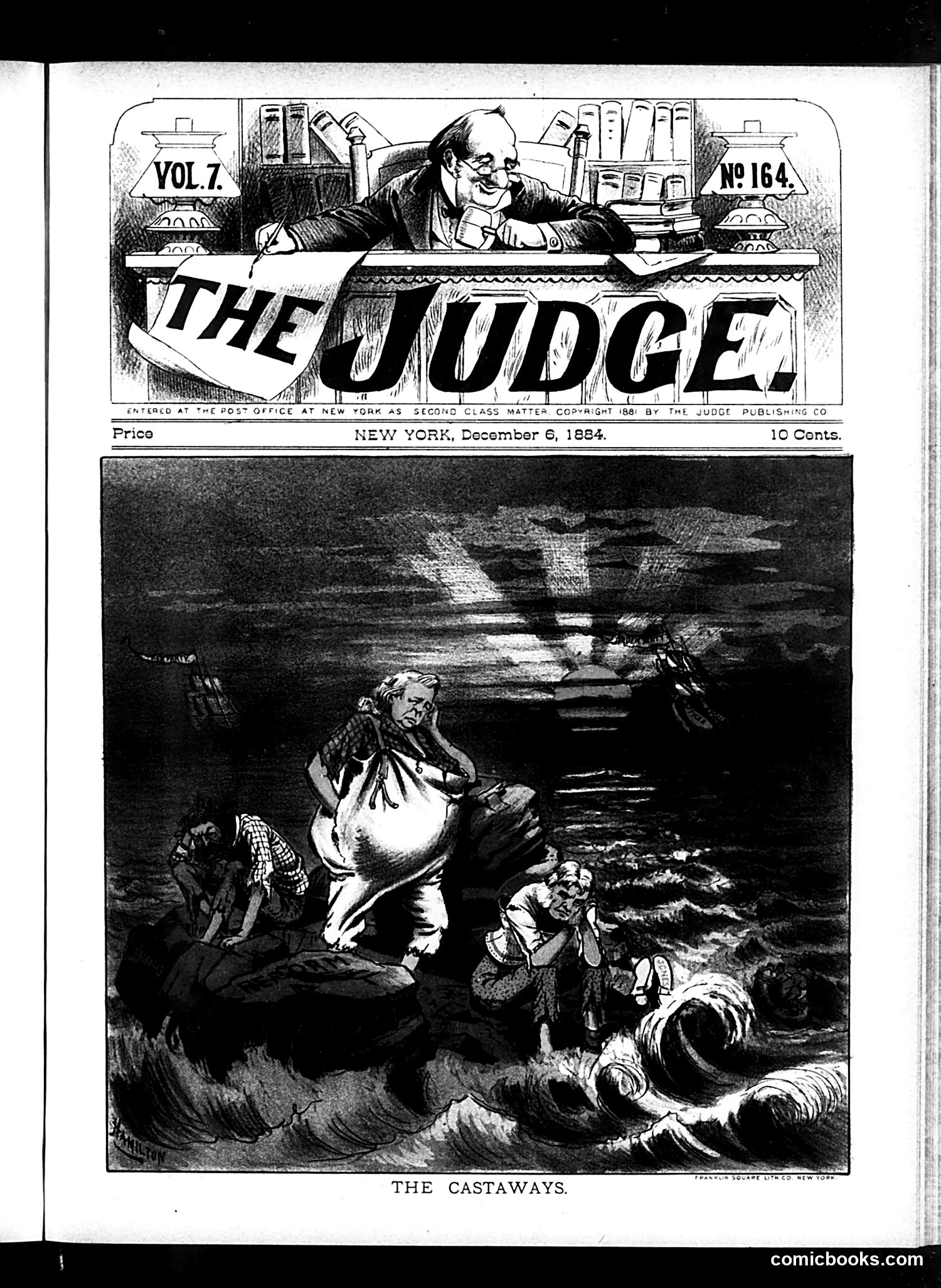
This political cartoon depicts shipwrecked figures—appearing to be caricatured politicians or public figures—clinging to survival in turbulent waters. The large central figure, rendered grotesquely, likely represents a political figure or corrupt official "cast away" by recent events or electoral defeat. The title "The Castaways" suggests these individuals have been abandoned or discredited, possibly referencing the 1884 election or a political scandal. The imagery of drowning or struggling in rough seas was a common Victorian metaphor for political ruin or loss of power. The masthead shows Judge's editor presiding from his desk, suggesting editorial judgment has been rendered upon these "castaways." Without clearer identification of specific figures, the exact political targets remain unclear, though the satire targets failed or disgraced politicians.
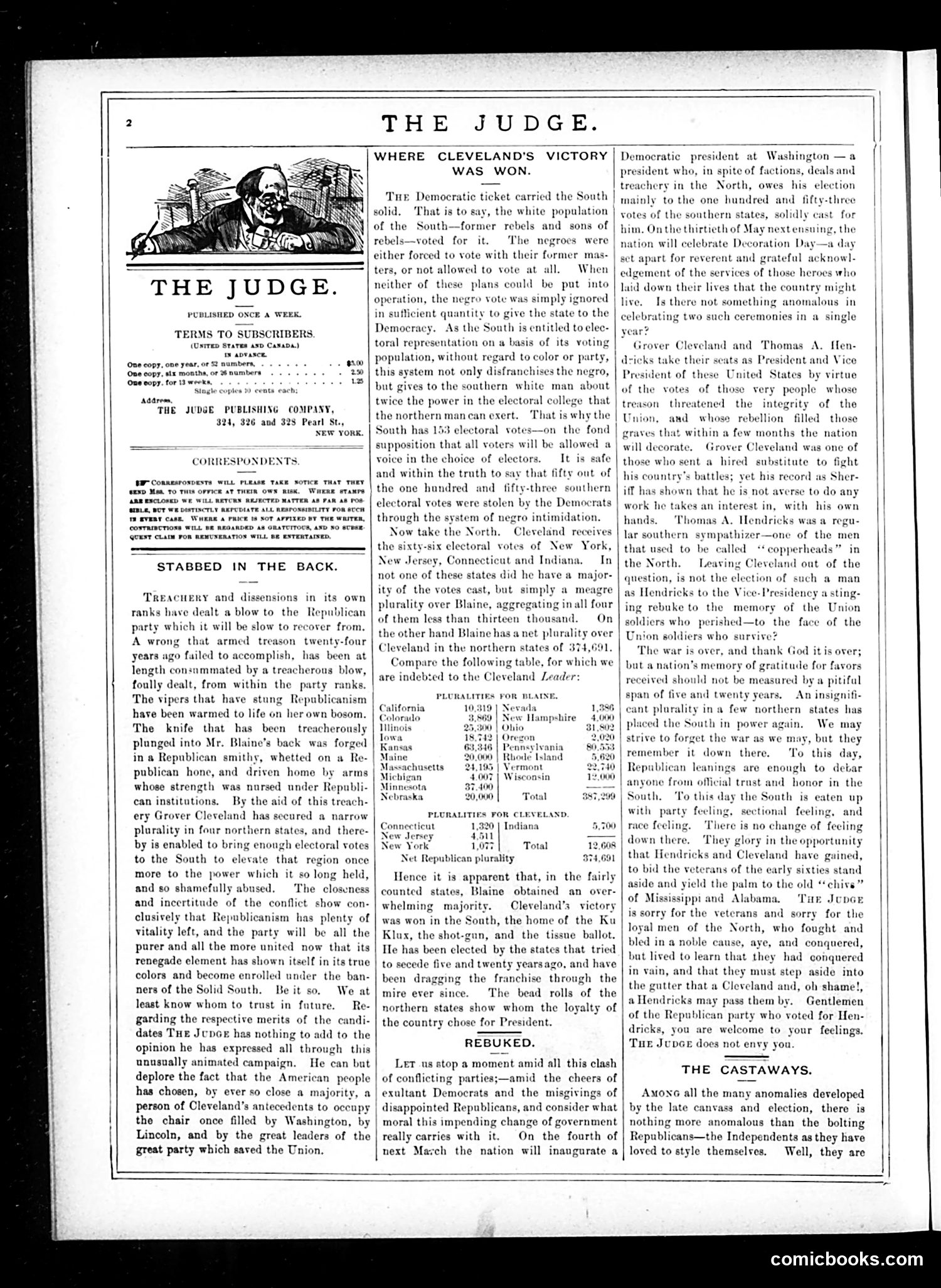
This 1884 Judge magazine page attacks Cleveland's presidential victory as illegitimate, achieved through Republican betrayal and Southern voter suppression. **The Cartoon (top left):** Shows a figure stabbed in the back—representing the Republican Party wounded by internal treachery. **Key Arguments:** The editorial claims Cleveland won the "Solid South" by suppressing Black votes through intimidation and exclusion, effectively stealing ~50 electoral votes. It then notes Cleveland won four Northern states (New York, New Jersey, Connecticut, Indiana) without majorities—implying narrow, suspicious victories. **Historical Context:** This reflects post-Reconstruction tensions. Though the 15th Amendment guaranteed Black voting rights, Southern Democrats used violence and intimidation to prevent Black Republicans from voting. The "Solid South" remained Democratic through such disenfranchisement. **The Satire's Irony:** Judge criticizes Democratic suppression of Black voters while the Republican Party itself had begun abandoning Reconstruction-era civil rights protections. The magazine presents this selectively—defending Republican interests rather than voting rights principle.
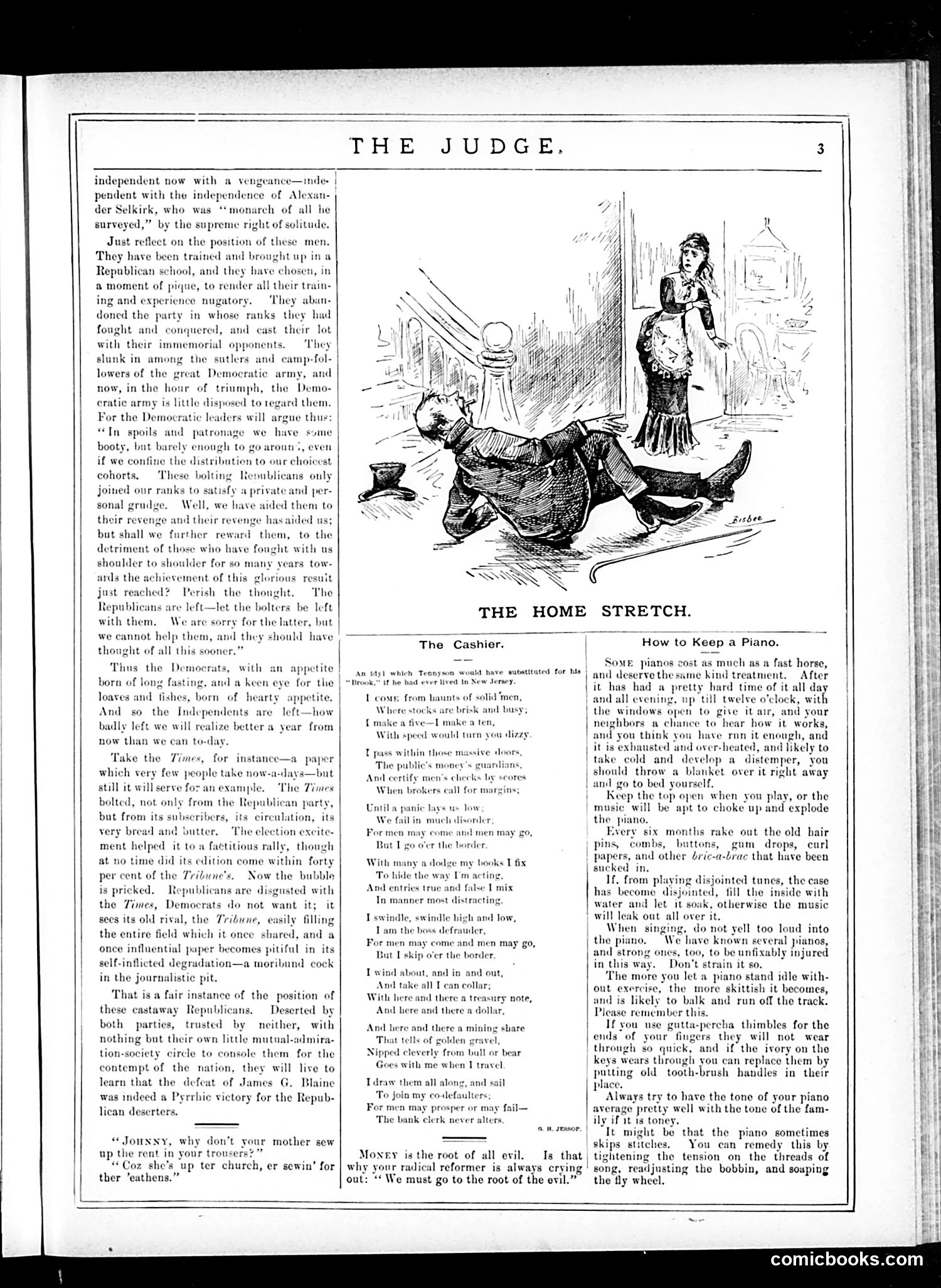
This page contains political commentary on Republican Party defectors ("Mugwumps") who abandoned the GOP to support Democrat candidates, particularly during the 1884 election era. **The Main Cartoon** ("The Home Stretch"): depicts a man sprawled on the floor while a woman stands nearby—likely satirizing the exhausted state of these Republican deserters after their failed political gamble. The accompanying text, a parody of Tennyson's "Brook," mocks their hollow victory: they switched parties seeking spoils and patronage, but the Democratic machine offers them little reward despite their "betrayal" of Republican ranks. **The Political Point**: Judge argues these defectors will be left worse off—abandoned by both parties, trusted by neither. The satire suggests their moral and political inconsistency deserves the contempt of the nation. The page positions them as self-serving opportunists whose "Pyrrhic victory" ultimately proves their undoing. **Secondary Content**: "How to Keep a Piano" and "The Cashier" (a poem about embezzlement) fill remaining space—typical for satirical magazines of this era.
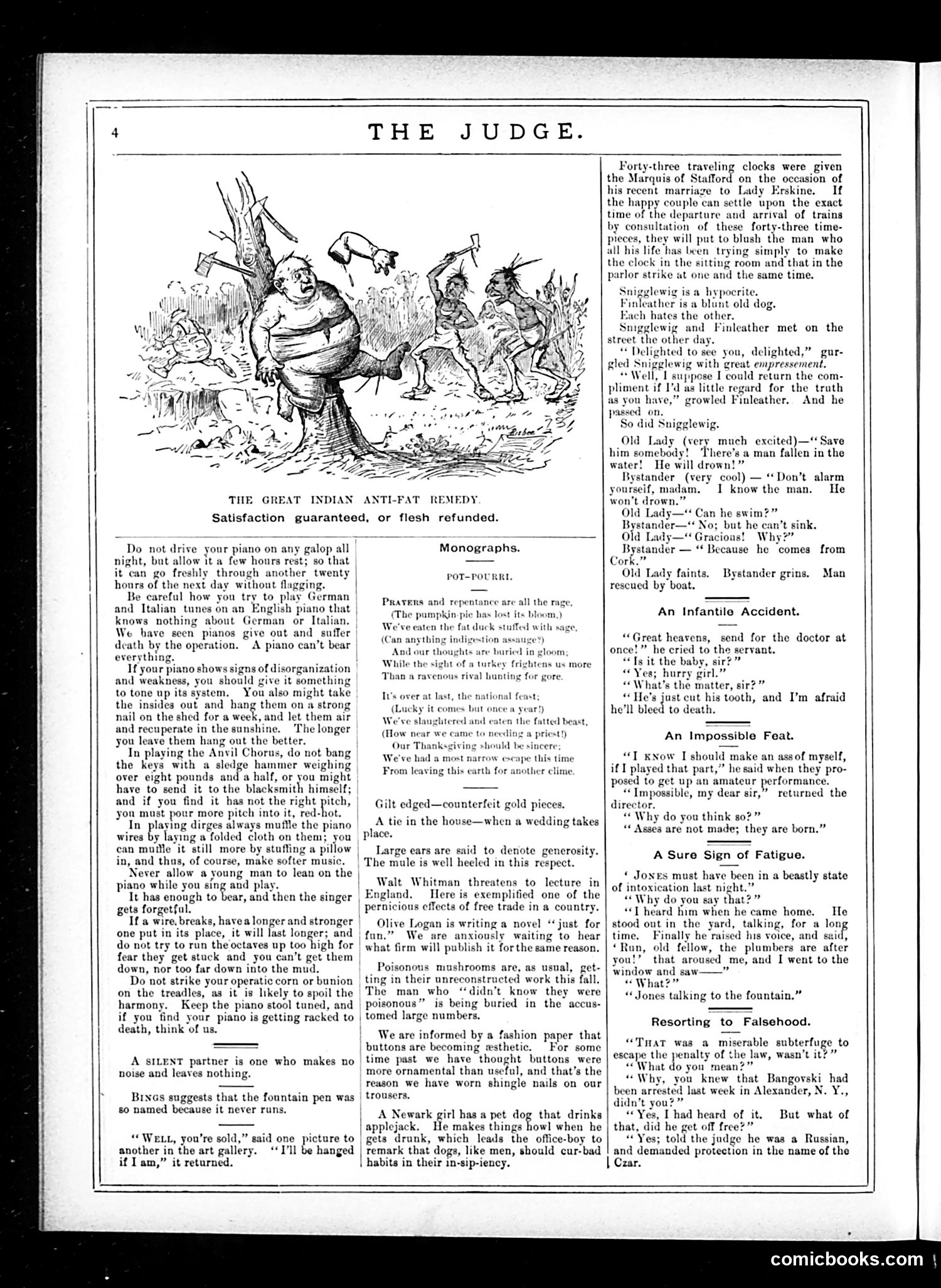
This page from **Judge** magazine contains satirical humor and practical advice columns typical of 19th-century American publications. The main cartoon depicts **"The Great Indian Anti-Fat Remedy"**—a fat man juggling, satirizing fraudulent weight-loss products aggressively marketed in that era. The caption "Satisfaction guaranteed, or flesh refunded" mocks the absurd promises of such remedies. The brief anecdotes mock social hypocrisy (Snigglewig and Finleather's false civility) and British class concerns (the Marquis of Stafford's wedding gift of 43 clocks—a humorous commentary on wealth and impracticality). The "Piano Advice" column parodies overly earnest household instruction manuals, offering deliberately ridiculous care tips (hitting keys with sledgehammers, hanging piano innards to dry) to mock Victorian pedantry. Other items target contemporary frauds and absurdities: counterfeit gold, fountain pens that "never run," and dubious claims about physiognomy (large ears indicating generosity). The overall tone is irreverent mockery of commercial deception and social pretension.
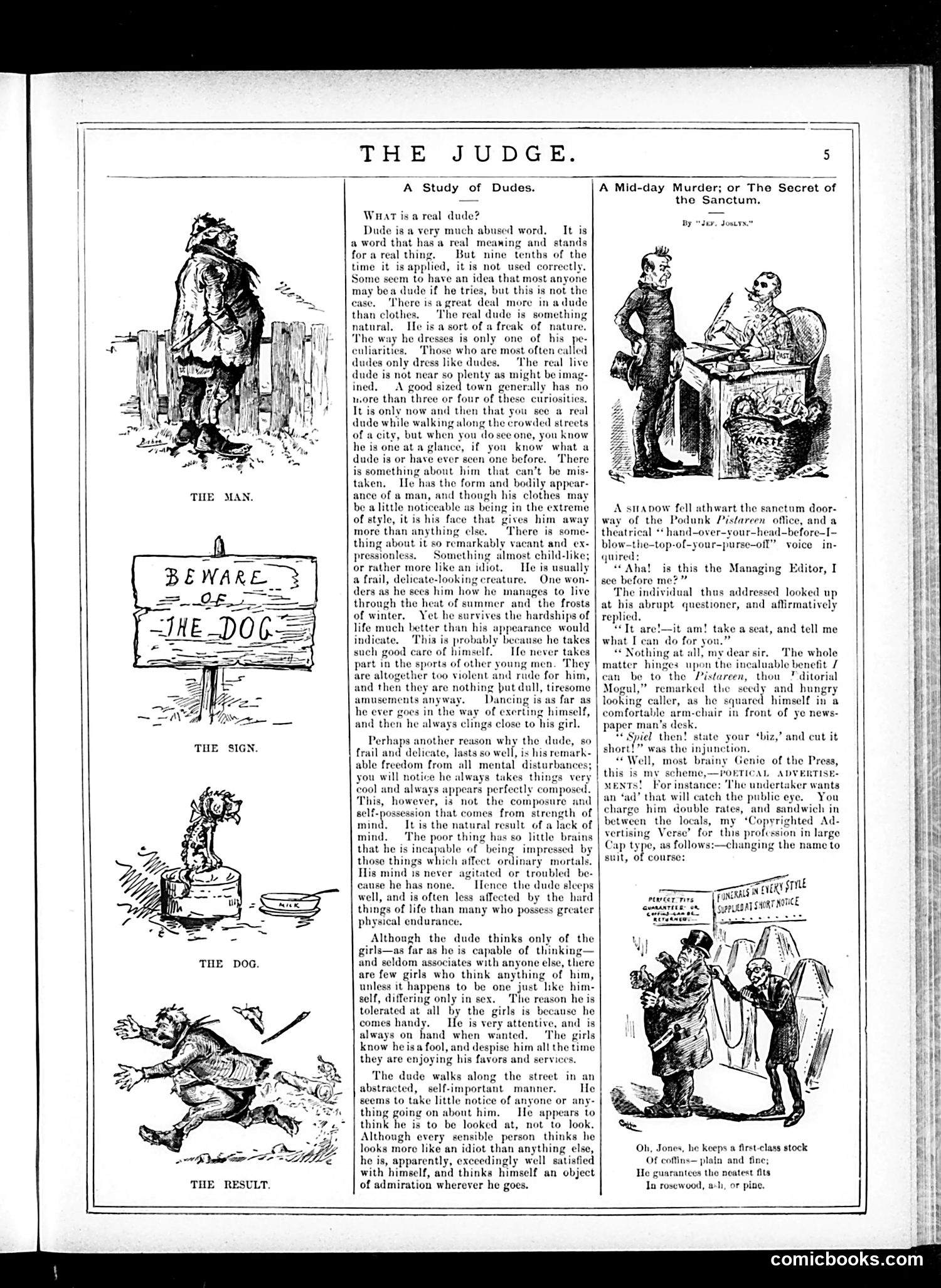
This page satirizes the "dude"—a dandy or excessively fashionable young man who was a stock figure of ridicule in late 19th-century American humor. The central essay mocks dudes as naturally vain, intellectually vacant creatures who dress extravagantly and obsess over girls while contributing nothing to society. Key satirical points include: dudes are rare "freaks of nature," not simply well-dressed men; they're physically delicate yet mysteriously hardy; their composure stems from lack of brains, not strength; girls tolerate them only for convenience while despising their foolishness; and they believe themselves objects of admiration while appearing idiotic. The cartoon vignettes ("The Man," "The Dog," "The Result," and the "Beware of the Dog" sign) use animal comparisons to reinforce the dude's subhuman status—suggesting he's as oblivious and useless as a lap dog. The secondary story, "A Mid-day Murder," appears unrelated satirical fiction.
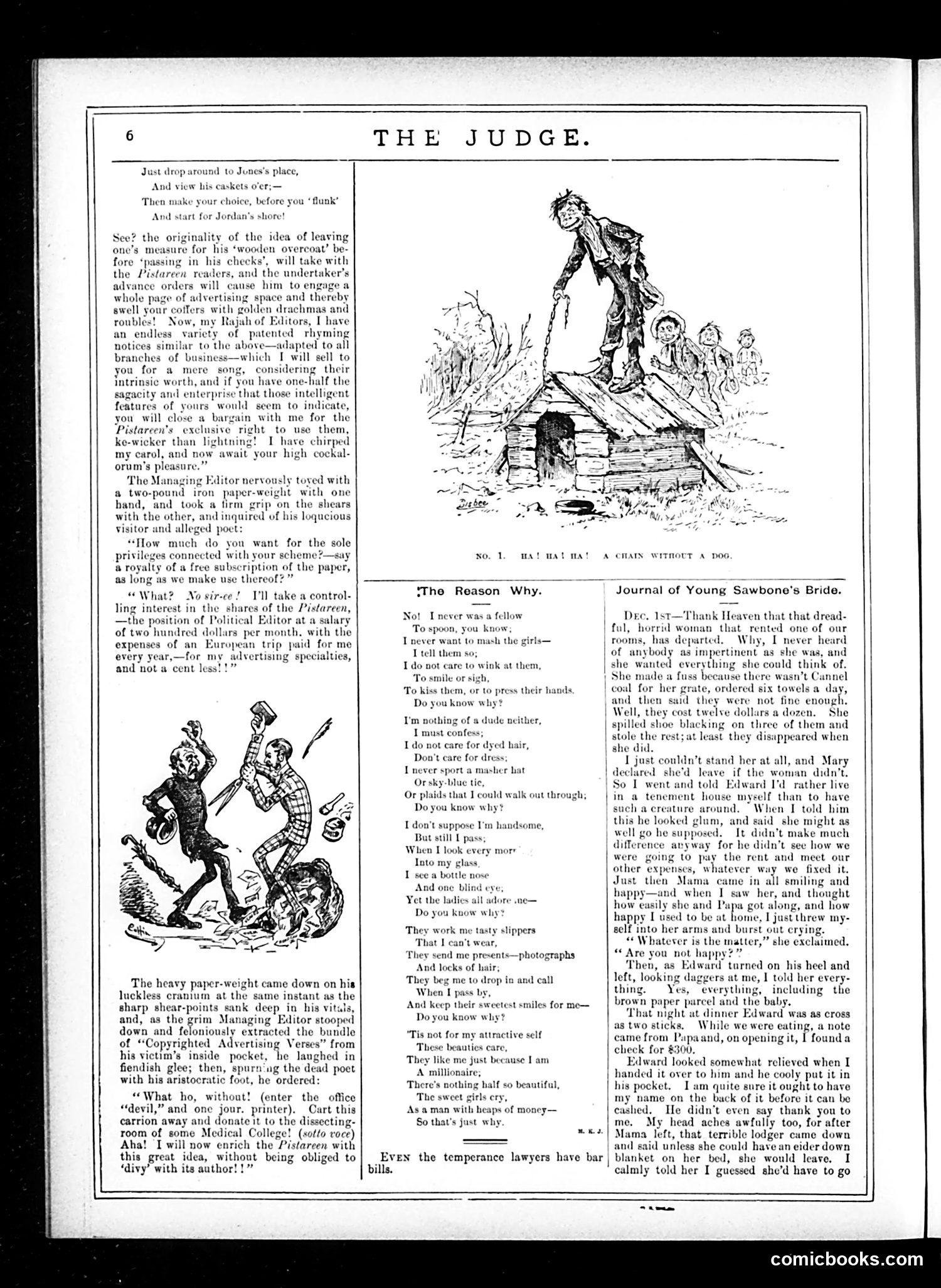
This page contains two satirical pieces typical of late-19th-century American humor magazines: **The Main Cartoon** (top left): A Managing Editor violently attacks a persistently annoying poet/editor who keeps pitching terrible ideas—including a scheme to profit from funeral-home advertising by writing rhyming notices about death. The satire mocks both the poet's shameless self-promotion and his outrageous salary demands (he wants controlling shares in the magazine, a Political Editor position, and a European trip—for what amounts to worthless advertising copy). The Editor's violent response, while played for dark comedy, reflects period frustration with con-artist salesmen. **"The Reason Why"** (right): A poem satirizing women's supposed mercenary nature. A man claims he's indifferent to romance, fashion, and appearance—yet women pursue him relentlessly. The punchline: they're attracted solely to his wealth. This reflects period cynicism about gender relations and contains the era's characteristic misogyny. Both pieces exemplify *Judge*'s brand of crude, violent, and dismissive humor targeting perceived social annoyances.
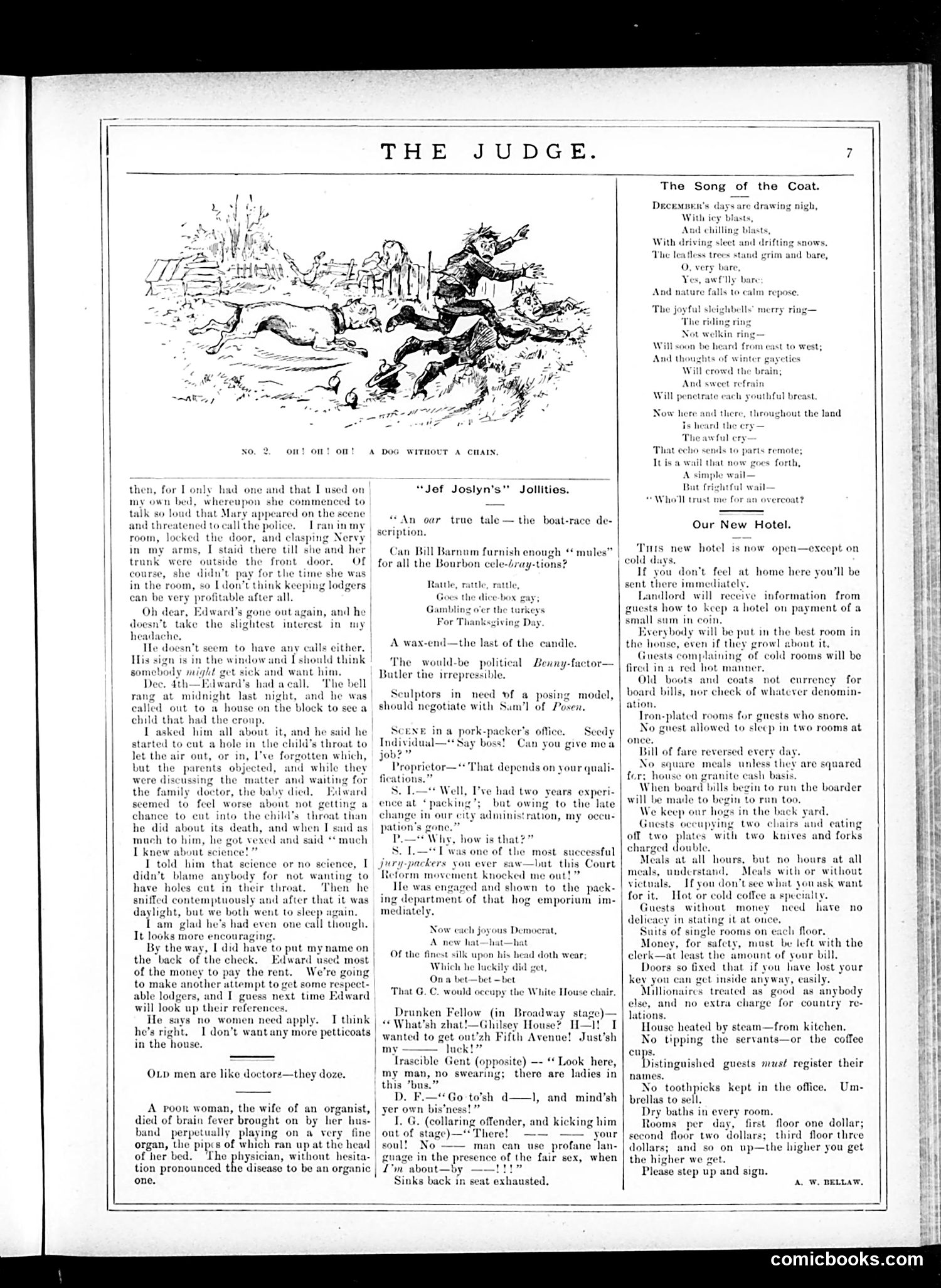
This page from Judge (a 19th-century American satirical magazine) contains several humor sections rather than a single cohesive political cartoon. The main visual cartoon shows a hunting scene titled "A Dog Without a Chain," depicting what appears to be comedic chaos during a hunt—likely satirizing hunting mishaps or incompetence. The text sections include "Jef Joslyn's Jollities"—humorous anecdotes. One story mocks a doctor's obsession with bloodletting (cutting patients' throats), satirizing outdated medical practices. Another section includes references to "Bill Barnum" and "Bourbon cele-bray-tions," suggesting Democratic Party political humor. The "Our New Hotel" section advertises a budget hotel with tongue-in-cheek descriptions of bare-bones accommodations, poking fun at cheap lodging houses. The page also contains brief comic dialogues about drunken men and respectability, typical of Judge's working-class humor. Overall, this represents Judge's mix of social satire, medical critique, and Democratic Party ribbing typical of late 19th-century American humor magazines.
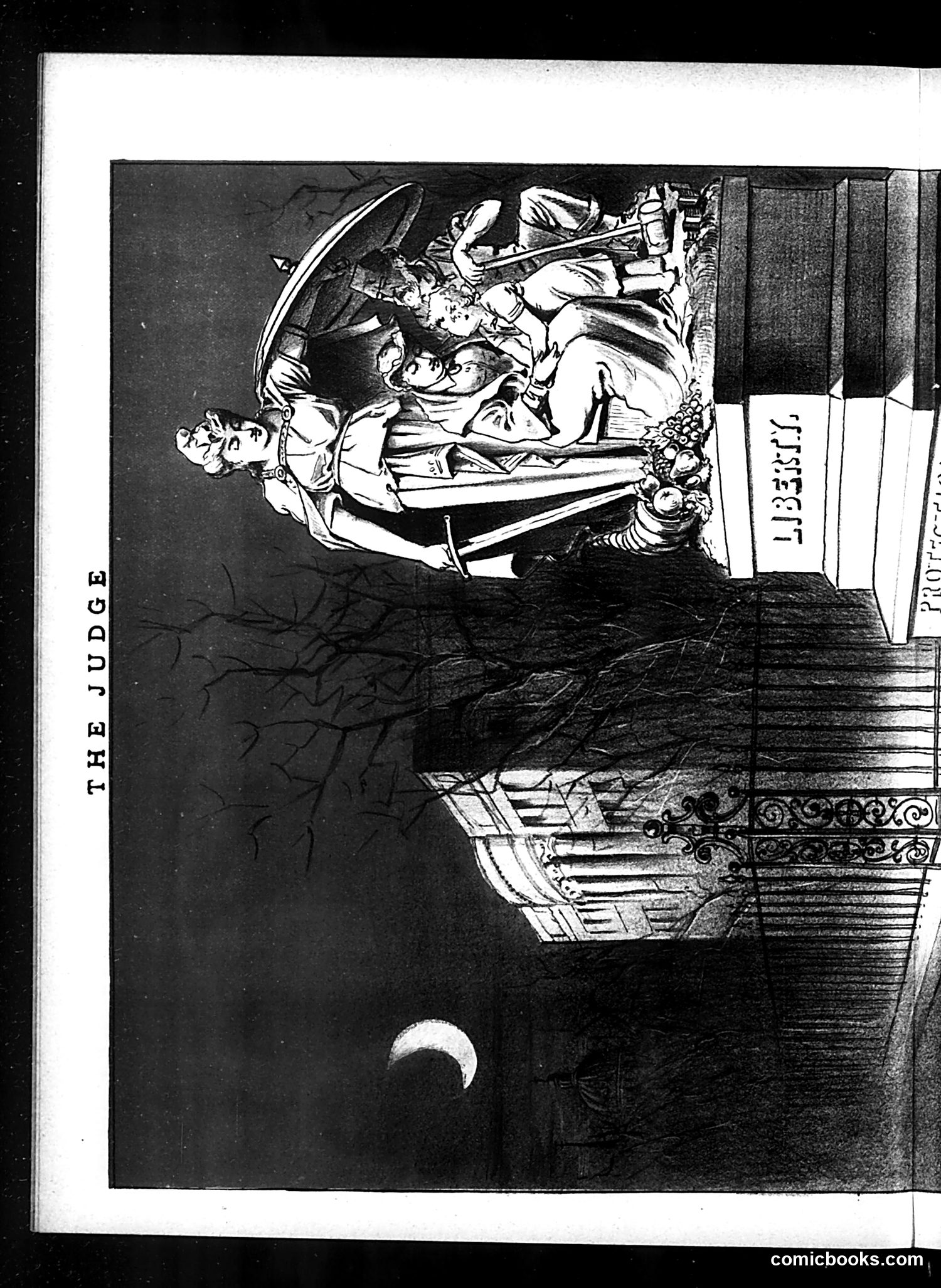
This appears to be a page from the satirical magazine *Judge*, rotated 90 degrees. The visible text reads "THE JUDGE" on the left margin and "LIBERTY" on the right side of the illustration. The engraving shows a classical allegorical figure (Liberty, identifiable by the label) depicted as a robed woman holding a torch and sword, surrounded by smaller figures that appear to represent citizens or cherubs. The architectural setting and classical style suggest this is commenting on American ideals or governance. Without a clear date or additional context visible, the specific political situation being satirized remains unclear, though the imagery invokes traditional American liberty symbolism to make some point about the nation's state or direction.
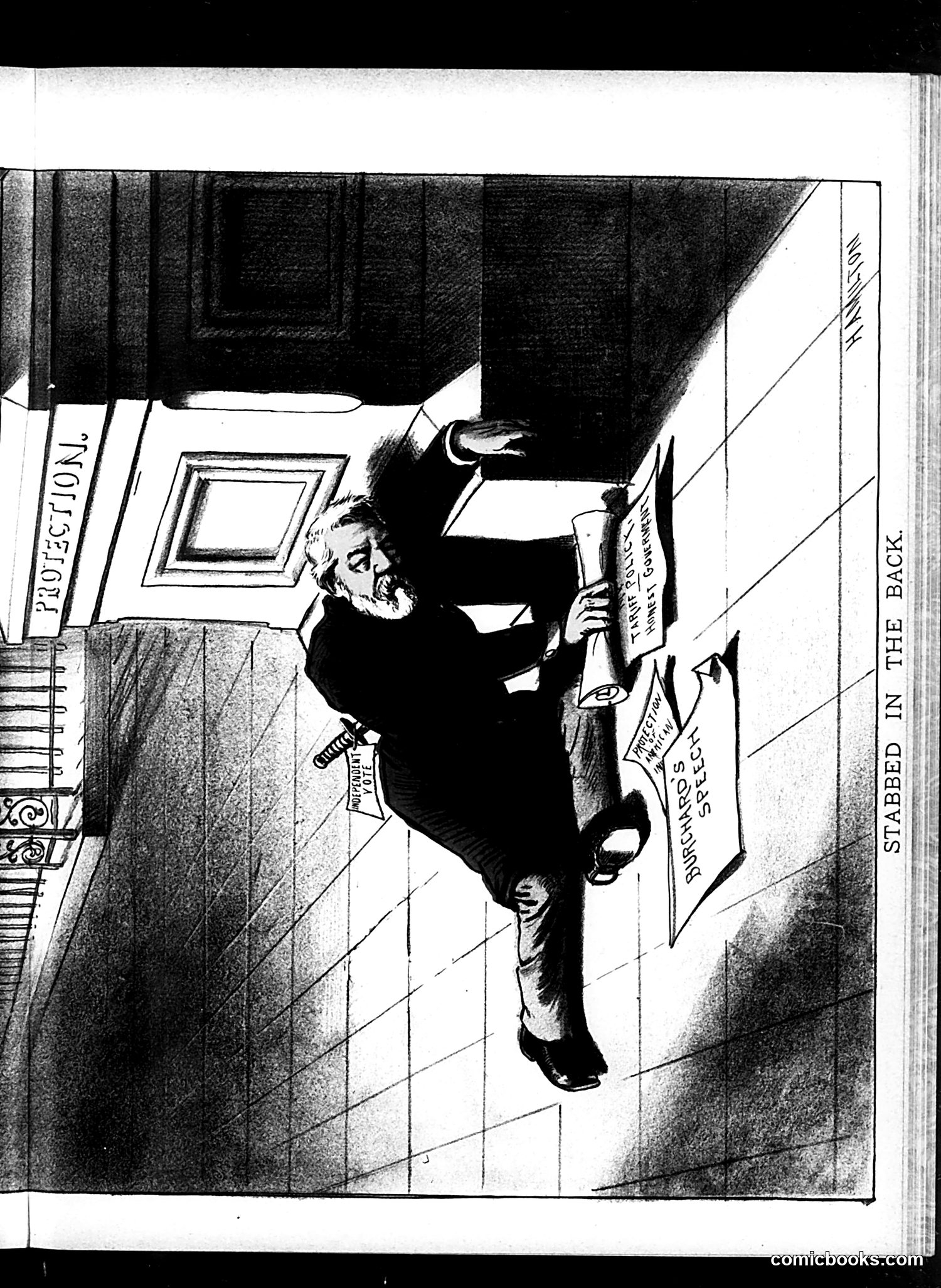
The OCR text is too corrupted to read reliably. However, the image shows a single cartoon figure (an older man with a beard) standing in what appears to be an interior space, reading or holding documents labeled "PROTECTION" and what seems to be other text (possibly "FREE SPEECH" or similar). The visual suggests satire about protectionism or political/economic policy positions. Without legible text identifying the specific figure, date, or context, I cannot confidently explain which politician or historical moment this references. The cartoon appears to critique someone's stance on tariffs or protection policies, but determining the precise target and satirical point requires clearer source material.
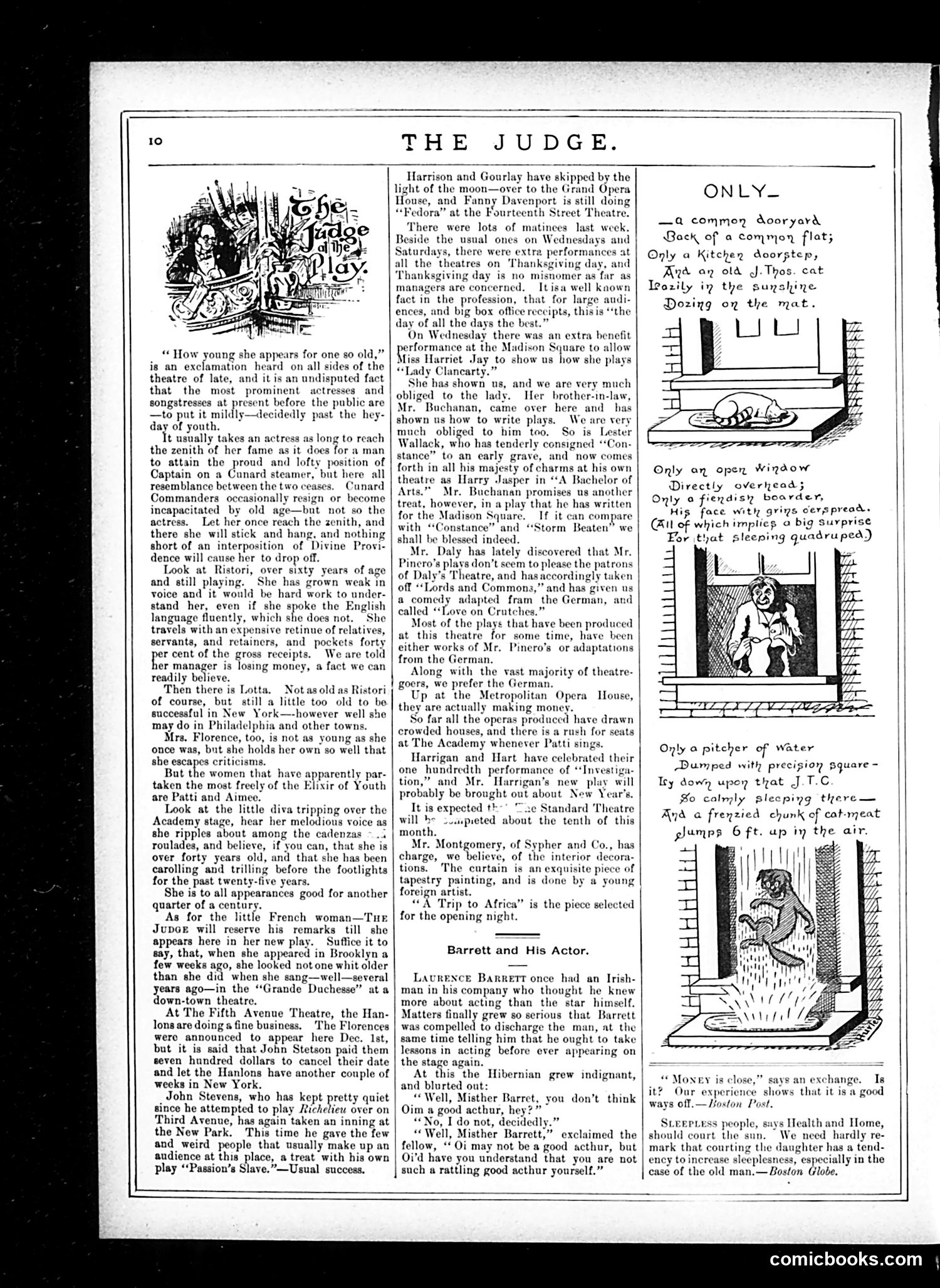
This page is primarily **theater criticism and gossip** from Judge magazine, with accompanying satirical illustrations about stage life. The main article critiques aging actresses who remain performing despite advanced age. It references specific performers: **Ristori** (over 60, with weakening voice), **Lotta**, **Mrs. Florence**, and notably **Patti and Aimee**—describing them as apparently benefiting from an "Elixir of Youth" despite performing for decades. The satire suggests these women defy natural career decline through cosmetic or other means, contrasting them with male performers (Cunard ship captains) who age out of positions. The accompanying illustrations are humorous domestic sketches labeled "Only," depicting mundane household scenes like kitchen doorsteps, open windows, and water pitchers—visual jokes about ordinary life. The page also reports on various theater productions and actors, including references to plays at specific New York theaters and performances by Harrison, Gourlay, and Fanny Davenport. The overall tone is **gossipy and mildly misogynistic satire** about aging performers.
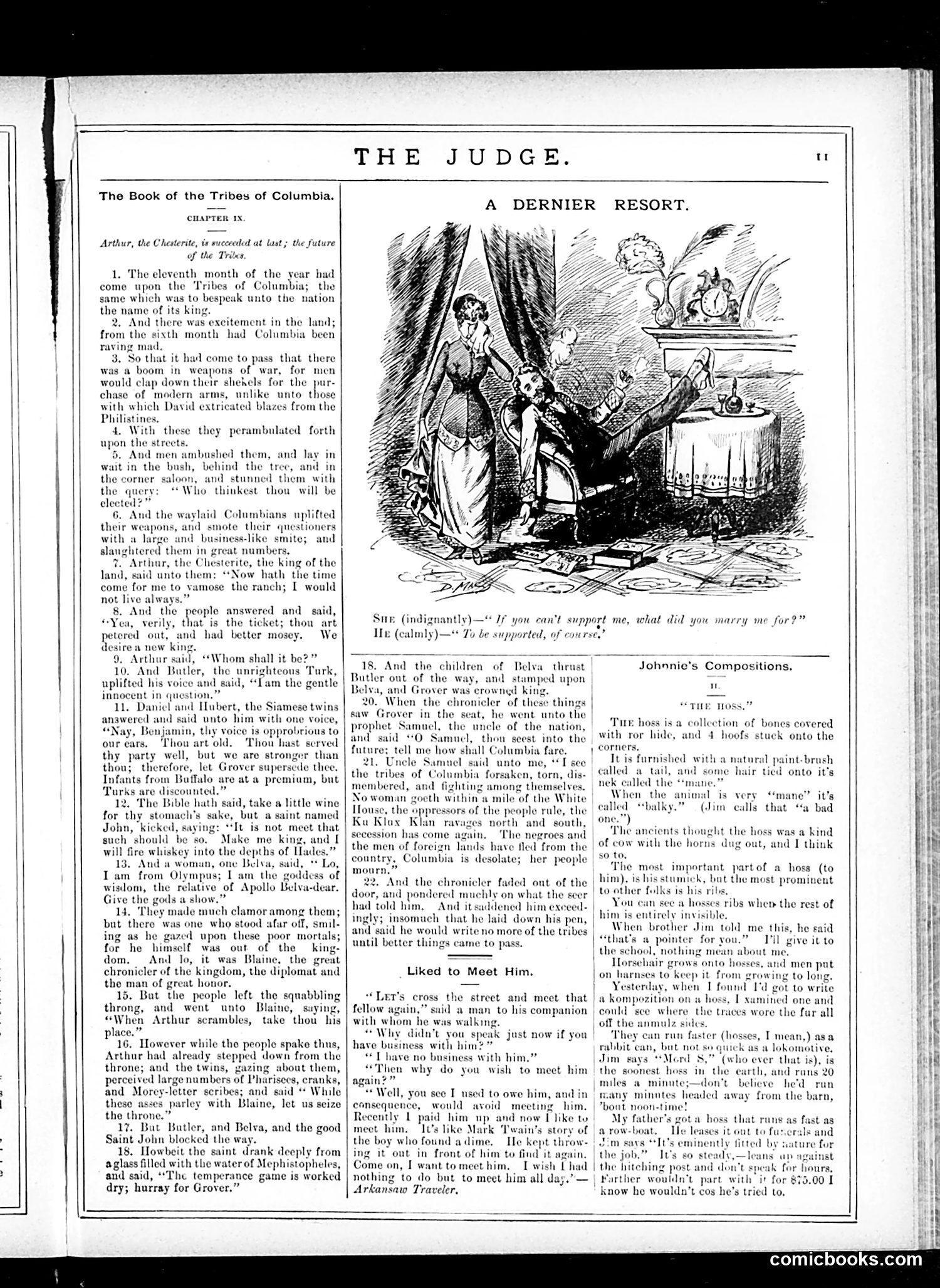
This page satirizes the 1884 U.S. presidential succession, written as mock-biblical prophecy. "Arthur, the Chesterite" refers to President Chester A. Arthur, who announces he will not seek re-election ("vamose the ranch"). The "tribes" then squabble over succession: Butler (likely James G. Blaine's rival General Benjamin Butler) offers himself; the "Siamese twins" (unclear which figures) support Grover Cleveland; Saint John (likely prohibitionist John St. John) campaigns; and Belva (likely women's suffrage advocate Belva Lockwood) declares herself a goddess-candidate. The cartoon "A Dernier Resort" shows a woman asking a man for financial support, mocking the tension between romantic expectations and economic reality—a side satire on gender relations. The prophecy ends darkly, with Samuel predicting Columbia's desolation under future rule, the KKK's resurgence, and minorities fleeing—satire warning against particular election outcomes.
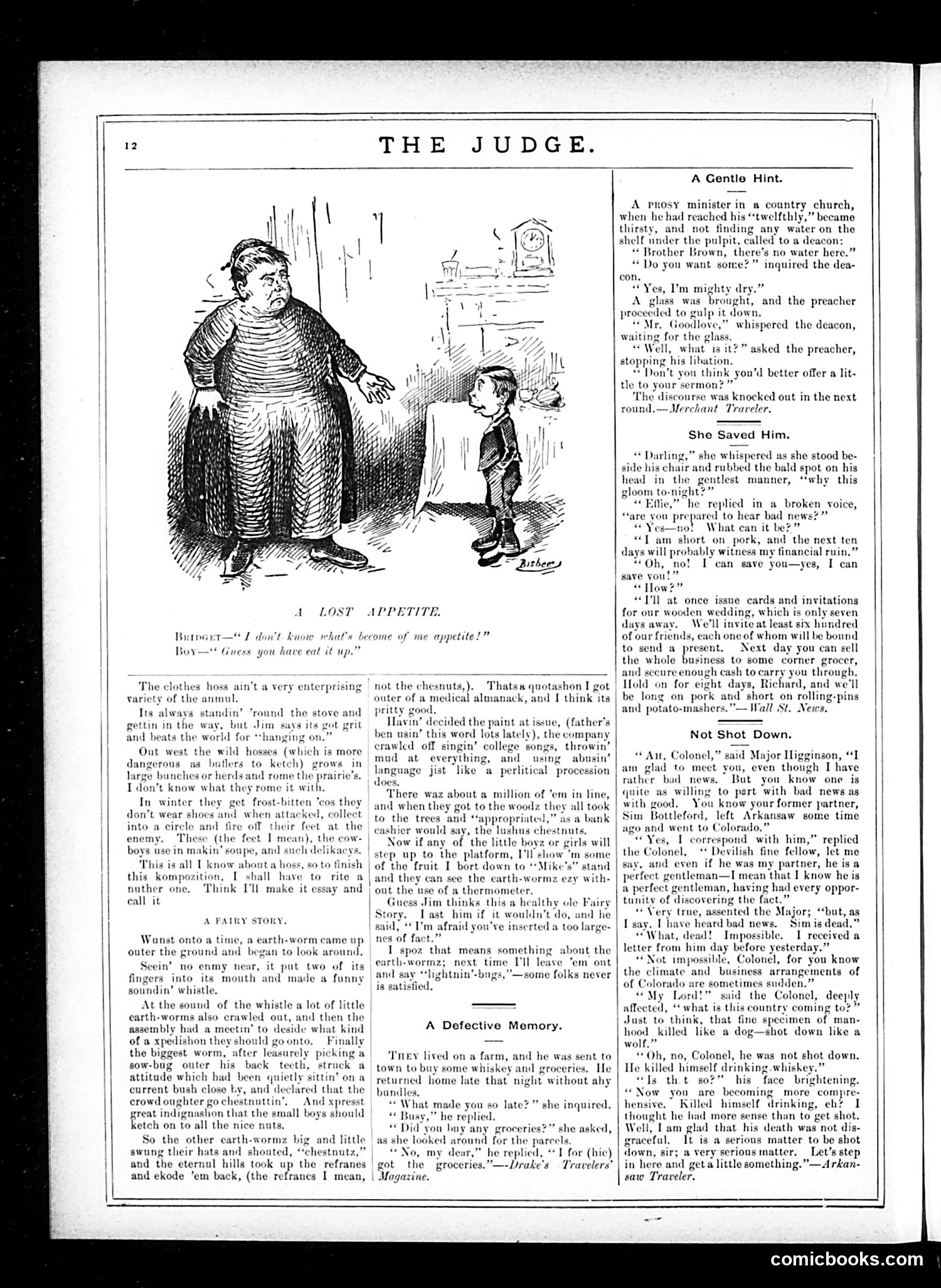
This **Judge magazine page** contains multiple short humorous pieces typical of 19th-century American satire: **"A Lost Appetite"** features a crude dialogue between a Burgher and Boy about horses—using exaggerated dialect humor ("romeing," "komponition") common to the era. The satire targets rural ignorance and malapropisms. **"A Defective Memory"** jokes about a farm husband who returned from town without groceries, claiming he was "busy"—later revealed he spent time drinking whiskey instead. The humor relies on the wife's suspicion and his transparent excuse. **"A Gentle Hint"** mocks a verbose preacher ("twelfthly") who becomes thirsty mid-sermon and eagerly drinks water offered by a deacon, who sarcastically suggests he "offer a little to your sermon"—implying the preacher should have offered prayer instead of gulping greedily. **"She Saved Him"** presents a wife consoling her bald husband, framed sentimentally. The satire targets pretension, rural dialect humor, marital dynamics, and clergy pomposity—reflective of Judge's satirical approach to American life.
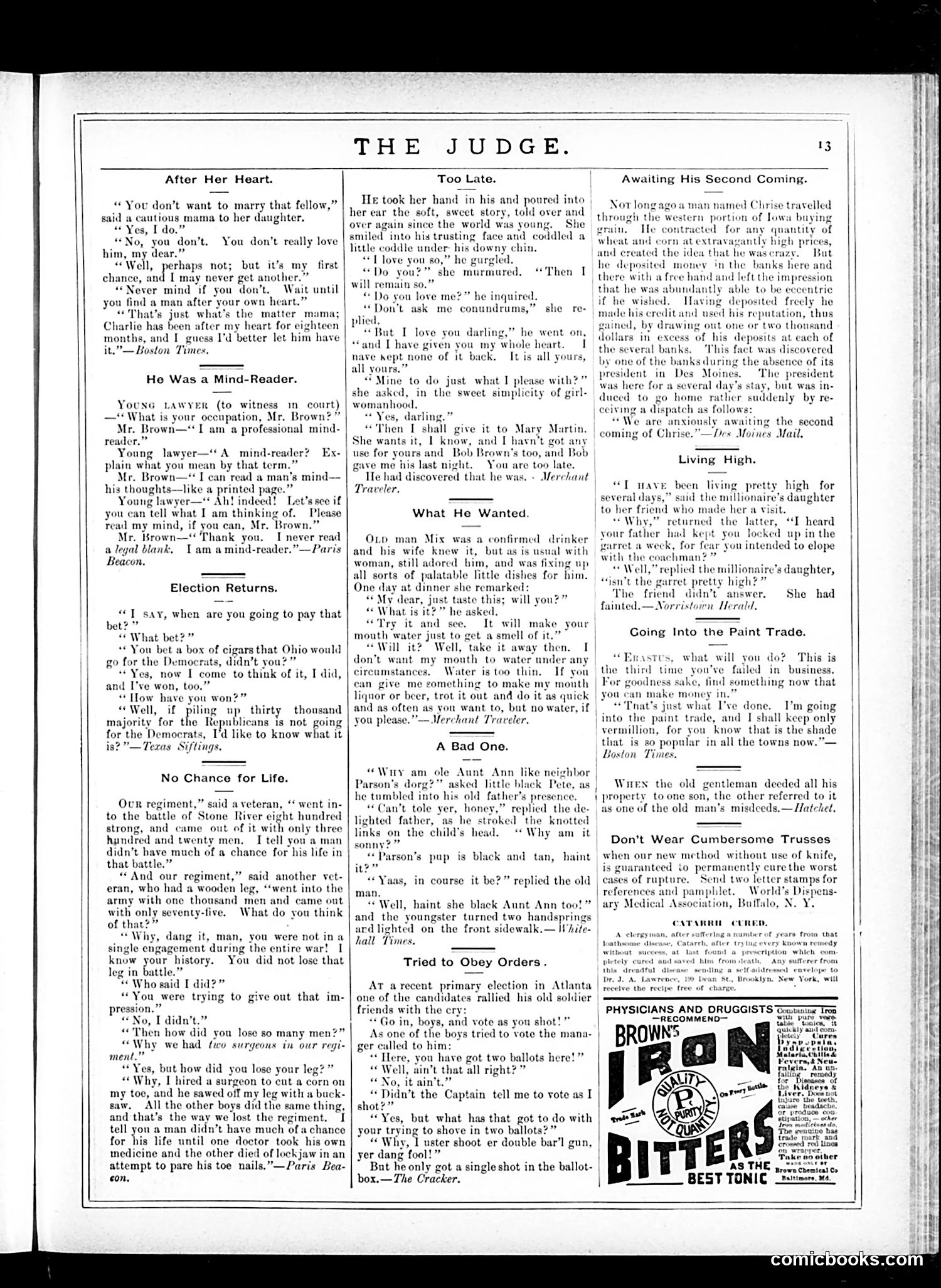
This page from *Judge* magazine contains several brief satirical sketches typical of late-19th-century humor: **"After Her Heart"** mocks a young woman's logic: she agrees to marry a suitor simply because he's "been after my heart" for months—a pun on persistence rather than love. **"He Was a Mind-Reader"** jokes that a self-proclaimed mind-reader refuses to read a lawyer's thoughts, claiming he only reads minds, not "legal blanks"—satirizing lawyers as mechanical or inhuman. **"Election Returns"** features someone claiming Ohio went Democratic while citing a 30,000-vote *Republican* majority—absurd illogic presented as "winning." **"No Chance for Life"** presents two veterans competing over casualty claims, culminating in the revelation that a surgeon accidentally amputated a soldier's leg while treating a corn—dark humor about medical incompetence. The remaining sketches use similar wordplay and situational humor. The overall tone reflects *Judge*'s satirical approach to American life: poking fun at romantic naiveté, professional pretension, political dishonesty, and institutional bungling.
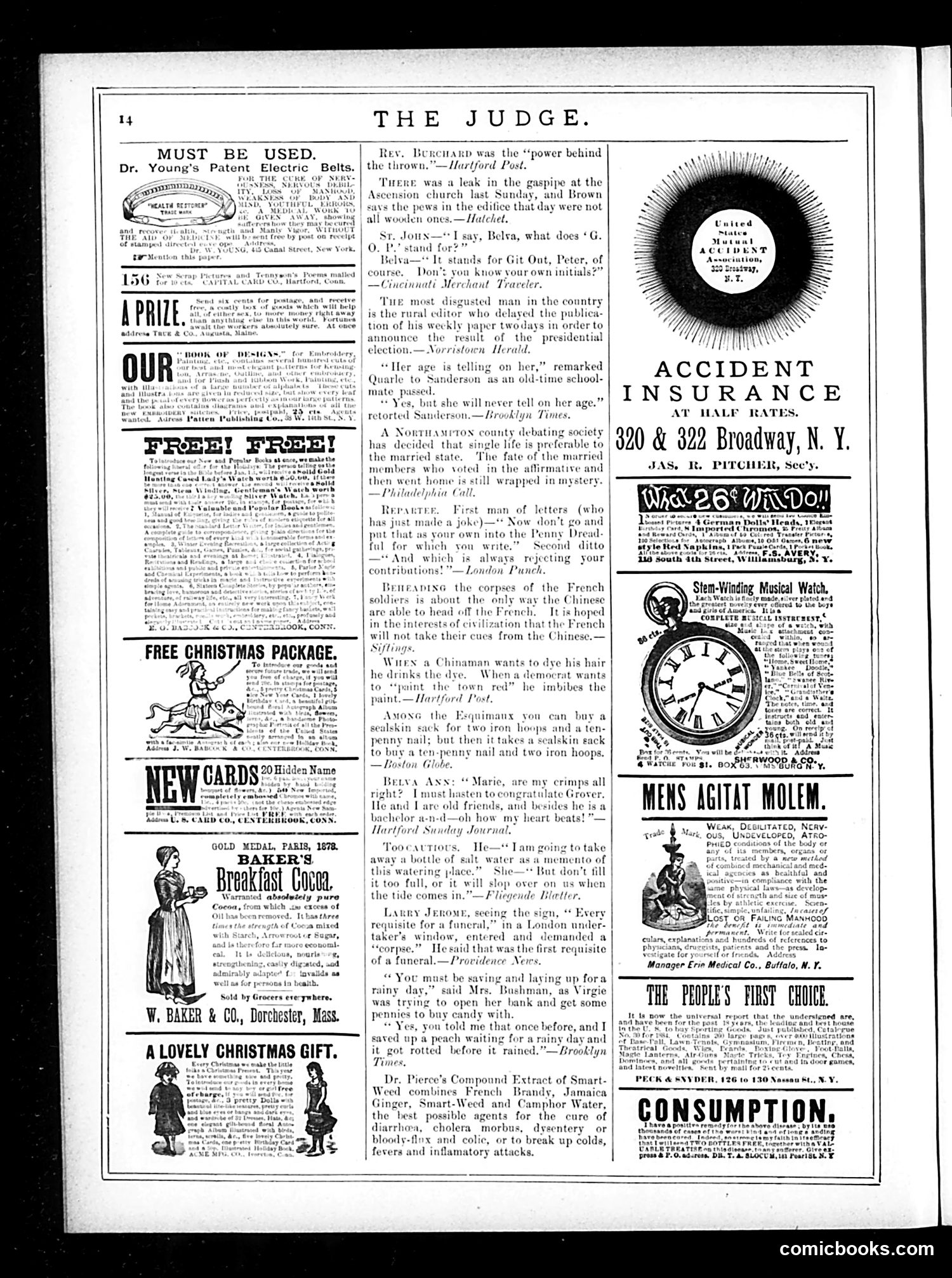
This page is primarily **advertisements and brief jokes/anecdotes** rather than political cartoons. The content reflects late-19th-century American humor and commercial culture. **Key elements:** The advertisements—for electric belts, cocoa, Christmas gifts, and insurance—represent typical patent medicines and dubious health devices marketed to readers. These were common targets of satire during the era. **The jokes** are brief, disconnected items typical of Judge's format: - Puns on initials and names - Observations about rural editors and small-town life - Ethnic humor (Chinese and Esquimaux/"Inuit" stereotypes) - Gender humor about women's vanity and behavior - Wordplay and misunderstandings The humor relies on **period-specific references** (Belva likely refers to Belva Lockwood, a women's rights advocate; references to "painting the town red") and **social attitudes** now considered offensive, particularly toward non-white populations. Rather than sustained political satire, this represents Judge's miscellaneous filler content—lightweight, disposable humor meant for quick laughs between advertisements.
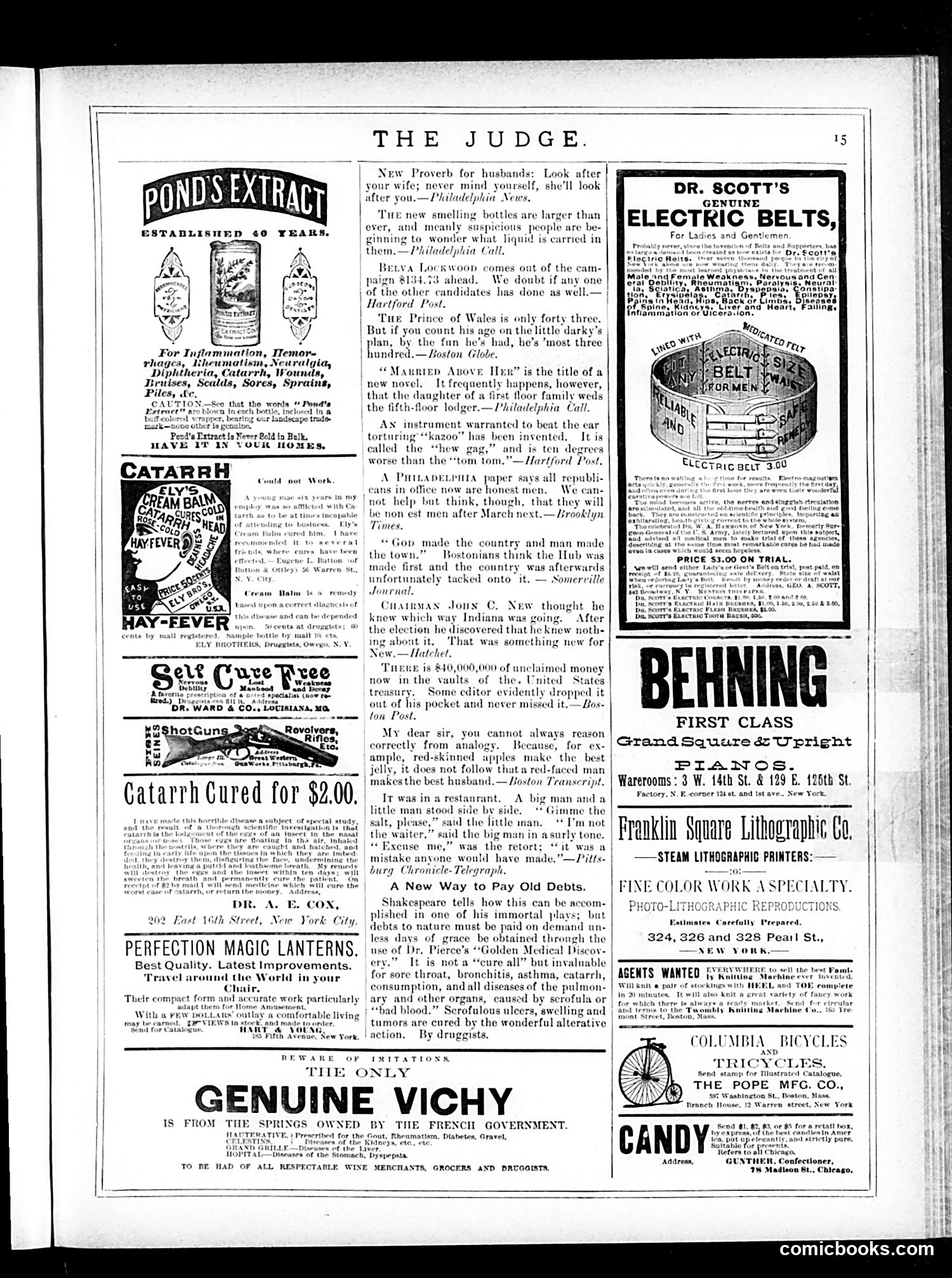
This page is primarily **advertising with scattered satirical remarks**, typical of Judge's format. The actual editorial content consists of brief, witty observations about contemporary American life, not a single unified cartoon. The humor relies on: - **Political jabs**: A remark about Republican officials becoming dishonest after March (likely referencing patronage or corruption concerns) - **Social observations**: Notes on suspicious "smelling bottles" (possibly containing alcohol during Prohibition-era concerns), a quip about the Prince of Wales's age, and commentary on urban snobbery ("God made the country, man made the town") - **Domestic humor**: A proverb mocking husbands; a joke about a red-faced man not making a good husband despite red apples making good jelly - **Local pride**: Bostonians believing their city was created before the country itself The page is dominated by patent medicine ads (Pond's Extract, Dr. Scott's Electric Belts, Dr. Cox) and product advertisements typical of 1880s-era magazines. The "satire" is brief editorial asides between ads rather than illustrated cartoons.
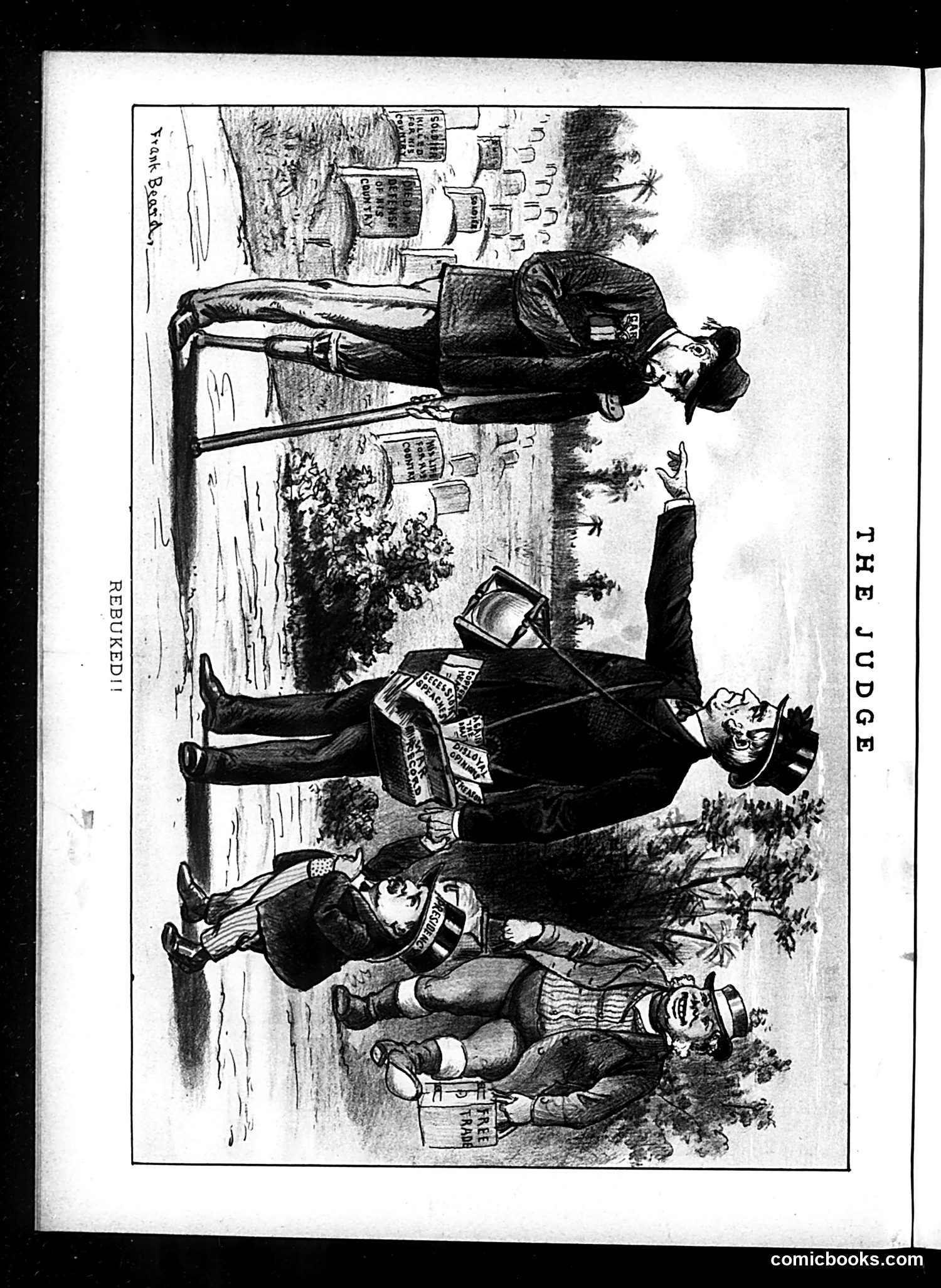
This appears to be a satirical cartoon titled "THE JUDGE" showing what looks like a courtroom scene. The image depicts several figures in formal dress, including what appears to be a judge or authority figure standing elevated above others in lower positions. The composition suggests a commentary on judicial power dynamics or courtroom hierarchy. However, the OCR text provided is largely illegible—consisting mainly of scattered letters and symbols rather than readable words. Without clear text identifying the specific political figures, historical event, or social issue being satirized, I cannot definitively explain the cartoon's particular point or context. To properly interpret this Judge magazine satire, clearer source text would be needed, or additional context about the publication date and political circumstances.