
A complete issue · 16 pages · 1884
Judge — October 4, 1884
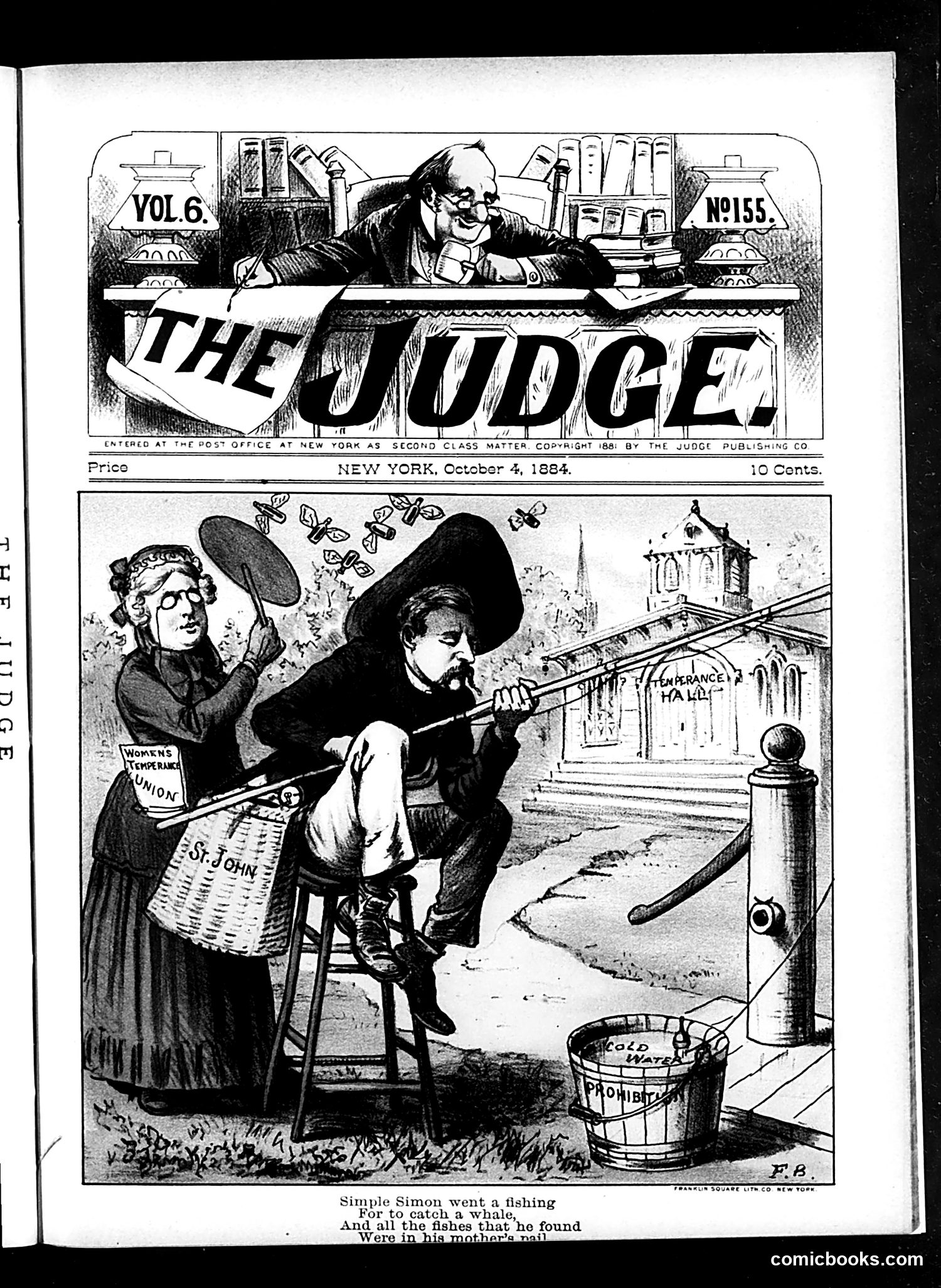
This satirical cartoon addresses **temperance and prohibition debates** of the 1880s. A woman labeled "Women's Temperance Union" and wearing a "St. John" (likely referencing a temperance organization) wields a large paddle at a man sitting on a chair, apparently to-catch a whale." The accompanying verse suggests domestic conflict over drinking habits. The "Temperance Hall" building in the background and the bucket labeled "Cold Prohibition" reinforce the anti-alcohol theme. The cartoon satirizes **aggressive temperance activism**, particularly **women-led prohibition movements**, mocking their militant tactics. The "whale-catching" metaphor suggests the cartoon views temperance advocates' efforts as absurdly ambitious or misguided attempts at moral reform.
This page from Judge magazine contains political satire attacking Cleveland's presidential campaign during what appears to be the 1884 election cycle. **"DRIFTING"** compares Cleveland's fading political momentum to Moses wandering the wilderness—a biblical metaphor suggesting Cleveland, like Moses, will never reach the "Promised Land" (the presidency). The satire mocks his remaining supporters as stubborn loyalists clinging to a lost cause, comparing them unfavorably to biblical Pharisees. **"THE COLD WATER CANDIDATE"** ridicules St. John, the Prohibition Party's presidential candidate. The piece argues that temperance, while respectable, shouldn't dominate a presidential election. The "cold water" reference is both literal (temperance advocates drinking water instead of alcohol) and metaphorical—suggesting his campaign is unpopular and ineffective. The satire warns that single-issue candidates waste votes that might otherwise influence major party politics. Both pieces use humor to delegitimize candidates Judge considered unelectable or ideologically extreme for their era.
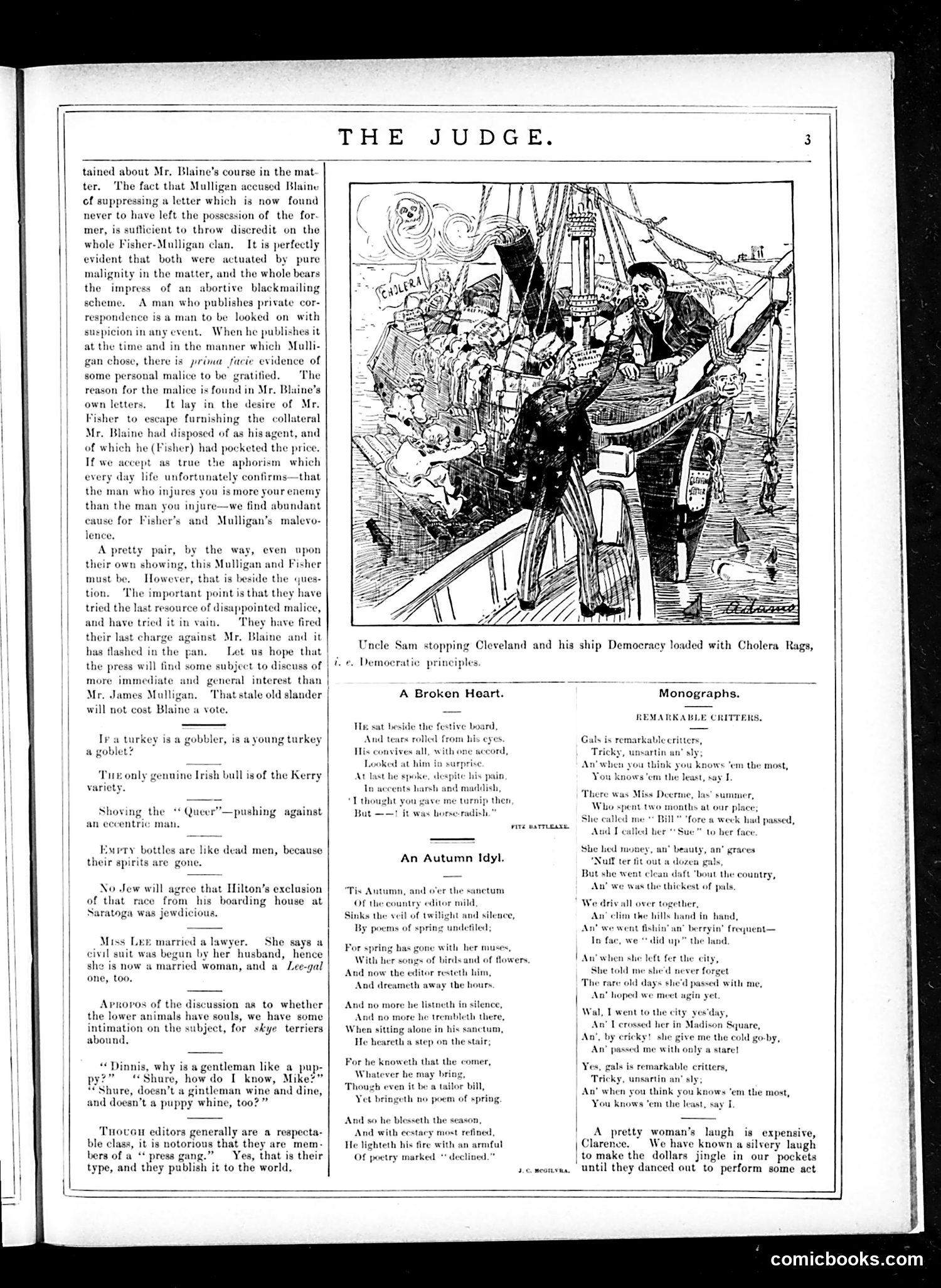
This page satirizes the **Blaine-Mulligan scandal** of the 1884 presidential campaign. The main text discusses James G. Blaine, a Republican presidential candidate, who was accused by James Mulligan of suppressing damaging letters. Judge's editors defend Blaine, arguing that Mulligan's blackmail scheme reveals *Mulligan's* malice, not Blaine's guilt—a transparent partisan defense. The cartoon depicts **Uncle Sam restraining Cleveland and a ship labeled "Democracy"** loaded with "Cholera Rags"—attacking Democratic principles and likely referencing Cleveland's political vulnerabilities. The caption suggests Democrats are dangerous to the nation. The page's lighter content (poetry, puns, anecdotes) fills space typical of satirical magazines. The overall thrust: Judge defended Republican Blaine against scandal charges while attacking his Democratic rival Cleveland as unfit.
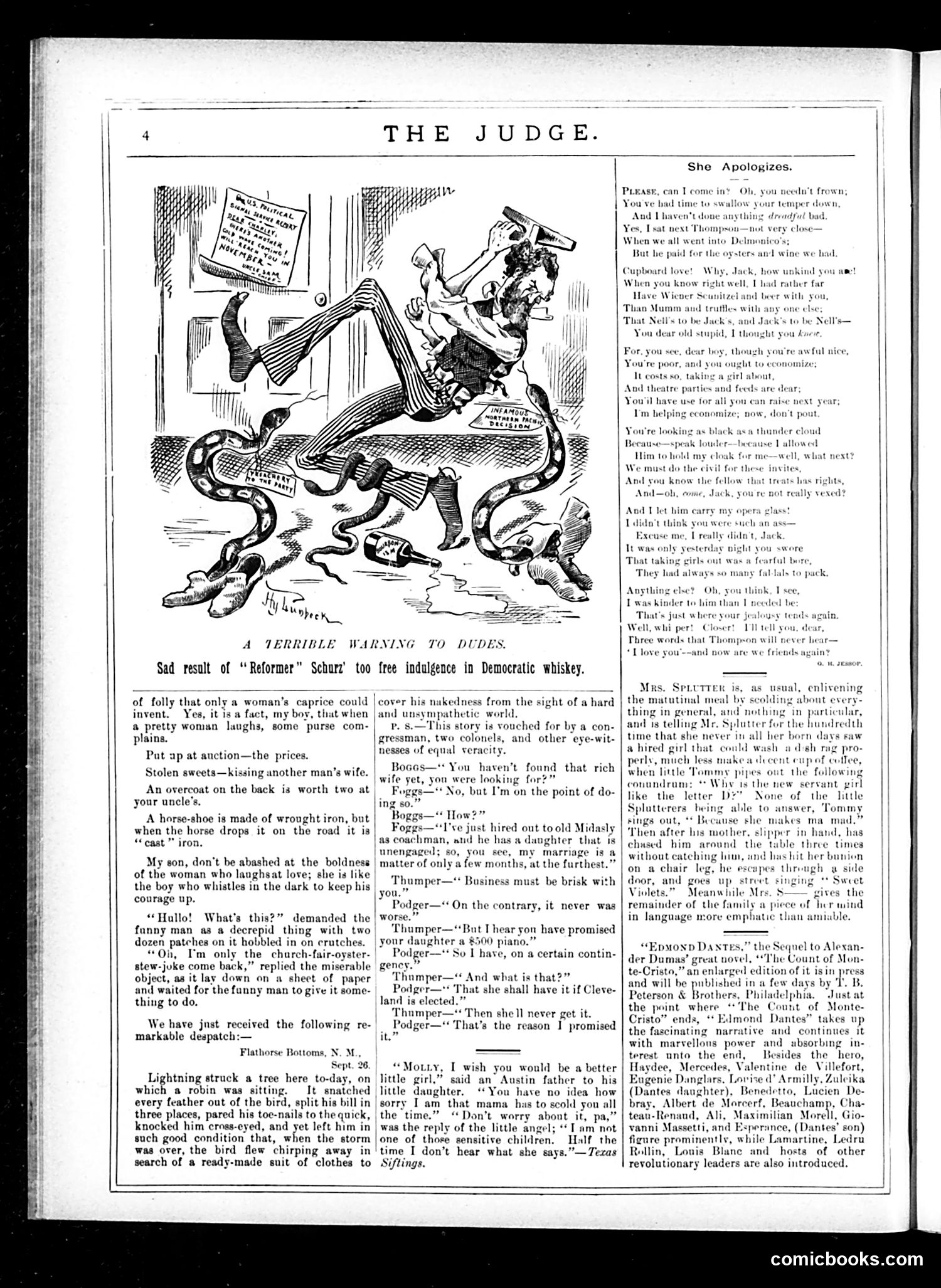
This satirical cartoon attacks **Carl Schurz**, a prominent "Reformer" Republican politician of the 1880s, by depicting him as a grotesque, drunken figure riding an octopus-like creature labeled with various scandals or vices. The subtitle mocks Schurz for allegedly indulging too freely in "Democratic whiskey"—suggesting he's compromised his reformist principles through excessive drinking or, metaphorically, through corrupt association with Democrats. The cartoon's core satire: Schurz, who positioned himself as a moral reformer and critic of political corruption, is portrayed as a cautionary spectacle of hypocrisy and degradation. The chaotic, violent imagery conveys Judge magazine's contempt for what it saw as Schurz's unprincipled political behavior. The joke relies on readers' familiarity with Schurz's public reputation and current political controversies circa the 1880s.
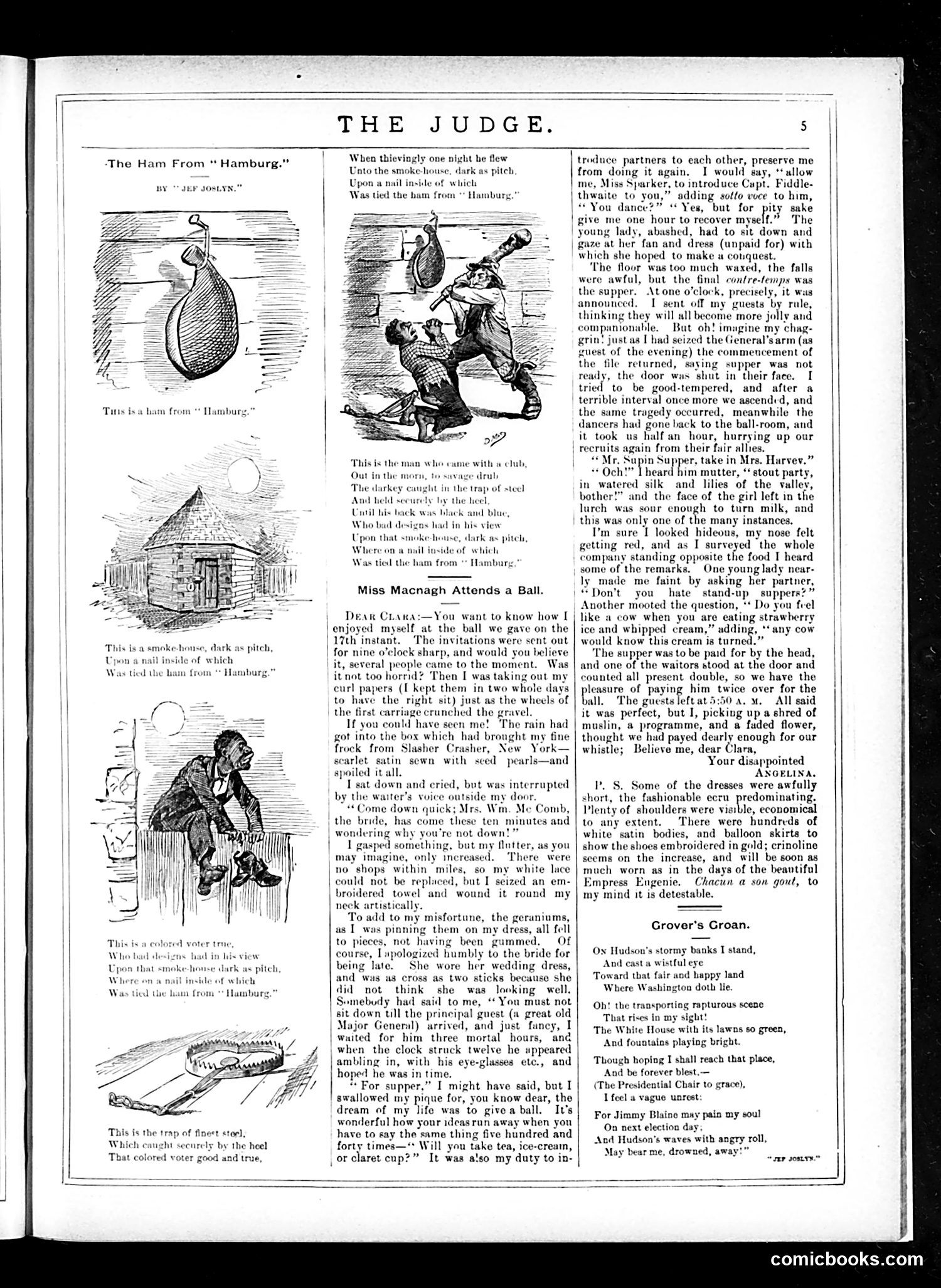
This page from *Judge* contains three distinct pieces of humor: **"The Ham From Hamburg"** (left) is a nonsense poem with accompanying illustrations about a stolen ham, repeated in circular fashion. The joke appears to be absurdist wordplay typical of 19th-century comic verse—humor through repetition and ridiculous rhyming rather than political content. **"Miss Macnagh Attends a Ball"** (center/right) is a satirical letter mocking upper-class social pretension. The author describes a disastrous ball where she serves as hostess: late arrivals, ruined clothing, failed flower decorations, and—the ultimate indignity—the supper wasn't ready when guests arrived. The satire targets both her anxious social-climbing and the absurd rigidity of formal etiquette. The humor relies on Victorian-era ball conventions that modern readers would find quaint. **"Grover's Groan"** (bottom right) is a brief poem, unclear in specific reference without additional context. The page lacks overt political satire, focusing instead on social mockery and absurdist comedy typical of 1880s-90s humor magazines.
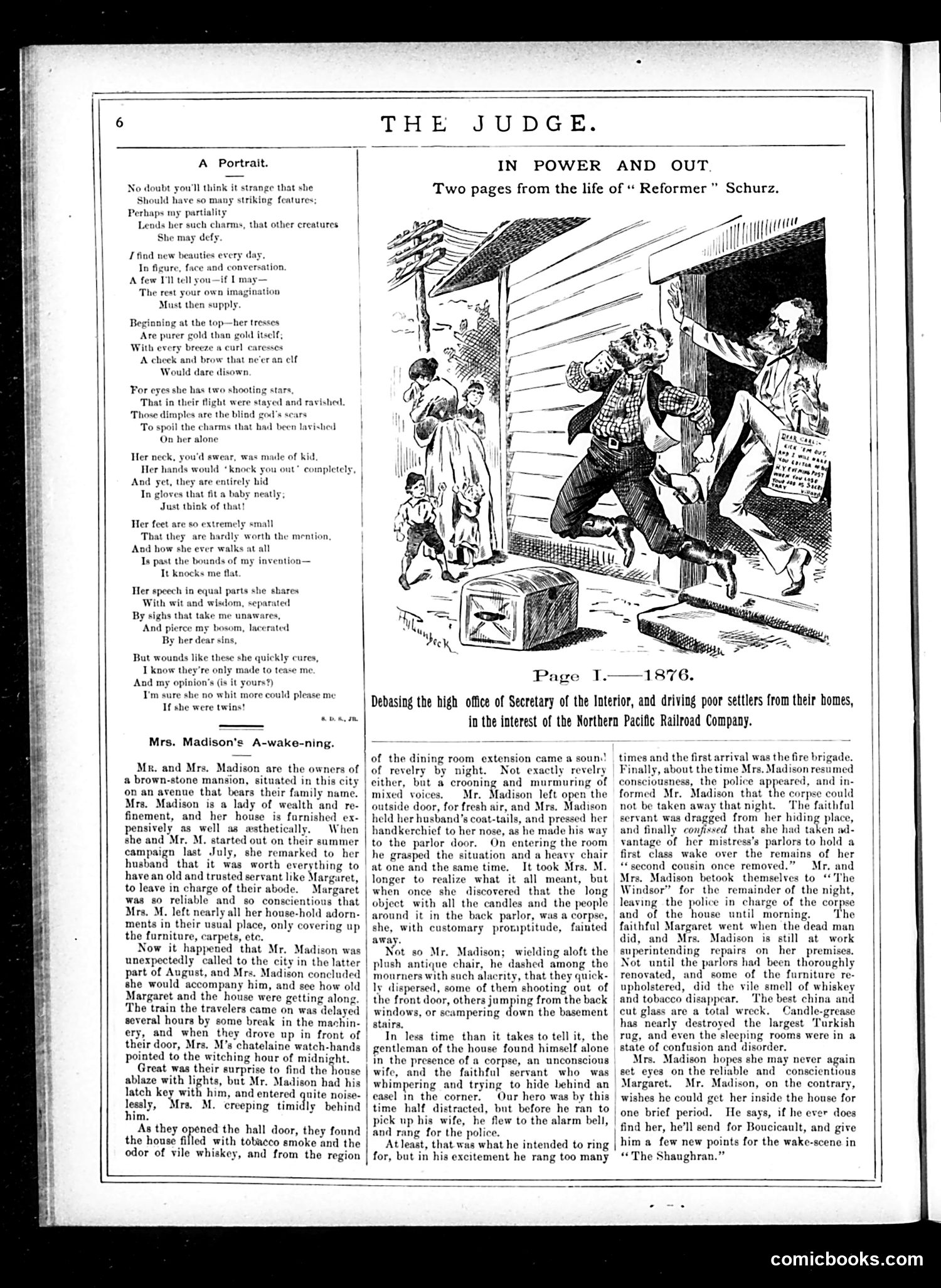
This page contains two separate pieces from *Judge* magazine: **"A Portrait"** is a romantic poem praising a woman's beauty—conventional Victorian verse unrelated to satire or politics. **"Mrs. Madison's A-Wake-ning"** is a humorous domestic story about a wealthy couple returning home unexpectedly to find their trusted servant Margaret has thrown a wild party in their absence, complete with whiskey drinking and what appears to be a corpse in the parlor. The satire targets servants' behavior when employers are away—a common Victorian comedic theme. **"Prize 1.—1876"** is the political content: a cartoon attacking **Carl Schurz**, a German-American reformer who served as Secretary of the Interior under President Hayes. The caption accuses Schurz of abusing his office to benefit the Northern Pacific Railroad by displacing poor settlers. This reflects real 1870s corruption scandals involving railroads and federal land policy. The cartoon satirizes the gap between reform rhetoric and corrupt practice.
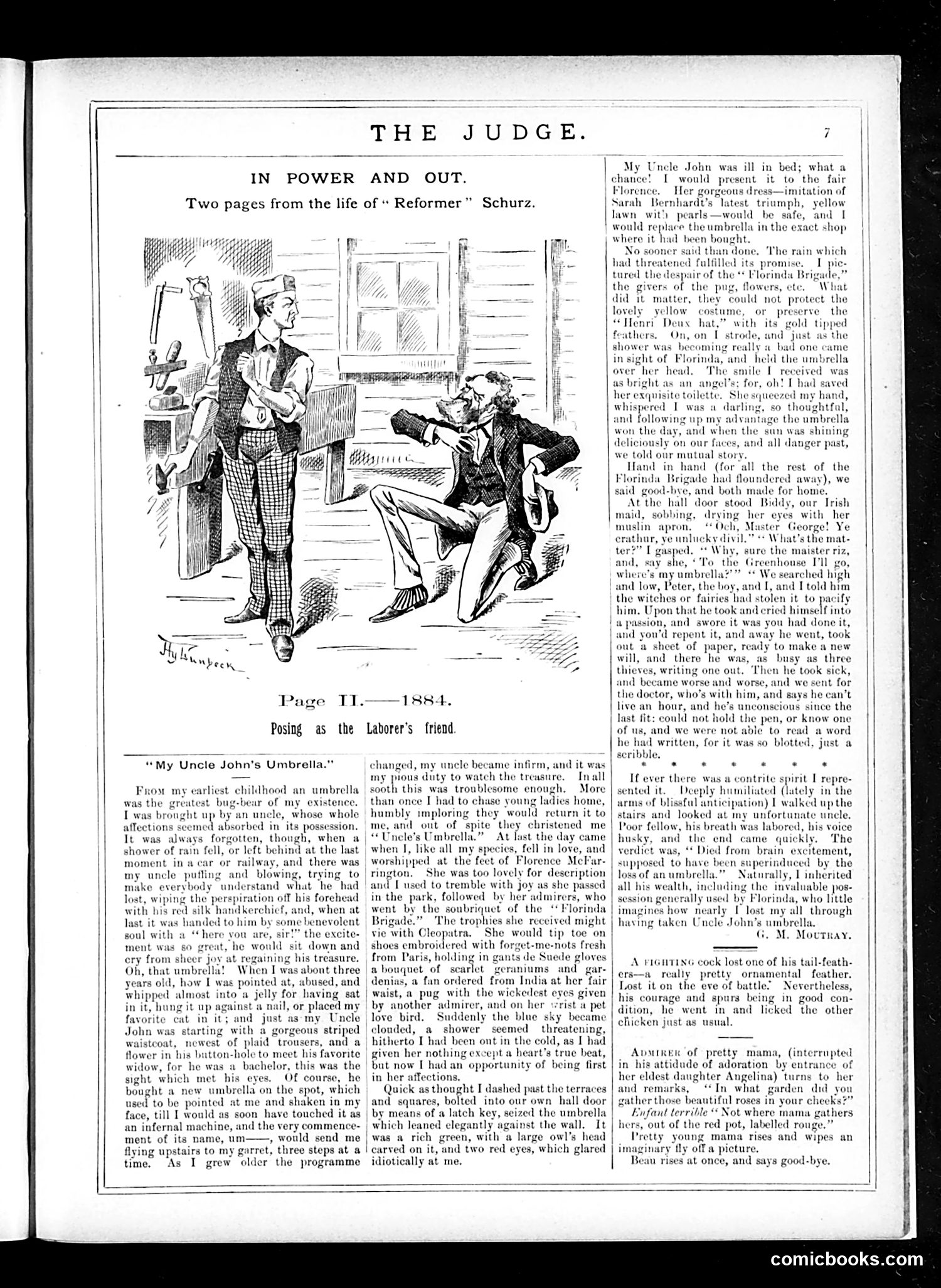
This 1884 *Judge* page satirizes Carl Schurz, a prominent "Reformer" politician. The cartoon shows Schurz in two contrasting poses: posing as a working-man's friend (left) versus his actual conduct in power. The accompanying story—"My Uncle John's Umbrella"—is a satirical allegory. The narrator's uncle's prized umbrella represents political office or reform principles. The narrator repeatedly loses or damages it, mirroring how reformers like Schurz supposedly abandoned their ideals once gaining power. The elaborate subplot about winning a lady's affection by retrieving the umbrella mocks the hypocrisy: appearing virtuous to gain favor while actually serving self-interest. The satire suggests Schurz presented himself as a champion of laborers and reform while actually pursuing personal political advantage. By 1884, Schurz had shifted political affiliations multiple times, making him a target for accusations of opportunism and inconsistency.
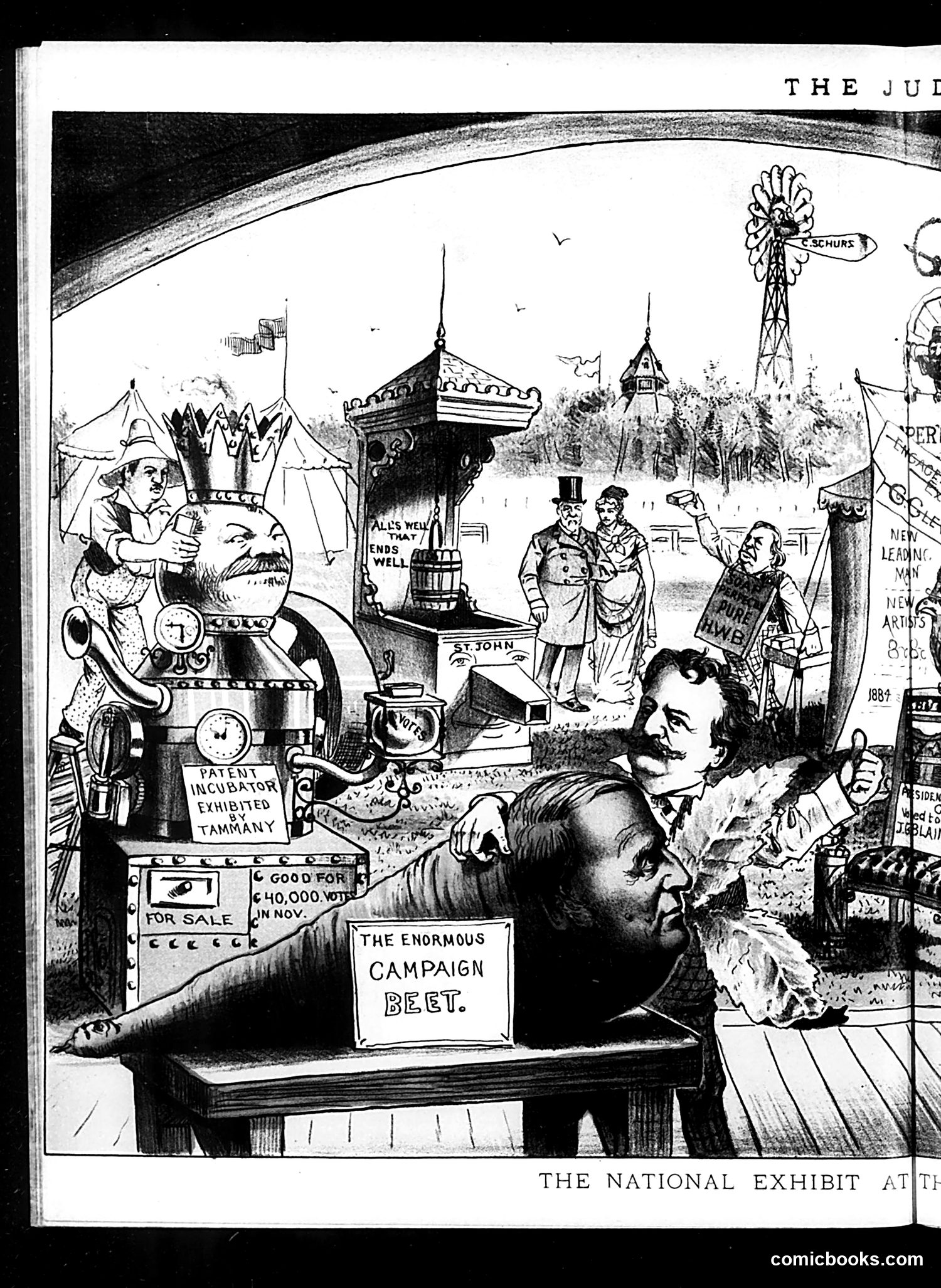
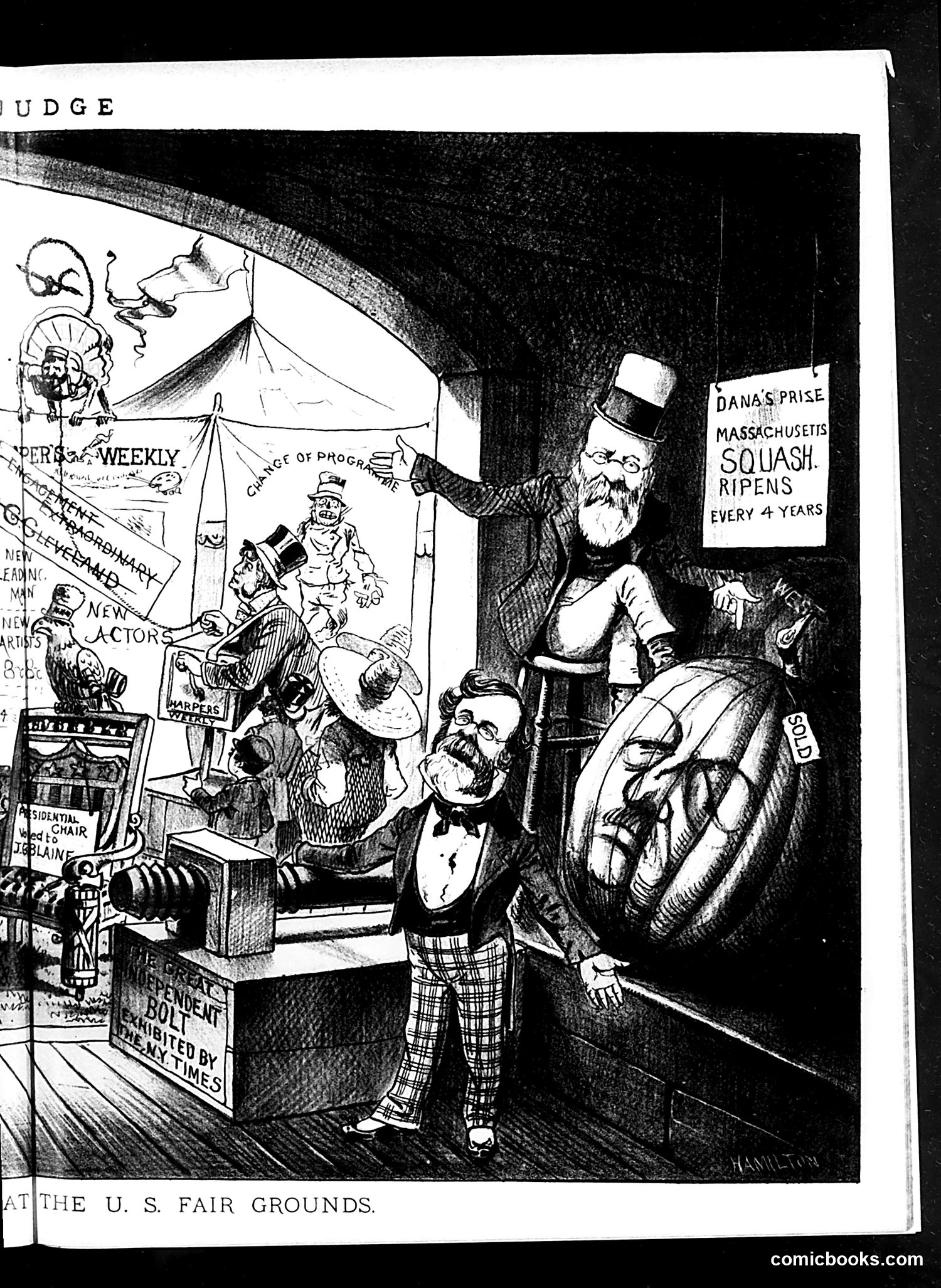
This Judge cartoon satirizes the American exhibitionism and promotional culture of late-19th-century world's fairs. The central figure—a barker or showman in a top hat—presents various curiosities and attractions typical of fair midways: performers labeled "Extraordinary," "New Actors," and other entertainment acts in a tent marked "Change of Programme." The joke appears to mock the aggressive salesmanship and dubious claims made at such fairs. A sign advertising "Dana's Prize Massachusetts Squash. Ripens Every 4 Years" likely references agricultural exhibits promoted as record-breaking. The massive hand in the foreground may represent either a famous "freak show" attraction or the overwhelming scale of American boosterism and hype that characterized these public spectacles.
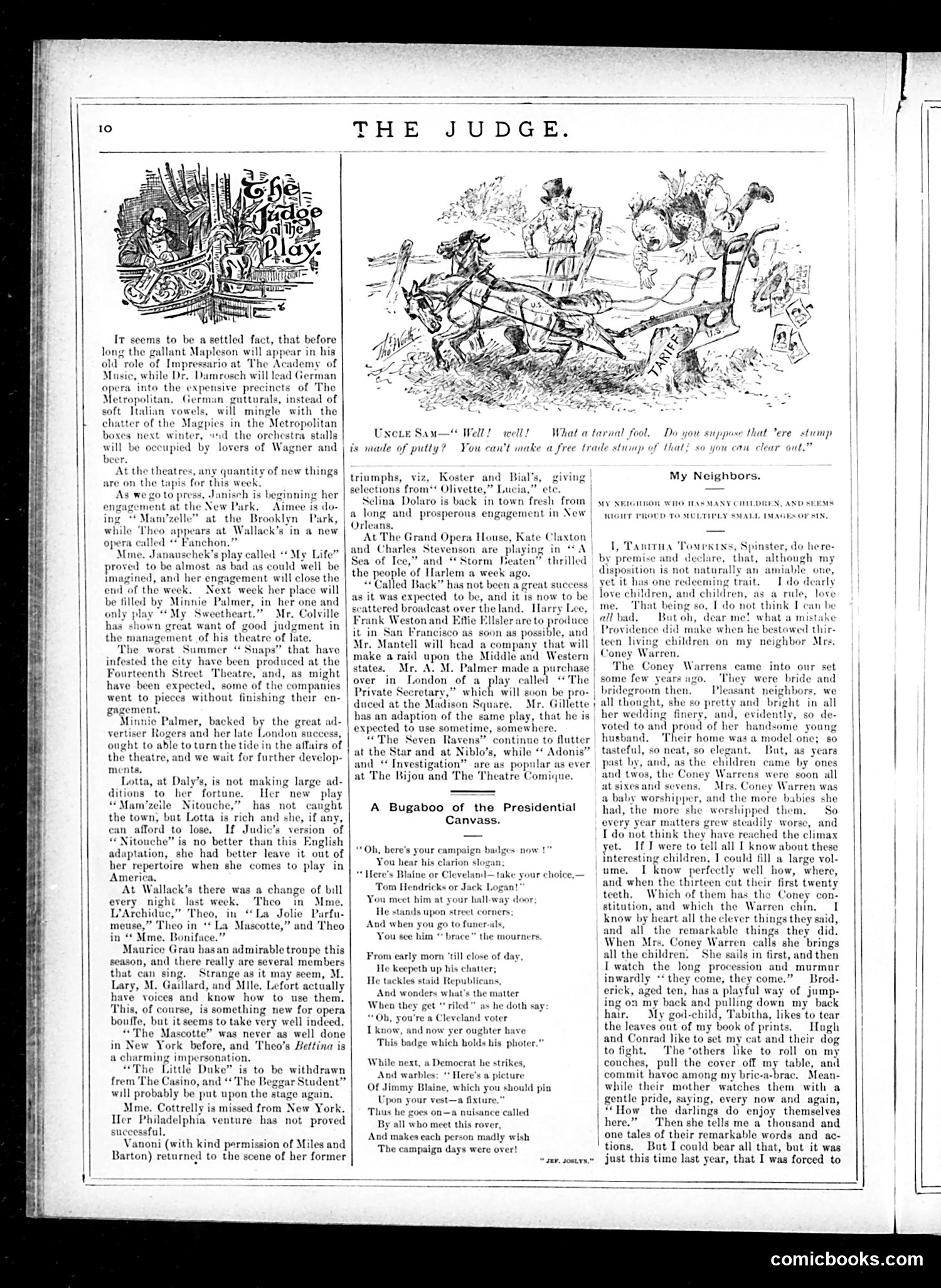
This page from *Judge* satirizes 1884 opera and theater management while including a presidential campaign cartoon. **Main Opera Cartoon (left):** The text discusses impresario Mapleson and conductor Damrosch competing for New York audiences. The satire mocks the shift from Italian opera (Mapleson) to German opera (Damrosch) at the Metropolitan, joking that German "gutturals" and beer-loving Wagner fans will replace refined Italian culture in the opera boxes. **Presidential Campaign Cartoon (right):** Titled "A Bugaboo of the Presidential Canvass," this depicts an annoying campaign operative pushing ballot choices—"Blaine or Cleveland" and "Hendricks or Jack Logan"—upon unwilling voters everywhere, even at funerals. The satire criticizes relentless political canvassing tactics during the 1884 presidential election. **"My Neighbors" column:** A light personal essay about a neighbor, Mrs. Coney Warren, and her children. The page reflects *Judge*'s role as humorous social and political commentary on contemporary American life.
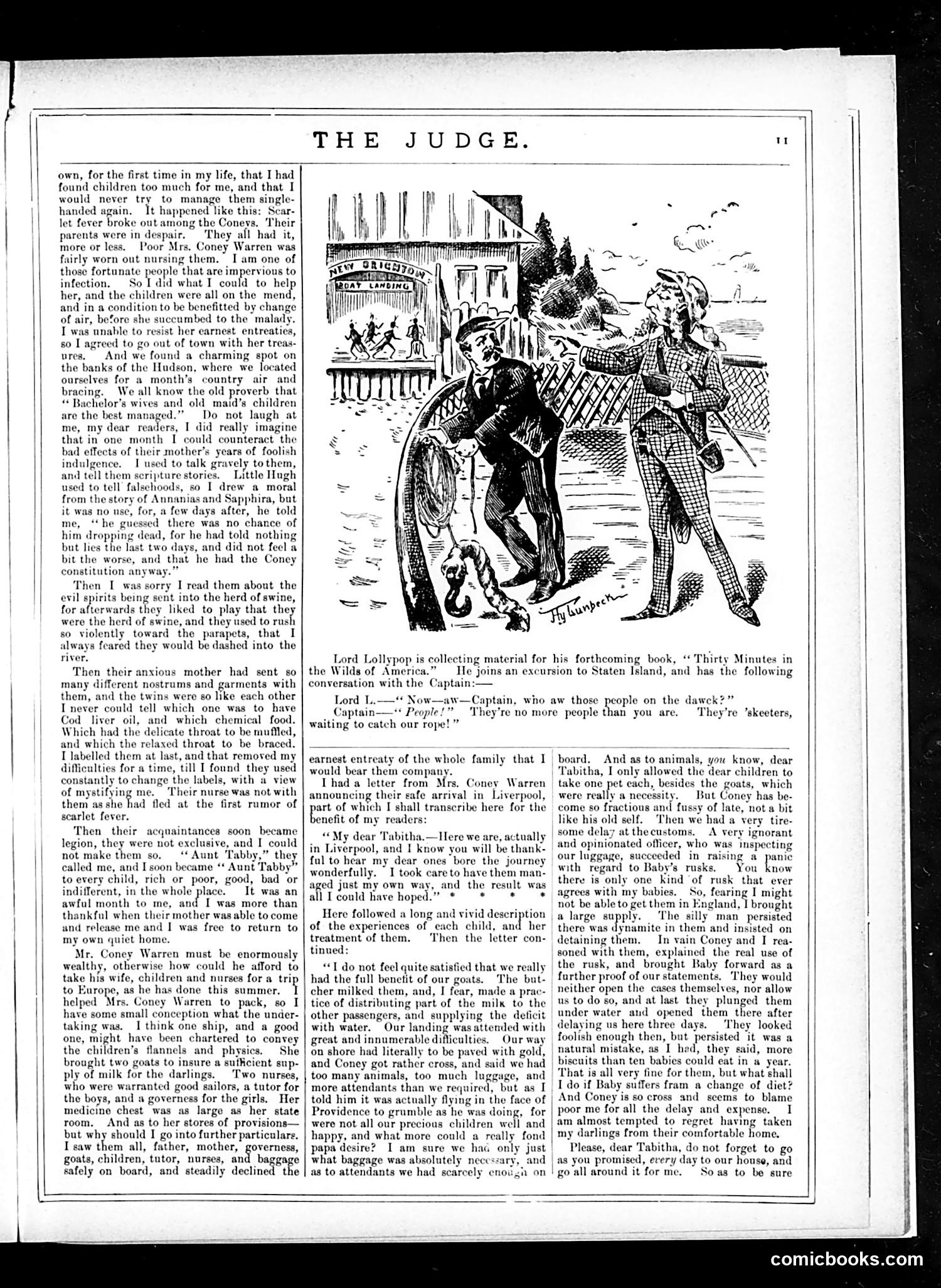
This page from Judge magazine satirizes **indulgent parenting** and the chaos of managing undisciplined children. The narrator, "Aunt Tabby," recounts her disastrous month attempting to supervise the Coney Warren children while their mother recovered from scarlet fever. The central joke is that despite Tabby's attempts at moral instruction (scripture stories, lectures on honesty), the children remain incorrigible—Little Hugh cynically notes he's suffered no consequences from lying, attributing his resilience to the "Coney constitution." The children constantly deceive her (switching medical labels, impersonating the demon-possessed swine from scripture), befriend every undisciplined child in town, and generally exhaust her authority. The cartoon depicts a chaotic scene reflecting this narrative chaos. The satire targets both **permissive parenting** and the absurd overprotection visible in the Coneys' European trip: two goats for milk, a medicine chest the size of a stateroom, multiple nurses, and excessive provisions—all for children clearly capable of managing themselves through sheer mischief. The humor rests on the contradiction between parental anxiety and childhood resilience.
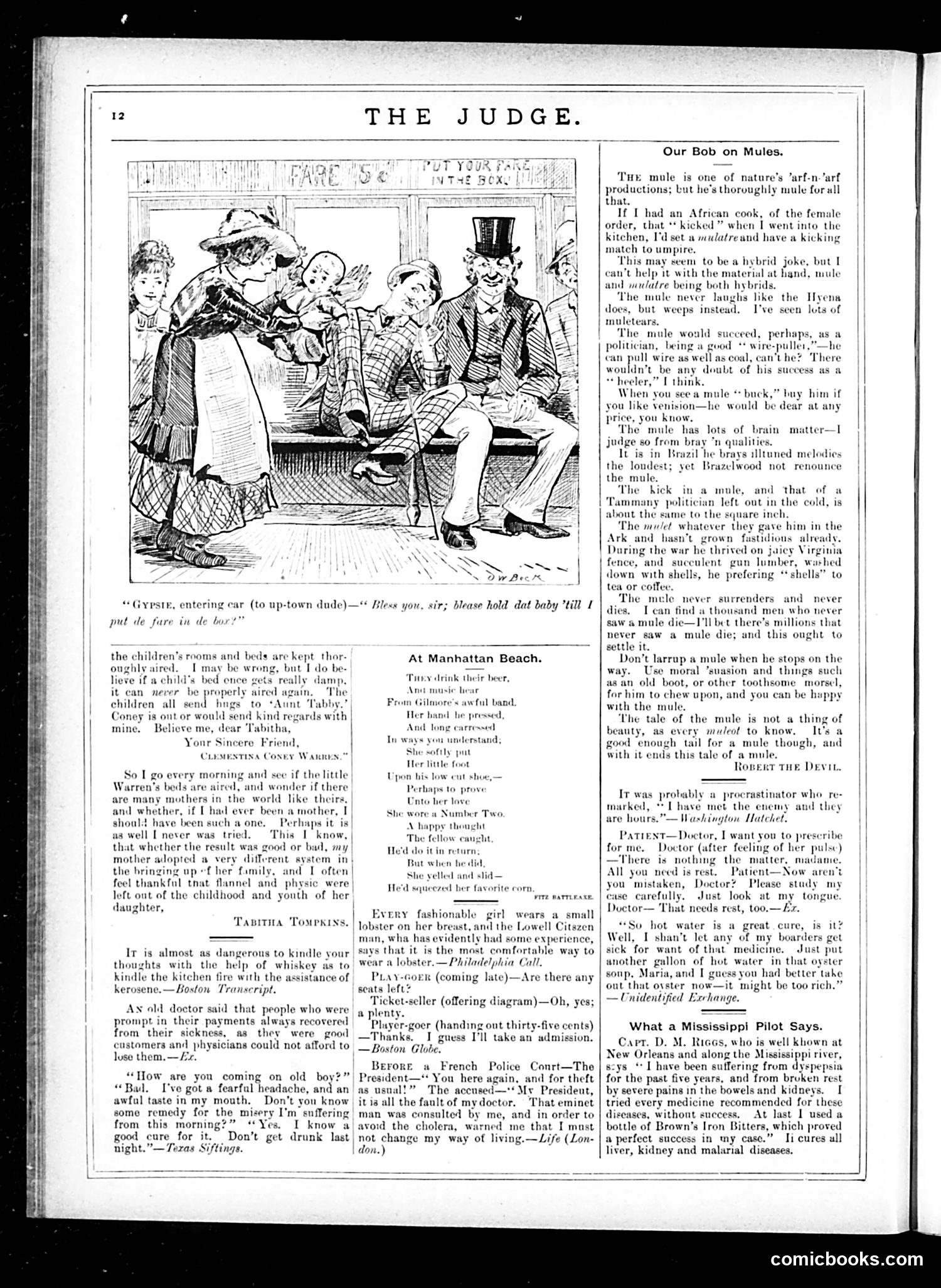
This page contains multiple satirical pieces typical of *Judge* magazine's humor: **Main Cartoon:** Shows a gypsy woman entering a streetcar, asking a well-dressed man to hold her baby while she pays fare. The satire targets both the gypsy stereotype (depicted with exaggerated features) and the gentleman's presumed courtesy—the humor lies in the absurdity of entrusting an infant to a stranger. **"Our Bob on Mules":** A humorous essay comparing mules to various human types, particularly politicians. References to "Tammany politician" suggest critique of New York's corrupt Democratic political machine. The joke equates a mule's stubbornness with political corruption—both equally immovable. **"At Manhattan Beach":** A comic poem about courtship mishaps at a fashionable beach resort, ending with a man accidentally stepping on his date's foot instead of reciprocating her romantic gesture. **French Police Court anecdote:** Jokes about a repeat offender blaming his doctor's advice for his continued criminal behavior. The page reflects *Judge's* characteristic mix of social satire, ethnic humor (by modern standards, offensive), and commentary on contemporary institutions like Tammany Hall politics.
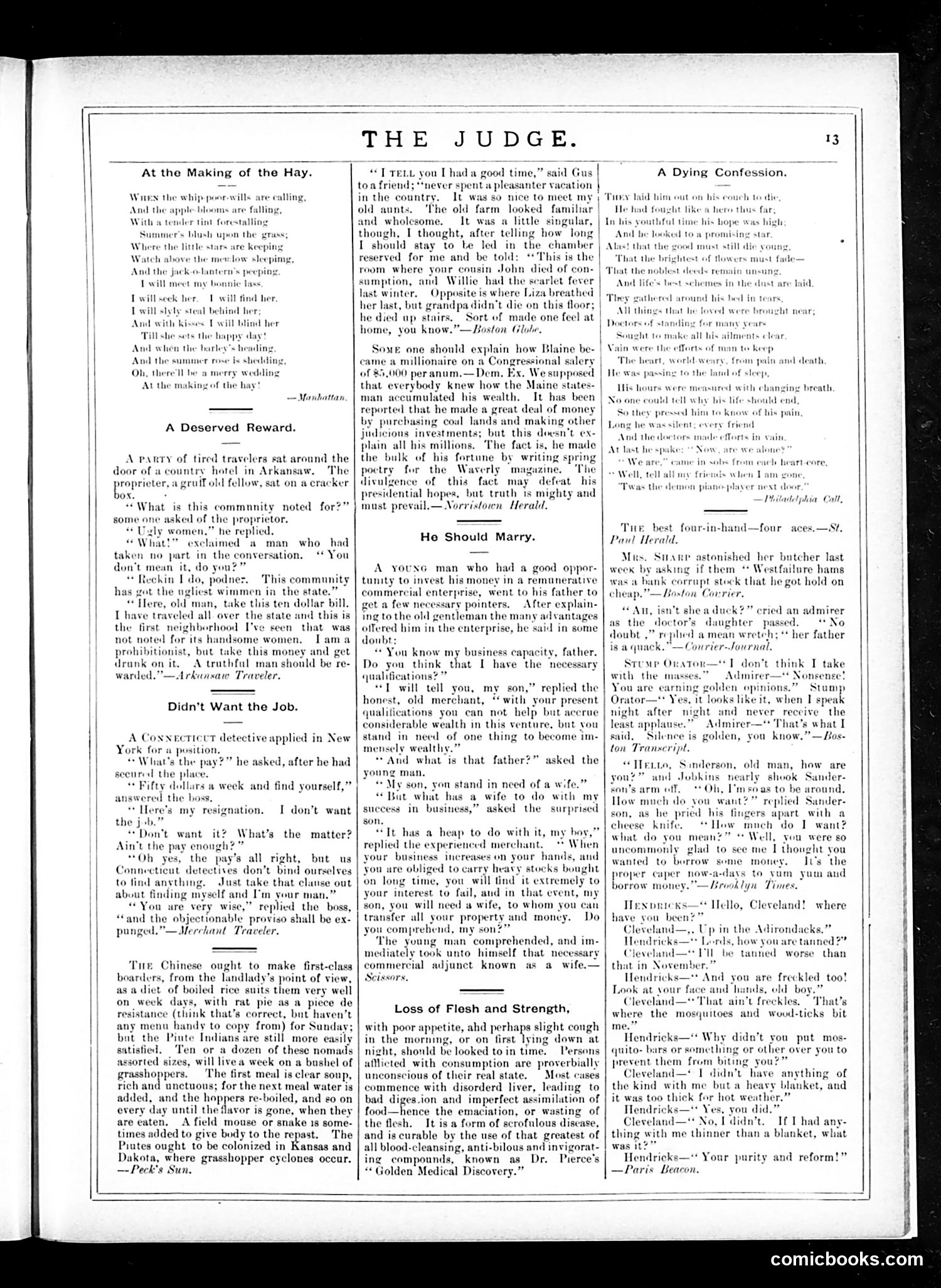
This page from the satirical magazine *Judge* contains several short humorous pieces rather than political cartoons. The content includes: **"A Deserved Reward"**: A joke about an Arkansas hotel proprietor who claims his community is notable for having the ugliest women in America. A traveling man rewards him for this honest boast, finding it refreshingly truthful compared to other towns' vanity. **"Didn't Want the Job"**: A Connecticut detective refuses a New York position because the employment contract requires him to "find himself"—he objects to the literal wording, wanting the clause removed before accepting work. **Political reference**: One item mockingly explains how Congressman James Blaine became a millionaire on a $5,000 annual salary, sarcastically suggesting he made his fortune through "spring poetry for the Waverly magazine"—critiquing alleged corruption or unexplained wealth accumulation among politicians. The page demonstrates *Judge*'s typical approach: satirizing American life through brief, punny anecdotes rather than elaborate visual cartoons.
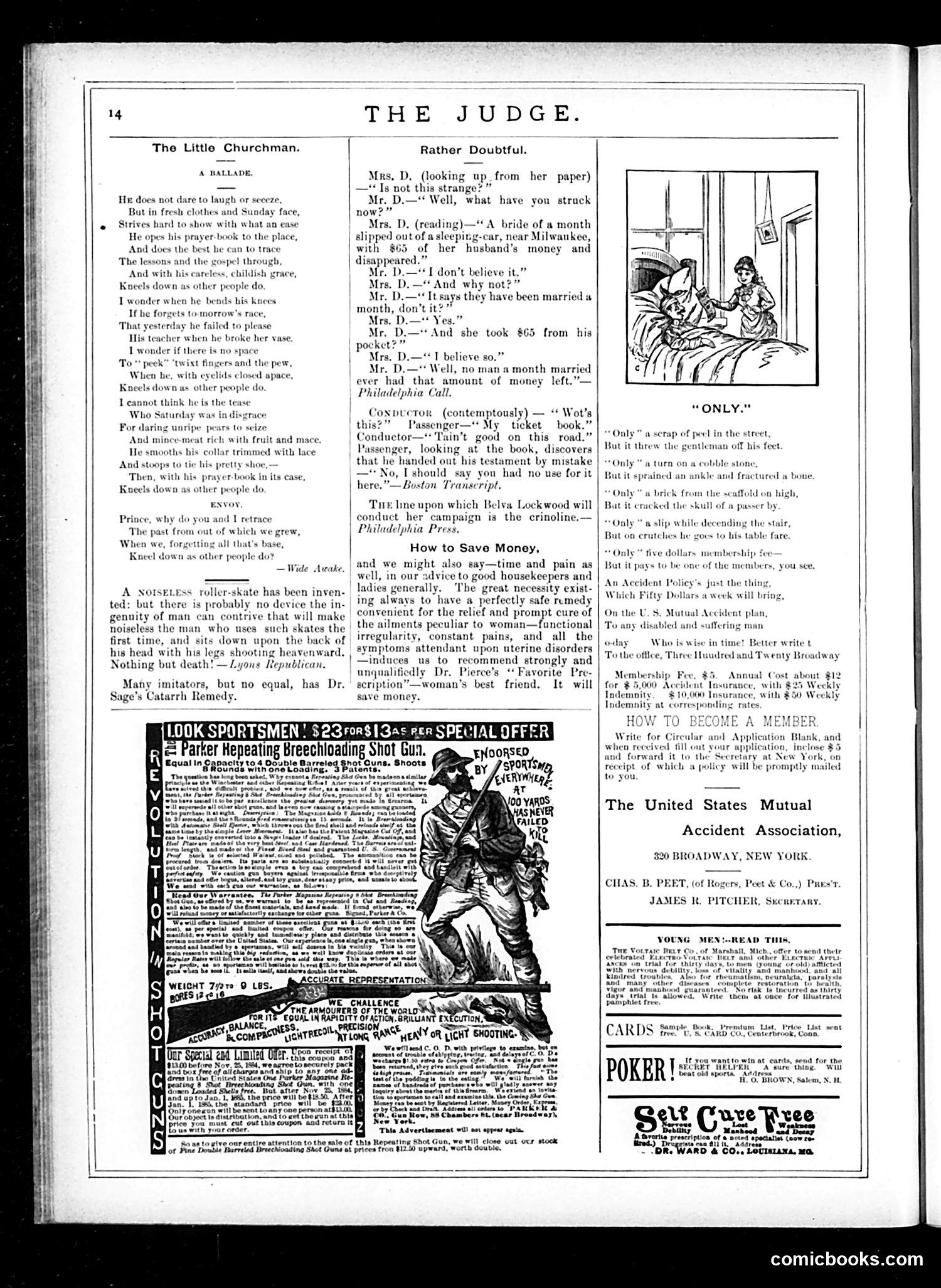
This page contains several distinct pieces of satirical content: **"The Little Churchman"** (poem): Satirizes a young boy in church who struggles to behave properly—fidgeting, peeking through fingers during prayer, breaking things. The satire gently mocks children's inability to maintain composure in religious settings. **"Rather Doubtful"** (dialogue): A husband and wife discuss a news story about a bride who fled with $865 after only one month of marriage. The husband's skeptical punchline—that no newly married man could have that much money left—satirizes the financial strain of marriage and male economic anxiety. **"Only"** (poem): Uses anaphora (repeated "Only") to illustrate how minor incidents create major consequences, leading into an advertisement for accident insurance. It's both humorous cautionary verse and marketing. The page also includes advertisements for sporting goods and other products typical of the era. The overall tone reflects turn-of-the-century American anxieties about propriety, marriage finances, and modern safety concerns.
This is primarily an **advertising page** from Judge magazine, not a political cartoon page. The content consists almost entirely of commercial advertisements and notices for products and services of the era (circa 1880s-1890s based on styling). The only satirical content appears in the opening section labeled "THE JUDGE," which contains **short humorous quips and definitions** reprinted from various newspapers. These are mild jokes about contemporary life—for example, defining a "crier, evil" as "the baby next door" or joking about a girl engaged to an Irishman who "will never dislike him, because she holds a pat hand" (a card-playing reference). The satire here is gentle wordplay and social observation rather than political commentary. The advertisements themselves (for catarrh cures, ear drums, roller skates, pianos, bicycles, magic lanterns) reflect consumer culture of the late 19th century. **Bottom line:** This is a monetized magazine page—ads dominate, with only light, nonpolitical humor interspersed.
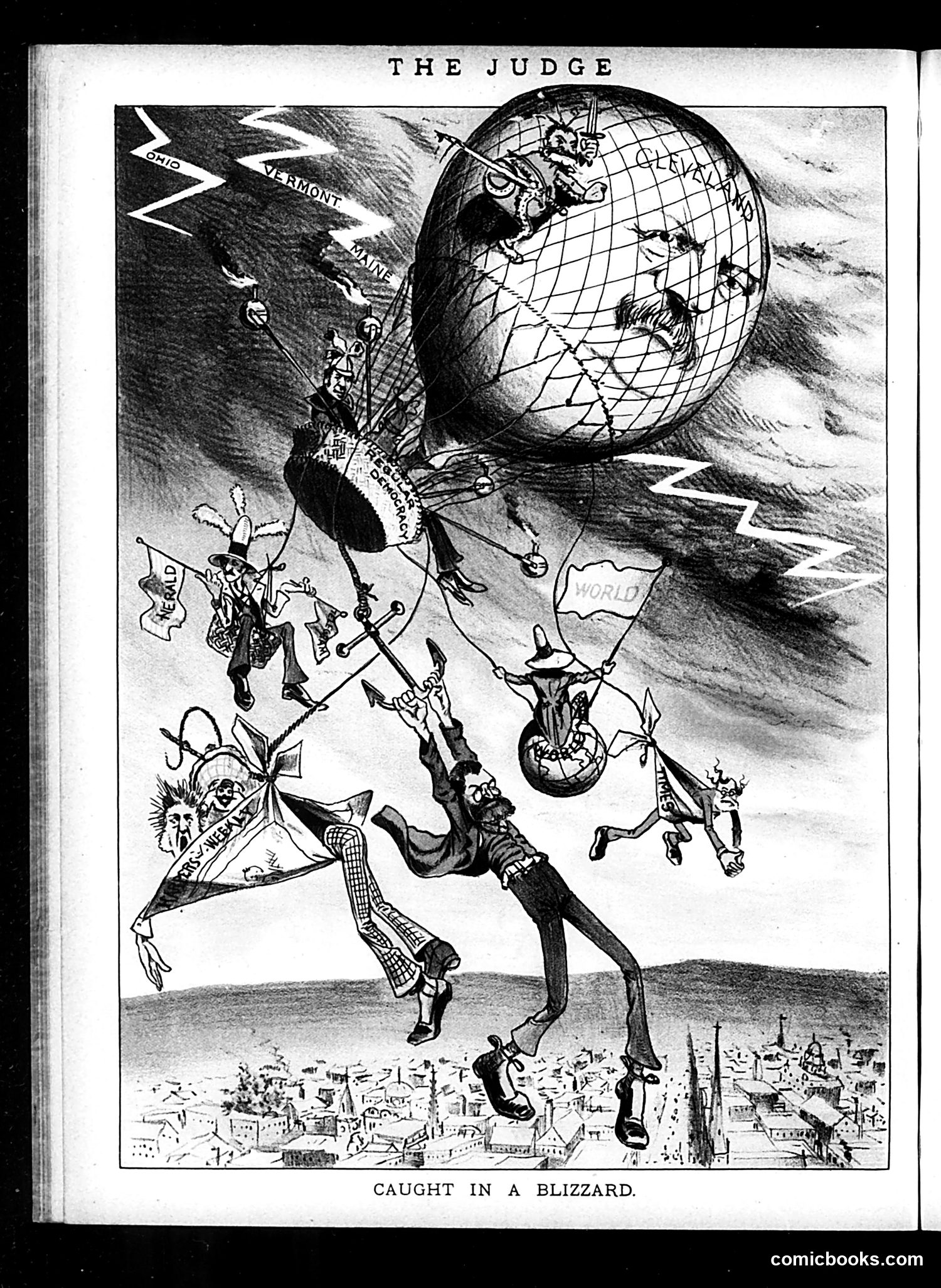
This political cartoon from *Judge* magazine depicts world leaders and political figures literally caught in a storm around a globe. A massive tornado or blizzard swirls around the Earth while various caricatured figures (appearing to represent national leaders and politicians) are swept up helplessly in the chaos below a cityscape. The satire appears to comment on international instability or political turmoil of the era—the "blizzard" serving as metaphor for chaotic global conditions beyond leaders' control. The figures' exaggerated poses suggest their helplessness against these forces. Without a visible date, the specific historical crisis referenced remains unclear, though the imagery suggests a period of significant international tension or conflict.