
A complete issue · 16 pages · 1884
Judge — July 26, 1884
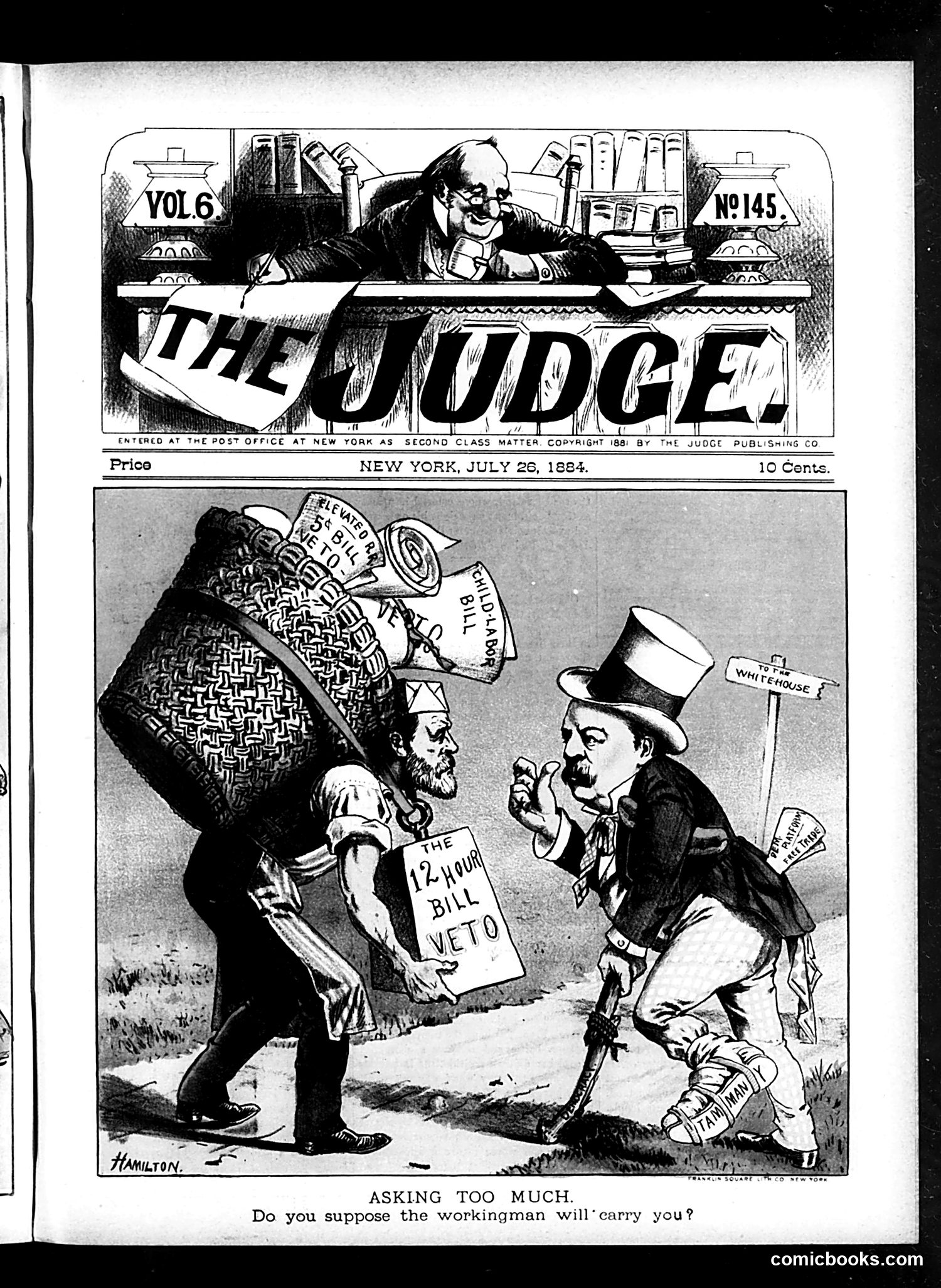
This political cartoon satirizes what appears to be a labor dispute or veto controversy. A bearded figure (likely representing a political leader or president) carries an enormous burden labeled with various bills and demands, including "THE 12 HOUR BILL VETO" prominently displayed. A man in a top hat—identified by the "WHITE HOUSE" sign, suggesting he represents the sitting president—gestures skeptically at the laden figure. The caption "Asking Too Much: Do you suppose the workingman will carry you?" implies the cartoon criticizes a political figure for placing excessive demands on working-class support. The visual metaphor of the heavy burden suggests the policies or vetoes in question were unpopular with laborers. This likely relates to 1880s disputes over labor legislation and presidential vetoes affecting workers' rights.
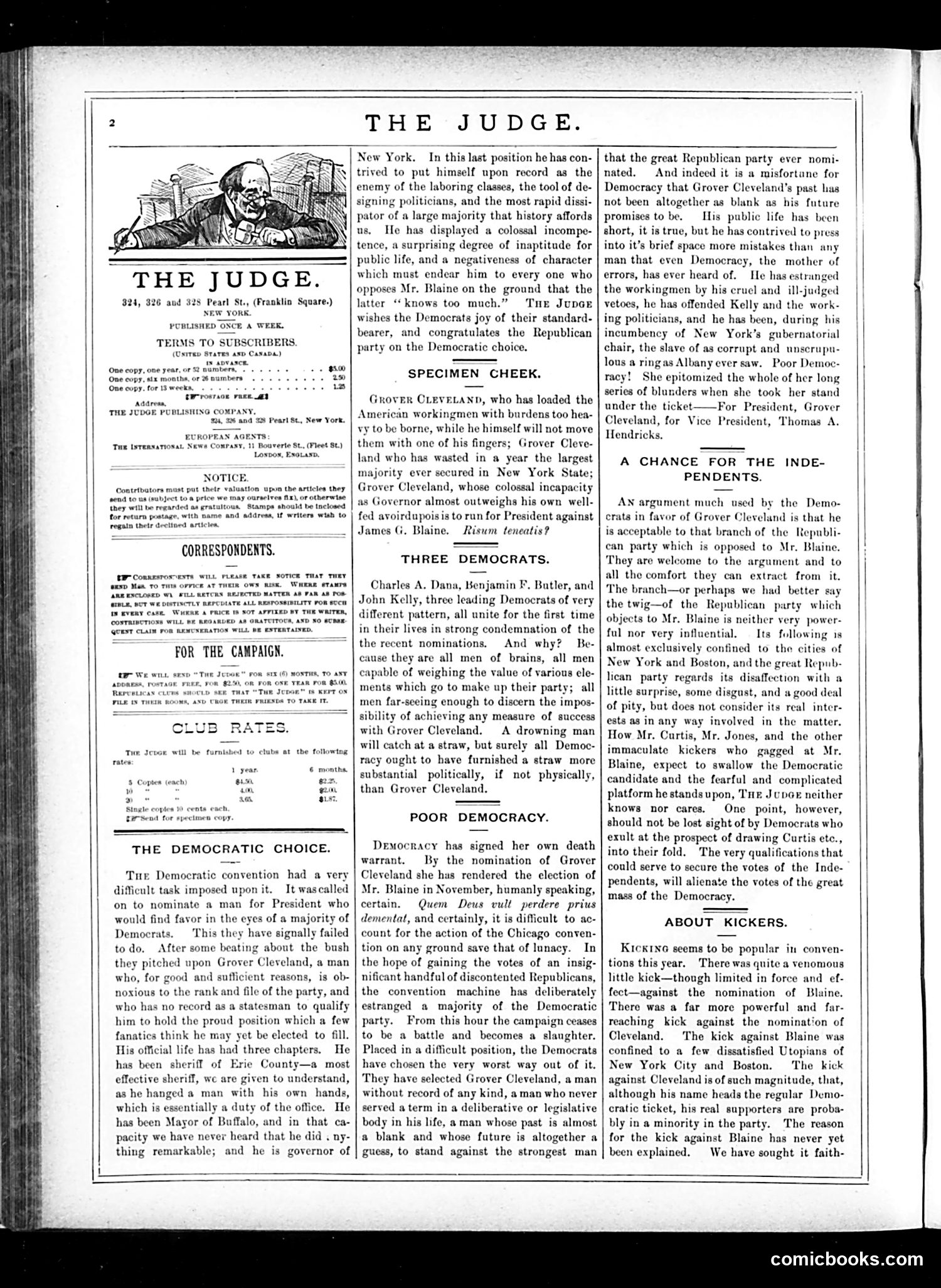
This page is a sustained Republican assault on Democrat Grover Cleveland's presidential nomination. The masthead cartoon depicts Cleveland as a skeletal, corrupt politician—the visual argument that he's unfit. The text hammers Cleveland across multiple articles: "The Democratic Choice" ridicules his thin resume (sheriff, Buffalo mayor, New York governor) and claims he's hostile to working people. "Specimen Cheek" sarcastically notes his physical bulk and incompetence. "Three Democrats" argues that even prominent Democrats like Charles Dana and Ben Butler oppose him—a sign the nomination is doomed. "Poor Democracy" uses Latin to suggest Cleveland's nomination amounts to Democratic suicide. The Judge's point: Cleveland is so weak a candidate that nominating him guarantees Republican James G. Blaine's victory. This is partisan opposition research masquerading as editorial commentary, typical of 19th-century political magazines.
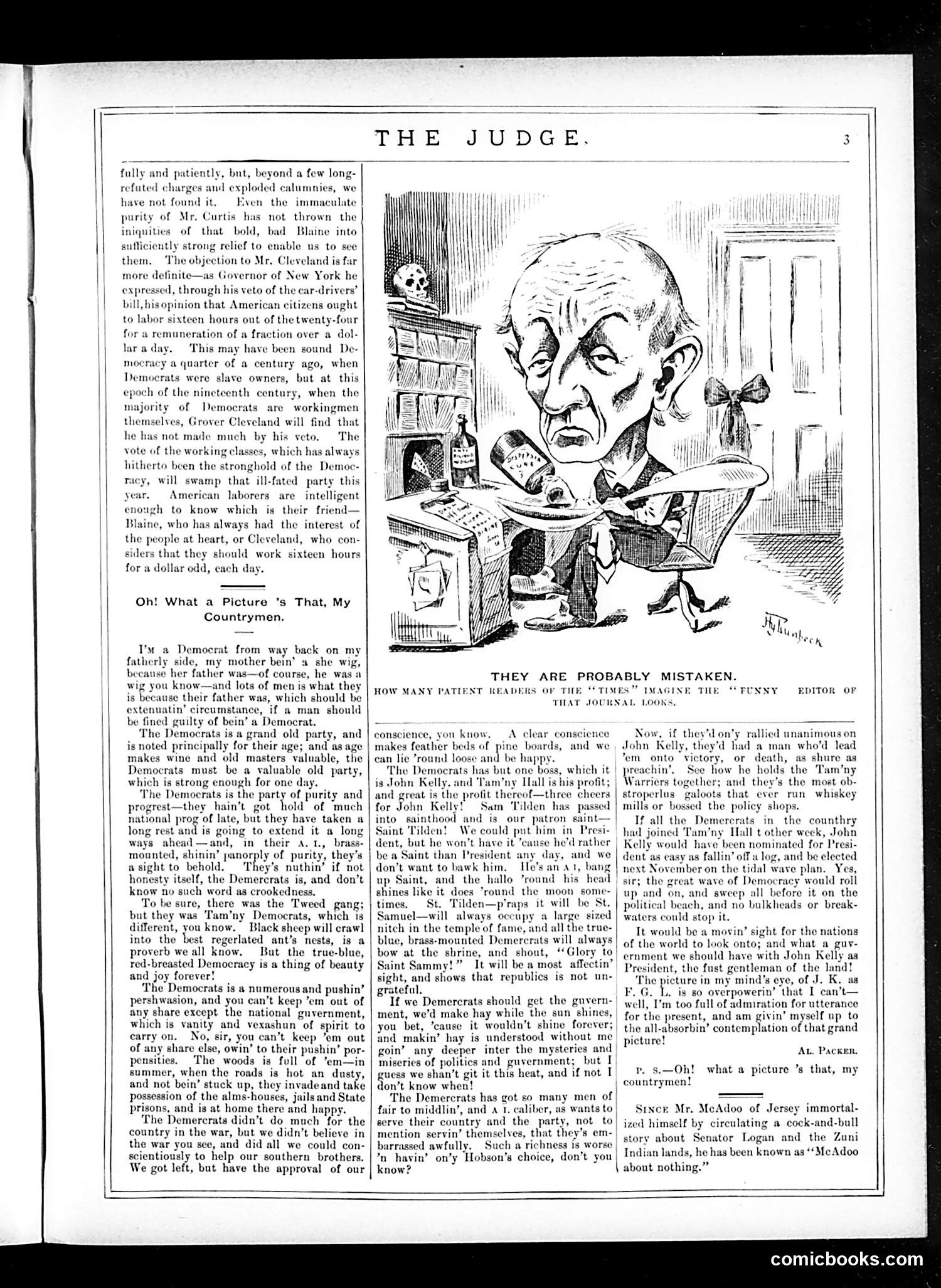
This page from *Judge* magazine attacks the Democratic Party and Governor Grover Cleveland's veto of an 1884 New York bill protecting street car drivers' working hours. The central caricature shows Cleveland as a grotesque figure, mocked for opposing labor protections. The satire contrasts Cleveland unfavorably with Republican James G. Blaine: while Cleveland vetoed limits on the brutal 16-hour workday, Blaine is portrayed as labor-friendly. The text uses heavy dialect to mock Democratic rhetoric—portraying the party as hypocritical, claiming "purity" while protecting the wealthy against workers' interests. References to Tammany Hall corruption ("Tweed gang") and Democratic leaders like John Kelly and Samuel Tilden reinforce themes of Democratic hypocrisy. The cartoon argues Democratic politicians care nothing for actual workers despite claiming to represent them, using working-class vernacular ironically to highlight this disconnect.
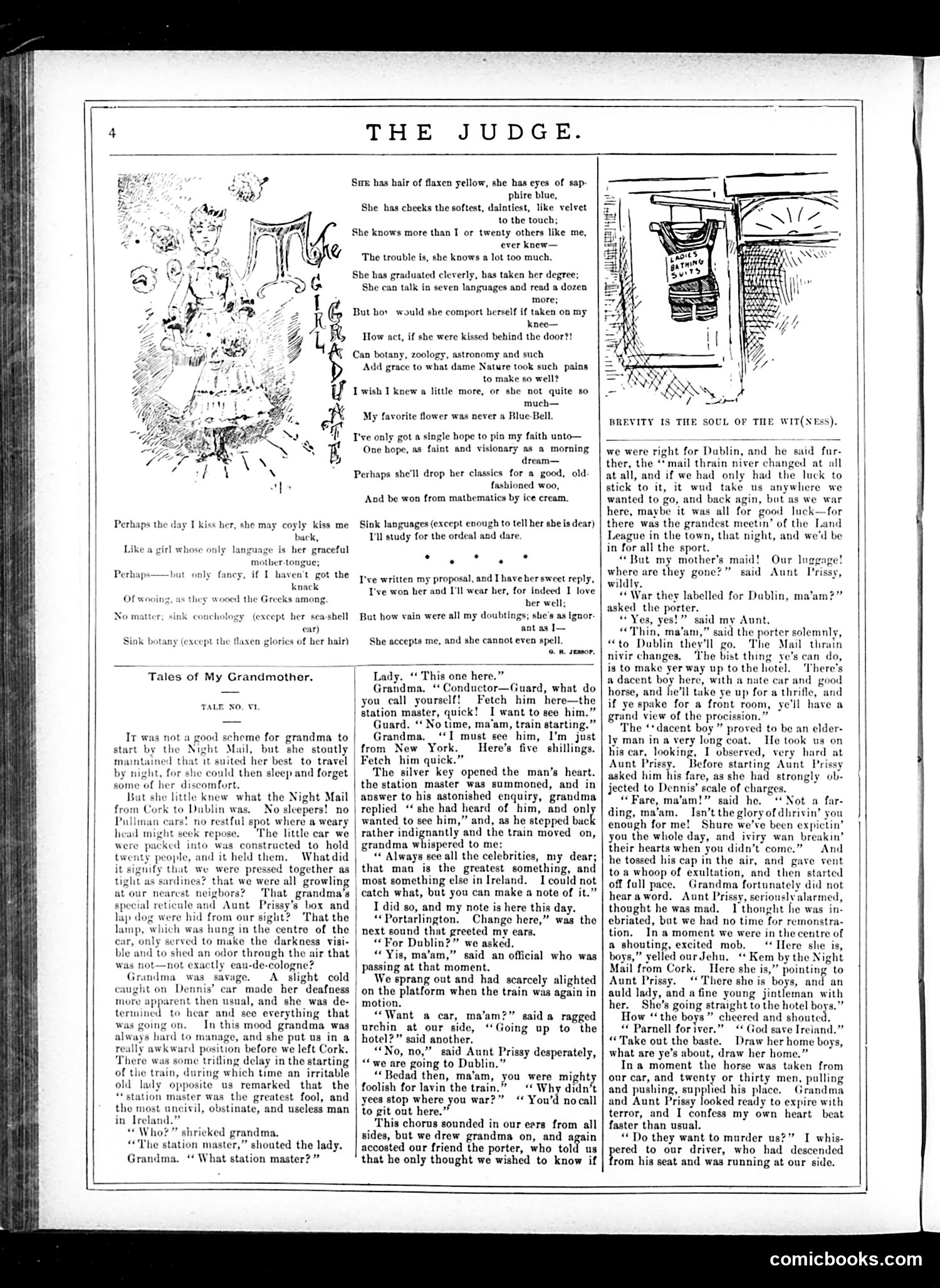
This page contains two unrelated pieces from *Judge* magazine: **Left side:** A poem about a highly educated woman—she knows multiple languages, has a degree, and excels at sciences. The speaker loves her but worries: will she abandon her intellect for romance? He hopes she'll be "won from mathematics by ice cream" and abandon her "classics" for old-fashioned courtship. The satire mocks anxieties about educated women, suggesting their learning makes them unmarriageable or unfeminine. **Right side:** "Tales of My Grandmother" humorously recounts a train journey from Cork to Dublin. The grandmother, deaf and irritable, hears an elderly woman insult the station master. Rather than ignore it, she demands to meet this "greatest something" celebrity—apparently anyone in a position of authority. The joke is her indiscriminate fascination with minor officials, and her deaf misunderstandings during travel chaos. Both pieces reflect late-Victorian attitudes: anxiety about women's education and gentle mockery of elderly eccentricity.
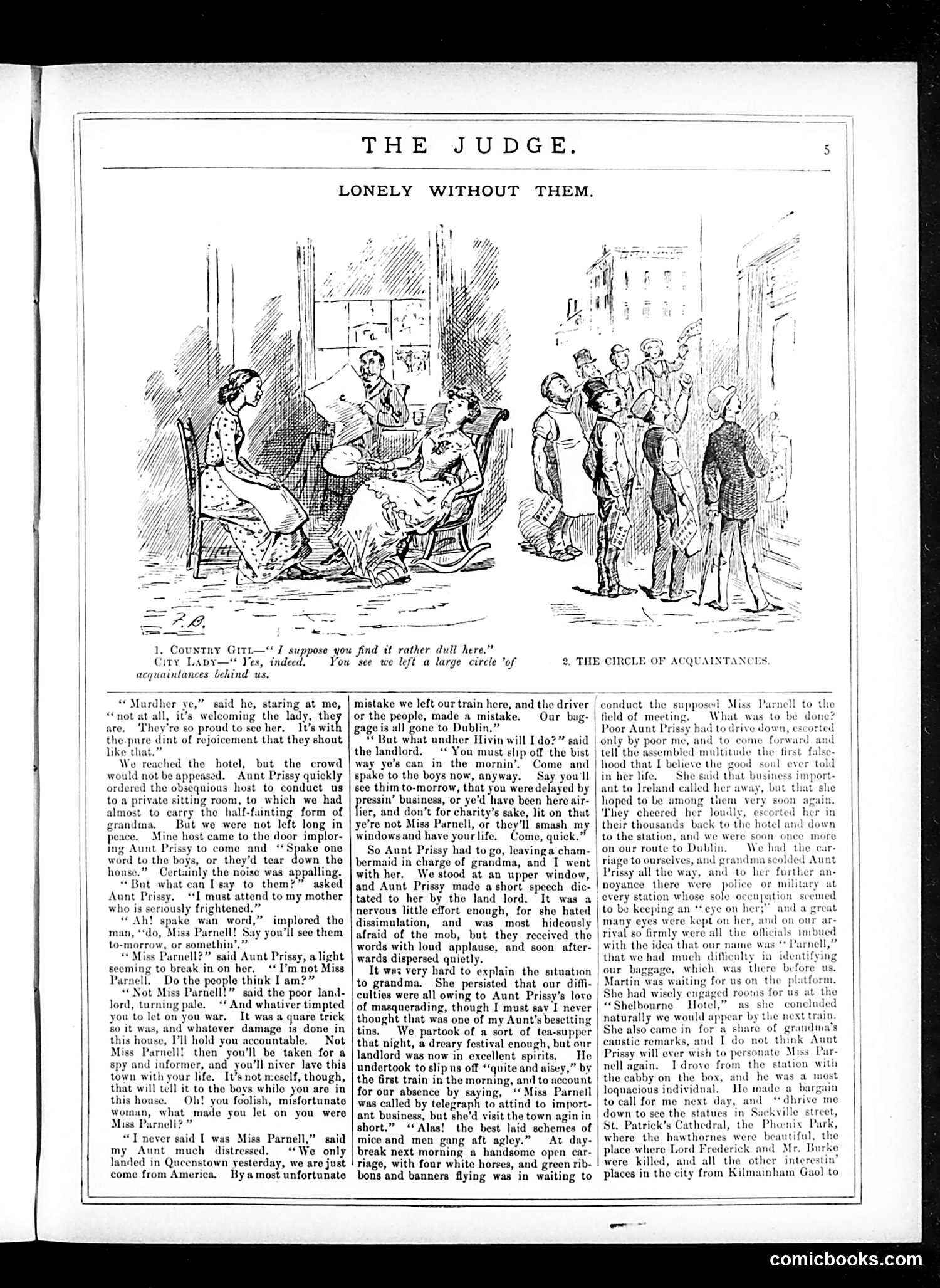
This two-panel cartoon satirizes Irish-American sentiment and political fervor during the late 19th century. **The Setup:** A country girl and city lady compare their social circles. The city lady misses her "large circle of acquaintances" left behind—depicted in panel 2 as a fashionable urban crowd. **The Story (text):** American tourists, including "Aunt Prissy," arrive in Ireland via Queenstown. A miscommunication leads locals to believe Aunt Prissy is **Miss Parnell**—likely referring to Charles Stewart Parnell's family, prominent Irish nationalist figures. The crowd gathers excitedly, treating her as a celebrity. When the truth emerges, the landlord fears mob violence if word spreads that she's *not* Parnell. Aunt Prissy must address the crowd from a window to appease them. **The Satire:** The joke mocks Irish nationalist enthusiasm and the idealization of Irish political figures among both Irish and Irish-American communities. The near-riot over a mistaken identity satirizes the passionate, sometimes volatile nature of Irish political sentiment of the era.
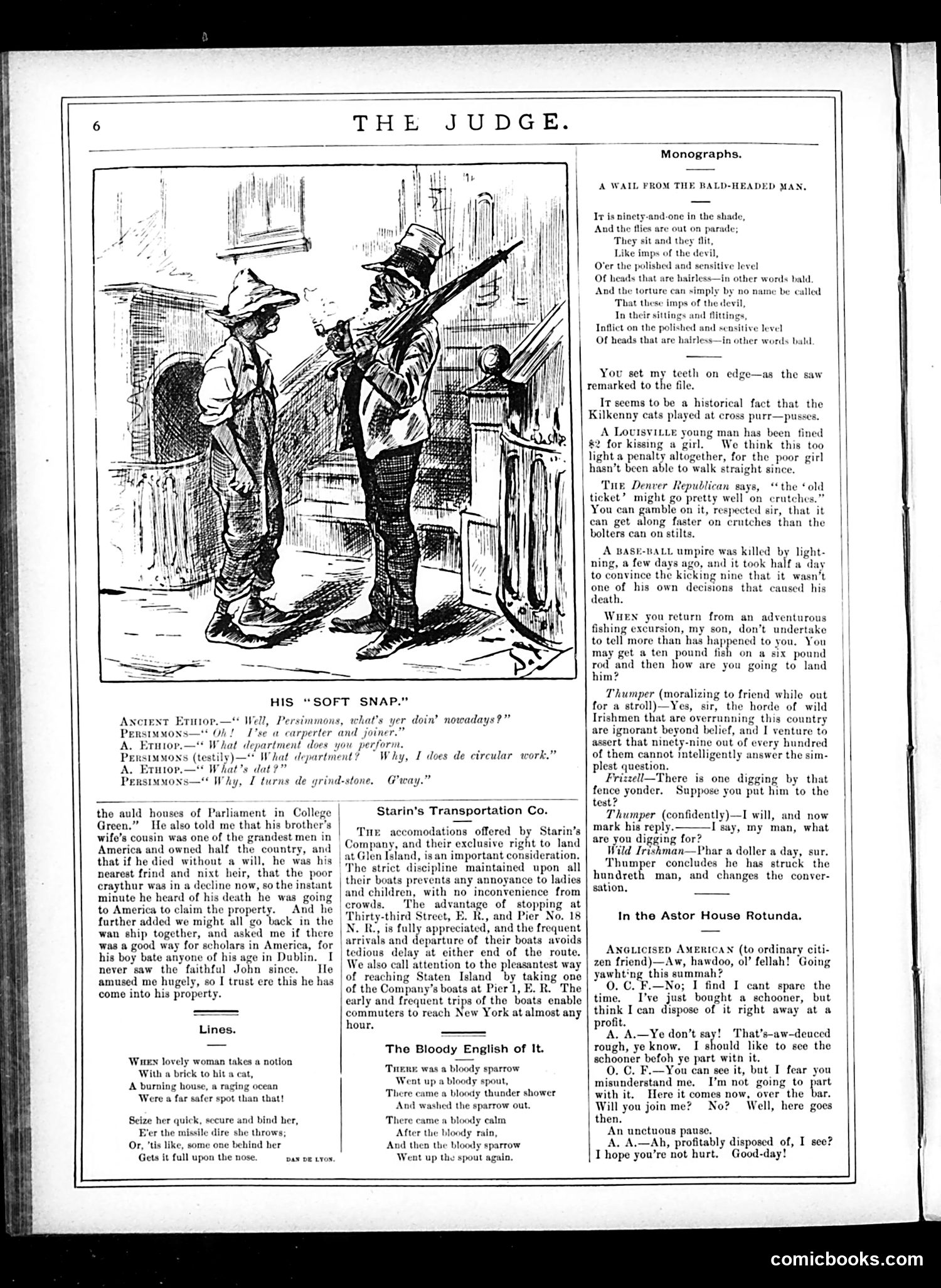
The main cartoon, "His 'Soft Snap,'" depicts two working-class figures—likely Irish immigrants based on the dialogue—discussing their jobs. One claims to do "circular work," apparently meaning grinding at a grindstone. The satire mocks working-class employment and Irish immigrant labor in late 19th-century America, portraying their occupations as monotonous and undignified. The page contains primarily **humorous miscellaneous content** rather than political commentary: brief jokes about a bald man suffering from flies, a Louisville man fined for kissing, baseball umpires, and fishing stories. "The Bloody English of It" is wordplay on British profanity. An advertisement for **Starin's Transportation Co.** promotes steamboat service to Staten Island—commercial content typical of Judge magazine. Overall, this page emphasizes **class-based humor** and **immigrant stereotyping** common to 1880s-90s American satire, with limited serious political content.
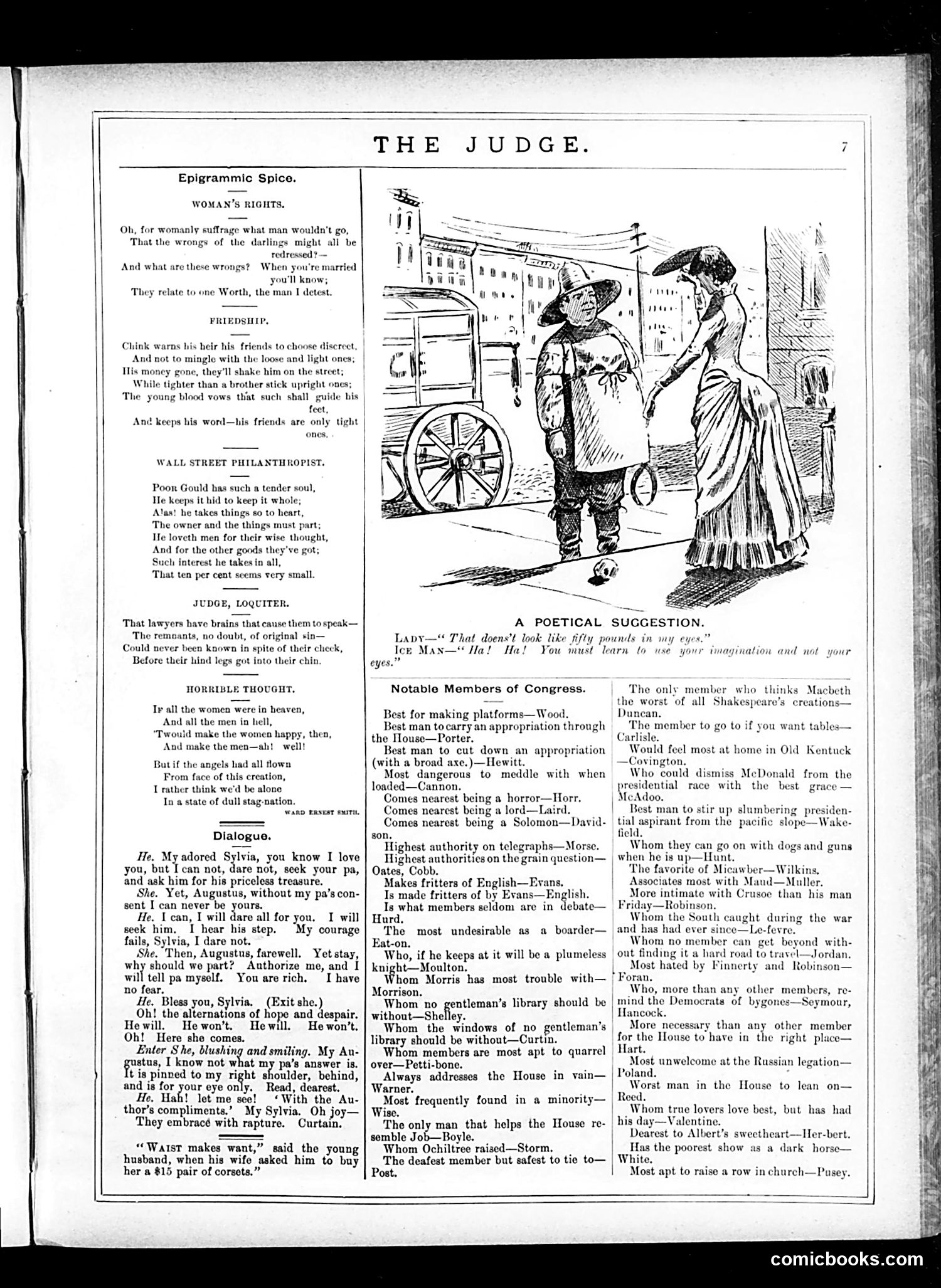
This page from Judge satirizes American society and politics through short poems, jokes, and a dialogue. The main cartoon depicts a woman (labeled "A Poetical Suggestion") confronting an ice man about his weight estimate—she's skeptical his claim of "fifty pounds" matches what she sees, prompting him to tell her to use imagination rather than eyes. This mocks both male gallantry and female vanity. The text sections lampoon: women's suffrage as trivial complaining about husbands; "tight" friendships (drunken friends); Wall Street philanthropist Jay Gould's shallow charity motivated by profit; and lawyers' incompetence. A "Notable Members of Congress" section uses puns on congressmen's names (Wood, Porter, Cannon, Horr, Laird) to mock their abilities and character. The overall tone is cynical about American institutions—politics, finance, and gender relations.
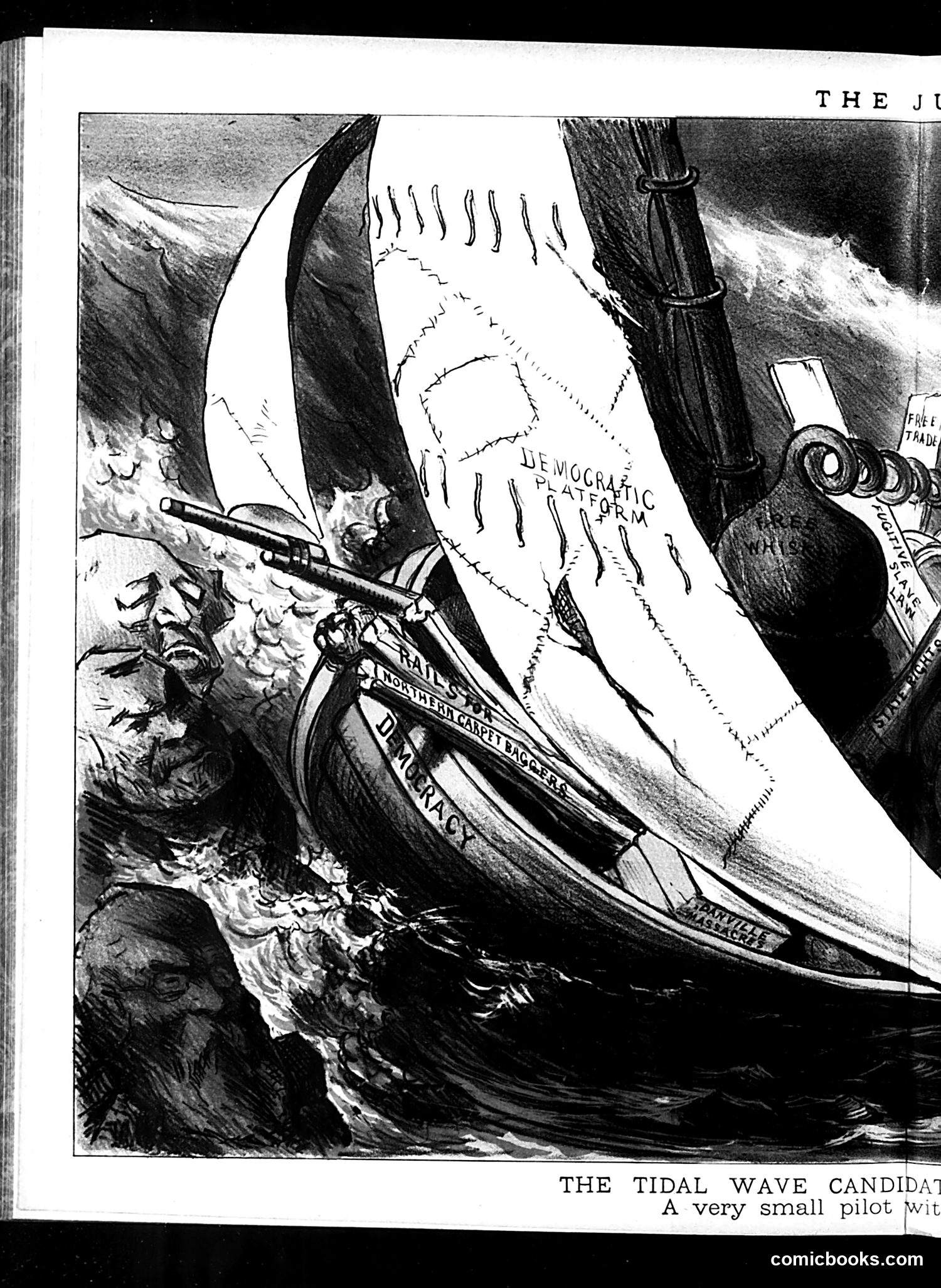
This political cartoon depicts a large wave labeled "DEMOCRATIC PLATFORM" threatening to engulf small figures below. The imagery suggests the Democratic Party platform is overwhelmingly powerful—a "tidal wave" of political force. The caption references "A very small pilot wit[h]," indicating the cartoon critiques a particular Democratic candidate as inadequately skilled or experienced to navigate such massive political forces. The drowning figures appear to represent either the candidate or Democratic leadership struggling against their own party's momentum. Without the publication date visible, the specific candidate and election cannot be definitively identified, but the satire clearly mocks a Democratic candidate as ill-equipped to handle or control their party's platform and political power during this election cycle.
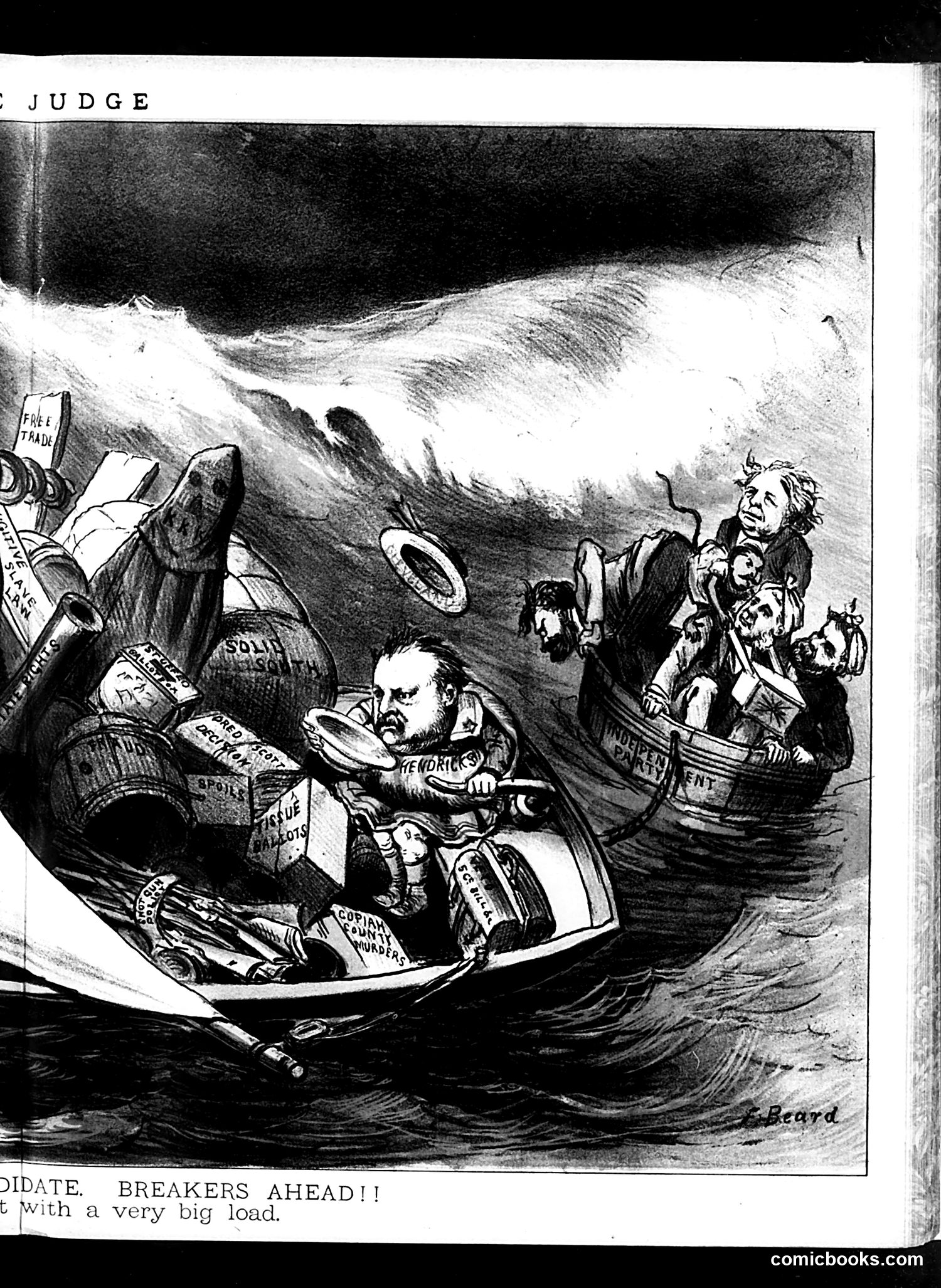
This satirical cartoon depicts a heavily laden boat navigating dangerous waters, with "BREAKERS AHEAD!!" as the warning caption. The central figure appears to be a political or business leader, surrounded by cargo labeled with what seem to be controversial policies or financial burdens (text on barrels is partially legible but unclear). The cartoon uses the metaphor of a sinking ship to suggest the passenger/leader is heading toward disaster while overloaded with problematic cargo. A figure on the right appears to be warning of danger ahead. This appears to be *Judge* magazine's commentary on some political figure or administration pursuing unpopular or unsustainable policies—the "breakers" representing impending failure or public backlash. Without a date or clearer text, the specific target remains unclear.
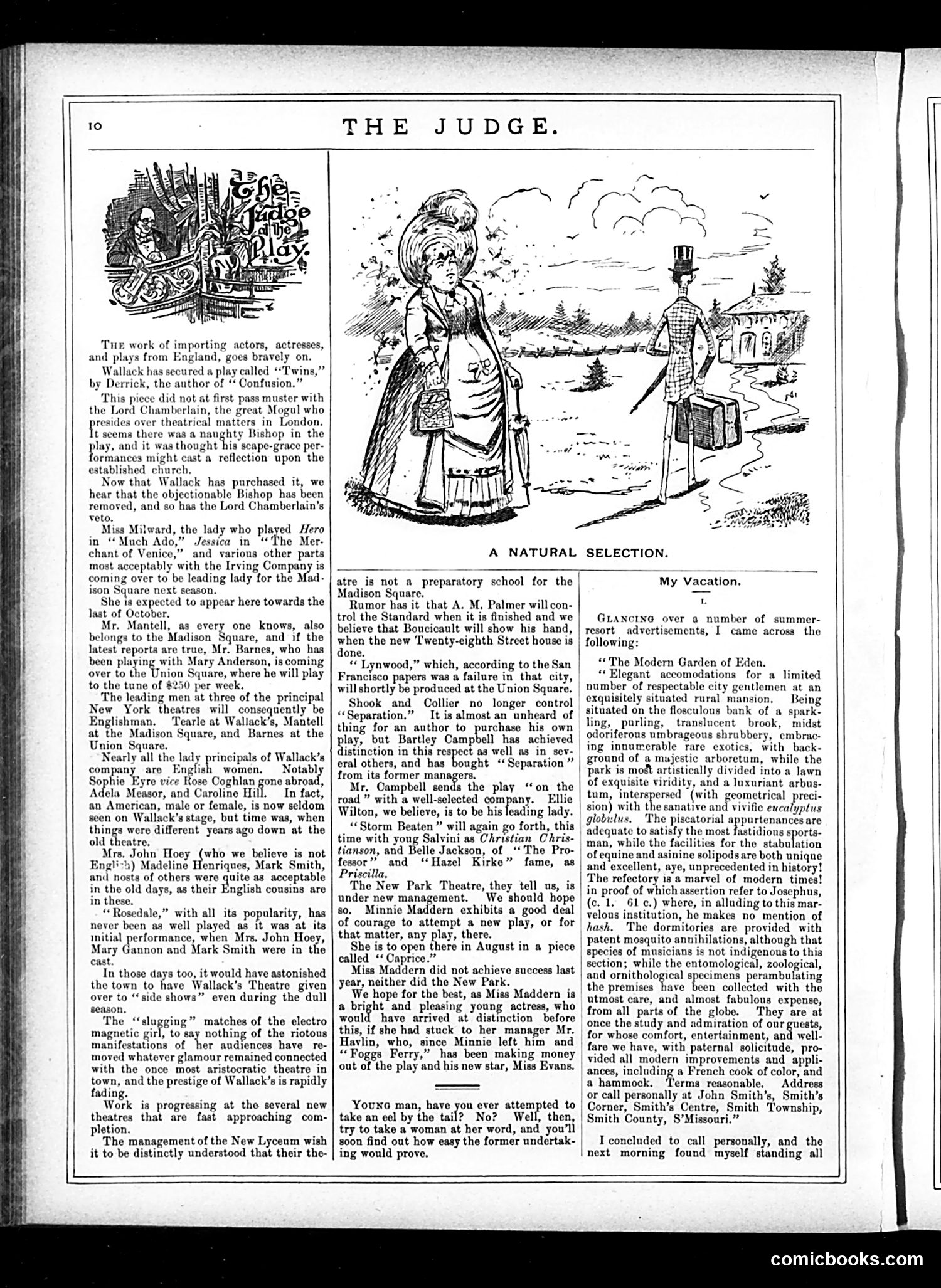
This page from *Judge* satirizes the American theater world's growing dependence on imported British actors and actresses. The main article criticizes how English performers—Tearle at Wallack's, Mantell at Madison Square, and Barnes at Union Square—now dominate leading roles, while American actors of previous generations (Mrs. John Hoey, Mark Smith) are displaced. The cartoon "A Natural Selection" uses Darwin's evolutionary theory as visual metaphor: a woman (likely representing American theater) stands abandoned as an English gentleman departs with her luggage. The satire suggests American theatrical talent is being naturally "selected out" in favor of British imports. The piece also notes Wallack's Theater's decline from its "aristocratic" status, now reduced to hosting "side shows" and "slugging matches" during slow seasons—another jab at falling standards. The tone expresses nostalgia for American theatrical excellence while mocking the theater industry's preference for foreign talent regardless of quality.
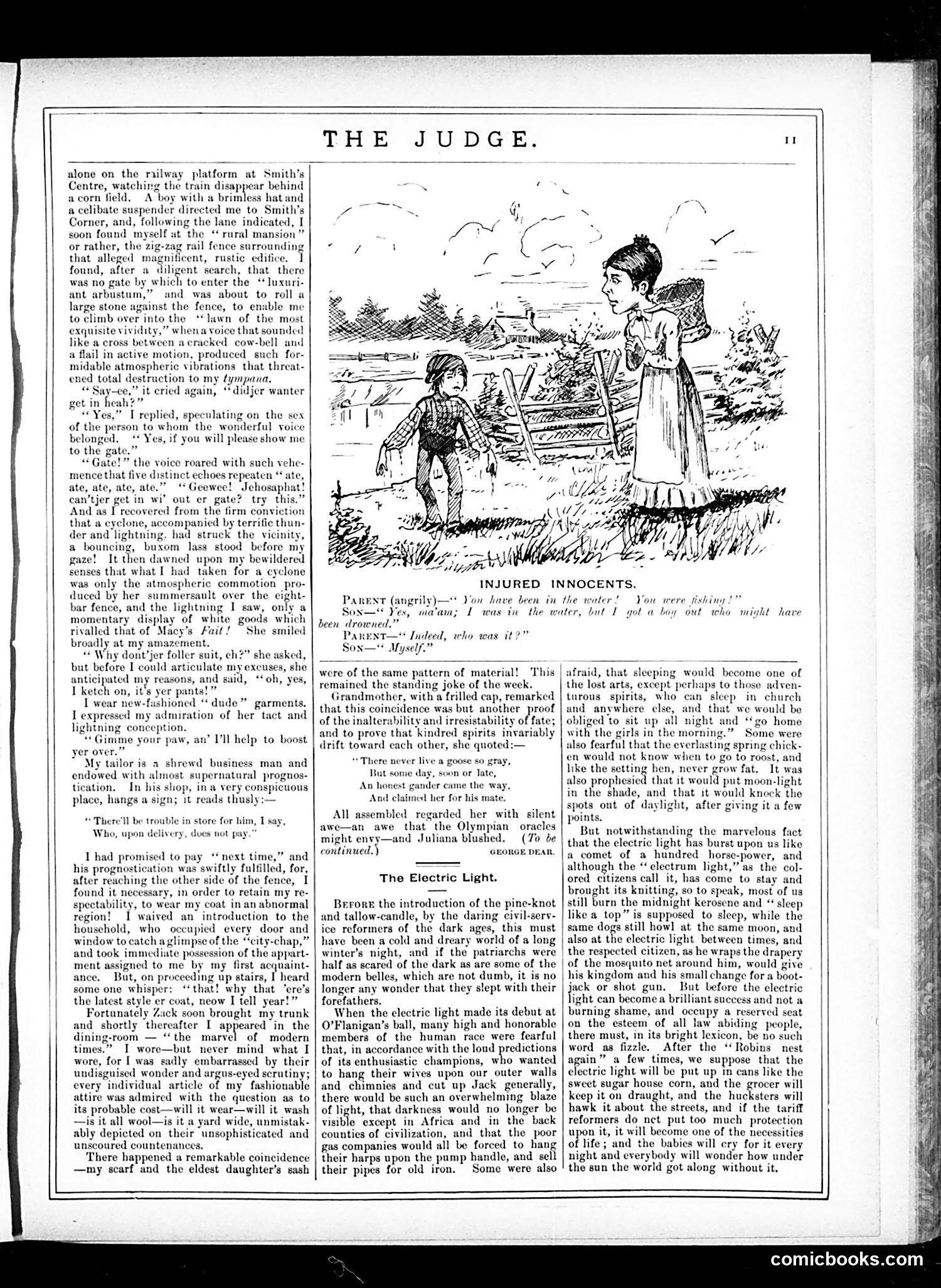
This *Judge* page contains two distinct pieces: **"Hard to Go" (top cartoon):** A satirical commentary on electric lighting adoption. The illustration shows a man in top hat looking distressed beside new electric lights. The satire targets how electric lights, unlike gas lamps or candlelight, are *too bright* for romantic situations—they eliminate the flattering dimness that allowed suitors to propose and conduct courtships. The joke: modern technology, though practical, destroys romance by exposing everything clearly. Men cannot be sentimental under harsh electric glare. **"Mossboyne" (serialized story, bottom):** An excerpt from what appears to be a comic domestic drama about two sisters, Miss Persilla and Miss Fenelope Brown. Persilla deliberately eats prunes (which cause digestive upset) simply to spite her sister's dislike of them—pure sibling antagonism played for humor. The narrative style suggests this is humorous fiction serialized in the magazine. The page demonstrates *Judge*'s dual format: satirical commentary on contemporary social issues mixed with serialized comic fiction.
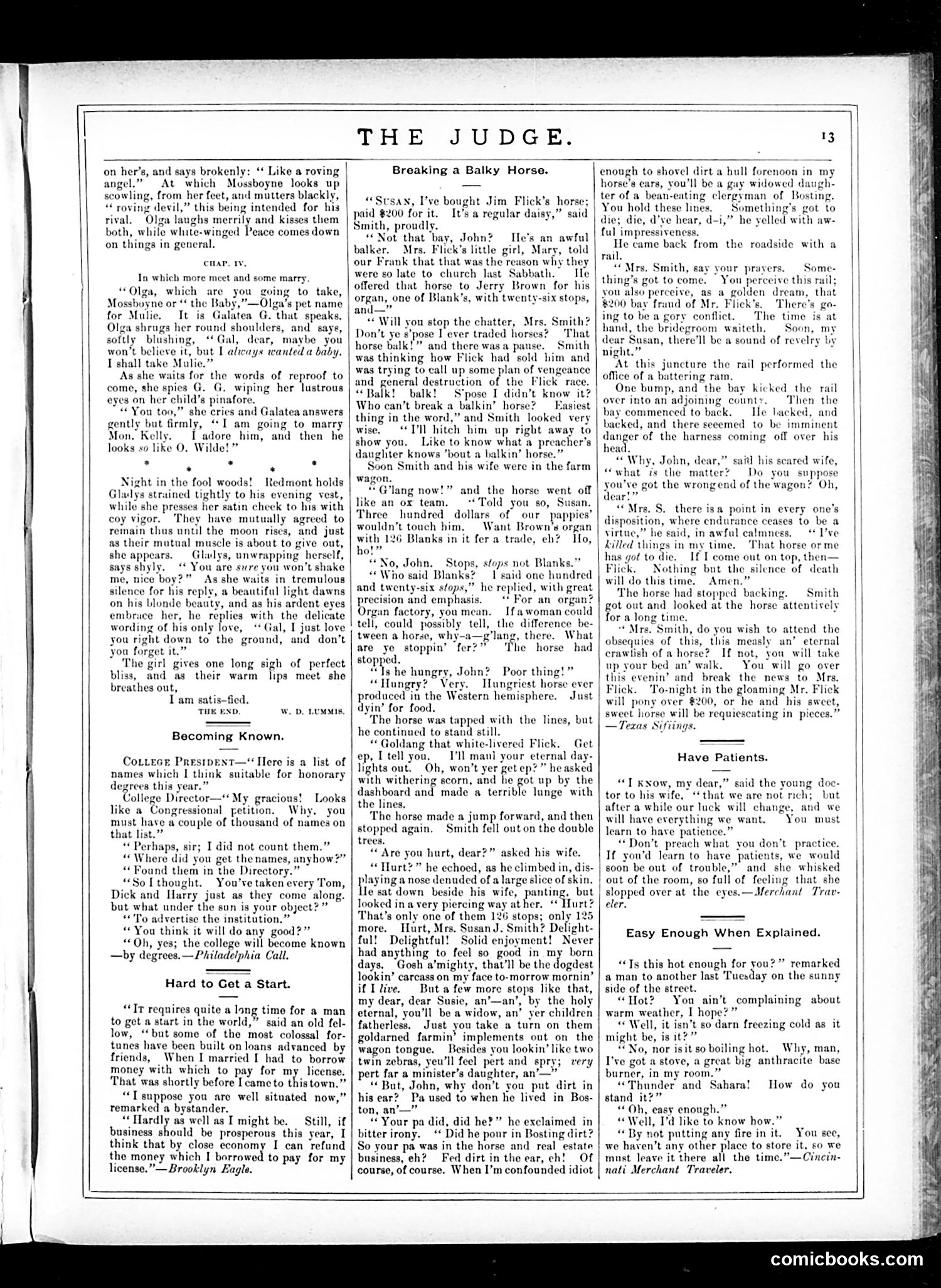
This page from the satirical magazine *Judge* contains several short humorous pieces aimed at American readers of the era. **"Breaking a Balky Horse"** depicts a domestic conversation where Mrs. Smith boasts of buying a stubborn horse, then her husband John interrupts her gossiping to claim he can easily break the animal. The satire targets marital dynamics—the husband's blustering confidence contrasting with his wife's endless chatter. The "balky horse" serves as both literal subject and metaphor for domestic obstruction. **"Becoming Known"** jokes about a college president padding an honorary degree list with names from a city directory to "advertise" the institution—the punchline being they'll become known "by degrees" (a pun on academic degrees). It satirizes institutional vanity and self-promotion. **"Hard to Get a Start"** presents an older man still repaying a loan from his wedding license decades later, mocking social mobility myths and suggesting that financial hardship is nearly inescapable for ordinary people. These pieces exemplify *Judge*'s focus on working-class and domestic American life, using gentle mockery of human nature, marriage, and social pretension.
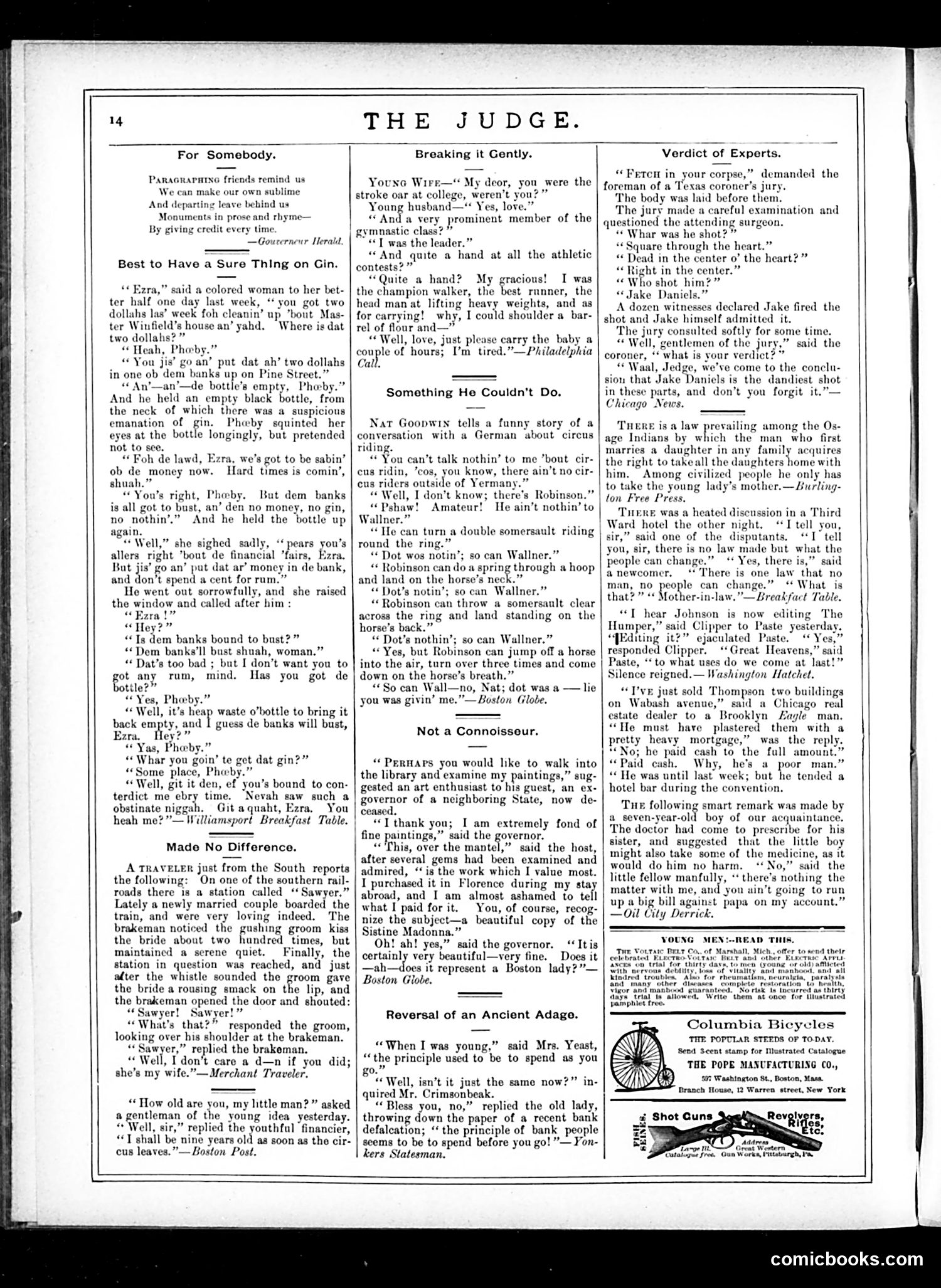
This page from **Judge** magazine (a 19th-century American satirical publication) contains several short humorous pieces reflecting period attitudes: **"Best to Have a Sure Thing on Gin"** uses racist dialect humor depicting an African American couple debating whether to save money in banks (which the husband claims will fail) or spend it on gin. The satire targets banking instability and financial anxiety of the era, but relies on offensive racial caricature. **"Made No Difference"** is a mild joke about a newlywed couple kissing repeatedly on a train; when the brakeman announces "Sawyer" station, the groom dismissively says it doesn't matter—she's his wife anyway. **"Breaking it Gently"** plays on gender expectations: a wife asks her athletic, boastful husband to carry their baby for two hours, revealing his physical prowess is useless for domestic duties. The remaining sketches are brief, forgettable anecdotes. The page includes period advertisements for Columbia Bicycles and revolvers, typical of the era's Judge content.
This page is primarily **advertising**, not satirical content. The masthead reads "THE JUDGE" with "The Presidential Campaign" noted, but the bulk of the page consists of commercial advertisements for products and services typical of the era: breweries, pianos, lithographic printing, patent medicines (Catarrh Cream, Hay-Fever treatments), roller skates, and other goods. The small text snippets alongside ads appear to be brief humorous observations on everyday topics—marriage, church, stomach troubles, watermelons—typical of Judge's light satirical style, but they're disconnected from any particular political figures or events visible here. Without clearer identification of the specific presidential campaign referenced or visible political figures in the page's imagery, I cannot definitively explain its satirical intent beyond noting it's promoting political engagement while selling products.
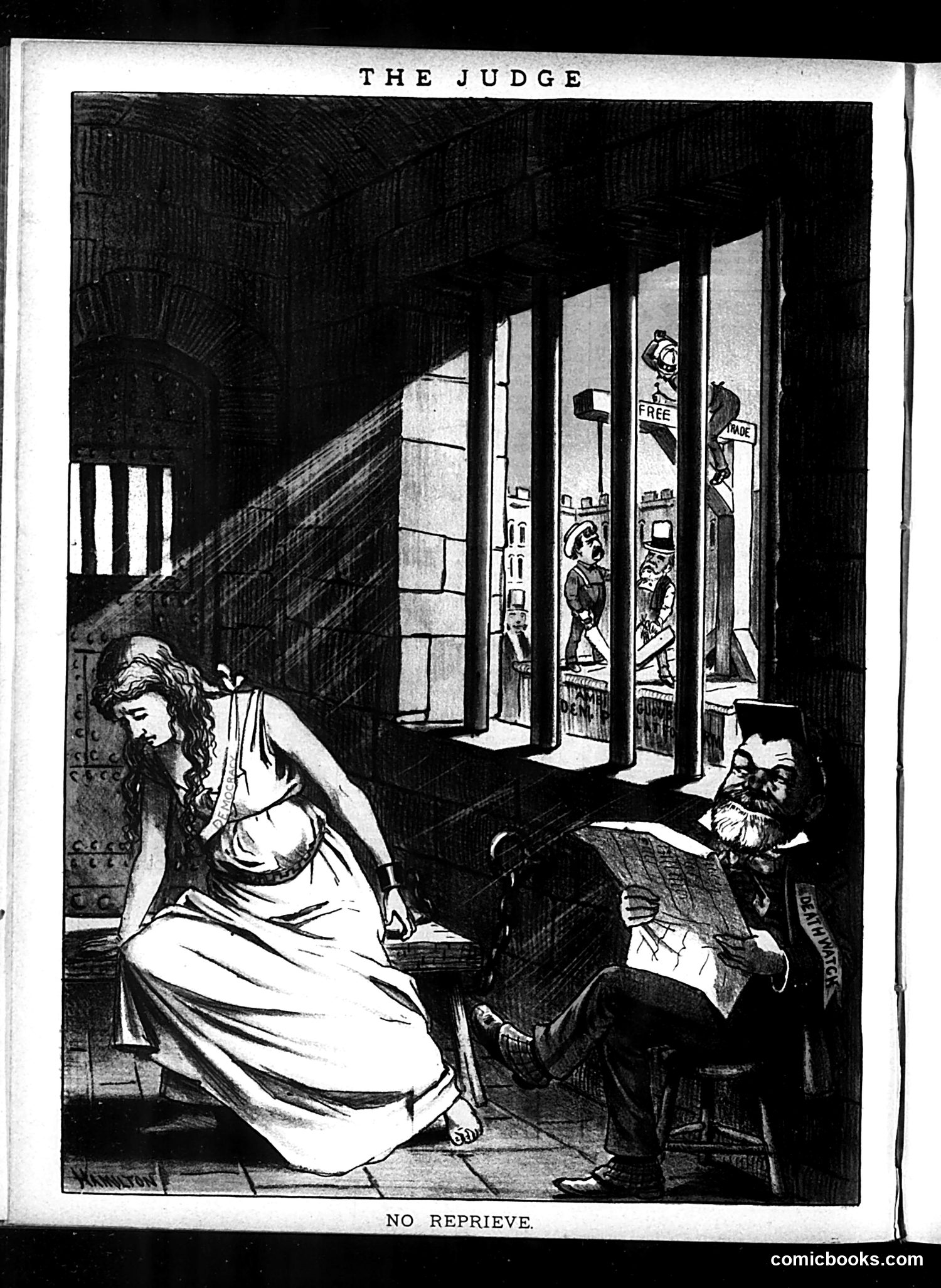
This political cartoon depicts **Lady Justice** (the classical female figure representing the legal system) seated on the left, appearing sorrowful or resigned. On the right, a figure in formal dress—likely representing a condemned prisoner or defendant—sits reading what appears to be a legal document or death warrant, labeled "NO REPRIEVE." Through the columned background, we can see what appear to be officials or witnesses observing the scene. The satire suggests **the inevitability of legal judgment without mercy or appeal**. The title "No Reprieve" combined with Lady Justice's downcast expression implies criticism of the judicial system's harshness or lack of compassion in sentencing. This likely references a specific high-profile legal case of the period where public sympathy existed for the defendant, but the court offered no clemency or possibility of commutation.