
Judge, 1884-07-26 · page 4 of 16
Judge — July 26, 1884 — page 4: what you’re looking at
What you’re looking at
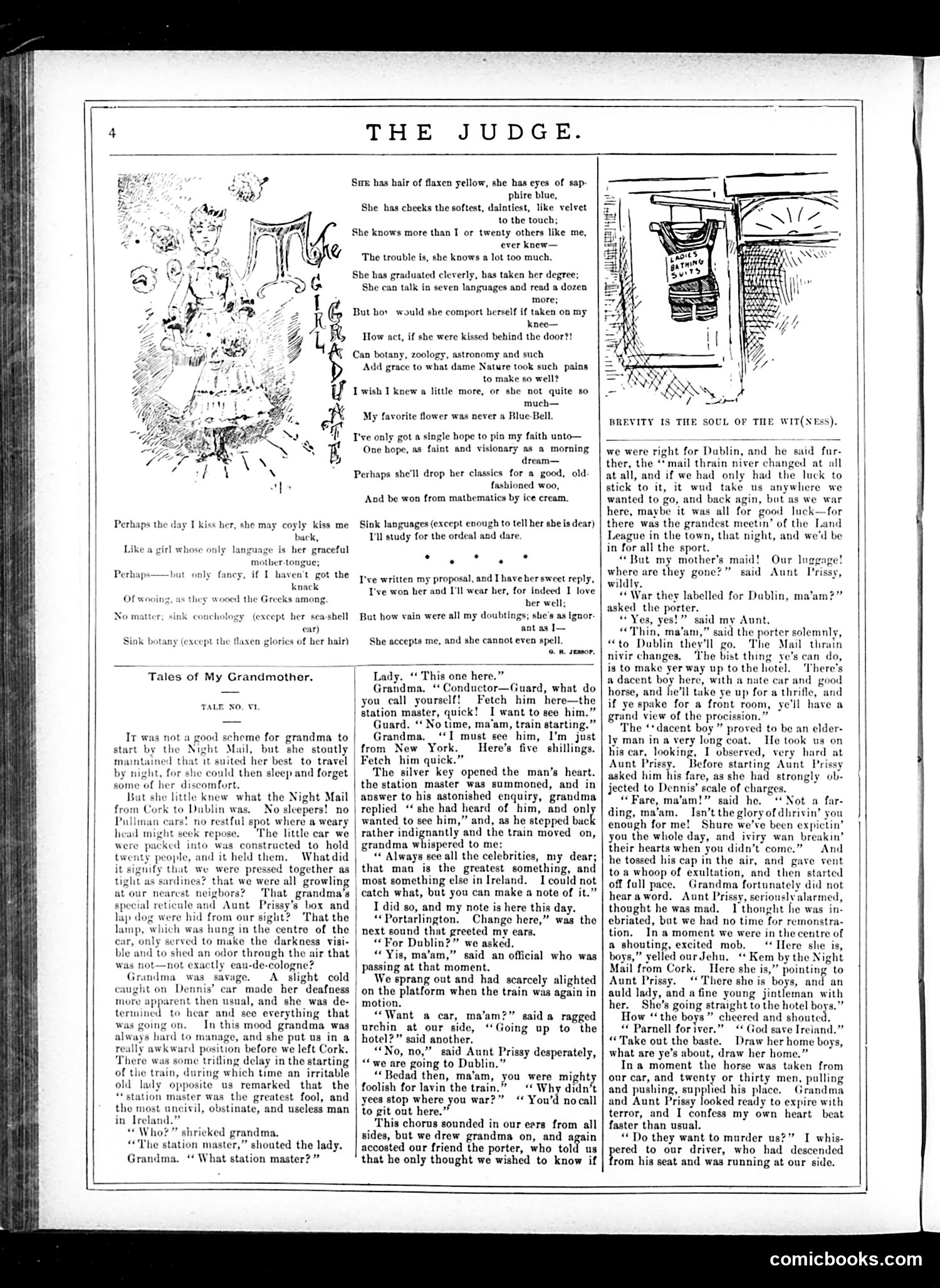
This page contains two unrelated pieces from *Judge* magazine: **Left side:** A poem about a highly educated woman—she knows multiple languages, has a degree, and excels at sciences. The speaker loves her but worries: will she abandon her intellect for romance? He hopes she'll be "won from mathematics by ice cream" and abandon her "classics" for old-fashioned courtship. The satire mocks anxieties about educated women, suggesting their learning makes them unmarriageable or unfeminine. **Right side:** "Tales of My Grandmother" humorously recounts a train journey from Cork to Dublin. The grandmother, deaf and irritable, hears an elderly woman insult the station master. Rather than ignore it, she demands to meet this "greatest something" celebrity—apparently anyone in a position of authority. The joke is her indiscriminate fascination with minor officials, and her deaf misunderstandings during travel chaos. Both pieces reflect late-Victorian attitudes: anxiety about women's education and gentle mockery of elderly eccentricity.
📄 Transcribed text from this page (OCR, searchable)
Machine-transcribed from the original scan — historical spelling and the odd misread are preserved.
THE JUDGE. Perhaps the day I kiss her, she may coyly kiss me back, Like a girl whose only language is her graceful mother-tongue; y. if I haven't got the knack ey wooed the Greeks among. Perbap, nly fanc Of wow No matter; sink couchology (except her sea-shell car) Sink botany (except the flaxen glories of her hair) Tales of My Grandmother. TALE NO. V1 It not a good scheme for grandma to start by the Night Mail, but she stoutly maintained that it suited her best to travel by night, for she could then sleep and forget some of her discomfort. But she little knew what the Night Mail Cork to Dublin was, No sleepers! no in cars! no restful spot where a weary head might repose. ‘The little car we were ked into was constructed to hold people, and it held them. Whatdid nify that we were pressed together as that we were all growling ti Th lap dog were hid from our sight? That the ump, which was hung in the centre of the erved to make the darkness visi- ble and to shed an odor through the air that was not—not exactly eau-de-cologne? Grandma was savage. A_ slight cold caught on Dennis’ car made her deafness more apparent then usual, and she was de- termined to hear and see everything that was going on. In this mood grandma was always hard to manage, and she put us in a really awkward position before we left Cork. There was some trifling delay in the starting of the train, during which time an irritable old lady opposite us remarked that the “*station master was the greatest fool, and the most uncivil, obstinate, and useless man in Ireland.” “ Who?” shrieked grandma. “The station master,” shouted the lady. Sire has hair of flaxen yellow, she has eyes of sap phire blue, She has cheeks the softest, daintiest, like velvet to the touch; She knows more than I or twenty others like me, ever knew— The trouble fs, she knows a lot too much. She bas graduated cleverly, has taken her degree; She can talk in seven languages and read a dozen more; would she comport herself if taken on my knec— How act, if she were kissed behind the door?! But hov Can botany, zoology, astronomy and such Add grace to what dame Nature took such pains to make so well? I wish I knew a little more, or she not quite so much— My favorite flower was never a Blue-Bell. I’ve only got a single hope to pin my faith unto— One hope, as faint and visionary as a morning dream— Perhaps she'll drop her classics for a good, old fashioned woo, And be won from mathematics by ice cream. Sink languages (except enough to tell her she is dear) I'll study for the ordeal and dare. nr I've written my proposal, and I have her sweet reply, I've won her and I'll wear her, for indeed I love her well; But how vain were all my doubtings; she’s as ignor- ant as J— She accepts me, and she cannot even spell 0. m semor, Lady. ‘‘ This one here.” Grandma. ‘‘ Conductor—Guard, what do you call yourself! Fetch him here—the station master, quick! I want to see him.” | Guard. ‘No time, ma’am, train atarting.” | Grandma. ‘I must see him, I’m just from New York. Here’s five shillings. Fetch him quick.” | The silver key opened the man’s heart. the station master was summoned, and in answer to his astonished enquiry, grandma replied ‘she had heard of him, and only wanted to see him,” and, as he stepped buc rather indignantly and the train moved on, grandma whispered to me: “ Always sce all the celebrities, my dear; that man is the greatest something, and most something else in Ireland. I could not | catch what, but you can make a note of it.” | Idid 80, and my note is here this day. “*Portarlington. Change here,” was the next sound that greeted my ears. “For Dublin?” we asked. “ Yis, ma’am,” said an official who was passing at that moment. We sprang out and had scarcely alighted on the platform when the train was again in motion. “Want a car, ma’am?” said a ragged urchin at our side, “Going up to the hotel?” said another. “No, no,” said Aunt Prissy desperately, “we are going to Dublin.” “Bedad then, ma'am, you were might: | foolish for lavin the train.” “Why didn’t yees stop where you war?” ‘* You’d nocall to git out here.” ‘This chorus sounded in our ears from all sides, but we drew grandma on, and again accosted our friend the porter, who told us that he only thought we wished to know if BREVITY IS THE SOUL OF THE WIT(NEsS). we were right for Dublin, and he said fur- ther, the ‘mail thrain niver changed at all atall, and if we had only had the luck to stick to it, it wud take us anywhere we wanted to go, and back agin, bu we war here, maybe it was all for good luck—for there was the grandest meetin’ of the Land League in the town, that night, and we'd be in for all the sport. “But my mother’s maid! Our Inggage! where are they gone?” said Aunt Prissy, wildly. “War they labelled for Dublin, ma’am?” asked the porter. “Yes, yes!” said my Aunt. “Thin, ma'am,” said the porter solemnly, “to Dublin they'll go. The 1 thrain nivir changes. The bist thing ye’s is to make yer way up to the hote a dacent boy here, with a nate car and good horse, and he'll tuke ye up for a thrifle, and if ye spake for a front room, ye'll have a d view of the procission.”” The ‘*dacent boy” proved to be an elder- ly man ina very long coat. He took us on his car, looking, I observed, very hard Aunt Prissy. Before starting Aunt Pri: asked him his fare, as she had strongly ob- jected to Dennis’ scale of charges. “Fare, ma’am!” said he. ** Not ding, ma’am. _Isn’t the glory of drivin’ 5 enough for me! Shure we've been expictin’ you the whole day, and iviry wan bi their hearts when you didn’t come.” he tossed his cap in the air, and gs to a whoop of exultation, and then sts off full pace. Grandma fortunately did not hear aword. Aunt Prissy, seriously alarmed, thought he was mad. Ithonght he was in- ebriated, but we had no time for remonstra- tion. In a moment we were in the centre of a shouting, excited mob. _ ‘ Ilere she is, boys,” yelled ourJehu. “Kem by the Night Mail from Cork. Here she is,” pointing to Aunt Prissy. “There she is ‘boys, and an auld lady, and afine young jintleman with her. She's going straight to the hotel boys.” How “the boys” cheered and shouted. ** Parnell foriver.” ‘* God save Ireiand.” “Take out the baste. Draw her home boys, what are ye’s about, draw her home.” Ina moment the horse was taken from our car, and twenty or thirty men, pulling and pushing, supplied his place. Grandma and Aunt Prissy looked ready to expire with terror, and I confess my own heart beat faster than usual. “Do they want to murder us?” I whis- pered to our driver, who had descended rom his seat and was running at our side. ll Grandma. ‘‘ What station master?” comicbooks.com