
Judge, 1884-07-26 · page 12 of 16
Judge — July 26, 1884 — page 12: what you’re looking at
What you’re looking at
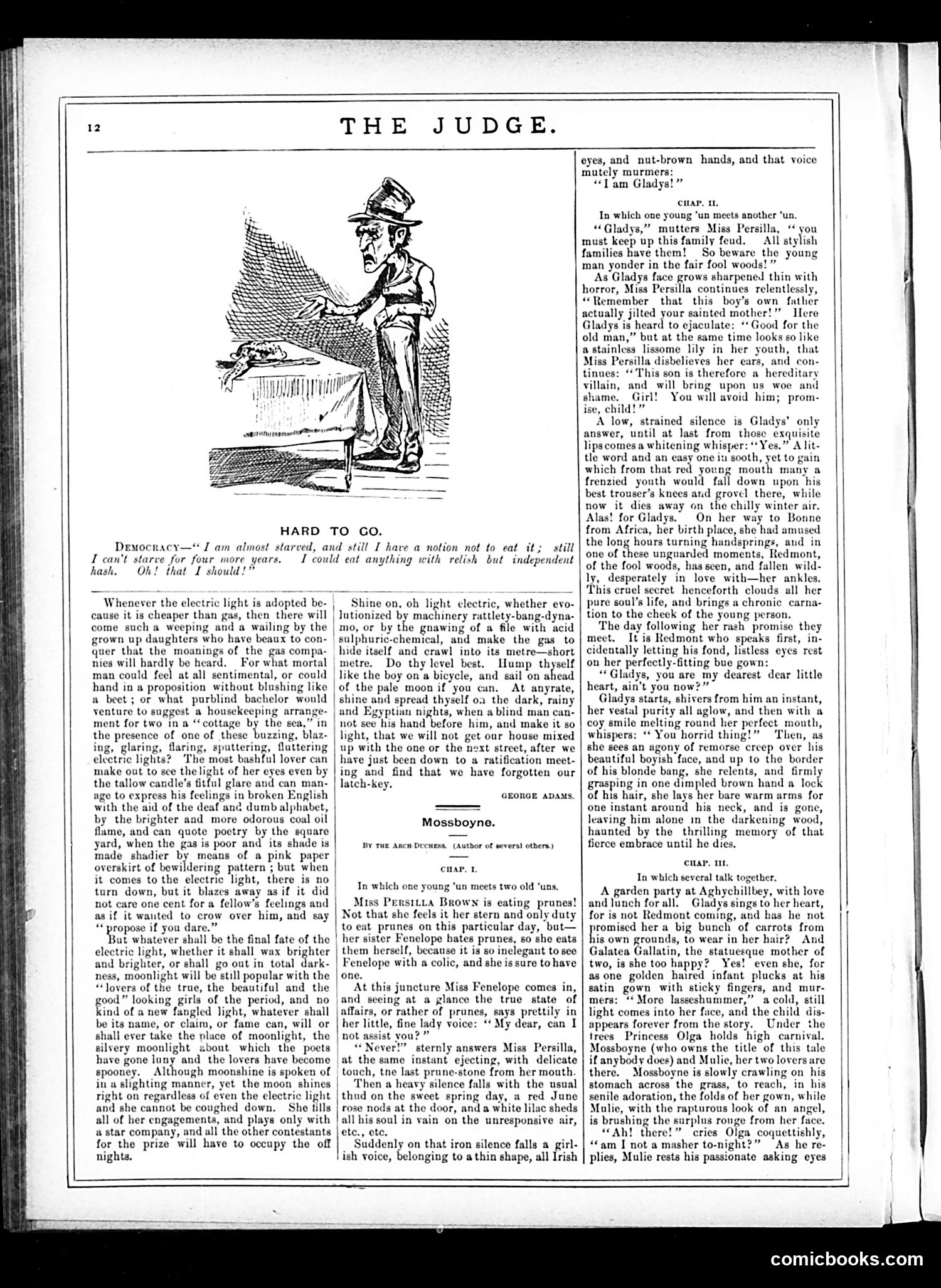
This *Judge* page contains two distinct pieces: **"Hard to Go" (top cartoon):** A satirical commentary on electric lighting adoption. The illustration shows a man in top hat looking distressed beside new electric lights. The satire targets how electric lights, unlike gas lamps or candlelight, are *too bright* for romantic situations—they eliminate the flattering dimness that allowed suitors to propose and conduct courtships. The joke: modern technology, though practical, destroys romance by exposing everything clearly. Men cannot be sentimental under harsh electric glare. **"Mossboyne" (serialized story, bottom):** An excerpt from what appears to be a comic domestic drama about two sisters, Miss Persilla and Miss Fenelope Brown. Persilla deliberately eats prunes (which cause digestive upset) simply to spite her sister's dislike of them—pure sibling antagonism played for humor. The narrative style suggests this is humorous fiction serialized in the magazine. The page demonstrates *Judge*'s dual format: satirical commentary on contemporary social issues mixed with serialized comic fiction.
📄 Transcribed text from this page (OCR, searchable)
Machine-transcribed from the original scan — historical spelling and the odd misread are preserved.
THE JUDGE. \| i HARD cy—“ I am almost starved, and still I have a notion not to eat it; I can't starve for four more J years. hash, Oh! that I should! Whenever the electric light is adopted be- cause it is cheaper than gas, then there will come such a weeping and a wailing by the grown up daughters who have beaux to con- quer that the moanings of the gas compa- nies will hardly be heard. For what mortal man could feel at all sentimental, or could hand in a proposition without blushing like a beet; or what purblind bachelor would venture to suggest a housekeeping arrange- ment for two in a ‘‘cottage by the sea,” in the presence of one of these Suzzing, ble ing, glaring, flaring, sputtering, fluttering | electric lights? The most bashful lover can make out to see the light of her n by the tallow candle’s fitful glare and can man- age to express his feelings in broken English with the aid of the deaf and dumb alphabet, by the brighter and more odorous coal oil flame, and can quote poetry by the square yard, when the gas is poor and its shade is made shadier by means of a pink paper overskirt of bewildering pattern ; but when it comes to the electric light, there is no turn down, but it blazes away as if it did | not care one cent for a fellow’s feelings and as if it wanted to crow over him, and say * propose if you dare.” But whatever shall be the final fate of the electric light, whether it shall wax brighter and brighter, or shall go out in total dark- ness, moonlight will be still popular with the “lovers of the true, the beautiful and the zood” looking girls of the period, and no ind of a new fangled light, whatever shall be its name, or claim, or fame can, will or shall ever take the place of moonlight, the silvery moonlight about which the poets have gone luny and the lovers have become spooney Although moonshine is spoken of in a slighting manner, yet the moon shines | right on regardless of even the electric light and she cannot be coughed down. She fills all of her engagements, and plays only with a star company, and all the other contestants for the prize will have to occupy the off TO GO. still I could eat anything with relish but independent Shine on, oh light electric, whether evo- | lutionized by machinery rattlety-bang-dyna- | mo, or by the gnawing of a file with acid sulphuric-chemical, and make the gas to hide itself and crawl into its metre—short |metre. Do thy level best. Hump thyself like the boy ona bicycle, and sail on ahead |of the pale moon if you can. At anyrate, shine and spread thyself oa the dark, rainy and Egyptian nights, when a blind man can- not see his hand before him, and make it so light, that we will not get our house mixed up with the one or the next street, after we have just been down to a ratification meet- ing and find that we have forgotten our latch-key. GEORGE ADAM. Mossboyne. By Tue Ancm DUcHEsR (Author of several others) cuar. 1. In which one young ‘un meets two old ‘uns. Miss Persitta Brown is eating prunes! Not that she feels it her stern and only duty to eat prunes on this particular day, but— her sister Fenelope bates prunes, so she eats them herself, because it is so inelegant to see Fenelope with a colic, and she is sure to have | one. At this juncture Miss Fenelope comes in, and seeing at a glance the true state of jaffairs, or rather of prunes, says prettily in her little, fine lady voice: ‘¢ My dear, can I not assist vou?” “Never!” sternly answers Miss Persilla, at the same instant ejecting, with delicate touch, tne last prune-stone from her mouth Then a heavy silence falls with the usual thud on the sweet spring day, a red June rose nods at the door, anda white lilac sheds all his soul in vain on the unresponsive air, etc., etc, Suddenly on that iron silence falls a girl- ish voice, belonging to athin shape, all Irish eyes, and nut-brown hands, and that voice mutely murmers: “Tam Gladys!” CHAP. 11. In which one young ‘un meets another ‘un. “Gladys,” mutters Miss Persilla, ‘ you must keep up this family feud. All stylish families have them! So beware the young man yonder in the fair fool woods!” ‘As Gladys face grows sharpened thin with horror, Miss Persilla continues relentlessly, “Remember that this boy’s own father actually jilted your sainted mother!” Here Gladys is heard to ejaculate: “Good for the old man,” but at the same time looks so like astainless lissome lily in her youth, that Miss Persilla disbelieves her ears, and con- tinues: ‘This son is therefore a hereditary villain, and will bring upon us woe and shame. Girl! You will avoid him; prom- ise, child!” A low, strained silence is Gladys’ only answer, until at last from those exquisite lipscomes a whitening whisper: “Yes.” A lit- tle word and an easy one iu sooth, yet to gain which from that red young mouth many a frenzied youth would fall down upon ‘his best trouser’s knees and grovel there, while now it dies away on the chilly winter air. Alas! for Gladys. On her way to Bonne from Africa, her birth place, she had amused the long hours turning handsprings, and in one of these unguarded moments, Redmont, of the fool woods, has scen, and fallen wild- ly, desperately in love with—her ankles. This cruel secret henceforth clouds all her pure soul's life, and brings a chronic carna- tion to the cheek of the young person. The day following her rash promise they meet. It is Redmont who speaks first, in- cidentally letting his fond, listless eyes rest on her perfectly-fitting bue gown: “Gladys, you are my dearest dear little heart, ain’t you now?” Gladys starts, shivers from him an instant, her vestal purity all aglow, and then with a coy smile melting round her perfect mouth, whispers: ‘¢ You horrid thing!” Then, as she sces an agony of remorse creep over his beautiful boyish face, and up to the border of his blonde bang, she relents, and firmly grasping in one dimpled brown hand a lock of his hair, she lays her bare warm arms for one instant around his neck, and is gone, leaving him alone im the darkening wood, haunted by the thrilling memory of that fierce embrace until he dies, cuar, m1. In which several talk together, A garden party at Aghychillbey, with love and lunch forall. Gladys sings to her heart, for is not Redmont coming, and has he not promised her a big bunch of carrots from his own grounds, to wear in her hair? And Galatea Gallatin, the statuesque mother of two, is she too happy? Yes! even she, for as one golden haired infant plucks at his satin gown with sticky fingers, and mur- mers: More lasseshummer,” a cold, still light comes into her face, and the child dis- appears forever from the story. Under the trees Princess Olga holds high carnival. Mossboyne (who owns the title of this tale if anybody does) and Mulie, her two lovers are there. Mossboyne is slowly crawling on his stomach across the grass, to reach, in his senile adoration, the folds of her gown, while Malie, with the rapturous look of an an; is brushing the surplus rouge from her face. “Ah! there!” cries Olga coquettishl “am I not a masher to-night?” As he ri plies, Mulie rests his passionate asking eyes comicbooks.com