
Judge, 1884-07-26 · page 2 of 16
Judge — July 26, 1884 — page 2: what you’re looking at
What you’re looking at
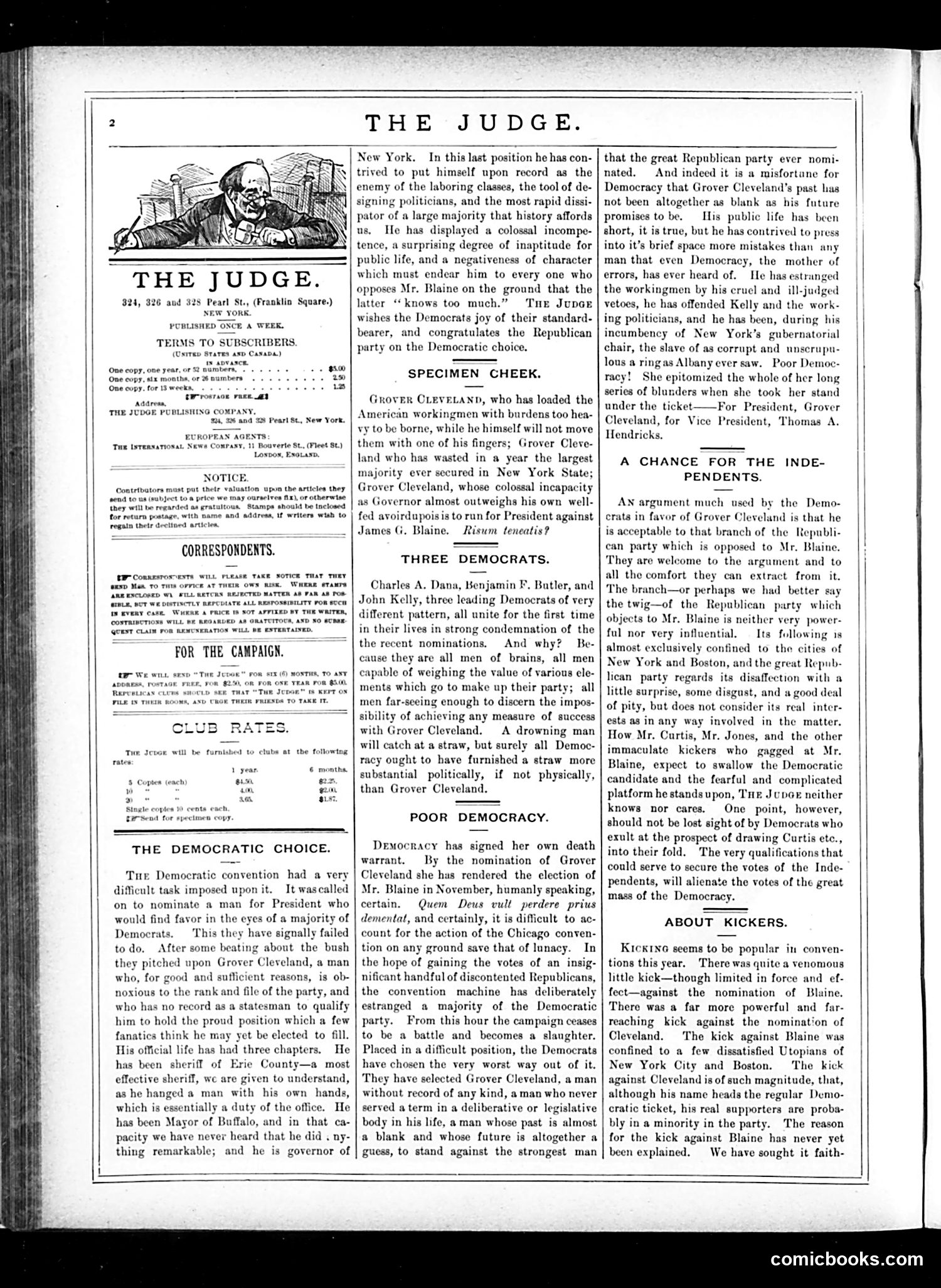
This page is a sustained Republican assault on Democrat Grover Cleveland's presidential nomination. The masthead cartoon depicts Cleveland as a skeletal, corrupt politician—the visual argument that he's unfit. The text hammers Cleveland across multiple articles: "The Democratic Choice" ridicules his thin resume (sheriff, Buffalo mayor, New York governor) and claims he's hostile to working people. "Specimen Cheek" sarcastically notes his physical bulk and incompetence. "Three Democrats" argues that even prominent Democrats like Charles Dana and Ben Butler oppose him—a sign the nomination is doomed. "Poor Democracy" uses Latin to suggest Cleveland's nomination amounts to Democratic suicide. The Judge's point: Cleveland is so weak a candidate that nominating him guarantees Republican James G. Blaine's victory. This is partisan opposition research masquerading as editorial commentary, typical of 19th-century political magazines.
📄 Transcribed text from this page (OCR, searchable)
Machine-transcribed from the original scan — historical spelling and the odd misread are preserved.
THE JUDGE. § avd 328 Pearl St., (Franklin Square.) NEW YORK. PUBLISHED ONCE A WEEK. TERMS TO SUI RIBERS. (Osirep Staves asp Casapa.) Ove copy, one year, 0 One copy, aix months One copy. for IS weeks. rrrosr) 3% pumbers cared Address, THE JUDGE PUBLISHING COMPANY. 324, 206 and SS Pearl St, EUROPEAN AGENTS. ‘Tue isrensariosat, News Comraxy, 1 Bouverte St., (Fleet St) regain thelr deeltoed article, CORRESPONDENTS. EW ConnesrosvesTs WILL FLEASE TAKE OTICR TmaT THEY OFrice AT THEIR OWS (8 REMUNERATION WILE, ME ENTERTAINED, FOR THE CAMPAIGN. We writ, sexy “THe Je THE DEMOCRATIC CHOICE. Tue Democratic convention had a very difficult task imposed upon it. It wascalled on to nominate a man for President who would find favor in the eyes of a majority of Democrats. ‘This they have signally failed todo. After some beating about the bush they pitched upon Grover Cleveland, a man who, for good and sufficient reasons, is ob- noxious to the rank and file of the party, and who has no record as a statesman to qualify him to hold the proud position which a few fanatics think he may yet be elected to fill. His official life has had three chapters. He has been sheriff of Erie County—a most effective sheriff, we are given to understand, as he hanged a man with his own hands, which is essentially a duty of the office. He has been Mayor of Buffalo, and in that ca- pacity we have never heard that he did . ny- thing remarkable; and he is governor of New York. In this last position he has con- trived to put himself upon record as the enemy of the laboring classes, the tool of de- signing politicians, and the most rapid di pator of a large majority that history affords us, He has displayed a colossal incompe- tence, a surprising degree of inaptitude for public life, and a negativeness of character which must endear him to every one who opposes Mr. Blaine on the ground that the latter ‘‘knows too much.” Tue JupGE wishes the Democrats joy of their standard- bearer, and congratulates the Republican party on the Democratic choice. SPECIMEN CHEEK. Grover CLEVELAND, who has loaded the American workingmen with burdens too hea- vy to be borne, while he himself will not move them with one of his fingers; Grover Cleve- land who has wasted in a year the largest majority ever secured in New York State; Grover Cleveland, whose colossal incapacity as Governor almost outweighs his own well- fed avoirdupois is to run for President against James G. Blaine. Risum teneatis? THREE DEMOCRATS. Charles A. Dana, Benjamin F, Butler, and John Kelly, three leading Democrats of very different pattern, all unite for the first time in their lives in strong condemnation of the the recent nominations. And why? Be- cause they are all men of brains, all men capable of weighing the value of various ele- ments which go to make up their party; all men far-seeing enough to discern the impos- sibility of achieving any measure of success with Grover Cleveland. A drowning man will catch at a straw, but surely all Democ- racy ought to have furnished a straw more substantial politically, if not physically, than Grover Cleveland. POOR DEMOCRACY. Democracy has signed her own death warrant. By the nomination of Grover Cleveland she hus rendered the election of Mr. Blaine in November, humanly speaking, certain. Quem Deus vult perdere prius dementat, and certainly, it is difficult to ac- count for the action of the Chicago conven- tion on any ground save that of lunacy. In the hope of gaining the votes of an insig- nificant handful of discontented Republicans, the convention machine has deliberately estranged a majority of the Democratic party. From this hour the campaign ceases to be a battle and becomes a slaughter. Placed in a difficult position, the Democrats have chosen the very worst way out of it. They have selected Grover Cleveland, a man without record of any kind, aman who never served aterm in a deliberative or legislative body in his life, aman whose past is almost a blank and whose future is altogether a guess, to stand against the strongest man that the great Republican party ever nomi- nated. And indeed it is a misfortune for Democracy that Grover Cleveland’s past has not been altogether as blank as bis future promises to be. His public life has been short, it is true, but he has contrived to press into it’s brief space more mistakes than any man that even Democracy, the mother of errors, has ever heard of. He has estranged the workingmen by his cruel and ill-judged vetoes, he has offended Kelly and the work- ing politicians, and he has been, during his incumbency of New York’s gubernatorial chair, the slave of as corrupt and unscrupu- lous a ringas Albany ever saw. Poor Democ racy! She epitomized the whole of her long series of blunders when she took her stand under the ticket For President, Grover Cleveland, for Vice President, ‘Thomas A. Hendricks. A CHANCE FOR THE INDE- PENDENTS. AN argument much used by the Demo- crats in favor of Grover Cleveland is that he is acceptable to that branch of the Republi- can party which is opposed to Mr, Blaine. They are weleome to the argument and to all the comfort they can extract from it. The branch—or perhaps we had better say the twig—of the Republican party whi objects to Mr. Blaine is neither very power- ful nor very influential. Its following is almost exclusively confined to the cities of New York and Boston, and the great Repub- lican party regards its disaffection with a little surprise, some disgust, and a good deal of pity, but does not consider its real inter- ests as in any way involved in the matter. How Mr. Curtis, Mr. Jones, and the other immaculate kickers who gagged at Mr. Blaine, expect to swallow the Democratic candidate and the fearful and complicated platform he stands upon, THe JupGe neither knows nor cares. One point, however, should not be lost sight of by Democrats who exult at the prospect of drawing Curtis etc., into their fold. The very qualifications that could serve to secure the votes of the Inde- pendents, will alienate the votes of the great mass of the Democrac ABOUT KICKERS. Kickrno seems to be popular in conven- tions this year. There was quite a venomous little kick—thongh limited in force and ef- fect—against the nomination of Blaine. There was a far more powerful and far- reaching kick against the nomination of Cleveland. The kick against Blaine was confined to a few dissatisfied Utopians of New York City and Boston. The kick against Cleveland is of such magnitude, that, although his name heads the regular Demo- cratic ticket, his real supporters are proba- bly in a minority in the party. ‘The reason for the kick against Blaine has never yet been explained. We have sought it faith- comicbooks.com