
A complete issue · 16 pages · 1884
Judge — June 28, 1884
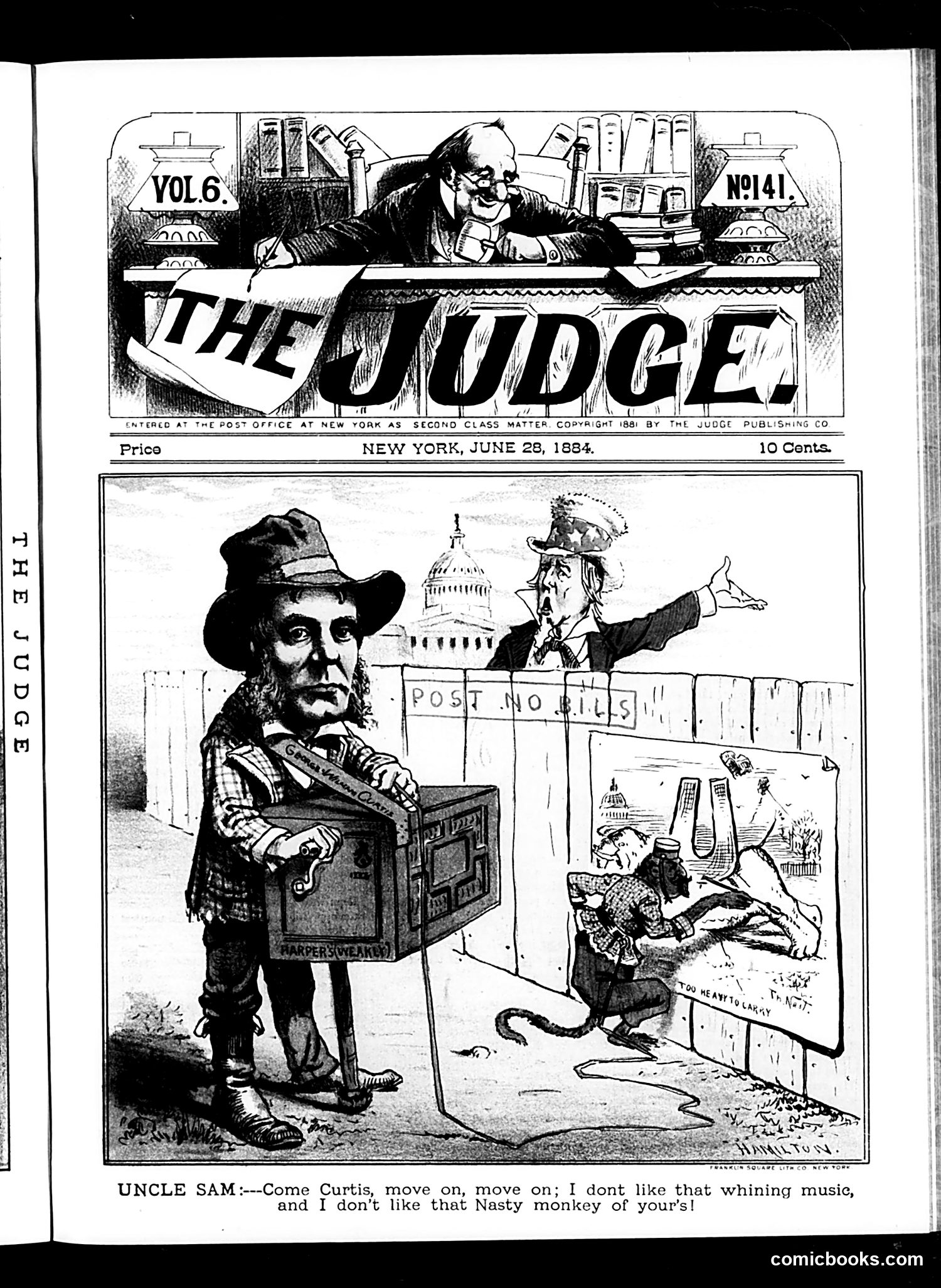
This political cartoon depicts "Uncle Sam" (personified America, left) confronting a figure labeled "Curtis" with a barrel organ and a monkey. The caption has Uncle Sam rejecting "whining music" and the "nasty monkey." The cartoon likely references **George William Curtis**, a prominent editor and political reformer of the era, or political controversy surrounding him. The barrel organ and monkey are traditional symbols of street performers—suggesting Curtis is portrayed as producing tiresome, repetitive political rhetoric ("whining music") with questionable support ("nasty monkey"). The background shows the Capitol building and a "Post No Bills" sign, indicating this concerns Washington politics and possibly concerns about unsightly political campaigning or Curtis's reform message being unwanted.
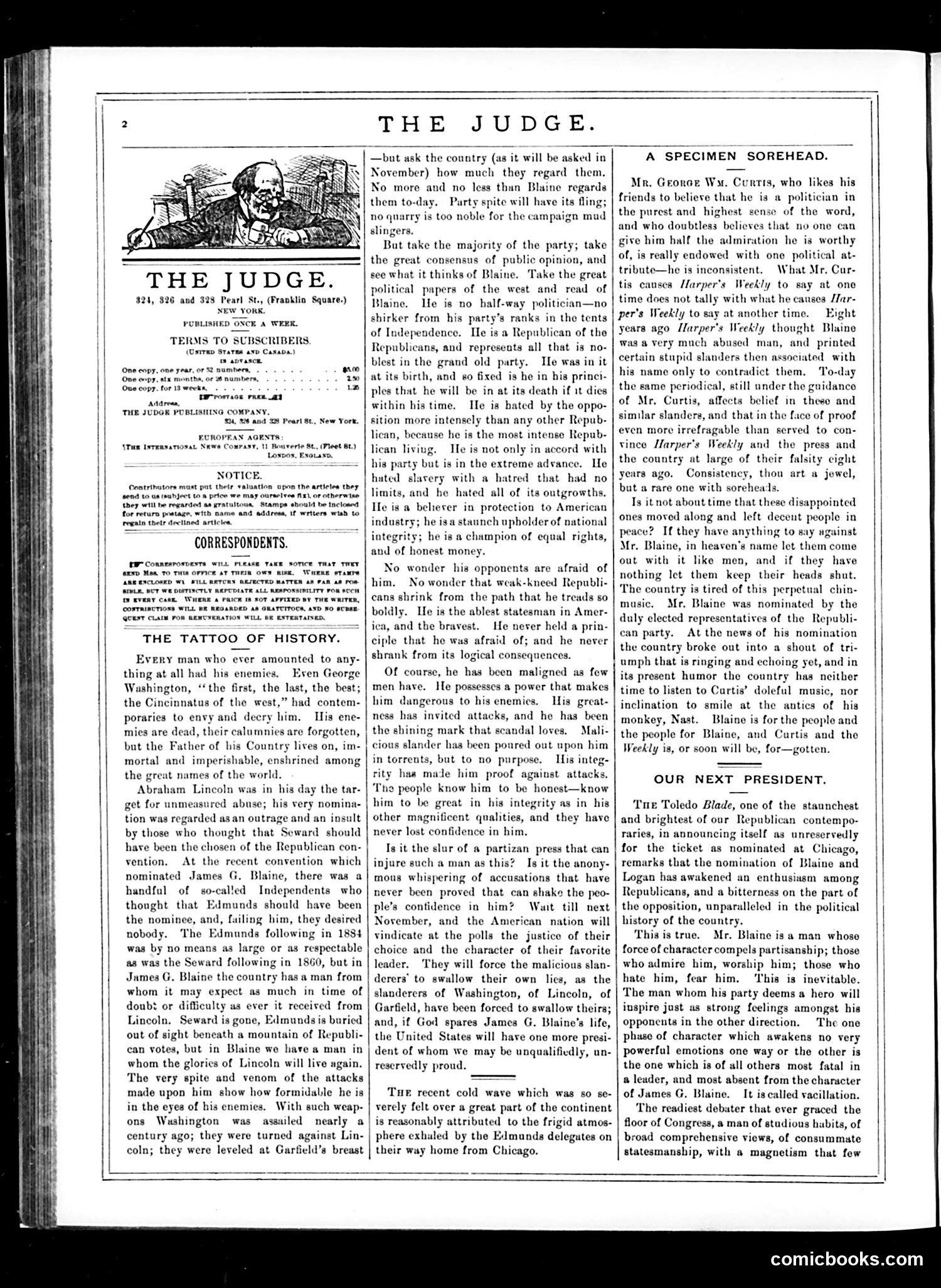
This page from **Judge** magazine (a satirical Republican publication) contains political commentary defending **James G. Blaine**, the 1884 Republican presidential nominee, against critics within his own party. **The Key Argument:** The editorial "The Tattoo of History" draws parallels between Blaine and revered figures like Washington and Lincoln—all faced fierce partisan attacks that history ultimately vindicated. The piece argues that Blaine's intense enemies prove his strength and commitment to Republican principles. **The Political Context:** Some Republicans ("Independents") opposed Blaine's nomination, preferring George Edmunds. Judge dismisses this faction as insignificant and urges party unity behind Blaine in the November election. **The Satire's Point:** By comparing Blaine to Lincoln and Washington, the magazine ironically elevates a controversial politician while mocking his detractors as short-sighted. The heavy-handed historical comparison serves Judge's partisan purpose: legitimizing Blaine through association with greatness. The cartoon header (an engraved portrait) and "Specimen Sorehead" section mock critics of Blaine and Harper's Weekly's opposition to him.
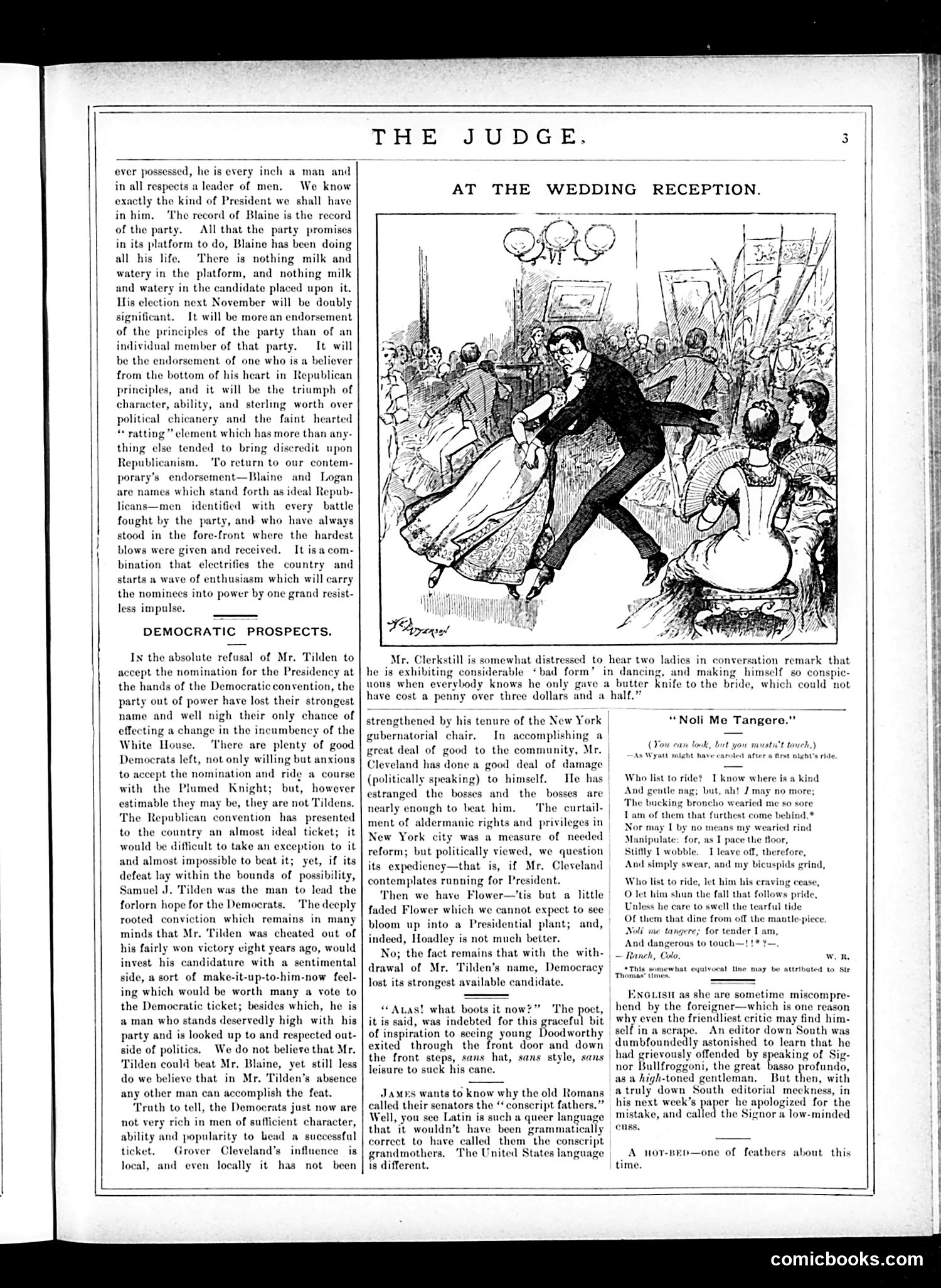
This *Judge* magazine page covers the 1884 presidential election. The main article praises Republican nominee James G. Blaine ("the Plumed Knight") and his running mate Logan as ideal party representatives, while lamenting Democrat Samuel Tilden's refusal to run again—a blow to Democratic chances. The cartoon satirizes Mr. Clerkstill at a wedding reception, mocking his poor dancing etiquette and conspicuous behavior. Two women criticize both his "bad form" on the dance floor and his stingy gift (a three-dollar butter knife) to the bride. The joke targets social pretension and cheapness masquerading as sophistication. The sidebar poem "Noli Me Tangere" humorously advises against touching the speaker, likely continuing the social-misstep theme. The *Judge* content reflects 1880s partisan Republican politics and upper-class social anxieties about proper conduct.
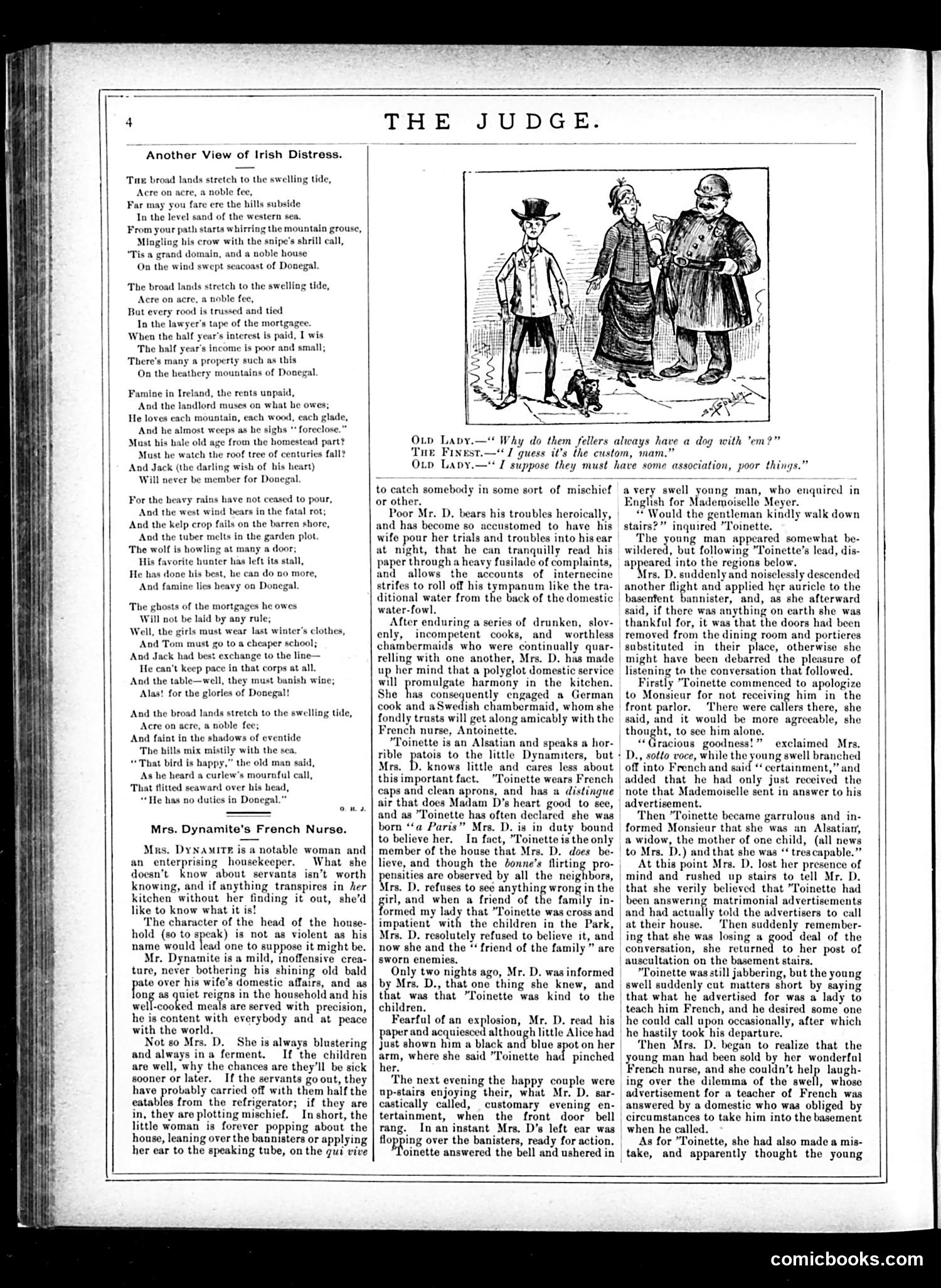
This poem satirizes the plight of Irish landlords during famine, likely referencing the late 19th-century Irish agricultural crisis. The irony is deliberate: a wealthy landowner possesses vast, beautiful estates in Donegal but cannot collect rents because tenants face starvation. Mortgages, failed crops, and diseased potatoes force him toward foreclosure despite his emotional attachment to the land. His children must wear old clothes and abandon education; even his prized hunting horse is sold. The final stanza—where the old man envies a bird unburdened by "duties in Donegal"—crystallizes the satire: the *landlord* is pitied as victim of circumstance, not the starving tenants. Judge presents this sympathetically yet ironically, highlighting how economic collapse affects even the privileged class during Ireland's agricultural disaster. The cartoon above shows three figures discussing why Irish people have dogs, with a servant responding it's "the custom"—likely a separate, lighter joke about Irish cultural habits.
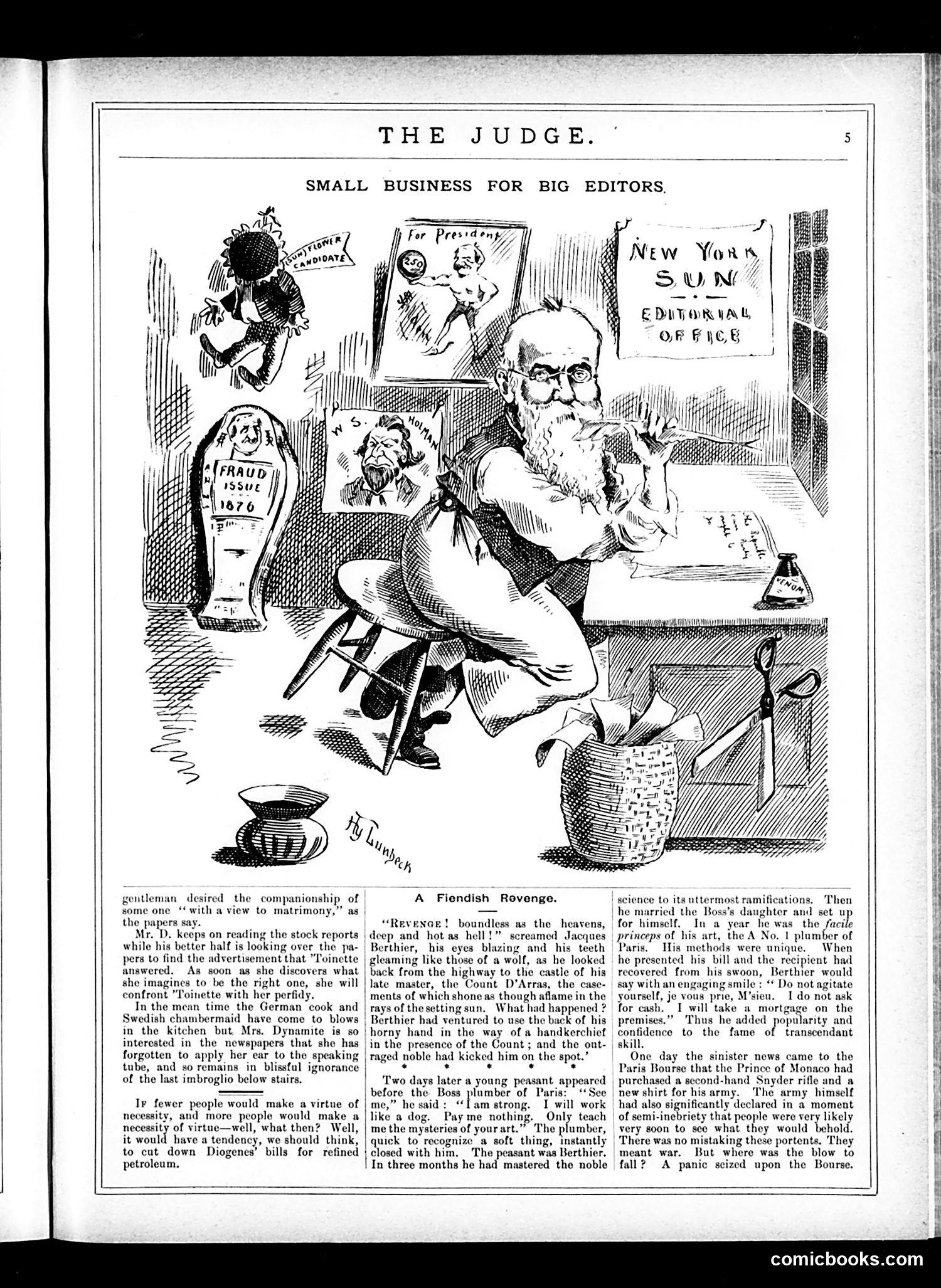
This page contains two satirical pieces mocking contemporary social pretensions and media sensationalism. **Top cartoon:** Depicts a newspaper editor at his desk surrounded by domestic chaos he ignores—a cook and chambermaid fighting below stairs, while he obsesses over stock reports and matrimonial advertisements. The satire targets editors' self-absorption and the trivial "small business" (personal drama) that occupies supposedly important men. **"A Fiendish Revenge"** (lower text): A mock-melodramatic story parodying overwrought French revenge narratives popular in literature. A peasant servant (Berthier) is kicked by his noble master, becomes a plumber instead, grows wealthy and successful, and marries the boss's daughter—a deliberately anticlimactic "revenge" that subverts the expected tragedy. The absurd conclusion about Monaco's military preparations underscores the satire's mockery of overwrought dramatic conventions and newspaper sensationalism. Both pieces ridicule the pretensions and obsessions of editors and readers alike.
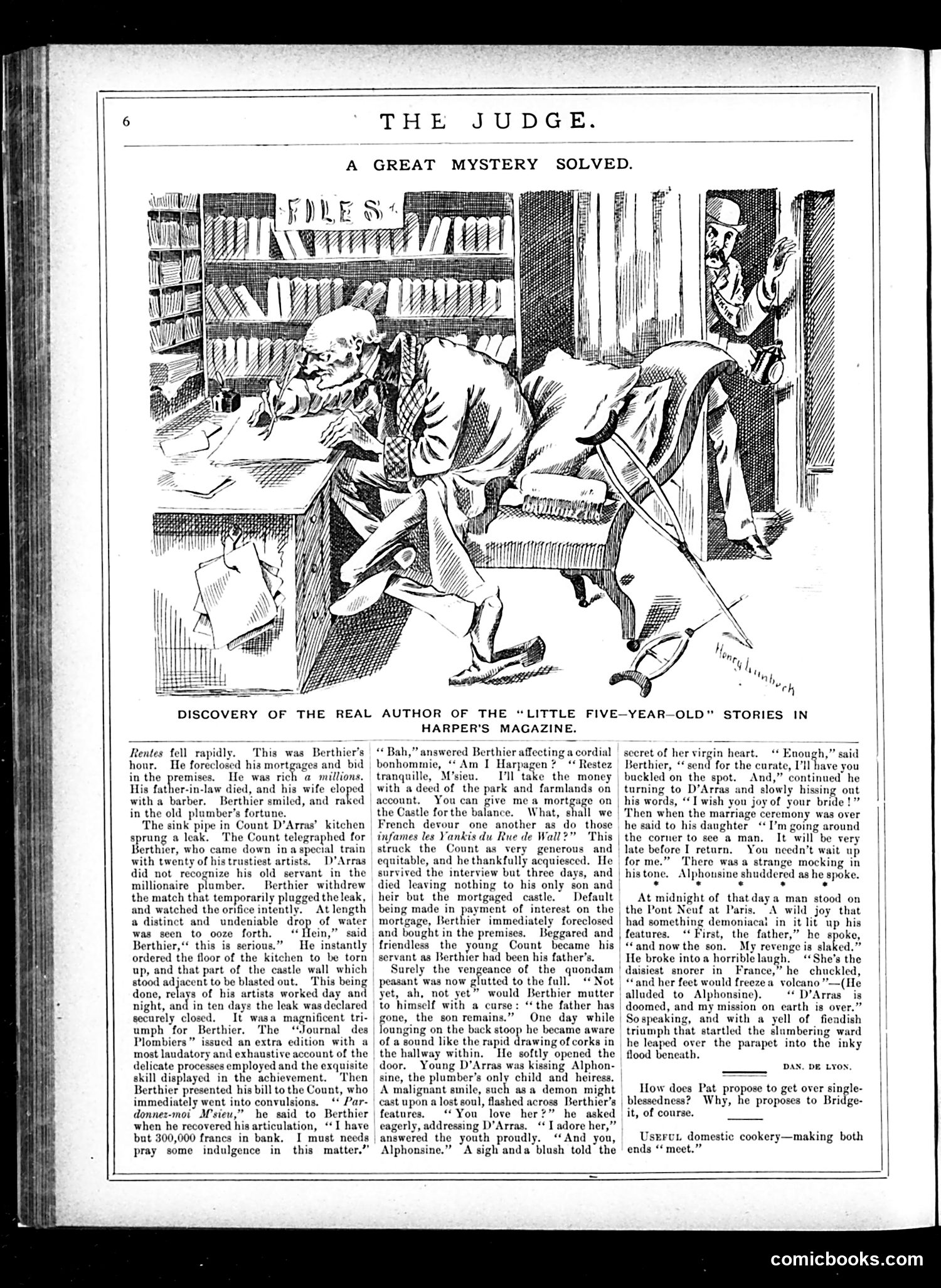
This page satirizes sentimental serialized fiction, particularly the "Little Five-Year-Old" stories published in *Harper's Magazine*. The headline announces the "discovery" of their real author through an absurdist tale. The cartoon depicts a Machiavellian plumber named Berthier who systematically destroys a French aristocratic family across generations through cunning financial manipulation. Starting as a servant, he becomes wealthy by exploiting the Count through exorbitant repair bills, then forecloses on mortgaged estates, reducing the young Count to servitude. The story culminates with Berthier forcing his daughter to marry the impoverished nobleman, then abandoning them on their wedding night with sinister intent. The satire mocks both *Harper's* saccharine melodrama and the predictable plotting of popular serialized fiction—the overwrought moral lessons, unlikely coincidences, and melodramatic revenge plots. By attributing this overwrought tale to such a cynical schemer, Judge ridicules the sentimentality that readers apparently craved.
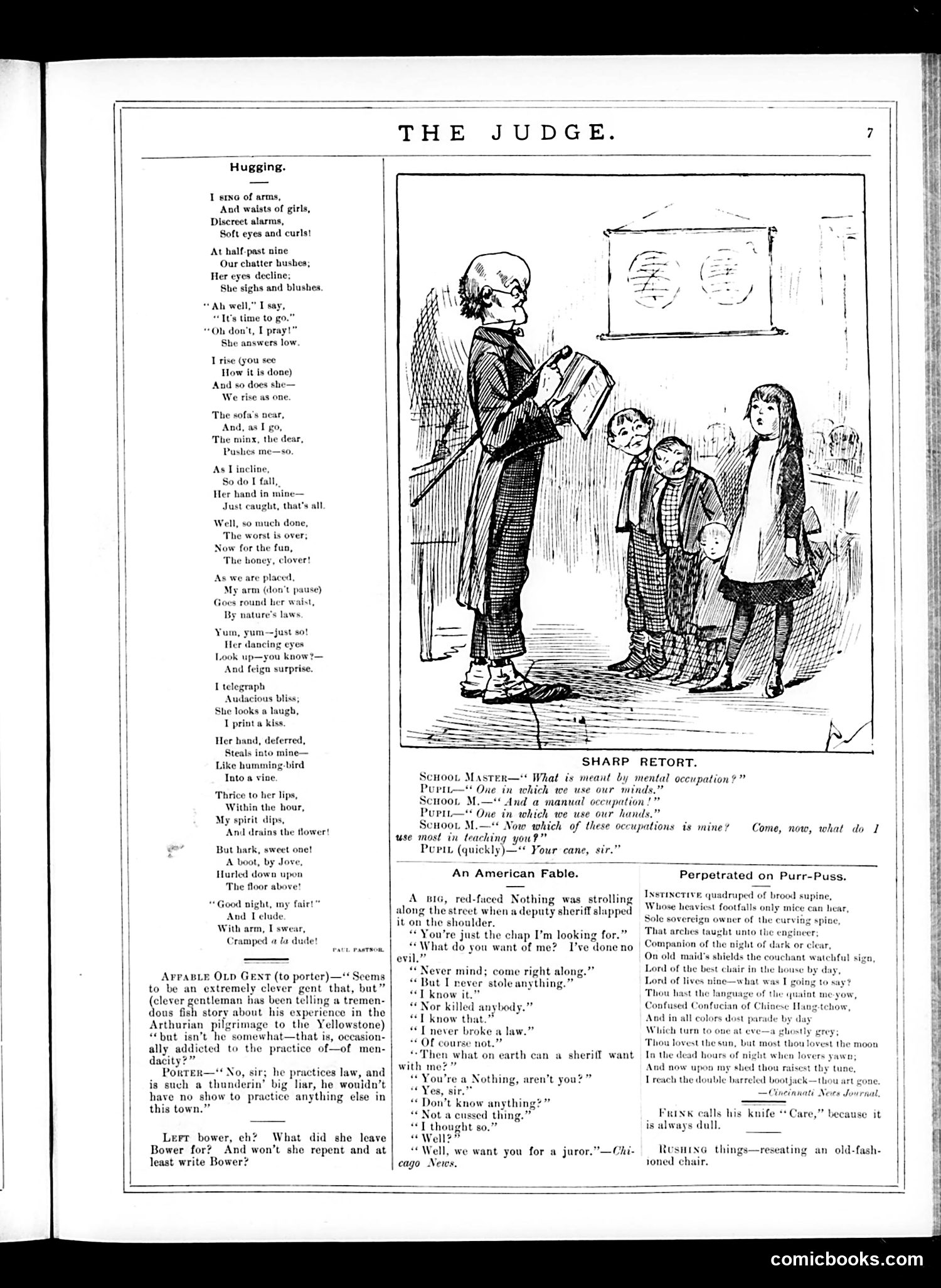
This page contains several satirical pieces typical of late-19th-century Judge magazine: **"Hugging"** (left column): A sentimental poem describing a courtship scene, interrupted by slapstick—a boot drops from above, forcing the couple apart. The satire mocks Victorian courtship rituals and romantic poetry's pretensions. **"Sharp Retort"** (center): A schoolmaster asks a pupil which occupation is "mental"—the pupil answers the cane (the teacher's instrument of punishment), implying teachers use force rather than intellect. Sharp social critique of corporal punishment in schools. **"An American Fable"** (bottom center): A sheriff arrests a man named "Nothing" for jury duty—satirizing the absurdity of compulsory jury service and the difficulty of finding willing jurors. **"Perpetrated on Purr-Puss"** (right): A mock-heroic poem about a cat, parodying grandiose Victorian verse by applying it to mundane animal behavior. The page reflects Judge's typical mix of social satire, domestic humor, and literary parody targeting educated readers familiar with Victorian conventions.
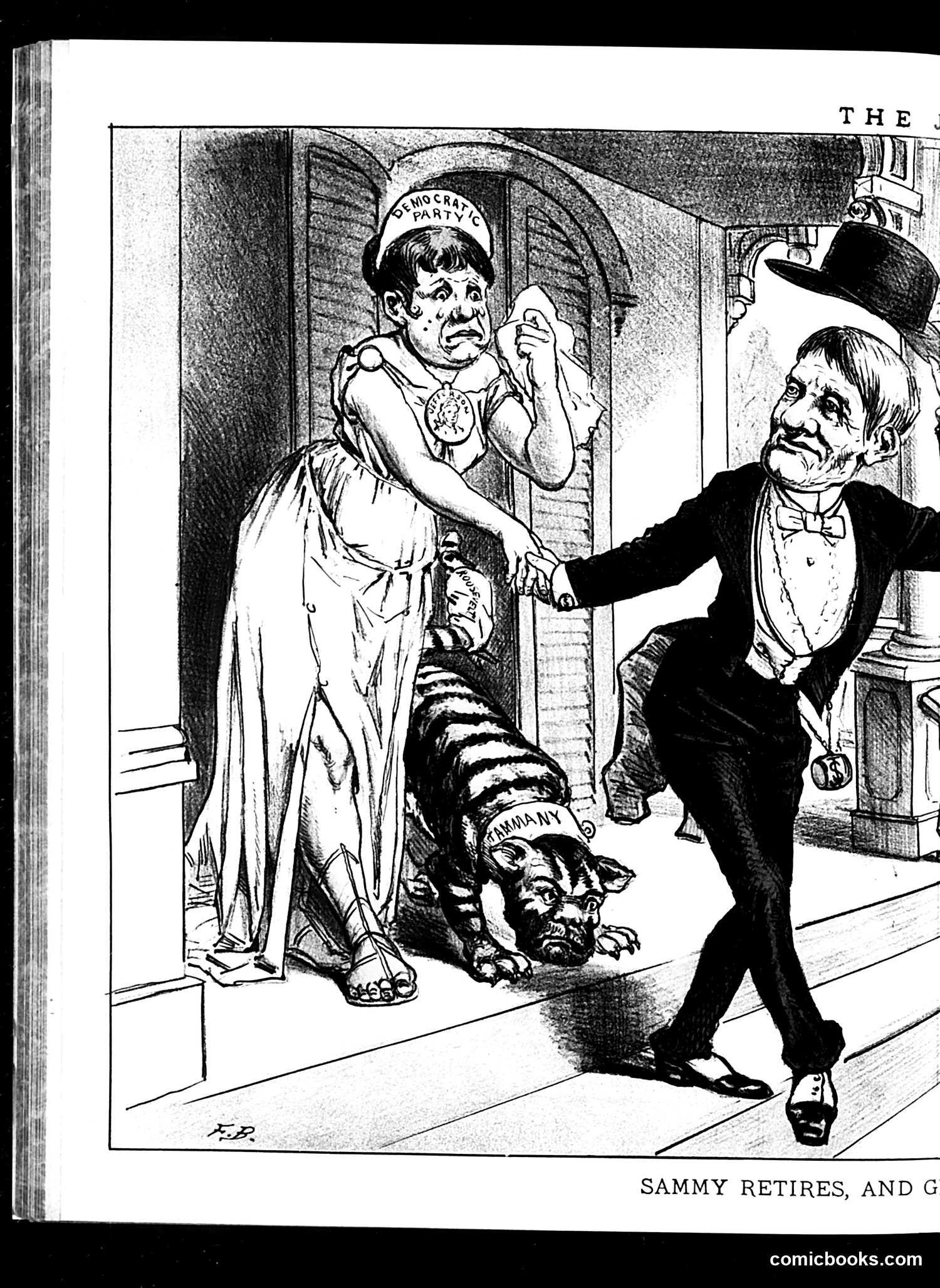
This appears to be a satirical cartoon from *Judge* magazine depicting a scene labeled "Sammy Retires, and G[...]" (text cut off). The image shows a woman wearing a "Democracy" headband, appearing distressed or crying, being led away by a well-dressed gentleman in formal attire. A tiger labeled "Germany" crouches nearby. The satire likely references American political or military leadership during a period of international tension—possibly World War I era, given the Germany reference and democracy imagery. "Sammy" appears to represent American interests or leadership. The cartoon suggests anxiety about Democratic principles being compromised or abandoned as a gentleman (possibly representing a political figure) escorts Democracy away while Germany threatens. Without the complete caption, precise identification of the political figures remains unclear.
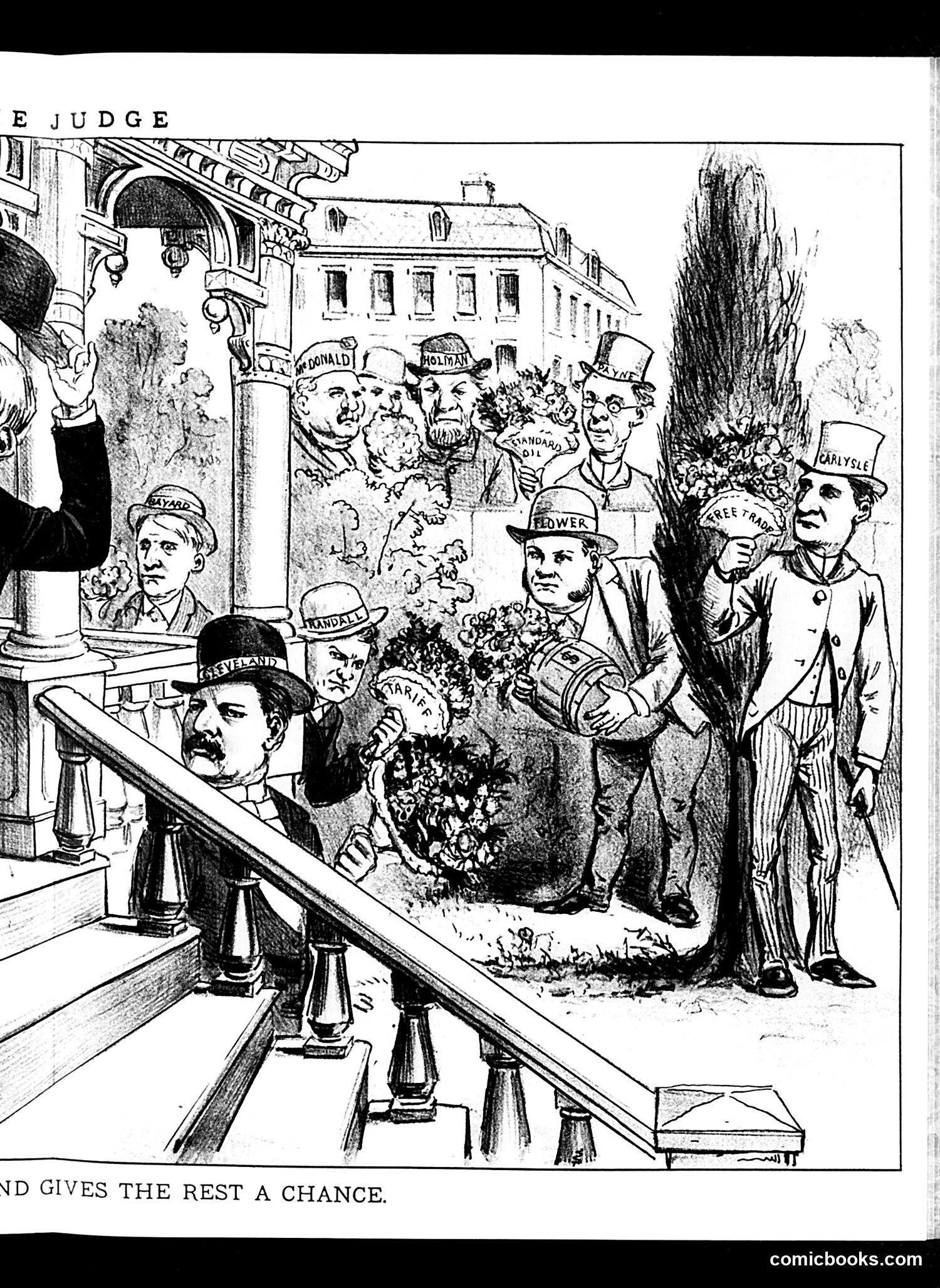
This appears to be a Judge magazine political cartoon showing a courtroom scene. A stern-faced judge sits elevated on the left, while a group of men wearing hats labeled with various locations or interests (visible labels include "Randall," "Flower," "Carlyle," "Tree Fraud," and others) stand before him in the courthouse. The caption reads "AND GIVES THE REST A CHANCE," suggesting the judge is offering fairness or impartiality to multiple parties with competing interests or claims. Without clearer label visibility or date information, I cannot definitively identify the specific political figures or historical event referenced. However, this appears to satirize either judicial proceedings involving multiple regional or commercial interests, or perhaps political patronage and fairness in judging competing claims. The cartoon likely criticized or commented on contemporary political corruption or favoritism.
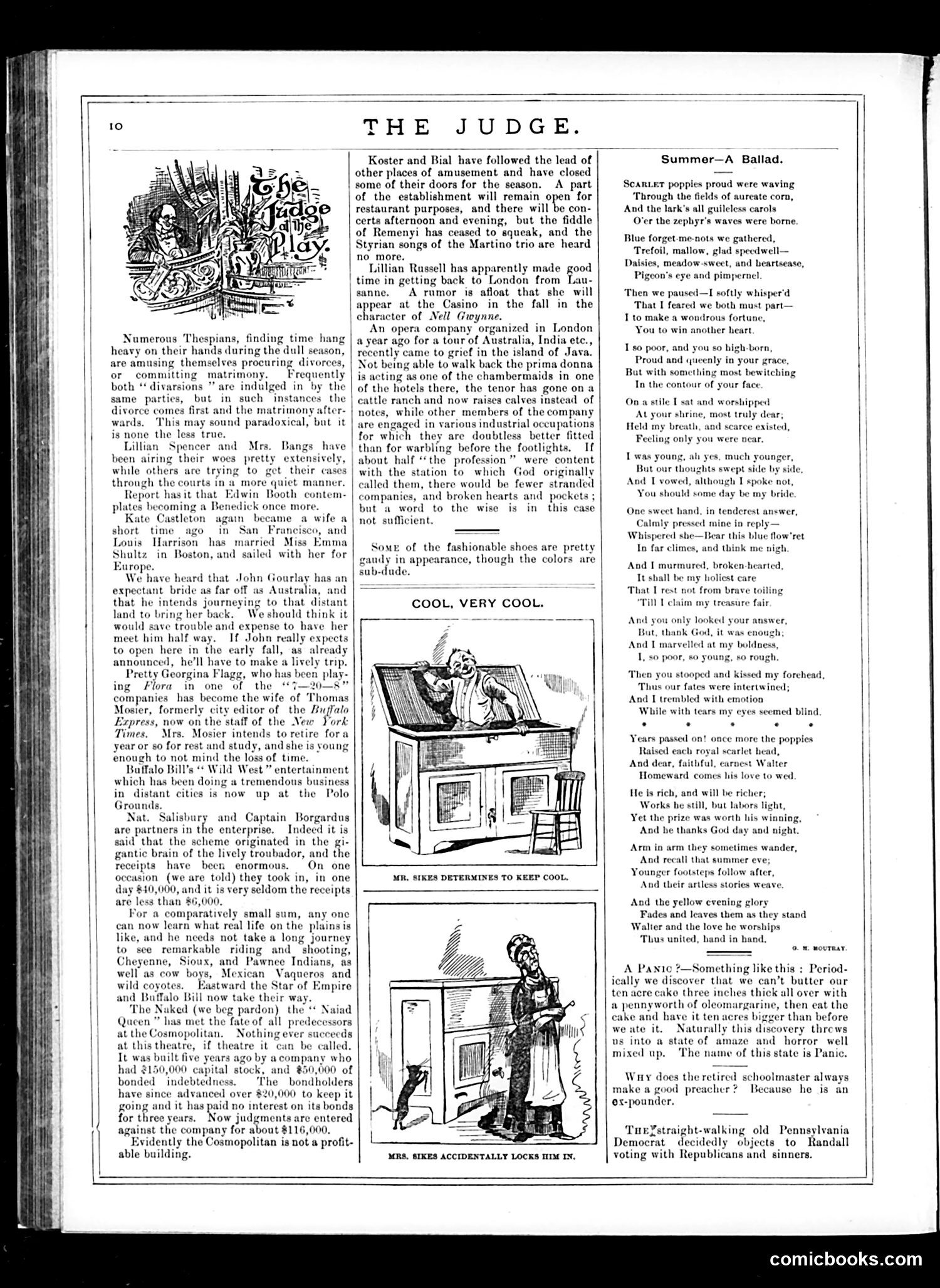
This page from the satirical magazine *Judge* contains theatrical gossip and commentary, circa late 1880s. The main text discusses actors' marriages, divorces, and career moves—presenting these as frivolous entertainment-world scandals. The tone mocks the instability of theatrical life, where performers rapidly marry, divorce, and remarry. Key satirized subjects include: - **Buffalo Bill's "Wild West" show** at the Polo Grounds, portrayed as a successful spectacle - **The Cosmopolitan Theatre**, criticized as perpetually unprofitable despite investor bailouts - **Lillian Russell**, a famous actress, and other performers' romantic entanglements - An **opera company's failure** in Java, with humorous details about displaced performers (prima donna working as maid, tenor raising calves) The cartoons show "Mrs. Sikes" attempting to stay cool in summer heat—a domestic humor piece unrelated to the theatrical gossip. The satire's point: theatrical life is commercially unstable and morally questionable, with performers treating marriage casually.
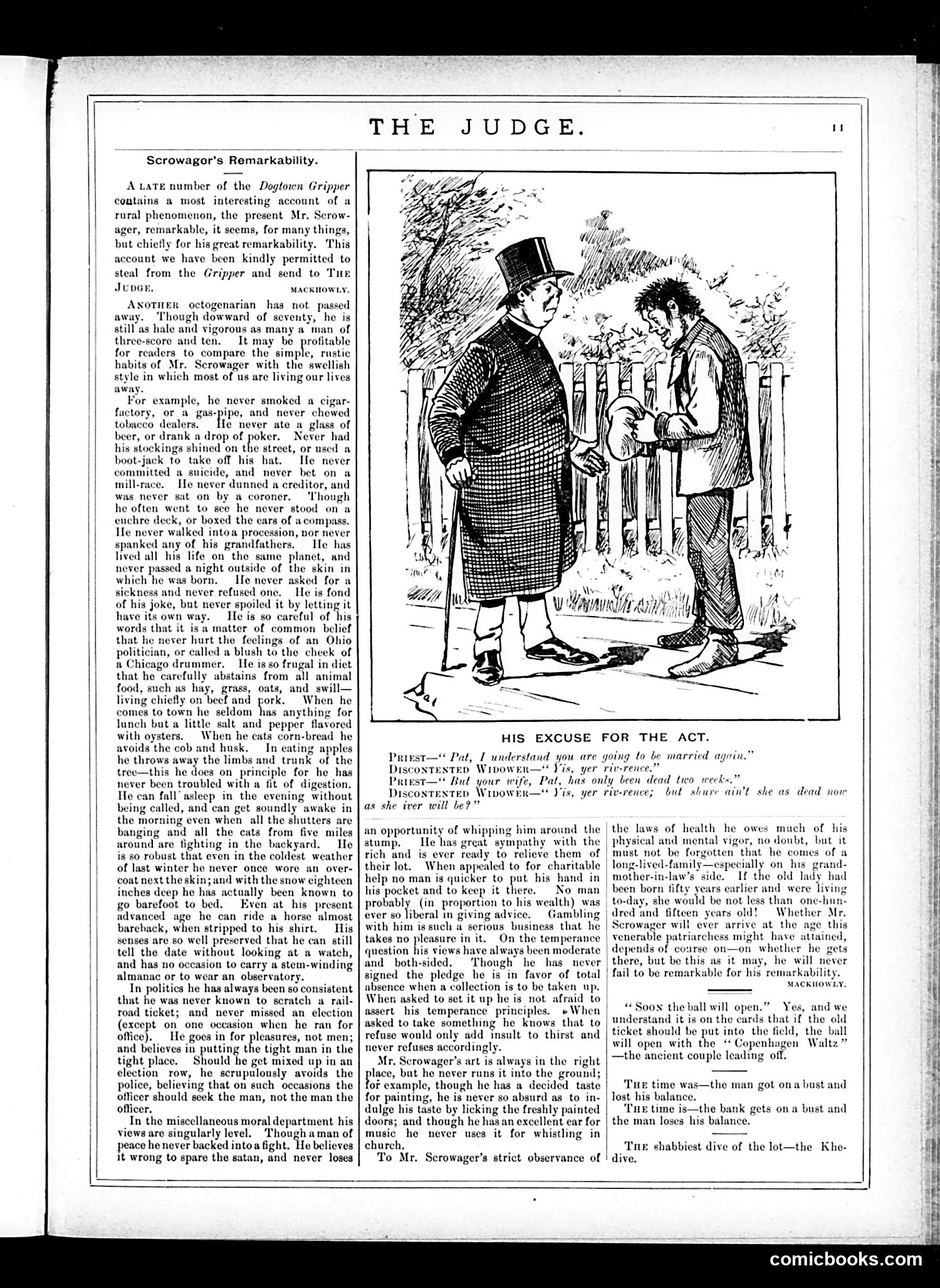
This page satirizes rural virtue through the character Mr. Scrowager, whose absurdly contradictory lifestyle is described with mock-serious praise. The text humorously lists his "remarkability"—he abstains from vices yet eats only meat; he's careful with words yet never offends politicians; he avoids animal feed while living on beef and pork. The satire mocks both rural simplicity and the tendency to romanticize it. The cartoon below, titled "His Excuse for the Act," depicts a priest questioning a "discontented widower" about remarrying. The widower's response (partially illegible in the OCR) apparently justifies taking another wife. The joke likely targets either marital unhappiness or the contradiction between religious principle and human desire—the "excuse" being inadequate or hypocritical. The cartoon satirizes how people rationalize actions contrary to their stated values.
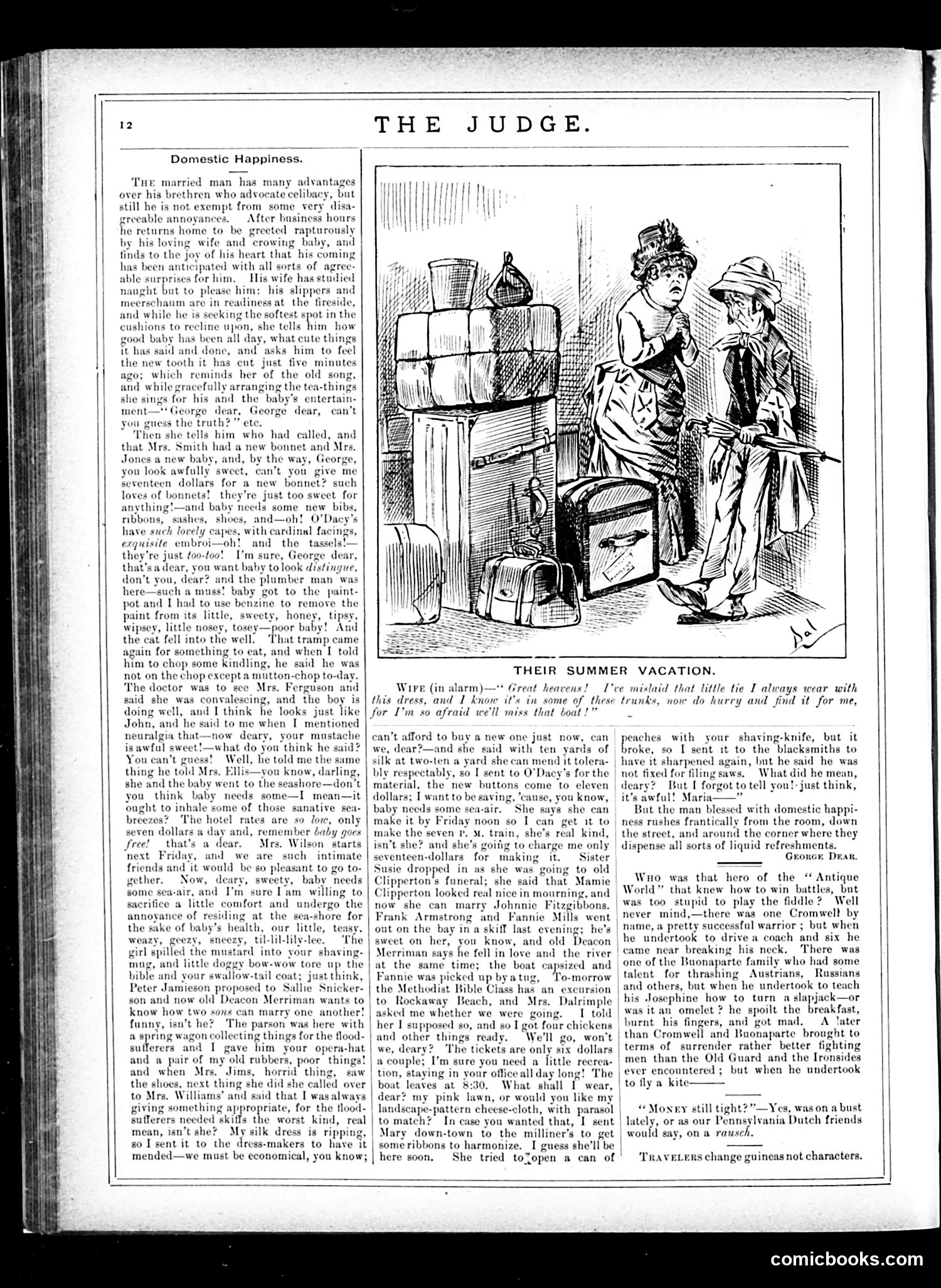
This page satirizes the anxieties of middle-class married life through two contrasting scenes. **The main cartoon** depicts a husband and wife preparing for summer vacation. The wife, in alarm, searches frantically through packed trunks for a missing necktie, pressuring her harried husband to help find it before they miss their boat. She rattles off complaints: she can't afford new clothes, needs items mended, forgot to retrieve her sharpened shaving-knife from the blacksmith—a cascade of domestic crises. **The satire's point**: The cartoon mocks how wives transform simple travel preparations into elaborate dramas, burdening husbands with endless minor catastrophes and anxieties. The husband's frantic departure "around the corner where they dispense all sorts of liquid refreshments" suggests escape—he flees to a bar. **Context for modern readers**: This reflects Victorian-era gender dynamics where wives were depicted as emotionally demanding and detail-obsessed, while husbands sought refuge in male spaces. The humor targets both the wife's fussiness and the husband's weakness. The accompanying "Domestic Happiness" text reinforces this theme: wives bombard returning husbands with gossip, complaints, and shopping demands.
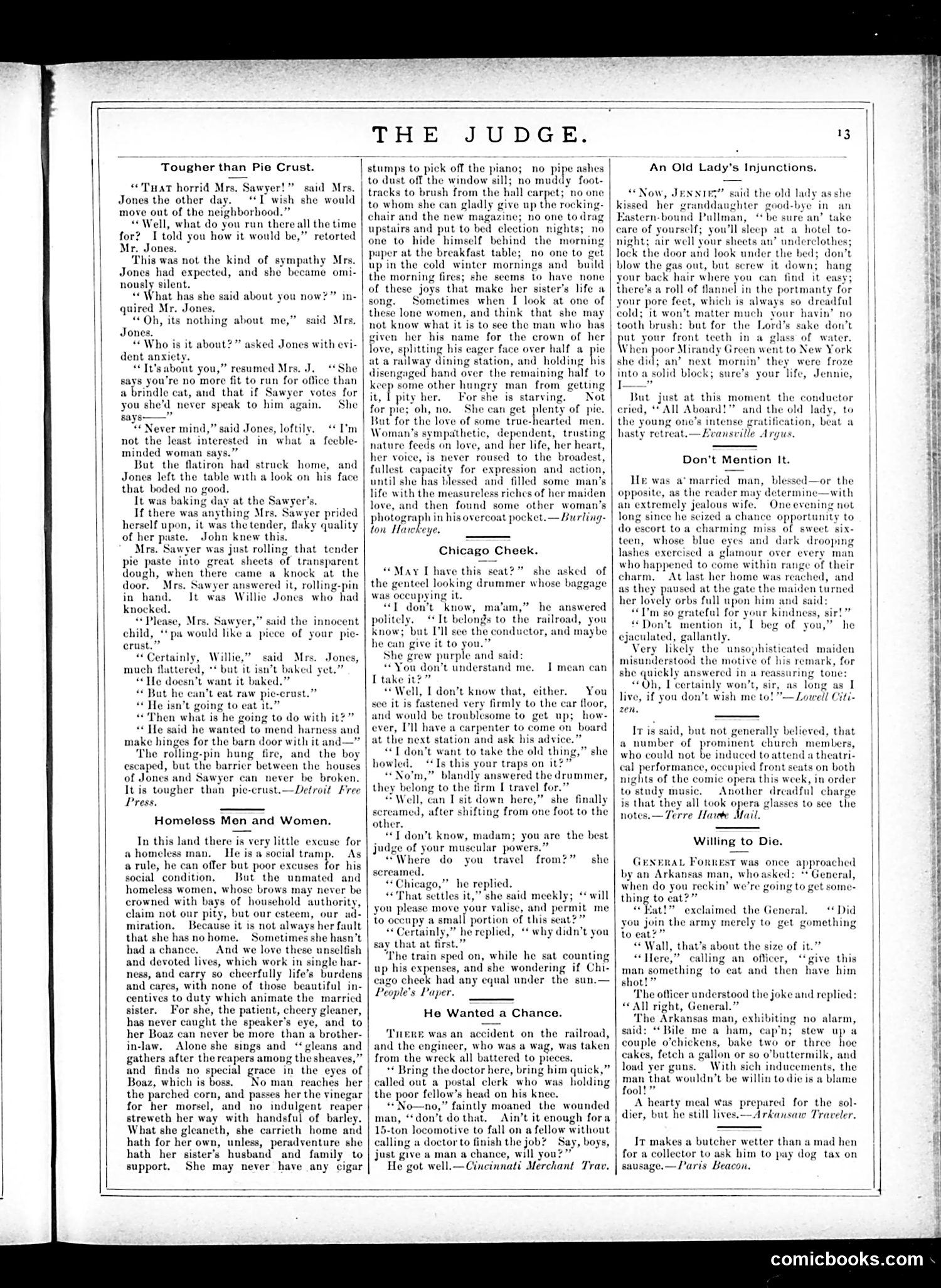
This page contains three humorous short stories from *Judge* magazine, a 19th-century American satirical publication. **"Tougher than Pie Crust"** satirizes petty neighborhood feuds. Mrs. Jones gossips to her husband about Mrs. Sawyer, insulting his political fitness. Jones retaliates by sending his son to humiliate Mrs. Sawyer by asking for her prized pie crust—not to eat, but to use as harness repair material. The joke: the insult is so devastating that the neighborhood barrier becomes "tougher than pie-crust"—permanently broken. **"Homeless Men and Women"** offers social commentary, arguing that unmarried women deserve sympathy because homelessness isn't always their fault, unlike homeless men deemed "social tramps." It uses biblical imagery (the Ruth/Boaz story) to romanticize spinsters' selfless lives. The remaining stories employ similar satirical humor about domestic life and social propriety. The satire reflects Victorian-era anxieties about gender roles, reputation, and community standing.
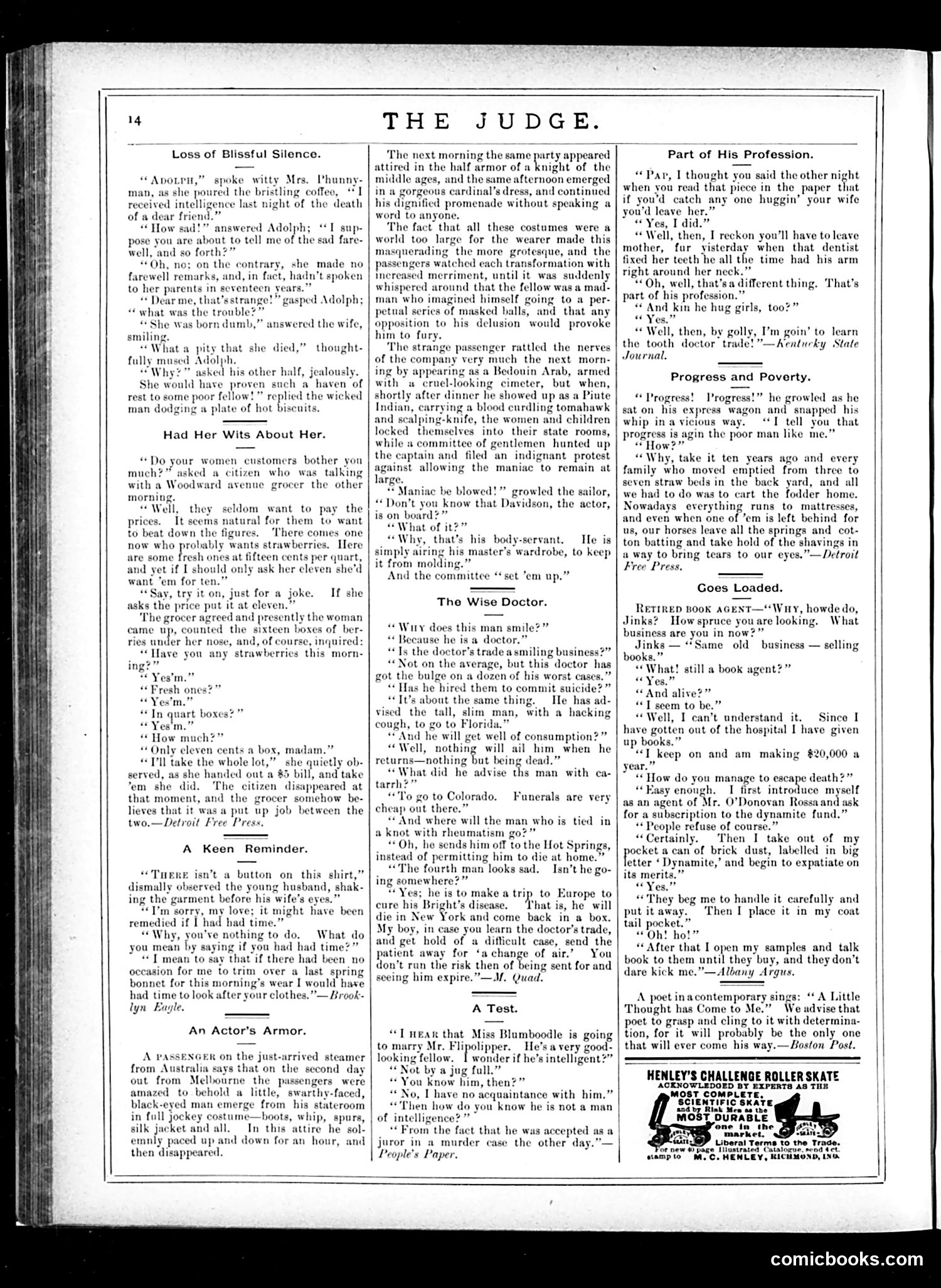
This page from **Judge** (a satirical weekly) contains five brief humorous pieces mocking everyday social behavior: 1. **"Loss of Blissful Silence"**: A husband celebrates a woman's death solely because she was mute—satirizing misogynistic attitudes about women's voices being bothersome. 2. **"Had Her Wits About Her"**: A grocer's customer tricks him into lowering his strawberry price, then buys his entire stock—mocking both women haggler-shoppers and male gullibility. 3. **"A Keen Reminder"**: A husband complains about missing shirt buttons; his wife retorts she was too busy trimming a bonnet—satirizing domestic blame-shifting and unequal household labor expectations. 4. **"An Actor's Armor"**: An eccentric passenger constantly changes elaborate costumes aboard a ship, eventually frightening other passengers who assume he's insane—poking fun at theatrical pretension and public hysteria. 5. **"The Wise Doctor"**: Various anecdotes about a smiling doctor who profits from treating wealthy patients while avoiding poorer ones—social criticism of medical commerce. The page primarily satirizes gender relations, consumer behavior, and professional ethics typical of the era.
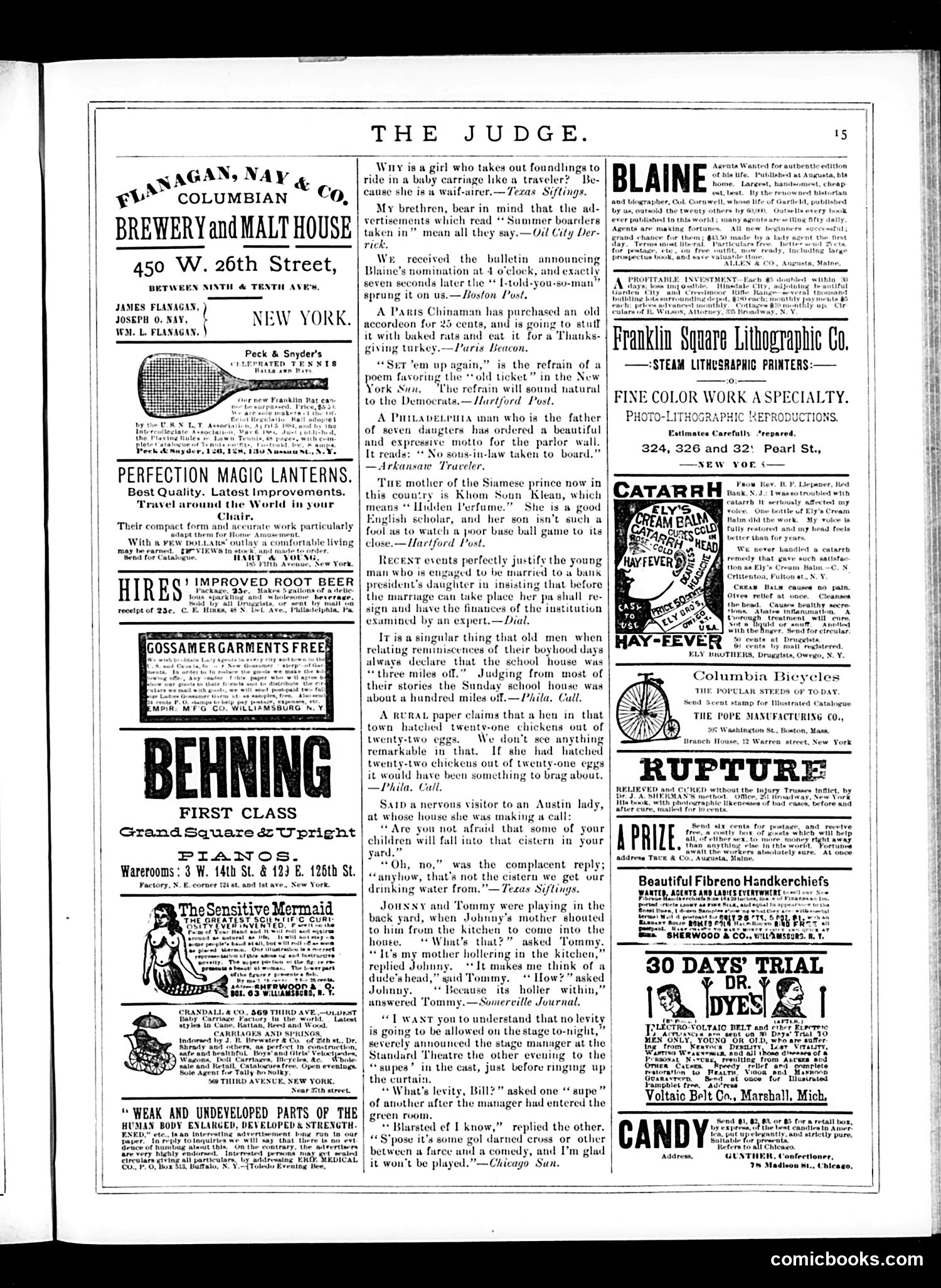
This page is primarily **advertisements and light humor columns**, typical of Judge's format. The substantive satirical content appears in the text jokes rather than visual cartoons. ## Key Content: The humor section includes a joke referencing **James G. Blaine's 1884 presidential nomination** ("Blaine's nomination at 4 o'clock"). Blaine was the controversial Republican nominee that year, so Judge's joke about Democratic enthusiasm for "the old ticket" suggests editorial skepticism about his candidacy. Other jokes target familiar topics: rural life absurdities, nervous visitors, children's mishaps—standard period humor without specific political reference. ## Visual Elements: The advertisements dominate (pianos, breweries, medical remedies). Small ads like "The Sensitive Mermaid" appear to promote questionable patent medicines or body-development schemes typical of Gilded Age advertising. **Bottom line:** This is an ordinary issue page mixing commercial advertising with generic humor and mild political jabs, not a sustained satirical commentary.
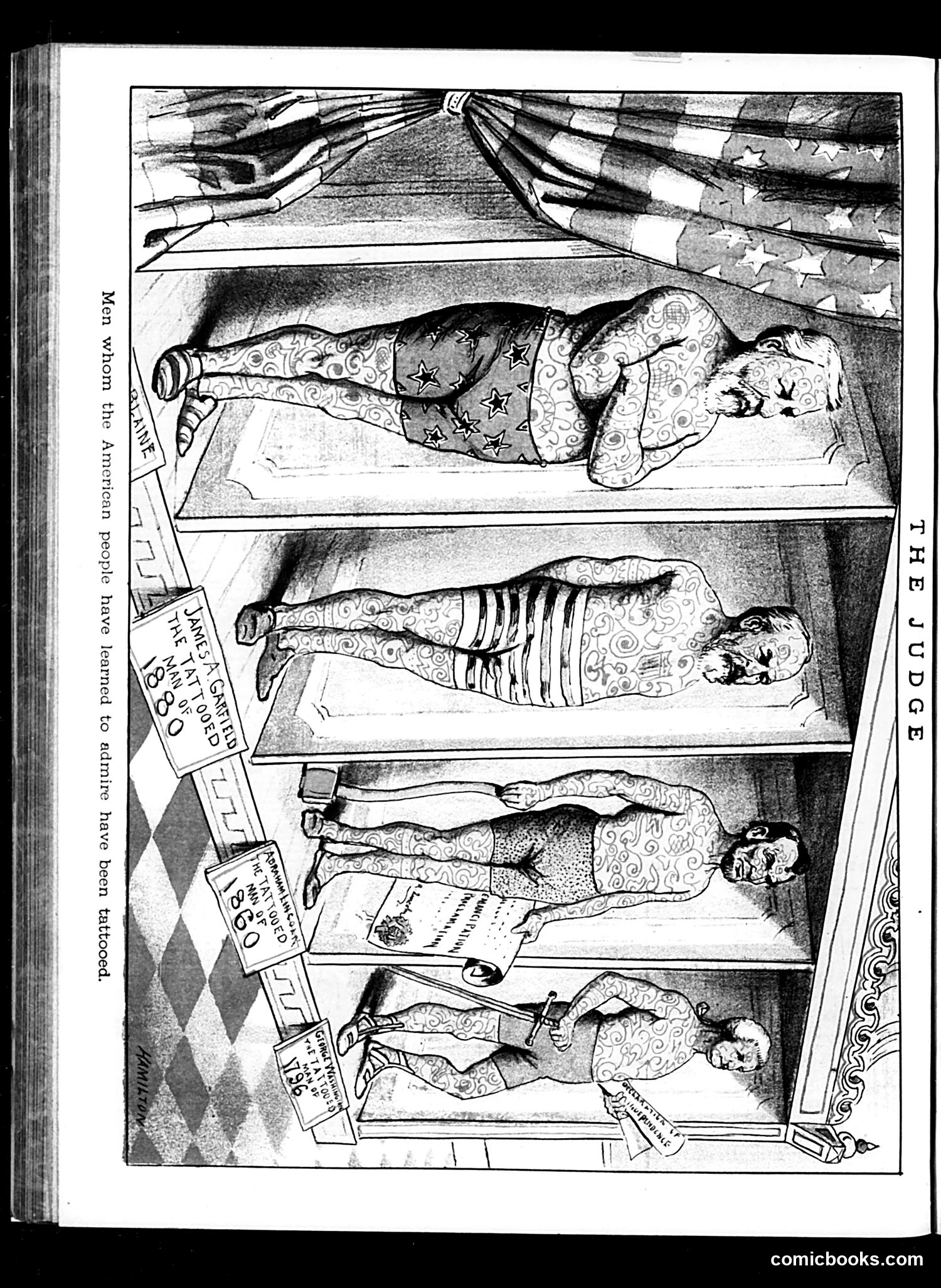
This page satirizes prominent American men who have become tattooed. The illustration shows four figures displayed horizontally, each with visible tattoos covering their bodies, presented like museum specimens or carnival exhibits. The caption states these are "Men whom the American people have learned to admire," suggesting the satire targets respected public figures who have surprisingly adopted tattooing. The presentation as if on display shelves with labels mocks both the tattooed men and society's peculiar admiration for them. Without clearer identification of the specific figures, the exact targets remain unclear, but the joke appears to critique either hypocrisy (respectable men getting tattoos) or the shifting cultural acceptance of tattooing among the elite during this era. The satirical framing questions why Americans would admire tattooed individuals.