
Judge, 1884-06-28 · page 5 of 16
Judge — June 28, 1884 — page 5: what you’re looking at
What you’re looking at
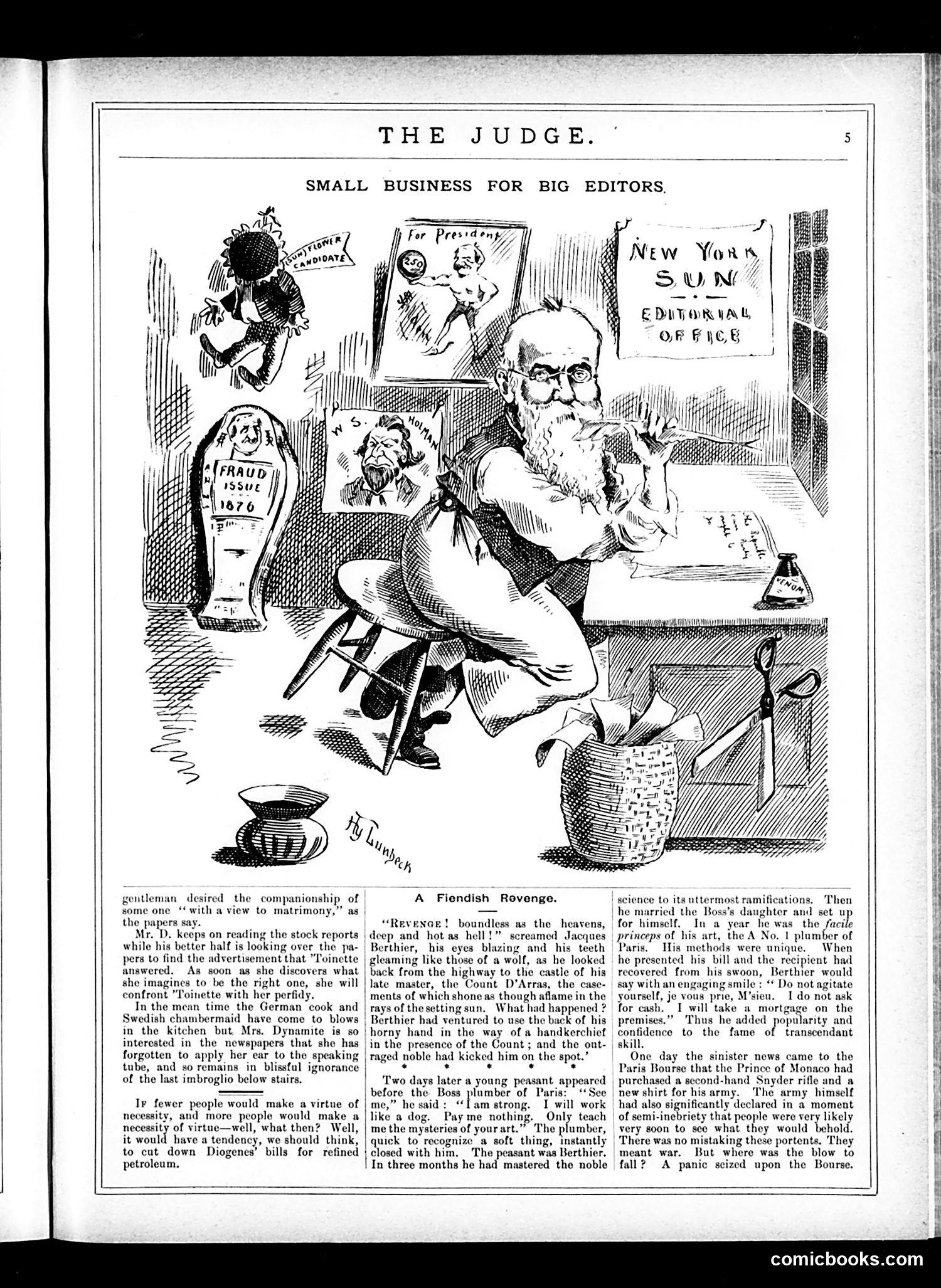
This page contains two satirical pieces mocking contemporary social pretensions and media sensationalism. **Top cartoon:** Depicts a newspaper editor at his desk surrounded by domestic chaos he ignores—a cook and chambermaid fighting below stairs, while he obsesses over stock reports and matrimonial advertisements. The satire targets editors' self-absorption and the trivial "small business" (personal drama) that occupies supposedly important men. **"A Fiendish Revenge"** (lower text): A mock-melodramatic story parodying overwrought French revenge narratives popular in literature. A peasant servant (Berthier) is kicked by his noble master, becomes a plumber instead, grows wealthy and successful, and marries the boss's daughter—a deliberately anticlimactic "revenge" that subverts the expected tragedy. The absurd conclusion about Monaco's military preparations underscores the satire's mockery of overwrought dramatic conventions and newspaper sensationalism. Both pieces ridicule the pretensions and obsessions of editors and readers alike.
📄 Transcribed text from this page (OCR, searchable)
Machine-transcribed from the original scan — historical spelling and the odd misread are preserved.
THE JUDGE. SMALL BUSINESS FOR BIG EDITORS. gentleman desired the companionship of some one ‘‘ with a view to matrimony,” as the papers say. Mr. D. keeps on reading the stock reports while his better half is looking over the pa- pers to find the advertisement that “Toinette answered. As soon as she discovers what she imagines to be the right one, she will confront ’Toinette with her perfidy. In the mean time the German cook and Swedish chambermaid have come to blows in the kitchen but Mrs. Dynamite is so interested in the newspapers that she has forgotten to apply her ear to the speaking tube, and so remains in blissful ignorance | of the last imbroglio below stairs. Ir fewer people would make a virtue of necessity, and more people would make a necessity of virtue—well, what then? Well, it would havea tendency, we should think” to cut down Diogenes” bills for refined petroleum, ' I A Fiendish Rovenge. “RevenGe! boundless as the heavens, deep and hot as hell!” screamed Jacques Berthier, his eyes blazing and his teeth gleaming like those of a wolf, as he looked back from the highway to the castle of his | late master, the Count D’Arras, the case- | ments of which shone as though aflame in the rays of thesetting sun. What had happened ? Berthier had ventured to use the back of his | horny id in the way of a handkerchief in the presence of the Count ; and the out- | raged noble had kicked him on the spot.’ . * * . . ‘Two days later a young peasant appeared | before the Boss plumber of Paris: ‘See me,” he said: “Lam strong. I will work like a dog. Pay me nothing. Only teach me the mysteries of your art.” The plumber, quick to recognize a soft thing, instantly {closed with him, The peasant was Berthier. In three months he had mastered the noble New Yor Sw NZ — | EDITORIAL OF FICK aS Kw y, eae (y | science to its uttermost ramifications. Then he married the Boss’s daughter and set up for himself. In a year he was the facile princeps of his art, the A No. | plumber of Paris. THis methods were unique. When he presented his bill and the recipient had recovered from his swoon, Berthier would say with an engaging smile : ‘ Do not agitate yourself, je vous pric, M’sieu. I do not ask for cash. I will tal mortgage on the premises.” Thus he added Popularity and confidence to the fame of transcendant skill. One day the sinister news came to the Paris Bourse that the Prince of Monaco had purchased a second-hand Snyder rifle and a new shirt for his army. ‘The army himself had also significantly declared in a moment of semi-inebriety that people were very likely very soon to sce what they would behold. ‘There was no mistaking these portents. They meant war. But where was the blow to fall? A panic scized upon the Bourse. comicbooks.com