
Judge, 1884-06-28 · page 13 of 16
Judge — June 28, 1884 — page 13: what you’re looking at
What you’re looking at
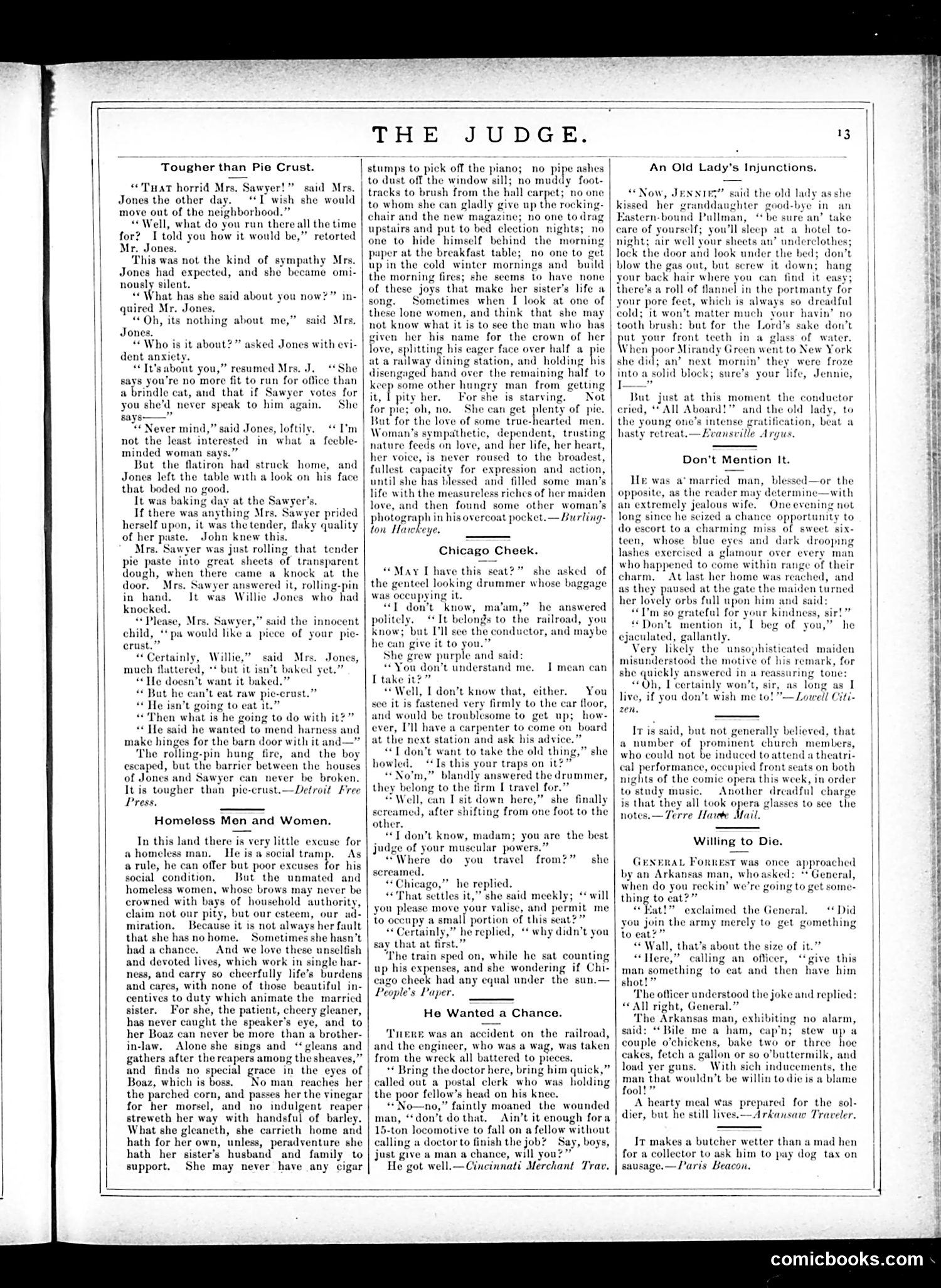
This page contains three humorous short stories from *Judge* magazine, a 19th-century American satirical publication. **"Tougher than Pie Crust"** satirizes petty neighborhood feuds. Mrs. Jones gossips to her husband about Mrs. Sawyer, insulting his political fitness. Jones retaliates by sending his son to humiliate Mrs. Sawyer by asking for her prized pie crust—not to eat, but to use as harness repair material. The joke: the insult is so devastating that the neighborhood barrier becomes "tougher than pie-crust"—permanently broken. **"Homeless Men and Women"** offers social commentary, arguing that unmarried women deserve sympathy because homelessness isn't always their fault, unlike homeless men deemed "social tramps." It uses biblical imagery (the Ruth/Boaz story) to romanticize spinsters' selfless lives. The remaining stories employ similar satirical humor about domestic life and social propriety. The satire reflects Victorian-era anxieties about gender roles, reputation, and community standing.
📄 Transcribed text from this page (OCR, searchable)
Machine-transcribed from the original scan — historical spelling and the odd misread are preserved.
Tougher than Pie Crust. «Tuat horrid Mrs, Sawyer!” said Mrs. Jones the other day. ‘I wish she would move out of the neighborhood.” “Well, what do you run there all the time for? I told you how it would be,” Mr. Jones. ‘This was not the kind of sympathy Mrs. Jones had expected, and she became omi- nously silent. What has she said about you now?” in- quired Mr. Jones, “Oh, its nothing Jones. Who is it about?” dent anxiety. “Tt'sabout you,” resumed Mrs. J. ** She says you're no more fit to run for office than a brindle cat, and that if Sawyer votes for you she’d never speak to him/again. She Bays: about me,” sai asked Jones with evi- ever mind, id Jones, loftily. not the least interested in what a minded woman say But the flatiron had struck home, Jones left the table with a look on his that boded no good. It was baking day at the If there was anything Mrs. Sawyer prided herself upon, it was the tender, flaky quality of her paste. John knew this. Mrs. Sawyer was just rolling that tender pie paste into great sheets of transparent dough, when there came a knock at the “Tm feeble- and face door. | Mrs. Sawyer answered it, rolling-pin in hand, It was Willie Jones who had knock “Pl child, crust.” Sawyer,” said the innocent “pa would like a piece of your pie- nly, Willie,” said much flattered, ** but it isn’t t “He doesn’t want it baked.” But he can’t eat raw pic- rust.” “He isn’t going to eat it.” “Then what is he going to do with it?” “ He said he wanted to mend harness and make hinges for the barn door with it and—” The rolling-pin hung fire, and the boy escaped, but the barrier between the houses of Jones and Sawyer can never be broken. It is tougher than pie-crust.—Detroit Free Press. Mrs. Jones, ked yet.” Homeless Men and Women, In this land there is very little excuse for a homeless man. He is a social tramp. As arule, he can offer but poor excuses for his social condition, But the unmated and homeless women, whose brows may never be crowned with bays of household authority, claim not our pity, but our esteem, our miration. Because it is not always her fault that she has no home. Sometimes she hasn’t had achance. And we love these unselfish and devoted lives, which work in single har- ness, and carry so cheerfully life’s burdens and cares, with none of those beautiful in- centives to duty which animate the married sister. For she, the patient, cheery gleaner, has never ca aught the speaker's eye, “and to her Boaz can never be more than a brother- in-law. Alone she sings and ‘gleans and gathers after the reapers among the sheaves,” and finds no special grace in the eyes of Boaz, which is bo: No man reaches her the parched corn, and passes her the vinegar for her morsel, and no indulgent reaper streweth her way with handsful of barley. What she gleaneth, she carrieth home and hath for her own, unless, peradventure she hath her sister's husband and family to support. She may never have any cigar ”” retorted | THE JUDGE. stumps to pick off the piano; no vipe ashes to dust off the window sill; no muddy foot- tracks to brush from the hall carpet; no one to whom she can gladly give up the rocking chair and the new magazine; no one todrag upstairs and put to bed election nights; no one to hide himself behind the morning puper at the breakfast table; no one to get up in the cold winter mornings and build the morning fires; she seems to have none of these joys that make her sister's life a Sometimes when I look at one of these lone women, and think that she n not know what it is to see the man who has given her his name for the crown of her | love, splitting his eager face over half a pie | at a railway dining station, and holdi Mis disengaged hand over the remaining half to M 'p some other hungry man from getting I pity her. For she is starving. Not fer pie; oh, no. She can get plenty of pi But for the love of some true-hearted men. Woman’s sympathetic, dependent, trusting nature feeds on love, and hee life, her heart, her voice, is never roused to the broadest, fullest capacity for expression and action, until she has blessed and filled some man life with the measure! riches of her maiden love, and then found some other woman's photograph in hisovere pocket.—Burling- ton Hawkeye. Chicago Cheek. “May [have this seat?” she asked of the genteel looking drummer whose baggaze was occupying it. “T don’t know, ma’am,” he answered politely, “It belongs to the railroad, you know; but I'll see the conductor, and maybe he can give it to you.” She grew purple and said: “You don’t understand me. I take it?” “Well, I don’t know that, either. You see it is fastened very firmly to the car floor, and would be troublesome to get up; how- ever, I'll have a carpenter to come on board at the next station and ask his ad vic *T don’t want to take the old thin, howled. ‘*Is this your traps on it?” No’m,” blandly answered the drummer, they belong to the firm I travel for.” “Well, can I git down here,” she finally screamed, after shifting from one foot to the other. “TF don't know, madam; you are the best judge of your muscular powers.” Where do you travel from?” screamed. “Chicago,” he replied. ‘That settles it,” she said meekly; ‘* will you please move your valise, and permit me | to oceupy a small portion of this seat?” * Certainly,” he replied, ‘ why didn’t you say that at first.” "Ihe train sped on, while he sat counting up his expenses, and she wondering if Chi- o cheek had any equal under the sun.— People's Paper. song. I mean can she she He Wanted a Chance. ‘Trtene was an accident on the railroad, and the engineer, who was a wag, was taken | from the wreck all battered to pieces. ** Bring the doctor here, bring him quick,” called out a pos al clerk who was holding the poor fellow’s head on his knee. **No—no,” faintly moaned the wounded man, “don’t do that. | | | | | Ain’t it enough fora | 15-ton locomotive to fall on a fellow without | calling a doctor to finish the job? Say, boys, just give a man a chance, will you He got well.—Cincinnati Merchant Trav. >in An Old Lady's Injunctions. “Now, JF kissed her said the old lady as she nddaughter good-bye in an astern-bound Pullman, ‘ be sure an’ take re of yourself; you'll slee a hotel to- night; air well your sheets an’ underclothes; lock the door and look under the bed; don’t blow the gas out, but screw it down; hang your back hair where you can find it easy; there’s a roll of flannel in the portmanty for your pore fect, which is always so dreadful cold; it won't matter much your havin’ no tooth brush: but for the Lord’s sake don’t pn your front teeth in a glass of water. When poor Mirandy Green went to New York she did; an’ next mornin’ they were froze into a solid block; sure’s your ‘life, Jennie, Lo But just at this moment the conductor eried, ** All Aboard!”” and the old lady, to the young one’s intense gratification, t a hasty retreat.— Evansville Argus. Don't Mention It. Ile was a‘ married man, blessed—or the opposite, as the reader may determine—wit an extremely jealous wife. Oneevening not long since he seized a chance opportunity to do escort toa charming miss of sweet six- teen, whose blue eyes and dark drooping lashes exercised a glamour over every man who happened to come within range of their charm, At last her home was reached, and s they paused at the gate the maiden turned her lovely orbs full upon him and si “T'm so grateful for your kindness, sir!” “Don't mention it, I beg of you,” he ejaculated, gallantly. Very likely the unsophisticated maiden misunderstood the motive of his remark, for she quickly answered in a reassuring tone “Oh, [certainly won’t, sir, as long as I live, if you don’t wish me to! *— Lovell Citi- zen. Iv is 1, but not generally believed, that a number of prominent church members, who could not be induced to attend a theatri- al performance, occupied front seats on both hts of the comic opera this week, in order to study music. Another dreadful charg is that they all took opera glasses to see the notes.— Terre Harte Mail. Willing to Die. GENERAL Fornest was one yan Ar man, whoasked when do you reckin’ thing to eat?” “Hat!” exclaimed the General. you join the army merely to to eat?” “Wall, that’s about the size of it.” “Here,” callin: officer, “give man something to eat and then have shot!” ‘The officer understood the joke and re “All right, General.” The Arkansas man, exhibiting no alarm, said: “Bile me a Yn; stew up a couple o’chickens, bake two or three hoe cakes, fetch a gallon or so o’buttermilk, and load yer guns. With sich inducements, the man that wouldn’t be willin to die is a blame fool!” A hearty meal was prepared for the sol- dier, but he still lives. —Arkansaw Traveler. approached General, we're going to get some- “Di et. gomething this him Ir makes a butcher wetter than a mad hen for a collector to ask him to pay dog tax on sausage.—Paris Beacon. comicbooks.com ' |