
A complete issue · 16 pages · 1884
Judge — May 24, 1884
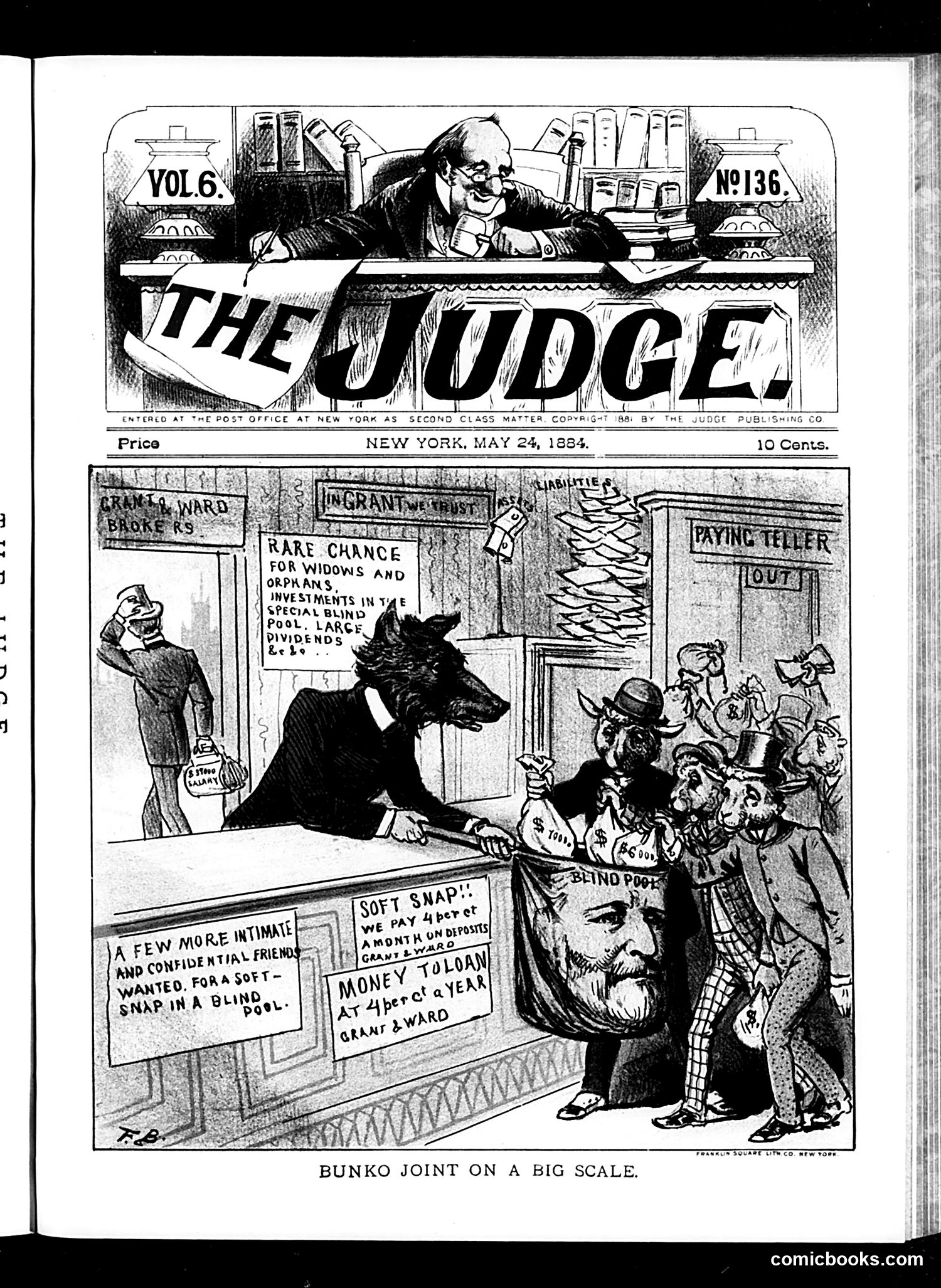
This 1894 *Judge* cartoon satirizes financial fraud schemes targeting vulnerable people. The central figure—a man with wolf-like features wearing formal attire—represents a con artist operating a fake investment operation. The storefront advertises various scams: "soft snap" loans at exploitative rates, investment schemes promising dividends for widows and orphans, and money-lending at 4½ percent yearly (labeled "Grant 2 Ward," likely referencing a notorious 1880s fraud). A line of desperate people—some appearing impoverished—queue outside, clutching money bags marked with dollar signs. The title "Bunko Joint" (slang for a confidence game operation) suggests this depicts organized fraud victimizing the economically desperate, particularly women and the elderly. The cartoon criticizes widespread financial predation during the Gilded Age.
This article critiques General Ulysses S. Grant's catastrophic involvement in the 1884 financial collapse of Grant & Ward, a Wall Street banking firm. The piece expresses bewilderment that a celebrated military hero and former president—already wealthy from public gratitude—would risk his reputation through speculative finance. The satire targets the "insensate craze" of speculation endemic to Gilded Age finance. The author argues Grant was seduced by the obsession with rapid wealth accumulation that drove men like Gould and Vanderbilt, ultimately ruining countless homes, causing suicides, and filling prisons. The editorial questions what additional wealth could possibly gain a man already honored beyond measure, portraying speculation as spiritually corrosive rather than beneficial. The real villain, implicitly, is the speculative financial system itself—the fact that someone of Grant's stature could be destroyed by it.
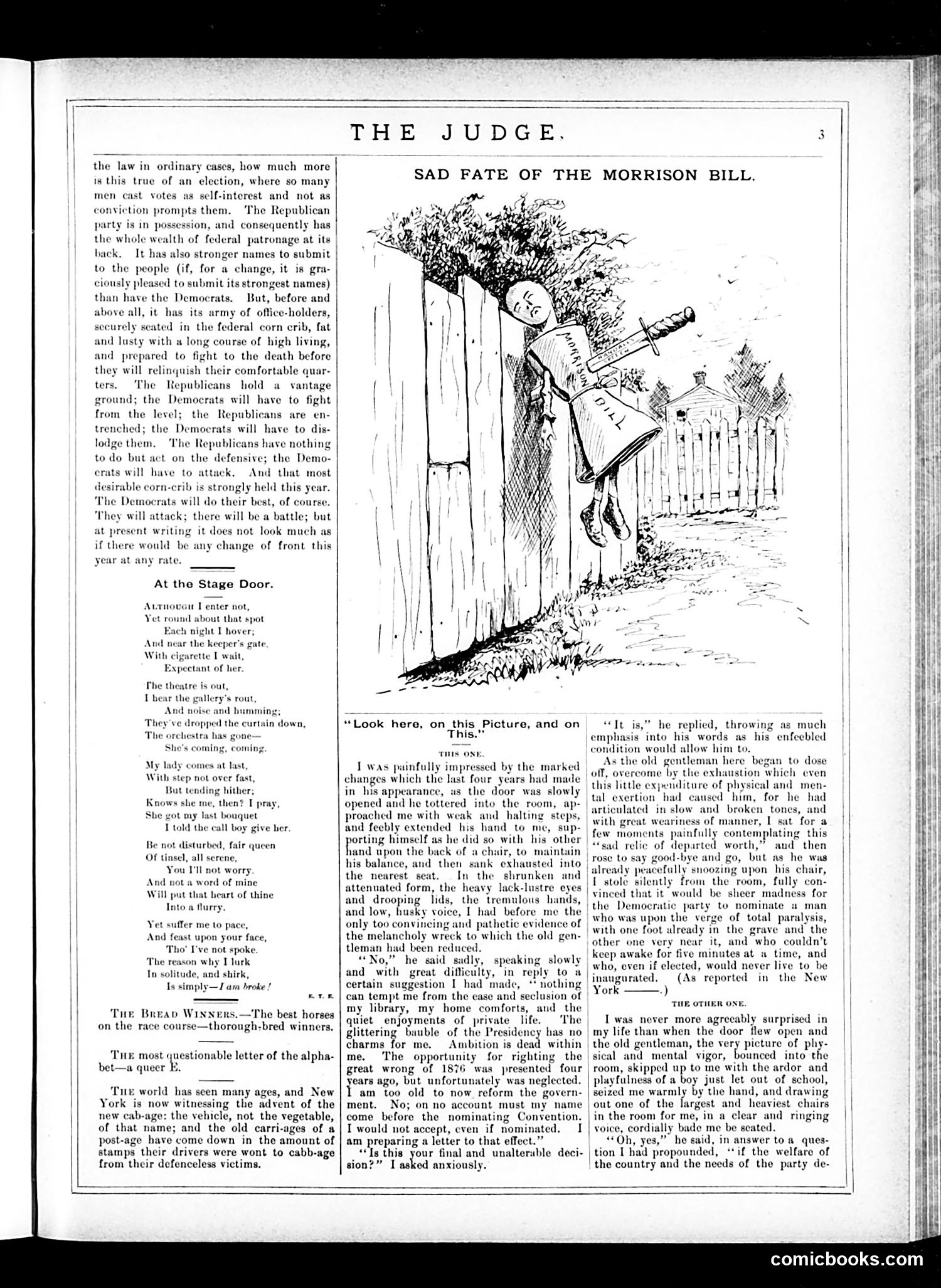
This page contains political satire from the 1880s addressing the **Morrison Bill** (likely the 1884 tariff measure). The main cartoon depicts a skeletal, decrepit figure hanging from a gallows-like structure labeled "the Morrison Bill," showing the legislation as dead or dying. The accompanying text features a conversation where an old gentleman—appears to be a Democratic politician—explains he's been destroyed by political defeat and won't seek office again. He references "the great wrong of 1876" (the disputed Hayes-Tilden election), explaining his broken health and lost ambition. The satire mocks Democratic weakness and the party's inability to achieve policy goals. Republicans controlled federal patronage and resources; Democrats faced constant defeat. The Morrison Bill's "sad fate" symbolizes Democratic legislative failures during Republican dominance. The page's other content includes light verse and minor jokes unrelated to the political cartoon.
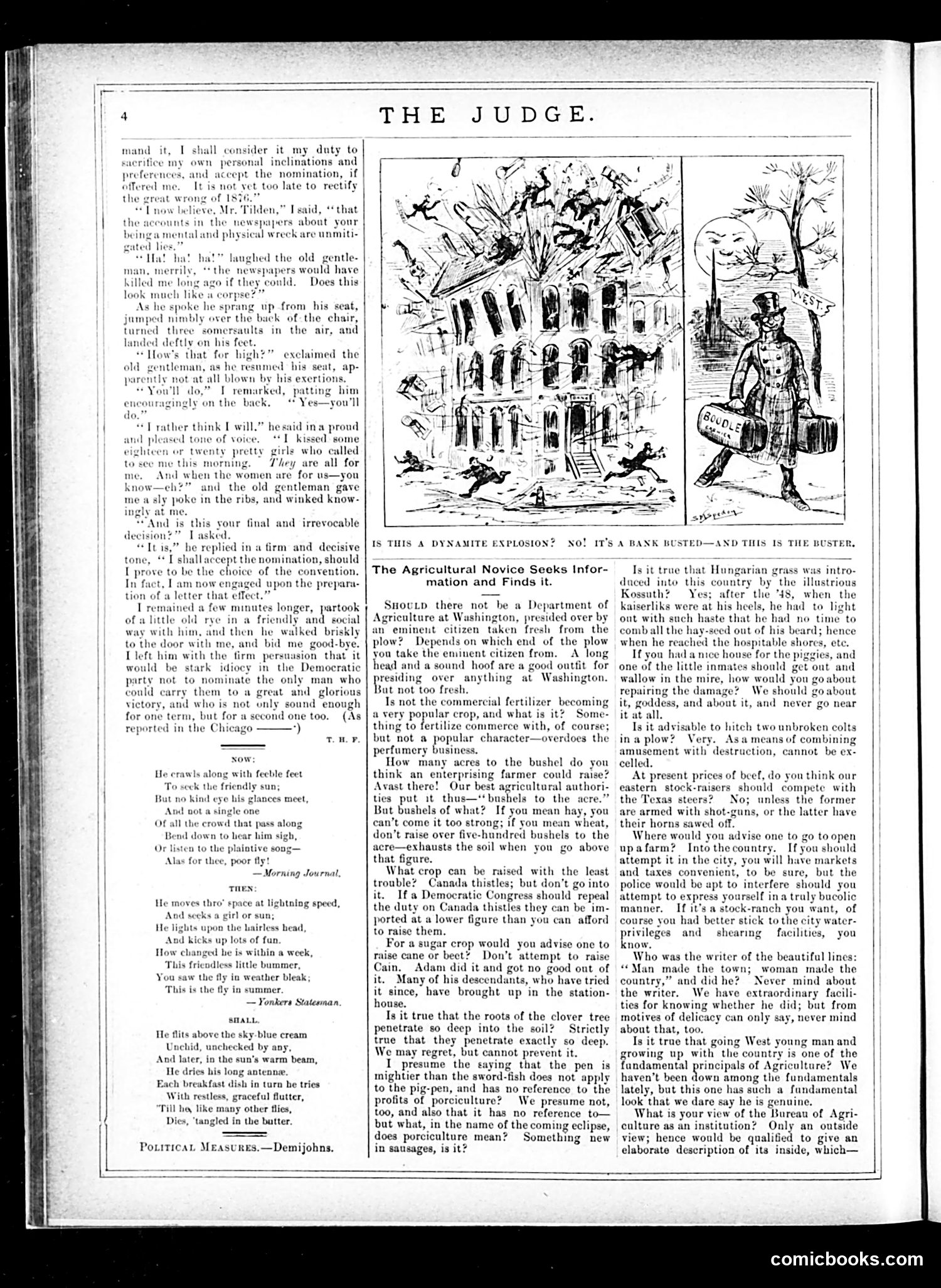
This Judge magazine page contains satirical commentary on 1870s American politics and agriculture. **Political Content:** The left column discusses Samuel Tilden, the 1876 Democratic presidential candidate who lost the contested election to Rutherford B. Hayes. The satire mocks Tilden's alleged physical frailty while he claims vigor—performing acrobatics to prove his fitness for office. This references contemporary debate about whether Tilden should run again in a future election. **The Cartoons:** The two illustrations appear to show a building explosion (labeled "Is This a Dynamite Explosion? No! It's a Bank Busted") and a well-dressed man, likely representing a banker or financial figure. This references late-19th-century anxieties about bank failures and financial instability. **Agricultural Satire:** The right section humorously addresses farming advice, mocking earnest questions about crop yields and fertilizers with absurdist answers—typical Judge style ridicule of agricultural ignorance among city readers. The page exemplifies Judge's approach: political commentary wrapped in humor targeting both politicians and urban audiences unfamiliar with rural life.
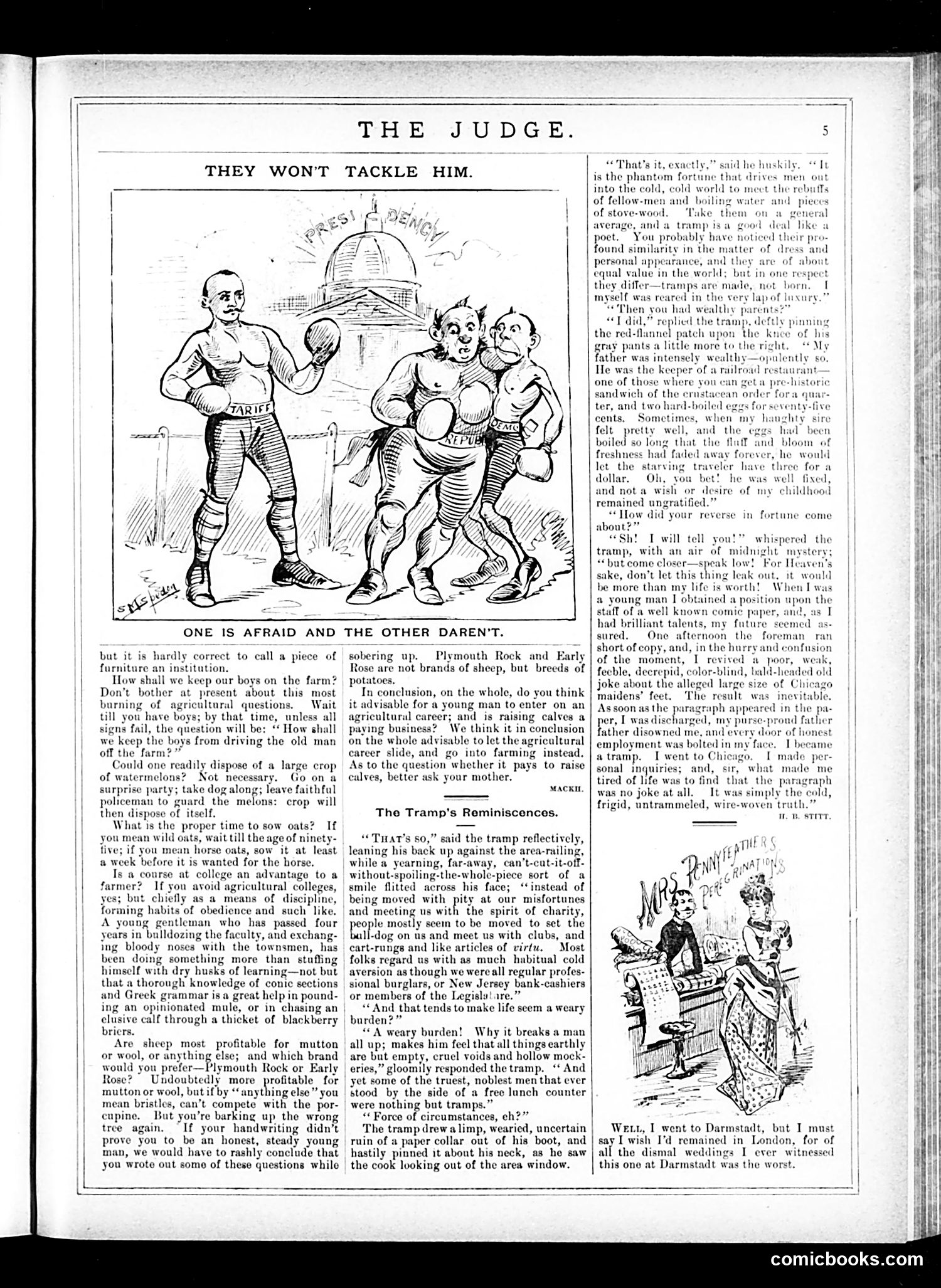
## The Main Cartoon: "They Won't Tackle Him" The large illustration shows a muscular boxer labeled "TARIFF" confronting two smaller, cautious figures. The satire critiques political cowardice regarding tariff policy—neither politician wants to directly challenge or reform the tariff issue because it's politically dangerous. One figure is "afraid and the other daren't," meaning they lack either courage or political will to tackle this powerful economic policy. ## The Text Content The page also contains satirical advice columns mocking agricultural questions and "The Tramp's Reminiscences," a sympathetic portrayal of vagrant life that critiques society's harsh treatment of homeless people. The tramp reflects bitterly on how society shows more charity to criminals than to the destitute. ## Historical Context This reflects late-19th-century American debates over protective tariffs—a heated political issue where both parties hesitated to propose major reforms despite acknowledged problems.
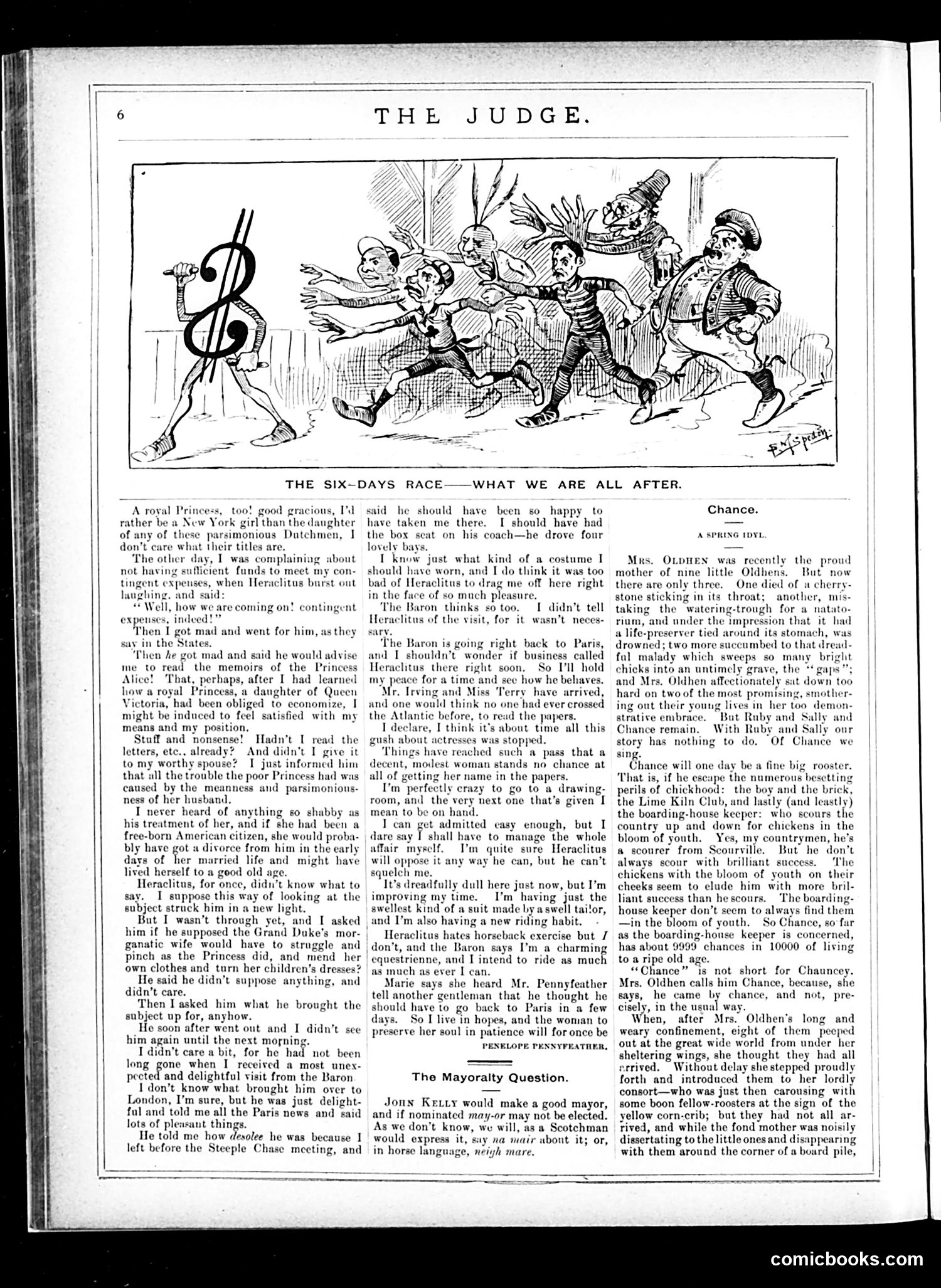
This cartoon satirizes the **Six-Day Bicycle Race**, a popular sporting spectacle of the 1890s. The image shows figures chasing a dollar sign ($), depicting how participants and spectators pursue the event's financial rewards and glamorous prizes. The accompanying text is a gossipy society column featuring a wealthy American woman complaining about her husband Heraclitus's stinginess while boasting about attention from a visiting French Baron. The satire mocks both the shallow materialism of the leisure class and the narrator's obliviousness to her own absurd contradictions—she simultaneously resents her constrained finances while planning expensive new riding habits and social conquests. The overall message: everyone—from working athletes to idle aristocrats—chases money and status. The "six-days race" becomes a metaphor for modern life's exhausting, undignified pursuit of wealth.
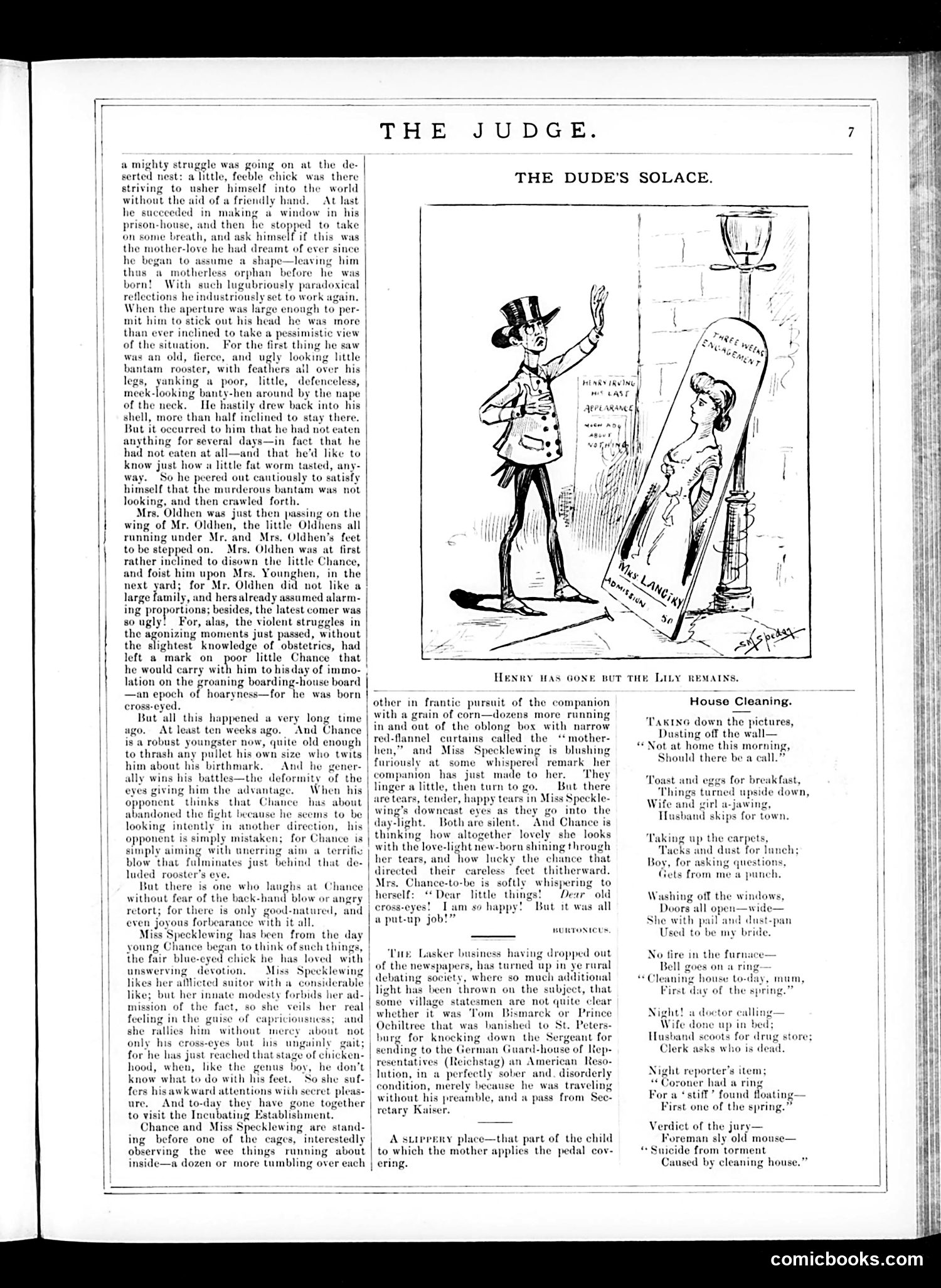
This cartoon satirizes a fashionable gentleman (a "dude") seeking refuge from modern life's complications. The figure, dressed in top hat and formal attire, appears to be escaping into theatrical entertainment—the caption references "Henry Irving's last appearance," alluding to the famous English actor. The cartoon mocks the genteel class's tendency to use high culture and theater as an escape from reality's messier concerns. The dude is depicted almost hiding within or clinging to the theatrical placard, suggesting he's retreating into artifice rather than confronting actual life. The accompanying story about chickens—with a cross-eyed rooster named "Chance" overcoming hardship—appears to offer implicit contrast: genuine life involves struggle and adaptation, not theatrical escapism. The satire targets urban sophistication and dandyism as forms of cowardice or avoidance.
This page from *Judge* magazine presents a satirical cartoon titled "THE JUDGE" (visible on the left margin). The image appears to depict a courtroom or judicial scene shown from an unusual rotated perspective. Multiple figures are present, including what appears to be a judge at a elevated position and other characters arranged around a room with furniture and architectural elements. The cartoon likely satirizes judicial proceedings or legal authority, though the specific political figures and context aren't clearly identifiable from the image alone. The exaggerated perspective and caricatured figures are typical of *Judge*'s style in mocking institutions and public figures. Without clearer identification of the specific individuals depicted or accompanying article text, the exact target of satire remains unclear, though it appears to critique some aspect of the American legal system or a particular court case of the era.
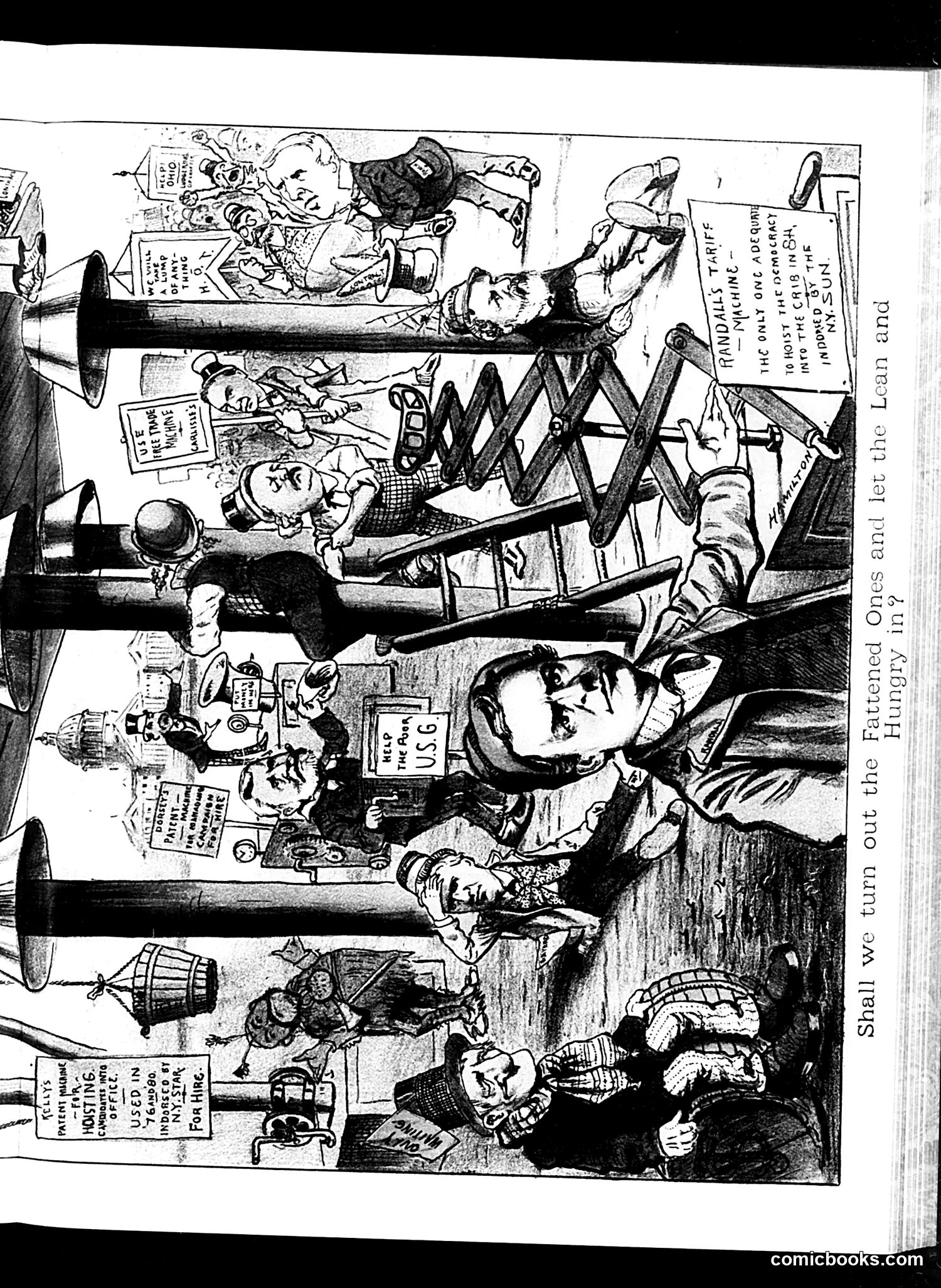
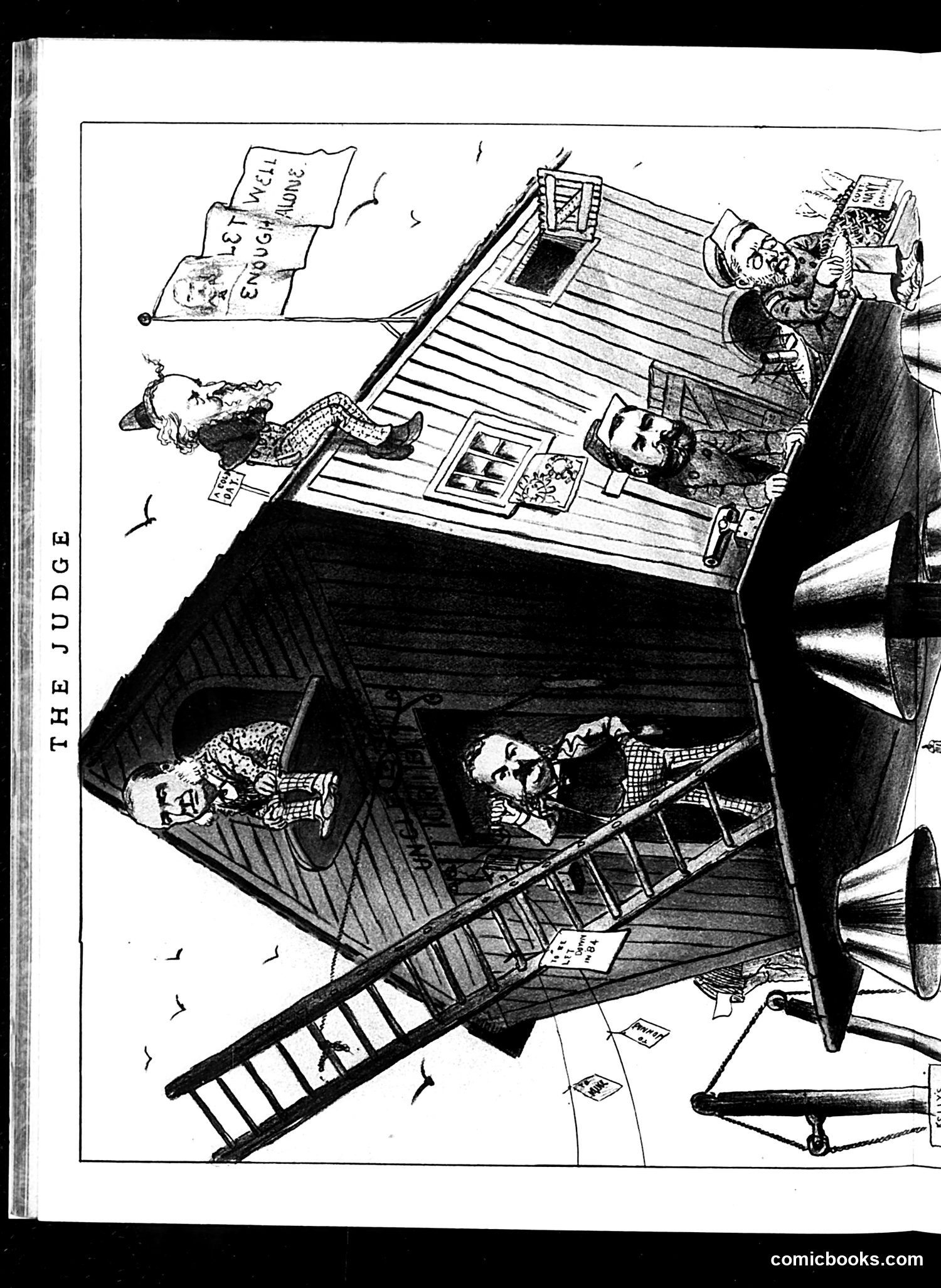
I can see this is a political cartoon from Judge magazine, but the OCR text is too corrupted to read clearly, making it difficult to identify specific figures or references with confidence. From the IMAGE alone, I can observe: multiple caricatured figures arranged vertically, large megaphones or horns suggesting loud speech/propaganda, various labels on small signs (though illegible in this reproduction), and what appears to be a hierarchical or stacked composition emphasizing amplification of messages. The caption at right reads "Shall we turn out the Fraternal Opus and let Leon and..." but trails off incompletely. Without legible text labels identifying the figures or a readable date, I cannot reliably explain which political figures or events this satirizes. To properly interpret this cartoon, clearer source material would be needed.
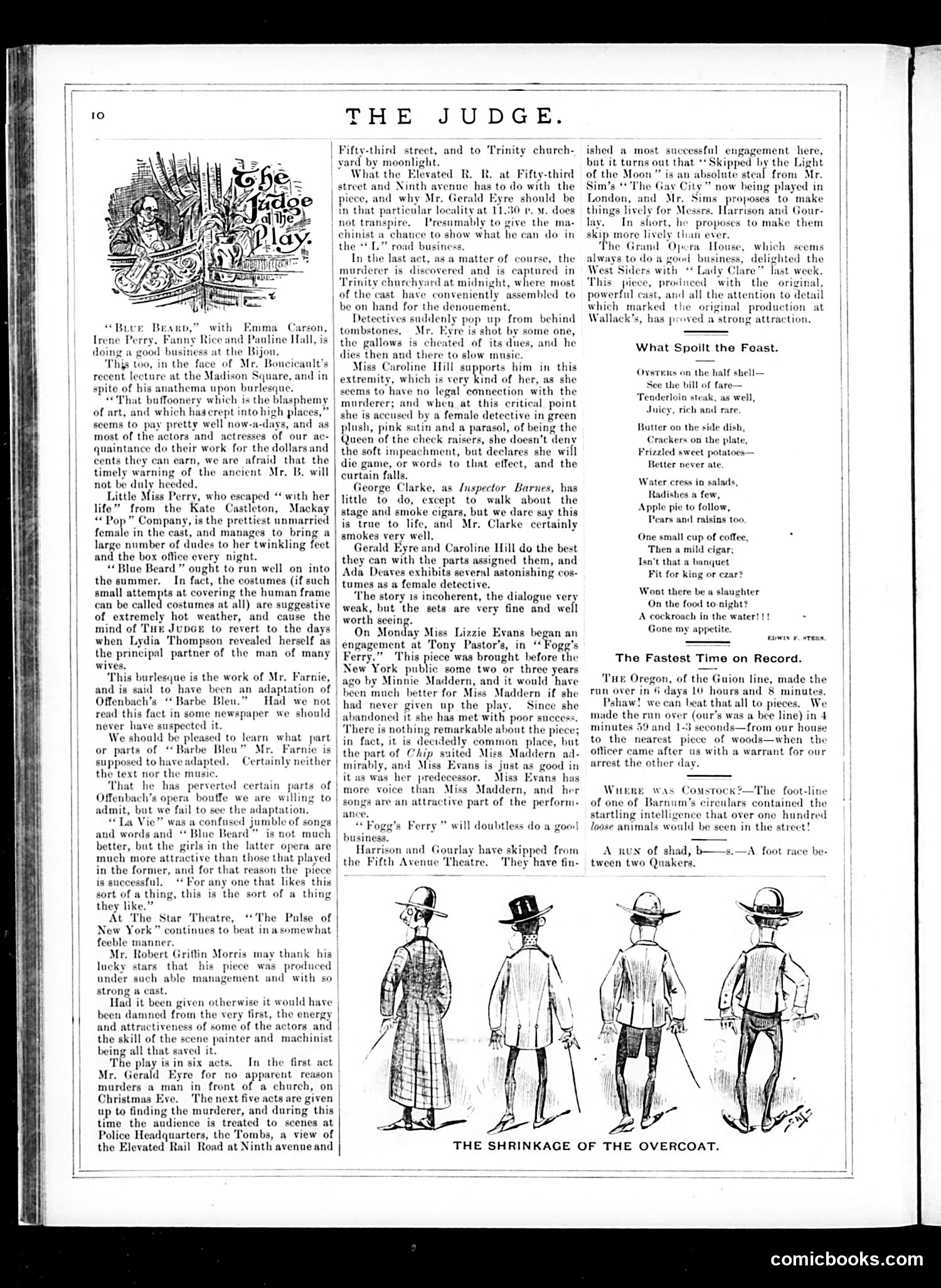
This page reviews several theatrical productions from 1880s New York. The main cartoon, titled "The Shrinkage of the Overcoat," depicts four figures showing progressive shrinkage of winter clothing—likely satirizing either poor tailoring, clothing fraud, or the comical disparity between how garments fit in different seasons or after washing. The text reviews burlesques and melodramas, including "Blue Beard" at the Bijou and "The Pulse of New York" at the Star Theatre. The critic dismisses these as lowbrow entertainment yet acknowledges their financial success despite moral objections. References to police headquarters, the Tombs (a prison), and the Elevated Railroad suggest melodramatic plots relying on sensational scenery rather than coherent storytelling. The page exemplifies Judge's satirical stance: mocking popular entertainments while recognizing their commercial appeal to audiences indifferent to artistic merit.
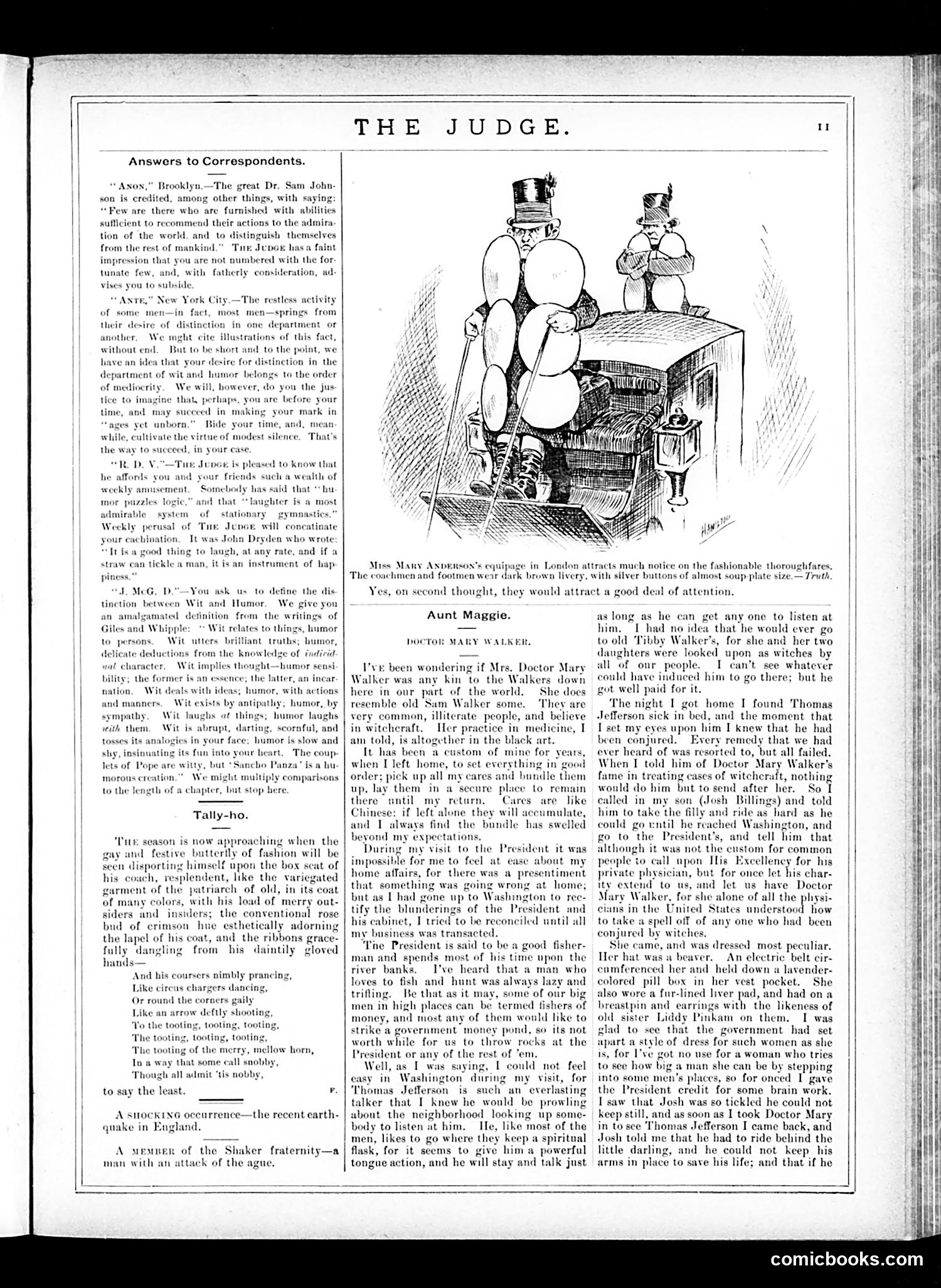
This page from the satirical magazine *Judge* contains three main elements: **The Cartoon:** The illustration shows a portly man in formal dress sitting atop a large cabinet or dresser, depicted in an exaggerated, undignified pose. A woman stands nearby observing. The caption references "Miss Mary Anderson's equipage in London" and fashionable women's attire, suggesting the humor targets Victorian fashion and social pretension. **"Aunt Maggie" Column:** The text discusses Doctor Mary Walker, a real historical figure known for wearing men's clothing and practicing medicine unconventionally. The correspondent from Boston compares Walker unfavorably to local "Walkers," calling her practice "black art" (witchcraft). This satirizes public skepticism toward female physicians and unconventional women. **"Answers to Correspondents":** The magazine responds to reader letters about wit versus humor, ambition, and social conduct—typical advice-column fare with gentle mockery of human nature. The page satirizes Victorian social anxieties: fashion excess, female independence (particularly in medicine), and middle-class pretension.
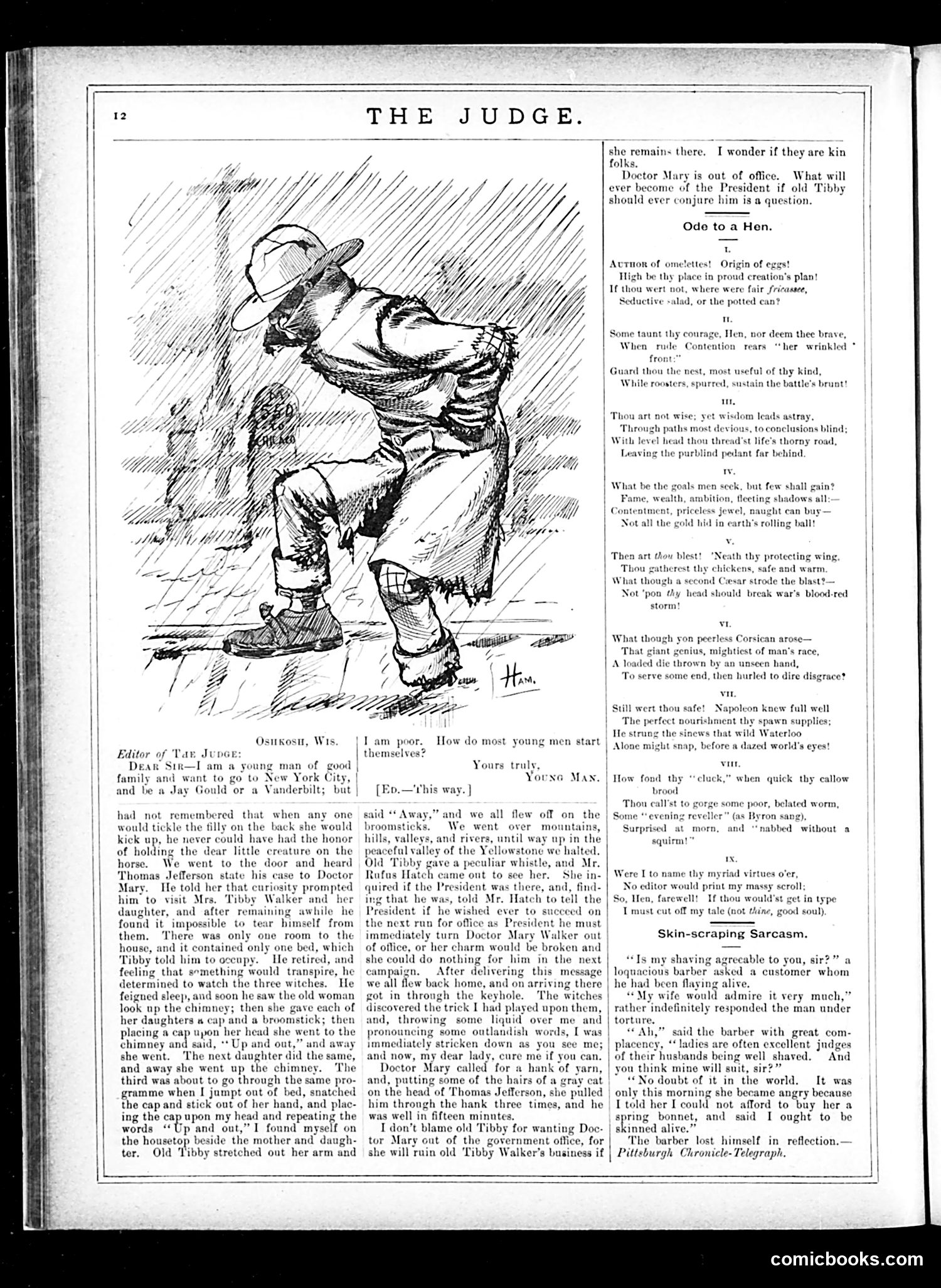
This page from *Judge* magazine contains two distinct pieces: **Main Cartoon/Letter**: A humorous tall tale mocking spiritualism and women in politics. A young man writes about visiting "three witches" (including "Doctor Mary Walker"—likely referencing the real Dr. Mary Walker, a Civil War surgeon and women's rights advocate). The narrative ridicules belief in witchcraft while satirizing Walker's political influence, suggesting she has magical power over the President. The joke attacks both supernatural superstition and female political involvement, implying Walker's presence in government is absurd and dangerous. **"Ode to a Hen"**: A mock-heroic poem praising chickens in exaggerated language, likely satirizing overwrought Victorian poetry. It humorously elevates poultry to noble status while subtly reinforcing traditional female domestic roles (egg production, nest-tending). Both pieces reflect late-19th-century anxieties about women gaining professional authority and influence.
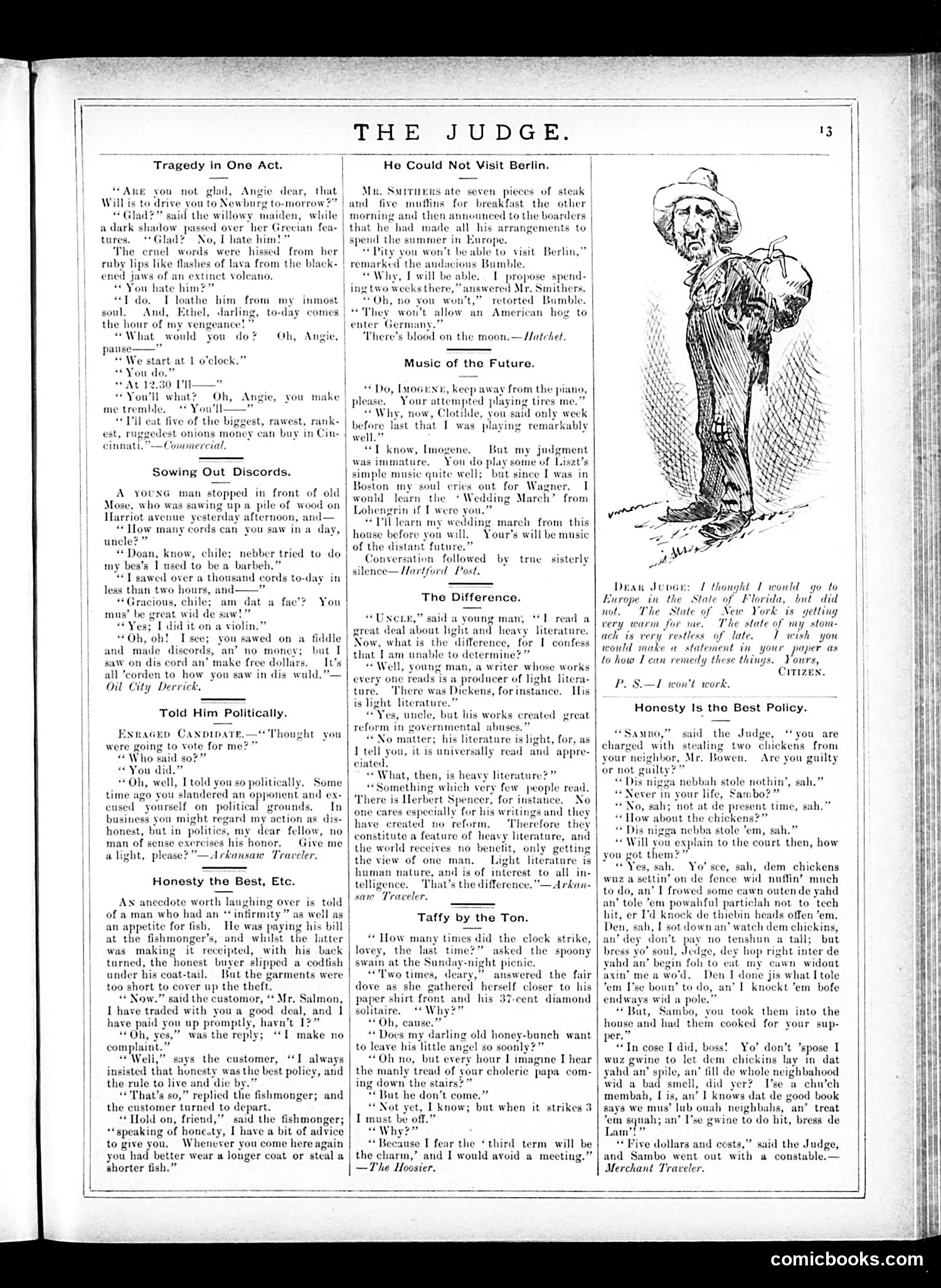
This page from the satirical magazine *Judge* contains multiple short humorous pieces mocking various social types and behaviors: **"Tragedy in One Act"** parodies melodramatic theater by having a woman threaten revenge through eating onions—deflating dramatic tension with absurdity. **"Sowing Out Discords"** uses racial dialect humor (common in period publications) to joke about a Black man claiming to have "sawed" musical discords on a violin rather than wood, playing on the double meaning of "saw." **"Told Him Politically"** satirizes political corruption, showing a candidate justifying slander by claiming political "standards" differ from business ethics. **"Honesty the Best, Etc"** uses a fish-theft anecdote to mock hypocrisy about honesty. **"He Could Not Visit Berlin"** contains ethnic insult humor, with "Bumble" claiming America won't allow an "American hog" into Germany—calling Smithers a pig. The illustration appears to show a grizzled, roughly-dressed man, likely accompanying one of these rural/working-class comedic sketches. These pieces reflect period conventions of satirizing immigrants, racial caricature, and political incompetence through exaggerated dialect and stereotypes.
This page from *Judge*, a satirical magazine, contains several brief humorous anecdotes and social commentary rather than political cartoons. **Key content includes:** - **"In a Garden"**: A poem mocking lazy husbands avoiding gardening while wives read novels and shoo chickens—poking fun at gender roles and domestic leisure. - **"A Sportsman Who Loved His Dog"**: Dark satire where a sportsman is upset his hunting dog's tail feathers were burned rescuing a child from fire—absurdly prioritizing the dog's appearance over the child's life. - **"Leap-Year"**: A woman (Mabel) flirts with a man by claiming she can't follow the golden rule because she's "not tall enough to reach"—likely mocking the Leap Year tradition where women proposed to men. - **"How Johnny's Father Got in Trouble"**: A child innocently reveals his doctor father had a "skeleton in his closet" (hidden shame), triggering the wife's anger—wordplay on the Victorian idiom. The remaining items are newspaper clippings and advertisements. Overall, this represents typical late 19th-century genteel humor focused on domestic situations and wordplay.
This is primarily an **advertising page** from Judge magazine, with minimal editorial cartoon content. The page consists almost entirely of commercial advertisements for various products and services typical of late 19th-century America: breweries, pianos, patent medicines (Hires Root Beer, Catarrh remedies), lithography services, and insurance. The only substantive editorial content appears as brief **humorous snippets** scattered among ads—short satirical observations about contemporary life: - A quip about retired "battle" becoming obsolete language - A joke about barbers' mirrors showing customers how they look while being "talked to death" - Commentary on dukes disguising themselves as tramps versus tramps posing as dukes - A sardonic note about a motion thanking a dead citizen passing unanimously These snippets mock Victorian social pretenses and American optimism. However, **no specific political figures or events are identifiable** from the visible material. The page primarily showcases Judge's function as a revenue-generating advertising vehicle rather than hard-hitting satire.
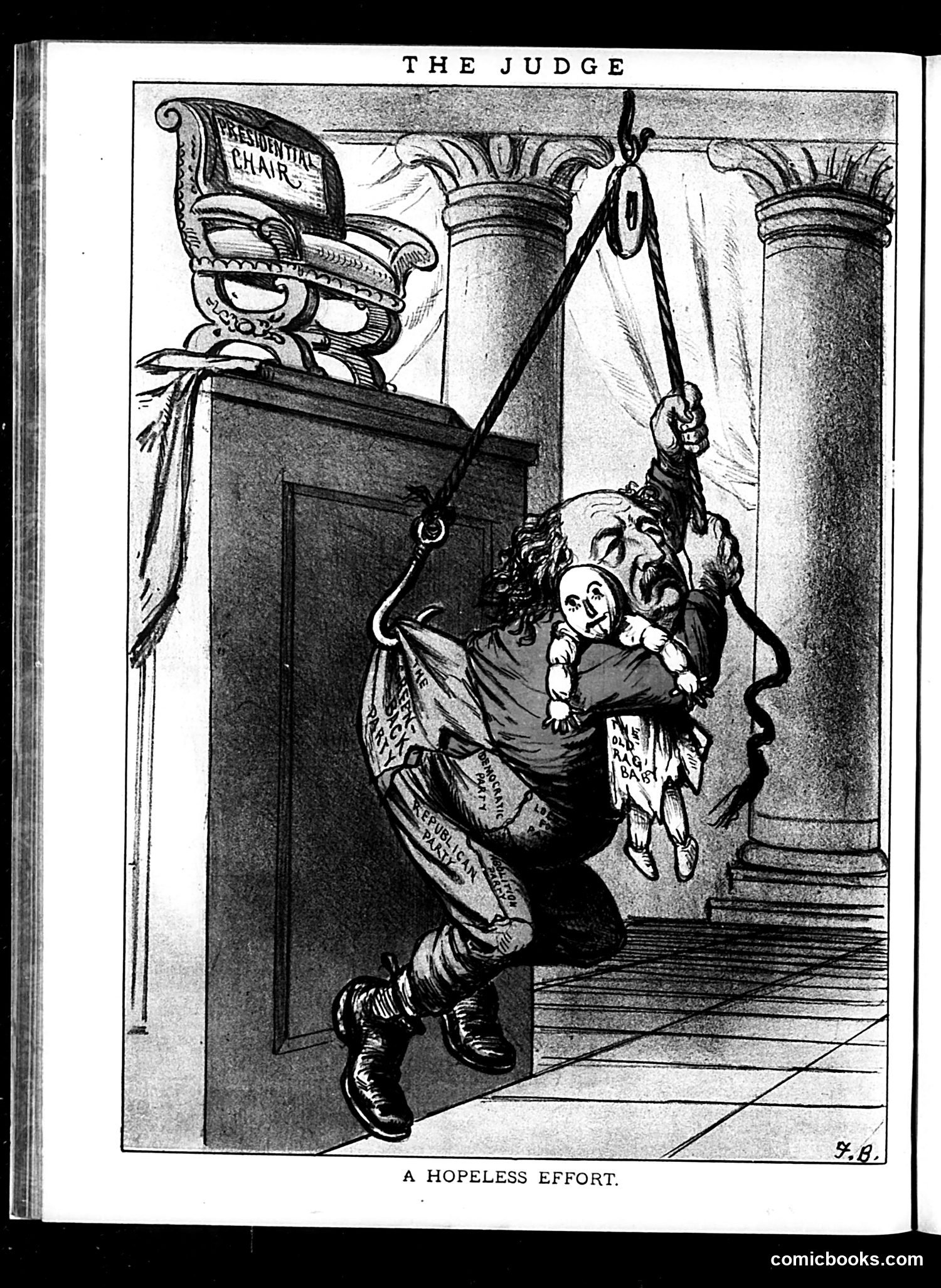
This political cartoon from *Judge* magazine depicts a figure labeled "IMPERIALISM CHAIRS" (visible on the ornate chair at top left) attempting to lift a child using a pulley system. The figure appears to be struggling futilely—hence "A Hopeless Effort." The satire critiques imperialist ambitions as fundamentally futile or doomed. The elaborate classical architectural setting (columns, formal furniture) suggests grandeur and institutional power, yet the mechanical contraption fails to accomplish its goal. The child likely represents a colonized people or territory the imperial power seeks to control. The cartoon suggests that despite sophisticated systems and institutional authority, imperial expansion is an inherently failing enterprise. This reflects anti-imperialist sentiment common in late 19th/early 20th-century American political discourse.