
Judge, 1884-05-24 · page 3 of 16
Judge — May 24, 1884 — page 3: what you’re looking at
What you’re looking at
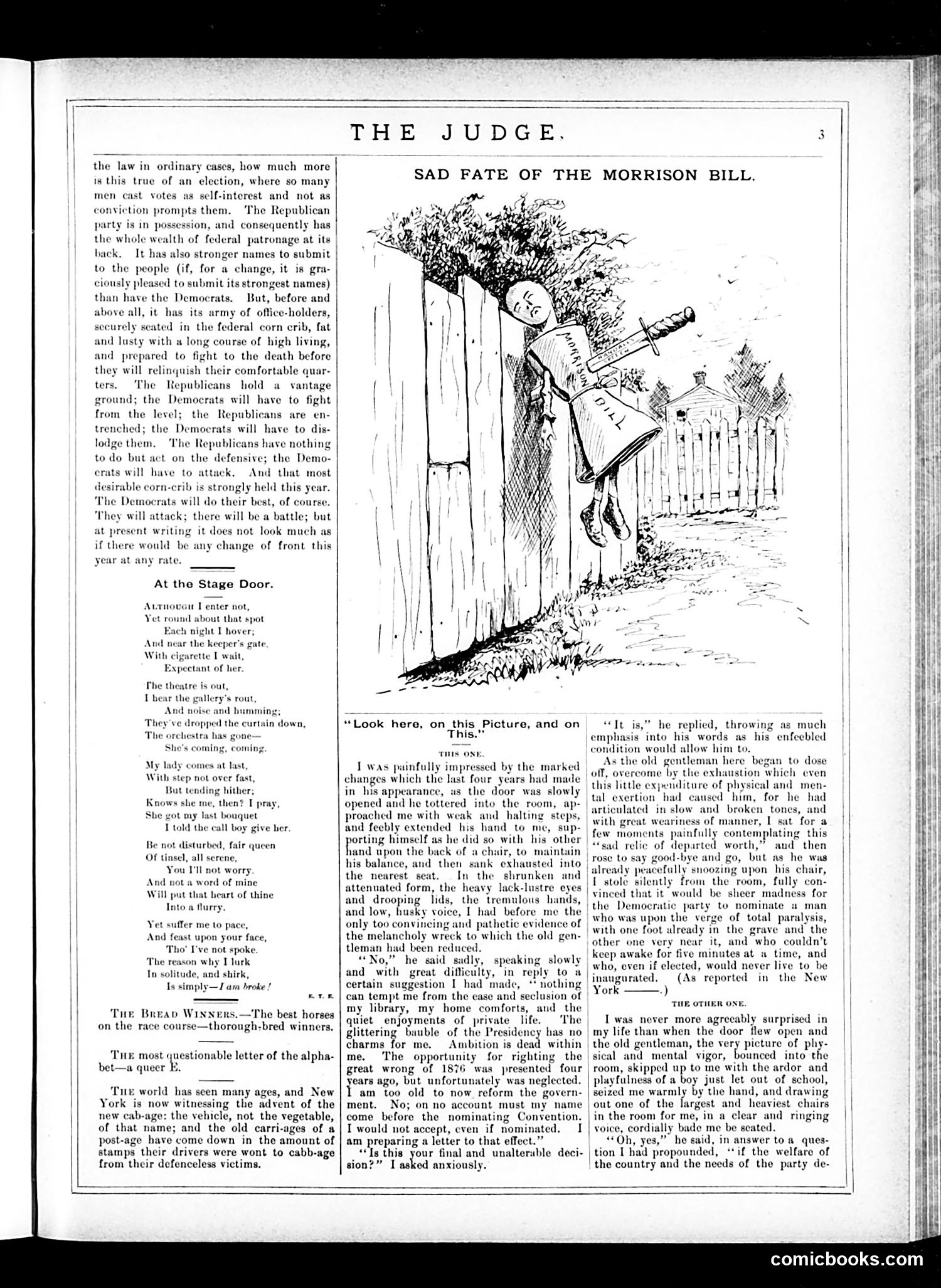
This page contains political satire from the 1880s addressing the **Morrison Bill** (likely the 1884 tariff measure). The main cartoon depicts a skeletal, decrepit figure hanging from a gallows-like structure labeled "the Morrison Bill," showing the legislation as dead or dying. The accompanying text features a conversation where an old gentleman—appears to be a Democratic politician—explains he's been destroyed by political defeat and won't seek office again. He references "the great wrong of 1876" (the disputed Hayes-Tilden election), explaining his broken health and lost ambition. The satire mocks Democratic weakness and the party's inability to achieve policy goals. Republicans controlled federal patronage and resources; Democrats faced constant defeat. The Morrison Bill's "sad fate" symbolizes Democratic legislative failures during Republican dominance. The page's other content includes light verse and minor jokes unrelated to the political cartoon.
📄 Transcribed text from this page (OCR, searchable)
Machine-transcribed from the original scan — historical spelling and the odd misread are preserved.
the law in ordinary cases, how much more is this true of an election, where so many men cast votes as self-interest and not as conviction prompts them. ‘The Republican party is in possession, and consequently has the whole wealth of federal patronage at its back. to the people (if, for ciously pleased to submit its strongest names) than But, before and above all, it has its army of office-holders, ly seated in the federal corn crib, fat id lusty with # long course of high living, change, it is gra- e the Democrats, and prepared to fight to the death before | they will relinquish their comfortable quar- ters. ‘The Republic ground; the Democrats will ha from the level; the Republic trenched; the Democrats will lodge them. vantage to fight are en- © to dis- ‘The Republicans have nothing todo but act on the defensive; the Demo- crats will have to attack, And that most able corn-criby is strongly held this year. will do their best, of course. ‘They will attack; there will be a battle; but at present writing it does not look much as if there would be any change of front this at any rate. At the Stage Door. at Tenter not, about that spot Aut 1 night I hover; And near the keeper's gate arette I wait, pectant of her. The theatre is out, I bear the allery’s rout, nd humming; They've dropped the curtain down ‘The orchestra has gone: She's com| nin My lady comes at last, M } step not over fast, But tending hit Knows she me, then Shi T pray, ot my last bouquet I told the call boy give ber Be not disturbed, Of tinsel, all serene, You Il not wor And not a word of mine Will put that heart of thine Into a flurry. ir queen Yet suffer me to pace, And f st upon your fai “ve not spoke, ‘The reason why I lurk In solitude, and shirk, Is simply—J ain broke! nee Tue NNERS.—The best horses on the race course—thorongh-bred winners. ‘THe most questionable letter of the alpha- bet—a queer E. ‘Tux world has seen many ages, and New York is now witnessing the advent of the new cab-age: the vehicle, not the vegetable, of that name; and the old carri-ages of a post-age have come down in the amount of stamps their drivers were wont to cabb-age from their defenceless victims. It has also stronger names to submit THE JUDGE. SAD FATE OF THE MORRISON BILL. “Look here, on this Picture, and on This.” I was painfully impressed by the marked changes which the last four years had made in his appearance, us the door was slowly opened and he tottered into the room, ap- proached me with weak and halting steps, and fecbly extended his hand to me, sup- porting himself as he did so with his other hand upon the back of a chair, to: maintain his balance, and then sank exhausted into the nearest seat. In the shrunken and attenuated form, the heavy lack-lustre eyes and drooping lids, the tremulous hand and low, husky voice, I had before me the only too convincing and pathet idence of the melancholy wreck to which the old gen- tleman had been reduced. “No,” he said sadly, speaking slowly and with great difficulty, in reply to a certain suggestion I had made, ‘* nothing can tempt me from the ease and seclusion of my library, my home comforts, and the quiet enjoyments of private life ‘The glittering bauble of the Presidency has no charms for me. Ambition is dead within me. The opportunity for righting the great wrong of 1876 was presented four years ago, but unfortunately was neglected. 1 am too old to now reform the govern- ment. No; on no account must my name come before the nominating Convention. I would not accept, even if nominated. I am preparing a letter to that effec! “Ts this your final and unalte: sion?” I asked anxiously. ble deci- “Tt is,” he replied, throwing as much emphasis into his words as his’ enfeebled condition would allow him to. As the old gentleman here began to dose off, overeome by the exhaustion which even this little expenditure of physical and men- exertion had caused him, for he had articulated in slow and broken tones, and with great weariness of manner, L sat for a few moments painfully contemplating this ad relic of departed worth,” and then rose to say good-bye and go, but as he was already peacefully snoozing upon his chair, I stole silently from the room, fully con- vinced that it would be sheer madness for the Democratic party to nominate a man who was upon the verge of total paralysis, with one foot already in the grave and’ the other one very near it, and who couldn’t keep awake for five minutes at a time, and who, even if elected, would never live to be inaugurated. (As reported in the New York THE OTHER ONE. Iwas never more agreeably surprised in my life than when the door flew open and the old gentleman, the very picture of phy- sical and mental vigor, bounced into the room, skipped up to me with the ardor and playfulness of a boy just let out of school, seized me warmly by the hand, and drawing out one of the largest and heaviest chairs in the room for me, in a clear and ringing voice, cordially bade me be seated. “Oh, yes,” he said, in answer to a ques- tion I had propounded, “if the welfare of the country and the needs of the party de- comicbooks.com