
Judge, 1884-05-24 · page 2 of 16
Judge — May 24, 1884 — page 2: what you’re looking at
What you’re looking at
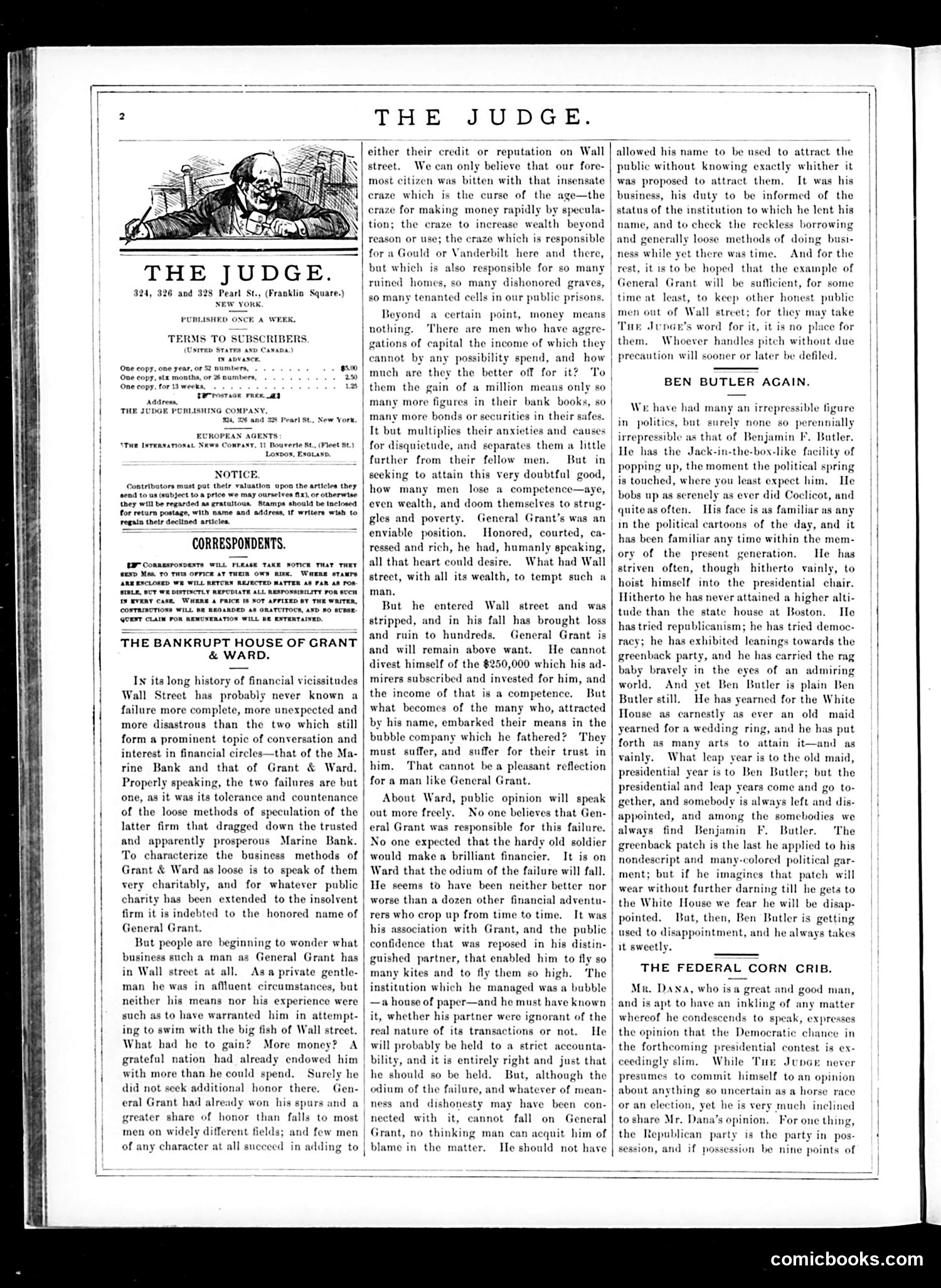
This article critiques General Ulysses S. Grant's catastrophic involvement in the 1884 financial collapse of Grant & Ward, a Wall Street banking firm. The piece expresses bewilderment that a celebrated military hero and former president—already wealthy from public gratitude—would risk his reputation through speculative finance. The satire targets the "insensate craze" of speculation endemic to Gilded Age finance. The author argues Grant was seduced by the obsession with rapid wealth accumulation that drove men like Gould and Vanderbilt, ultimately ruining countless homes, causing suicides, and filling prisons. The editorial questions what additional wealth could possibly gain a man already honored beyond measure, portraying speculation as spiritually corrosive rather than beneficial. The real villain, implicitly, is the speculative financial system itself—the fact that someone of Grant's stature could be destroyed by it.
📄 Transcribed text from this page (OCR, searchable)
Machine-transcribed from the original scan — historical spelling and the odd misread are preserved.
THE JUDGE. | 324 6 and 328 Beal Bi) Franklin Square.) PURLISHED ONCE A WEEK. TERMS TO SUBSCRIBERS, (Ustrep Starrs axp € One copy, one year, of 2 numbers, . One copy, alx months, or 3 numbers, ‘One cops. for 13 weeks, . frrostAok yuan ad | further from NOTICE, Contribators must put thelr valuation apo the articles they send to us (aubject to a price we may ourselves fx), oF otherwise they will be regarded aa gratuitoua Stamps should be inclosed for return postage, with name and address, if writers wish to regain thelr declined articles, _ CORRESPONDENTS. far ConaEsroNDENTS WILL PLRASE TAKE NOTICE THAT THEY sexp Mea To THUS OFFICE AT TuEIR OWN Rink, WHERE eTaure ARE EXCLOMED WE WILL RETCRN REJECTED MATTER AS FAR AB POS: SURLE, BUY WE DIFTINCTLY REFCDLATE ALL RESPONHIRILITY FoR stcH IH RVERY Case, WHERE A PRICE If SOT AFFIXED BY THE WRITER, CONTRIRCTIONA WILL RE REOARDED A# ORATUITOCA, AND HO SUBSE. QOENT CLAIM FOR REMUNERATION WILL BE ENTERTAINED, THE BANKRUPT HOUSE OF GRANT & WARD. In its long history of financial vicissitudes Wall Street has probably never known a failure more complete, more unexpected and more disastrous than the two which still form a prominent topic of conversation and interest in financial circles—that of the Ma- rine Bank and that of Grant & Ward. Properly speaking, the two failures are but one, as it was its tolerance and countenance of the loose methods of speculation of the latter firm that dragged down the trusted and apparently prosperous Marine Bank. To characterize the business methods of Grant & Ward as loose is to speak of them | very charitably, and for whatever public charity has been extended to the insolvent | firm it is indebted to the honored name of | General Grant. | But people are beginning to wonder what | business such a man as General Grant has in Wall street at all, Asa private gentle- man he was in affluent circumstances, but neither his means nor his experience were such as to have warranted him in attempt- ing to swim with the big fish of Wall street. | What had he to gain? More money? A | grateful nation had already endowed him with more than he could spend. Surely he did not seek additional honor there. Gen- eral Grant had already won his spurs and a greater share of honor than falls to most men on widel of any chars different fields; and few men er at all succeed in adding to | | craze for n | rers who crop up from time to time. THE JUDGE. either their credit or reputation on Wall street. We can only believe that our fore- most citizen bitten with that insensate craze which the cu king mone tion; the craze to increa of the age—the pidly by specula- wealth beyond reason or use; the craze which is responsible for a Gould or Vanderbilt here and there, but which is also responsible for so many ruined homes, so many dishonored graves, so many tenanted cells in our public prisons, Beyond point, nothing. ‘There are men who have aggre- gations of capital the income of which they cannot by any possibility spend, and how | much are they the better off for it? To a certain money means | them the gain of a million means only so many more figures in their bank books, so | many more bonds or securities in their safes. It but multiplies their anxieties and causes for disquietude, and separates them a little their fellow men. But seeking to attain this very doubtful good, how many men lose a competence—aye, | even wealth, and doom themselves to strug- gles and poverty. General Grant’s was an enviable position. Honored, courted, ca- ressed and rich, he had, humanly speaking, all that heart could desire. What had Wall street, with all its wealth, to tempt such a man. But he entered Wall street stripped, and in his fall has brought loss and ruin to hundreds. General Grant is and will remain above want. He cannot divest himself of the $250,000 which his ad- mirers subscribed and invested for him, and the income of that is a competence. But what becomes of the many who, attracted by his name, embarked their means in the bubble company which he fathered? ‘They must suffer, and suffer for their trust in him. That cannot be a pleasant reflection for a man like General Grant. and was About Ward, public opinion will speak out more freely. No one believes that Gen- eral Grant was responsible for this failure. No one expected that the hardy old soldier would make a brilliant financier. It is on Ward that the odium of the failure will fall. He seems to have been neither better nor worse than a dozen other financial adventu- It ation with Grant, and the public confidence that was reposed in his distin- guished partner, that enabled him to fly so many kites and to fly them so high. The institution which he managed was a bubble —a house of paper—and he must have known it, whether his partner were ignorant of the real nature of its transactions or not. He will probably be held to a strict accounta- bility, and it is entirely right and just that he should so be held. But, although the odium of the failure, and whatever of mean- ness and dishonesty may nected with it his have been con- fall General Grant, no thinking man can acquit him of blame in the matter. Ie should not have nnot on | ness while ye | He allowed his name to be used to attract the public without knowing e whither it was proposed to attract them. It was his business, his duty to be informed of the status of the institution to which he lent his name, and to check the reckless borrowing and generally loose methods of doing busi- t th as time. And for the rest, it is to be hoped that the example of General Grant will time at least, to keep other honest men out Wall street: for they may take Tur June's word for it, it is no place for them. Whoever handles pitch without due precaution will sooner or be suflicient, for some public ater be defiled. BEN BUTLER AGAIN. We ha in polities, but s vy none so perennially irrepressible as that of Benjamin F. Butler. as the Ja n-the-box-like facility of popping up, the moment the political spring is touched, where you least expect him. He bobs up as serenely as ever did Coclicot, and quite as often. His face is as familiar as any in the political cartoons of the day, and it has been familiar any time within the mem- ory of the present generation. He has striven often, though hitherto vainly, to hoist himself into the presidential chair. Hitherto he has never attained a higher alti- tude than the state house at Boston. He has tried republicanism; he has tried democ- racy; he has exhibited leanings towards the greenback party, and he has carried the rag baby bravely in the eyes of an admiring world. And yet Ben Butler is plain Ben Butler still. He has yearned for the White House as carnestly as ever an old maid yearned for a wedding ring, and he has put forth many arts to attain it nd as, vainly. What leap year is to the old maid, presidential year is to Ben Butler; but the presidential and leap years come and go to- gether, and somebody is always left and dis- appointed, and among the somcbodies we always find Butler. ‘The greenback patch is the last he applied to his nondescript and many-colored political gar- ment; but if he imagines that patch will wear without further darning till he gets to the White House we fear he will be disap- pointed. Bat, then, Ben Butler is getting used to disappointment, and he always takes it sweetly. had many an irrepressible figure re as Benjamin F. THE FEDERAL CORN CRIB. Mr. Dana, who isa great and good man, and is apt to have an inkling of any matter whereof he condescends to speak, expresses the opinion that the Democratic chance in the forthcoming presidential contest is ex- ceedingly slim. While Tie JupGe never presumes to commit himself to an opinion about anything so uncertain as a horse race or an election, yet he is very much inclined to share Mr. Dana’s opinion. For one thing, the Republican party is the party in pos- on, and if possession be nine points of comicbooks.com