
A complete issue · 16 pages · 1884
Judge — April 19, 1884
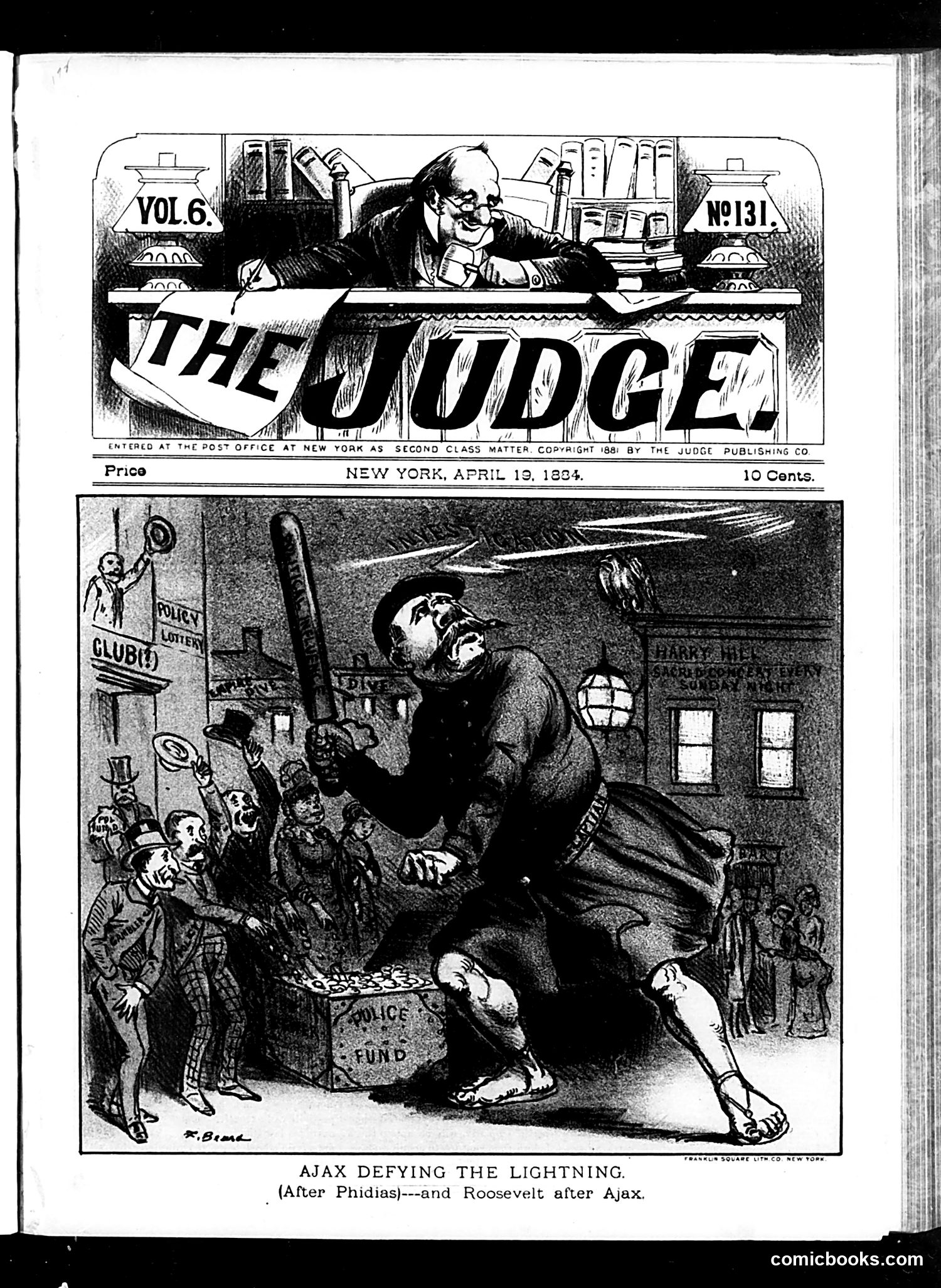
This is a satirical cartoon from *Judge* magazine (April 19, 1894) comparing a contemporary figure to Ajax, the legendary Greek hero who defied the gods. The large, muscular central figure holding a club appears to represent a politician or public figure standing defiantly against authority, indicated by the lightning bolts above. The subtitle references both the classical Philias sculpture and Roosevelt, suggesting this satirizes Theodore Roosevelt's combative political stance. The "Police Fund" box and surrounding crowd indicate conflict between this figure and law enforcement or city government. The satire criticizes what the artist views as reckless, hubris-filled defiance of legitimate power structures—comparing modern political aggression to mythological pride punished by the gods.
The cartoon criticizes President Chester Arthur's rumored bid for a second term. The image shows Arthur reaching unsuccessfully toward a star—a metaphor for the presidency becoming unattainable to him. **The satire:** Despite Arthur's success as a "ward politician," Judge argues he only reached the White House by accident (Vice President, ascending after Garfield's assassination). The magazine contends lightning doesn't strike twice—his political strength has limits, and a second-term presidency is simply beyond his grasp. The accompanying editorial reinforces this dismissal: Arthur, though distinguished in local politics, lacks the exceptional qualities needed for higher office. The star symbolizes an unrealistic ambition; some men simply cannot reach that far, no matter how they stretch. This reflects late 1880s skepticism about Arthur's legitimacy as an elected president, given his accidental path to power.
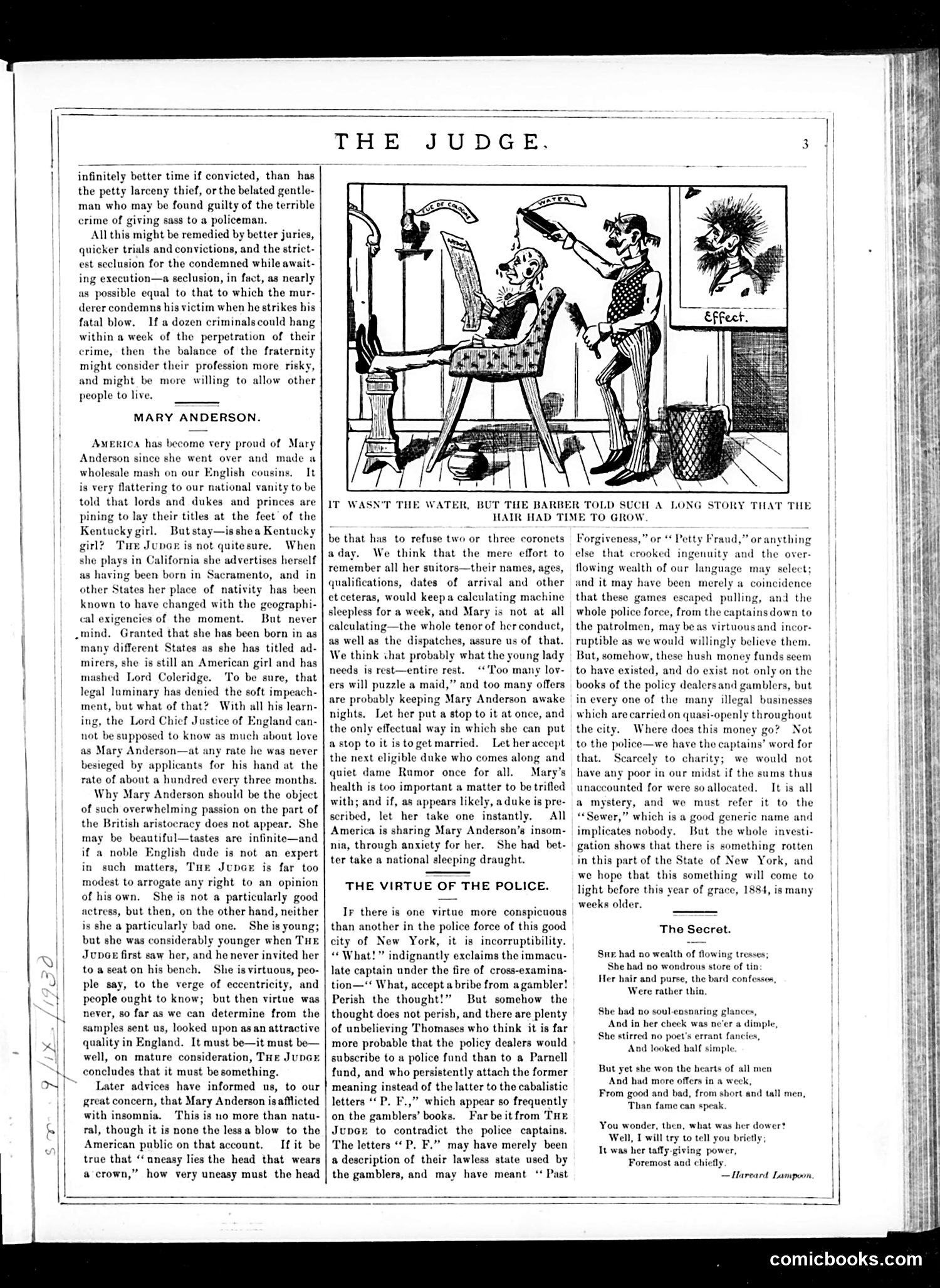
This page contains two distinct pieces of Judge magazine satire: **The Mary Anderson Article** mocks the American actress's celebrity abroad. Anderson had become famous in England, where British aristocrats allegedly pursued her romantically. Judge satirizes this by suggesting her insomnia stems not from anything mysterious, but simply from having too many suitors to remember—their names, ages, and arrival dates. The piece implies American actresses gain exaggerated prestige abroad and that Anderson's sudden "nativity" changing between states (Sacramento vs. Kentucky) reveals opportunistic self-promotion. The satire targets both American vanity about European approval and the absurdity of her celebrity status. **The Barber Cartoon** (captioned "It Wasn't the Water, but the Barber Told Such a Long Story That the Hair Had Time to Grow") depicts a barber's customer with visibly grown hair during a haircut—a visual gag about the barber's legendary long-windedness. The humor is straightforward slapstick: the barber talks so much the hair actually grows back while being cut.
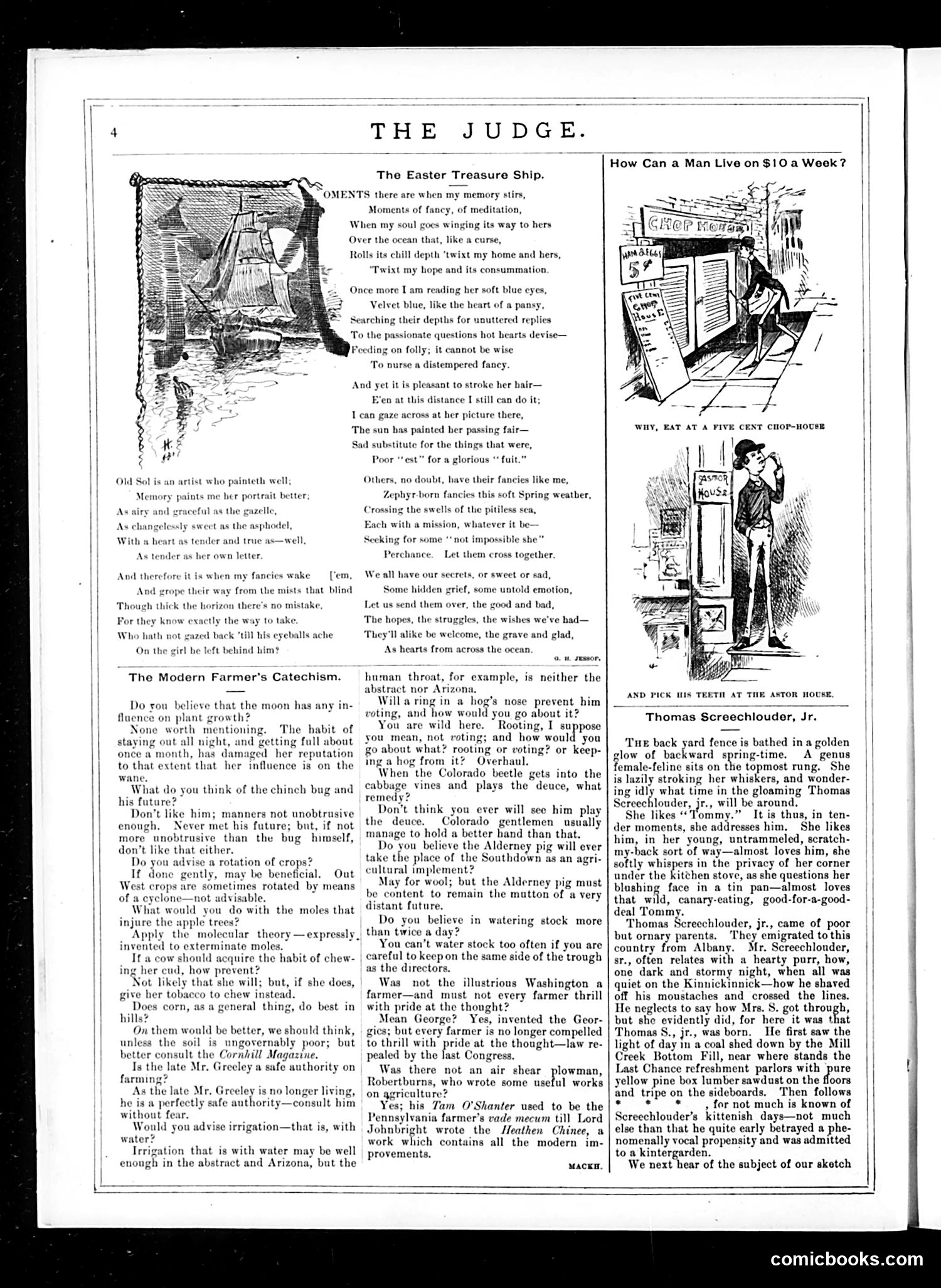
This page from Judge magazine contains three unrelated pieces of satire typical of the publication's format: **"The Easter Treasure Ship"** is a sentimental poem about a lovesick man whose beloved lives across the ocean, imagining letters and memories crossing the sea like a "treasure ship." **"The Modern Farmer's Catechism"** is absurdist humor mocking agricultural advice columns. It uses deliberately ridiculous answers to farming questions—suggesting applying "molecular theory" to kill moles, or giving tobacco to cows with digestive problems. The satire targets the pseudoscientific farming advice that circulated in agricultural publications of the era. **"Thomas Screechhoulder, Jr."** and the other illustrated vignettes appear to be humorous domestic sketches about everyday urban poverty and working-class life—including references to cheap food establishments and tenement living. The page reflects Judge's typical mix of romantic poetry, agricultural satire, and urban social commentary aimed at middle-class readers.
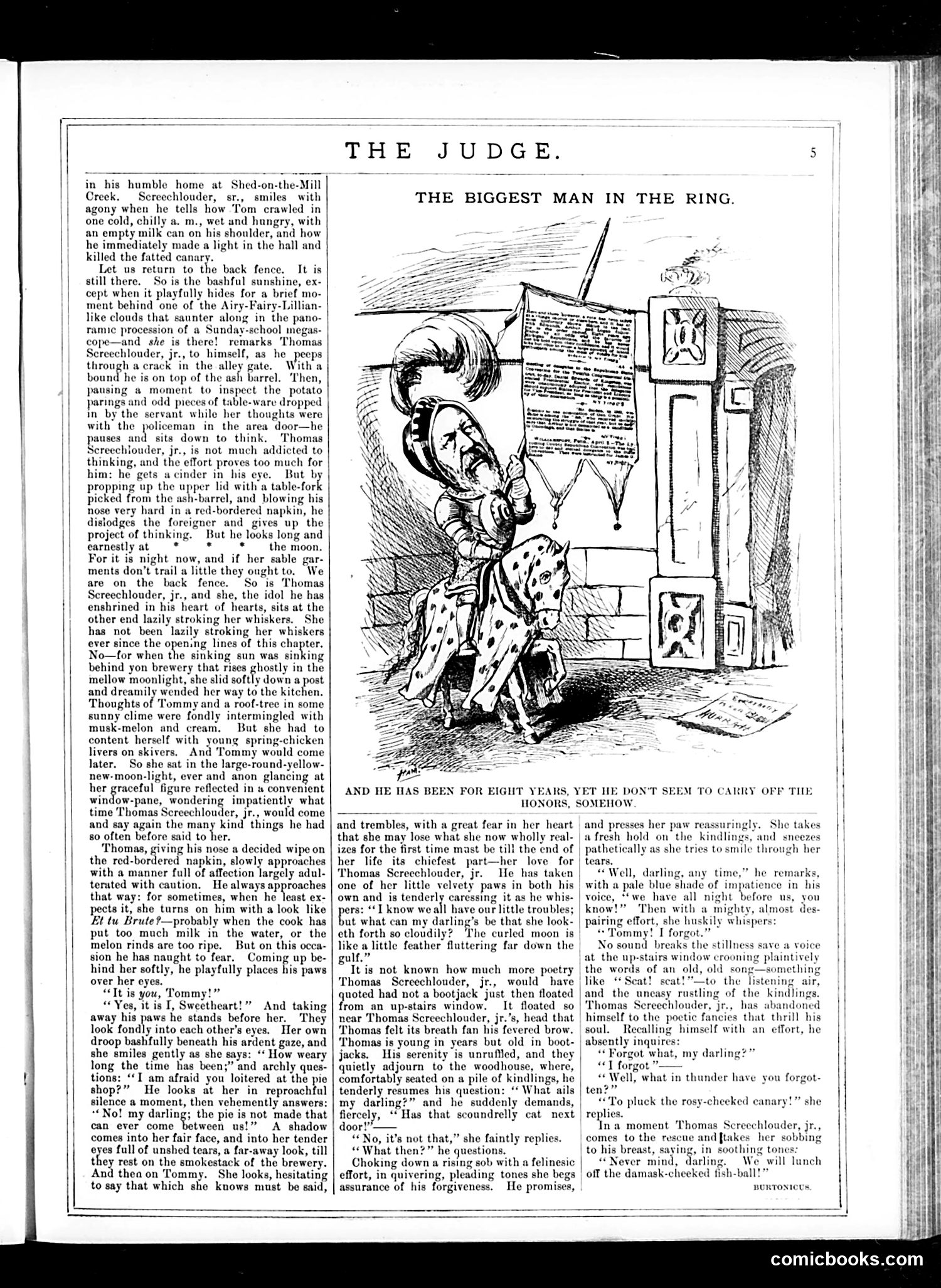
This page from *Judge* magazine presents two distinct pieces: a sentimental story about "Thomas Screechlouder, jr." and his cat on a back fence, and a political cartoon titled "The Biggest Man in the Ring." The cartoon (illustrated right) appears to reference boxing/prizefighting as metaphor for political or social dominance. The figure depicted—a large, muscular man in the boxing ring—likely represents a prominent public figure of the era, though the image quality and OCR limitations prevent certain identification. The caption states he "has been for eight years, yet he don't seem to carry off the honors somehow," suggesting satirical commentary on an incumbent political figure or celebrity boxer whose dominance is questioned or challenged despite his long tenure. The accompanying text story is domestic humor, not political satire—a Victorian-era romantic narrative about a young man courting through sentimental gestures involving his cat.
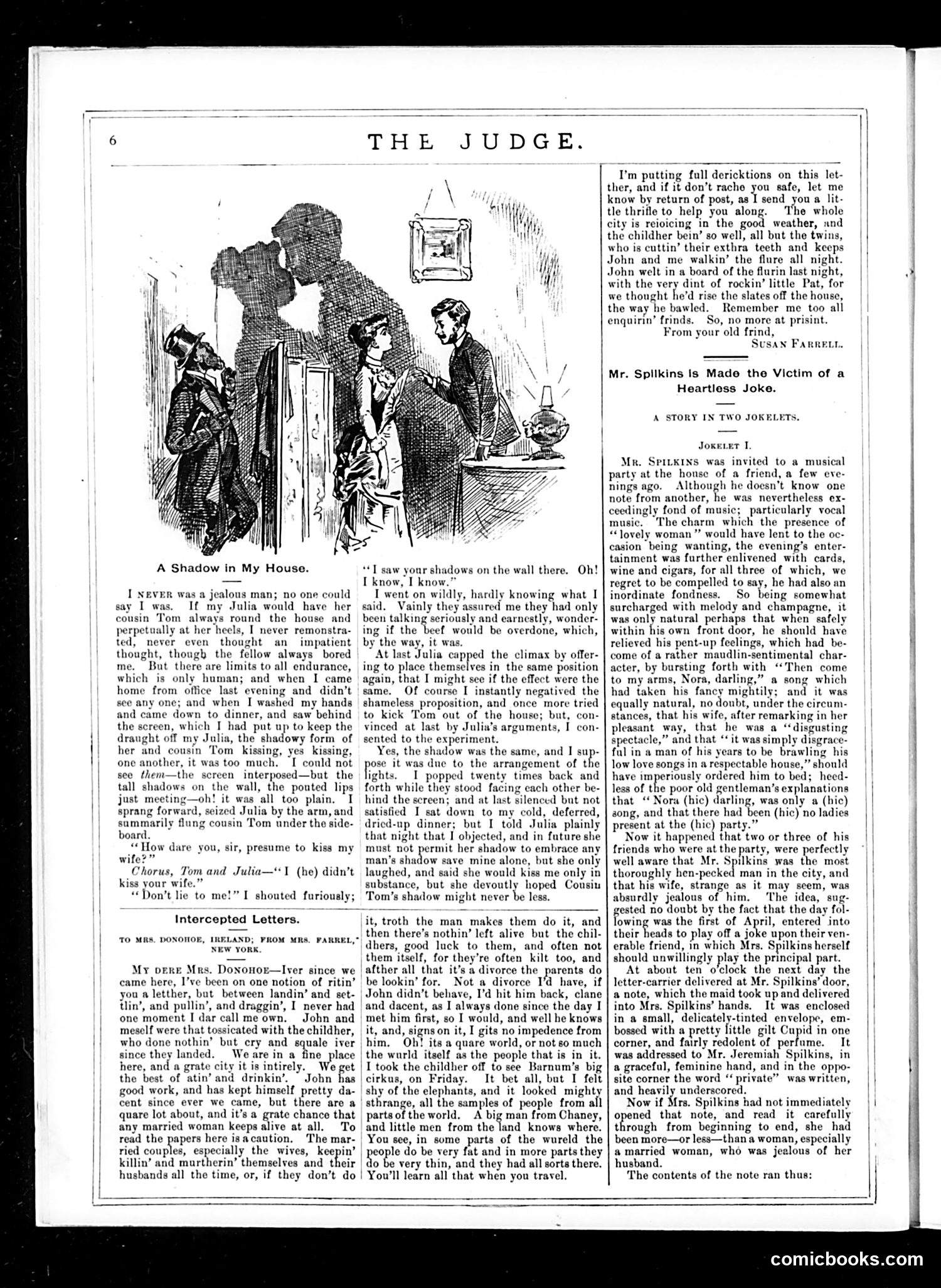
This page contains two separate pieces of Victorian-era domestic humor. **"A Shadow in My House"** depicts a jealous husband who witnesses what appears to be his wife Julia kissing her cousin Tom behind a screen—but only sees their *shadows* on the wall. When confronted, they claim they were merely discussing whether the beef would overcook. The joke is absurdist: the husband obsesses over shadow-kissing, demands a demonstration, and watches them repeat the pose multiple times to "prove" the shadows were innocent. He remains unsatisfied but accepts the explanation, only to comically ban his wife's shadow from embracing any man's shadow but his own. The satire mocks masculine jealousy and the often-ridiculous logic men use to rationalize suspicious behavior. **"Intercepted Letters"** appears to be an Irish immigrant woman's account of American life, written in exaggerated Irish dialect for comedic effect. It's primarily comedic ethnic humor common to the period, though the content discusses marital violence and divorce.
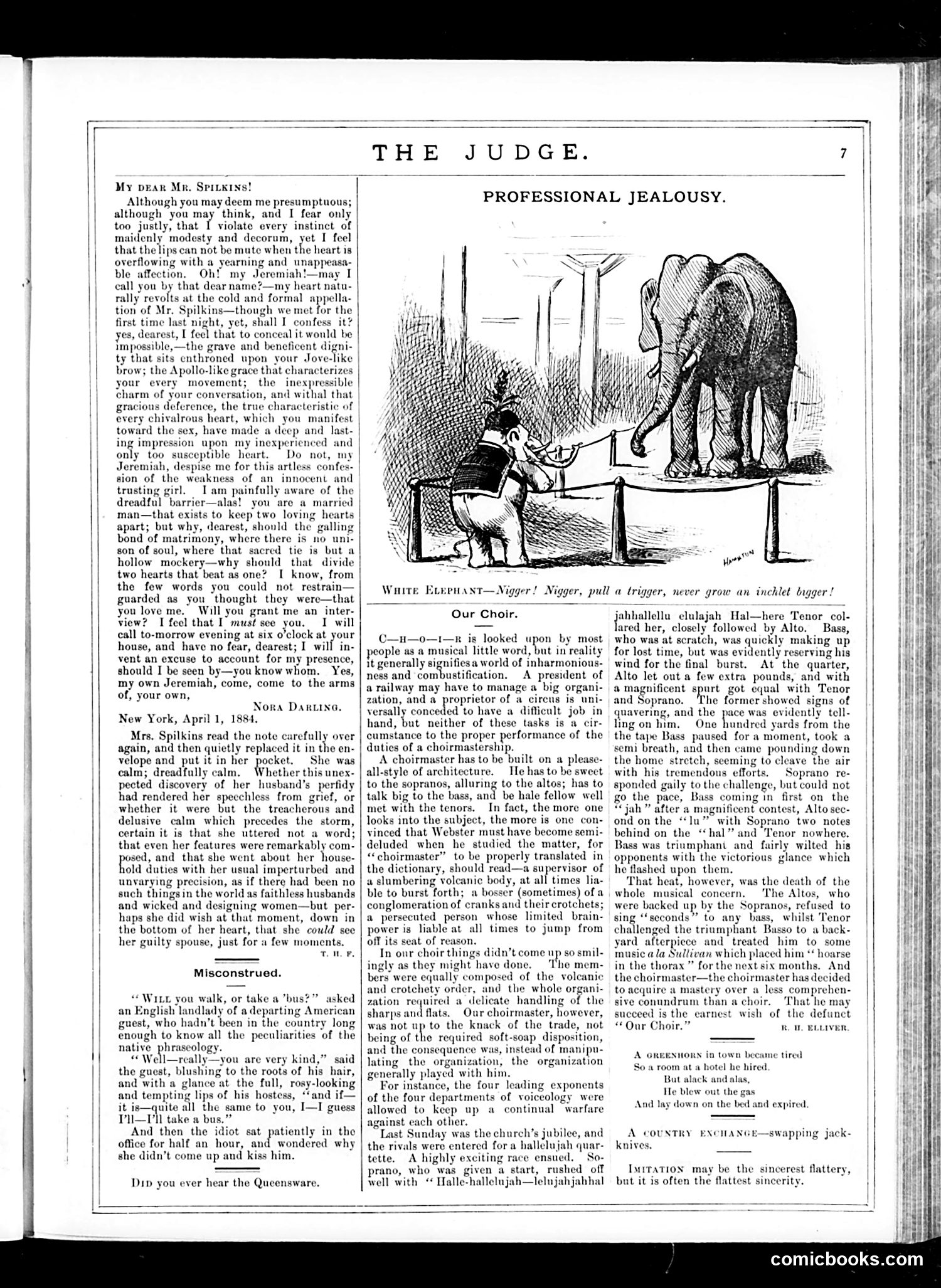
This page from *Judge* (April 1, 1884) satirizes discord within church choirs. The cartoon depicts a small man (representing a choir member or conductor) being physically threatened by a large elephant labeled "White Elephant"—a Victorian-era phrase meaning a burdensome, unwanted possession. The accompanying text mocks choir management, suggesting that organizing singers requires navigating constant internal rivalries and egos. The piece argues that choir members—soprano, tenor, bass—engage in petty "warfare," each convinced their part matters most. The satire targets the inflated self-importance of amateur musicians who treat choir participation as serious professional competition rather than collaborative devotion. The "White Elephant" imagery suggests the choir itself has become an unwieldy, troublesome burden—implying that what should unite a congregation instead generates absurd professional jealousy and conflict among its vocalists.
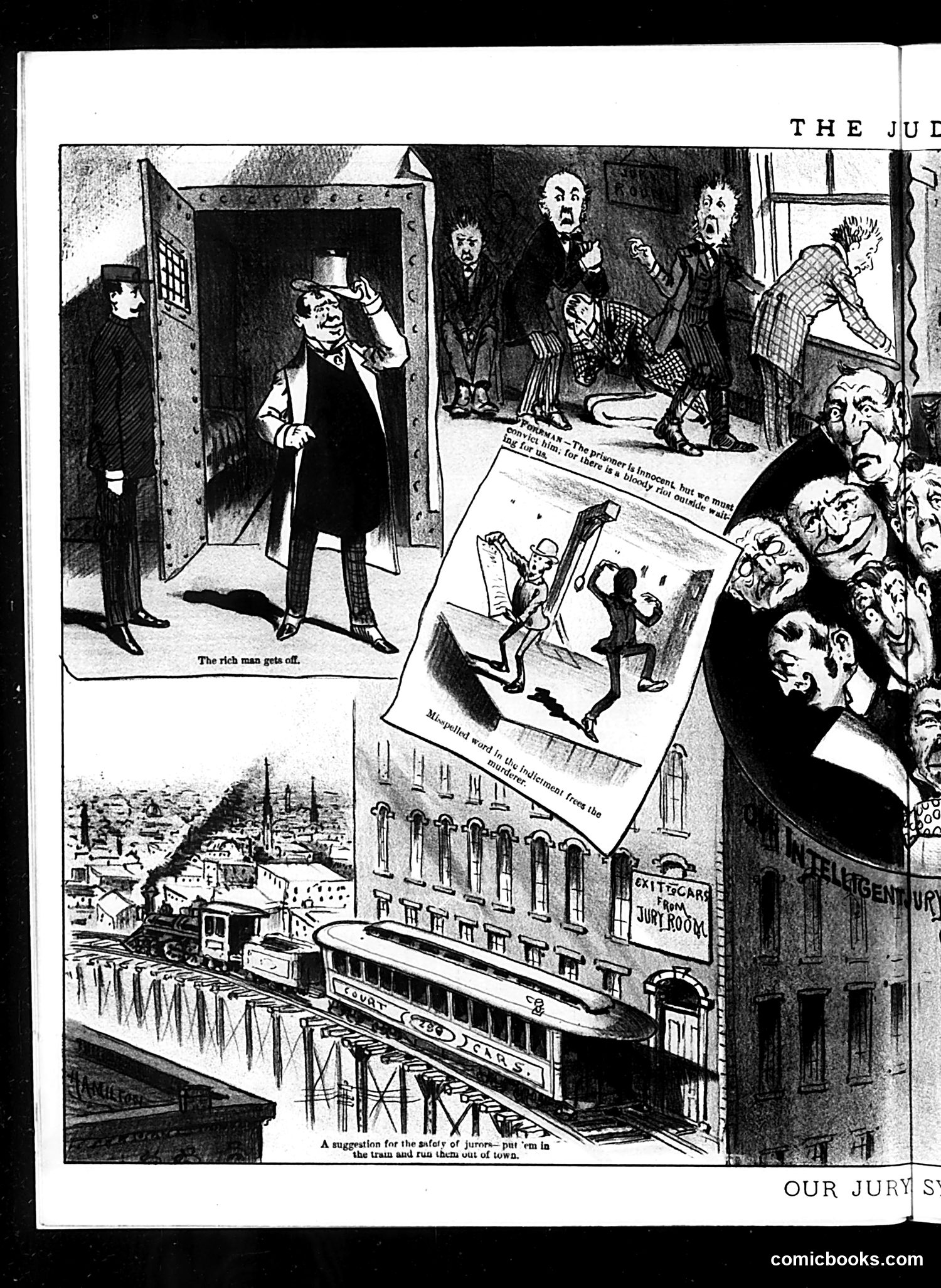
This Judge magazine page satirizes jury duty and public safety concerns in late 19th/early 20th-century America. The main cartoon shows a wealthy man ("The rich man gets off") departing while ordinary citizens gather in what appears to be a courthouse or jury room. The inset panels depict chaos—figures running or fighting, labeled "Misspelled word in indictment from the"—suggesting courtroom confusion or legal incompetence. The caption's dark joke proposes exiling jurors by train "for the safety of jurora"—a pun on the misspelled word itself, implying that jurors are so dangerous or incompetent they threaten public safety and should be removed from town entirely. The satire mocks both the jury system's dysfunction and class disparities in justice, where the wealthy escape while ordinary citizens face jury duty's burdens.
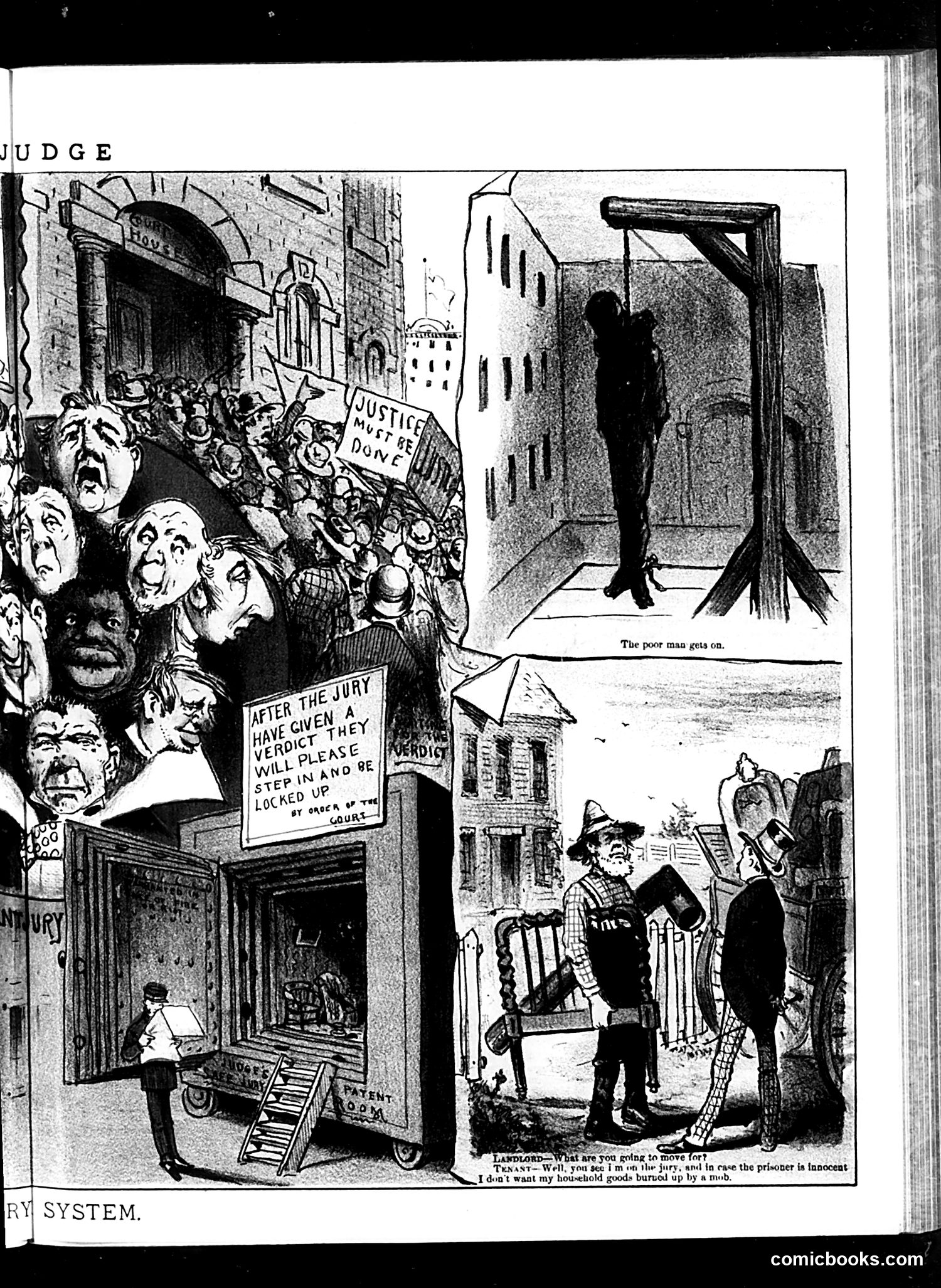
This *Judge* magazine page satirizes the American legal system's class bias. The top panel shows a hanged man—"The poor man gets on"—a darkly ironic caption about social mobility through execution. The lower panels depict a landlord and tenant dispute. A sign reads: "After the jury have given a verdict please [it] will be locked up by order of the court," suggesting the jury itself is imprisoned for their verdict. The tenant protests moving, citing fear of eviction and lost possessions ("I didn't want my household goods burnt up by a bomb"). The cartoon critiques how the legal system protects wealthy landlords while poor tenants have no recourse—they face homelessness or destruction if they resist. The "locked up jury" detail suggests the court manipulates justice to favor property owners. It's social commentary on economic inequality and judicial corruption in the service of capital.
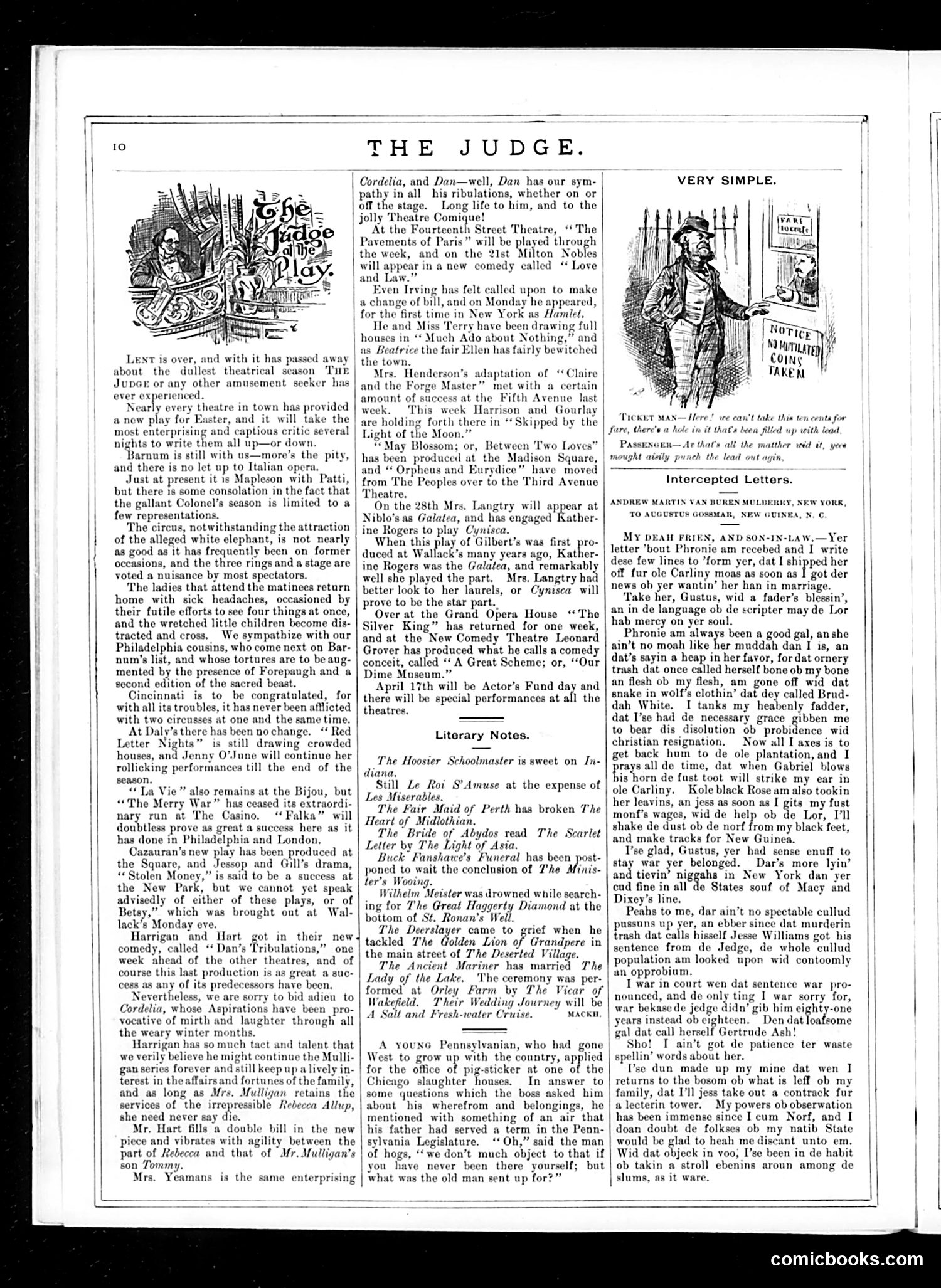
This page from *Judge* magazine contains theatrical reviews and gossip rather than political cartoons. The small illustrations are decorative headers for theater sections. The main content critiques New York's entertainment scene following Lent. The author sarcastically complains the theatrical season is "dull"—despite numerous productions including Barnum's circus (called "alleged white elephant"), Italian opera, and various plays at established theaters like Daly's and the Casino. The piece mocks circus attendance, noting women suffer "sick headaches" trying to watch multiple rings simultaneously, while children become "distracted and cross." There's particular praise for Harrigan and Hart's comedy "Dan's Tribulations" at the Theatre Comique, and for the ongoing success of their "Mulligan" series featuring Mrs. Yeamans as Cordelia. The review celebrates Henry Irving's recent New York debut as Hamlet and Ellen Terry's performance as Beatrice in "Much Ado about Nothing." Overall, this is entertainment journalism—gossipy and opinionated theater criticism for *Judge's* readers interested in New York's cultural scene.
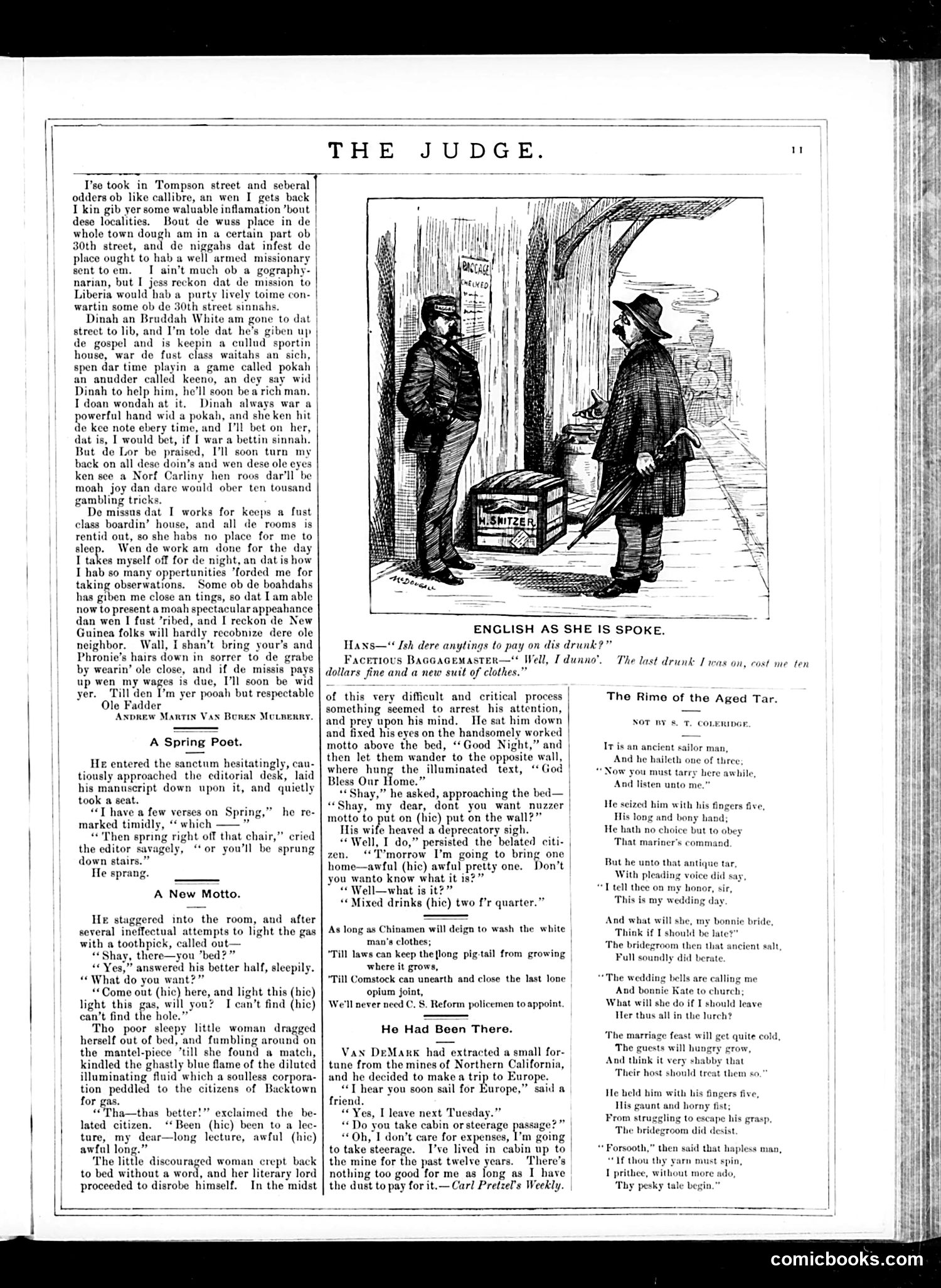
This page contains racist dialect humor typical of 19th-century American satirical magazines. The main content features "Ole Fadder" (an African American character speaking in exaggerated slave dialect) describing conditions in a poor New York neighborhood, mentioning a woman named Dinah running a disreputable establishment on 30th Street. The illustrated cartoon shows a German immigrant ("Hans") confronting a baggage master about payment for a drunk passenger—a joke about language barriers and ethnic stereotypes. Additional satirical pieces mock a nervous poet rejected by an editor, and a drunk man returning home. **For modern readers**: This reflects Judge magazine's reliance on ethnic caricature and racial mockery as entertainment. The dialect, stereotypes, and casual racism would be considered deeply offensive today. The humor depends entirely on mocking Irish, German, and African American characters through exaggerated speech and behavior—representing how mainstream American publications casually dehumanized immigrant and Black communities in this era.
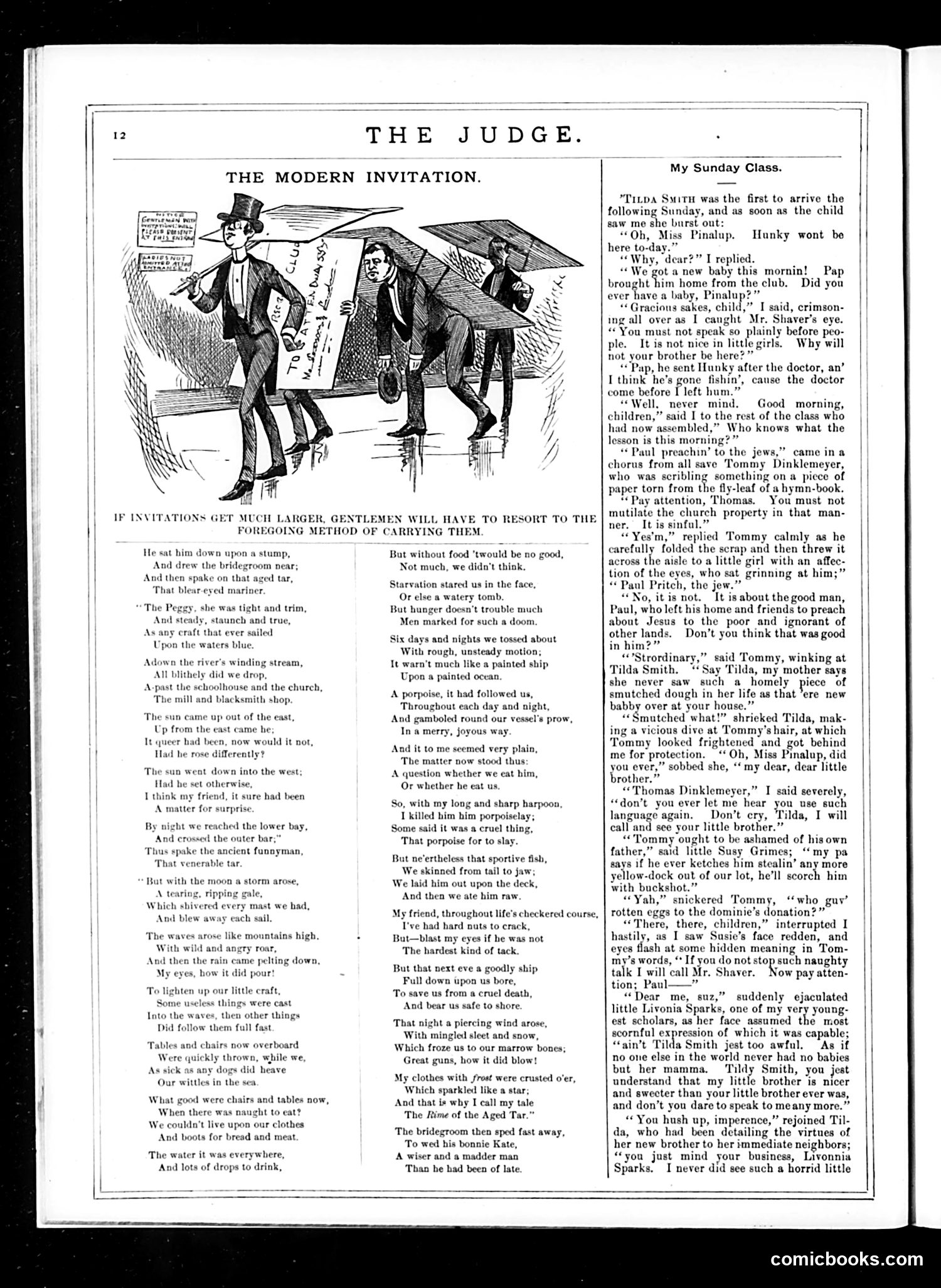
This page contains two distinct pieces of satirical content from *Judge* magazine. **"The Modern Invitation"** (left): A visual satire about how formal invitations have become unwieldy. The cartoon shows gentlemen struggling to carry enormous rolled invitations, so large they require mechanical assistance. The accompanying poem is a lengthy sailor's narrative (parodying Coleridge's "Rime of the Ancient Mariner") that spirals absurdly—describing shipwreck, eating a porpoise raw, and endless maritime suffering—as an extended metaphor for the burden of modern invitation etiquette. The joke: formal invitations have become so elaborately detailed and lengthy that they're impractical to deliver or carry. **"My Sunday Class"** (right): A brief humor piece about a Sunday school teacher whose young student, Tilda Smith, innocently reveals that her father brought home a "new baby" from his club—implying an illegitimate child. The teacher blushes mortified, while the child remains obliviously naive about social propriety. The humor derives from the child's inappropriate candor exposing adult hypocrisy.
This page contains several humorous short stories and anecdotes typical of Judge magazine's satirical content, rather than political cartoons. **"Cut Out of Whole Cloth"** mocks a son's faulty Biblical knowledge—he claims David was a tailor because Saul "cut his garment" in a cave, misunderstanding the scripture. The father's exasperated response (wishing for a pistol) satirizes generational ignorance. **"Rough on Reporters"** jokes that newspaper reporters are so disreputable they're mistaken for prisoners. A wealthy witness, horrified to learn the shabby men are journalists rather than criminals, requests to see the dungeons instead—suggesting reporters are worse company than actual convicts. The other pieces ("The Druggist," "Politics in Wyoming," "He Didn't Steal It," "How to Secure Customers," "A Very Brief Honeymoon") are humorous fiction, not satire of specific political figures or events. They target social types and human folly rather than current events.
This page from **Judge** (a major American satirical weekly) contains several short humor pieces typical of the publication's style: **"Didn't Want a Thermometer"** is the lead story—a comedic dialogue between a door-to-door salesman and a stubborn farmer who refuses to see the practical value of a thermometer. The farmer's resistance is portrayed as provincial ignorance; he insists he can tell temperature by physical sensation and doesn't need scientific instruments. The satire mocks rural resistance to modern technology and progress, a common theme in Gilded Age humor. **Other brief pieces** include "Good Advice" (a pun about financial "drafts"), "Knew It Wasn't Him" (a story about a vain young man at a masked ball), and "The Same Old Story" (a domestic squabble mistaken for a crime). The page is otherwise filled with period **advertisements** for patent medicines, services, and products—typical for Judge's revenue model. The overall tone reflects late 19th-century urban sophistication mocking rural and working-class conservatism.
This page is primarily **advertising** with satirical anecdotes interspersed. The cartoons and jokes illustrate typical *Judge* content—humorous, lighthearted social commentary rather than political satire. ## Key Content: The anecdotes mock small social absurdities: an Indiana boy imprisoned for stealing clothes; a colored man (Jim Webster) accused of theft who naively praises his employer Colonel Jones's honesty while being detained; a woman praised a grocer for fair weights, then he fires the clerk who served her (revealing hypocrisy); various domestic humor about spouses and cake. One joke references **Anthony Comstock**, the famous moral crusader, regarding transported dressed cattle—possibly mocking Comstock's zealous regulation of public morality. The "**Siberian comic paper**" joke sardonically suggests Siberia's grim reputation makes humor futile. Overall, this reflects *Judge*'s style: gentle satire on everyday human foibles, workplace dishonesty, domestic life, and social pretense—not hard political criticism. The ads for pianos, remedies (hay-fever, consumption), and printing services dominate the layout.
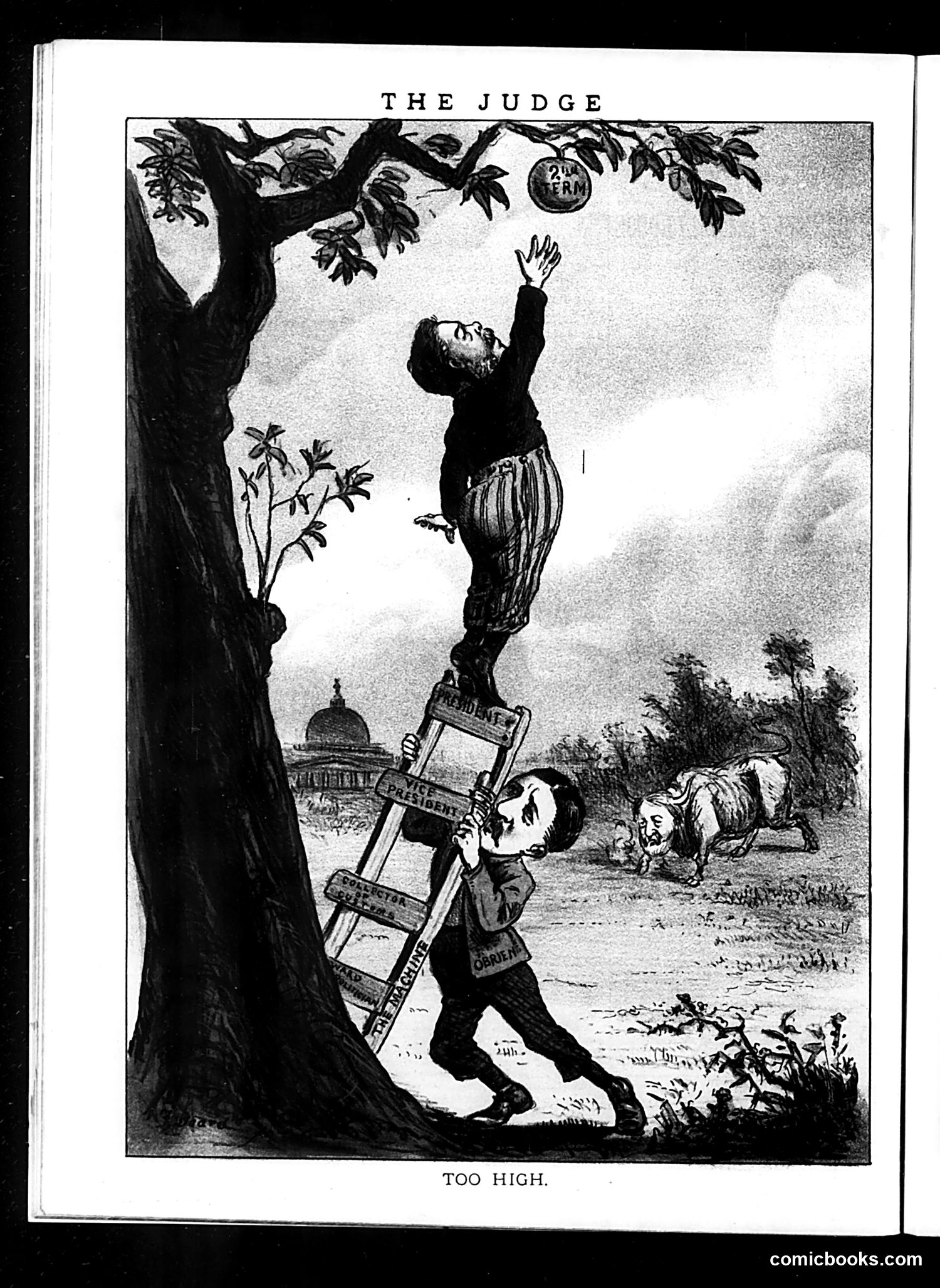
This political cartoon depicts a figure standing on a ladder against a tree, reaching upward toward a hanging pocket watch or clock labeled "2 P.M." while a second figure below struggles to support the ladder. The satire appears to criticize ambition that exceeds realistic grasp—the title "Too High" suggests someone is reaching for an unattainable goal. The pocket watch likely represents time, deadlines, or appointment-related aspirations. The figure below, straining under the weight, suggests the cost or burden placed on others by such overreaching ambition. Without clearer identification of the figures or historical context, the cartoon's specific political target remains unclear, though it generally critiques excessive or unrealistic striving.