
Judge, 1884-04-19 · page 3 of 16
Judge — April 19, 1884 — page 3: what you’re looking at
What you’re looking at
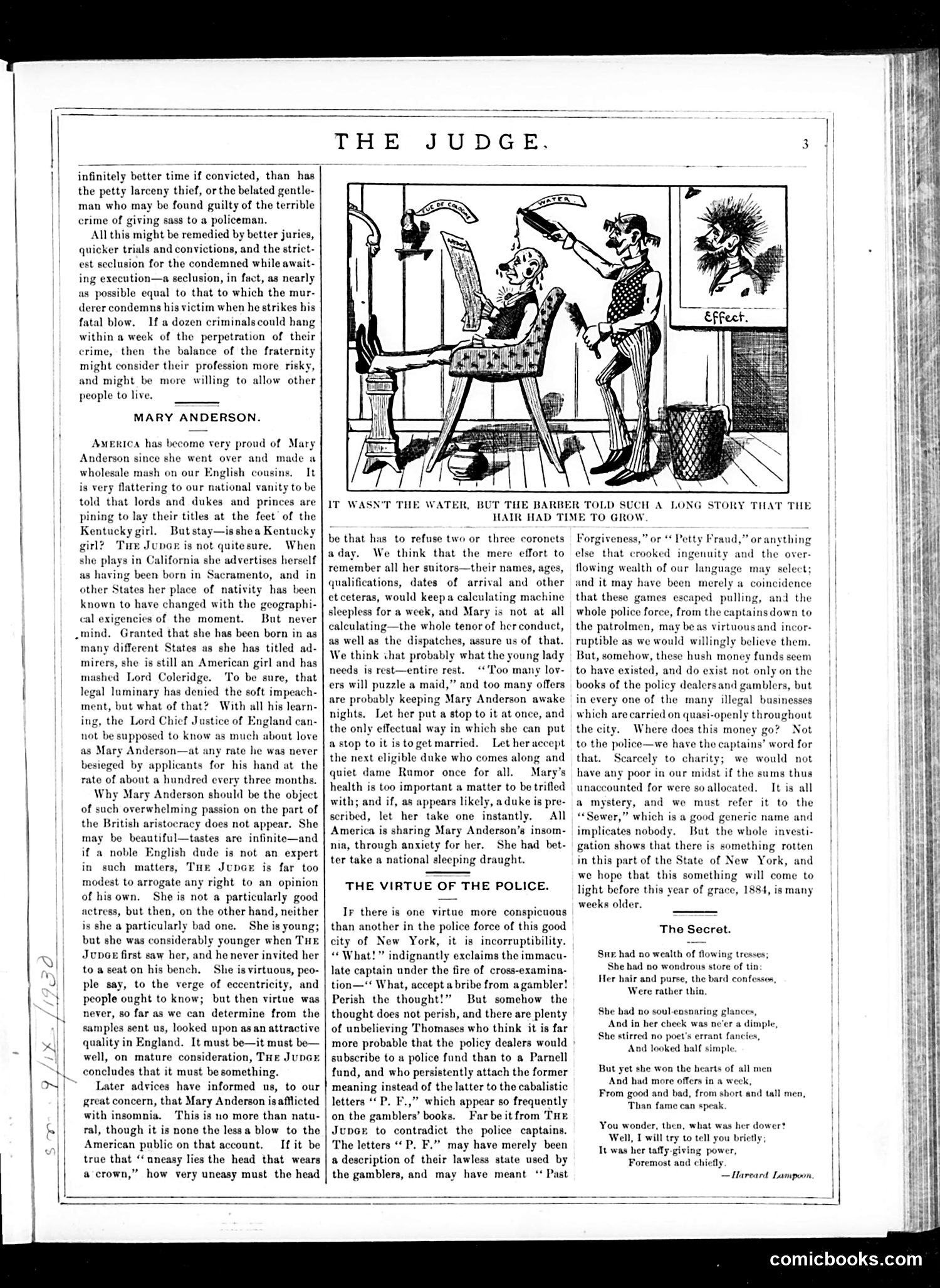
This page contains two distinct pieces of Judge magazine satire: **The Mary Anderson Article** mocks the American actress's celebrity abroad. Anderson had become famous in England, where British aristocrats allegedly pursued her romantically. Judge satirizes this by suggesting her insomnia stems not from anything mysterious, but simply from having too many suitors to remember—their names, ages, and arrival dates. The piece implies American actresses gain exaggerated prestige abroad and that Anderson's sudden "nativity" changing between states (Sacramento vs. Kentucky) reveals opportunistic self-promotion. The satire targets both American vanity about European approval and the absurdity of her celebrity status. **The Barber Cartoon** (captioned "It Wasn't the Water, but the Barber Told Such a Long Story That the Hair Had Time to Grow") depicts a barber's customer with visibly grown hair during a haircut—a visual gag about the barber's legendary long-windedness. The humor is straightforward slapstick: the barber talks so much the hair actually grows back while being cut.
📄 Transcribed text from this page (OCR, searchable)
Machine-transcribed from the original scan — historical spelling and the odd misread are preserved.
cmind. infinitely better time if convicted, than has the petty larceny thief, or the belated gentle- man who may be found guilty of the terrible crime of giving sass to a policeman. All this might be remedied by better jurics, quicker trials and convictions, and the strict- est seclusion for the condemned while await- ing execution—a seclusion, in fact, as nearly as possible equal to that to which the mur- derer condemns his victim when he strikes his fatal blow. If a dozen criminals could hang within a week of the perpetration of their crime, then the balance of the fraternit. might consider their profession more risky, and might be more willing to allow other people to live. MARY ANDERSON. America has become very proud of Ma Anderson since she went over and made « whol is very flattering to our national vanity to be told that lords and dukes and princes are pining to lay their titles at the feet of the Kentucky girl. But stay—is shea Kentucky girl? Tie Jvpor is not quitesure. When she plays in California she advertises herself as having been born in Sacramento, and in other States her place of nativity has been known to have changed with the geographi- cal exigencies of the moment. But never Granted that she has been born in as many different States as she has titled ad- mirers, she is still an American girl and has hed Lord Coleridge. To be sure, that legal luminary has denied the soft impeach- me! rent, but what of that? With all his learn- ing, the Lord Chief Justice of England can- not be supposed to know as much about love as Mary Anderson—at any rate he was never besieged by applicants for his hand at the rate of about a hundred every three months. Why Mary Anderson should be the object of such overwhelming passion on the part of the British aristocracy does not appear. She may be beautiful—tastes are infinite—and if a noble English dude is not an expert in such matters, Tue JupGe is far too modest to arrogate any right to an opinion of his own. She is not a particularly good actress, but then, on the other hand, neither is she a particularly bad one. She is young; but she was considerably younger when THE JunGe first saw her, and he never invited her to aseaton his bench. She is virtuous, peo- ple say, to the verge of eccentricity, and people ought to know; but then virtue was never, 80 far as we can determine from the samples sent us, looked upon as an attractive quality in England. It must be—it must be— well, on mature consideration, Tue Jupcr concludes that it must be something. Later advices have informed us, to our great concern, that Mary Anderson is afflicted with insomni This is no more than natu- ral, though it is none the lessa blow to the American public on that account. If it be true that ‘“aneasy lies the head that wears a crown,” how very uneasy must the head je mash on our English cousins. It IT WASN’T THE WATER, BUT THE BARBER TOLD SU HA LONG STORY THAT THE HAIR HAD TIME TO GROW be that has to refuse two or three coronets aday. We think that the mere effort to remember all her suitors—their names, ages, qualifications, dates of arrival and other etceteras, would keepa calculating machine sleepless for a week, and Mary is not at all calculating—the whole tenor of her conduct, as well as the dispatches, assure us of that. We think chat probably what the young lady needs is rest—entire rest. ‘Too many lov- ers will puzzle a maid,” and too many offers are probably keeping Mary Anderson awake nights. Let her put a stop to it at once, and the only effectual way in which she can put a stop to it istoget married. Let her accept the next eligible duke who comes along and quiet dame Ramor once for all. Mary's health is too important a matter to be trifled with; and if, as appears likely, a duke is pre- scribed, let her take one instantly. All America is sharing Mary Anderson’s insom- nia, through anxiety for her. She had bet- ter take a national sleeping draught. THE VIRTUE “OF THE POLICE. Ir there is one virtue more conspicuous than another in the police force of this good city of New York, it is incorruptibility. “What!” indignantly exclaims the immacu- late captain under the fire of cross-examina- tion—‘« What, accept a bribe from agambler! Perish the though: But somehow the thought does not perish, and there are plenty of unbelieving Thomases who think it is far more probable that the policy dealers would subscribe to a police fund than to a Parnell fund, and who persistently attach the former meaning instead of the latter to the cabalistic letters “P. F.,” which appear so frequently on the gamblers’ books. Far be it from THE JupGE to contradict the police captains. ‘The letters ‘‘ P. F.”” may have merely been a description of their lawless state used by the gamblers, and may have meant ‘ Past Forgiveness,” or ‘* Petty Fraud,” else that crooked ingenuity flowing wealth of our langu oranything and the may select and it may have been merely a coincidence | | that these games escaped pulling, and the whole police force, from the captains down to the patrolmen, may be as virtuous and incor- ruptible as we would willingly believe them. But, somehow, these hush money funds seem to have existed, and do exist not only on the books of the policy dealersand gamblers, but | in every one of the mat which are carried on qua the city. over- |) illegal businesses | i-openly throughout Not to the police—we have the captains’ word for that. Where does this money go? earcely to charity; we would not | any poor in our midst if the sums thus accounted for were so allocated. It is all tery, must refer it to the Sewer,” which is a good generic name and implicates nobody. But the whole investi- gation shows that there is something rotten in this part of the State of New York, and we hope that this something will come to light before this year of grace, 1884, is many weeks older. | and we The Secret. Sne had no wealth of flowing tresses; She had no wondrous store of tin | Her hair and purse, the bard confesses, | Were rather thin. She had no soul-ensnaring glances, And in her check was ne'er a di She stirred no poet's errant fancies, And looked half simple | But yet she won the hearts of all men And had more offers in a week, From good and bad, from short and tall men, Than fame can speak You wonder, then, what was her dower? Well, I will try to tell you brietly; It was her tafly-giving power, Foremost and chiefly —Hareard Lampoon. comicbooks.com