
Judge, 1884-04-19 · page 2 of 16
Judge — April 19, 1884 — page 2: what you’re looking at
What you’re looking at
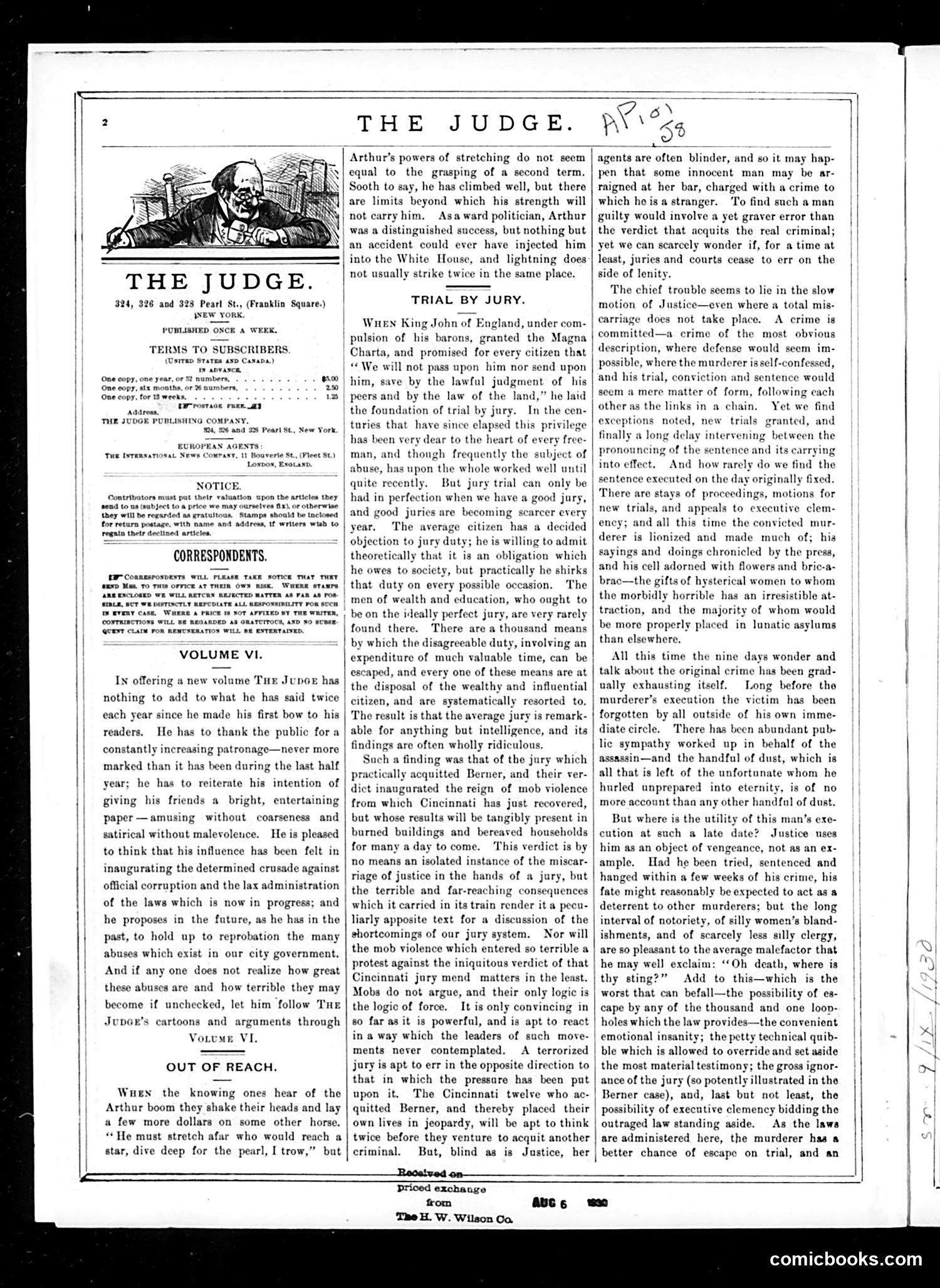
The cartoon criticizes President Chester Arthur's rumored bid for a second term. The image shows Arthur reaching unsuccessfully toward a star—a metaphor for the presidency becoming unattainable to him. **The satire:** Despite Arthur's success as a "ward politician," Judge argues he only reached the White House by accident (Vice President, ascending after Garfield's assassination). The magazine contends lightning doesn't strike twice—his political strength has limits, and a second-term presidency is simply beyond his grasp. The accompanying editorial reinforces this dismissal: Arthur, though distinguished in local politics, lacks the exceptional qualities needed for higher office. The star symbolizes an unrealistic ambition; some men simply cannot reach that far, no matter how they stretch. This reflects late 1880s skepticism about Arthur's legitimacy as an elected president, given his accidental path to power.
📄 Transcribed text from this page (OCR, searchable)
Machine-transcribed from the original scan — historical spelling and the odd misread are preserved.
———— THE JUDGE. 324, 326 and 323 Pearl St. (Franklin Square.) PUBLISHED ONCE A WEEK. TERMS TO SUBSCRIBERS. (Ustrmp StarEs 4x0 Cas By ADVANCR One copy, one year, of St numbers, Bo One copy, six months, or 3 numbers, 20 One copy, for 13 weeks, 13 EW-rosTaok rum ad Address. THE JUDGE PUBLISHING COMPANY. $24, 26 and S Pearl St, New York. AGENTS. NY, 1! Bouverte St., (Fleet St.) Lospos, Exoaxn, NOTICE. Contribators must put thelr valuation upon the end to us (subject to a price we may ourselves Ax), they will be regarded aa gratuitoaa Stamps should be tnclosed for return postage, with name and address, if writers wish to regain thetr declined articles CORRESPONDENTS. TUITOCR, AND 8O sCRRR ENTERTAINED, VOLUME VI. I offering a new volume Tue Jupor has nothing to add to what he each year since he made his first bow to his as said twice readers. He has to thank the public fora constantly increasing patronage—never more marked than it has been during the last half year; he has to reiterate his intention of giving his friends a bright, entertaining paper —amusing without coarseness and satirical without malevolence. He is pleased to think that his influence has been felt in inaugurating the determined crusade against official corruption and the lax administration of the laws which is now in progress; and he proposes in the future, as he has in the past, to hold up to reprobation the many abuses which exist in our city government. And if any one does not realize how great these abuses are and how terrible they may become if unchecked, let him follow Tue Jupoe’s cartoons and arguments through Vi. LUM OUT OF REACH. Wen the knowing ones hear of the Arthur boom they shake their heads and lay a few more dollars on some other horse. ‘He must stretch afar who would reach a star, dive deep for the pearl, I trow,” but THE JUDGE. equal to the grasping of a second term. Sooth to say, he has climbed well, but there are limits beyond which his strength will not carryhim. Asa ward politician, Arthur was a distinguished success, but nothing but an accident could ever have injected him into the White House, and lightning does not usually strike twice in the same place. TRIAL BY JURY. Wuen King John of England, under com- pulsion of his barons, granted the Magna Charta, and promised for every citizen that “We will not pass upon him nor send upon him, save by the lawful judgment of his peers and by the law of the land,” he laid the foundation of trial by jury. In the cen- turies that have since elapsed this privil has been very dear to the hi art of every free- man, and though frequently the subject of abuse, has upon the whole worked well until quite recently. But jury trial can only be had in perfection when we have a good jury, and good juries are becoming scarcer every year. The average citizen has a decided objection to jury duty; he is willing to admit theoretically that it is an obligation which he owes to ety, but practi he shirks that duty on every possible occasion. ‘The men of wealth and education, who ought to sc | be on the ideally perfect jury, are very rarely found there. There are a thousand means by which the disagreeable duty, involving an penditure of much valuable time, can be escaped, and every one of these means are at the di 1 of the wealthy and influentia | citizen, and are systematically resorted to. | The result is that the average jury is remark- able for anything but intelligence, and its findings are often wholly ridiculous. Such a finding was that of the jury which practically acquitted Berner, and their ver- dict inaugurated the reign of mob violence from which Cincinnati has just recovered, but whose results will be tangibly present in burned buildings and bereaved households for many aday to come. This verdict is by no means an isolated instance of the miscar- riage of justice in the hands of a jury, but the terrible and far-reaching consequences which it carried in its train render it a pecu- liarly apposite text for a discussion of the shortcomings of our jury system. Nor will the mob violence which entered so terrible a protest against the iniquitous verdict of that Cincinnati jury mend matters in the least. Mobs do not argue, and their only logic is the logic of force. It is only convincing in so far as it is powerful, and is apt to react in a way which the leaders of such move- ments never contemplated. A terrorized jury is apt to err in the opposite direction to that in which the pressare has been put upon it. The Cincinnati twelve who a quitted Berner, and thereby placed the own lives in jeopardy, will be apt to think | outraged law standing aside. | more account than a 7, 3) V5 i Arthur’s powers of stretching do not seem | agents are often blinder, and so it may hap- pen that some innocent man may be ar- raigned at her bar, charged with a crime to which he is a stranger. To find such a man guilty would involve a yet graver error than the verdict that acquits the real criminal; yet we can scarcely wonder if, for a time at least, juries and courts cease to err on the side of leni The chief trouble seems to lie in the slow motion of Justice—even where a total mis- carriage does not take place. committed—a crime of the obvior description, where defense would seem im- possible, where the murderer is self-confessed, and his trial, conviction and sentence would seem a mere matter of form, following each othe the links in a chain. Yet we find exceptions noted, new trials granted, and inally a long ¢ A crime is most jay intervening between the pronouncing of the sentence and its carrying into effect. And how rarely do we find the sentence executed on the day originally fixed. ‘There are stays of proceedings, motions for new trial Is to executive clem- ency; and all this time the convicted mur- derer is lionized and made much of; his sayings and doings chronicled by the presi and his cell adorned with flowers and bri brac—the gifts of hysterical women to whom the morbidly horrible has an irresistible at- traction, and the majority of whom would be more properly placed in lunatic asylums than elsewhere, All this time the nine days wonder and talk about the original crime has been grad- ually exhausting itself. Long before the murderer’s execution the victim has been forgotten by all outside of his own imme- diate circle. There has been abundant pub- lic sympathy worked up in behalf of the assassin—and the handful of dust, which is all that is left of the unfortunate whom he hurled unprepared into eternity, is of no y other handful of dust. But where is the utility of this man’s exe- cution at such a late date? Justice uses him as an object of vengeance, not as an ex- ample. Had he been tried, sentenced and | hanged within a few weeks of his crime, his fate might reasonably be expected to act as a deterrent to other murderers; but the long interval of notoriety, of silly women’s bland- ishments, and of scarcely less silly clergy, are so pleasant to the average malefactor that he may well exclaim: ‘Oh death, where is thy sting?” Add to this—which is the worst that can befall—the possibility of es- cape by any of the thousand and one loop- holes which the law provides—the convenient emotional insanity; the petty technical quib- ble which is allowed to override and set aside the most material testimony; the gross ignor- ance of the jury (so potently illustrated in the Berner case), and, last but not least, the possibility of executive clemency bidding the As the laws twice before they venture to acquit another | are administered here, the murderer haa a criminal. But, blind as is Justice, her | better chance of escape on trial, and an comicbooks.com | | |