
A complete issue · 16 pages · 1884
Judge — April 5, 1884
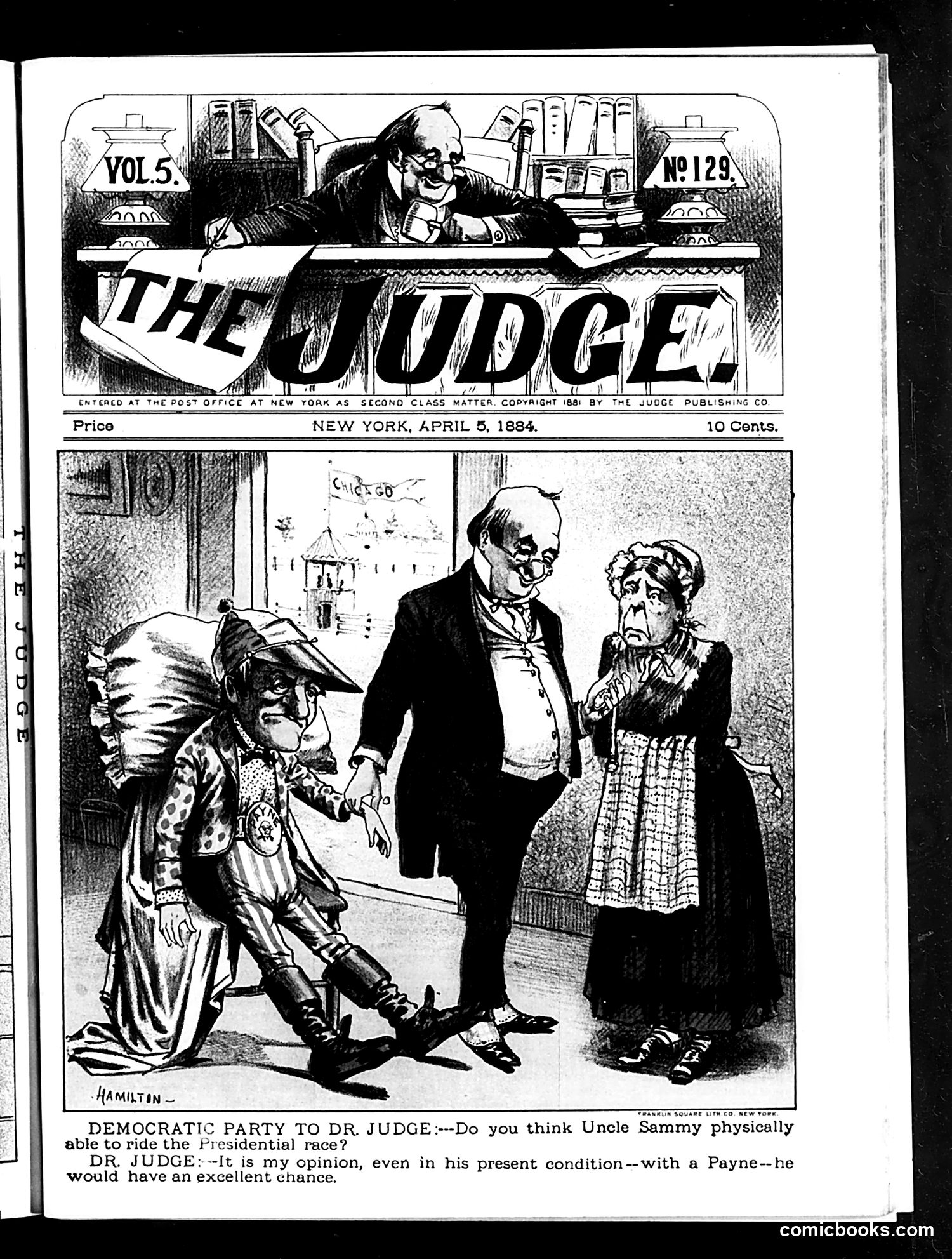
This political cartoon satirizes Democratic Party doubts about their presidential candidate. The caption presents a dialogue where Democrats ask Dr. Judge whether "Uncle Sammy" (representing America) can physically endure the presidential race. Dr. Judge responds that even in poor health, with a "Payne," the candidate would have excellent chances. The figure on the left appears to be a caricatured political opponent or rival. The cartoon mocks Democratic concerns about candidate fitness while making a pun on "Payne"—likely referencing Henry B. Payne, a prominent Ohio Democrat of that era. The satire suggests Democrats are desperate enough to support their candidate regardless of physical condition, provided they have Payne's support.
This page from *Judge* magazine satirizes the dangers facing poor children in late 19th-century America. The editorial compares contemporary threats to children to King Herod's biblical "Massacre of the Innocents." The target is not a specific political figure but rather systemic "Greed" and "Carelessness." The magazine highlights real hazards: adulterated candy containing fusel oil (poisonous whiskey byproduct), contaminated milk in tenement districts, and inadequate sanitation. The satire argues that while wealthy children like Vanderbilts and Goulds are protected, poor children—the majority—face preventable deaths from poisoned food, unsanitary conditions, and ignorant medical practices (laudanum-laced syrups). *Judge* uses religious language ironically to shame society for tolerating these conditions. The cartoon illustrates a skeletal figure (Death) hovering over vulnerable infants, emphasizing the moral outrage of preventable childhood mortality among the urban poor.
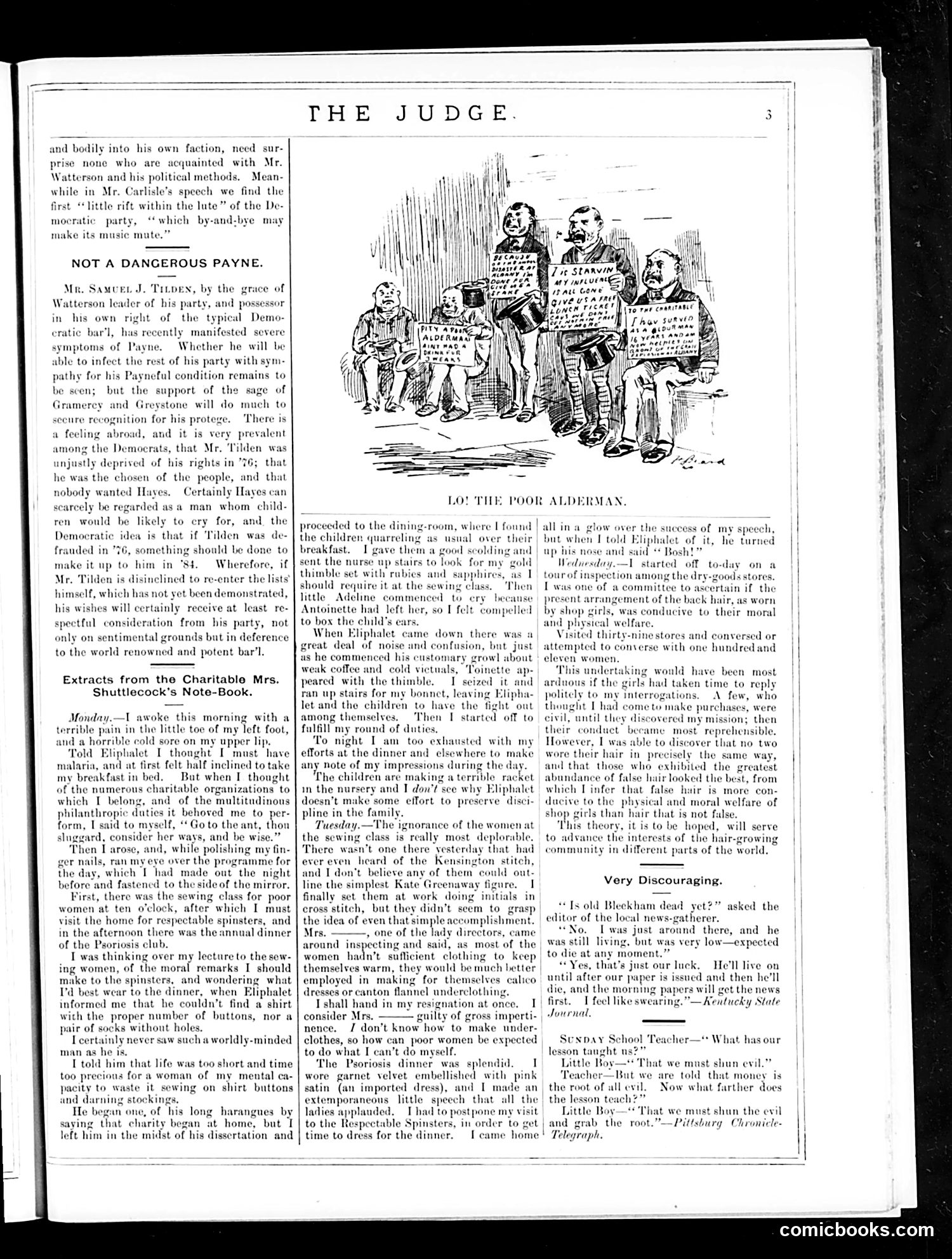
This page contains two distinct satirical pieces from a late-19th-century American political magazine. **"Not a Dangerous Payne"** discusses Samuel J. Tilden, a Democratic leader. The text suggests Tilden was unjustly denied the presidency in 1876 (the disputed Hayes-Tilden election). The satire criticizes how Democrats might attempt to compensate Tilden in 1884, warning that his reinstatement could fracture the party—hence the "rift within the lute" metaphor. **"Lo! The Poor Alderman"** cartoon depicts five working-class men holding signs indicating various misfortunes or complaints. The satire appears to mock aldermen (city officials) for neglecting public welfare while the poor suffer. **"Mrs. Shuttlecock's Note-Book"** is a satirical diary mocking wealthy women who perform charity work while ignoring their own household duties—a common Judge target. Mrs. Shuttlecock attends to poor women and spinsters while her husband lacks clean shirts, illustrating hypocrisy. The overall page exemplifies Judge's focus on political corruption, class inequality, and moral pretense among the privileged.
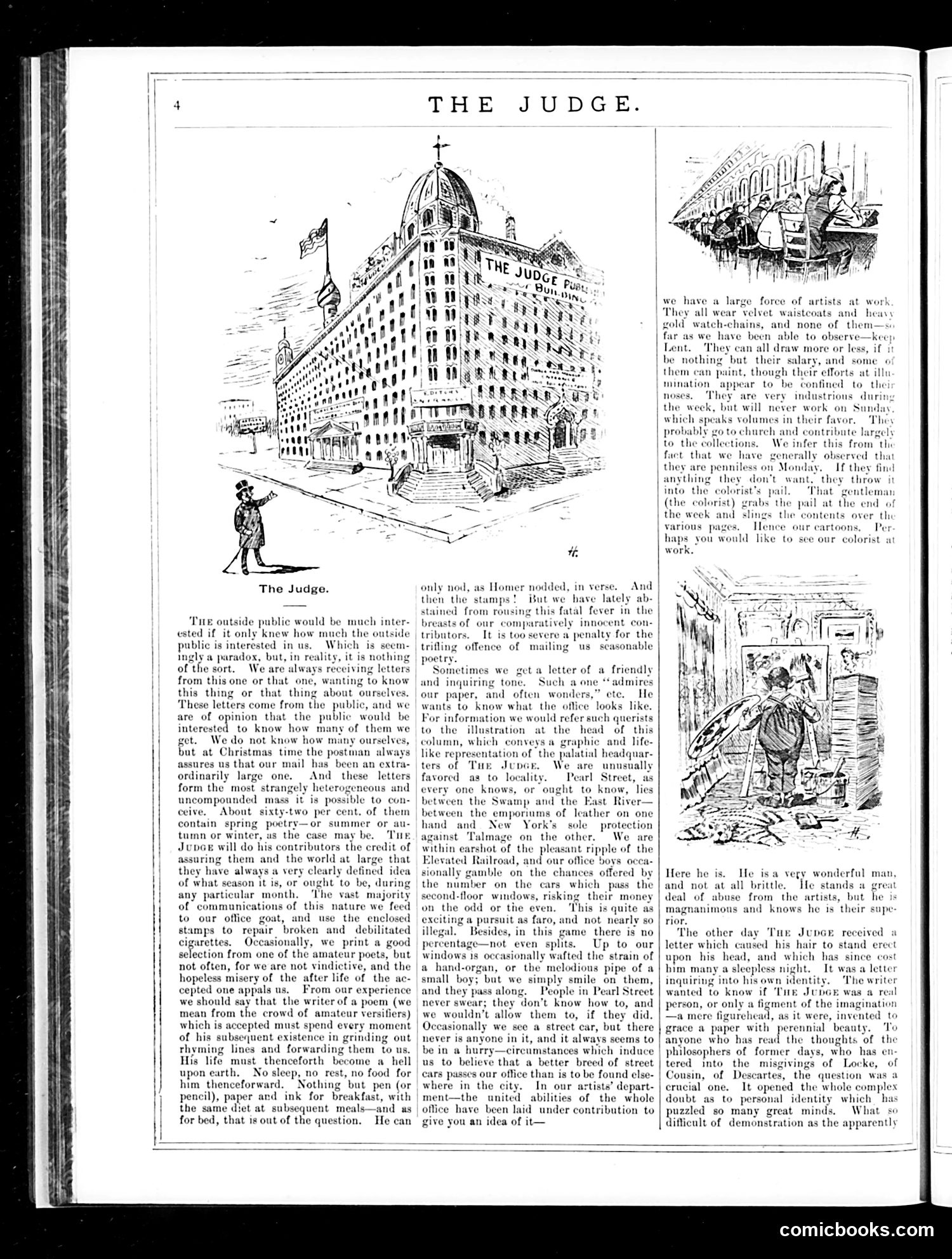
This page is primarily **editorial commentary** rather than a political cartoon. The editor of *Judge* magazine explains what letters and submissions the publication receives and how the office operates. **Key points:** The editor describes receiving countless amateur poems from readers—so many that rejected poets apparently become obsessed with resubmitting. He humorously suggests accepting one poem condemns the writer to eternal torment, compulsively writing verses. **The office itself:** Located on Pearl Street (between the leather district and East River in lower Manhattan), the illustration shows their building. The editor jokes that their office is so quiet, street cars passing the windows appear empty and unhurried. **The artists:** *Judge* employs many illustrators wearing velvet waistcoats and gold watch chains. They're industrious workers who never take Mondays off and create the magazine's cartoons. **The satire:** This is self-directed humor about the magazine's operations and the obsessive nature of amateur poets. It's workplace comedy rather than political commentary—poking fun at their own chaotic office life and slush pile.
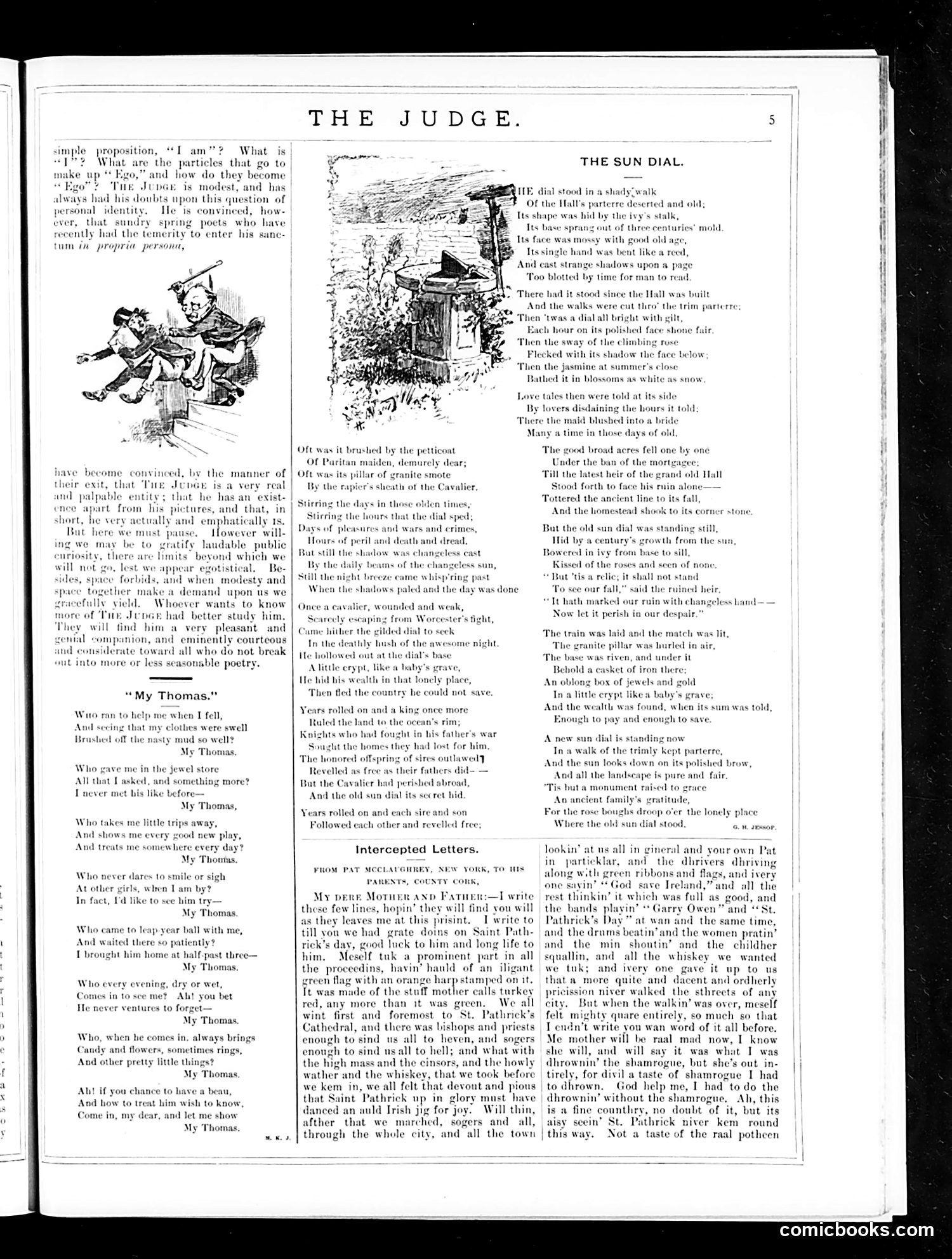
This page contains two distinct pieces: **Left side:** A humorous editorial titled "My Thomas" — a romantic poem celebrating an attentive boyfriend named Thomas who provides gifts, attention, and companionship. It's sentimental Victorian courtship humor, likely poking gentle fun at romantic devotion through repetitive praise. **Right side:** "The Sun Dial" — a lengthy narrative poem about an old sundial at a English manor house. The poem traces the dial's history through romantic and tragic events: it witnesses love stories, serves as a hiding place for a Cavalier's treasure during what appears to be the English Civil War period, and eventually becomes a symbol of time's passage and lost history. The poem is nostalgic, using the dial as a metaphor for how ordinary objects witness great historical and personal dramas. Neither piece appears satirical or overtly political. Both reflect late-19th-century *Judge* magazine's literary content—sentimental, romantic verse balanced with the more biting political cartoons typical of the publication.
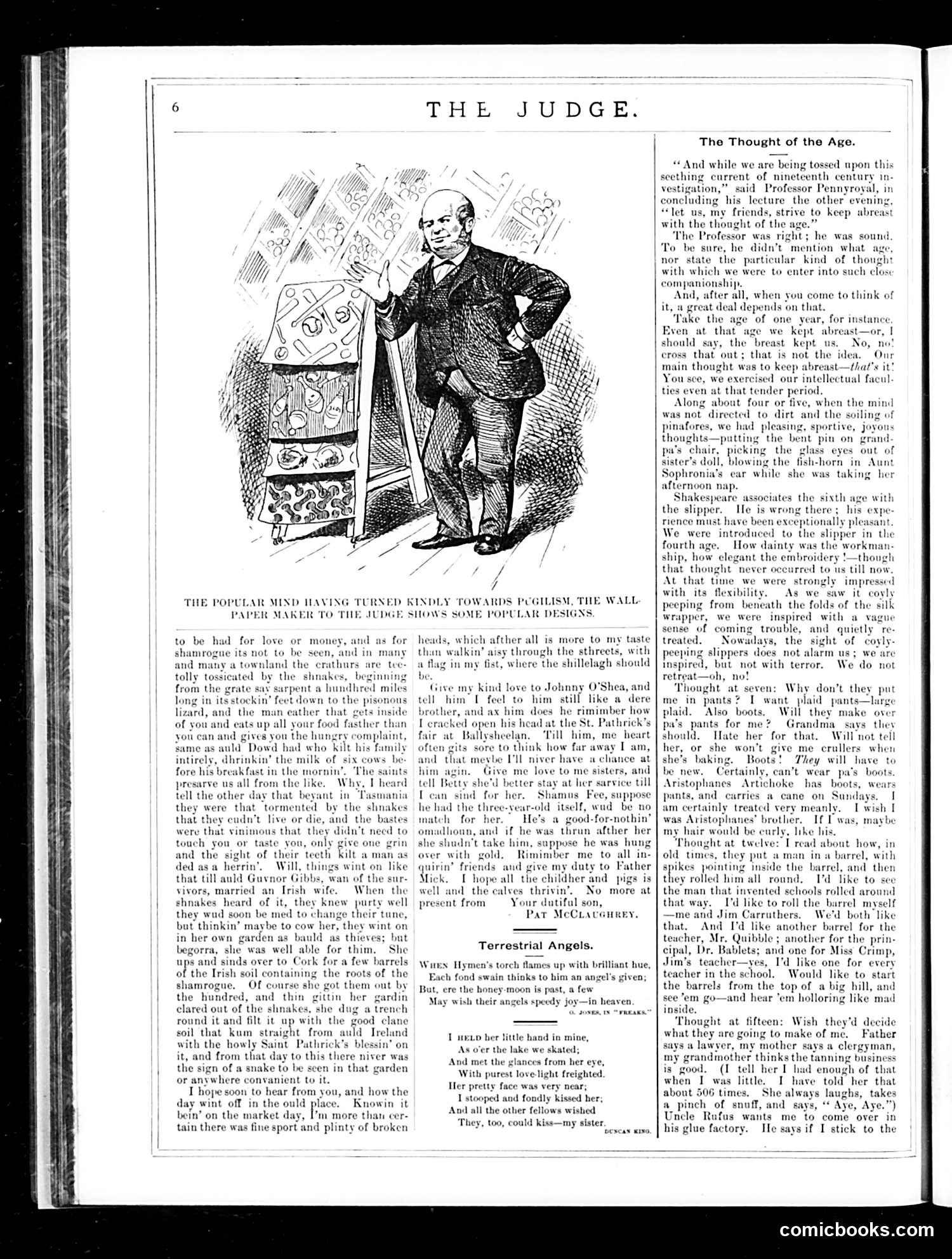
This page contains two distinct pieces of satirical content: **The Main Cartoon:** Depicts a wallpaper manufacturer presenting designs to a judge. The caption indicates that "the popular mind having turned kindly towards pugilism" (boxing/fighting), the wallpaper maker is showing designs featuring pugilistic imagery. The satire mocks how commercial manufacturers exploit whatever happens to be fashionable—in this case, boxing—by incorporating it into everyday consumer goods, reflecting the period's growing obsession with prizefighting. **The Text Content:** Includes two separate pieces: a humorous Irish-dialect letter describing snake-infested Tasmania and Irish resilience, and a poem about romantic love titled "Terrestrial Angels," plus editorial commentary titled "The Thought of the Age" about following intellectual trends. The page satirizes popular culture's tendency to commodify whatever captures public attention, whether fighting trends or philosophical fashions.
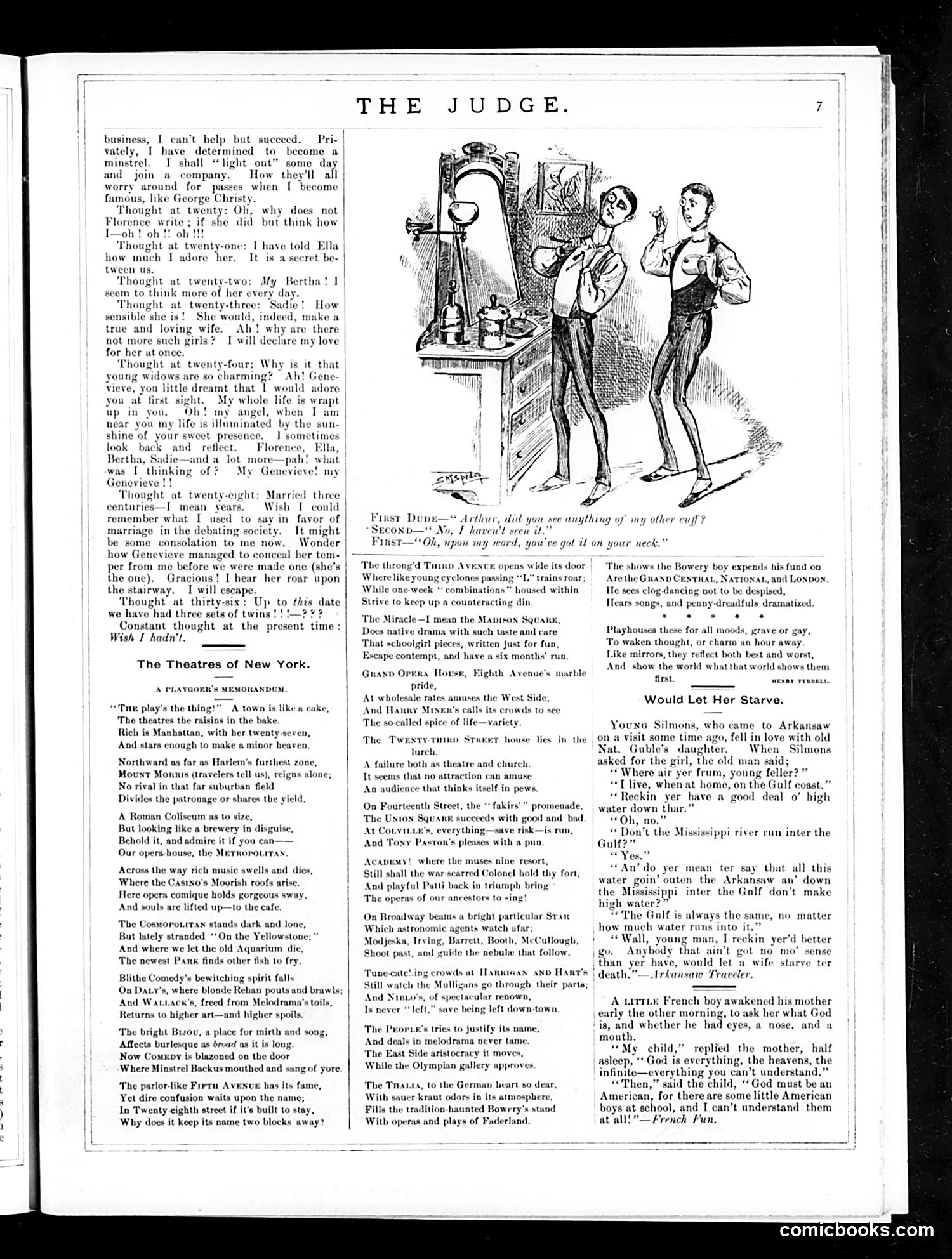
The main cartoon shows two thin men in what appears to be a dude ranch or similar establishment, with one asking the other "Arthur, did you see anything of my other calf?" The reply is "No, I haven't seen it," followed by "Oh, upon my word, you've got it on your neck." This appears to be a visual pun satirizing urban sophistication and pretense. The joke likely plays on the phrase "getting it on one's neck" (receiving criticism or blame) while depicting city men at a dude ranch, suggesting they're out of their element. The cartoonist mocks the artificial rusticity of such establishments and the naive urbanites who frequent them for entertainment. The surrounding text discusses various New York theaters, offering commentary on Manhattan's entertainment scene and cultural pretensions.
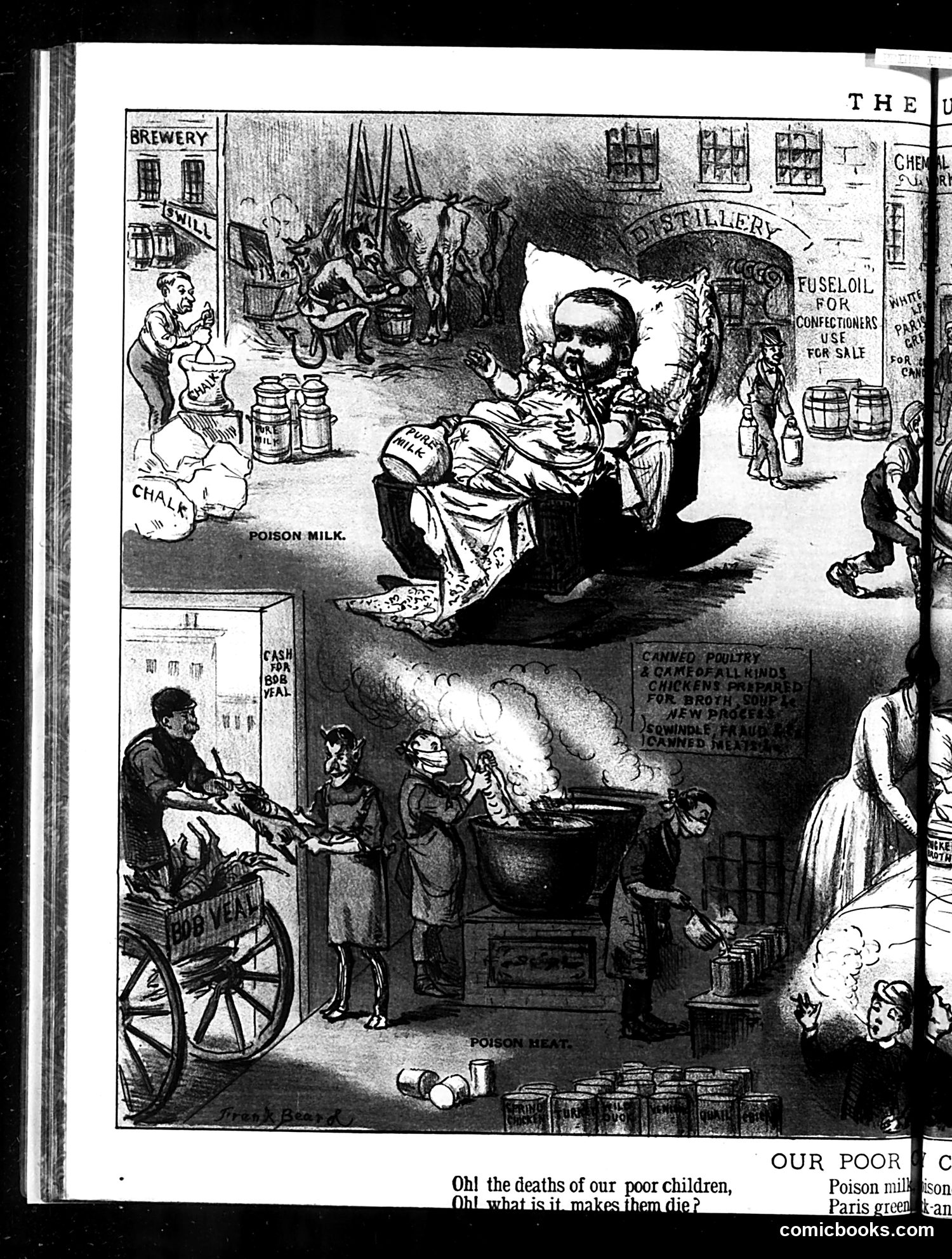
This is a satirical illustration about food adulteration and public health hazards in late 19th-century America. The cartoon depicts two scenarios labeled "POISON MILK" (top) and "POISON MEAT" (bottom), showing contaminated food sources reaching poor children and families. The top panel shows milk being distributed from what appears to be a brewery or distillery—suggesting milk was diluted or mixed with alcohol or other adulterants. The bottom panel depicts meat preparation in unsanitary conditions, with children present. The visible text "Oh! the deaths of our poor children, / Oh! what is it makes them die?" emphasizes the human cost. This satirizes the widespread problem of food contamination affecting working-class populations, likely advocating for food safety regulations and inspection standards. The "JUDGE" magazine context indicates this was political advocacy journalism masked as humor.
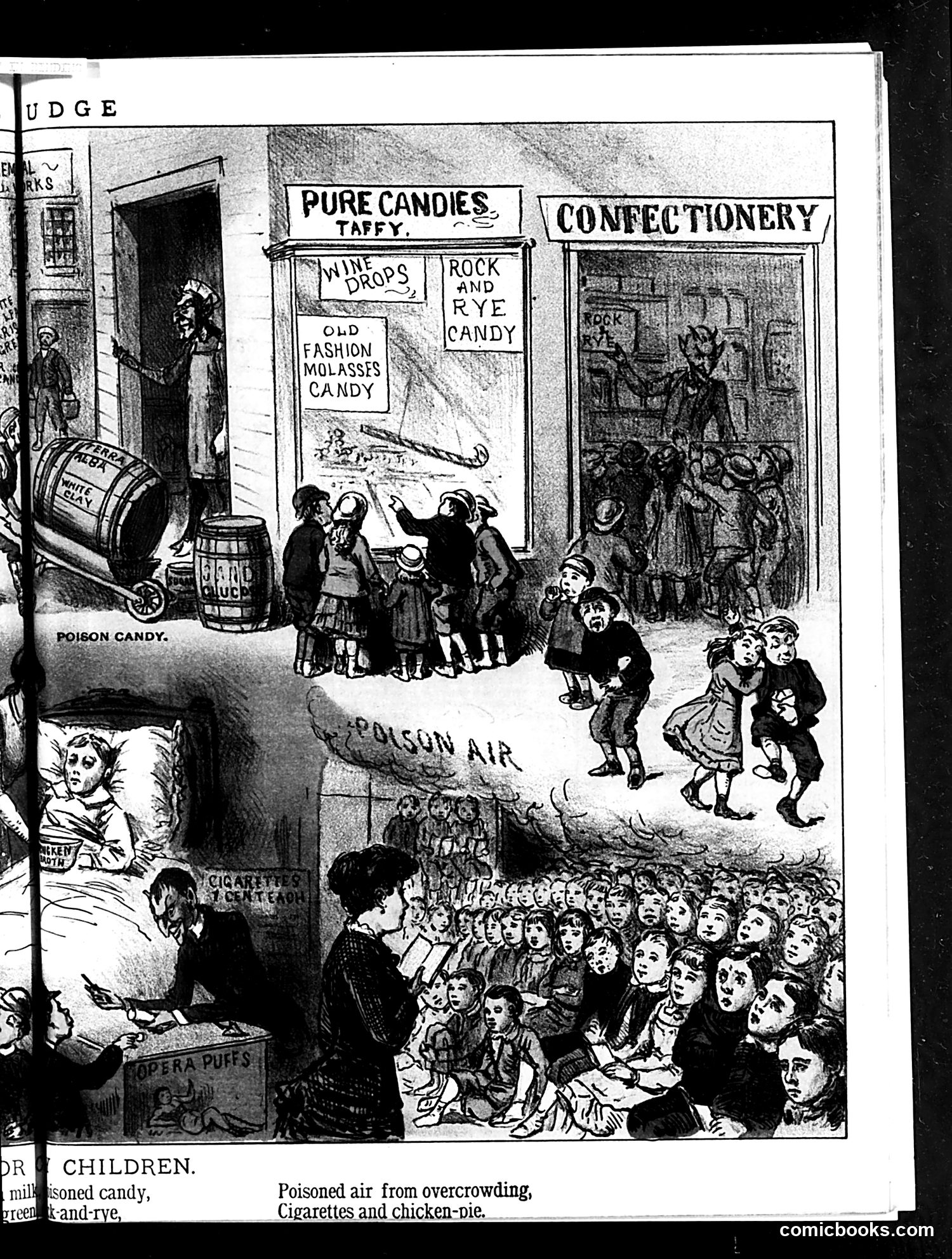
This is a satirical cartoon criticizing the sale of candy and other products to children in urban areas. The scene shows a confectionery shop with storefronts advertising "Pure Candies," "Taffy," "Wine Drops," and "Rock and Rye Candy"—products marketed as wholesome but presented here as dangerous. The satire contrasts the shops' innocent-sounding names with the actual hazards facing poor urban children depicted below: a massive crowd of sickly-looking children suffering from "poisoned air from overcrowding, cigarettes and chicken-pie." Additional dangers are labeled: a barrel marked "Poison Candy," a sick child in bed labeled "Cigarettes Destruction," and references to "Opera Puffs." The cartoon critiques both deceptive marketing to vulnerable children and the broader urban public health crisis—overcrowding, poor air quality, and inadequate nutrition—that made such products particularly harmful to impoverished youth.
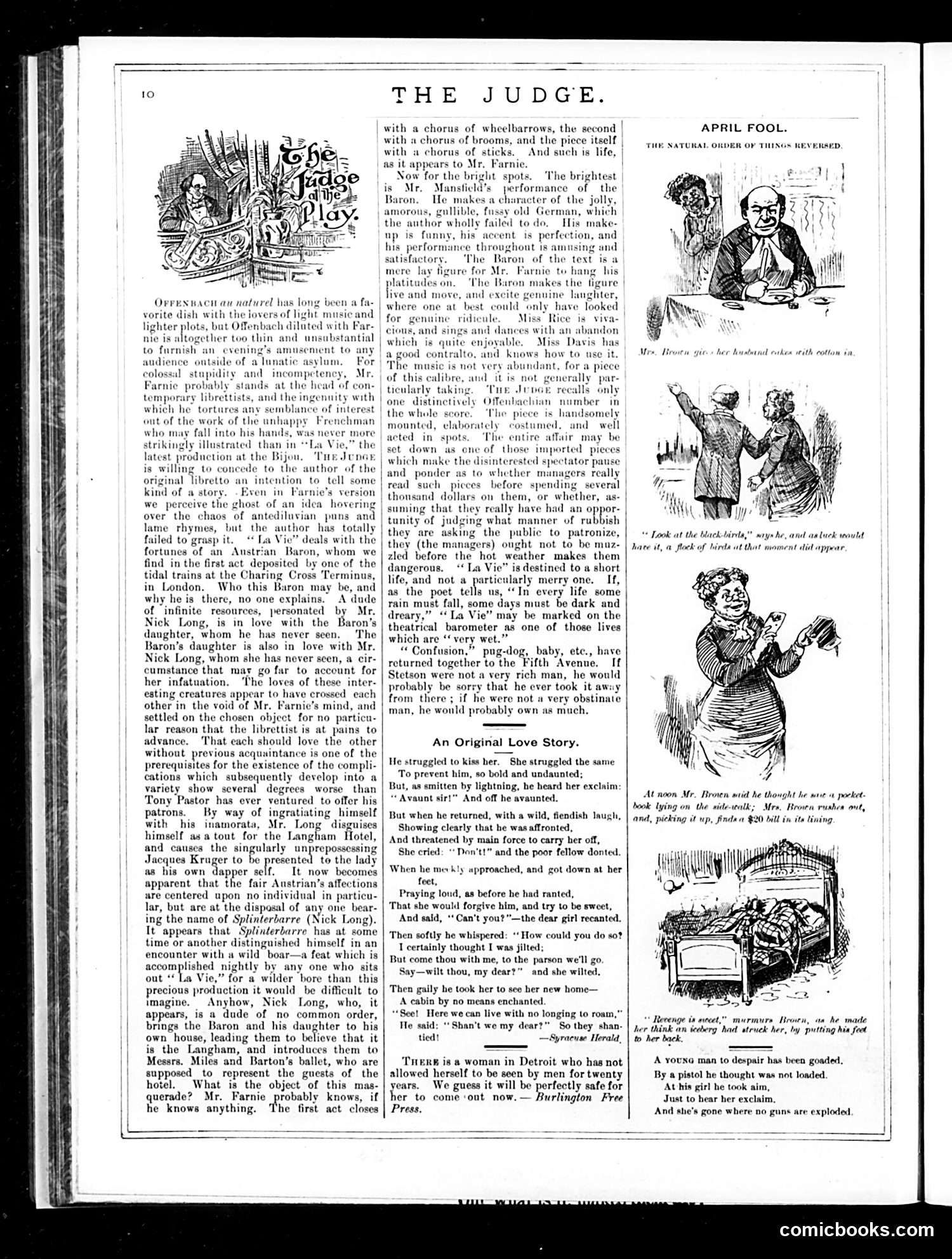
This page reviews **"La Vie,"** an Offenbach operetta adapted by librettist **Farnie** at London's Bijou Theatre. The critic savagely attacks Farnie's incompetence, calling him among the worst contemporary librettists. The plot—involving an Austrian Baron, a wealthy dude (Nick Long) in love with the Baron's daughter whom he's never met, reciprocal love based on nothing, and elaborate deceptions—is so nonsensical the critic suggests even Farnie may not understand it. However, **Richard Mansfield** receives praise for his charismatic performance as the Baron, transforming a thin character into something genuinely amusing through skilled acting and a perfect German accent. The review credits Mansfield's talent rather than Farnie's writing. The satirical point: even talented performers cannot salvage fundamentally inept dramatic work. The illustrations appear to show scenes from the production, though specific characters are unclear from the image alone.
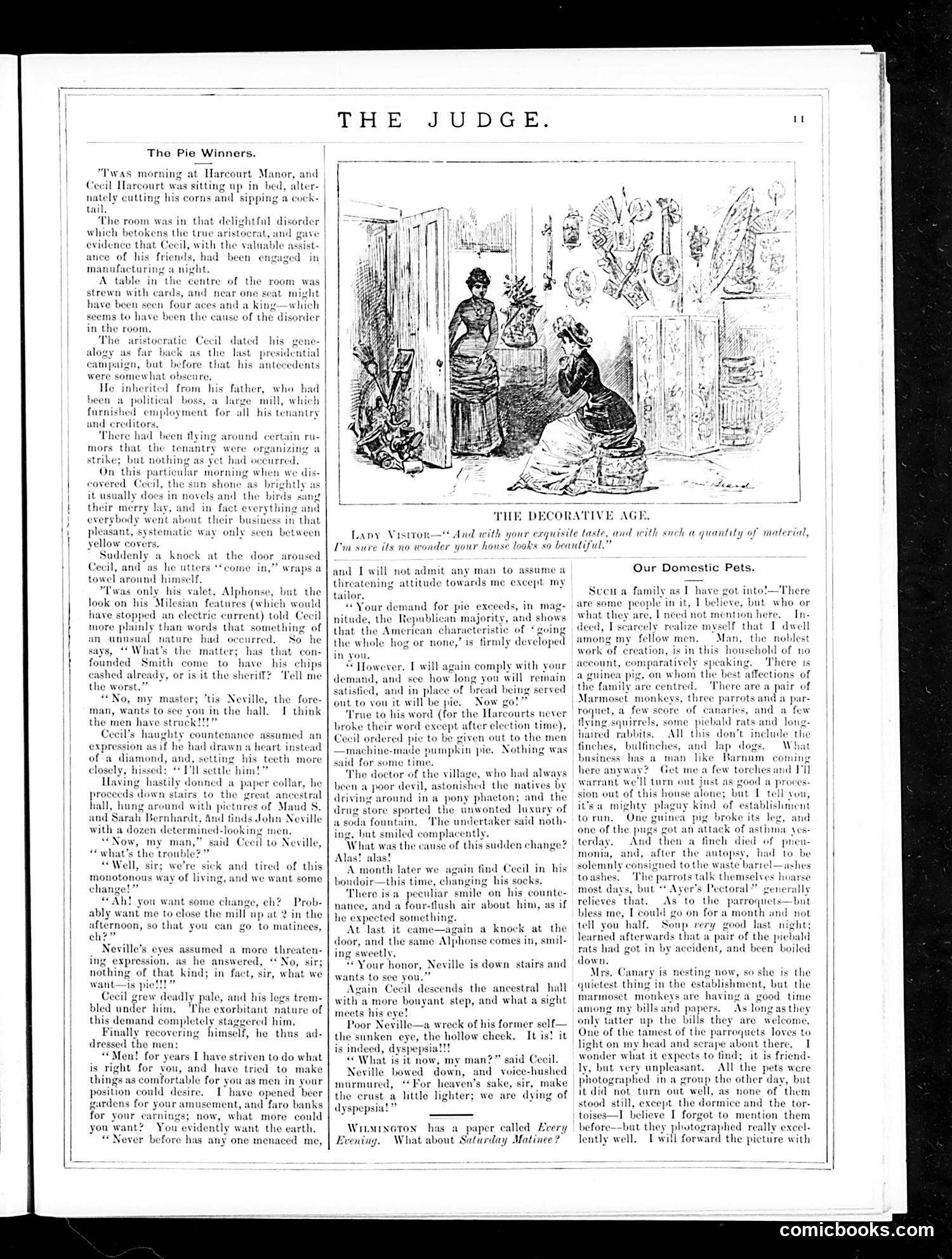
This satirical story mocks aristocratic condescension toward working-class labor unrest. Cecil Harcourt, a wealthy landowner with inherited political connections, faces striking tenants demanding better conditions. Rather than negotiate seriously, he patronizingly assumes they want "change"—implying frivolous desires—and offers them pie as a solution. The joke targets both Cecil's obliviousness to legitimate grievances and his lazy paternalism: he believes providing "beer gardens" and "faro banks" (gambling) constitutes generosity. When forced to give "machine-made pumpkin pie" to the workers, a month later everyone in the village (doctor, undertaker, druggist) mysteriously becomes happy and well-off—implying the pie somehow magically resolved the crisis. The satire critiques how wealthy elites dismiss working-class demands as unreasonable while offering trivial concessions as if solving real problems. The "decorative age" framing reinforces that such shallow gestures are merely aesthetic window-dressing.
This page contains multiple items, but the most prominent is the "Cullud Man's Corner" - a dialect-based humor column using heavy, mocking misspellings and stereotyped language to represent African American speech. The section offers pseudo-folk wisdom ("Better go fru de swamp to see yer gal dan to go 'cross de feels") presented as humorous advice from Black characters. This reflects late 19th-century Judge magazine's casual racism: the "humor" relies entirely on mocking African American dialect, intelligence, and morality (warnings against stealing, infidelity, violence). No actual joke structure exists—the satire is the caricature itself. The other content includes anecdotes about a squirrel incident and Artemus Ward (a historical humorist), plus advertisements. These are standard magazine filler, but the "Cullud Man's Corner" exemplifies how mainstream American publications normalized racial mockery as entertainment.
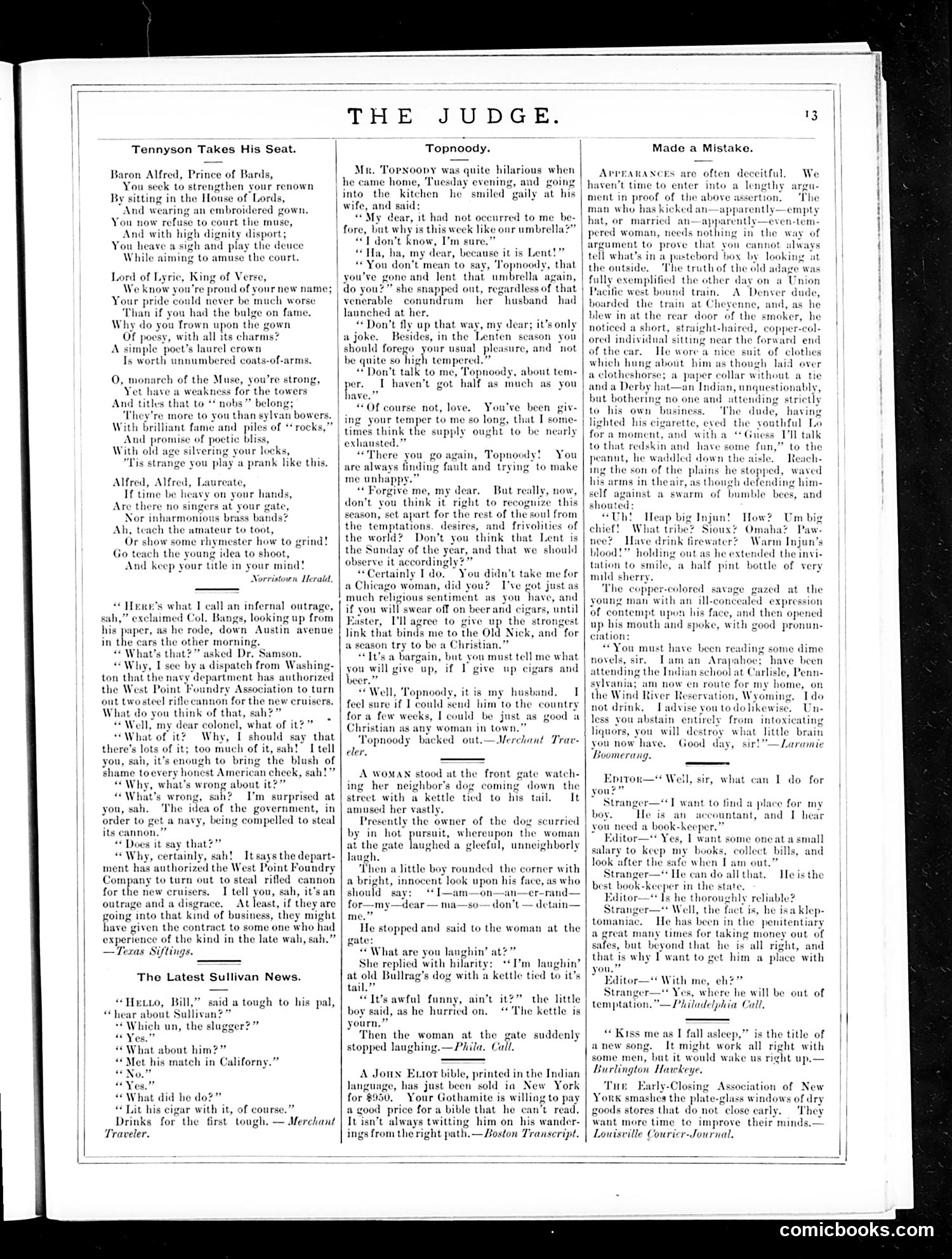
This page contains three distinct sections satirizing 1880s British and American society: **"Tennyson Takes His Seat"** mocks poet Alfred Lord Tennyson's acceptance of a peerage (baronetcy), joining the House of Lords. The satire criticizes him for abandoning poetry for aristocratic titles and "dignity," suggesting he's traded genuine artistic achievement for hollow social status and fancy robes. **"Topnoody"** depicts a husband and wife's bickering, where she accuses him of lending their umbrella during Lent—suggesting he's hypocritical about religious observance. He counters by noting her own "temper," proposing she give up her worst trait while he abandons beer and cigars for Lent. The joke satirizes superficial religious practice and marital hypocrisy. **"The Latest Sullivan News"** contains a brief joke about a rough using a cigar as a lighter—likely referencing boxer John L. Sullivan or the popular "tough" culture of the era, mocking lower-class behavior. The page overall satirizes pretension, hypocrisy, and social climbing across class boundaries.
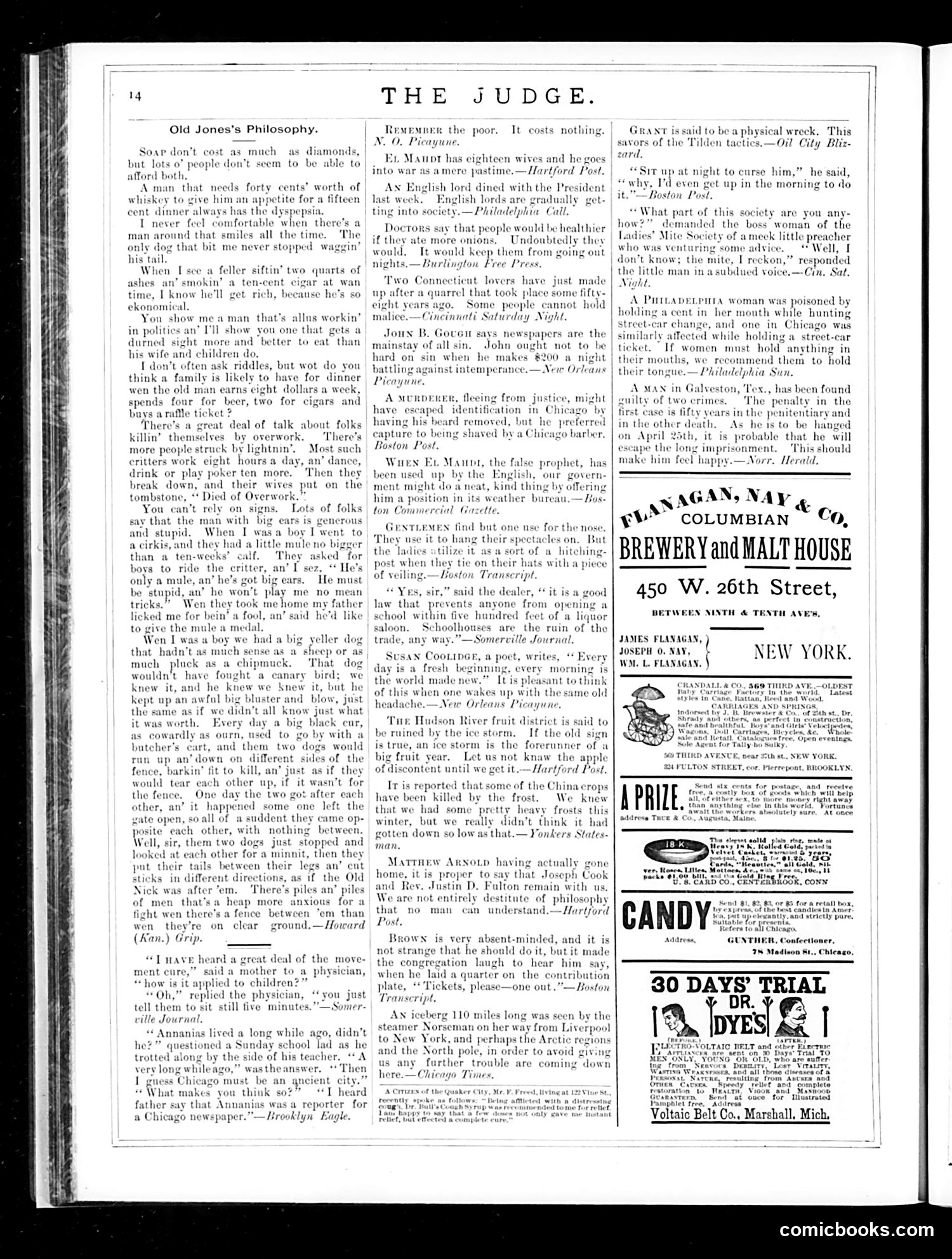
This page is primarily **advertising and humor commentary** rather than political cartoons. It features: **"Old Jones's Philosophy"** — A folksy advice column using rural/working-class vernacular to mock pretension. Jones critiques people who spend beyond their means (whiskey, cigars, beer) while earning modest wages, and rails against the myth that overwork kills people (he suggests they're actually killed by dissipation). **The scattered witticisms below** are brief satirical quips about social absurdities: a Connecticut couple reconciling after 8 years of quarreling; the notion that onions improve health (by keeping people home); commentary on marriage customs and false prophets. **No specific political figures** are caricatured visibly. The satire targets **general American failings**: working-class financial irresponsibility, pseudo-scientific health claims, and social hypocrisy. The advertisements (brewery, candy, dyes) occupy significant space, typical for Judge's business model.
This page is primarily **advertisements and filler content** rather than a coherent satirical cartoon. The main visual element is a Cupid illustration labeled "See What Cuticura Does for Me"—a beauty product ad. The text section titled "The Way It Goes" contains **short humorous anecdotes** about contemporary social situations: - **Leap year courtship**: A bachelor hopes a woman will propose in leap year, but nothing happens; he becomes angry. - **Marriage regrets**: A man divorced after fifteen minutes because he "knew if she waited till she knew him better, she'd never have him." - **Social commentary**: Jokes about lying, book salesmen, local politics, and a St. Louis woman who married hastily to avoid better judgment. These jokes reflect **late 19th-century anxieties** about gender roles, particularly women's autonomy in courtship and marriage—leap year traditions allowed women to propose. The humor targets both genders: foolish bachelors and impulsive women. The page is otherwise filled with **patent medicines, pianos, and typesetting equipment advertisements**—typical Judge content of the period. No specific political figures or events are targeted.
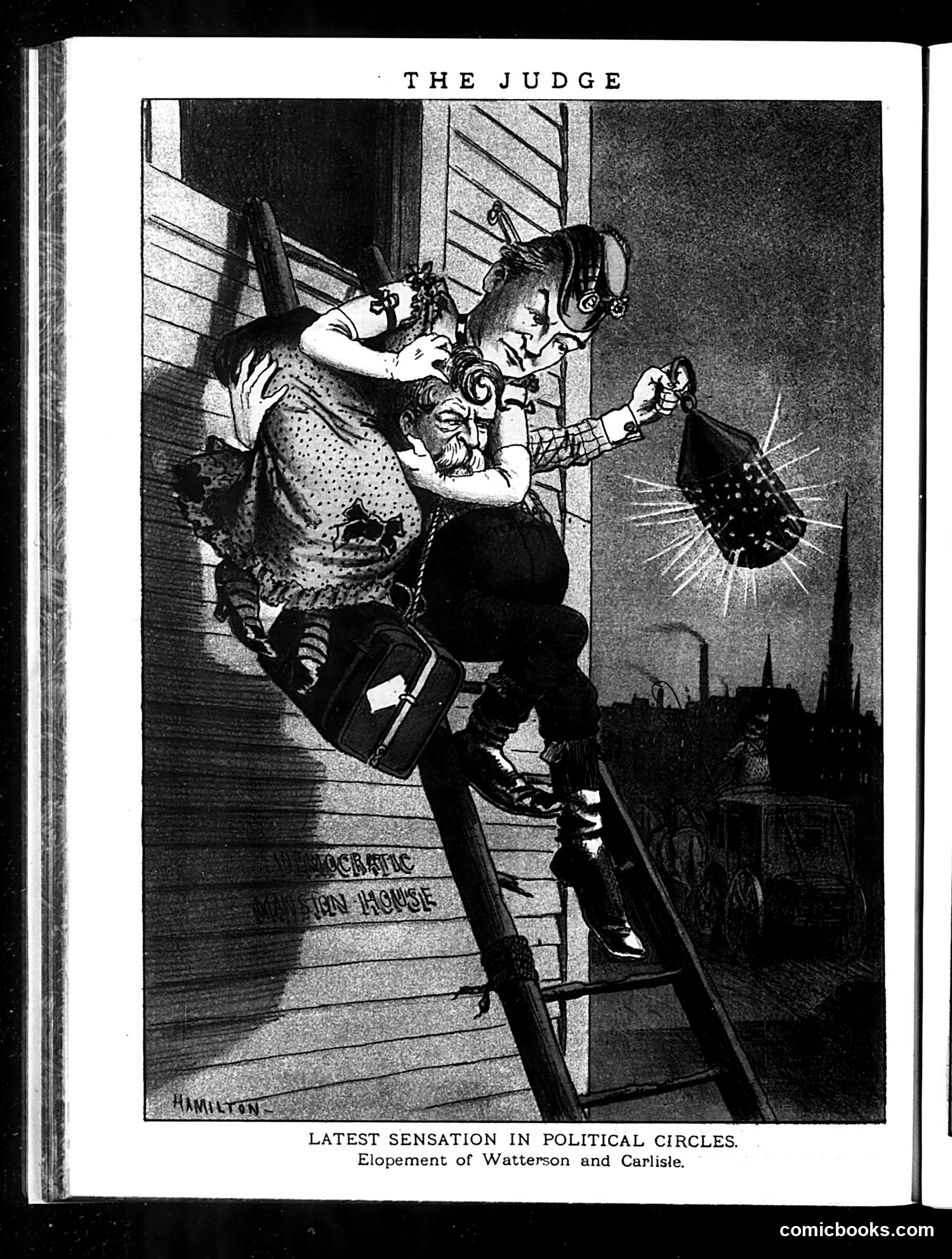
This Judge magazine cartoon satirizes a scandal in political circles involving two prominent figures: **Watterson** and **Carlisle**. The caption's reference to an "elopement" is metaphorical—suggesting these two politicians have unexpectedly joined forces or allied themselves in a shocking way. The illustration depicts a man and woman (caricatured figures) climbing out a window of what appears to be a government building, carrying bundles and escaping into the night. A searchlight or spotlight illuminates them, emphasizing the public scandal. The cartoonist (Hamilton) uses the elopement metaphor to mock what was likely a controversial political partnership or betrayal of party loyalty that shocked contemporary observers. Without additional context, the specific historical event remains unclear, but the satire targets political opportunism or unexpected coalitions in late-19th or early-20th century American politics.