
Judge, 1884-04-05 · page 2 of 16
Judge — April 5, 1884 — page 2: what you’re looking at
What you’re looking at
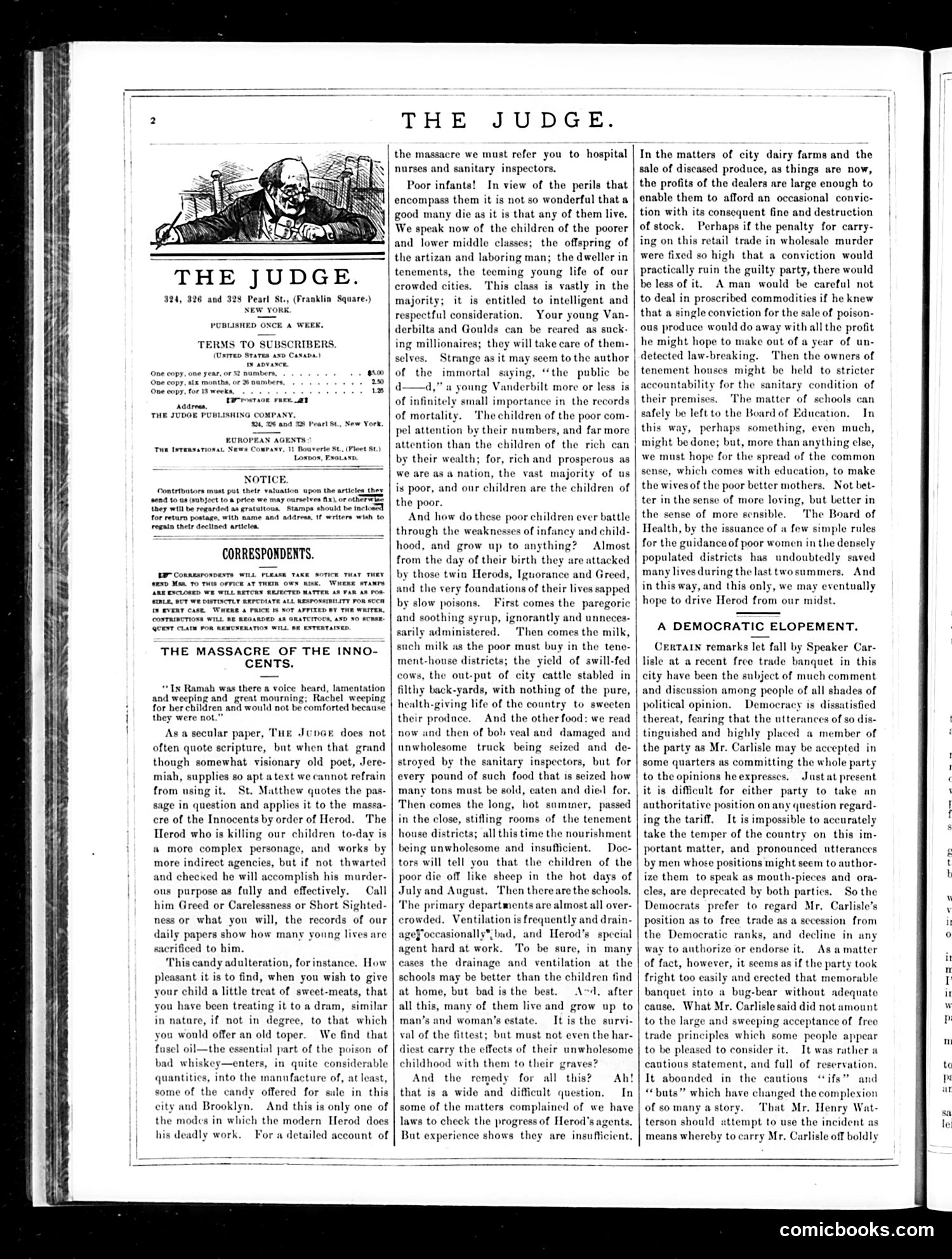
This page from *Judge* magazine satirizes the dangers facing poor children in late 19th-century America. The editorial compares contemporary threats to children to King Herod's biblical "Massacre of the Innocents." The target is not a specific political figure but rather systemic "Greed" and "Carelessness." The magazine highlights real hazards: adulterated candy containing fusel oil (poisonous whiskey byproduct), contaminated milk in tenement districts, and inadequate sanitation. The satire argues that while wealthy children like Vanderbilts and Goulds are protected, poor children—the majority—face preventable deaths from poisoned food, unsanitary conditions, and ignorant medical practices (laudanum-laced syrups). *Judge* uses religious language ironically to shame society for tolerating these conditions. The cartoon illustrates a skeletal figure (Death) hovering over vulnerable infants, emphasizing the moral outrage of preventable childhood mortality among the urban poor.
📄 Transcribed text from this page (OCR, searchable)
Machine-transcribed from the original scan — historical spelling and the odd misread are preserved.
THE JUDGE. 324, 326 and 328 Pearl St., (Franklin Square.) NEW YORK, PUBLISHED ONCE A Wi TERMS TO SUBSCRIBERS. (Usrrep States axD 1 apvasce, 2 numbers SB oumbers, One copy. « Ove copy, « One copy, fo 1 year, months, Addrees, THE JUDGE PUBLISHING COMPANY. FI 8t., New York, 11 Douverte St. (Fleet St.) Loxpor, F they will be regarded as gratuitous Stamps «by for return postage, with name and address tf writers wiah to regain thetr declined articles, 4 be ine axxo Man To THis OFNICE AT THEIR OW ARE EXCLORED WE WIL (ERLE, HOT WE DISTINCTLY REFUDIATE ALL RESTON fe EVERY Case WHERE 4 PRICE #8 SOT AFFIXED RY THR WRITER, CONTRIBUTIONS WILL. RE REOARDED AS GRATCITODA, AXD 40 ACREE QUEYT CLAM POR RENUNERATION WILL SIE ENTERTAINED. THE MASSACRE OF THE INNO- CENTS. “Is Ramah was there a voice heard, lamentation and weeping and great mourning; Rachel weeping for her children and would not be comforted because they were not.” Asasecular paper, THE June does not often quote scripture, but when that grand though somewhat visionary old poet, Jere- miah, supplies so apt atext we cannot refrain from using it. St, Matthew quotes the pas- in question and applies it to the massa- cre of the Innocents by order of Herod. The Herod who is killing our children to-day is & more complex personage, and works by more indirect agencies, but if not thwarted and checked he will accomplish his murder- ous purpose as fully and effectively. Call him Greed or Carelessness or Short Sighted- ness or what you will, the records of our daily papers show how many young lives are sacrificed to him, ‘This candy adulteration, for instance. How pleasant it is to find, when you wish to give your child a little treat of sweet-meats, that you have been treating it toa dram, simi in nature, if not in degree, to that which you wonld offer an old toper. We find that fusel oil—the essential part of the poison of bad whiskey—enters, in quite considerable quantities, into the manufacture of, at least, some of the candy offered for sale in this city and Brooklyn. And this is only one of the modes in which the modern Herod does his deadly work. For a detailed account of THE JUDGE. the massacre we must refer you to hospital nurses and sanitary inspectors. Poor infants! In view of the perils that encompass them it is not so wonderful that a good many die as it is that any of them live. We speak now of the children of the poorer and lower middle classes; the offspring of the artizan and laboring man; the dweller in tenements, the teeming young life of our crowded cities. This class is vastly in the majority; it is entitled to intelligent and respectful consideration. Your young Van- derbilts and Goulds can be reared as suck- ing millionaires; they will take care of them- Strange as it may seem to the author of the immortal saying, ‘the public be selves. d——d,” of infinitely s of mortality. pel attention by their numbers, and far more attention than the children of the rich can by their wealth; for, rich and prosperous as we are as a nation, the vast majority of us is poor, and our children are the children of the poor. And how do these poor children ever battle through the weakne: of infancy and child- hood, and grow up to anything? Almost from the day of their birth they are attacked by those twin Herods, Ignorance and Greed, and the very foundations of their lives sapped by slow poisons. First comes the paregoric and soothing syrup, ignorantly and unneces- sarily administered. Then comes the milk, such milk as the poor must buy in the tene- ment-house districts; the yield of swill-fed cows, the out-put of city cattle stabled in filthy back-yards, with nothing of the pure, health-giving life of the country to sweeten their produce. And the other food: we read now and then of bob veal and damaged and unwholesome truck being seized and de- stroyed by the sanitary inspectors, but for every pound of such food that is seized how many tons must be sold, eaten and died for. Then comes the long, hot sumimer, passed in the close, stifling rooms of the tenement house districts; all this time the nourishment being unwholesome and insuflicient. Doc- tors will tell you that the children of the poor die off like sheep in the hot days of July and August. ‘Then thereare the schools. ‘The primary departments are almost all over- crowded. Vent agefoce young Vanderbilt more or less is all importance in the records ‘The children of the poor com- ition is frequently and drain- sionally*;bad, and Herod’s special agent hard at work. ‘To be sure, in many cases the drainage and ventilation at the schools may be better than the children find at home, but bad is the best. A>d. after all this, many of them live and grow up to man’s and woman’s estate. It is the survi- val of the fittest; but must not even the har- diest carry the effects of their unwholesome childhood with them to their graves? And the remedy for all this? Ab! that is a wide and difficult question. In some of the mutters complained of we have laws to check the progress of Herod's agents. But experience shows they are insufficient. In the matters of city dairy farms and the sale of diseased produce, as things are now, the profits of the dealers are large enough to enable them to afford an occasional convic- tion with its consequent fine and destruction of stock. Perhaps if the penalty for carry- ing on this retail trade in wholesale murder were fixed so high that a conviction would practically ruin the guilty party, there would be less of it. A man would be careful not to deal in proscribed commodities if he knew that a single conviction for the sale of poison- ous produce would do away with all the profit he might hope to make out of a year of un- detected law-breaking. Then the owners of tenement houses might be held to stricter accountability for the sanitary condition of their premises. ‘The matter of schools can safely be left to the Board of Education, In this way, perhaps something, even much, might be done; but, more than anything else, we must hope for the spread of the common sense, which comes with education, to make the wives of the poor better mothers. Not bet- ter in the sense of more loving, but better in the sense of more sensible. The Board of Health, by the issuance of a few simple rules for the guidance of poor women in the densely populated districts has undoubtedly saved many lives during the last twosummers. And in this way, and this only, we may eventually hope to drive Herod from our midst. A DEMOCRATIC ELOPEMENT. Certain remarks let fall by Speaker Car- lisle at a recent free trade banquet in this city have been the subject of much comment and discussion among people of all shades of political opinion. Democracy is dissatisfied thereat, fearing that the utterances of so dis- tinguished and highly placed a member of the party as Mr. Carlisle may be accepted in some quarters as committing the whole party to the opinions heexpresses, Just at present it is difficult for either party to take an authoritative position on any question regard- ing the tariff. It is impossible to accurately take the temper of the country on this im- portant matter, and pronounced utterances by men whose positions might seem to author- ize them to speak as mouth-pieces and ora- cles, are deprecated by both parties. So the Democrats prefer to regard Mr. Carlislo’s position as to free trade as a secession from the Democratic ranks, and decline in any way to authorize or endorse it. As amatter of fact, however, it seems as if the party took fright too easily and erected that memorable banquet into a bug-bear without adequate cause. What Mr. Carlisle said did not amount to the Jarge and sweeping ept of fr trade principles which some people appear to be pleased to consider it. It was rather a cautious statement, and full of reservation. It abounded in the cautions ‘ ifs” and “buts” which have changed the complexion of somany a story. That Mr. Henry Wat- terson should uttempt to use the incident as means whereby to carry Mr. Carlisle off boldly comicbooks.com