
Judge, 1884-04-05 · page 10 of 16
Judge — April 5, 1884 — page 10: what you’re looking at
What you’re looking at
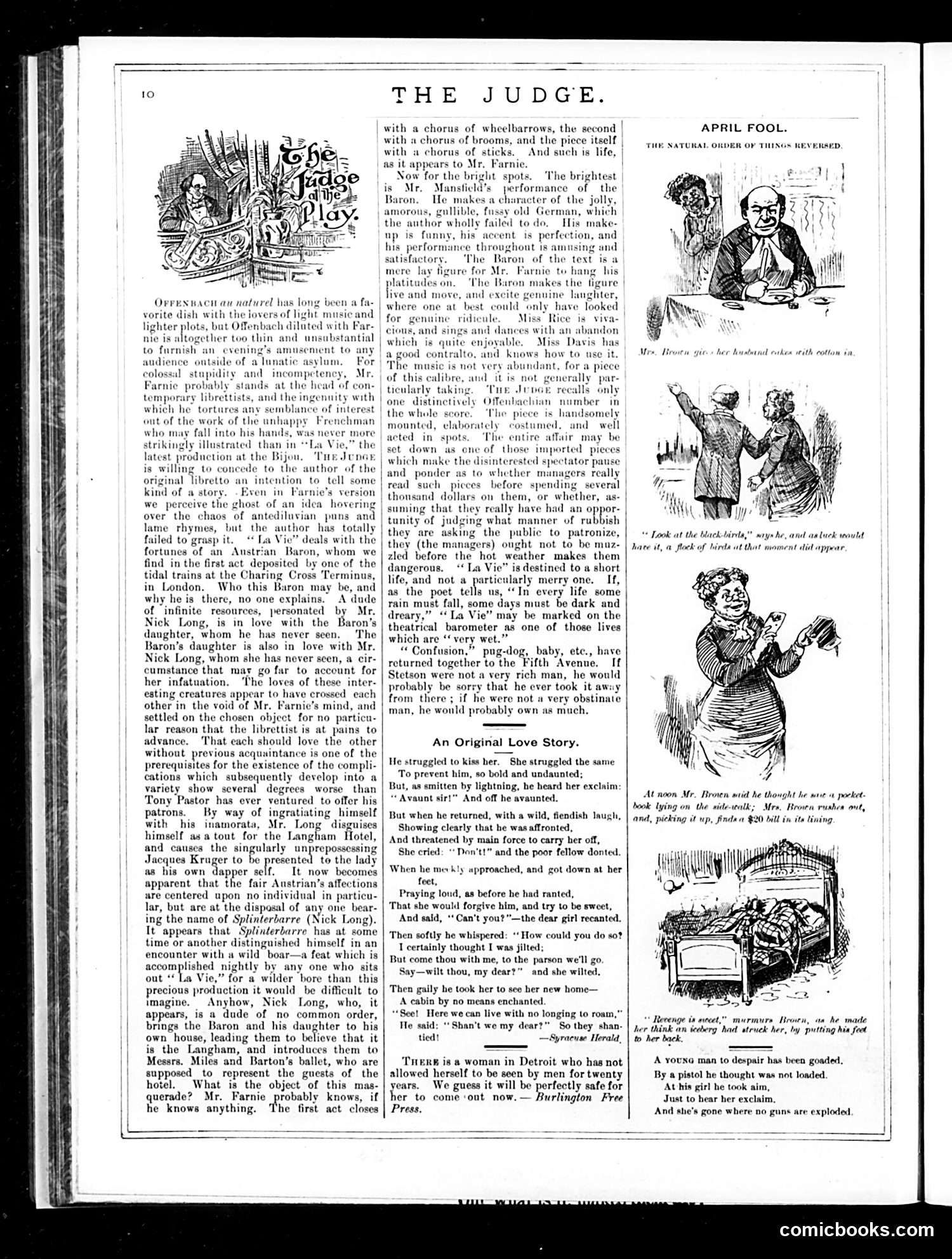
This page reviews **"La Vie,"** an Offenbach operetta adapted by librettist **Farnie** at London's Bijou Theatre. The critic savagely attacks Farnie's incompetence, calling him among the worst contemporary librettists. The plot—involving an Austrian Baron, a wealthy dude (Nick Long) in love with the Baron's daughter whom he's never met, reciprocal love based on nothing, and elaborate deceptions—is so nonsensical the critic suggests even Farnie may not understand it. However, **Richard Mansfield** receives praise for his charismatic performance as the Baron, transforming a thin character into something genuinely amusing through skilled acting and a perfect German accent. The review credits Mansfield's talent rather than Farnie's writing. The satirical point: even talented performers cannot salvage fundamentally inept dramatic work. The illustrations appear to show scenes from the production, though specific characters are unclear from the image alone.
📄 Transcribed text from this page (OCR, searchable)
Machine-transcribed from the original scan — historical spelling and the odd misread are preserved.
Orrennaci au naturel has long been a fi vorite dish with the lovers of light music lighter plots, but Offenbach diluted with Far- nie is altogether too thin and substantial to furnish an cvening’s amusement te audie outside of a lunatic lum. nlossal stupidity and incompetency, Mr. rnie probably’ stands at the head of con- temporary librettists, and the ing 5 which he tortures any semblance of intere out of the work of the unhappy Frenchn who may fall into his hands, was never more strikingly illustrated than in La Vie,” the atest production at the Bijc ‘Tue Junge is willing to conc to the author of the original libretto kind of a story. .Even in Farnie’s version we perceive the ghost of an idea hovering over the chaos of antediluvian puns and lame rhymes, but the author has y failed to grasp it. ‘* La Vie” deals with the fortunes of an Austrian Baron, whom we find in the first act deposited by one of the tidal trains at the Charing Cross Terminus, in London. Who this Baron may be, and A dude of infinite resources, personated by Mr. Nick Long, is in love with the Baron’s daughter, whom he has never seen. The Baron’s daughter is also in love with Mr. ick Long, whom she has never seen, a cir- cumstance that may go far to account for her infatuation. ‘The loves of these inter- esting creatures appear to have crossed each other in the void of Mr. Farnie’s mind, and settled on the chosen object for no particn- lar reason that the librettist is at pains to advance. That each should love the other without previous acquaintance is one of the prerequisites for the existence of the compli- cations which subsequently develop into a variety show several degrees worse than Tony Pastor has ever ventured to offer his patrons. By way of ingratiating himself with his inamorata, Mr. Long disguises himself asa tout for the Langham Hotel, and causes the singularly unprepossessing Jacques Kruger to be resented to the lady as his own dapper self. It now becomes apparent that the fair Austrian’s affections ure centered upon no individual in particu- lar, but are at the disposal of any one bear- ing the name of Splinterbarre (Nick Long). It appears that Splinterbarre has at some time or another distinguished himself in an encounter with a wild boar—a feat which is accomplished nightly by any one who sits out ‘‘ La Vie,” for a wilder bore than this precious production it would be difficult to imagine. Anyhow, Nick Long, who, it appears, is a dude of no common order, brings the Baron and his daughter to his own house, leading them to believe that it is the Langham, and introduces them to Messrs. Miles and Barton’s ballet, who are supposed to represent the guests of the hotel. What is the object of this mas- querade? Mr. Farnie probably knows, if he knows anything. The first act closes un why he is there, no one explains. nuity with | intention to tell some | totally | THE JUDGE. with a chorus of wheelb with a chorus of brooms, with a chorus of stick as it appears to Mr, Farnie. Now for the bright spots. The brightest is Mr. Mansficld’s performance of the Baron. He ma achuracter of the jolly, amorous, gullible, fussy old German, which the author wholly fai todo. His make- up is funny, his accent is perfection, a his performance throughout is amt satisfactory. he Baron of the text mere lay figure for Mr. Farnie to hang his platitudes on. ‘The Baron makes the fi ive and move, and excite genuine I | where one at best could only have for genuine ridicule Miss Rice is viva- cious, and sings and dances with an abandon | which is quite enjoyable. Miss Davis has a good contralto, and knows how to use it. The music is not very abundant, for a piece of this calibre, and it is not ticularly tak Tie Je one distinctively Offenbachian the whole score. ‘The piec mounted, elaborately costuni and acted in spots. The entire affair may be set down as one of those imported pieces which make the disinterested spectator p and ponder as to whether m really read such picces before spet thousand dollars on them, or whether, as- suming that they really have had an oppor- tunity of judging what manner of rubbish | they ‘are asking the public to patronize, they (the nagers) ought not to be muz- zled before the hot weather makes them dangerous. ‘‘ La Vie” is destined to a short life, and not a particularly merry one. If, as the poet tells us, ‘In every life some | rain must fall, some days must be dark and | dreary,” “La Vie” may be marked on the theatrical barometer as one of those lives which are ‘‘ very wet.” “ Confusion,” pug-dog, baby, ete., have returned together to the Fifth Avenue. If Stetson were not a very rich man, he would probably be sorry that he ever took it a from there ; if he were not a very obstinate man, he would probably own as much. rrows, the second And such is life, hand. An Original Love Story. He struggled to kiss her. She struggled the same To prevent him, so bold and undaunted; But, as smitten by lightning, he heard her exclaim Avaunt sir!” And off he avaunted. But when he returned, with a wild, fiendish Inugh, Showing clearly that he was affronted, And threatened by main force to carry her off, She cried: “Don't!” and the poor fellow donted. When he me kiy approached, and got down at her feet, Praying loud, as before he had ranted, ‘That she would forgive him, and try to be sweet, And said, “Can't you? "—the dear girl recanted. Then softly he whispered: ‘How could you do sot I certainly thought I was jilted; But come thou with me, to the parson we'll go. Say—wilt thou, my dear?” and she wilted, ‘Then gaily he took her to sce her new home— A cabin by no means enchanted ‘ Here we can live with no longing to roam,” e said: “"Shan’t we my dear?” So they shan- tied! —Syracuse Herald, Tiers is a woman in Detroit who has not allowed herself to be seen by men for twenty years. We guess it will be perfectly safe for her to come ‘out now. — Burlington Free Press. ind the piece itself | APRIL FOOL. THE NATURAL ORDER OF THINGS REVERSED, At noon Mr. Brown mid he thought he uve porket. book lying on the wide-walk Mrs, Brown rushes ont, and, picking it up, finden i * Revenge is mrcet,” murmura Brown, aa he made her think an teeberg'had struck her, by putting hia feet to her back, A yousa man to despair has been goaded, By a pistol he thought was not loaded. At his girl he took aim, Just to hear her exclaim, And she’s gone where no guns are exploded comicbooks.com