
A complete issue · 16 pages · 1884
Judge — January 12, 1884
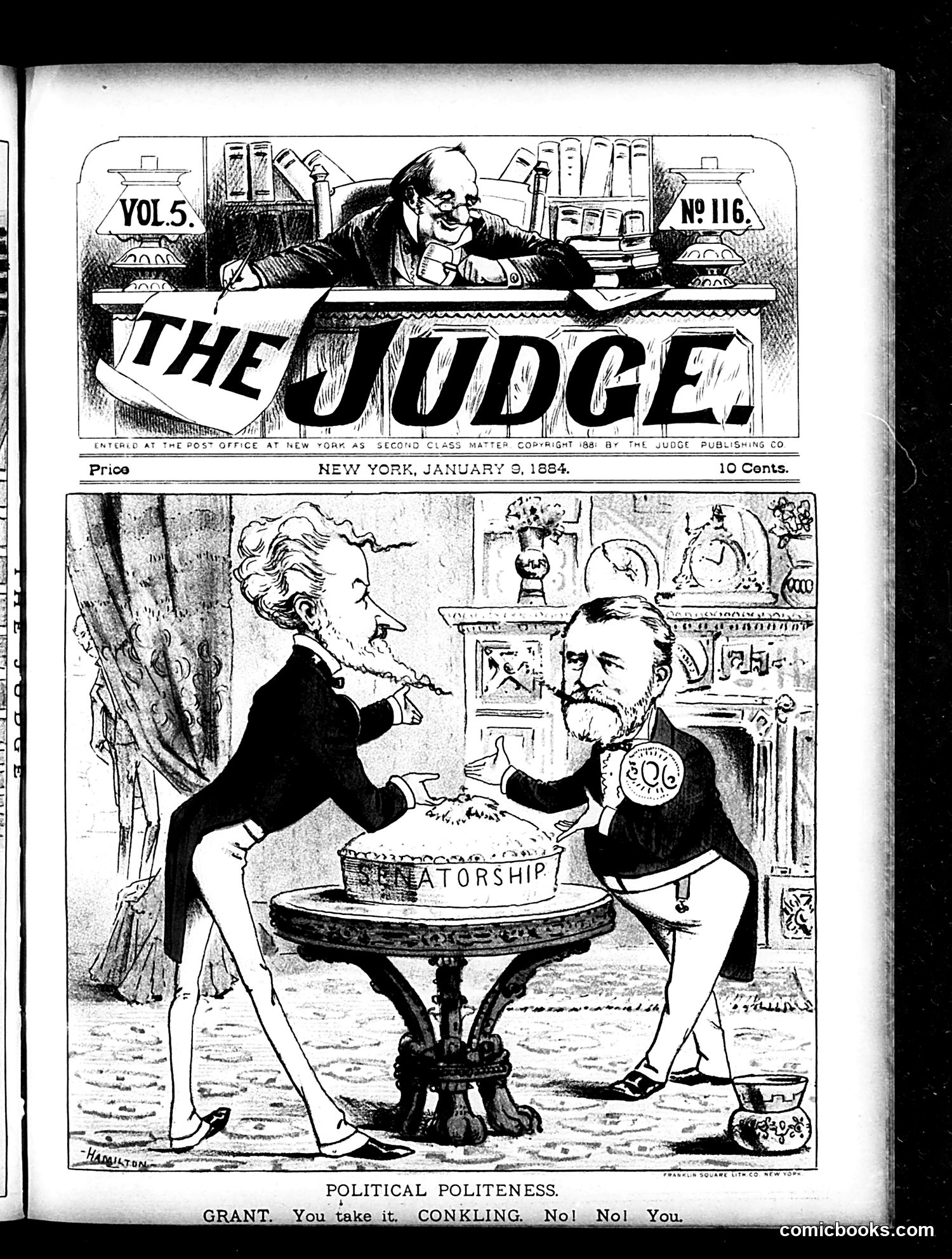
This cartoon depicts two figures in formal dress positioned opposite each other at a small table labeled "SENATORSHIP," engaged in a tense negotiation. The caption reads: "GRANT. You take it. CONKLING. No! No! You." The satire concerns a disputed Senate seat. Based on the historical context of 1884, this likely references a political conflict between former President Ulysses S. Grant and Senator Roscoe Conkling, prominent Republican figures. The cartoon mocks their exaggerated politeness—each insisting the other claim the position—as false civility masking genuine political ambition. The artist (Hamilton, per signature) suggests both men desperately want the seat while maintaining a facade of gentlemanly deference, exposing the hypocrisy beneath formal political discourse.
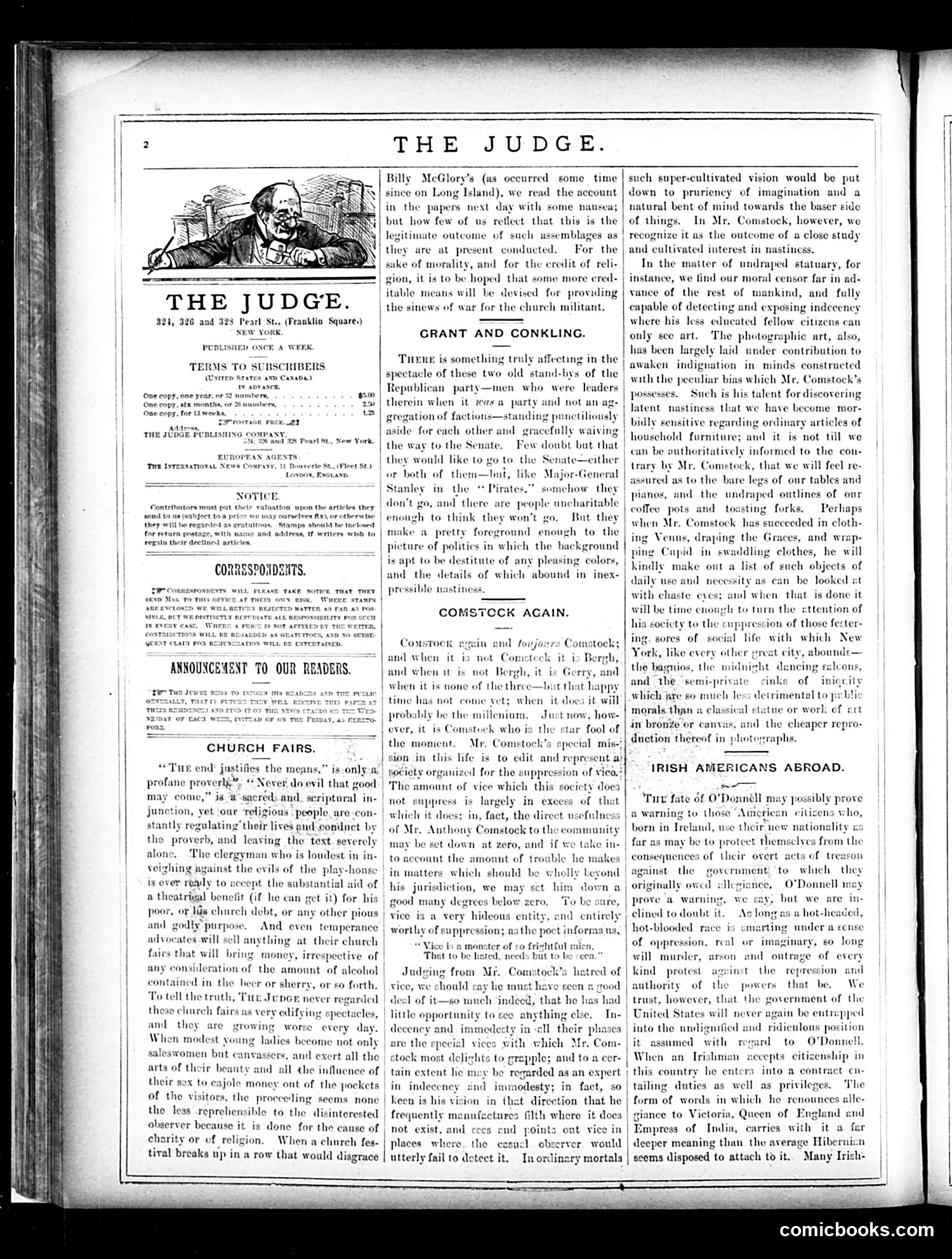
**The Main Cartoon:** The masthead illustration depicts a caricatured figure (likely representing editorial authority) seated among papers and documents—a standard Victorian representation of journalistic commentary. **Key Articles:** 1. **"Church Fairs"**: Satirizes the hypocrisy of religious institutions holding fundraising events that serve alcohol and entertainment while simultaneously condemning theater and drinking. The specific reference to Billy McGlory's (apparently a disreputable venue) suggests a real scandal where a church fair devolved into rowdy behavior. 2. **"Grant and Conkling"**: Mocks the political posturing of two Republican leaders pretending to defer to each other regarding a Senate seat, comparing them to characters in *The Pirates of Penzance* who engage in elaborate pretense. 3. **"Comstock Again"**: Criticizes Anthony Comstock (a real anti-vice crusader) as a self-righteous busybody whose activities cause more trouble than good, suggesting his suppression efforts exceed actual community benefit. The page exemplifies *Judge*'s satirical critique of institutional hypocrisy and moral self-righteousness in Gilded Age America.
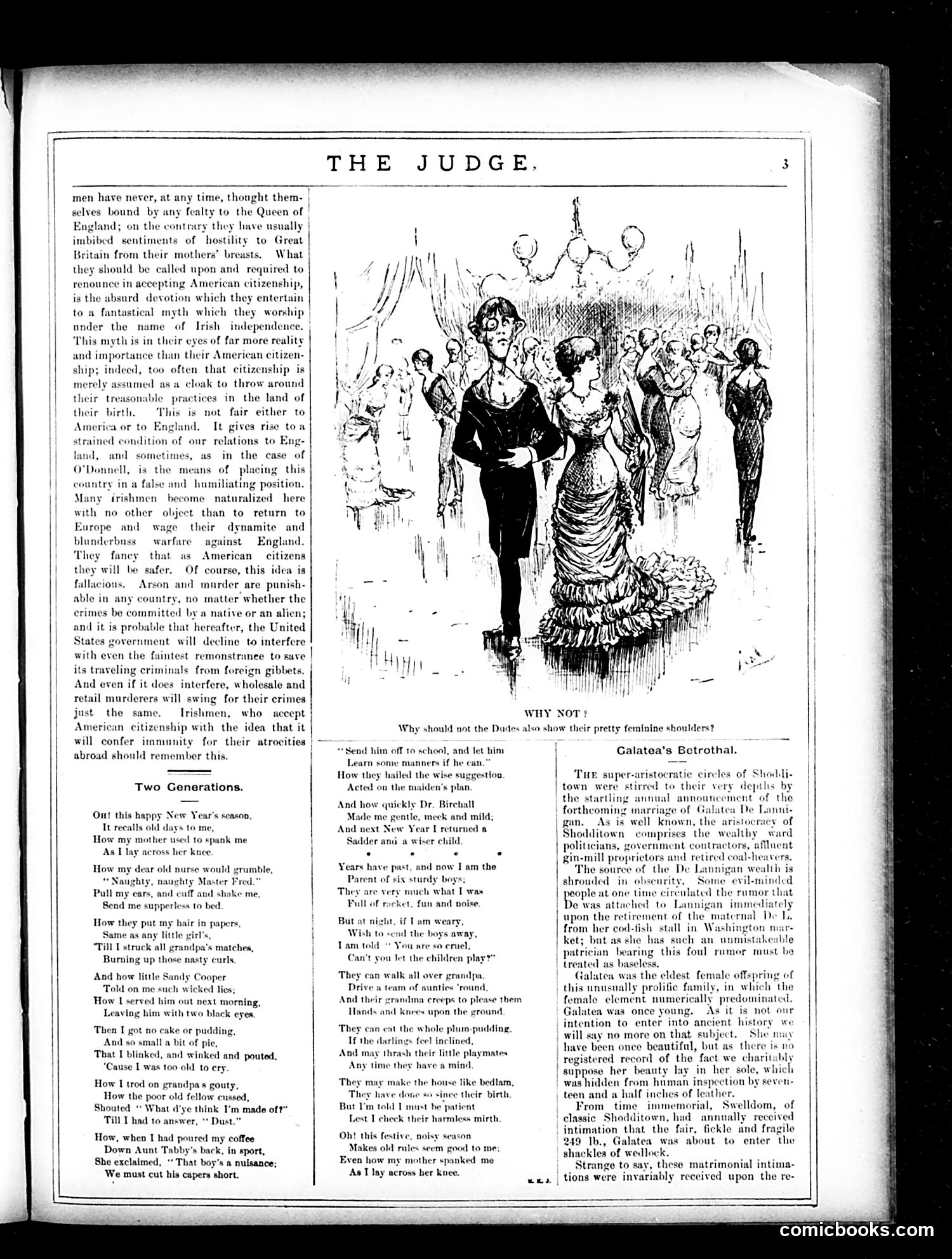
This Judge page contains two distinct pieces of satirical content: **The Main Text (Left Column):** A scathing political essay attacking Irish-American immigrants. The author argues that Irish naturalized citizens secretly maintain loyalty to "Irish independence" rather than America, and use citizenship as cover to commit violent acts (bombings/dynamite attacks) against England while evading prosecution. The piece warns that the U.S. government should stop protecting Irish-Americans accused of crimes abroad. This reflects late-19th-century American nativism and anti-Irish prejudice, portraying Irish immigrants as inherently disloyal terrorists. **The Illustration & Poetry:** Shows a fashionably-dressed couple at a social event. The accompanying poem "Two Generations" humorously contrasts the author's strict Victorian childhood (spanking, punishment) with his lenient parenting of six rowdy sons—a common satirical theme mocking changing parenting styles. **"Why Not?" Caption:** A brief sarcastic quip suggesting male "dudes" (fashionable men) should expose their shoulders like women in contemporary fashion—mocking masculine vanity and fashion trends. The page reflects period anxieties about immigration, morality, and social change in Gilded Age America.
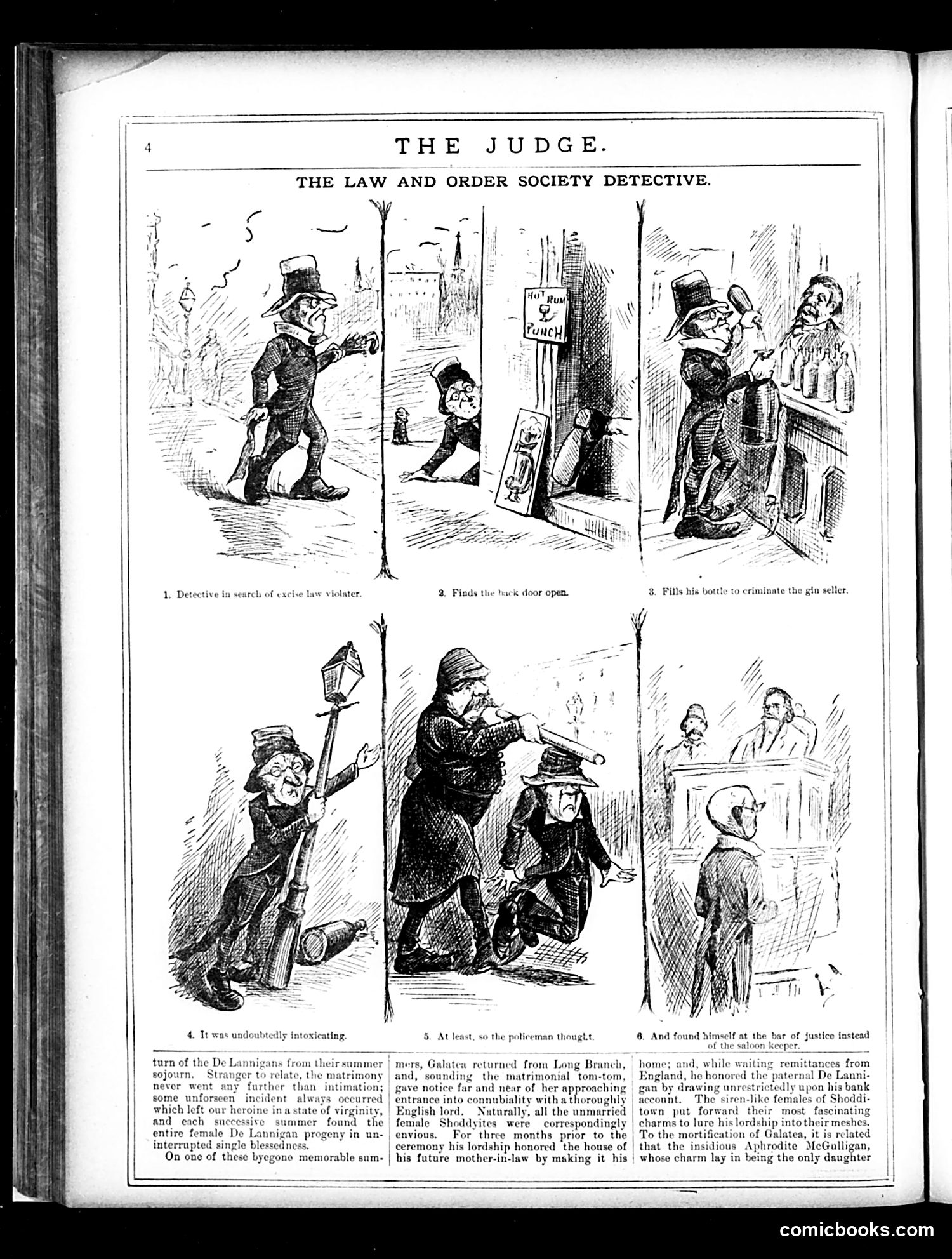
This six-panel satirical sequence mocks a self-righteous "Law and Order Society" detective pursuing a moral crusade against illegal liquor sales ("excise law violator"). The humor escalates as the detective's investigation unravels into farce. The narrative involves a wealthy woman named Galatea (likely a "Shoddy" — satirical term for nouveau riche Americans) preparing to marry an English lord. During his three-month courtship, other unmarried women scheme to seduce him. The detective, conducting his pompous investigation, inadvertently discovers himself at a disreputable establishment rather than finding the intended lawbreaker. The satire targets both moral-crusading reformers (presented as bumbling and self-deluded) and the social-climbing pretensions of wealthy American women seeking titled European husbands—a common Gilded Age satire theme. The "detective" becomes the joke's ultimate fool.
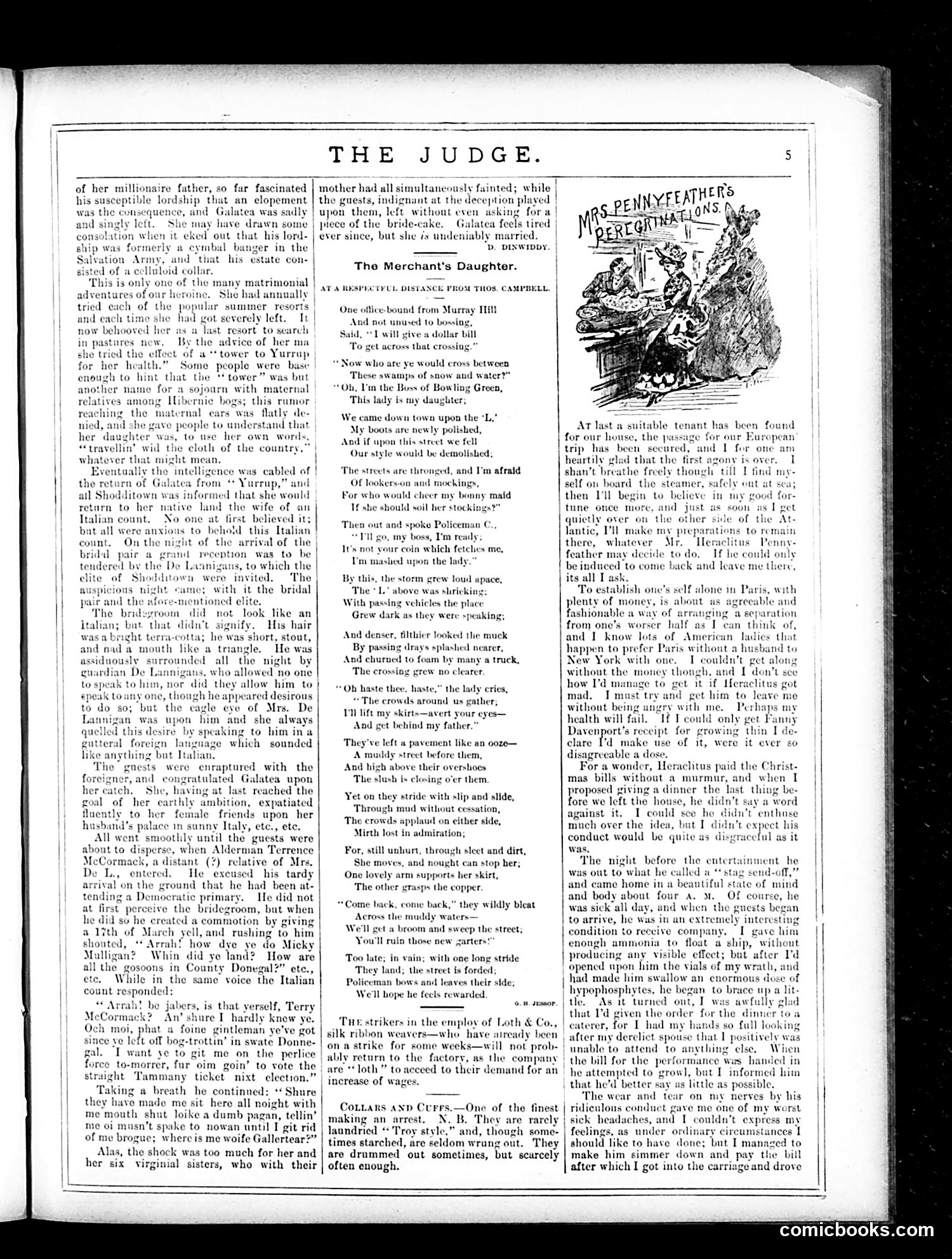
This satirical story mocks social-climbing pretension among wealthy Americans. A millionaire's daughter repeatedly fails to secure a suitable husband at fashionable resorts, so her mother sends her to Europe ("Yurrup") supposedly for health reasons—actually to find a titled husband. She returns married to an Italian "count," impressing New York society. The satire's punchline: Alderman Terrence McCormack recognizes the groom as "Micky Mulligan," an Irish immigrant from County Donegal who works at a factory, not Italian nobility. The fake count immediately reverts to Irish brogue, revealing the entire deception. The joke targets both the daughter's social ambition and her family's willingness to hide an immigrant's working-class origins behind a fake foreign title. It satirizes Gilded Age snobbery while mocking Irish-Americans' own aspirations to respectability through marriage fraud.
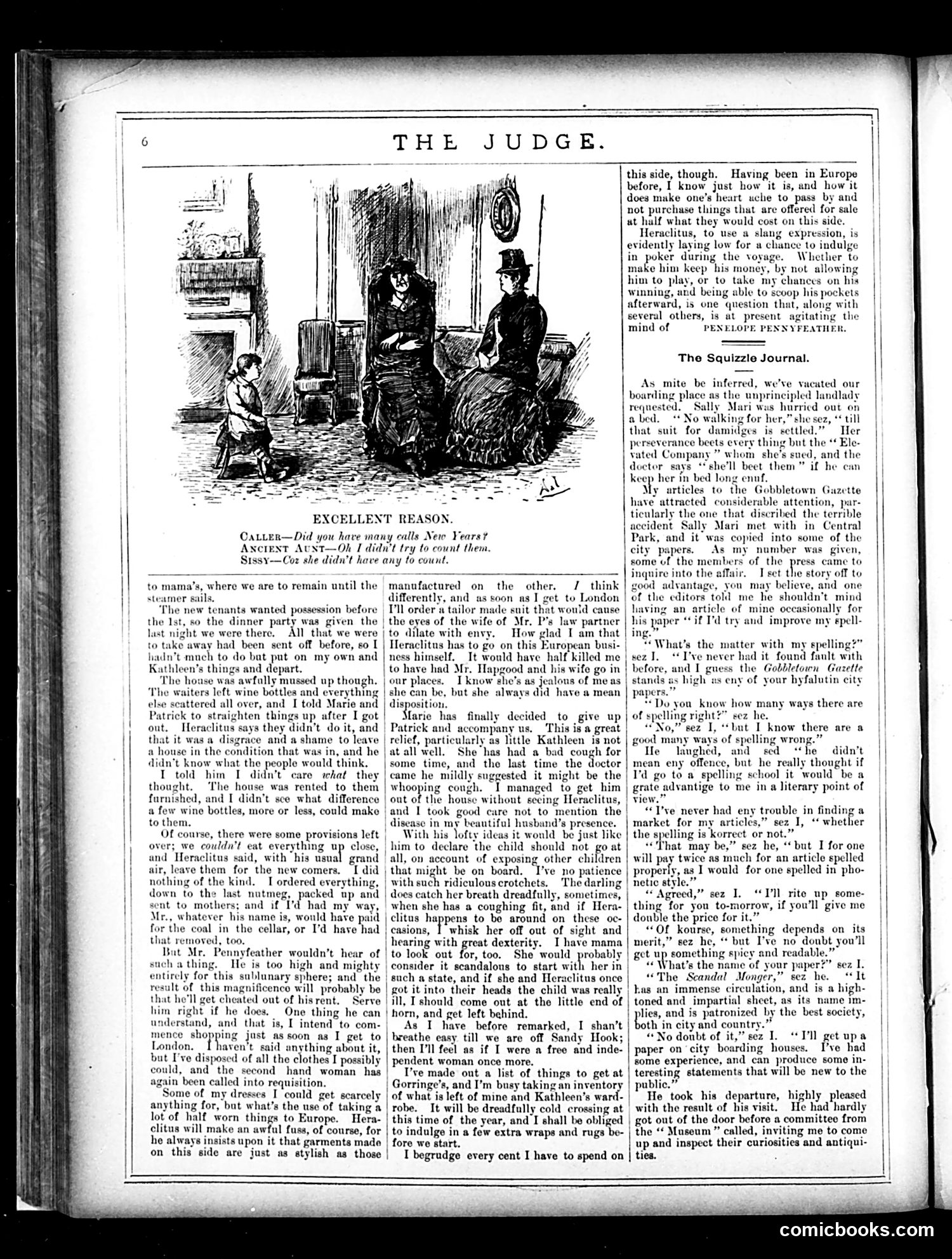
This page contains two distinct pieces from *Judge* magazine: **The Cartoon "Excellent Reason"** depicts a social New Year's call scenario. The dialogue is a mild joke: when asked if she received many New Year's visitors, an elderly aunt claims she lost count, but her young relative reveals the truth—she received none at all. This satirizes Victorian social rituals where formal calls were expected during the holiday season. **"The Squizzle Journal"** is a longer satirical narrative about a wealthy, materialistic woman preparing for European travel. The satire targets her selfishness: she clears the rental house of provisions to send to her mother rather than leave them for incoming tenants, plans to sell old dresses rather than transport them, and deliberately hides her daughter's possible whooping cough from her sanctimonious husband to avoid travel delays. The piece mocks upper-class hypocrisy, marital manipulation, and social pretension—particularly her eagerness to acquire fashionable London clothing to impress others. Both pieces reflect *Judge*'s focus on satirizing American society, particularly wealthy, status-conscious urbanites of the Gilded Age.
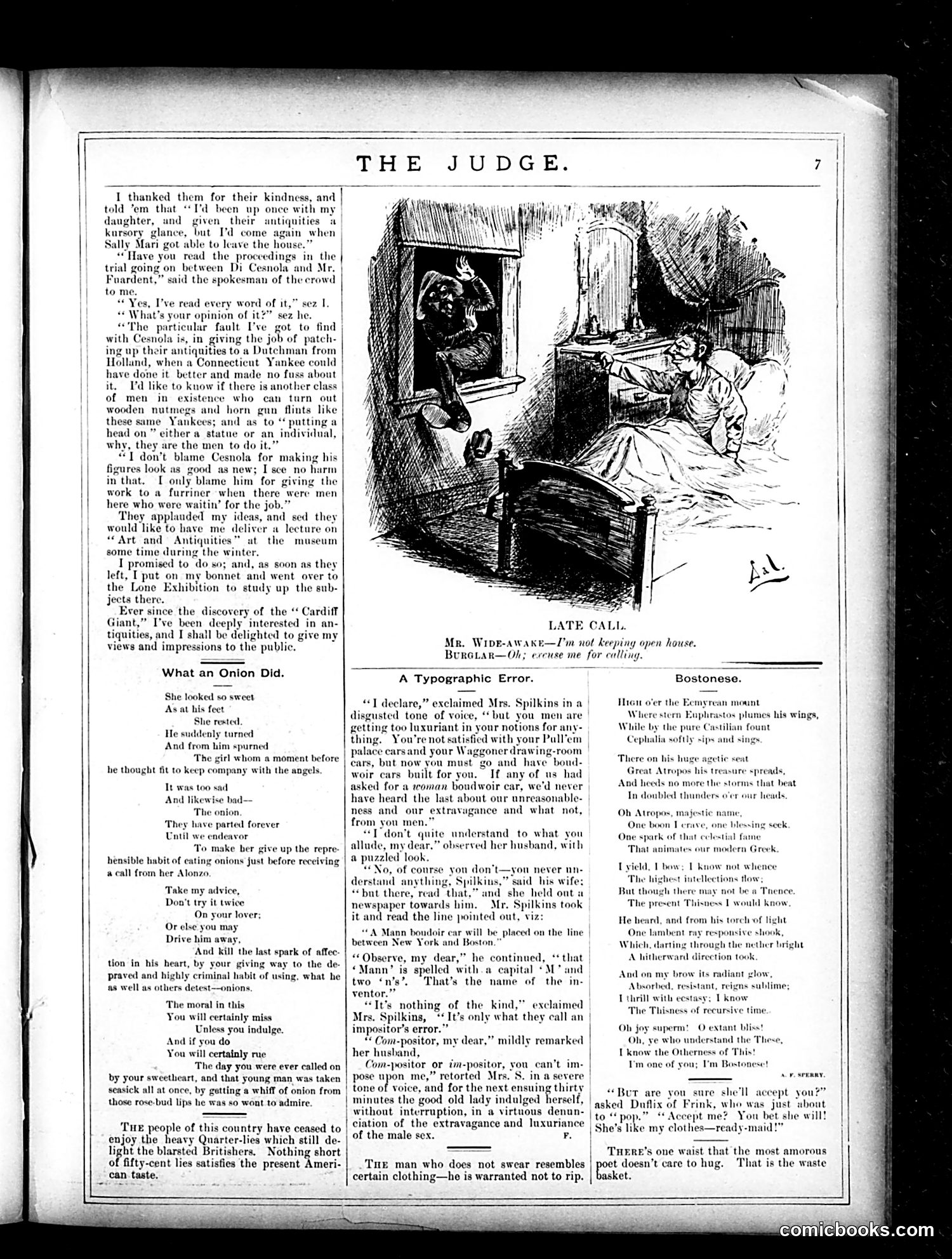
This page contains several satirical pieces typical of 19th-century American humor: **Main Cartoon ("Late Call"):** Shows a burglar interrupting a woman at home. The joke plays on the double meaning of "keeping open house"—the woman misunderstands the burglar's intrusion as a social call, offering refreshment. **"What an Onion Did":** A comic verse mocking romantic conventions. A suitor abandons his girlfriend after she eats onions before his visit, satirizing male fastidiousness and the exaggerated importance placed on women's behavior in courtship. **"A Typographic Error":** Satirizes marital dynamics and newspaper mistakes. Mrs. Spilkins complains about men's luxurious demands (fancy railroad cars), then points out a typo where "Mann" appears instead of something else—her husband defensively explains it's spelled correctly as a proper name, missing her actual point. The satire targets both gender relations and masculine obliviousness. The Di Cesnola reference in the text appears to reference an art restoration controversy, though context is unclear.
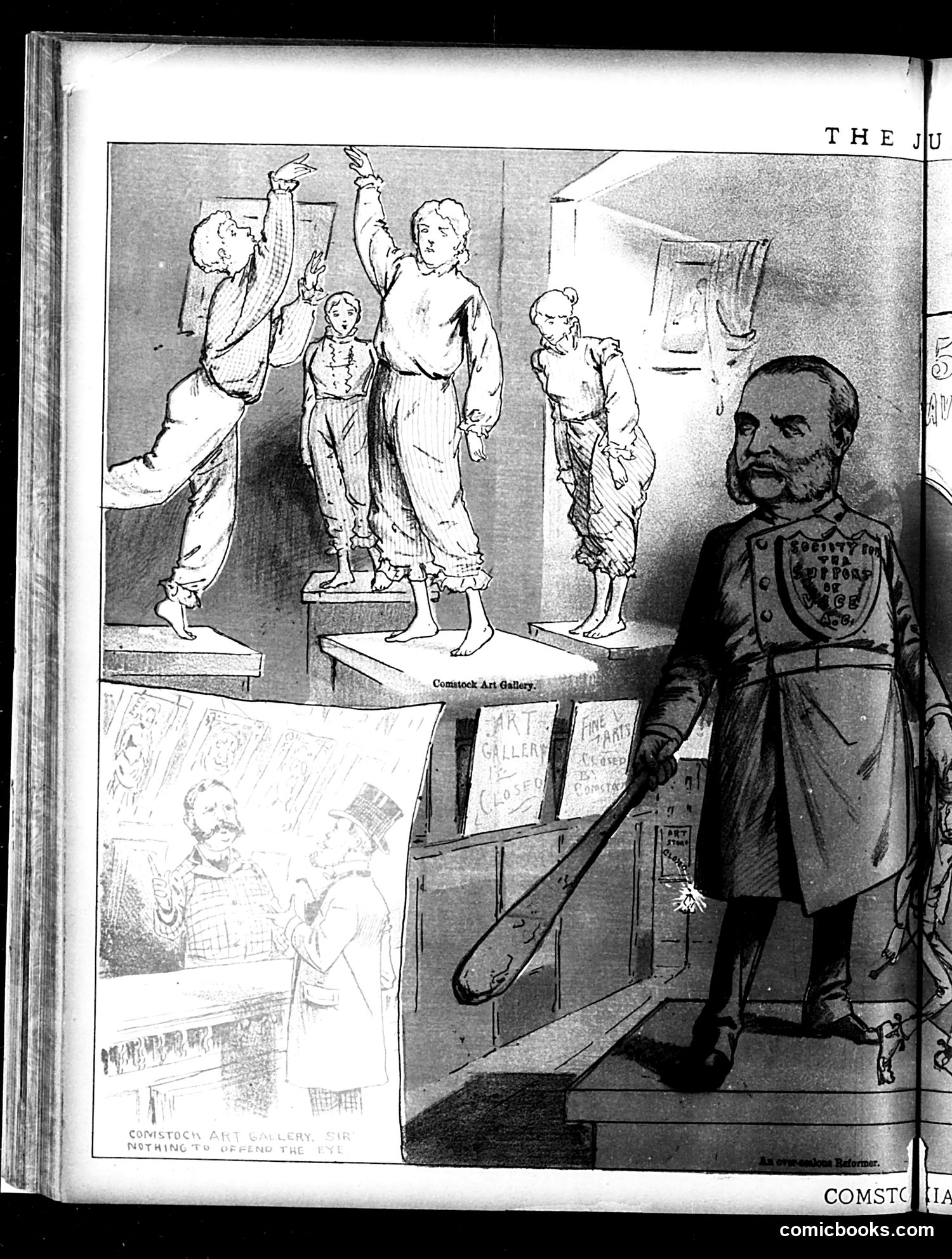
This page contains two cartoons mocking Anthony Comstock, the notorious anti-obscenity crusader (depicted as the stern man on the right). The upper cartoon shows classical nude statuary at the "Comstock Art Gallery"—figures with raised arms in artistic poses. The satire suggests that Comstock's aggressive censorship campaigns, which targeted "immoral" materials, would classify even legitimate fine art as obscene if he had authority over galleries. The lower cartoon shows Comstock at an art gallery with the caption "Sir, nothing to offend the eye"—implying his prudish standards were so extreme that even classical masterpieces would be considered offensive. The joke: Comstock's moral crusade was so zealous and absurd that it threatened to censor legitimate art and culture itself.
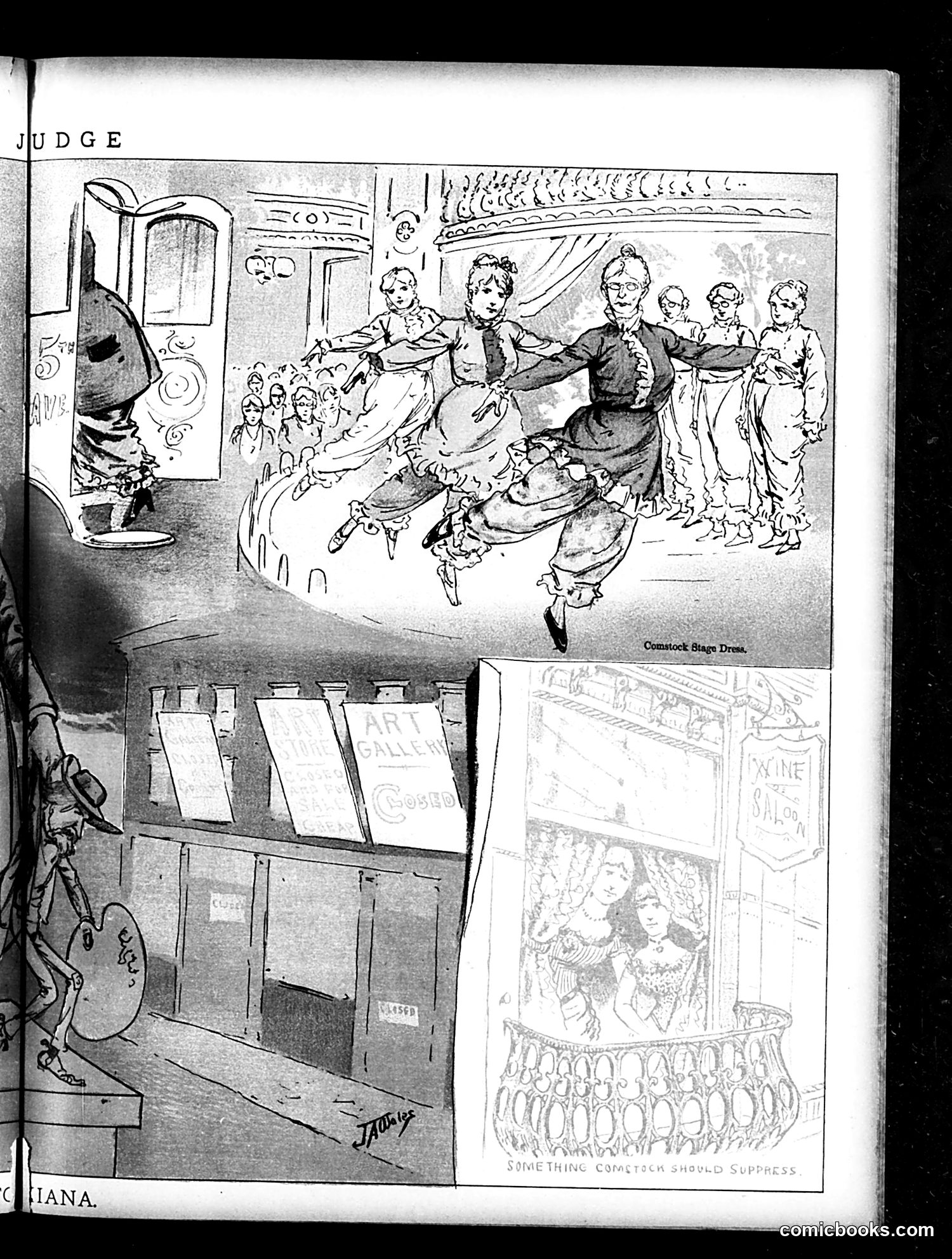
This page from *Judge* magazine contains satirical cartoons about theatrical and social matters. The top cartoon depicts a chaotic indoor scene with children dancing or playing while adults supervise—labeled "Comstock Ragg Dress," likely referencing Anthony Comstock, the famous anti-obscenity crusader who monitored theatrical productions and clothing standards in the late 19th/early 20th century. The bottom cartoons appear to satirize theater regulations and public decency standards, with one showing what appears to be a storefront or theater entrance, and another labeled "SOMETHING COMSTOCK SHOULD SUPPRESS," mocking Comstock's notorious campaigns to censor stage productions he deemed immoral. The satire critiques Comstock's zealous policing of entertainment and dress codes of the era.
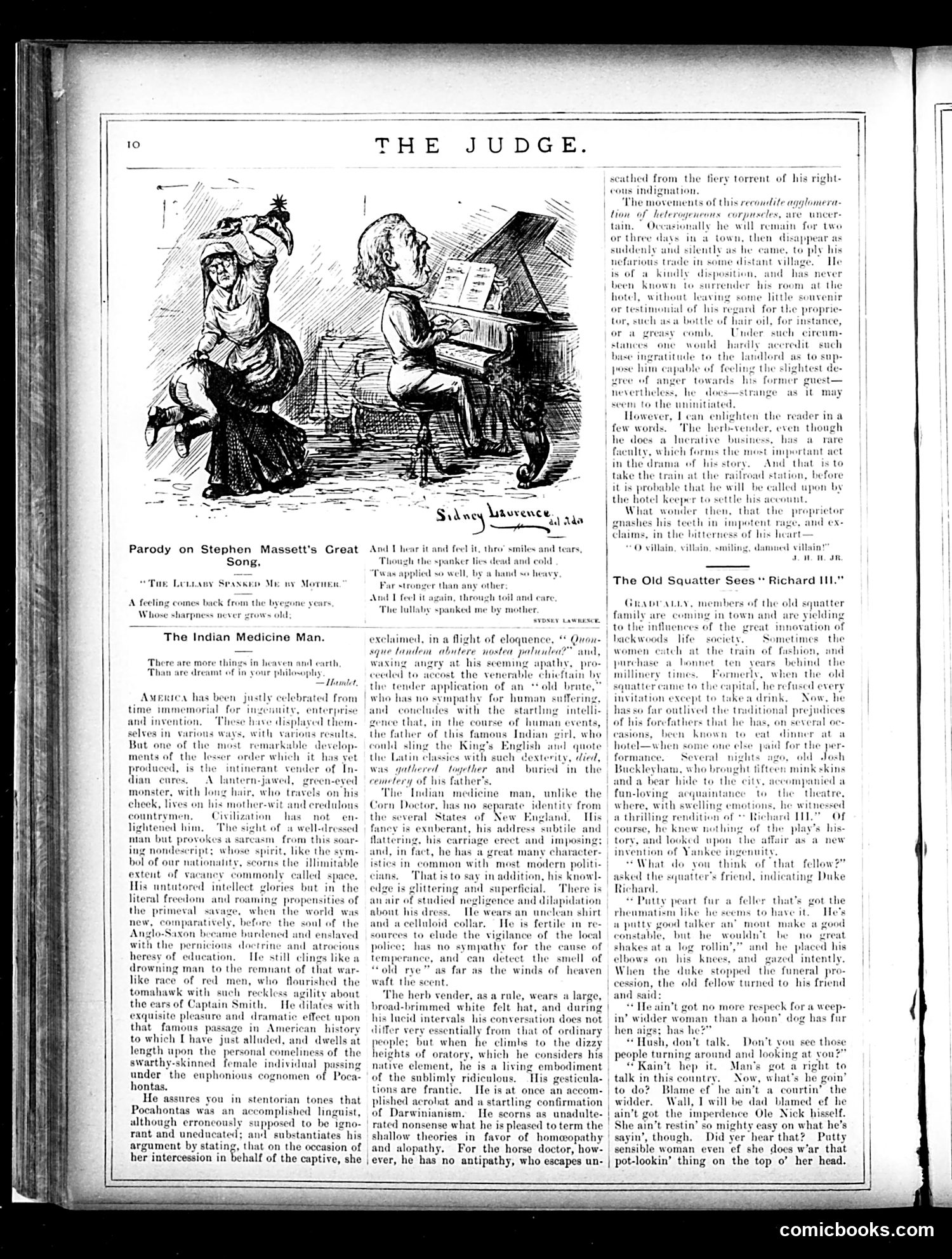
This page mocks itinerant "Indian medicine men"—traveling con artists who exploited late 19th-century Americans by peddling fake patent remedies. The satirist targets their theatrical fraudulence: they wore long hair and affected "Indian" mystique to seem authentic, quoted Latin absurdly, and told elaborate tall tales (like Pocahontas speaking classical languages) to impress credulous audiences. The cartoon illustration (top left) shows such a charlatan operating in a town setting. The text ridicules these peddlers' contradictory characteristics—their grandiose oratory masking profound ignorance, their fancy dress concealing shabby morality, their mysterious disappearances when authorities approached. Judge's satire reflects genuine Progressive-era concerns about medical fraud and the gullibility of ordinary people. The "Indian" costume was exploitative exotica, while the fake cures preyed on desperate patients. This represents period anxieties about both charlatanism and rapid urbanization creating vulnerable populations.
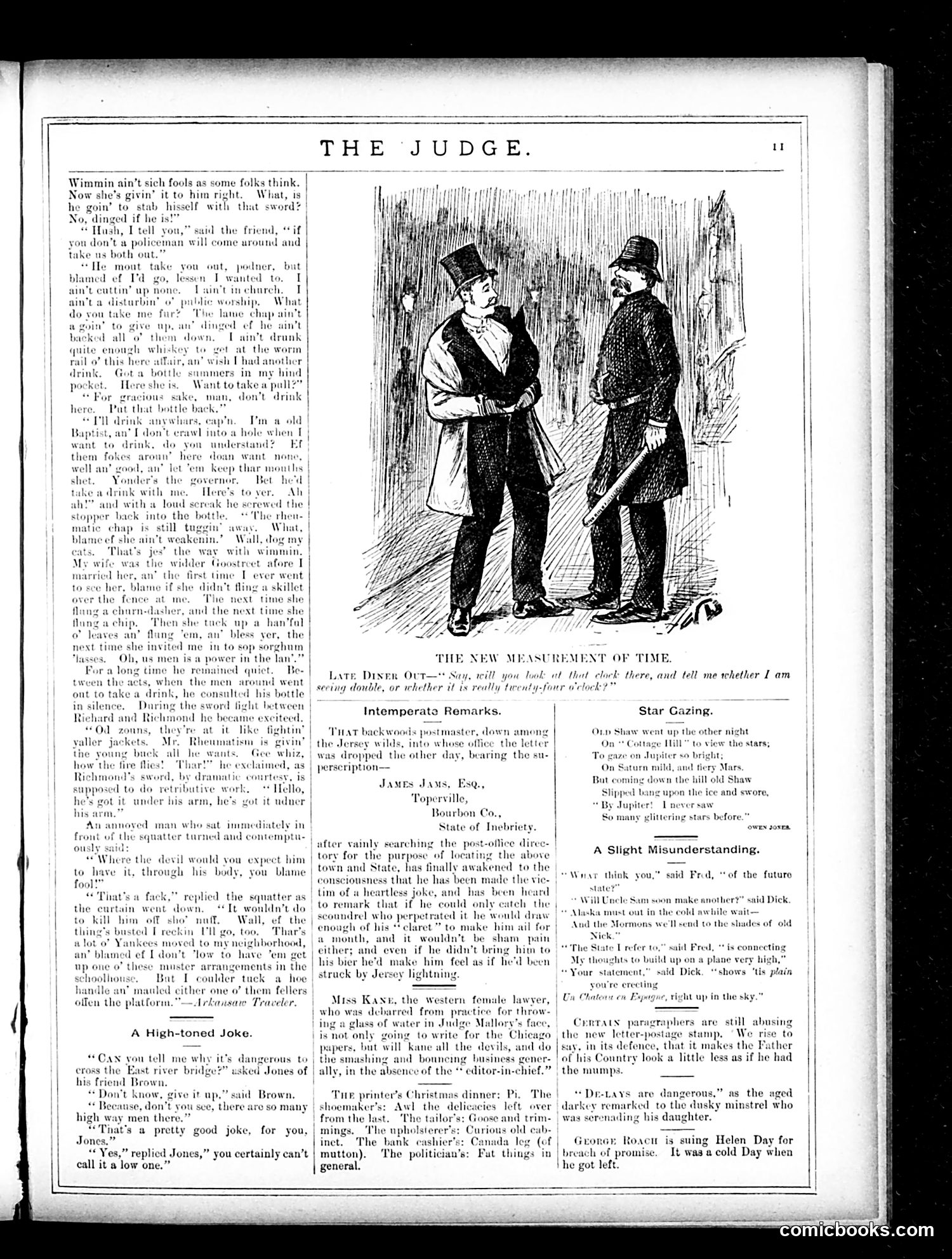
This page from the satirical magazine *Judge* contains several humorous sketches and brief comic pieces rather than a single political cartoon. **"The New Measurement of Time"** depicts two men, apparently after drinking, with one asking the other to verify whether a clock reads "twenty-four o'clock"—a joke about intoxication causing double vision or mental confusion. **"Intemperate Remarks"** includes satirical vignettes mocking various professions' Christmas dinners (a printer, shoemaker, tailor, and politician), presented as humorous social commentary. **"Star Gazing"** and **"A Slight Misunderstanding"** are brief dialogues playing on misheard words and confusion—common comedic devices of the era. The prominent left-side cartoon, **"The New Measurement of Time,"** shows two men in Victorian dress, one appearing to convince the other to drink. The lengthy dialogue criticizes drinking culture and domestic conflict, with the satirist suggesting that alcohol causes men to behave foolishly and harm their families. The page overall reflects *Judge* magazine's focus on social satire, particularly targeting drinking, marital discord, and professional pretension.
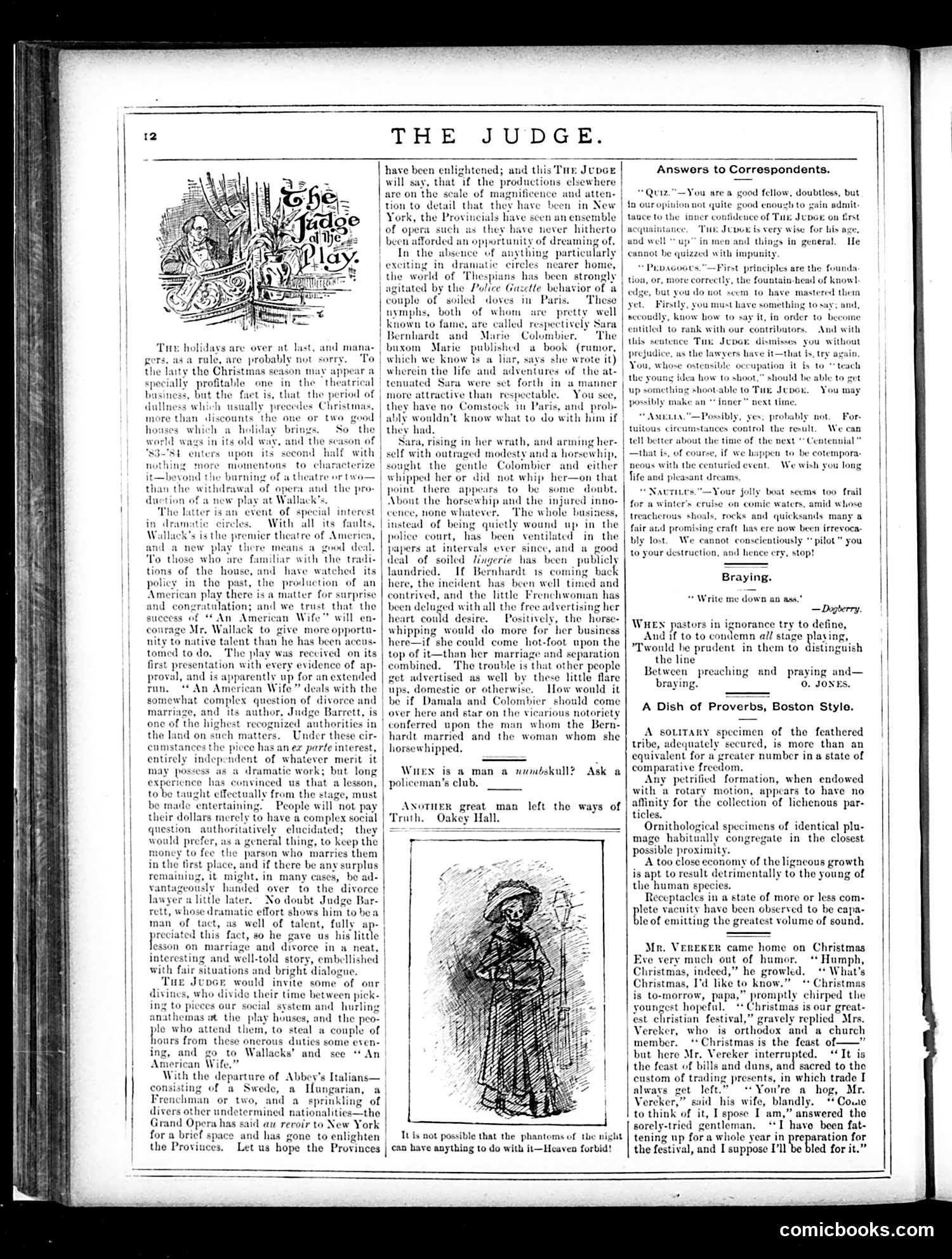
This page from *Judge* magazine (a satirical weekly) discusses the post-holiday theatrical season. The main article reviews "An American Wife," a new play at Wallack's Theatre—notable because it's an American play, which the author says is unusual for this prestigious venue. The play addresses divorce and marriage, complex social issues. The satire targets both the theater world and moralistic clergy who criticize playhouses while ignoring divorce lawyers. The author ironically suggests that sermons are cheaper than theater tickets, and divorced people might better spend money on clergy than entertainment. The article also mentions Abbey's Italian opera company departing New York for provincial tours, and gossip about two famous Parisian actresses (Sara Bernhardt and Marie Colombier). The sketch shows a woman in period dress—likely representing one of the actresses or theatrical figures discussed.
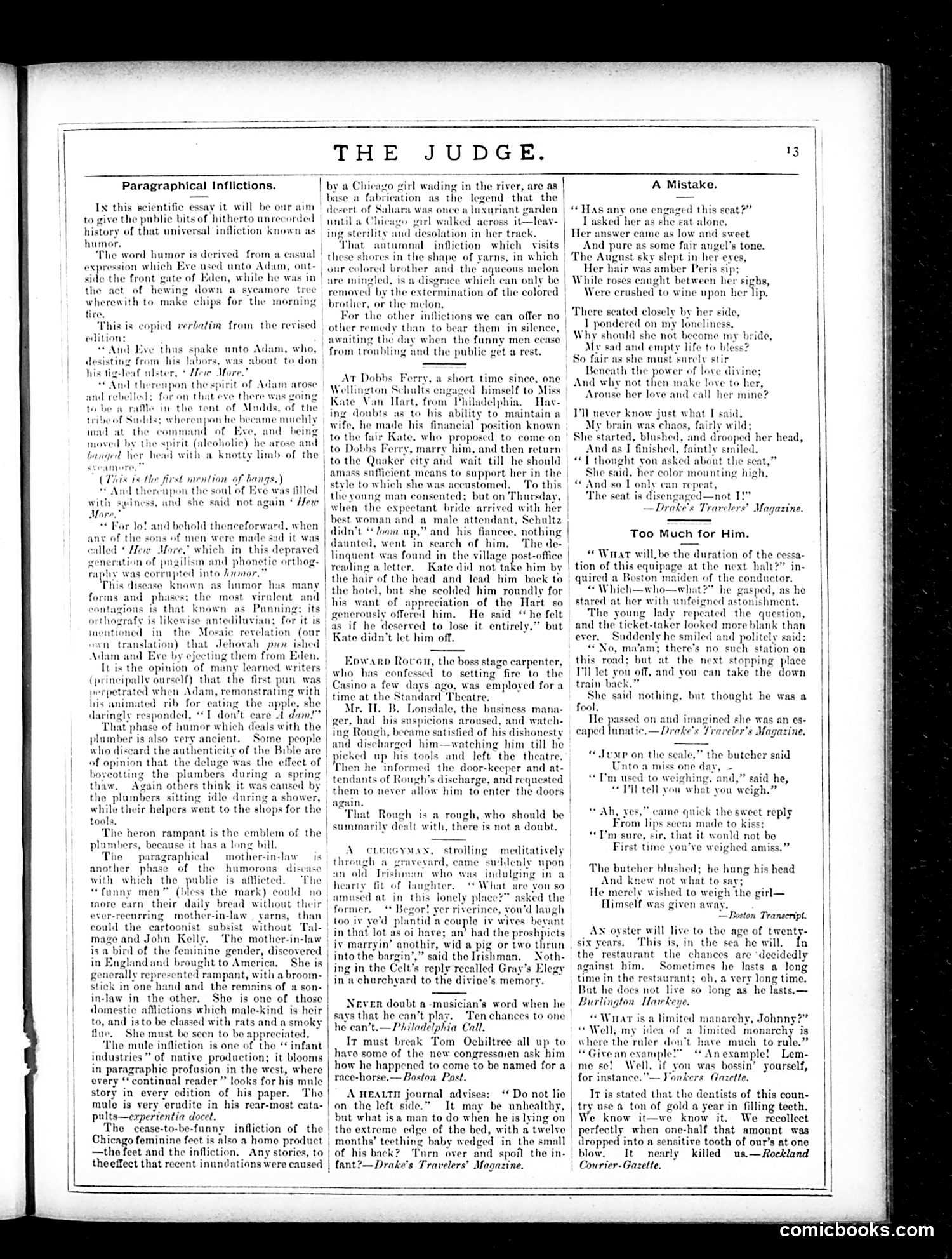
This is a humorous essay defining various categories of jokes and comic subjects prevalent in American journalism of the era. The piece uses mock-scholarly language to trace the etymology of "humor" back to Adam and Eve, establishing a comedic genealogy. The author satirizes popular joke categories that dominated newspapers and magazines: - **Puns** (the oldest "viral" humor) - **Plumber jokes** (ancient and ubiquitous) - **Mother-in-law jokes** (attributed to British origin, now American staple) - **Mule stories** (Western phenomena) - **Chicago women jokes** (mocking the "new woman") The satire targets how predictable and exhausted these joke formulas had become in the press. References to cartoonist **Talmage** and political figure **John Kelly** suggest contemporaneous popular targets. The piece mocks journalists' reliance on these recycled comedic tropes while simultaneously perpetuating them—a self-aware critique of the magazine's own content.
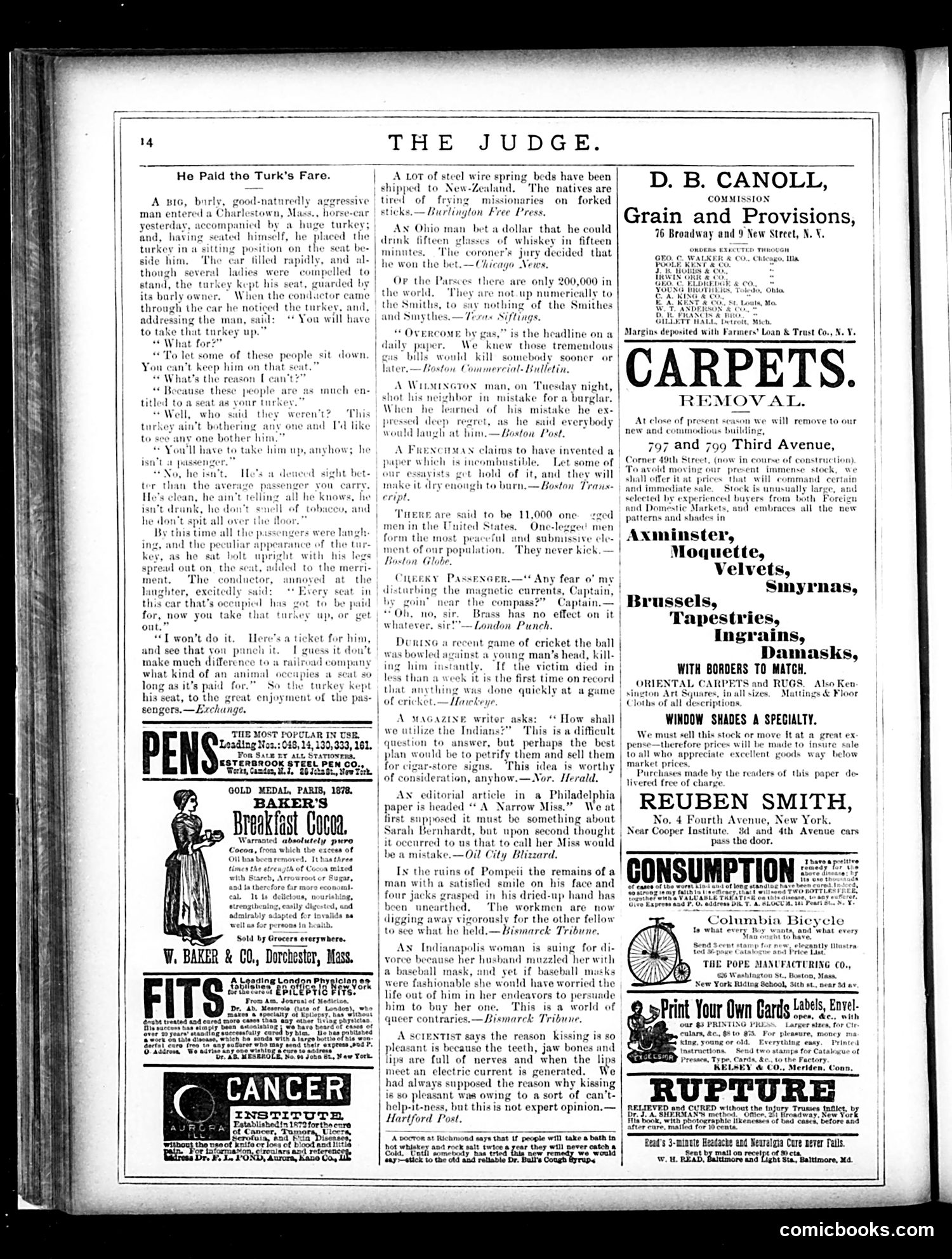
This page is primarily **advertisements and humorous anecdotes** rather than political cartoons. The main illustrated content is commercial ads (Baker's Cocoa, Pens, medical institutes). The anecdotes are brief satirical pieces typical of Judge's humor: 1. **"He Paid the Turk's Fare"** – A working-class man refuses to move his turkey from a streetcar seat despite pressure from the conductor and other passengers. The joke mocks both his stubbornness and the absurdity of the situation, likely poking fun at common transit disputes and working-class assertiveness. 2. **Other brief items** humorously report on contemporary incidents: an Ohio man drinking whiskey fatally, a Wilmington man shooting his neighbor by mistake, etc. These serve as social commentary on human foolishness. 3. **Magazine writer's question about "utilizing the Indian"** appears to reference Native American policy debates of the era, though the context is unclear. The humor is genteel and situational rather than explicitly partisan political satire.
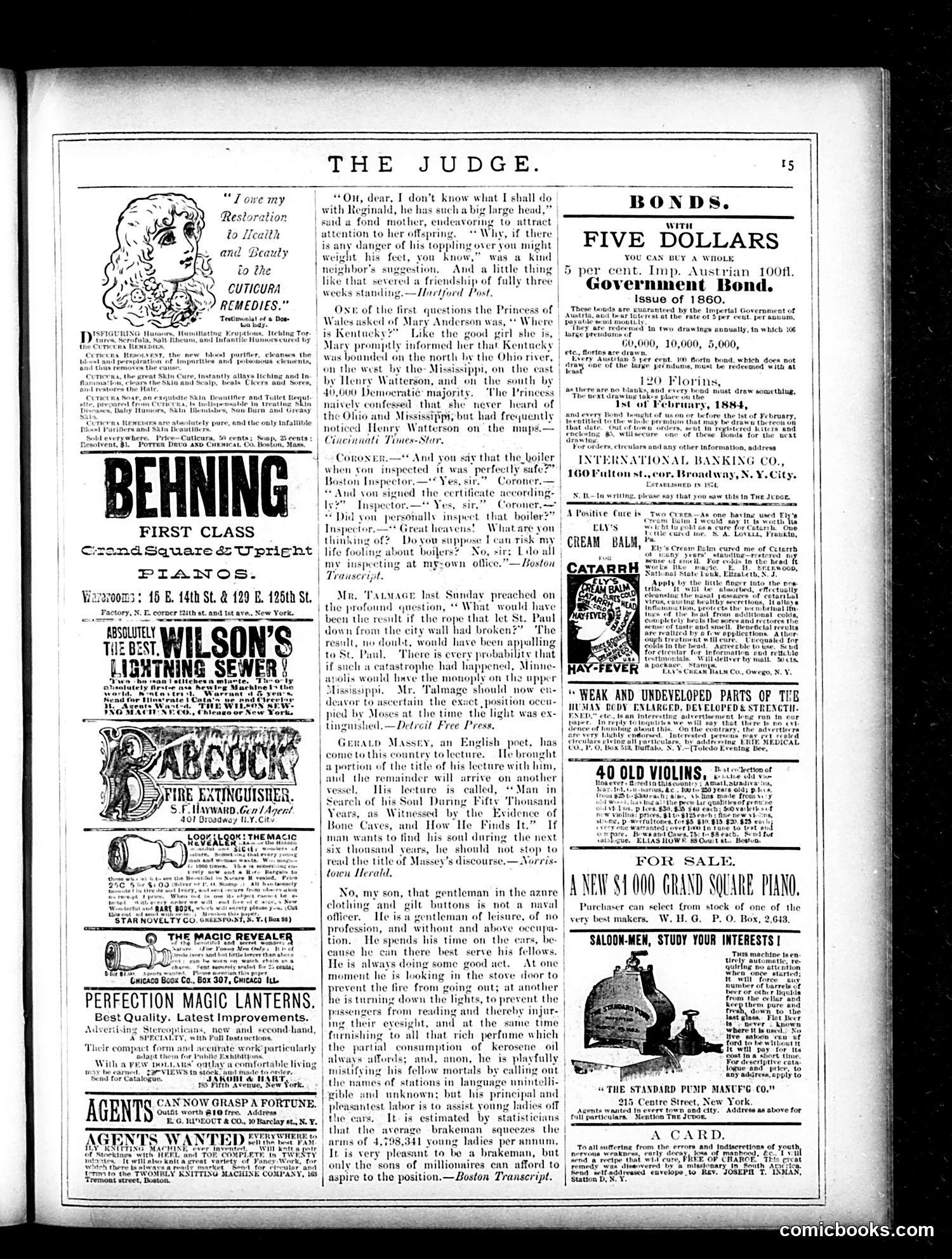
This is primarily an **advertising page** with marginal satirical content. The main visible cartoons are brief humorous anecdotes in text form: 1. **"The Large Head" joke**: A mother worries her son Reginald has an oversized head; a neighbor quips his heavy feet prevent him toppling over. Satire targets anxious Victorian parenting and vanity. 2. **"Kentucky Geography" bit**: The Princess of Wales asks American actress Mary Anderson about Kentucky. Anderson describes it geographically, but the Princess admits she's never heard of the Ohio/Mississippi rivers—only of prominent journalist **Henry Watterson** (a real figure). This mocks European ignorance of American geography and elevates a journalist to cartographic prominence. 3. **"The Boiler Inspector" exchange**: Dialogue between a coronet and inspector about boiler safety—likely mocking bureaucratic incompetence or inspection failures common in the Gilded Age. 4. **"The Brakeman" piece**: Satirizes railway brakemen as romantic figures courting wealthy young women, suggesting only millionaires' sons can afford to marry them. The page is otherwise dominated by period advertisements for pianos, sewers, fire extinguishers, and financial bonds.
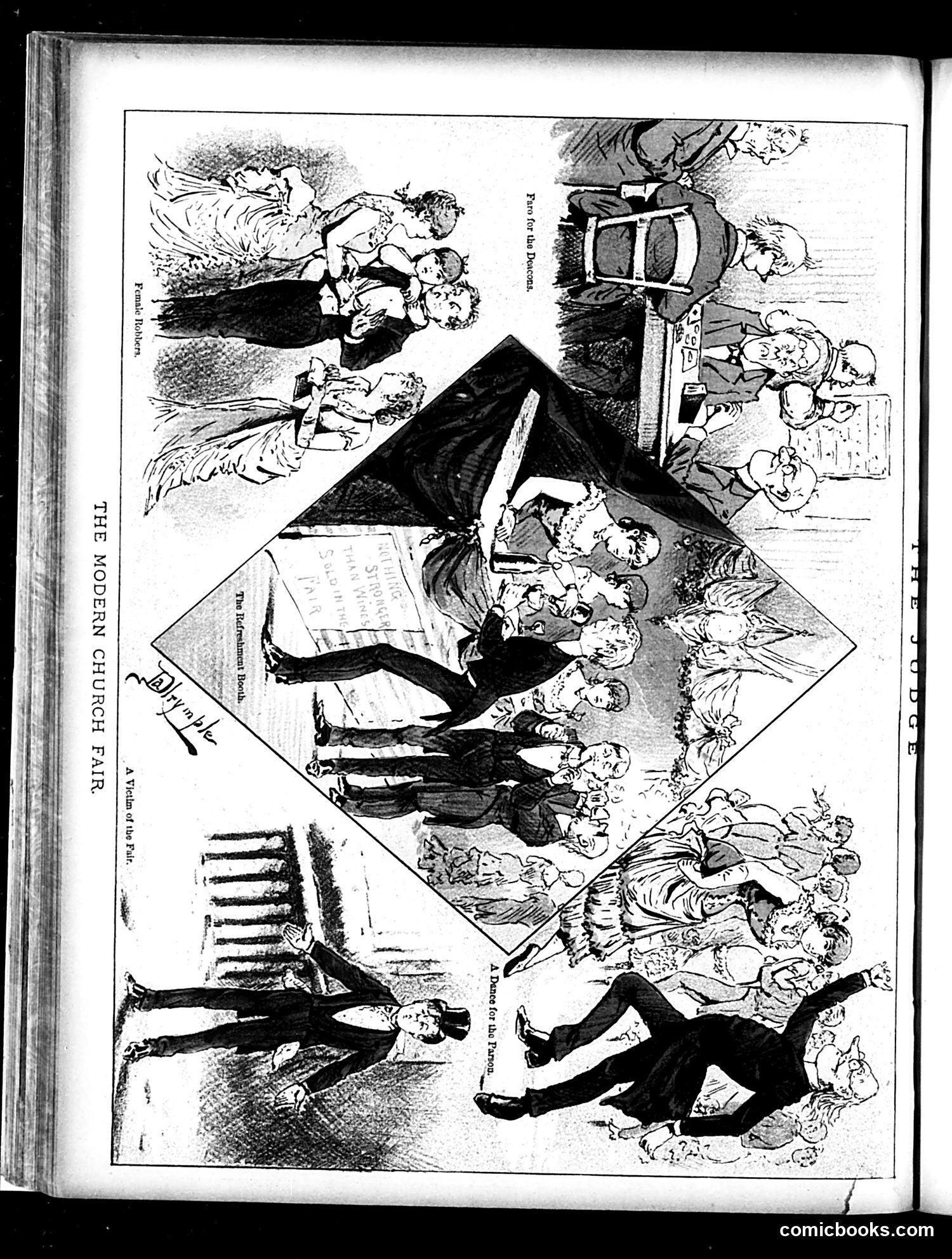
This page from *Judge* magazine satirizes church fundraising events through multiple vignettes arranged around a central diamond-shaped scene. The cartoons depict various activities at a church fair—including what appears to be fortune telling, raffles, food sales, and games of chance—all presented as somewhat undignified or morally questionable for a religious institution. The satire targets the apparent contradiction between churches' spiritual missions and their reliance on carnival-like entertainment and gambling-adjacent activities to raise money. The exaggerated, chaotic scenes suggest the author viewed these fairs as worldly, commercialized, and inconsistent with religious principles. The title emphasizes "modern" church practices, implying this represents contemporary social decline in religious institutions.