
Judge, 1884-01-12 · page 2 of 16
Judge — January 12, 1884 — page 2: what you’re looking at
What you’re looking at
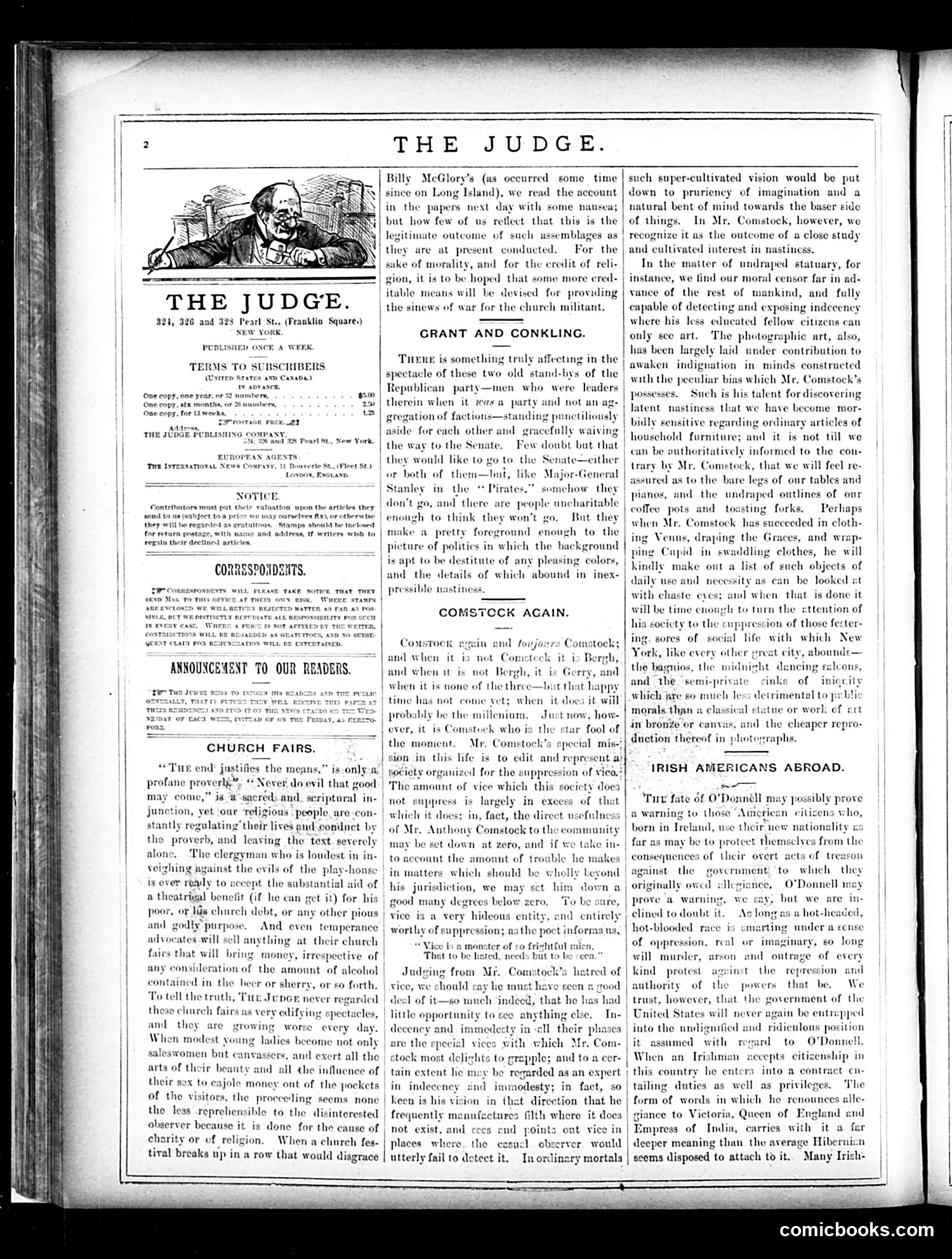
**The Main Cartoon:** The masthead illustration depicts a caricatured figure (likely representing editorial authority) seated among papers and documents—a standard Victorian representation of journalistic commentary. **Key Articles:** 1. **"Church Fairs"**: Satirizes the hypocrisy of religious institutions holding fundraising events that serve alcohol and entertainment while simultaneously condemning theater and drinking. The specific reference to Billy McGlory's (apparently a disreputable venue) suggests a real scandal where a church fair devolved into rowdy behavior. 2. **"Grant and Conkling"**: Mocks the political posturing of two Republican leaders pretending to defer to each other regarding a Senate seat, comparing them to characters in *The Pirates of Penzance* who engage in elaborate pretense. 3. **"Comstock Again"**: Criticizes Anthony Comstock (a real anti-vice crusader) as a self-righteous busybody whose activities cause more trouble than good, suggesting his suppression efforts exceed actual community benefit. The page exemplifies *Judge*'s satirical critique of institutional hypocrisy and moral self-righteousness in Gilded Age America.
📄 Transcribed text from this page (OCR, searchable)
Machine-transcribed from the original scan — historical spelling and the odd misread are preserved.
THE JUDGE 24, 326 and 328 Pearl St, (Franklin Square.) SEW YORK. PUBLISHED ONCE A WERK. TERMS TO SUBSCRID (Ustren States axp Cavan One copy, one year. nhers ‘One copy, al months, or % numbers One copy, for 13 wee a POSTAGE PRIM 29 tie abe Peatsmyc PANY 28 and 28 Peart St EUROPEAN AGENTS Sab News Courasy verte St. (Fleet § Loxoox, BXOLaxt, NOTICE must pat thelr valuation upon the articles they ANNOUNCEMENT TO OUR READERS. pe Tus Jeo: CHURCH FAIRS. “Tre end! justifies the means P . may come,” js a sacred and scriptur junction, yet our religious people, are -con- stantly regulating’ their lives and conduct by ‘The clergyman who is loudest in in- veighing ngainst the evils of the play-honse is ever ready to t the substantial aid of a theatrigal benefit (if he can get it) for his poor, or lis church debt, or any other pious and godly’purpose. And even temperance advocates will sell anything at their church fairs that will bring money, irrespective of any consideration of the amount of alcohol aincd in the beer or sherry, or so forth. » tell the truth, Tue JepGE never regarded these church fair: Mlifyin and they are growing worse n modest young ladies leswomen but ca’ arts of their b nd exert all the ty and all the influence of jole money ont of the pockets of tho visitors, the proceeling seems none the less reprehensible to the disinterested rver because it is done for the cause of ity or of religion, When a church fes- tival breaks up in a row that would disgrace Billy McGlory’s (as occurred some time since on Long Island), we read the account in the papers next day with some nausea; but how few of us retlect that this is the legitimate outcome of such assemblages as | For the and for the credit of reli- they are at present conducted, suke of moralit jon, it is to be hoped that some more cred- itable means will be devised for providing the sinews of war for the chureh militant. GRANT AND CONKLING. Tuene is something truly affecting in the spectacle of these two old stand-bys of the Republican party—men who were leaders | therein when it was a party and not ar gregation of factions—standing punetiliously aside for each oth the way to tl ‘ew doubt but that | they would like to go to the Scnate—eitl or both of them—bni, like Major-General Stanley in the ‘ Pirates,” fully waiving somehow they don't go, and there are people uncharitable enough to think they won't go. But they pretty foreground enough to the in which the background stitute of any pleasing colors, | and the details of which abound in inex. | | pressible nastine COMSTOCK AGAIN. DCK Rg toujours Comstock; Jand when it is net Comsteck it is Bergh, Jand when it is not Bergh, it is Gerry, and | when it is none of the three—but that happy yet; when it docs it will probably be the millenium. Just now, how- ever, it is Comstock who is th the moment. M time has not co: tar fool of Comstock’s special mis-; sion in this life is to edit and represent a. iety organized for the suppression of viea.? The amount of vice which this society does | is largely in execss of that in, fact, the direct usefuln of Mr. Anthony Comstock to the community may be set down at zero, and if we take in- hot suppress which it doe: to account the amount of trouble he makes in matters which should be whol his jurisdiction, we n ot Leyond good many degrees below zero. be sure, vice is a very hideous entity, end cntirely worthy of suppression; asthe poct informs ns, * Vice is a monster of co friehtful That to hated, needs but to by Judging from Mi. Comotock’s hatred of vice, we should cay he must heve scen a good | deal of it—so much indecd, that he has had little opportunity to ceo anything else. Tn- decency and immed cll their phases are the epecial vi which Mr. Com- stock most delights to grapple; and to a cer- tain extent he mey be regarded as an expert in indecency snd immodesty; in fact, so keen is his vision in that direction that he | frequently menufectures filth where it docs not exist, and nd points out vice in | places where. the rver would utterly fail to detect it. In ordinzry mortals im down a | such super-cultivated vision would be put down to pruriency of imagination and a natural bent of mind towards the baser side of thin, In Mr, Comstock, however, we recognize it as the outcome of a close study and cultivated interest in | In the matter of undraped statuary, for | instance, we find our moral censor far in ad- vance of the rest of mankind, and fully capable of detecting and exposing indecency tiness, where his less educated fellow citizens can only sce art. The phote hic art, also, | has been largely laid under contribution to | awaken indignation in minds constructed with the peculiur bias which Mr. Comstock’s | possesses. Such is his talent for discovering | latent nastiness that we have become mor- | bidly sensitive regarding ordinary articles of household furniture; and it is not till we can be authoritatively informed to the con- trary by Mr. Comstock, that we will feel re- assured as to the bare legs of our tables and pianos, and the undraped outlines of our coffee pots and toasting forks. Perhaps when Mr. Comstock has succeeded in cloth- | ing Venus, draping the Graces, and wrap- ping Cupid in swaddling clothes, he will | kindly make out a list of such objects of | daily use and necessity as can be looked st with chaste eyes; and when that is done it will be time enough to turn the sttention of ocicty to the cuppression of those fecter- sores of life with which New rk, like every other great city | the bagnios, the midnight dancin and the semi-private sinks of which are so much less detrimental to p | morals than a classical statue or work: of ert | in bronze’or canvas, and the cheaper repro- duction thereof in photosraphs. sbounds— aleons, IRISH AMERICANS ABROAD. a Tur fate 6f O'Donnell may possibly prove | a warning to those “American citizens who, | born in Ireland, use their new nationalits far as may be to protect themselves from the consequences of their overt acts of treason inst the government ‘to which they originally owed sllegiance, O'Donnell 1 prove ‘a warning, ¥ but we are in- clined to doubt it. As long hot-blooded is cmarting under a rcnse | of oppression hot-headed, real or imaginary, so long will murder, arson and ontrage of every | kind protest. aguinst the repression and authority of the powers that be. We trust, however, that the government of the United States will neve in be entrapped into the undignified and ridiculous position it umed with regard to O'Donnell. | When an Irishman aecepts citizenship in j this country he enters into a contract cn- ailing duties as well as_privile The form of words in which he renounces alle- giance to Victoria, Queen of England end Empress of India, carries with it a fer deeper meaning than the average Hiberni | scoms disposed to attach to it. Many Irish- comicbooks.com