
Judge, 1884-01-12 · page 12 of 16
Judge — January 12, 1884 — page 12: what you’re looking at
What you’re looking at
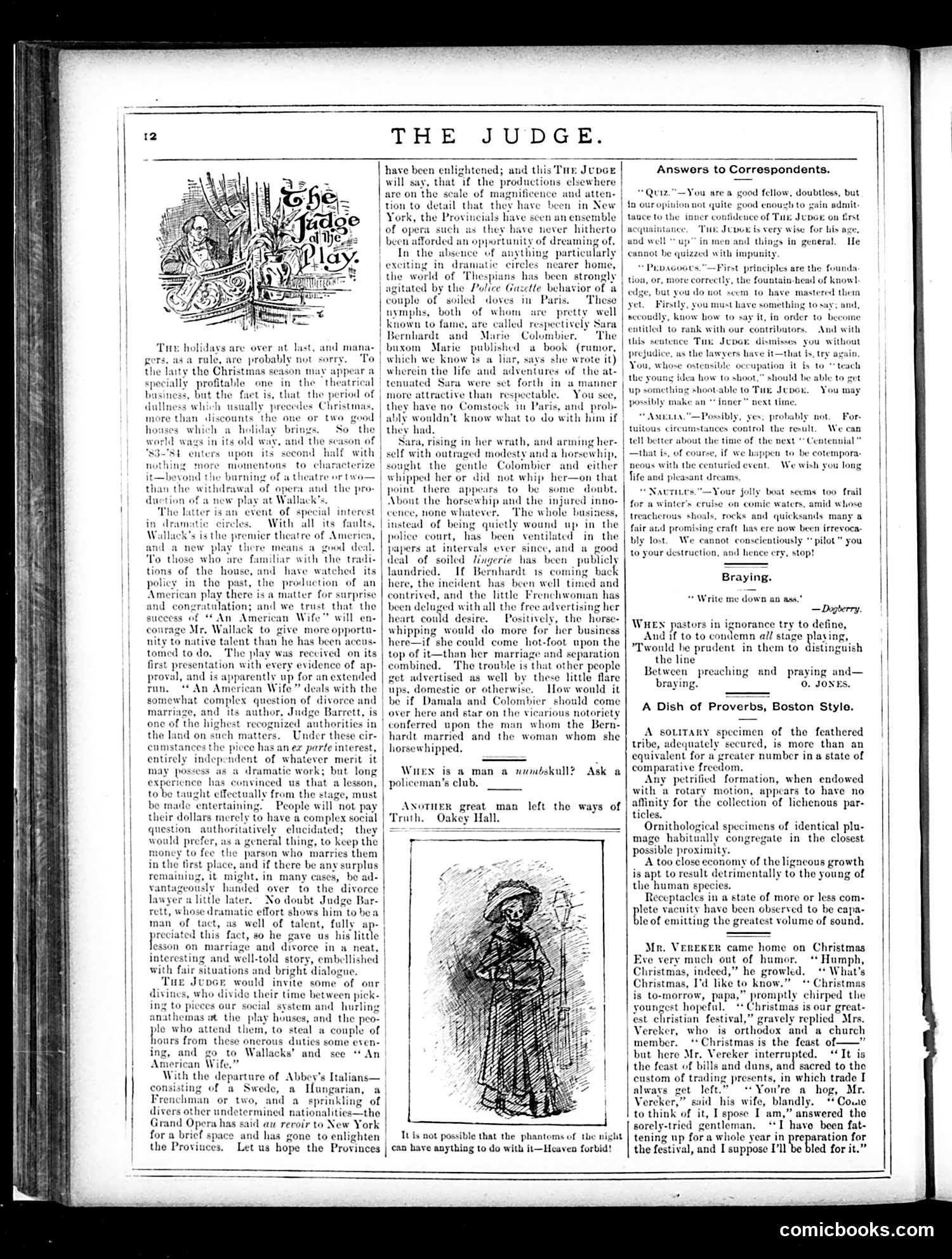
This page from *Judge* magazine (a satirical weekly) discusses the post-holiday theatrical season. The main article reviews "An American Wife," a new play at Wallack's Theatre—notable because it's an American play, which the author says is unusual for this prestigious venue. The play addresses divorce and marriage, complex social issues. The satire targets both the theater world and moralistic clergy who criticize playhouses while ignoring divorce lawyers. The author ironically suggests that sermons are cheaper than theater tickets, and divorced people might better spend money on clergy than entertainment. The article also mentions Abbey's Italian opera company departing New York for provincial tours, and gossip about two famous Parisian actresses (Sara Bernhardt and Marie Colombier). The sketch shows a woman in period dress—likely representing one of the actresses or theatrical figures discussed.
📄 Transcribed text from this page (OCR, searchable)
Machine-transcribed from the original scan — historical spelling and the odd misread are preserved.
Re EE THE JUDGE. Tue holidays are over at last, and mana- gers. asa rule, are probably not sorry. ‘To the laity the Christmas season may appear a specially profitable one in the theatrical business, but the faet is, that the p il of dullness which usually precedes Christmas, more than discounts the one or two houses which a holiday brings. x3 in its old way, and the sc enters upon its second half with nothing more momentous characteri burning of at than the withdrawal of opera and the py fa new play at Wallack’ risan event of special interest circles. With all its faults, Wallack’s is the premier theatre of America, and a new play there means a good deal, ‘To those who are familiar with the tradi- tions of the house, and have watched its policy in the past, the production of an American play there is a matter for surprise and congratulation; and we trust that the success of “An American Wife” will en- courage Mr. Wallack to give more opporta- nity to native talent than he has been aceus- tomed todo. The play was received on its first presentation with every evidence of ap- proval, and is apparently up for an extended run, An American Wife ” deals with the somewhat complex question of divorce and marriage, and its author, Judge Barrett, is one of th the I on such matters. Under these cir- cumstances the piece has an ex parte interest, entirely independent of whatever merit it may possess as a dramatic work; but long exper nee has convinced us that a lesson, to be taught effectually from the stage, must be made entertaining. People will not pay their dollars merely to have a complex social question authoritatively elucidated; they would prefer, as a general thing, to keep the noney to fee the parson who marries them in the first place, and if there be any surplus remaining, it might, in many vantageously handed over to the divore lawyer a little later.” No doubt Judge Bar- it—bey tre ortwo— rett, whose dramatic effort shows him to bea | man_ of tact, as well of talent, fully ap- | preciated this fact, so he gave us his little jesson on marriage and divorce in a neat, interesting and well-told story, embellished with fair situations and bright dialogue. Tue Jupcr would invite some of our divines, who divide their time between pick- ing to picees our social system and hurling anathemas at the play houses, and the peo- ple who attend them, to steal a couple of hours from these onerous duties some even- ing, and go to Wallacks’ and see ‘ An American Wife.” With the departure of Abbey's Italians— consisting of a Swede, a Hungarian, Frenchman or two, and a sprinkling of divers other undetermined nationalities—the Grand Opera has said aw revoir to New York for a brief space and has gone to enlighten the Provinces, Let us hope the Provinces hest recognized authorities in | have been enlightened; and this Tue Jepce will say, that if the productions elsewhere | are on the scale of magnificence and atten- | tion to detail that they have been in New York, the Provincials Have scen an ensemble of opera such as they have never hitherto | been afforded an opportunity of d ing of. | In the abse aything particularly exciting in dramatic circles nearer home the world of Thespians has been strongly agitated by the Police Gazelle behavior of a couple of. soiled doves in Paris. These | nymphs, both of whom are pretty well | known to fame, are called respectively Sara Bernhardt and = Marie Colombier. © ‘The | j buxom Marie published a book (rumor, | which we know is a liar, says she wrote it) wherein the life and adventures of the at- tenuated Sara were sct forth in a manner | more attractive than respectable. You see, | they have no Comstock in Paris, and prob- ably wouldn't know what to do with him if they had, | Sara, rising in her wrath, and arming her- self with outraged modesty and a horsewhiy sought the gentle Colombicr and either whipped her or did not whip her—on that point there appears to. be some doubt. About the horsewhip and the injured inno- cence, none whatever. ‘The whole business, instead of being quietly wound up in the | police court, has been ventilated in the | papers at intervals ever since, and a good deal of soiled lingerie has been publicly laundried. If Bernhardt 1s coming back here, the incident has been well timed and contrived, and the little Frenchwoman has been deluged with free advertising her heart could desire. Positively, the horse- | whipping would do more for her business here—if she could come hot-foot upon the top of it—than her marriage and separation combined. The trouble is that other people get advertised as well by these little flare ups, domestic or otherwise. How would it be if Damala and Colombier should come over here and star on the vicarious notoriety conferred upon the man whom the Bern- hardt married and the woman whom she horsewhipped. Wues is a man a numbskull? | policeman’s club, Ask a ANOTHER great man left the wi Truth. Oakey Hall. rr It is not possible that the phantoms of the 1 | yet. Firstly | can have anything to do with it—Heaven forbi Answers to Correspondents. “ Qviz."—You area good fellow, doubtless, but {n ouropinion not quite good enough to gain admit tuuce to the inner confidence of Tue Jepoe on first acquaintance. ‘Tie Jupce is very wise for his age, and well “up” in men and things in general. He cannot be quizzed with impunity \ooots."—First principles are the founda tion, or, more correctly, the fountain-head of know! 1 them u must have something to say; und, secoudly, know how to say it, in order to. bec entitled to rank with our contributors. And with this sentence Tu Jupor dismisses you without prejudice, ay the lawyers have it—that is, try again, You, whose ostensible occupation it is to “teach the young idea how to shoot,” should be able to get up something shoot.able to Tue Jt ake an * + Amnia.”"—Possibly, yes; probably not. For: tuitous circumstances control the result, We ean tell better about the time of the next “Centennial” edge, but you do not seem to have maste You may possibly er” next time. —that is, of course, if we happen to be cotempora- neous with the centuried event, We wish you long fife and pleasant dre “ Nactines."—Your jolly boat seems too. frail for a winter's cruise on comic waters, amid whose treacherous shoals, rocks and quicksands many a fair and promising craft has ere now been irrevoca- bly lost. We cannot conscientiously * pilot" you to your destruction, and hence ery, stop! Braying. “Write me down an ass," —Dogherry. WHEN pastors in ignorance try to define, And if to to condemn all stage playing, *Twonld be prudent in them to distinguish the line Between preaching and praying and— braying. 0. Jo: A Dish of Proverbs, Boston Style. A soLiTary specimen of the feathered tribe, adequately secured, is more than an equivalent for a greater number ina state of comparative freedom. Any petrified formation, when endowed with a rotary motion, appcars to have no aflinity for the collection of lichenous par- ticles. Ornithological specimens of identical plu- mage habitually congregate in the closest possible proximity. A too close economy of the ligneous growth is apt to result detrimentally to the young of the human species. Receptacles in a state of more or less com- ete vacuity have been observed to be capa- Je of emitting the greatest volume of sound. Mr. Vereker came home on Christmas Eve very much out of humor, ‘ Humph, Christmas, indeed,” he growled. ** What’s Christmas, I'd like to know.” ** Christmas is to-morrow, papa,” promptly chirped the youngest hopeful. ** Christmas is our great- est christian festival,” gravely replied Mrs. Vereker, who is orthodox and a church member. ‘* Christmas is the feast of—” but here Mr. Vereker interrupted. ‘It is the feast of bills and duns, and sacred to the | custom of trading presents, in which trade I always get left You're a hog, Mr. Vereker,” suid his wife, blandly. ‘* Coe to think of it, I spose I am,” answered the sorely-tried gentleman. ‘+I have been fat- tening up fora whole year in pre aration for the festival, and I suppose I’ll be bled for it.” comicbooks.com